 Скачать презентацию МИНИСТЕРСТВО ОБРАЗОВАНИЯ И НАУКИ Государственное образовательное учреждение высшего
презентация опера.ppt
- Количество слайдов: 28



МИНИСТЕРСТВО ОБРАЗОВАНИЯ И НАУКИ Государственное образовательное учреждение высшего профессионального образования НАЦИОНАЛЬНЫЙ ИССЛЕДОВАТЕЛЬСКИЙ ТОМСКИЙ ПОЛИТЕХНИЧЕСКИЙ УНИВЕРСИТЕТ Факультет Институт – ФТ Направление – Ядерные физика и технологии ЭКСПЕРИМЕНТ OPERA Выполнил студент группы 0 А 2 Г Смирнов Р. С. 2014

СОДЕРЖАНИЕ • Общая информация • Установка детектора OPERA • Заключение
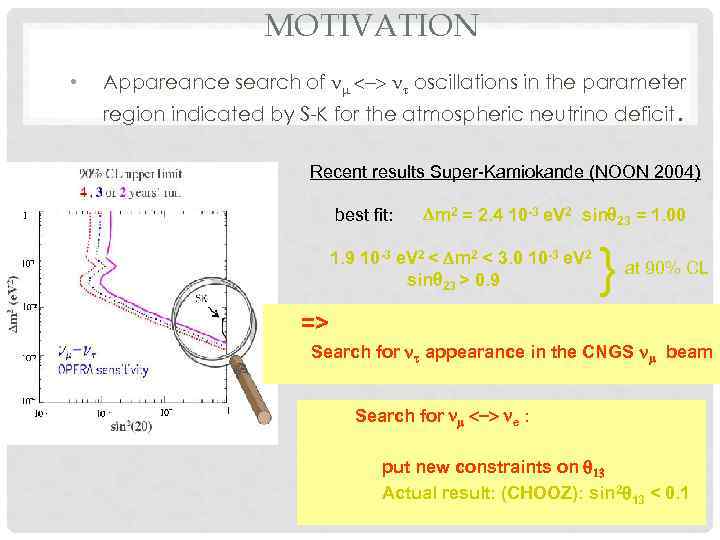
MOTIVATION • Appareance search of n <-> nt oscillations in the parameter region indicated by S-K for the atmospheric neutrino deficit. Recent results Super-Kamiokande (NOON 2004) best fit: Dm 2 = 2. 4 10 -3 e. V 2 sinq 23 = 1. 00 1. 9 10 -3 e. V 2 < Dm 2 < 3. 0 10 -3 e. V 2 sinq 23 > 0. 9 } at 90% CL => Search for nt appearance in the CNGS nm beam Search for nm <-> ne : put new constraints on q 13 Actual result: (CHOOZ): sin 2 q 13 < 0. 1 P
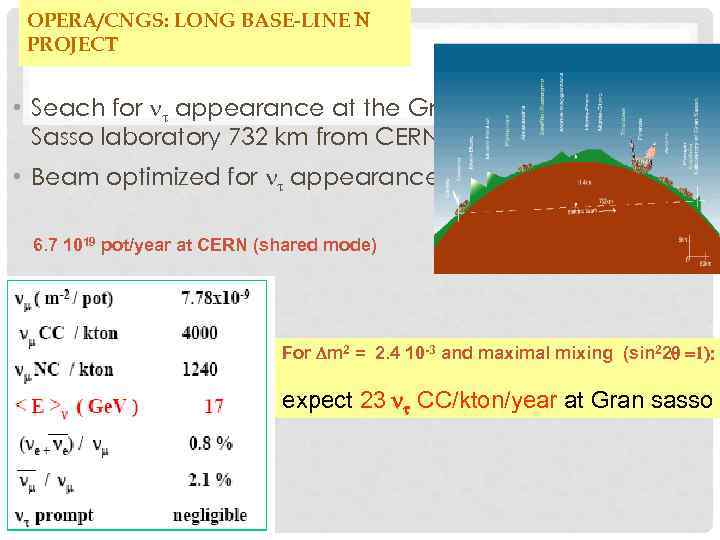
OPERA/CNGS: LONG BASE-LINE N PROJECT • Seach for nt appearance at the Gran Sasso laboratory 732 km from CERN • Beam optimized for nt appearance 6. 7 1019 pot/year at CERN (shared mode) For Dm 2 = 2. 4 10 -3 and maximal mixing (sin 22 q =1): expect 23 nt CC/kton/year at Gran sasso
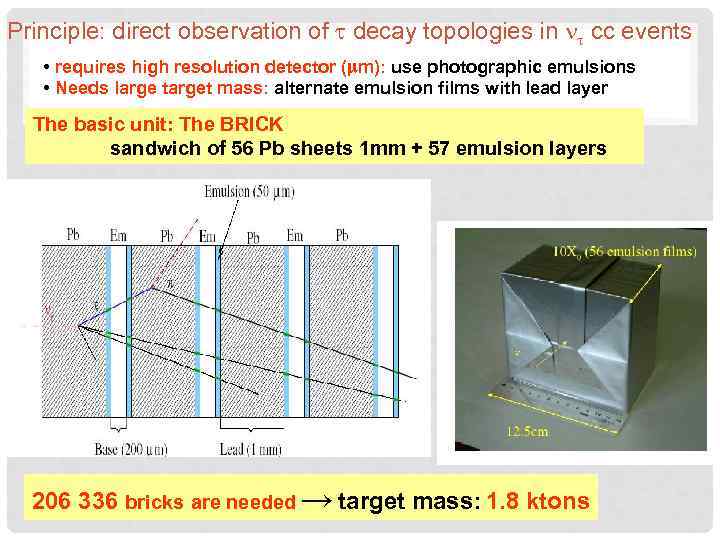
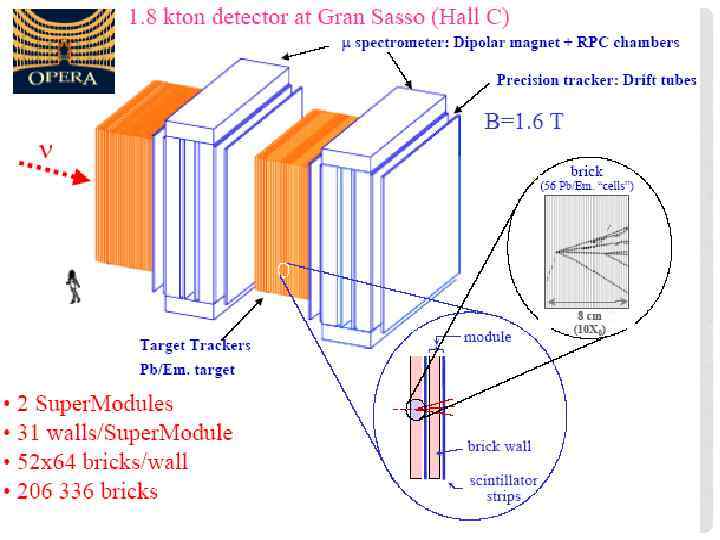
Principle: direct observation of t decay topologies in nt cc events • requires high resolution detector (mm): use photographic emulsions • Needs large target mass: alternate emulsion films with lead layer The basic unit: The BRICK sandwich of 56 Pb sheets 1 mm + 57 emulsion layers 206 336 bricks are needed → target mass: 1. 8 ktons
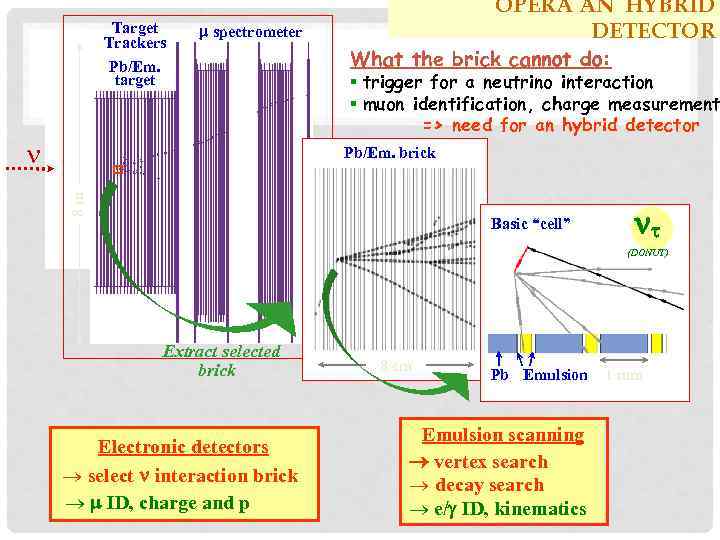
Target Trackers Pb/Em. target OPERA AN HYBRID DETECTOR m spectrometer What the brick cannot do: § trigger for a neutrino interaction § muon identification, charge measurement => need for an hybrid detector n 8 m Pb/Em. brick Basic “cell” nt (DONUT) Extract selected brick Electronic detectors select n interaction brick m ID, charge and p 8 cm Pb Emulsion scanning vertex search decay search e/g ID, kinematics 1 mm
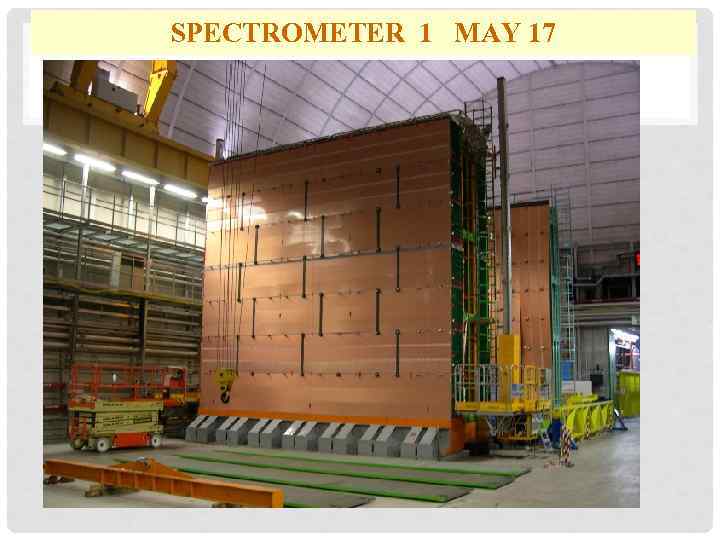
SPECTROMETER 1 MAY 17
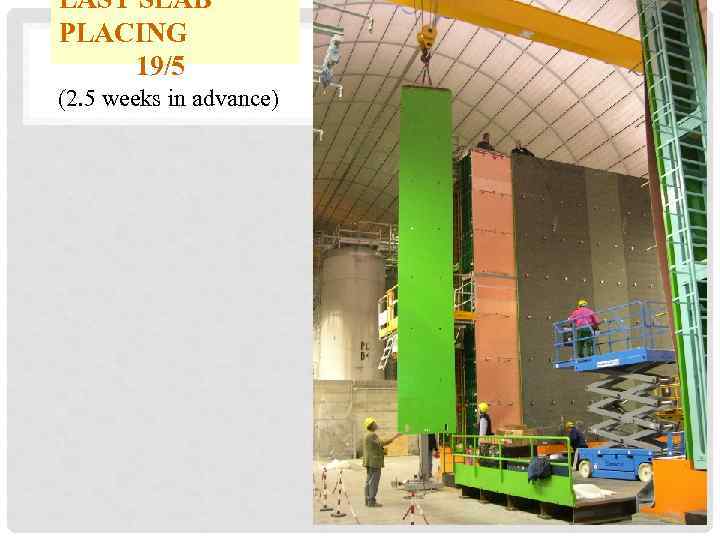
LAST SLAB PLACING 19/5 (2. 5 weeks in advance)
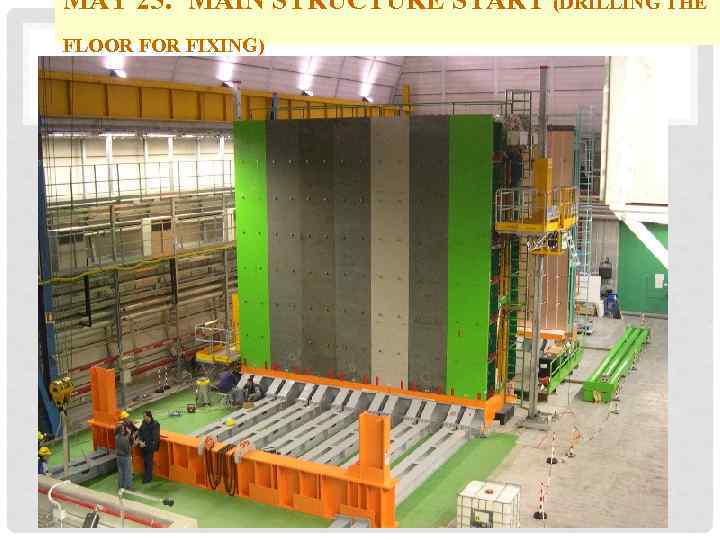
MAY 25: MAIN STRUCTURE START (DRILLING THE FLOOR FIXING)
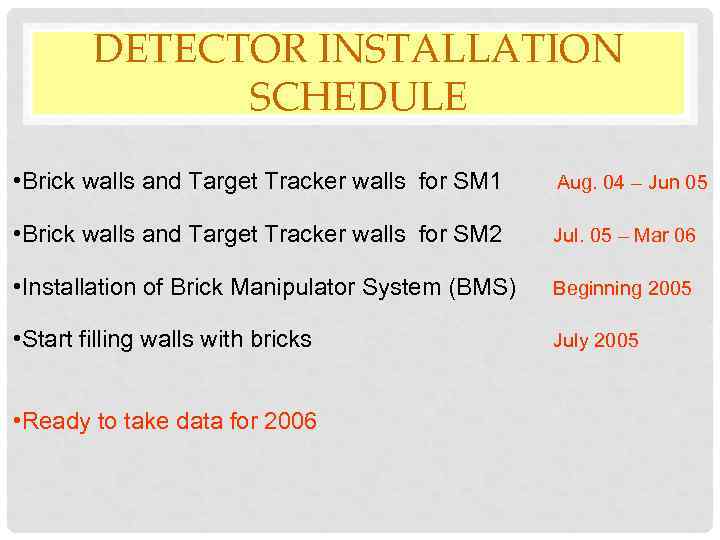
DETECTOR INSTALLATION SCHEDULE • Brick walls and Target Tracker walls for SM 1 Aug. 04 – Jun 05 • Brick walls and Target Tracker walls for SM 2 Jul. 05 – Mar 06 • Installation of Brick Manipulator System (BMS) Beginning 2005 • Start filling walls with bricks July 2005 • Ready to take data for 2006
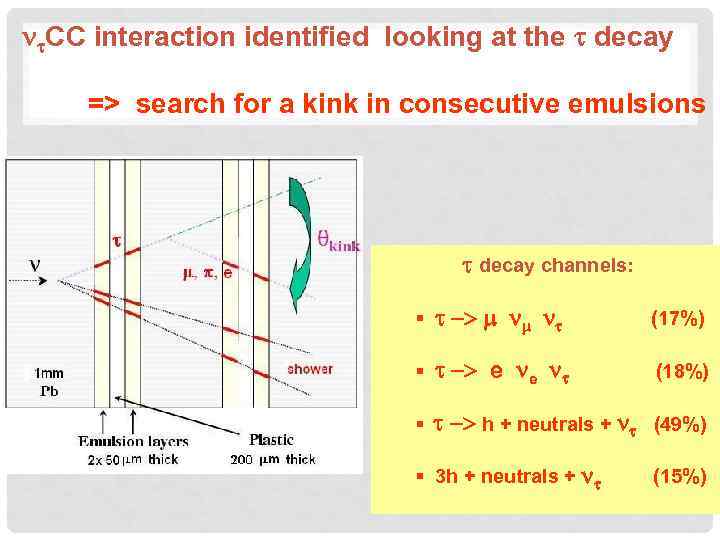
nt. CC interaction identified looking at the t decay => search for a kink in consecutive emulsions t decay channels: § t -> m nm nt (17%) § t -> e ne nt (18%) § t -> h + neutrals + nt (49%) § 3 h + neutrals + nt (15%)
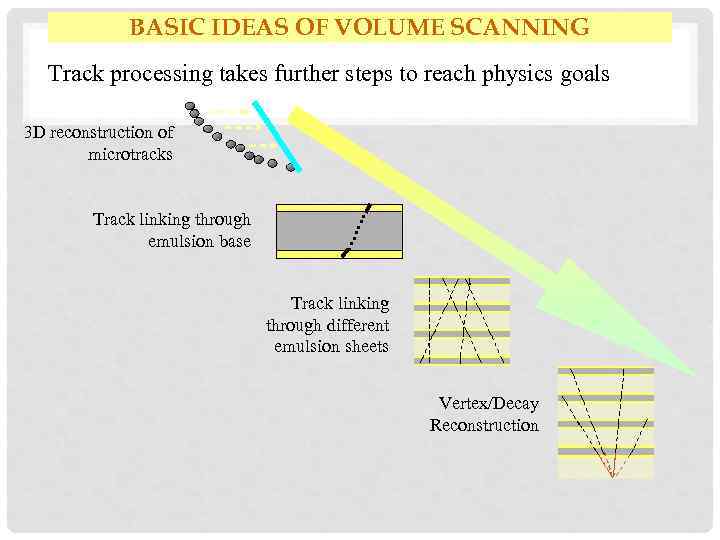
BASIC IDEAS OF VOLUME SCANNING Track processing takes further steps to reach physics goals 3 D reconstruction of microtracks Track linking through emulsion base Track linking through different emulsion sheets Vertex/Decay Reconstruction
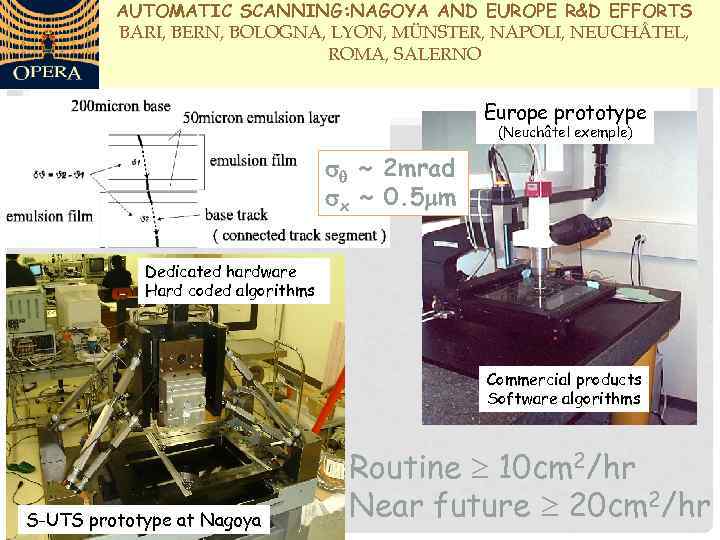
AUTOMATIC SCANNING: NAGOYA AND EUROPE R&D EFFORTS BARI, BERN, BOLOGNA, LYON, MÜNSTER, NAPOLI, NEUCH TEL, ROMA, SALERNO Europe prototype (Neuchâtel exemple) sq ~ 2 mrad sx ~ 0. 5 mm Dedicated hardware Hard coded algorithms Commercial products Software algorithms S-UTS prototype at Nagoya Routine 10 cm 2/hr Near future 20 cm 2/hr
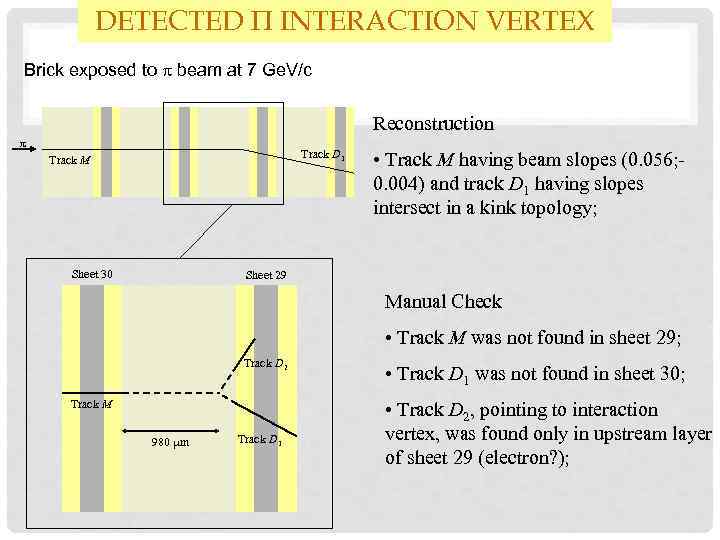
DETECTED P INTERACTION VERTEX Brick exposed to beam at 7 Ge. V/c Reconstruction Track D 1 Track M Sheet 30 • Track M having beam slopes (0. 056; 0. 004) and track D 1 having slopes intersect in a kink topology; Sheet 29 Manual Check • Track M was not found in sheet 29; Track D 2 Track M 980 m Track D 1 • Track D 1 was not found in sheet 30; • Track D 2, pointing to interaction vertex, was found only in upstream layer of sheet 29 (electron? );
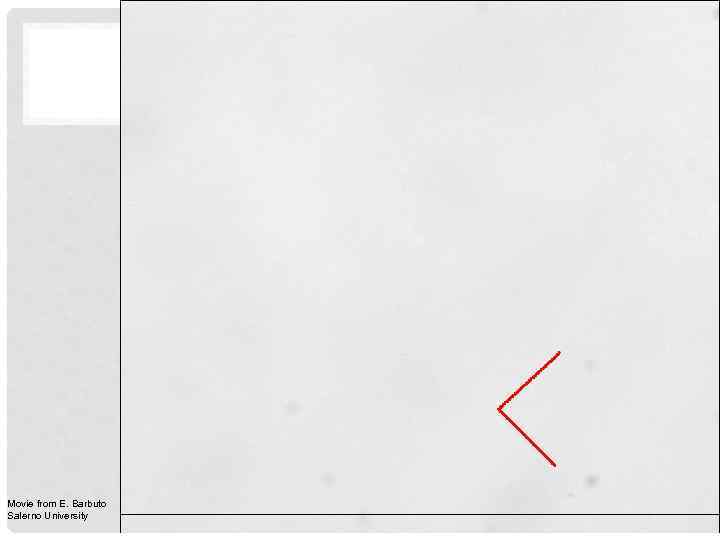
Movie from E. Barbuto Salerno University
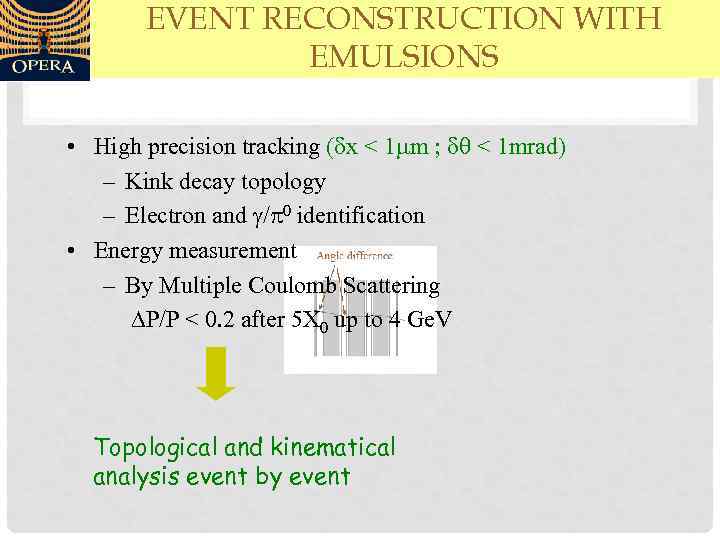
EVENT RECONSTRUCTION WITH EMULSIONS • High precision tracking (dx < 1 m ; dq < 1 mrad) – Kink decay topology – Electron and g/ 0 identification • Energy measurement – By Multiple Coulomb Scattering DP/P < 0. 2 after 5 X 0 up to 4 Ge. V Topological and kinematical analysis event by event
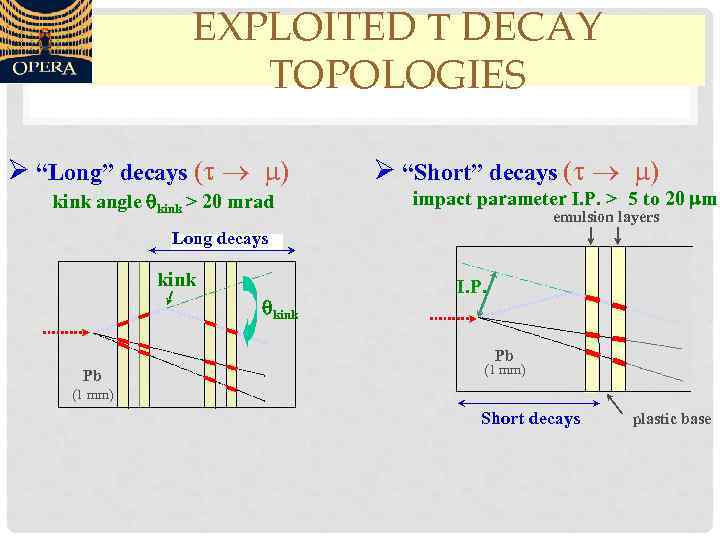
EXPLOITED T DECAY TOPOLOGIES Ø “Long” decays (t ) Ø “Short” decays (t ) kink angle qkink > 20 mrad impact parameter I. P. > 5 to 20 mm emulsion layers Long decays kink qkink I. P. Pb Pb (1 mm) Short decays plastic base
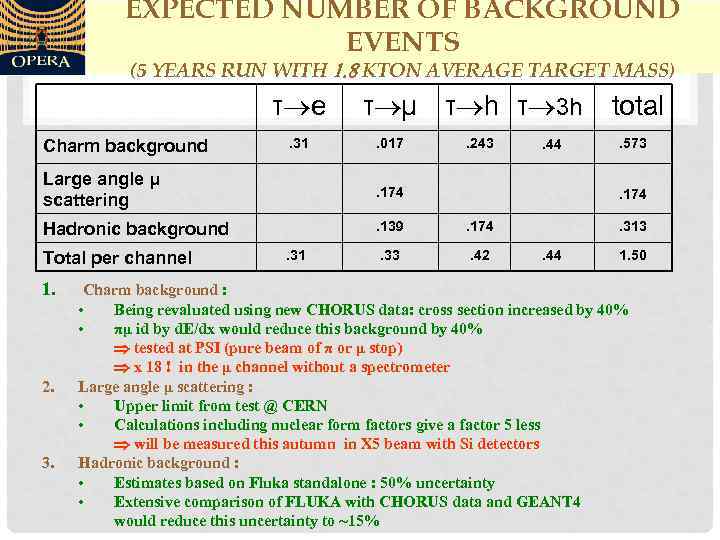
EXPECTED NUMBER OF BACKGROUND EVENTS (5 YEARS RUN WITH 1. 8 KTON AVERAGE TARGET MASS) τ e Charm background . 31 τ μ τ h τ 3 h. 017 . 243 Large angle μ scattering . 174 Hadronic background . 139 . 174 . 33 . 42 . 44 Total per channel 1. 3. . 573 . 174. 313. 44 1. 50 Charm background : • • 2. . 31 total Being revaluated using new CHORUS data: cross section increased by 40% πμ id by d. E/dx would reduce this background by 40% tested at PSI (pure beam of π or μ stop) x 18 ! in the μ channel without a spectrometer Large angle μ scattering : • Upper limit from test @ CERN • Calculations including nuclear form factors give a factor 5 less will be measured this autumn in X 5 beam with Si detectors Hadronic background : • Estimates based on Fluka standalone : 50% uncertainty • Extensive comparison of FLUKA with CHORUS data and GEANT 4 would reduce this uncertainty to ~15%
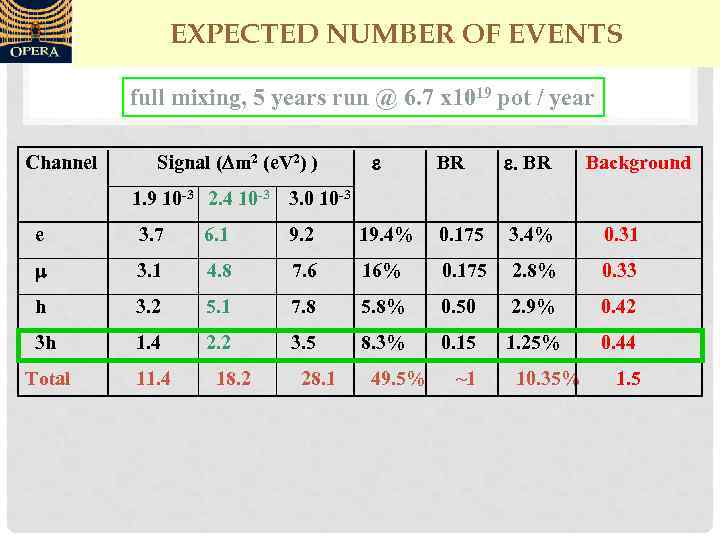
EXPECTED NUMBER OF EVENTS full mixing, 5 years run @ 6. 7 x 10¹⁹ pot / year Channel Signal (Dm 2 (e. V 2) ) e BR e. BR Background 1. 9 10 -3 2. 4 10 -3 3. 0 10 -3 e 3. 7 6. 1 9. 2 19. 4% 0. 175 3. 4% 0. 31 m 3. 1 4. 8 7. 6 16% 0. 175 2. 8% 0. 33 h 3. 2 5. 1 7. 8 5. 8% 0. 50 2. 9% 0. 42 3 h 1. 4 2. 2 3. 5 8. 3% 0. 15 1. 25% 0. 44 Total 11. 4 18. 2 28. 1 49. 5% ~1 10. 35% 1. 5
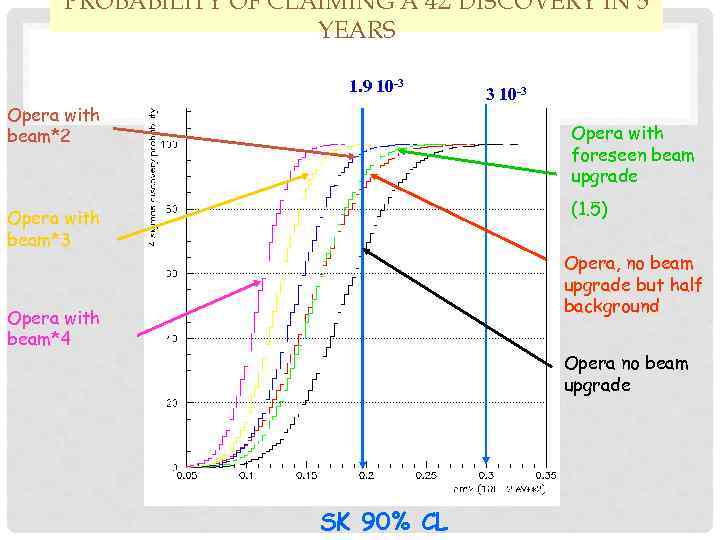
PROBABILITY OF CLAIMING A 4 S DISCOVERY IN 5 YEARS 1. 9 10 -3 Opera with beam*2 3 10 -3 Opera with foreseen beam upgrade (1. 5) Opera with beam*3 Opera, no beam upgrade but half background Opera with beam*4 Opera no beam upgrade SK 90% CL
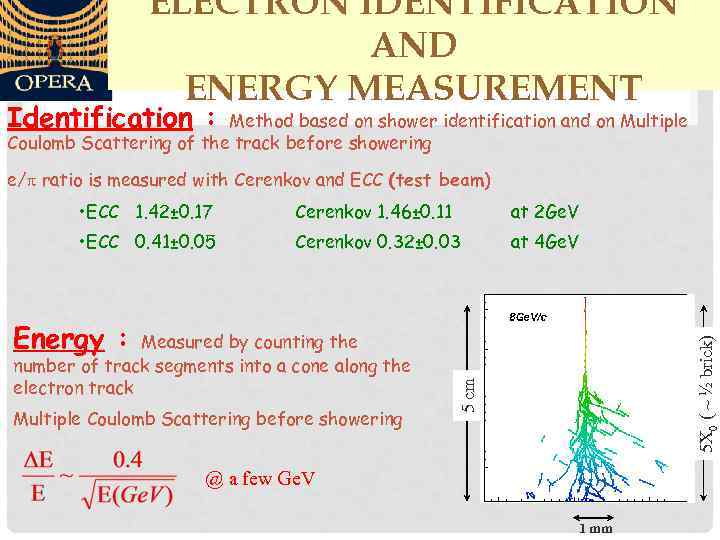
ELECTRON IDENTIFICATION AND ENERGY MEASUREMENT Identification : Method based on shower identification and on Multiple Coulomb Scattering of the track before showering e/ ratio is measured with Cerenkov and ECC (test beam) • ECC 1. 42± 0. 17 Cerenkov 1. 46± 0. 11 at 2 Ge. V • ECC 0. 41± 0. 05 Cerenkov 0. 32± 0. 03 at 4 Ge. V Multiple Coulomb Scattering before showering 5 cm Measured by counting the number of track segments into a cone along the electron track 5 X 0 ( ~ ½ brick) Energy : @ a few Ge. V 1 mm
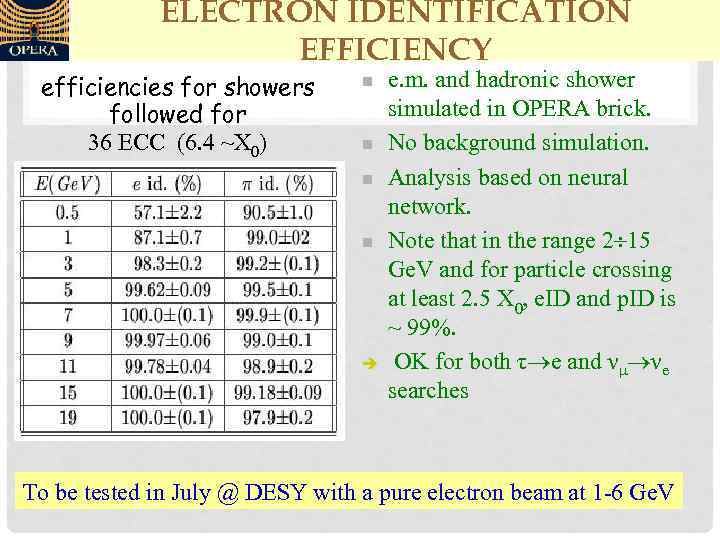
ELECTRON IDENTIFICATION EFFICIENCY efficiencies for showers followed for 36 ECC (6. 4 ~X 0) n n è e. m. and hadronic shower simulated in OPERA brick. No background simulation. Analysis based on neural network. Note that in the range 2 15 Ge. V and for particle crossing at least 2. 5 X 0, e. ID and p. ID is ~ 99%. OK for both τ e and νμ νe searches To be tested in July @ DESY with a pure electron beam at 1 -6 Ge. V
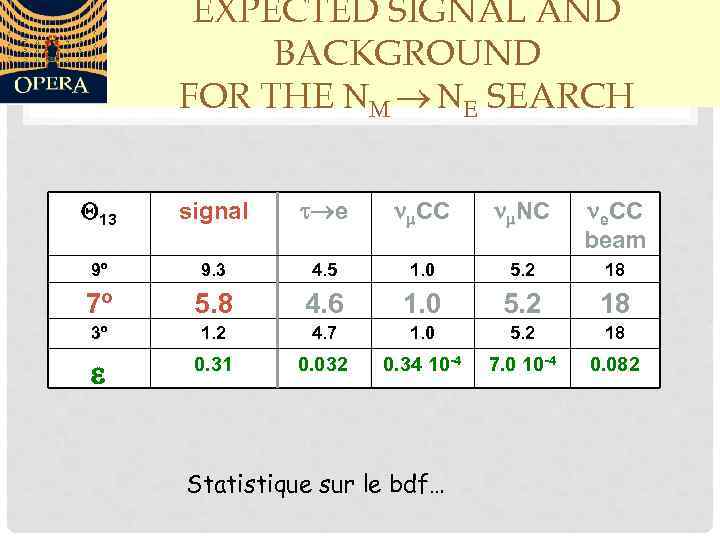
EXPECTED SIGNAL AND BACKGROUND FOR THE NM NE SEARCH Q 13 signal t e nm. CC nm. NC ne. CC beam 9º 9. 3 4. 5 1. 0 5. 2 18 7º 5. 8 4. 6 1. 0 5. 2 18 3º 1. 2 4. 7 1. 0 5. 2 18 e 0. 31 0. 032 0. 34 10 -4 7. 0 10 -4 0. 082 Statistique sur le bdf…
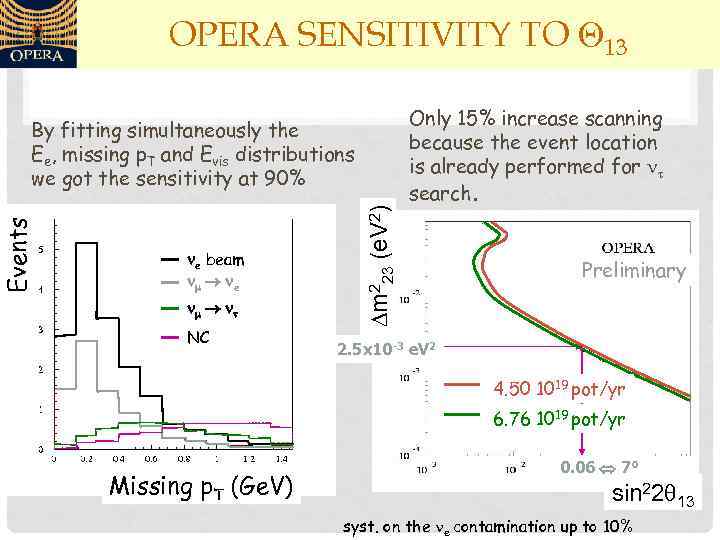
OPERA SENSITIVITY TO Q 13 ne beam nm ne nm nt NC Dm 223 (e. V 2) Events By fitting simultaneously the Ee, missing p. T and Evis distributions we got the sensitivity at 90% Only 15% increase scanning because the event location is already performed for nt search. Preliminary 2. 5 x 10 -3 e. V 2 4. 50 1019 pot/yr 6. 76 1019 pot/yr Missing p. T (Ge. V) 0. 06 7° sin 22 q 13 syst. on the ne contamination up to 10%
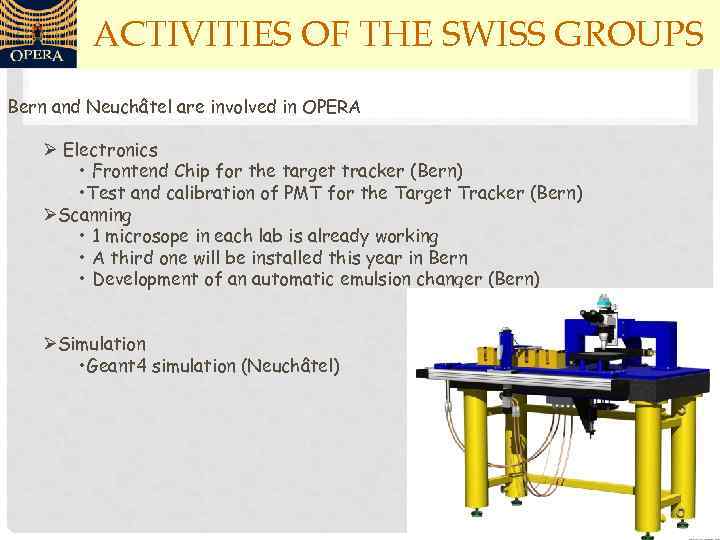
ACTIVITIES OF THE SWISS GROUPS Bern and Neuchâtel are involved in OPERA Ø Electronics • Frontend Chip for the target tracker (Bern) • Test and calibration of PMT for the Target Tracker (Bern) ØScanning • 1 microsope in each lab is already working • A third one will be installed this year in Bern • Development of an automatic emulsion changer (Bern) ØSimulation • Geant 4 simulation (Neuchâtel)
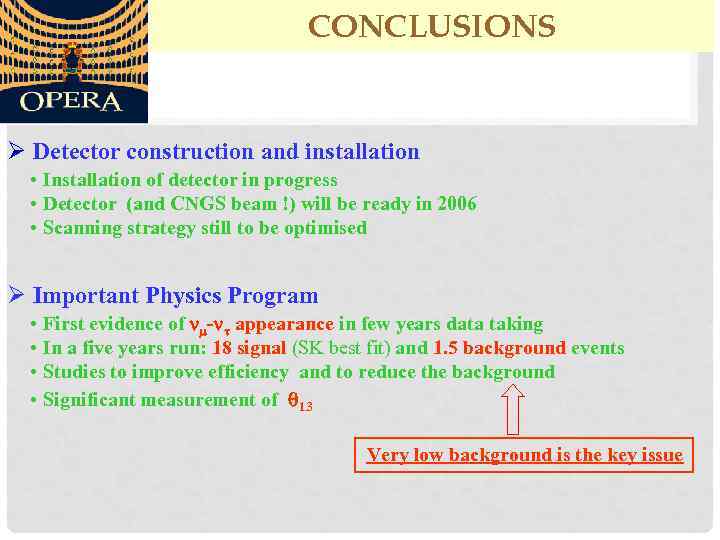
CONCLUSIONS Ø Detector construction and installation • Installation of detector in progress • Detector (and CNGS beam !) will be ready in 2006 • Scanning strategy still to be optimised Ø Important Physics Program • First evidence of nm-nt appearance in few years data taking • In a five years run: 18 signal (SK best fit) and 1. 5 background events • Studies to improve efficiency and to reduce the background • Significant measurement of q 13 Very low background is the key issue
Скачать презентацию МИНИСТЕРСТВО ОБРАЗОВАНИЯ И НАУКИ Государственное образовательное учреждение высшего
презентация опера.ppt