


 Скачать презентацию Ministerio de Fomento Industria y Comercio Nicaraguan Innovation
ca244b9b1be205abf7e847cc153a9184.ppt
- Количество слайдов: 15
 Ministerio de Fomento, Industria y Comercio Nicaraguan Innovation Fund for SMEs Government instrument to promote exports and national competitiveness by helping businesses find, adopt and adapt useful technologies Regina Lacayo Oyanguren Febuary 2007
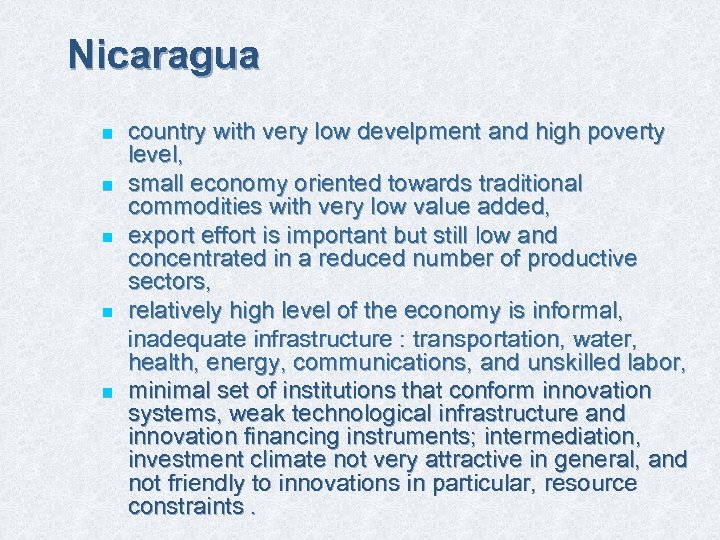 Nicaragua country with very low develpment and high poverty level, n small economy oriented towards traditional commodities with very low value added, n export effort is important but still low and concentrated in a reduced number of productive sectors, n relatively high level of the economy is informal, inadequate infrastructure : transportation, water, health, energy, communications, and unskilled labor, n minimal set of institutions that conform innovation systems, weak technological infrastructure and innovation financing instruments; intermediation, investment climate not very attractive in general, and not friendly to innovations in particular, resource constraints. n
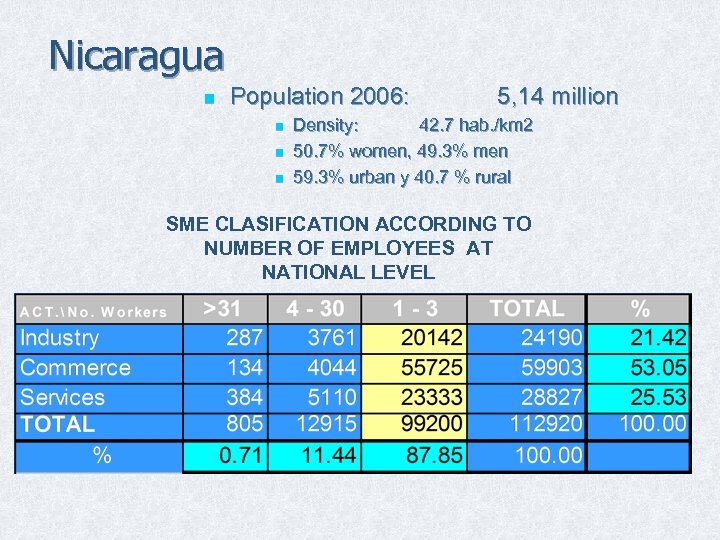 Nicaragua n Population 2006: n n n 5, 14 million Density: 42. 7 hab. /km 2 50. 7% women, 49. 3% men 59. 3% urban y 40. 7 % rural SME CLASIFICATION ACCORDING TO NUMBER OF EMPLOYEES AT NATIONAL LEVEL
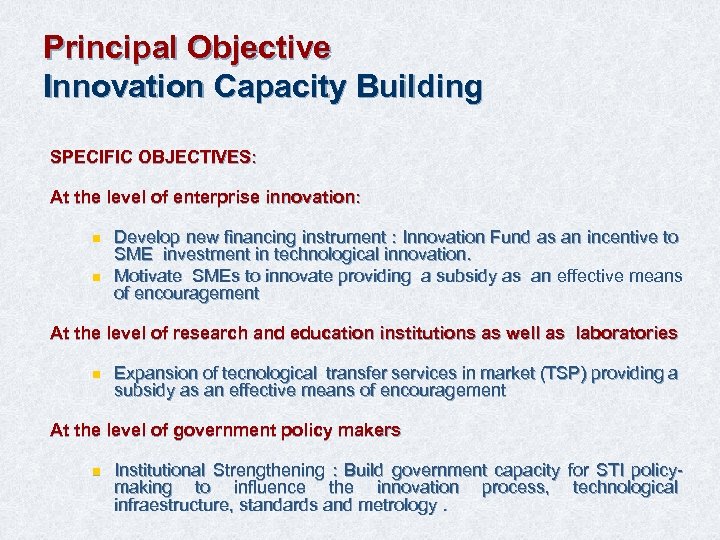 Principal Objective Innovation Capacity Building SPECIFIC OBJECTIVES: At the level of enterprise innovation: n n Develop new financing instrument : Innovation Fund as an incentive to SME investment in technological innovation. Motivate SMEs to innovate providing a subsidy as an effective means of encouragement At the level of research and education institutions as well as laboratories n Expansion of tecnological transfer services in market (TSP) providing a subsidy as an effective means of encouragement At the level of government policy makers n Institutional Strengthening : Build government capacity for STI policymaking to influence the innovation process, technological infraestructure, standards and metrology.
 At the level of government policy makers n Institutional Strengthening n National Council CONICYT n n Build government capacity for STI policy-making National Metrology and Standard Systems n Build technological infraestructure: metrology and certification system for laboratories, and complying with standards
 Technology diffusion and transfer network n Develop new model n n n With Universities creating Technological Service Centers, organized within the university with existing laboratories, workshops, R&D experts who are willing and interested in providing services for SME in the local territory according to the needs of each SME. Services offered include: technical assistance, training, standards, quality control and laboratory tests, specific technological training, applied R&D, design of new products, prototypes, market studies. Whatever the SME may need to incorporate the innovation. Sectoral and technological development as mission At the local territories n UPOLI in Masaya for SME s in leather and textile sectors n UNI in Managua for SME in food industries With Technological Facilitators as part of their staff
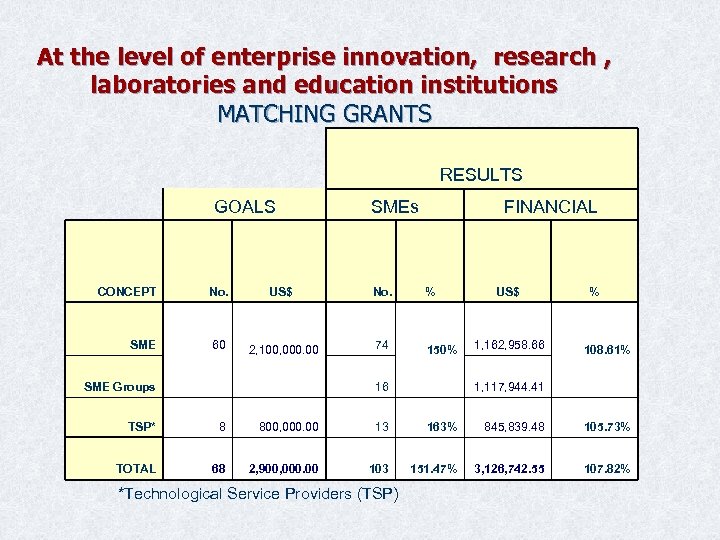 At the level of enterprise innovation, research , laboratories and education institutions MATCHING GRANTS RESULTS GOALS CONCEPT No. SMEs FINANCIAL US$ No. % 2, 100, 000. 00 74 150% US$ % SME 60 SME Groups TSP* 8 800, 000. 00 13 163% 845, 839. 48 105. 73% TOTAL 68 2, 900, 000. 00 103 151. 47% 3, 126, 742. 55 107. 82% 16 *Technological Service Providers (TSP) 1, 162, 958. 66 108. 61% 1, 117, 944. 41
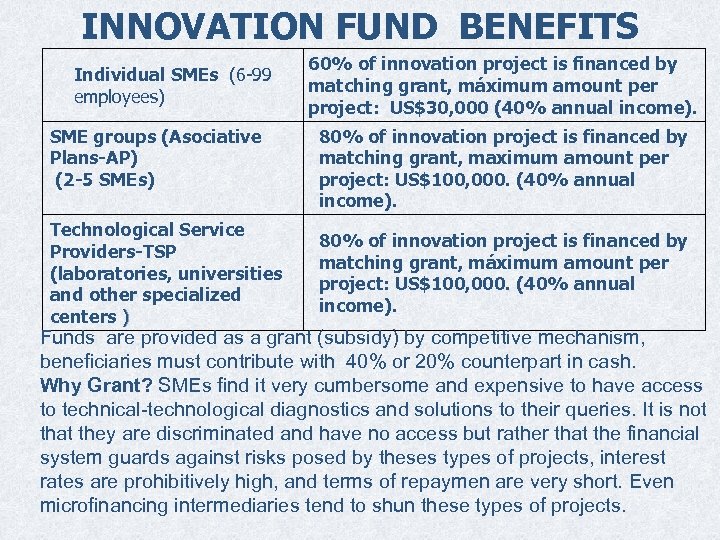 INNOVATION FUND BENEFITS Individual SMEs (6 -99 employees) SME groups (Asociative Plans-AP) (2 -5 SMEs) Technological Service Providers-TSP (laboratories, universities and other specialized centers ) 60% of innovation project is financed by matching grant, máximum amount per project: US$30, 000 (40% annual income). 80% of innovation project is financed by matching grant, maximum amount per project: US$100, 000. (40% annual income). 80% of innovation project is financed by matching grant, máximum amount per project: US$100, 000. (40% annual income). Funds are provided as a grant (subsidy) by competitive mechanism, beneficiaries must contribute with 40% or 20% counterpart in cash. Why Grant? SMEs find it very cumbersome and expensive to have access to technical-technological diagnostics and solutions to their queries. It is not that they are discriminated and have no access but rather that the financial system guards against risks posed by theses types of projects, interest rates are prohibitively high, and terms of repaymen are very short. Even microfinancing intermediaries tend to shun these types of projects.
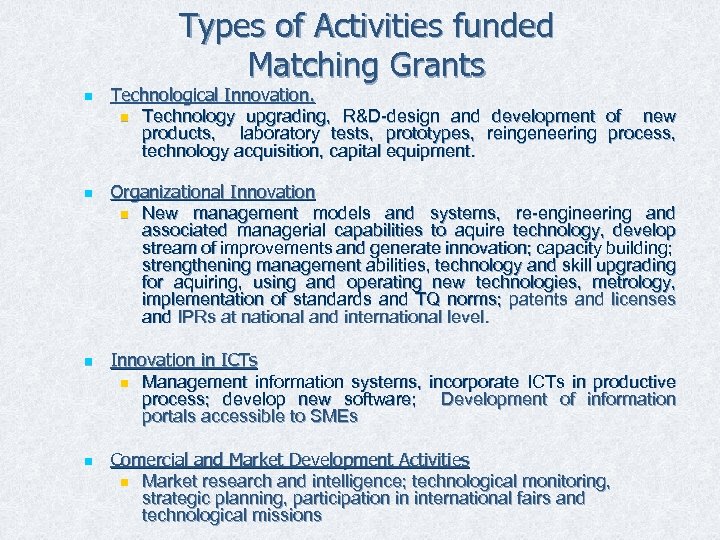 Types of Activities funded Matching Grants n Technological Innovation. n Technology upgrading, R&D-design and development of new products, laboratory tests, prototypes, reingeneering process, technology acquisition, capital equipment. n n n Organizational Innovation n New management models and systems, re-engineering and associated managerial capabilities to aquire technology, develop stream of improvements and generate innovation; capacity building; strengthening management abilities, technology and skill upgrading for aquiring, using and operating new technologies, metrology, implementation of standards and TQ norms; patents and licenses and IPRs at national and international level. Innovation in ICTs n Management information systems, incorporate ICTs in productive process; develop new software; Development of information portals accessible to SMEs Comercial and Market Development Activities n Market research and intelligence; technological monitoring, strategic planning, participation in international fairs and technological missions
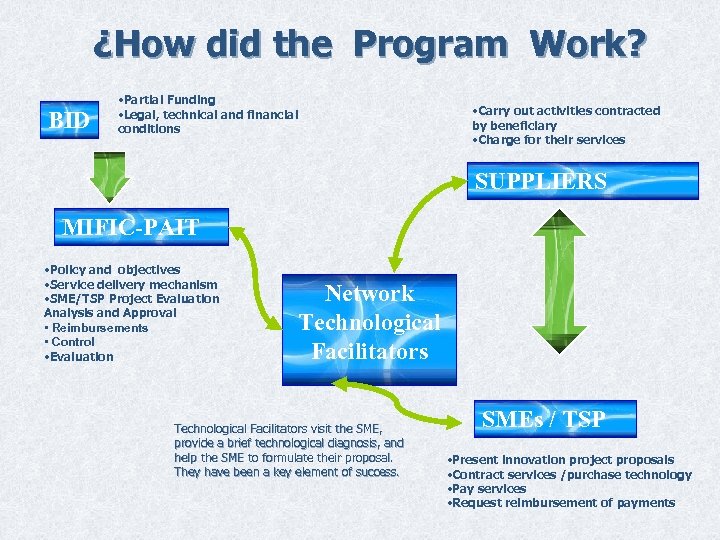 ¿How did the Program Work? BID • Partial Funding • Legal, technical and financial conditions • Carry out activities contracted by beneficiary • Charge for their services SUPPLIERS MIFIC-PAIT • Policy and objectives • Service delivery mechanism • SME/TSP Project Evaluation Analysis and Approval • Reimbursements • Control • Evaluation Network Technological Facilitators visit the SME, provide a brief technological diagnosis, and help the SME to formulate their proposal. They have been a key element of success. SMEs / TSP • Present innovation project proposals • Contract services /purchase technology • Pay services • Request reimbursement of payments
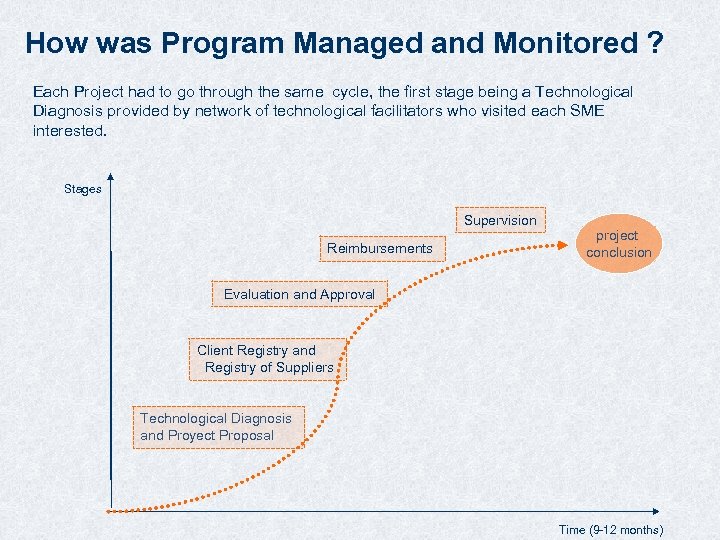 How was Program Managed and Monitored ? Each Project had to go through the same cycle, the first stage being a Technological Diagnosis provided by network of technological facilitators who visited each SME interested. Stages Supervision Reimbursements project conclusion Evaluation and Approval Client Registry and Registry of Suppliers Technological Diagnosis and Proyect Proposal Time (9 -12 months)
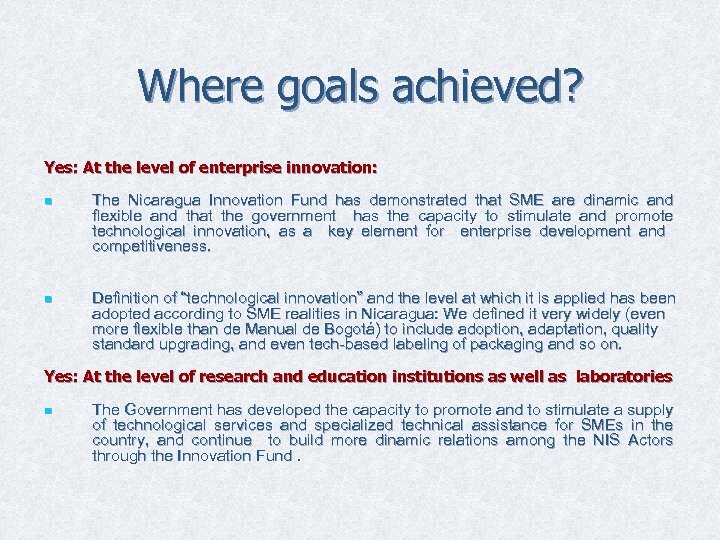 Where goals achieved? Yes: At the level of enterprise innovation: n The Nicaragua Innovation Fund has demonstrated that SME are dinamic and flexible and that the government has the capacity to stimulate and promote technological innovation, as a key element for enterprise development and competitiveness. n Definition of “technological innovation” and the level at which it is applied has been adopted according to SME realities in Nicaragua: We defined it very widely (even more flexible than de Manual de Bogotá) to include adoption, adaptation, quality standard upgrading, and even tech-based labeling of packaging and so on. Yes: At the level of research and education institutions as well as laboratories n The Government has developed the capacity to promote and to stimulate a supply of technological services and specialized technical assistance for SMEs in the country, and continue to build more dinamic relations among the NIS Actors through the Innovation Fund.
 SME one year results n n n Average : 6 new employees per SMEs Average : 33% increase in SMEs sales All SMEs employees were trained for innovation All SMEs developed new products, new markets, quality control standards , incorporated ICTs, reengineering process Positive Returns for Government within 8 years with increase in sales taxes
 Where goals achieved? Yes: Technology difusion and transfer n The technological facilitator network was successful, it allowed a fast diagnosis, and identification of opportunities for SME innovation projects. n This confirms the convenience of implementing technological service centers (TTUs/TSCs) for SMEs at the local level with local universities to facilitate innovation and technological development in SMEs as a competitiveness strategy.
 Where goals achieved? At the level of government policy makers n Yes: n National Metrology and Standards Office with technological infrastructure to support economic growth and exports with value added n Innovation Fund has been incorporated into government policy for SME at MIFIC n National Council of Universities (CNU) is incorporating with Cida. Sarek : Technology transfer Units TTUs , n Not Yet: n National Council (CONICYT) n Importance of institutional framework n n Who? Where? Why? And Mission Financial System: working to have new partners (sort of akin to angel investors except that we are not dealing with cutting edge start-ups) to help alleviate these financial constraints.