


 Скачать презентацию Ministerial NEtwo Rk for Valorising Activities in digitisation
ee9351791be8e4f860b2d916b8682378.ppt
- Количество слайдов: 54
 Ministerial NEtwo. Rk for Valorising Activities in digitisation THE MANAGEMENT OF DIGITISATION PROJECTS IN THE CULTURAL HERITAGE SECTOR Antonella Fresa Warsaw, 30 January 2006
 Scope of the presentation To present: • the MINERVA initiative • the Dynamic Action Plan • some of the MINERVA products which can help in the management of digitisation projects Antonella Fresa Warsaw, 30 January 2006
 The MINERVA initiative Working groups, conferences, workshops, publications, websites, newletter, international activities, services deployment, networking with other European initiatives, the political and strategic level. Antonella Fresa Warsaw, 30 January 2006
 Conferences and workshops From February 2004 to January 2006: • 36 events organised by MINERVA and MINERVAplus in AU, DE, EE, FR, GR, HU, IE, IL, IT, LU, MT, NL, PT, RU, SI, SW, UK • MINERVAplus participated to 54 events held by other organisations in the above mentioned countries PLUS BG, CA, CZ, DK, FYROM, HR, SP, SR, US. Different levels: local, national, international. Antonella Fresa Warsaw, 30 January 2006
 Publications 2004 Some of them are available in more than 10 languages! Technical Guidelines for Digital Cultural Content Creation Programmes http: //www. minervaeurope. org/publications/technicalguidelin es. htm (available in EN, FR, DE¸ soon also in IT) Good practices handbook http: //www. minervaeurope. org/publications/goodhand. htm (available in CZ, DE, EL, EN, FR, HU, IT, LV, PT, SI, SK) MINERVA: Digitising content together: Ministerial NEtwork for Valorising Activities in Digitisation: Activities 2003 - 2004 (information brochure about the project) http: //www. minervaeurope. org/publications. htm (available in EN, IT) Antonella Fresa Warsaw, 30 January 2006
 Publications 2005 Dynamic Action Plan for the EU co-ordination of digitisation of cultural and scientific content http: //www. minervaeurope. org/publications/dap. htm (available in EN, FR, DE, IT) Guide to Intellectual Property Rights and Other Legal Issues (draft version) http: //www. minervaeurope. org/publications/guideipr. htm (available in EN) Quality Principles for cultural Web sites: a handbook http: //www. minervaeurope. org/publications/qualitycommentary_en. htm (available in CZ, DE, EL, EN, FR, HU, LV, SI) Coordinating digitisation in Europe. Progress report of the National Representatives Group: coordination mechanisms for digitisation policies and programmes 2004 http: //www. minervaeurope. org/publications/globalreport/globalrep 2004. htm (available in EN) Manuale per la qualità dei siti Web pubblici culturali (2 nd edition) http: //www. minervaeurope. org/publications/qualitycriteria-i. htm (available in IT) Antonella Fresa Warsaw, 30 January 2006
 Postcards 16 titles (printed or planned to be). Goal: to give the widest diffusion to the MINERVA and MINERVAplus products. About 30, 000 pieces. Antonella Fresa Under preparation: • • • DAP Minerva Galaxy IPR Guide Report on Multilingualism Cost Reduction Study Map of the European organisational structure of the cultural sector • The Assessment report Warsaw, 30 January 2006
 Next titles • • • Report on multilingualism 4 th Progress Report of the NRG Cost reduction report IPR guide Assessment Report on the Coordination of Digitisation in Europe Map of the European organisational structure of the cultural sector French and German translation of the 10 quality principles handbook Italian translation of the DAP Second Italian edition of the Handbook for quality in cultural web sites Antonella Fresa Warsaw, 30 January 2006
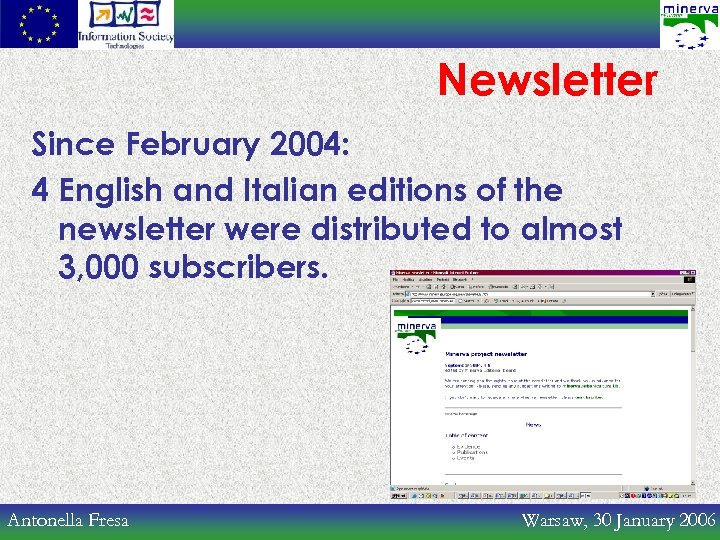 Newsletter Since February 2004: 4 English and Italian editions of the newsletter were distributed to almost 3, 000 subscribers. Antonella Fresa Warsaw, 30 January 2006
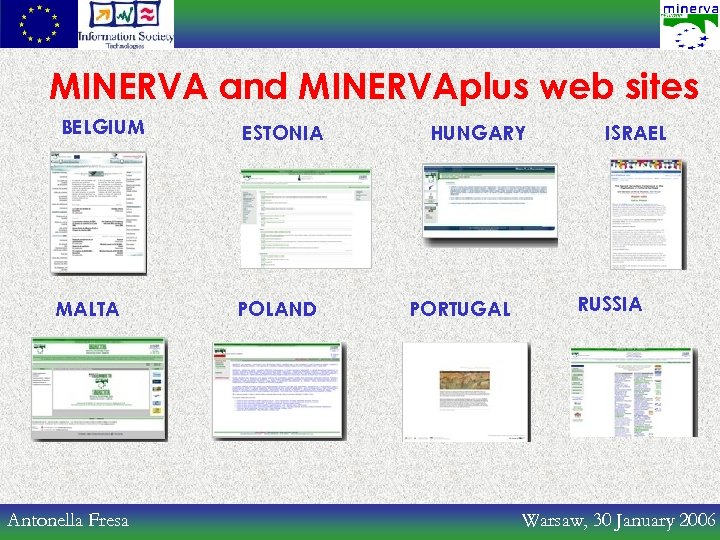 MINERVA and MINERVAplus web sites BELGIUM ESTONIA MALTA POLAND Antonella Fresa HUNGARY PORTUGAL ISRAEL RUSSIA Warsaw, 30 January 2006
 New initiatives based on the MINERVA results • MICHAEL and MICHAEL Plus • MEDCULT • MINERVA e. C Antonella Fresa Warsaw, 30 January 2006
 MICHAEL MINERVA spin off based on: • the data model elaborated by the MINERVA WP 3 • The technical guidelines elaborated by the MINERVA WP 4 • The survey on the multilingualism in Europe elaborated by the MINERVAplus WP 4 • The French platform Catalogue des fonds numérisés • The MINERVA prototype of portal for the digitised collection of Italy and France (produced by the WP 3) Antonella Fresa Warsaw, 30 January 2006
 MICHAEL - www. michael-culture. org MICHAEL (Multilingual Inventory of Cultural Heritage in Europe) is a project presented by the Mi. BAC in the framework of the e. TEN programme. MICHAEL will establish an international online service, to search, browse and examine multiple national cultural portals (starting with France, Italy, and UK) from a single point of access and using open source softwares. Antonella Fresa Warsaw, 30 January 2006
 MICHAEL Plus The enlargement of MICHAEL, elaborated by Mi. BAC in cooperation with France and UK. The following countries joined the MICHAEL system (based on the MINERVA results): Czech Republic, Finland, Germany, Greece, Hungary, Malta, The Netherlands, Poland, Portugal, Spain, Sweden Status: approved, under negotiation. Antonella Fresa Warsaw, 30 January 2006
 MEDCULT May 2005: MEDCULT project approved by UNESCO for funding, to spread MINERVA products through Mediterranean Arab countries, in cooperation with the STRABON network December 2005: MEDCULT kick-off in Rome Workshops: April 2006, Alexandria (Egypt) May 2006, Rabat (Morocco) August 2006, Amman (Jordan) http: //www. minervaeurope. org/MEDCULT/home. html Antonella Fresa Warsaw, 30 January 2006
 The MINERVAe. C proposal MInisterial NEtwo. Rk for Valorising Activities in digitisation e. Content. Plus Supporting the European Digital Library Submitted under e. Content+ Programme MAIN OBJECTIVES: ü Capitalising the results of MINERVA and MINERVA Plus; ü Implementing recommendations undertaken by the NRG; ü Large involvement of the cultural institutions and stakeholders ü Standard Agreements and Interoperability Frameworks; ü Coordination of content enrichment projects; Antonella Fresa Warsaw, 30 January 2006
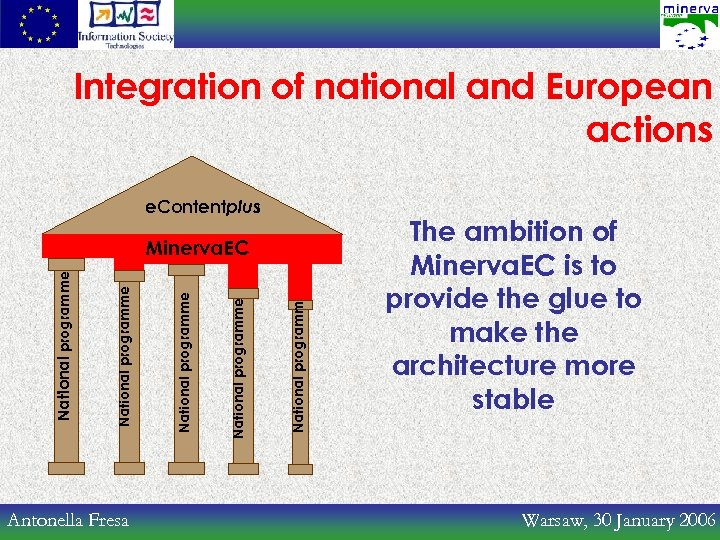 Integration of national and European actions e. Contentplus Antonella Fresa National programme National programme Minerva. EC The ambition of Minerva. EC is to provide the glue to make the architecture more stable Warsaw, 30 January 2006
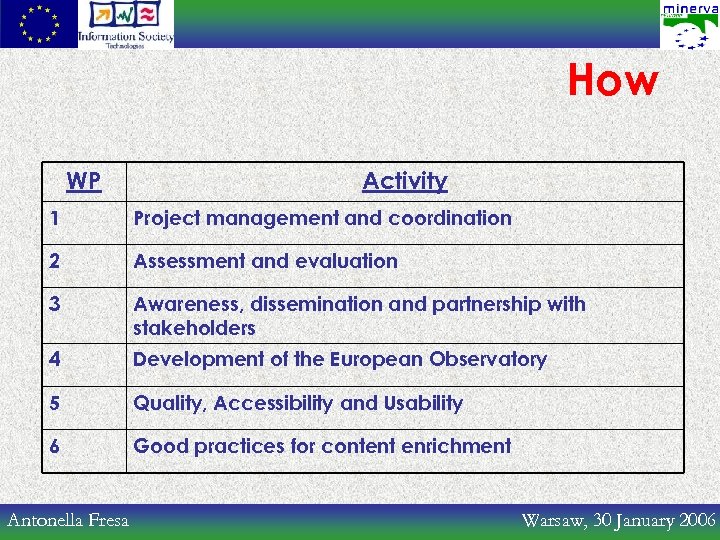 How WP Activity 1 Project management and coordination 2 Assessment and evaluation 3 Awareness, dissemination and partnership with stakeholders 4 Development of the European Observatory 5 Quality, Accessibility and Usability 6 Good practices for content enrichment Antonella Fresa Warsaw, 30 January 2006
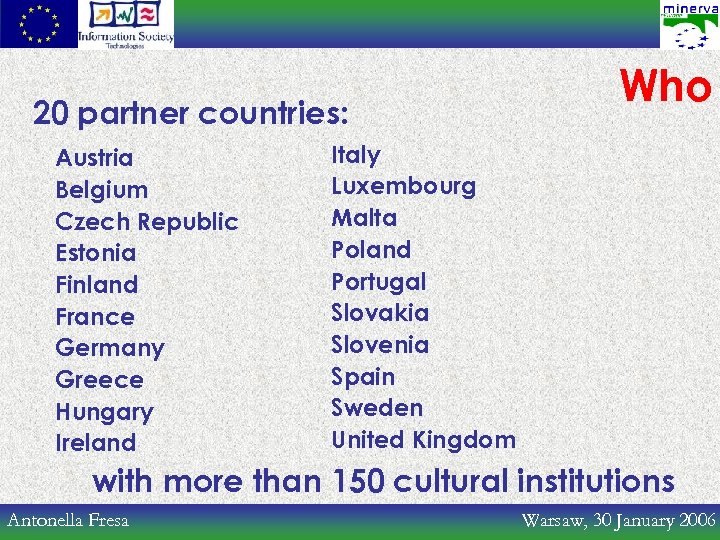 20 partner countries: Austria Belgium Czech Republic Estonia Finland France Germany Greece Hungary Ireland Who Italy Luxembourg Malta Poland Portugal Slovakia Slovenia Spain Sweden United Kingdom with more than 150 cultural institutions Antonella Fresa Warsaw, 30 January 2006
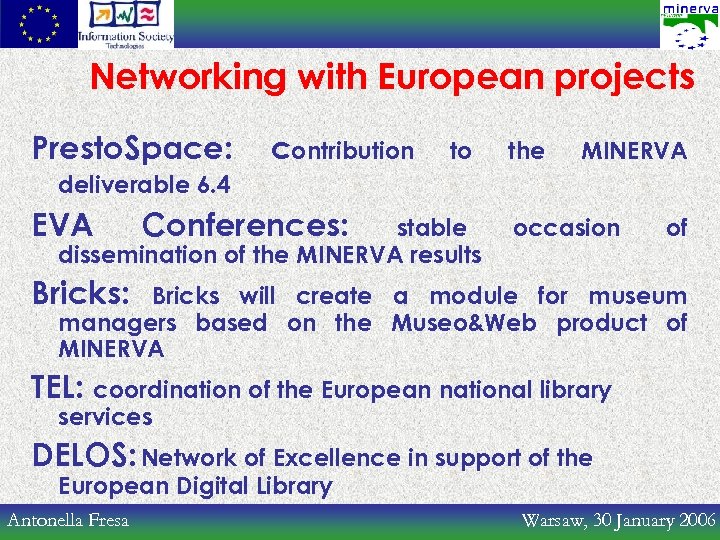 Networking with European projects Presto. Space: contribution to the MINERVA deliverable 6. 4 EVA Conferences: stable dissemination of the MINERVA results occasion of Bricks: Bricks will create a module for museum managers based on the Museo&Web product of MINERVA TEL: coordination of the European national library services DELOS: Network of Excellence in support of the European Digital Library Antonella Fresa Warsaw, 30 January 2006
 Map of the cultural institutions across Europe The Austrian Presidency and the Italian Ministry, with the contribution of NRG/MINERVA, are working together for the creation of a map of the cultural institutions across Europe. This study will be a road map of the future of the digitisation of the cultural heritage and will be integrated with the Marketing Plan of MINERVA. Antonella Fresa Warsaw, 30 January 2006
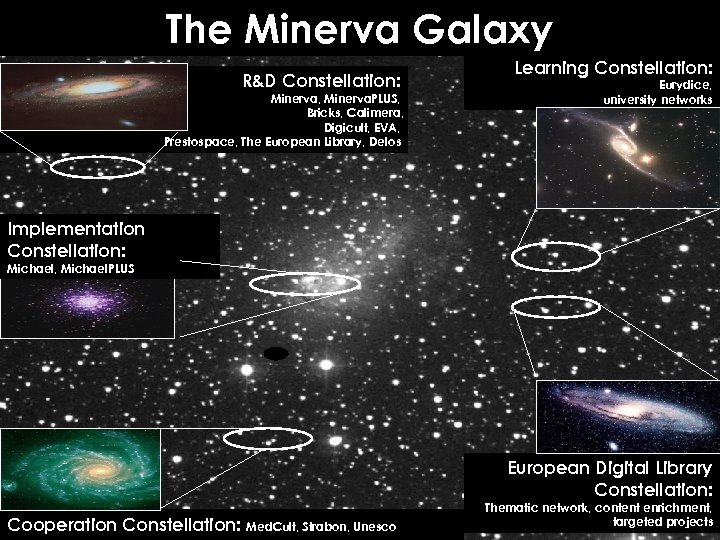 The Minerva Galaxy R&D Constellation: Minerva, Minerva. PLUS, Bricks, Calimera, Digicult, EVA, Prestospace, The European Library, Delos Learning Constellation: Eurydice, university networks Implementation Constellation: Michael, Michael. PLUS European Digital Library Constellation: Antonella Fresa Cooperation Constellation: Med. Cult, Strabon, Unesco Thematic network, content enrichment, targeted projects Warsaw, 30 January 2006
 The Dynamic Action Plan Launched on 15 th November 2005 in Bristol by the UK Minister for Culture, David Lammy. Available in DE, FR, IT, UK. It renews the Lund Action Plan. Main goals: (1)Providing strategic leadership in a dynamic and changing environment. (2)Strengthening co-ordination and forging stronger links between Member States’digitisation initiatives, EU networks and projects. (3)Continuing efforts in overcoming fragmentation and duplication of digitisation activities. (4)Assessing and identifying appropriate models, funding and policy approaches to sustain development and long-term preservation strategies. (5)Promoting cultural and linguistic diversity through digital content creation. (6)Improving online access to European cultural content. Antonella Fresa Warsaw, 30 January 2006
 The Dynamic Action Plan • re-affirms Lund Principles • sustainable and accessible digital cultural heritage • support e-inclusion, cultural diversity, education and training • promote resources of variety and richness and stimulate content industries • synergy between cultural and technology programmes Antonella Fresa Warsaw, 30 January 2006
 The Dynamic Action Plan Action areas: A. Users and content B. Technologies for digitisation C. Sustainability of content D. Digital preservation E. Monitoring progress Antonella Fresa Warsaw, 30 January 2006
 From the MINERVA products bouquet 3 titles are presented here: 1. Technical Guidelines for Digital Cultural Content Creation Programmes 2. Quality Principles for Cultural Websites 3. Good practices Handbook 4. sharing the same life-cycle segmentation Antonella Fresa Warsaw, 30 January 2006
 The Technical Guidelines for Digital Cultural Content Creation Programmes Aims: • To contribute to ensure consistency of approach to the creation, management and delivery of digital resources through the effective use of standards; • To identify those areas in which there is commonality of approach a to provide a core around which content-specific requirements might be built. Antonella Fresa Warsaw, 30 January 2006
 Standards: definition of the reference scenario de jure – formally recognised by a body responsible for setting and disseminating standards (e. g. TCP / IP maintained by the Internet Engineering Task Force) de facto – not formally recognised by a standards body but widely used (e. g. Adobe PDF file format) Antonella Fresa Warsaw, 30 January 2006
 Open-ness of Standards Open access – to the standard itself and to documents produced during its development Open use – implementing the standard does not incur any cost or IPR Ongoing support – driven by requirements of the user and not by the interest of the standard provider Preference is given to open standards Antonella Fresa Warsaw, 30 January 2006
 The benefits of deploying standards Interoperability Accessibility Preservation Security To: • users – the citizens, the learners, the children • Information providers and managers • Funding agencies • Creators Antonella Fresa Warsaw, 30 January 2006
 Levels of adoption Must – absolute technical Requirements Should - Guidance May – the topic deserves attention Vocabulary used in the Internet Engineering Task Force documentation (www. ietf. org) Antonella Fresa Warsaw, 30 January 2006
 The life-cycle approach 1. 2. 3. 4. 5. 6. 7. 8. 9. Preparation for digitisation Handling of originals The digitisation process Storage and preservation of the digital material Metadata capture Publication Disclosure Reuse and repurposing Intellectual property and copyright Antonella Fresa Warsaw, 30 January 2006
 The MINERVA Technical Guidelines provide a core set of guidelines, useful in many different contexts. The implementers of digitisation programmes and projects will need to adapt these guidelines to the specific contexts in which they are operating Antonella Fresa Warsaw, 30 January 2006
 The 10 Pinciples for good quality cultural websites Celebrating European cultural diversity by providing access to digital cultural content for all The 10 Principles are aimed at cultural websites – those developed by museums, libraries, archives and other cultural institutions. Antonella Fresa Warsaw, 30 January 2006
 A good quality cultural website must: be transparent, clearly stating the identity and purpose of the website, as well as the organisation responsible for its management select, digitise, author, present and validate content to create an effective website for users Implement quality of service policy guidelines to ensure that the website is maintained and updated at an appropriate level 1/3 Antonella Fresa Warsaw, 30 January 2006
 A good quality cultural website must: be accessible to all users, irrespective of the technology they use or their disabilities, including navigation, content, and interactive elements be user-centred, taking into account the needs of users, ensuring relevance and ease of use through responding to evaluation and feedback be responsive, enabling users to contact the site and receive and appropriate reply. Where appropriate, encourage questions, information sharing and discussions with and between users Antonella Fresa 2/3 Warsaw, 30 January 2006
 A good quality cultural website must: be aware of the importance of multilinguality by providing a minimum level of access in more than one language be committed to being interoperable within cultural networks to enable users to easily locate the content and services that meet their needs be managed to respect legal issues such as IPR and privacy and clearly state the terms and conditions on which the website and its contents may be used Adopt strategies and standards to ensure that the website and its contents can be preserved for the long-term 3/3 Antonella Fresa Warsaw, 30 January 2006
 the Quality Handbook It provides commentary an exploration of each of the 10 Quality Principles through: • interpretation, background information and motivation for the principle • a set of criteria which can be used to assess compliance of the website with the principles • a checklist based on the criteria • a set of practical and pragmatic tests and questions • the “priority matrix” Antonella Fresa Warsaw, 30 January 2006
 The life-cycle of digitisation projects • • • Website Planning Website Design Content Selection Digitisation Process Storage and Preservation of the Digital Master Material Metadata Capture Website Implementation Online Publication Ongoing Maintenance Antonella Fresa Warsaw, 30 January 2006
 Relationships between the various stages of a website life cycle and the 10 Principles For each principle-stage pair, a priority is provided: • 1 – Low priority • 2 – Mid priority • 3 – High priority Antonella Fresa Warsaw, 30 January 2006
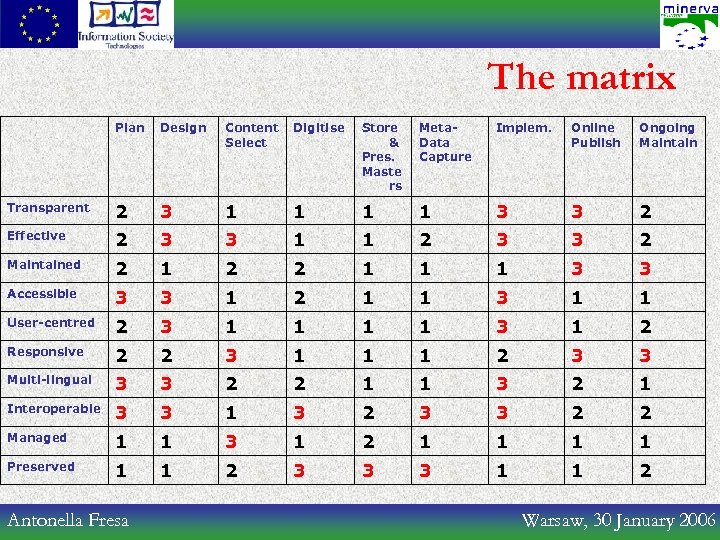 The matrix Plan Design Content Select Digitise Store & Pres. Maste rs Meta. Data Capture Implem. Online Publish Ongoing Maintain Transparent 2 3 1 1 3 3 2 Effective 2 3 3 1 1 2 3 3 2 Maintained 2 1 2 2 1 1 1 3 3 Accessible 3 3 1 2 1 1 3 1 1 User-centred 2 3 1 1 3 1 2 Responsive 2 2 3 1 1 1 2 3 3 Multi-lingual 3 3 2 2 1 1 3 2 1 Interoperable 3 3 1 3 2 3 3 2 2 Managed 1 1 3 1 2 1 1 Preserved 1 1 2 3 3 3 1 1 2 Antonella Fresa Warsaw, 30 January 2006
 Key messages Ø Quality must be planned into a website from the start Ø The user is critical – involve him at every stage Ø Relationships with other online resources (interoperability) and with future resources (long term preservation) must be given due attention Antonella Fresa Warsaw, 30 January 2006
 the Good Practices Handbook Ø Provides useful information to the establishment, execution and management of digitisation projects. Ø It is a reasoned organisation of lessons learnt by the analysis of the data collected across Europe since May 2002. Ø The Handbook is enriched with on-line complementary information, and in particular a selection of existing guidelines on digitisation. Antonella Fresa Warsaw, 30 January 2006
 The structure of the Handbook Introduction and background 10 sets of practical lessons learnt and information gathered by the Minerva project best practice team. A collections of practical ‘rules of thumb’, to be considered by organisations who are establishing, executing or managing digitisation projects in the cultural sphere. Complementary on-line information (addresses of existing guidelines and references to examples of good practices in the various sectors) Antonella Fresa Warsaw, 30 January 2006
 Practical Guidelines The material is broken down in accordance with the stages in the digitisation life-cycle. Each guideline description is structured as: - Title, - Issue definition, which sets the scene and introduces the problem(s) addressed, - Pragmatic suggestions, - Notes or commentary. Antonella Fresa Warsaw, 30 January 2006
 Areas of Practical Guidelines / stages Digitisation project planning in the life-cycle Selecting source material for digitisation Preparation for digitisation Handling of originals The digitisation process Preservation of the digital master material Meta-data Publication IPR and copyrigth Managing Digital Projects Antonella Fresa Warsaw, 30 January 2006
 Managing digitisation projects: some pragmatic suggestions Ø Digitisation process management Ø Team development Ø Staff training Ø Working with third parties for technical assistance Ø Working with third parties in cooperative projects and content sharing Ø Costs Antonella Fresa Warsaw, 30 January 2006
 Digitisation Process Management à To establish a work-flow that maximises the through-put of the digitisation team à Project knowledge base (database, spreadsheet or even a collection of documents), to ensure the recording of actions which are carried out à Name, identifier, status of the item, procedural choices and other relevant information for each item to be digitised should be entered in the knowledge base à Documenting parameters for hardware setup à Location, phone numbers and backup staff of key service personnel Antonella Fresa Warsaw, 30 January 2006
 Team development à If possible, include at least one person with appropriate information technology skill in the team à Assess the state of knowledge of the personnel, identify training needs and fill these before the project starts à IT skills are not the only ones which may be needed; specialist skills may be needed, e. g. : handling of delicate documents and artifacts, etc. à Better to have a small core of skilled personnel than a larger population of occasional participants Antonella Fresa Warsaw, 30 January 2006
 Staff training à Do not assume that no staff training is required, not that archives, library or museum staff automatically has all the relevant expertise à Identify training requirements at the start of the project: certain training may be ‘learn on the job’, other requires training in advance à Technology training may be well delivered from another project in the same institution; check first internal availability à A lack of staff training can jeopardise the whole project results; the same may result if the staff is removed from the project and new personnel start to work Antonella Fresa Warsaw, 30 January 2006
 Working with third parties for technical assistance à Services which are most commonly provided include: actual digitisation itself, project management, software development and integration, etc. à The relation should be governed by clear, strict contracts, including documented specification of the products/services to be provided à Review of the work on regular basis à It should be born in mind that expertise and experience gained by third parties will be mostly lost by the cultural institution at the end of the project (include long-term members of staff into the project) Antonella Fresa Warsaw, 30 January 2006
 Working with third parties in cooperative projects and content sharing à Ensure that all partners are aware of and have endorsed their roles and responsibilities à Establish common mode of communication across partners à Subcontractors should be governed by strict commercial contracts (deliverables, deadlines, etc. ) à IPR documented and agreed among partners Antonella Fresa Warsaw, 30 January 2006
 Costs à Take into account start-up and infrastructural costs as well as costs for running the project. The following costs should be considered: à Staff development (salaries, but also travel costs and training) à Facilities needed (low costs V/S high standard for image capture) à Operational costs à Costs for storage and for delivery systems à Image capture is often the least costly part of a digitisation project, on average: 1/3 of total costs are connected with digital convention 1/3 (or slightly less) to meta-data creation 1/3 (or even bit more) to administrative and quality assurance LAST BUT NOT LEAST: Regardless of the quality of the digital resources created by your digitisation project, they will not last long if the project cannot find funds for their maintenance PLANNING FOR SUSTAINABILITY IS A PRIORITY! Antonella Fresa Warsaw, 30 January 2006
 Thank you for your attention! Antonella Fresa fresa@promoter. it www. minervaeurope. org Antonella Fresa Warsaw, 30 January 2006