 Скачать презентацию MINING Surviving the Global Financial Crisis in the
ecb52d613a463882a722fbd4d687bca7.ppt
- Количество слайдов: 16



MINING Surviving the Global Financial Crisis in the Mining Sector Session 3 – Understanding the Key Indicators of Your Company’s Ability to Weather the Storm February 28, 2009 • C u r r e n t D e v e l 1
Agenda • Introductions • Broader industry and recent events • Fundamentals of Demand & Supply • Cash is king • Mergers and acquisitions • Forecasting and scenario planning • Stakeholder discussions • Find your dance partners • Mining M&A levels • Recent deals © 2009 KPMG LLP, a Canadian limited liability partnership and a member firm of the KPMG network of independent member firms affiliated with KPMG International, a Swiss cooperative. All rights reserved. 2
The broader industry and recent events • Surviving the short-term problems will be trickier for some. • Base metals have been more negatively impacted than precious • • • metals. Junior exploration and development companies will be starved of capital. High cost producers in an environment of declining prices. Many companies have halted production and have begun to defer investment. © 2009 KPMG LLP, a Canadian limited liability partnership and a member firm of the KPMG network of independent member firms affiliated with KPMG International, a Swiss cooperative. All rights reserved. 3
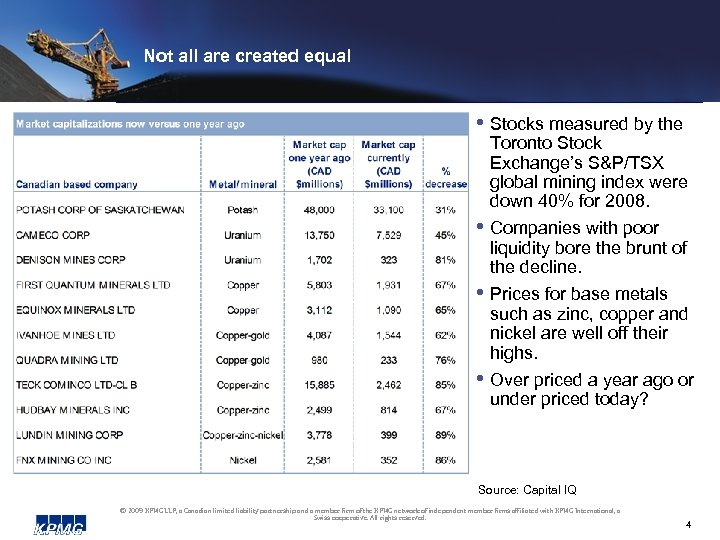
Not all are created equal • Stocks measured by the • • Toronto Stock Exchange’s S&P/TSX global mining index were down 40% for 2008. Companies with poor liquidity bore the brunt of the decline. Prices for base metals such as zinc, copper and nickel are well off their highs. • Over priced a year ago or under priced today? Source: Capital IQ © 2009 KPMG LLP, a Canadian limited liability partnership and a member firm of the KPMG network of independent member firms affiliated with KPMG International, a Swiss cooperative. All rights reserved. 4
Demand & Supply • Assuming companies can survive the next 18 to 24 months, there • remains reason for optimism in that the market fundamentals of supply and demand still line up very well for the mining industry. Companies that display best practices will emerge from this downturn prepared to capitalize on upcoming opportunities. © 2009 KPMG LLP, a Canadian limited liability partnership and a member firm of the KPMG network of independent member firms affiliated with KPMG International, a Swiss cooperative. All rights reserved. 5
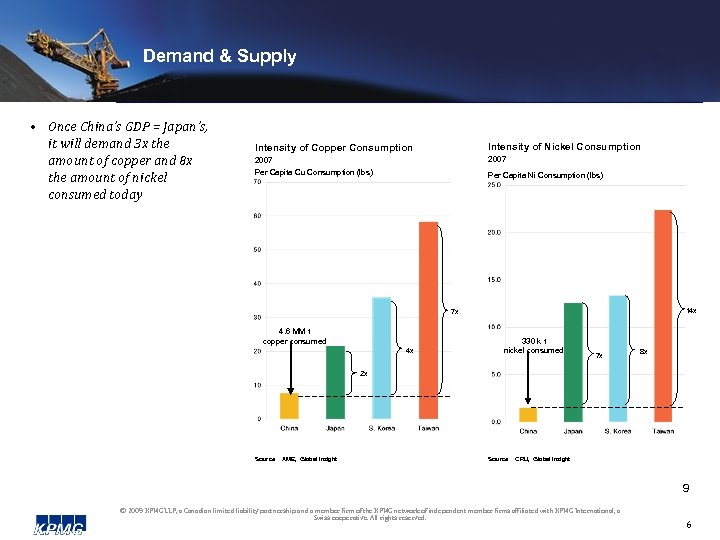
Demand & Supply • Once China’s GDP = Japan’s, it will demand 3 x the amount of copper and 8 x the amount of nickel consumed today Intensity of Copper Consumption Intensity of Nickel Consumption 2007 Per Capita Cu Consumption (lbs) Per Capita Ni Consumption (lbs) 14 x 7 x 4. 6 MM t copper consumed 4 x 330 k t nickel consumed 7 x 8 x 2 x Source AME, Global Insight Source CRU, Global Insight 9 © 2009 KPMG LLP, a Canadian limited liability partnership and a member firm of the KPMG network of independent member firms affiliated with KPMG International, a Swiss cooperative. All rights reserved. 6
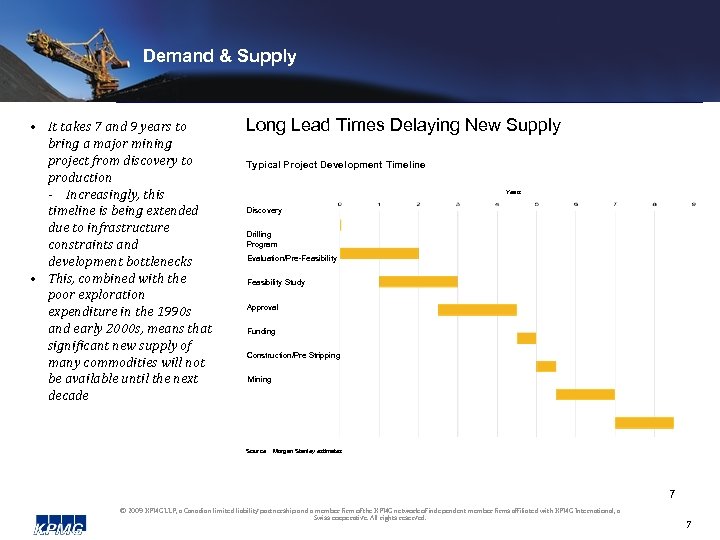
Demand & Supply • It takes 7 and 9 years to bring a major mining project from discovery to production - Increasingly, this timeline is being extended due to infrastructure constraints and development bottlenecks • This, combined with the poor exploration expenditure in the 1990 s and early 2000 s, means that significant new supply of many commodities will not be available until the next decade Long Lead Times Delaying New Supply Typical Project Development Timeline Years Discovery Drilling Program Evaluation/Pre-Feasibility Study Approval Funding Construction/Pre Stripping Mining Source Morgan Stanley estimates 7 © 2009 KPMG LLP, a Canadian limited liability partnership and a member firm of the KPMG network of independent member firms affiliated with KPMG International, a Swiss cooperative. All rights reserved. 7
Cash is king • The strength of a company’s balance sheet can be measured by management’s ability to preserve cash. Some considerations include: • Currency to use for operations – local currency or US dollars • Where is your cash? • Hedging strategies foreign exchange and interest rates • Functional currency determination • Working capital management – collect customer payments quicker, stretch suppliers and minimize inventory • Capital commitments • Minimize commitments, renegotiate contracts and actively defer potential contingent liabilities beyond the short-term • Refinance or reposition parts of the company for sale • Going concern © 2009 KPMG LLP, a Canadian limited liability partnership and a member firm of the KPMG network of independent member firms affiliated with KPMG International, a Swiss cooperative. All rights reserved. 8
Mergers and acquisitions (1) • In the last five years, acquisition strategies focused on: • Large companies becoming larger, more stable through acquisition • Larger companies were more attractive to shareholders and financiers • Larger companies were better able to launch large-scale projects • A new tier of “super major” companies (> $100 billion market cap) was created. • The number of deals surged from 2005 to 2007 and the value escalated for the • • biggest deals (CAD$1 billion plus) from 8 in 2005 to 25 in 2007. Rio Tinto set a new top deal bar with its USD$ 43 billion purchase of Alcan. State-owned mining companies from Brazil (Vale) and China (Jinchuan, Chinalco, China Minmetals) had a significant influence in restructuring the industry. © 2009 KPMG LLP, a Canadian limited liability partnership and a member firm of the KPMG network of independent member firms affiliated with KPMG International, a Swiss cooperative. All rights reserved. 9
Mergers and acquisitions (2) • In the current economic environment there is even more pressure on mergers • • and acquisitions. Gold companies and base metal companies with large projects in production continue to generate cash flow. Middle-tier companies with one or two projects run the risk of being driven into negative cash flow by cost increases. Junior exploration and development companies, with no revenue, may face difficulties accessing equity or debt financing. To avoid bankruptcy, middle-tier and junior exploration and development companies may need to arrange strategic mergers or other arrangements to raise funds and reduce costs. © 2009 KPMG LLP, a Canadian limited liability partnership and a member firm of the KPMG network of independent member firms affiliated with KPMG International, a Swiss cooperative. All rights reserved. 10
Forecasting and scenario planning • Management of cash flows is becoming more important: • the ability to accurately forecast 18 to 24 months into the future • identify funding shortfalls well in advance • build flexibility into the forecasting process through scenario planning • run cash flow forecasts for each site and jurisdiction, be wary of consolidated • • forecasts consider the tax implications of repatriating cash to the home country consider the implications of your corporate structure – the lack of tax treaties between countries and the impact of possible withholding taxes © 2009 KPMG LLP, a Canadian limited liability partnership and a member firm of the KPMG network of independent member firms affiliated with KPMG International, a Swiss cooperative. All rights reserved. 11
Stakeholder discussions • It is increasingly important to keep the various stakeholders informed and limit • • • surprises. Stakeholders include local communities, NGOs, environmental advocates and lenders. Project suspensions can create new issues where good relations with stakeholders can be a benefit to mining companies. Recent example – Hudbay and Lundin. © 2009 KPMG LLP, a Canadian limited liability partnership and a member firm of the KPMG network of independent member firms affiliated with KPMG International, a Swiss cooperative. All rights reserved. 12
Find your dance partner • Sources of funding could come from non-traditional sources such as Russia, • Japan and China. However, companies must assess the risk of new partners to the ownership and management profile. © 2009 KPMG LLP, a Canadian limited liability partnership and a member firm of the KPMG network of independent member firms affiliated with KPMG International, a Swiss cooperative. All rights reserved. 13
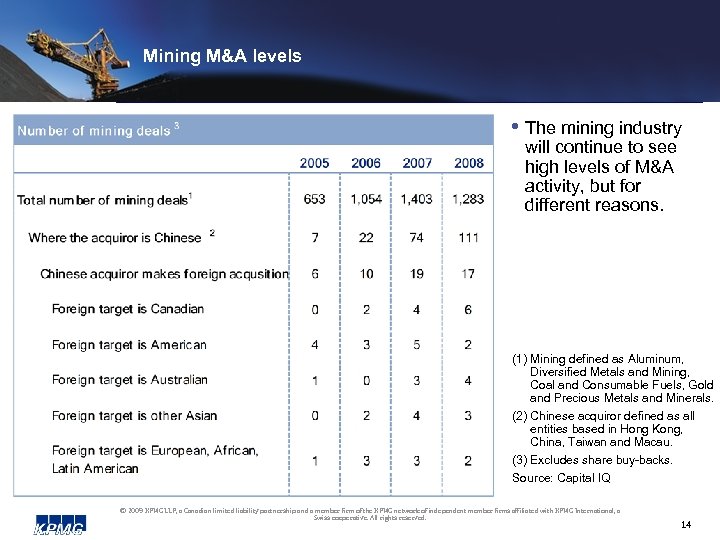
Mining M&A levels • The mining industry will continue to see high levels of M&A activity, but for different reasons. (1) Mining defined as Aluminum, Diversified Metals and Mining, Coal and Consumable Fuels, Gold and Precious Metals and Minerals. (2) Chinese acquiror defined as all entities based in Hong Kong, China, Taiwan and Macau. (3) Excludes share buy-backs. Source: Capital IQ © 2009 KPMG LLP, a Canadian limited liability partnership and a member firm of the KPMG network of independent member firms affiliated with KPMG International, a Swiss cooperative. All rights reserved. 14
Recent deals • Recent deal announcements • Toshiba lead consortium’s $223 million, 20% investment in Uranium One • Chinalco’s $19. 5 billion investment in Rio Tinto • Minmetals $1. 7 billion offer for Oz Minerals • Fortescue Metals in talks with Anglo American and China Investment Corp • about possible financing to develop a new mine and a second port Iamgold’s $140 million acquisition of Orezone (gold deposit in West Africa), which Orezone could not afford to develop on its own. © 2009 KPMG LLP, a Canadian limited liability partnership and a member firm of the KPMG network of independent member firms affiliated with KPMG International, a Swiss cooperative. All rights reserved. 15
Presenters contact details Lee Hodgkinson Jamie Samograd KPMG LLP Partner, Assurance 416 777 8351 lhodgkinson@kpmg. ca www. kpmg. ca Director, Transaction Advisory 416 777 3078 jwsamograd@kpmg. ca www. kpmg. ca © 2009 KPMG LLP, a Canadian limited liability partnership and a member firm of the KPMG network of independent member firms affiliated with KPMG International, a Swiss cooperative. All rights reserved. 16
Скачать презентацию MINING Surviving the Global Financial Crisis in the
ecb52d613a463882a722fbd4d687bca7.ppt