


 Скачать презентацию MINING AND MINERALS SECTOR SKILLS PLAN 1 APRIL
c8777eaea6a6fd4f5e10342824822fdf.ppt
- Количество слайдов: 34
 MINING AND MINERALS SECTOR SKILLS PLAN 1 APRIL 2010 – 31 MARCH 2011
 CONTENTS • Profile of the sector – Profile of employers – Profile of employees • • • Factors influencing change The demand for labour The supply of labour Scarce and critical skills Skills development priorities
 PROFILE OF THE SECTOR
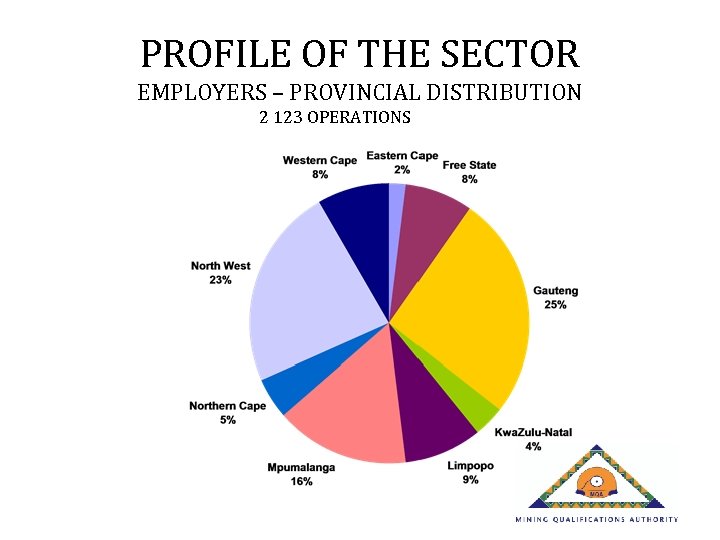 PROFILE OF THE SECTOR EMPLOYERS – PROVINCIAL DISTRIBUTION 2 123 OPERATIONS
 PROFILE OF THE SECTOR EMPLOYERS – SUBSECTOR
 PROFILE OF THE SECTOR EMPLOYEES – SUBSECTOR 556 000 EMPLOYEES
 PROFILE OF THE SECTOR EMPLOYEES – ORGANISATION SIZE 556 000 EMPLOYEES
 PROFILE OF THE SECTOR EMPLOYEES – PROVINCIAL DISTRIBUTION 556 000 EMPLOYEES
 PROFILE OF THE SECTOR EMPLOYEES – POPULATION GROUP 556 000 EMPLOYEES
 PROFILE OF THE SECTOR EMPLOYEES – GENDER 556 000 EMPLOYEES
 ECONOMIC TRENDS CHANGE IN OUTPUT -1994 TO 2008
 FACTORS INFLUENCING CHANGE IN THE SECTOR • Policy and legislation – – • • • Mineral rights and ownership of mining operations Black economic empowerment and employment equity Occupational health and safety Environmental conservation and rehabilitation The availability of mineral resources Commodity markets and the exchange rate Industry structure, work organisation and technology Infrastructure and electricity supply Social factors – – HIV/Aids Occupational diseases and injuries Migrant labour Local community involvement • Changes in the education and skills development environment
 THE DEMAND FOR SKILLS
 CURRENT EMPLOYMENT OCCUPATIONS
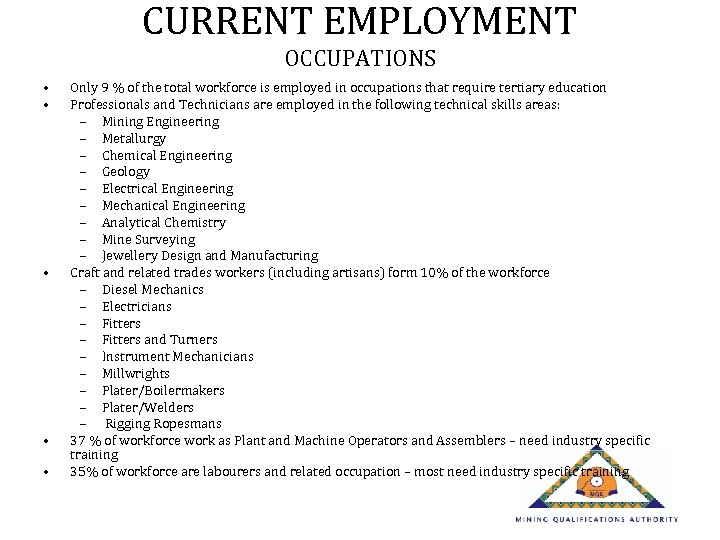 CURRENT EMPLOYMENT OCCUPATIONS • • • Only 9 % of the total workforce is employed in occupations that require tertiary education Professionals and Technicians are employed in the following technical skills areas: – Mining Engineering – Metallurgy – Chemical Engineering – Geology – Electrical Engineering – Mechanical Engineering – Analytical Chemistry – Mine Surveying – Jewellery Design and Manufacturing Craft and related trades workers (including artisans) form 10% of the workforce – Diesel Mechanics – Electricians – Fitters and Turners – Instrument Mechanicians – Millwrights – Plater/Boilermakers – Plater/Welders – Rigging Ropesmans 37 % of workforce work as Plant and Machine Operators and Assemblers – need industry specific training 35% of workforce are labourers and related occupation – most need industry specific training
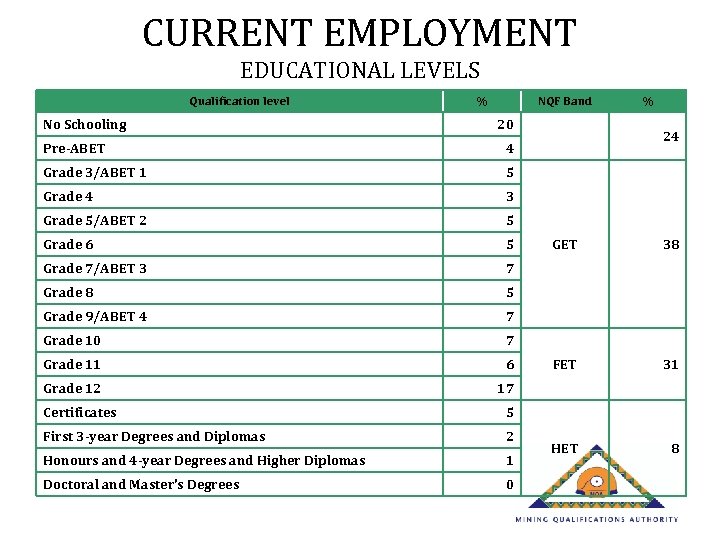 CURRENT EMPLOYMENT EDUCATIONAL LEVELS Qualification level No Schooling % NQF Band 20 Pre-ABET 5 Grade 4 3 Grade 5/ABET 2 5 Grade 6 5 Grade 7/ABET 3 7 Grade 8 5 Grade 9/ABET 4 7 Grade 10 7 Grade 11 6 Grade 12 24 4 Grade 3/ABET 1 % 17 Certificates 2 Honours and 4 -year Degrees and Higher Diplomas 1 Doctoral and Master’s Degrees 0 38 FET 31 HET 8 5 First 3 -year Degrees and Diplomas GET
 EMPLOYMENT TRENDS IN MINING 1980 - 2009
 EMPLOYMENT TRENDS PER SUBSECTOR 1980 - 2009
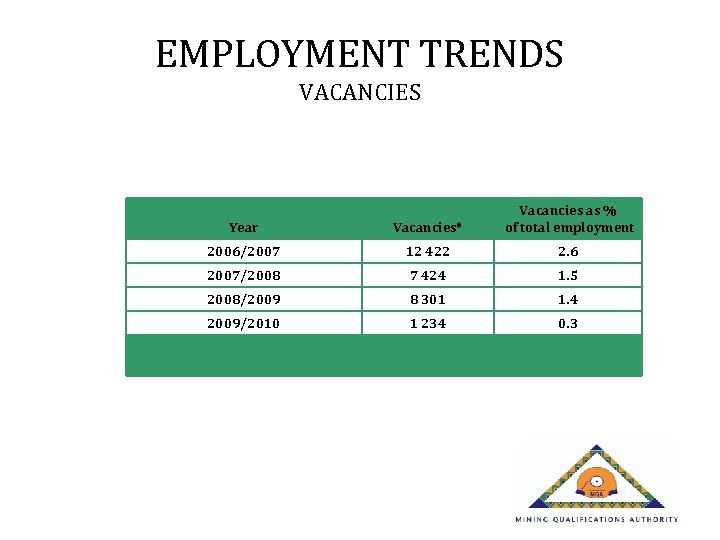 EMPLOYMENT TRENDS VACANCIES Year Vacancies* Vacancies as % of total employment 2006/2007 12 422 2. 6 2007/2008 7 424 1. 5 2008/2009 8 301 1. 4 2009/2010 1 234 0. 3
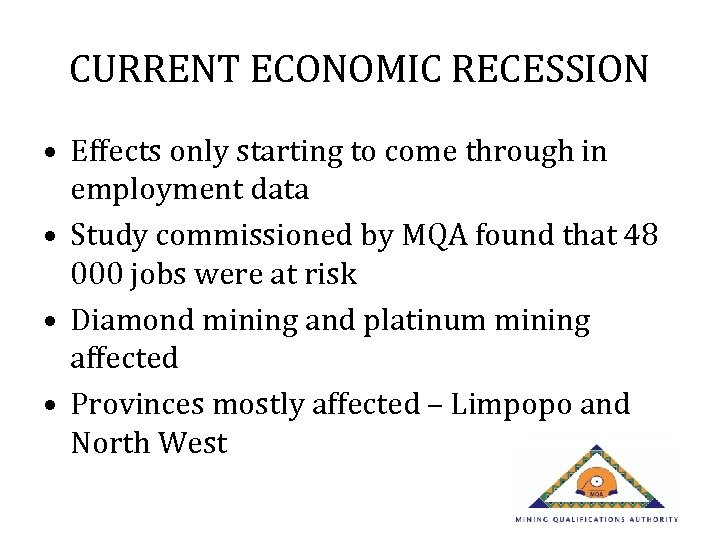 CURRENT ECONOMIC RECESSION • Effects only starting to come through in employment data • Study commissioned by MQA found that 48 000 jobs were at risk • Diamond mining and platinum mining affected • Provinces mostly affected – Limpopo and North West
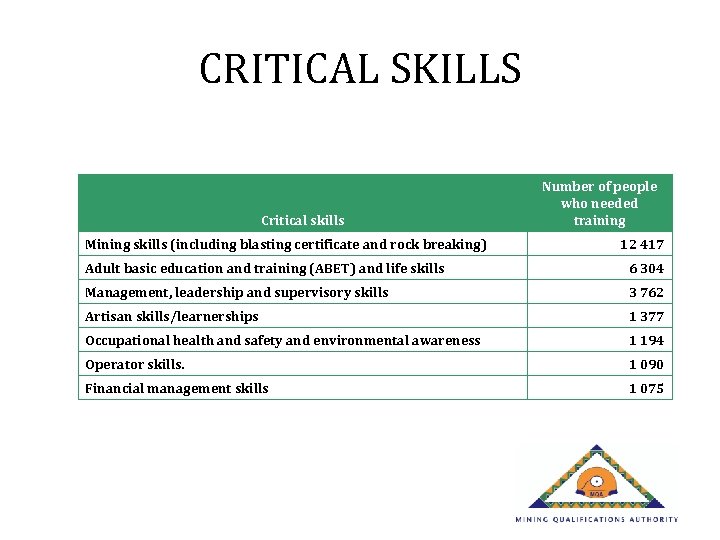 CRITICAL SKILLS Critical skills Mining skills (including blasting certificate and rock breaking) Number of people who needed training 12 417 Adult basic education and training (ABET) and life skills 6 304 Management, leadership and supervisory skills 3 762 Artisan skills/learnerships 1 377 Occupational health and safety and environmental awareness 1 194 Operator skills. 1 090 Financial management skills 1 075
 THE SUPPLY OF SKILLS
 UNEMPLOYED MINE WORKERS
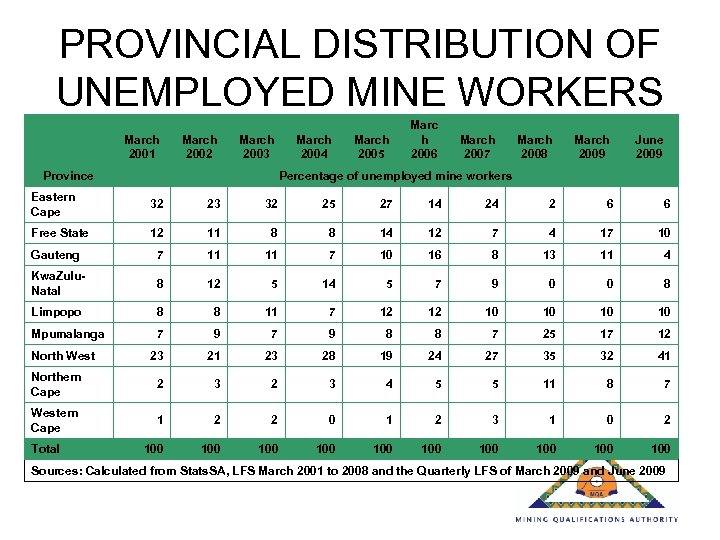 PROVINCIAL DISTRIBUTION OF UNEMPLOYED MINE WORKERS March 2001 March 2002 March 2003 March 2004 March 2005 Marc h 2006 March 2007 March 2008 March 2009 June 2009 Percentage of unemployed mine workers Province Eastern Cape 32 23 32 25 27 14 24 2 6 6 Free State 12 11 8 8 14 12 7 4 17 10 Gauteng 7 11 11 7 10 16 8 13 11 4 Kwa. Zulu. Natal 8 12 5 14 5 7 9 0 0 8 Limpopo 8 8 11 7 12 12 10 10 Mpumalanga 7 9 8 8 7 25 17 12 23 21 23 28 19 24 27 35 32 41 Northern Cape 2 3 4 5 5 11 8 7 Western Cape 1 2 2 0 1 2 3 1 0 2 100 100 100 North West Total Sources: Calculated from Stats. SA, LFS March 2001 to 2008 and the Quarterly LFS of March 2009 and June 2009
 HIGHER EDUCATION ENTRY-LEVEL QUALIFICATIONS AWARDED 1999 - 2006
 HIGHER EDUCATION POPULATION GROUP OF NEW GRADUATES 2006
 HIGHER EDUCATION GENDER OF NEW GRADUATES 2006
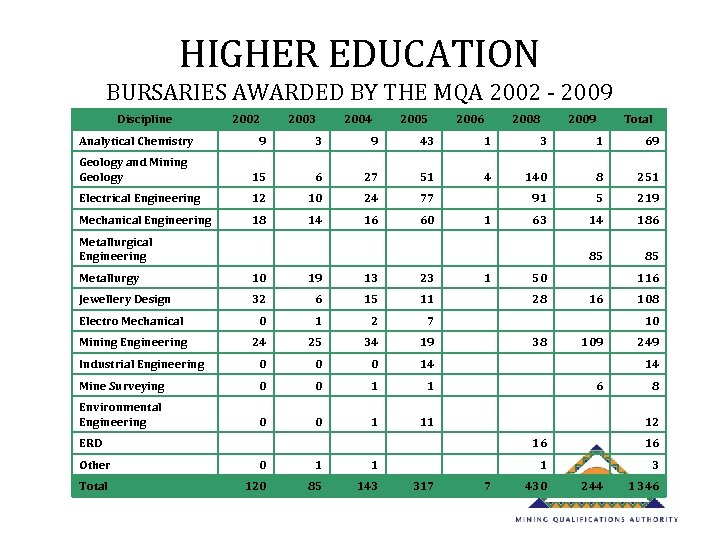 HIGHER EDUCATION BURSARIES AWARDED BY THE MQA 2002 - 2009 Discipline 2002 2003 2004 2005 2006 2008 2009 Total Analytical Chemistry 9 3 9 43 1 69 Geology and Mining Geology 15 6 27 51 4 140 8 251 Electrical Engineering 12 10 24 77 91 5 219 Mechanical Engineering 18 14 16 60 1 63 14 186 85 85 Metallurgy 10 19 13 23 1 50 116 Jewellery Design 32 6 15 11 28 16 108 Electro Mechanical 0 1 2 7 10 Mining Engineering 24 25 34 19 38 109 249 Industrial Engineering 0 0 0 14 Mine Surveying 0 0 1 1 6 8 Environmental Engineering 0 0 1 11 12 16 16 Other 0 1 1 1 3 Total 120 85 143 317 7 430 244 1 346 Metallurgical Engineering ERD
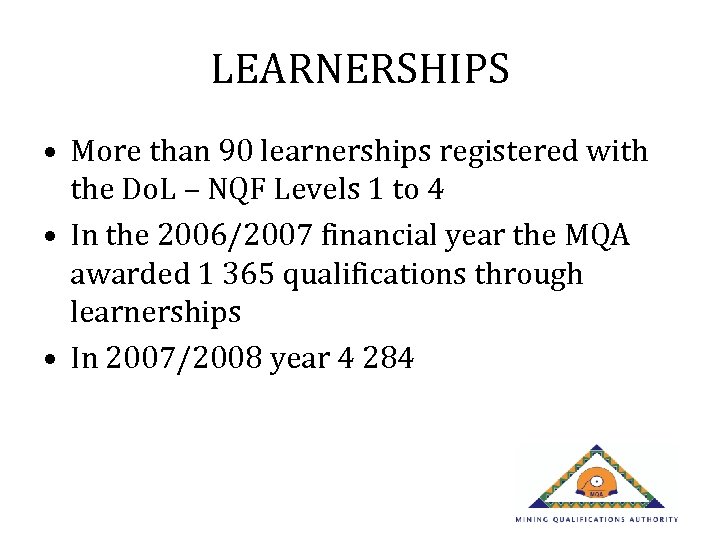 LEARNERSHIPS • More than 90 learnerships registered with the Do. L – NQF Levels 1 to 4 • In the 2006/2007 financial year the MQA awarded 1 365 qualifications through learnerships • In 2007/2008 year 4 284
 SKILLS DEVELOPMENT OF THE EXISTING WORKFORCE • 35 qualifications developed and registered with SAQA • Management and supervisory development – various courses accessed by industry • Skills programmes – MQA has registered 66 skills programmes – In 2006/2007 the MQA awarded 38 196 skills certificates – In 2007/2008 the MQA awarded 41 639 skills certificates • ABET – In 2006/2007 employers reported that more than 14 000 workers had completed ABET programmes (6. 7% of workers with educational qualifications below NQF level 1) • In-service training – Companies spend between 3. 6% and 3. 8% of payroll on training
 SCARCE SKILLS
 VACANCIES DUE TO SCARCITY • Marked decline between 2008/2009 and 2009/2010 – From 8 300 (1. 4% of total employment) to 1 200 (0. 3% of total employment) • Only 26% of scarcity ascribed to “absolute scarcity” while 60% were ascribed to “relative scarcity – Relative: geographical location of jobs – Race or gender preference of employer
 SCARCE SKILLS OCCUPATIONS • • • Professionals (267 vacant positions) – Geologists – Mining Engineers – Mechanical Engineers – Electrical Engineers – Metallurgists – Surveyors Technicians and trade workers (665 vacant positions) – Mining Technicians – Fitters – Electricians – Jewellers – Millwrights – Diesel Motor Mechanics – Fitters and Turners – Precision Instrument Makers and Repairers – Welders Machine Operators and Drivers (227 vacant positions) – Miners – Drillers – Engineering Production Systems Workers – Stone Processing Machine Operators
 OTHER SKILLS DEVELOPMENT PRIORITIES • Mine health and safety • Development of mining communities and communities in labour sending areas • Beneficiation in local areas • Training and development of retrenched employees