 Скачать презентацию Minimizing Green Construction Risk Brendan D Bowles Glaholt
4b5790e93aa51c7eadf4a6f7c221f072.ppt
- Количество слайдов: 26



Minimizing Green Construction Risk Brendan D. Bowles Glaholt LLP
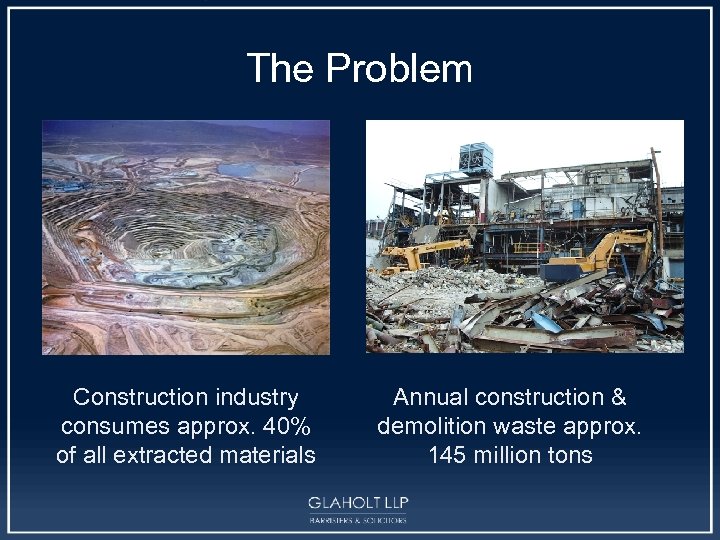
The Problem Construction industry consumes approx. 40% of all extracted materials Annual construction & demolition waste approx. 145 million tons
The Environmental Impact of Buildings 30% of total Canadian secondary energy use 30% of total Canadian greenhouse gas emissions 40% of raw materials use worldwide (= 3 billion tons annually) (Canadian Green Building Council)
Ecological Footprint: The amount of land needed to support a given population. Ø The Dutch need a land area 15 times larger than that of the Netherlands to support their population Ø London, U. K. needs 125 times the land it has Ø If every human being lived a North American lifestyle, it would take up 5 planet Earths Kilbert, Sustainable Construction: Green Building Design and Delivery, 2 nd ed. (Wiley & Sons, Inc. , 2007)
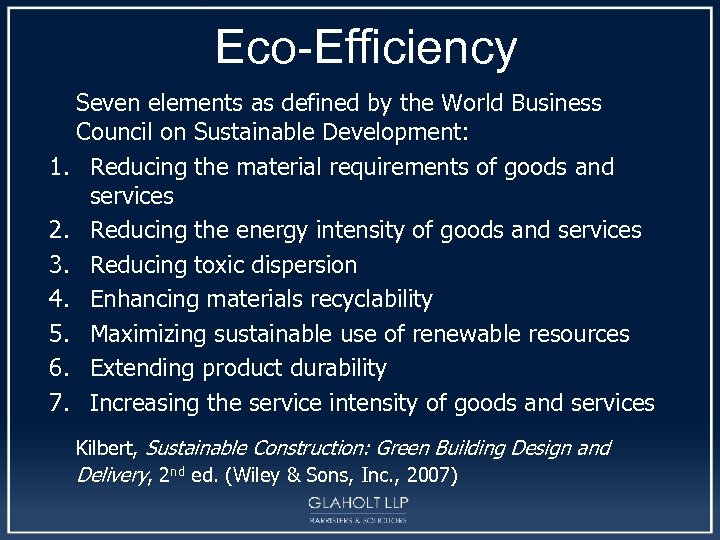
Eco-Efficiency Seven elements as defined by the World Business Council on Sustainable Development: 1. Reducing the material requirements of goods and services 2. Reducing the energy intensity of goods and services 3. Reducing toxic dispersion 4. Enhancing materials recyclability 5. Maximizing sustainable use of renewable resources 6. Extending product durability 7. Increasing the service intensity of goods and services Kilbert, Sustainable Construction: Green Building Design and Delivery, 2 nd ed. (Wiley & Sons, Inc. , 2007)
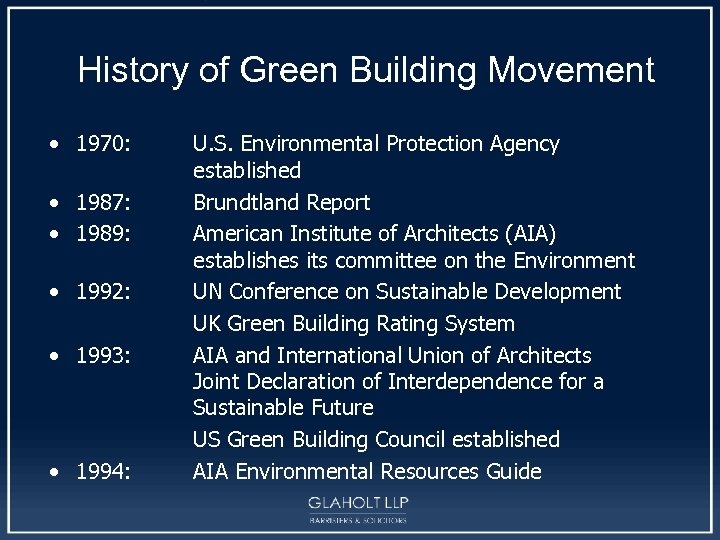
History of Green Building Movement • 1970: • 1987: • 1989: • 1992: • 1993: • 1994: U. S. Environmental Protection Agency established Brundtland Report American Institute of Architects (AIA) establishes its committee on the Environment UN Conference on Sustainable Development UK Green Building Rating System AIA and International Union of Architects Joint Declaration of Interdependence for a Sustainable Future US Green Building Council established AIA Environmental Resources Guide
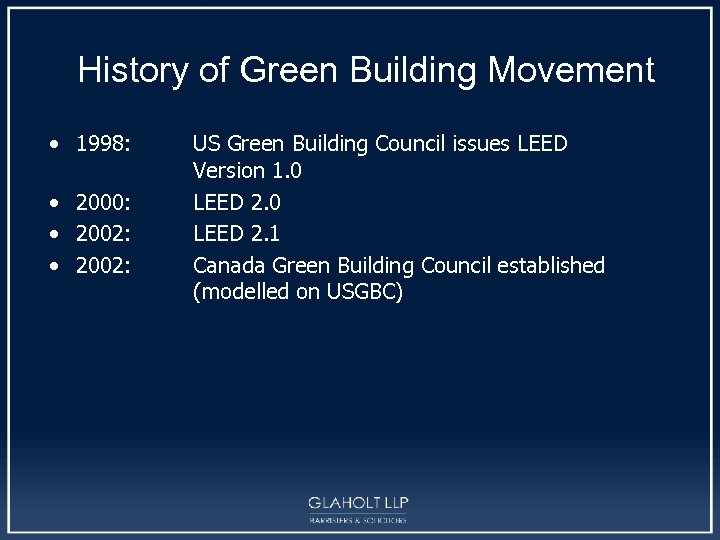
History of Green Building Movement • 1998: • 2000: • 2002: US Green Building Council issues LEED Version 1. 0 LEED 2. 1 Canada Green Building Council established (modelled on USGBC)
What is Green Construction? Some Basic Definitions
Green Construction “Green construction is planning and managing a construction project in accordance with the contract documents in order to minimize the impact of the construction process on the environment. ” Glavinich, Contractor’s Guide to Green Building Construction (Hoboken: Wiley & Sons, Inc. , 2008)
Green Building: “A building that provides the specified building performance requirements while minimizing disturbance to and improving the functioning of local, regional, and global ecosystems both during and after its construction and specified service life. ” American Society of Testing and Materials (ASTM) Standard E 2114 -06 a
Risks in the Green Building Project General principles apply equally to green building projects: • • Risk retention reduction transfer avoidance
Risks in the Green Building Project Increased liabilities: Ø Use of non-standard materials and systems Ø Increased risk of failure of such materials and systems Ø Failure of one integrated specialty can snowball into failure of multiple related specialties Ø Contractual responsibility for achieving LEED certification
Risks in the Green Building Project Reduced risks: Ø Air quality and mould litigation are unlikely, since green buildings tend to have exceptional air quality Ø Green projects are less vulnerable to energy price and water costs increases Ø Green projects tend to be more self-reliant (more natural light, internal water and energy generation) and therefore less vulnerable to power disruptions
Risks in the Green Building Project Reduced risks: Ø Every single step in a green building project must be meticulously documented, for example, to meet LEED requirements Ø Potential for error is reduced, as is the potential for disputes that arise because of insufficient documentation Ø Liability issues are more readily determined
LEED: Leadership in Energy and Environmental Design • LEED is: • A method of measuring • A voluntary rating system used during the building design process to set environmental and human health protection goals • A third-party certification process confirms the project’s achievement of the design goals by reviewing documentation collected during the design and construction process • A certain number of points must be achieved to meet certification standards
LEED: How does it work? • Owner decides that the project will be a green project • Owner registers its intent to have the project certified with the Ca. GBC • Registration gives the design team access to technical guidance by independent LEED experts • LEED scoring system consists of 7 prerequisites and 70 elective credits • Prerequisites have no points associated with them, but must be achieved to earn point in the associated category
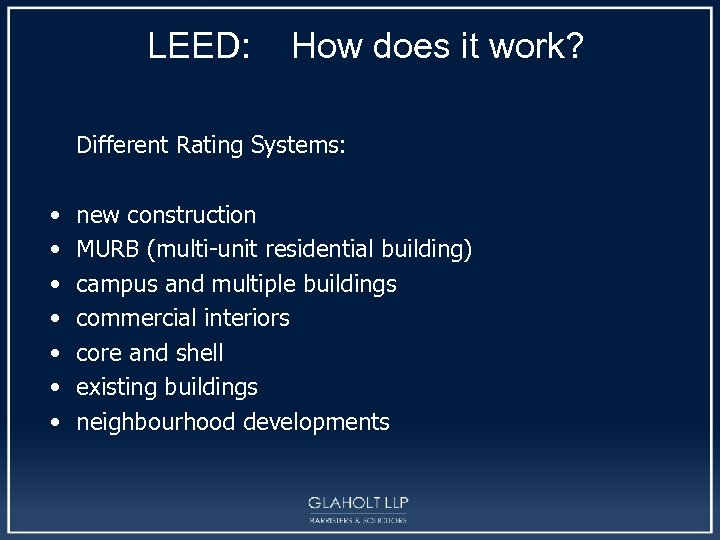
LEED: How does it work? Different Rating Systems: • • new construction MURB (multi-unit residential building) campus and multiple buildings commercial interiors core and shell existing buildings neighbourhood developments
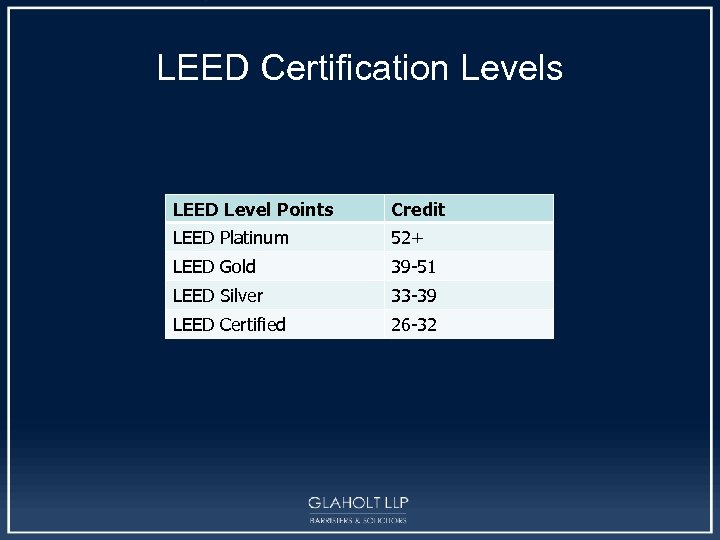
LEED Certification Levels LEED Level Points Credit LEED Platinum 52+ LEED Gold 39 -51 LEED Silver 33 -39 LEED Certified 26 -32
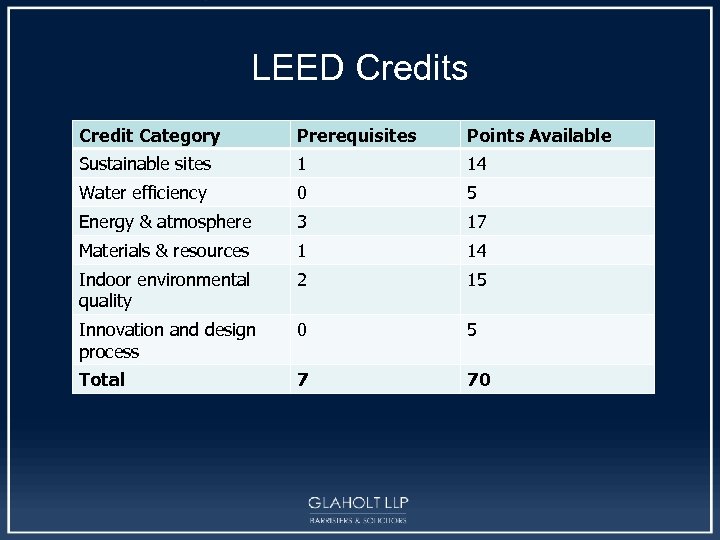
LEED Credits Credit Category Prerequisites Points Available Sustainable sites 1 14 Water efficiency 0 5 Energy & atmosphere 3 17 Materials & resources 1 14 Indoor environmental quality 2 15 Innovation and design process 0 5 Total 7 70
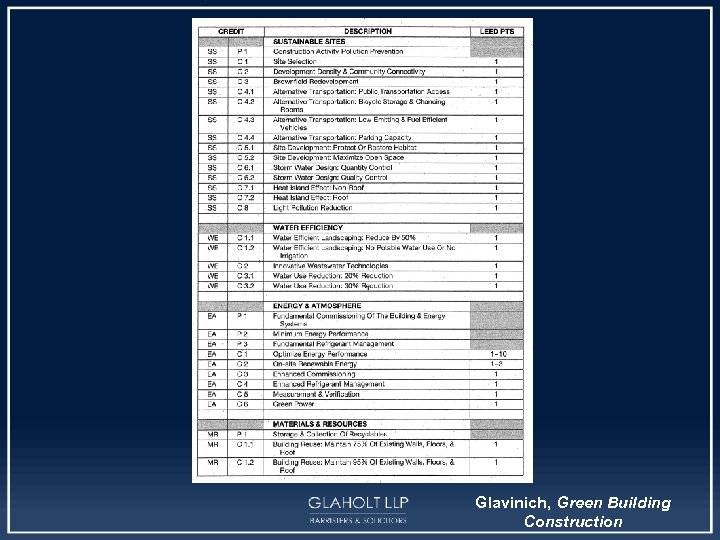
Glavinich, Green Building Construction
Executing the Green Building Project Phases: • • Owner decides on green project Selection of project team Implementation of integrated design process (IDP) Execution of design process – – Schematic Design development Construction documents Documentation of green building measures
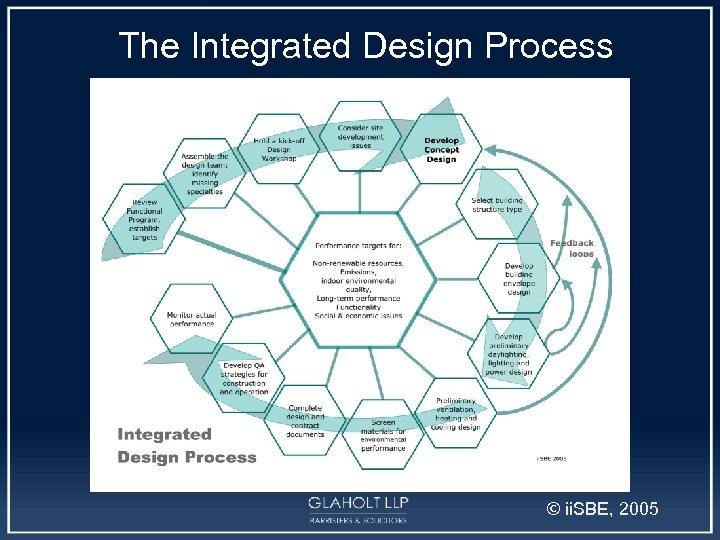
The Integrated Design Process © ii. SBE, 2005
Executing the Green Building Project Phases: • Construction – – – Implementation of green building measures Soil and erosion control Minimizing site disturbance Protection of flora and fauna Minimizing construction waste (recycling) Documentation of green building measures • Final commissioning and handover
Constructing the Green Building Project Material Conservation Strategies: Ø Designing and building to standard material dimensions reduces costs and waste Ø Fabrication of non-standard material dimensions Ø Prefabrication of material assemblies Ø Evaluation of material shipping Glavinich, Contractor’s Guide to Green Building Construction (Hoboken: Wiley & Sons, Inc. , 2008)
Constructing the Green Building Project Site Layout: Ø Setting of construction boundaries Ø Restriction of vehicle and equipment movement Ø Prevention of site erosion Ø Management of storm- and wastewater
Constructing the Green Building Project Ø Construction waste management Ø Material storage and protection Ø Make jobsite environmentally friendly Ø Guidelines for energy-efficient lighting and light pollution Ø Renewable energy to power equipment Ø Selection and operation of equipment Ø Minimize cycle time and idling Ø Efficiency training for operators Ø Alternative fuels
Скачать презентацию Minimizing Green Construction Risk Brendan D Bowles Glaholt
4b5790e93aa51c7eadf4a6f7c221f072.ppt