


 Скачать презентацию Mini-Seminar Dr James Throne Instructor 8 00
8b6902781387b2b52d0791048ec7ba03.ppt
- Количество слайдов: 68
 Mini-Seminar Dr. James Throne, Instructor • 8: 00 -8: 50 - Technology of Sheet Heating • 9: 00 -9: 50 - Constitutive Equations Applied to Sheet Stretching • 10: 00 -10: 50 - Trimming as Mechanical Fracture
 Mini-Seminar Advanced Topics in Thermoforming Part 3: 10: 00 -10: 50 Trimming as Mechanical Fracture
 Let’s begin!
 Mini-Seminar Advanced Topics in Thermoforming • All materials contained herein are the intellectual property of Sherwood Technologies, Inc. , copyright 1999 -2006 • No material may be copied or referred to in any manner without express written consent of the copyright holder • All materials, written or oral, are the opinions of Sherwood Technologies, Inc. , and James L. Throne, Ph. D • Neither Sherwood Technologies, Inc. nor James L. Throne, Ph. D are compensated in any way by companies cited in materials presented herein • Neither Sherwood Technologies, Inc. , nor James L. Throne, Ph. D are to be held responsible for any misuse of these materials that result in injury or damage to persons or property
 Mini-Seminar Advanced Topics in Thermoforming • This mini-seminar requires you to have a working engineering knowledge of heat transfer and stress-strain mechanics • Don’t attend if you can’t handle theory and equations • Each mini-seminar will last 50 minutes, followed by a 10 -minute “bio” break • Please turn off cell phones • Power. Point presentations are available at the end of this seminar for downloading to your memory stick
 Mini-Seminar Advanced Topics in Thermoforming • For those concerned about hearing the plenary speaker at 1100 hours, please be assured that this miniseminar will end promptly at 1050 hours… • And, if for some strange reason, it doesn’t, please feel free to leave… • THERE WILL BE NO FINAL! • You can download all PPTs at the end of this section
 Part 3: Trimming as Mechanical Fracture Outline • • • Fundamentals Fracture mechanics The mechanics of trimming Trimming accuracy Thin-gauge trimming Heavy-gauge trimming
 Part 3: Trimming as Mechanical Fracture What is Trimming? • Trimming is semi-controlled mechanical breaking • The objective is to separate the formed part from the web, skeleton, unformed plastic around it • The methods of trimming are strongly dependent on sheet thickness • Trimming can be manual or robotic, it can take place on the mold surface or in a remote fixture
 Part 3: Trimming as Mechanical Fracture Traditional trimming methods • Manual - knives, serrated for foam • Routers - hand-held, table-mounted fixedposition, multi-axis • Band saws • Circular saws - stationary, hand-held smalldiameter, toothless saws for foam • Abrasive wheels
 Part 3: Trimming as Mechanical Fracture Traditional trimming methods, cont. • Sharp-edged compression blades or dies - steel -rule, ground forged, machined • Linear shear guillotines - one-sided, two-sided • Flames • Lasers • Water jets
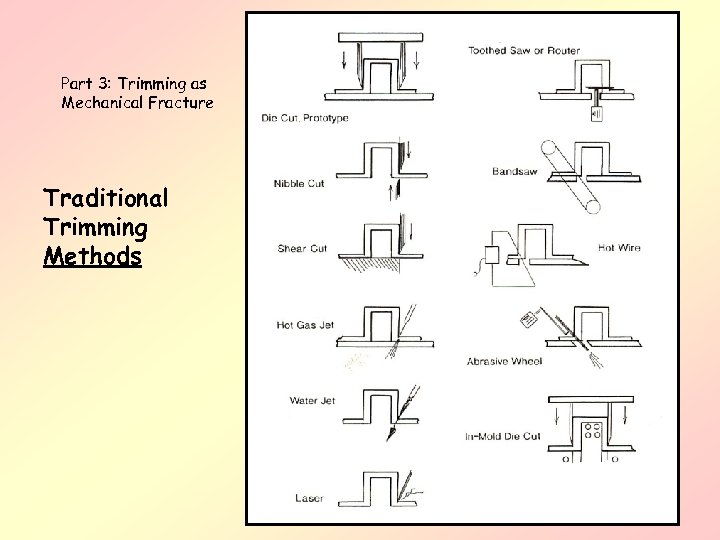 Part 3: Trimming as Mechanical Fracture Traditional Trimming Methods
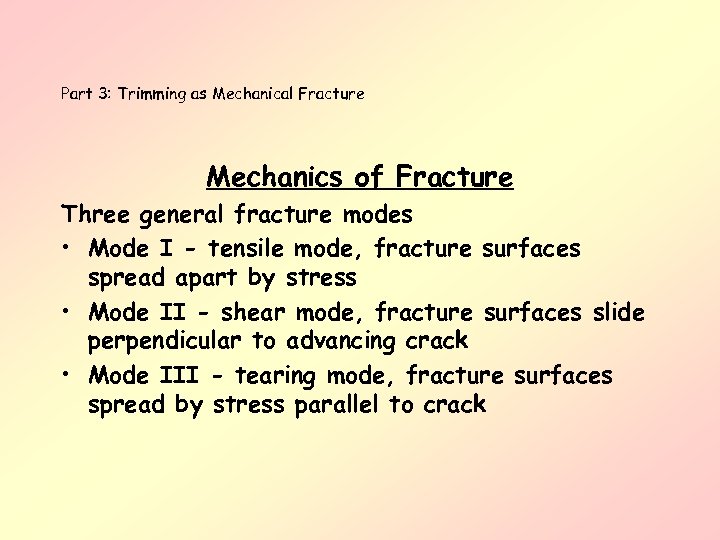 Part 3: Trimming as Mechanical Fracture Mechanics of Fracture Three general fracture modes • Mode I - tensile mode, fracture surfaces spread apart by stress • Mode II - shear mode, fracture surfaces slide perpendicular to advancing crack • Mode III - tearing mode, fracture surfaces spread by stress parallel to crack
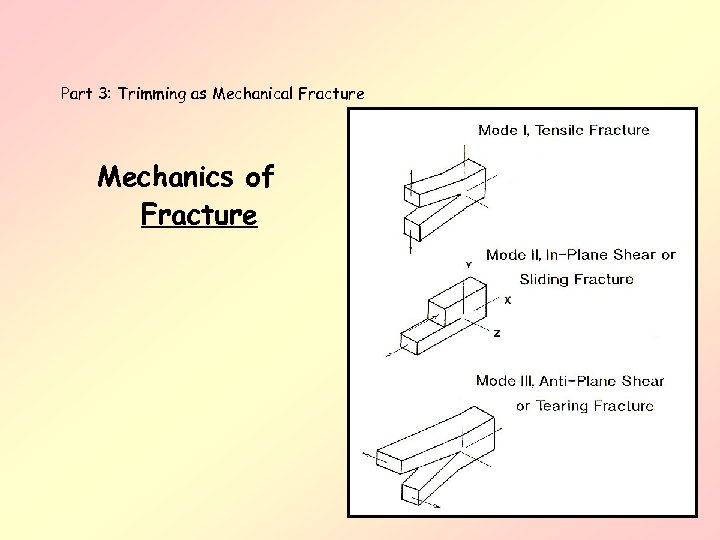 Part 3: Trimming as Mechanical Fracture Mechanics of Fracture
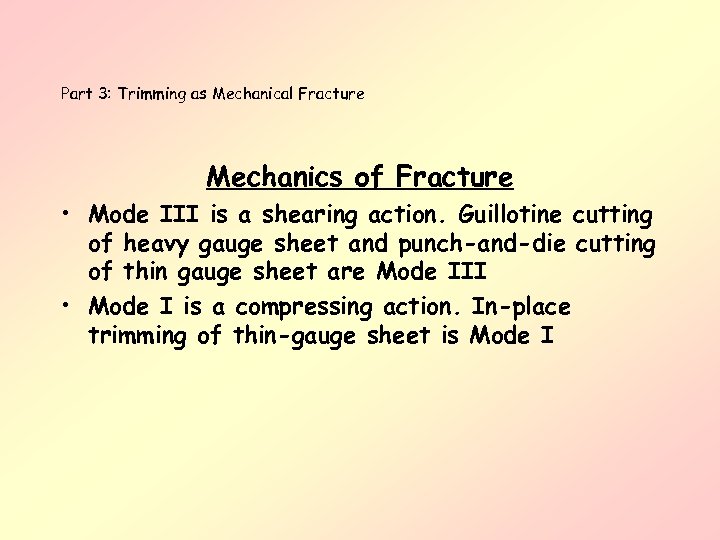 Part 3: Trimming as Mechanical Fracture Mechanics of Fracture • Mode III is a shearing action. Guillotine cutting of heavy gauge sheet and punch-and-die cutting of thin gauge sheet are Mode III • Mode I is a compressing action. In-place trimming of thin-gauge sheet is Mode I
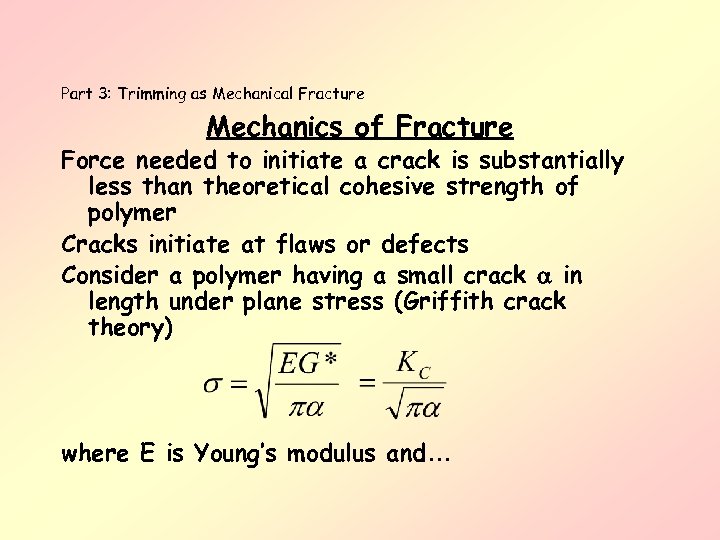 Part 3: Trimming as Mechanical Fracture Mechanics of Fracture Force needed to initiate a crack is substantially less than theoretical cohesive strength of polymer Cracks initiate at flaws or defects Consider a polymer having a small crack a in length under plane stress (Griffith crack theory) where E is Young’s modulus and. . .
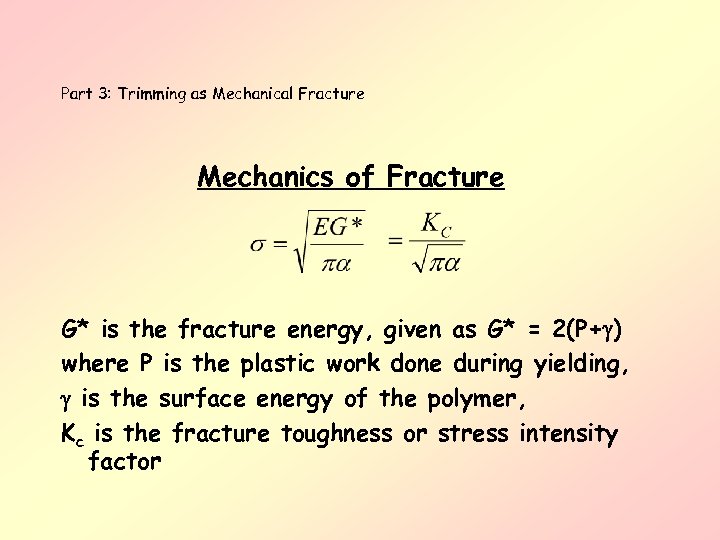 Part 3: Trimming as Mechanical Fracture Mechanics of Fracture G* is the fracture energy, given as G* = 2(P+g) where P is the plastic work done during yielding, g is the surface energy of the polymer, Kc is the fracture toughness or stress intensity factor
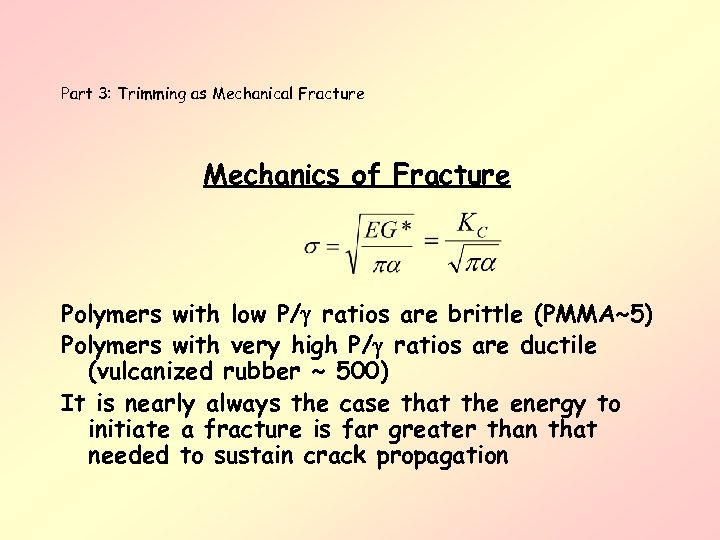 Part 3: Trimming as Mechanical Fracture Mechanics of Fracture Polymers with low P/g ratios are brittle (PMMA~5) Polymers with very high P/g ratios are ductile (vulcanized rubber ~ 500) It is nearly always the case that the energy to initiate a fracture is far greater than that needed to sustain crack propagation
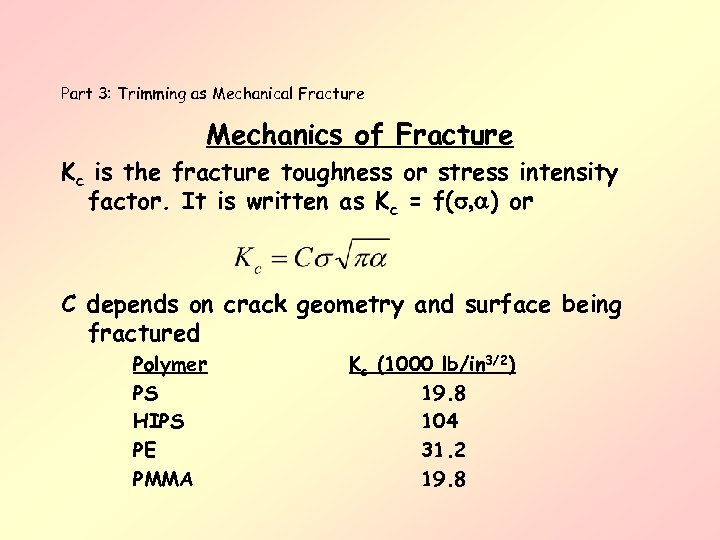 Part 3: Trimming as Mechanical Fracture Mechanics of Fracture Kc is the fracture toughness or stress intensity factor. It is written as Kc = f(s, a) or C depends on crack geometry and surface being fractured Polymer PS HIPS PE PMMA Kc (1000 lb/in 3/2) 19. 8 104 31. 2 19. 8
 Part 3: Trimming as Mechanical Fracture Mechanics of Fracture • • An aside Nanoparticles have initial sizes substantially below the Griffith crack criterion As a result, theoretically, fracture is unlikely to initiate on a nanoparticle Meaning that, theoretically, nano-filled polymers should have impact strengths equal to those of the polymers themselves The functional word here is “theoretically”
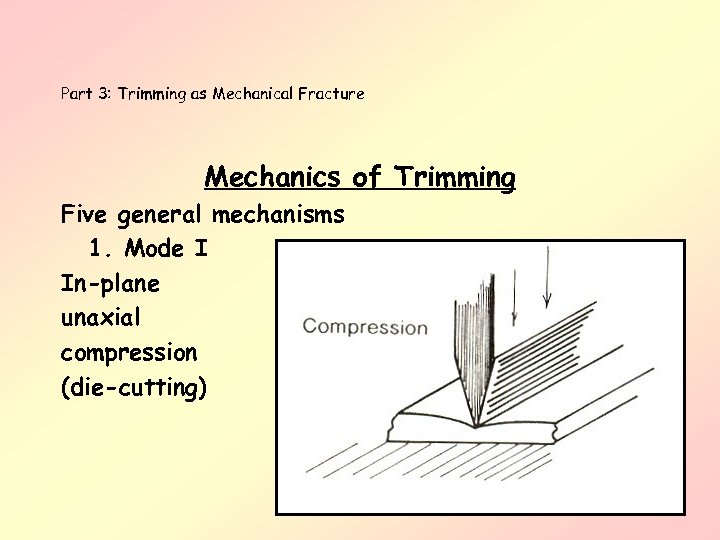 Part 3: Trimming as Mechanical Fracture Mechanics of Trimming Five general mechanisms 1. Mode I In-plane unaxial compression (die-cutting)
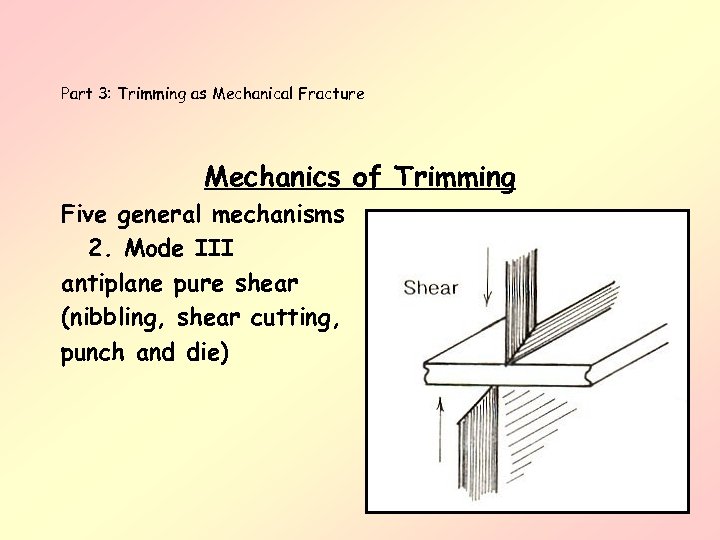 Part 3: Trimming as Mechanical Fracture Mechanics of Trimming Five general mechanisms 2. Mode III antiplane pure shear (nibbling, shear cutting, punch and die)
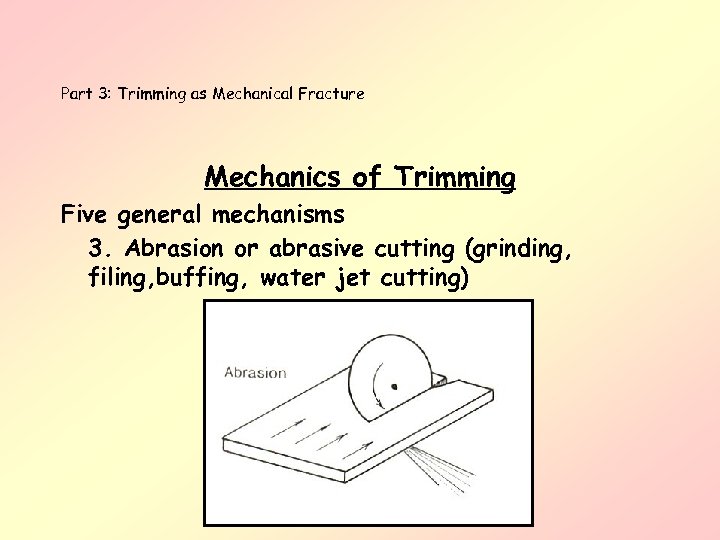 Part 3: Trimming as Mechanical Fracture Mechanics of Trimming Five general mechanisms 3. Abrasion or abrasive cutting (grinding, filing, buffing, water jet cutting)
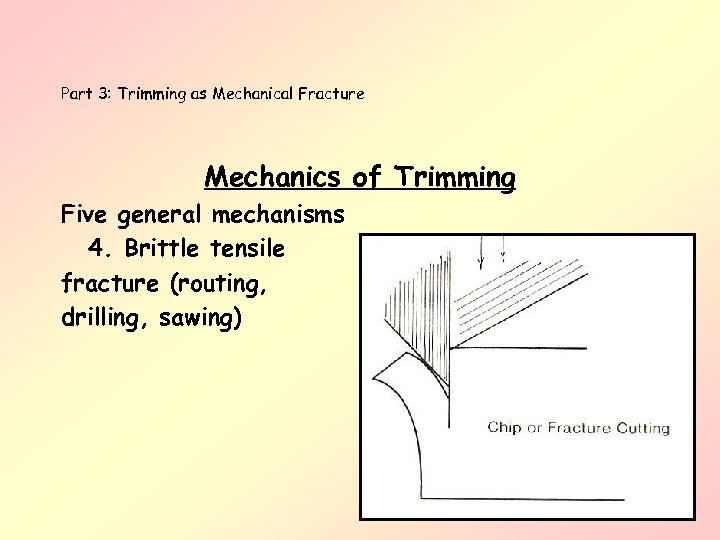 Part 3: Trimming as Mechanical Fracture Mechanics of Trimming Five general mechanisms 4. Brittle tensile fracture (routing, drilling, sawing)
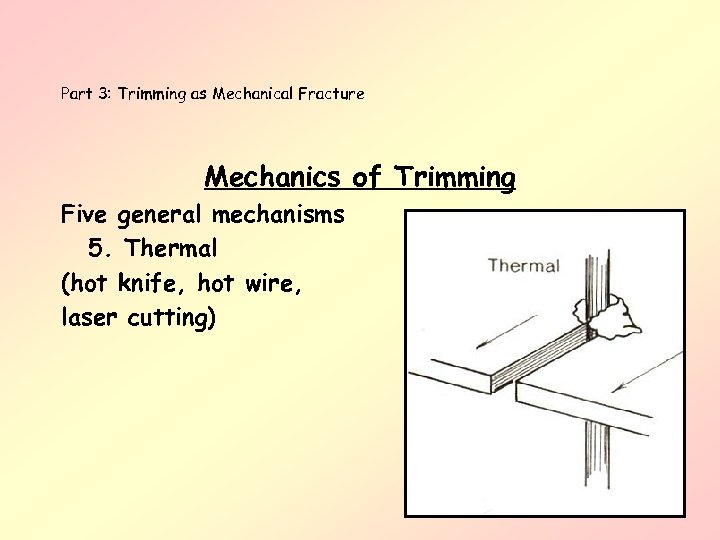 Part 3: Trimming as Mechanical Fracture Mechanics of Trimming Five general mechanisms 5. Thermal (hot knife, hot wire, laser cutting)
 Part 3: Trimming as Mechanical Fracture Trim Tolerance Limitation • Local polymer shrinkage • Polymer morphology • Time-dependent part shrinkage after trimming • Ductility of polymer • Fixture/part rigidity • Part temperature variation at trim line • Registry accuracy
 Part 3: Trimming as Mechanical Fracture Trim Tolerance Limitation, cont. • • Trim die temperature variation Part thickness, thickness variation Allowable wall thickness variation at trim line Die gap setting temperature v. trim die temperature • Clamp frame stiffness • Die flexing during trimming
 Part 3: Trimming as Mechanical Fracture Factors in Selecting a Trimming Technique • • Sheet gauge Part size Number of parts Overall draw ratio Nonplanar nature of trim line Cut surface roughness tolerance Dimensional tolerance
 Part 3: Trimming as Mechanical Fracture Factors in Selecting a Trimming Technique, continued • • • Required speed of trimming Extent of fixturing Number of secondary operations [drilling, machining] • Skill of operator/pressman • Availability of desired trim equipment • Availability of resharpening methods
 Part 3: Trimming as Mechanical Fracture The mechanics of trimming depends on the sheet gauge • • Thin-gauge trimming Heavy-gauge trimming
 Part 3: Trimming as Mechanical Fracture Thin Gauge Steel rule die cutting 1. In place, on the mold, in-situ 2. In machine, separate station 3. In line, separate machine
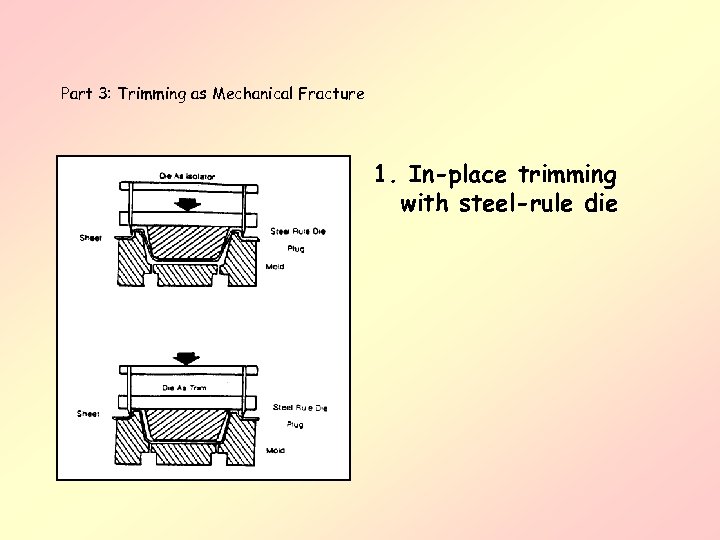 Part 3: Trimming as Mechanical Fracture 1. In-place trimming with steel-rule die
![Part 3: Trimming as Mechanical Fracture Thermoforming – 1. Form and inplace trimming [GN]](https://present5.com/presentation/8b6902781387b2b52d0791048ec7ba03/image-32.jpg "Part 3: Trimming as Mechanical Fracture Thermoforming – 1. Form and inplace trimming [GN]") Part 3: Trimming as Mechanical Fracture Thermoforming – 1. Form and inplace trimming [GN]
Part 3: Trimming as Mechanical Fracture Thermoforming – 1. Form and inplace trimming [GN]
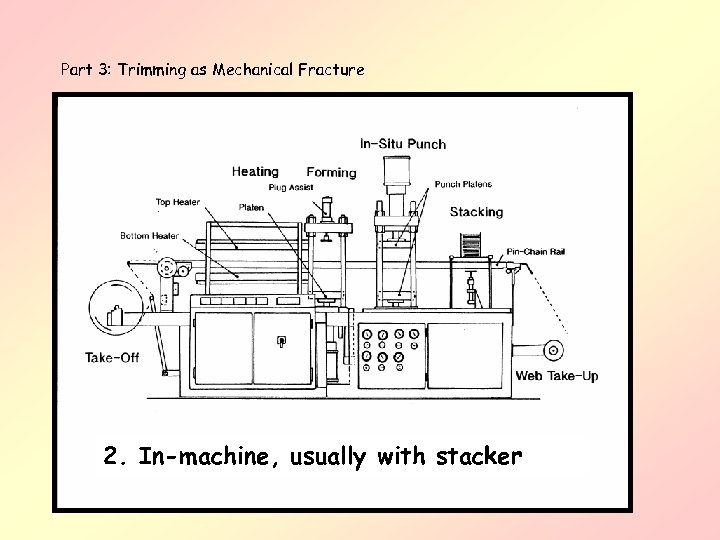 Part 3: Trimming as Mechanical Fracture 2. In-machine, usually with stacker
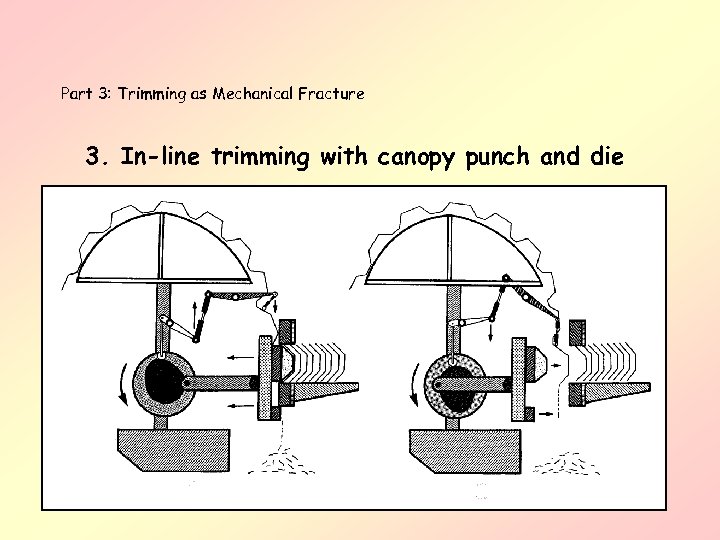 Part 3: Trimming as Mechanical Fracture 3. In-line trimming with canopy punch and die
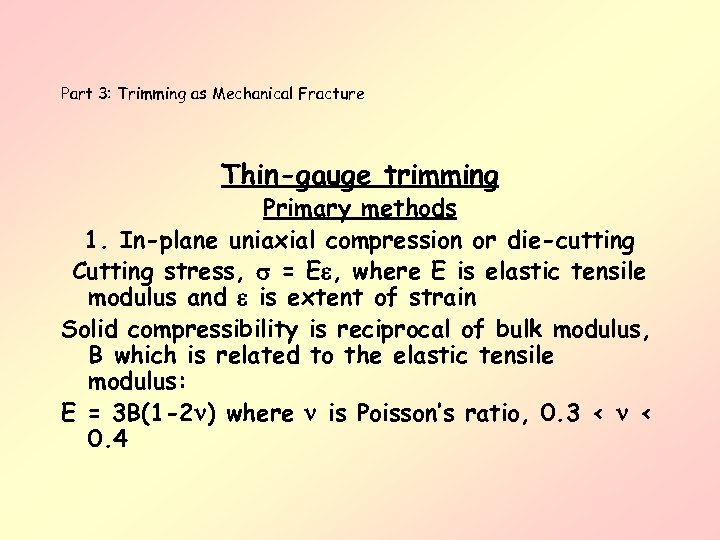 Part 3: Trimming as Mechanical Fracture Thin-gauge trimming Primary methods 1. In-plane uniaxial compression or die-cutting Cutting stress, s = Ee, where E is elastic tensile modulus and e is extent of strain Solid compressibility is reciprocal of bulk modulus, B which is related to the elastic tensile modulus: E = 3 B(1 -2 n) where n is Poisson’s ratio, 0. 3 < n < 0. 4
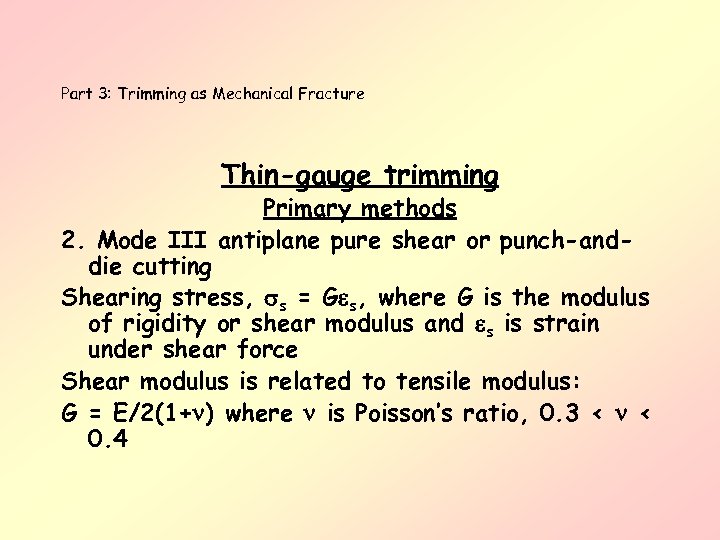 Part 3: Trimming as Mechanical Fracture Thin-gauge trimming Primary methods 2. Mode III antiplane pure shear or punch-anddie cutting Shearing stress, ss = Ges, where G is the modulus of rigidity or shear modulus and es is strain under shear force Shear modulus is related to tensile modulus: G = E/2(1+n) where n is Poisson’s ratio, 0. 3 < n < 0. 4
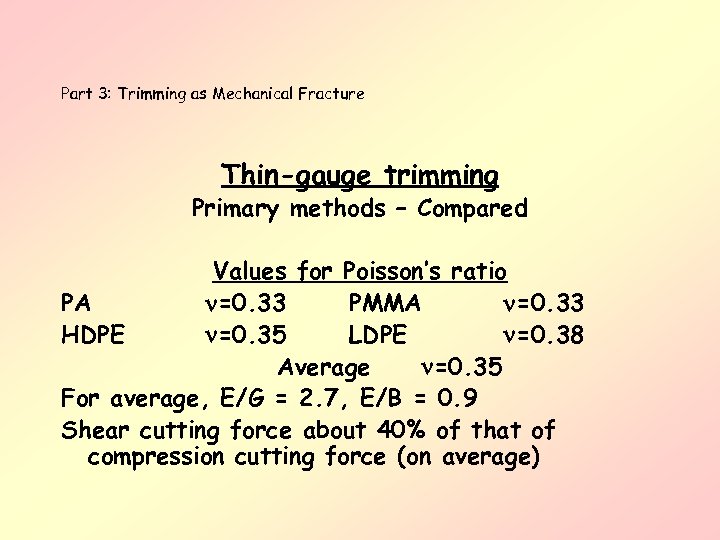 Part 3: Trimming as Mechanical Fracture Thin-gauge trimming Primary methods – Compared Values for Poisson’s ratio PA n=0. 33 PMMA n=0. 33 HDPE n=0. 35 LDPE n=0. 38 Average n=0. 35 For average, E/G = 2. 7, E/B = 0. 9 Shear cutting force about 40% of that of compression cutting force (on average)
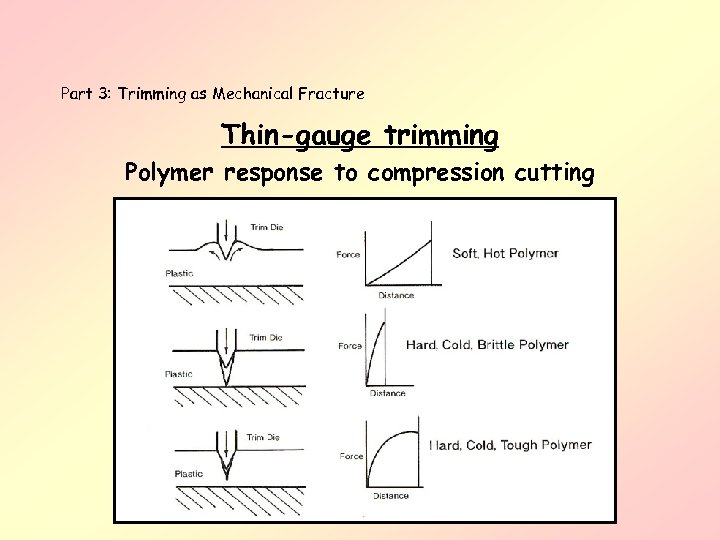 Part 3: Trimming as Mechanical Fracture Thin-gauge trimming Polymer response to compression cutting
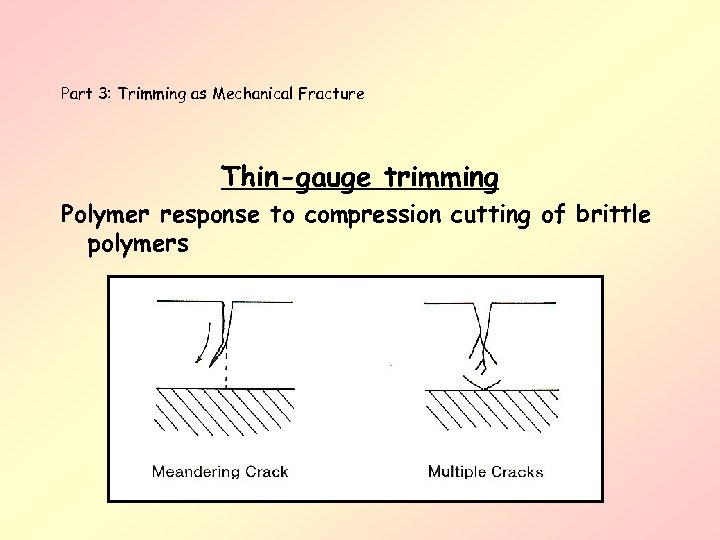 Part 3: Trimming as Mechanical Fracture Thin-gauge trimming Polymer response to compression cutting of brittle polymers
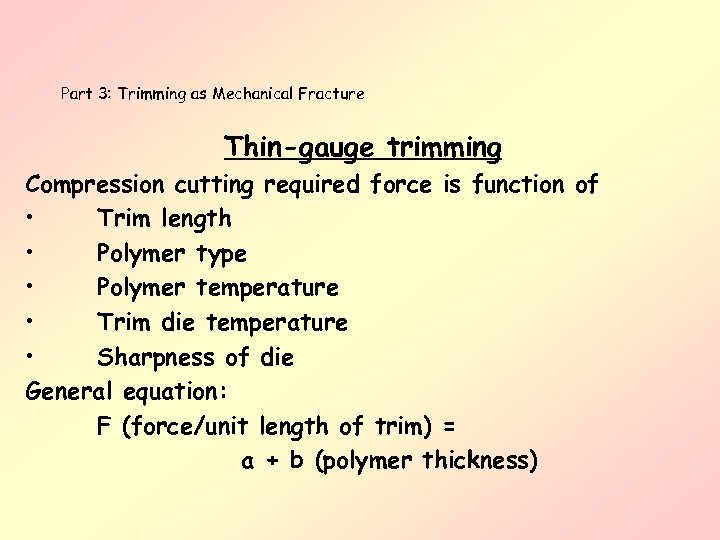 Part 3: Trimming as Mechanical Fracture Thin-gauge trimming Compression cutting required force is function of • Trim length • Polymer type • Polymer temperature • Trim die temperature • Sharpness of die General equation: F (force/unit length of trim) = a + b (polymer thickness)
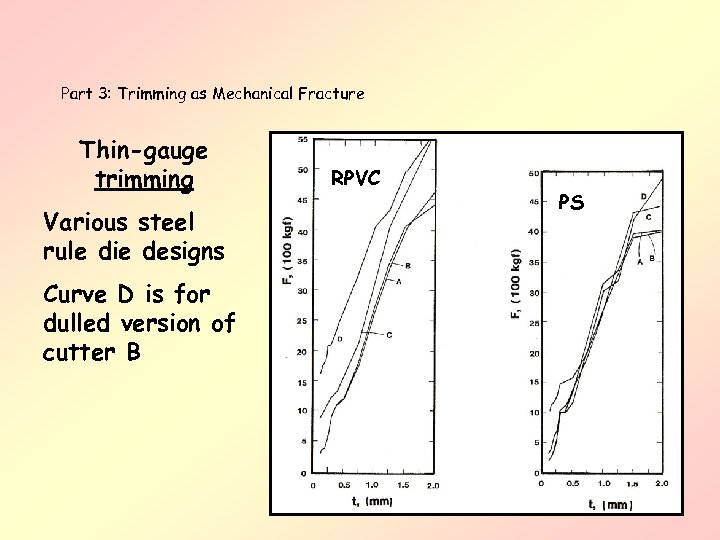 Part 3: Trimming as Mechanical Fracture Thin-gauge trimming Various steel rule die designs Curve D is for dulled version of cutter B RPVC PS
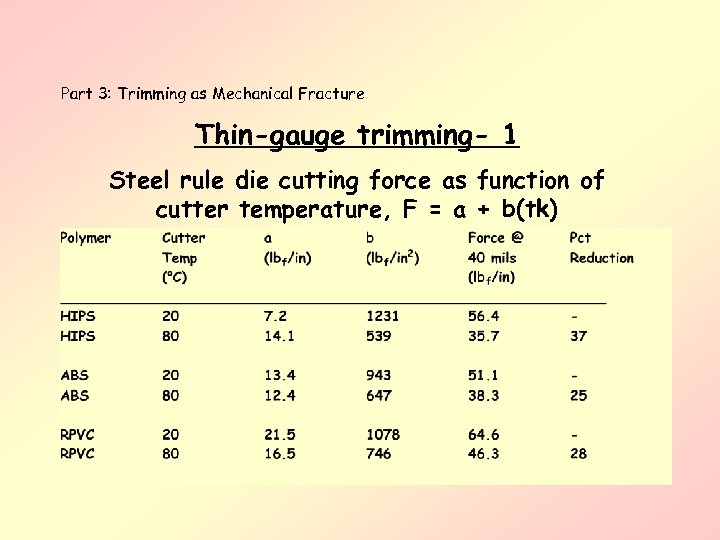 Part 3: Trimming as Mechanical Fracture Thin-gauge trimming- 1 Steel rule die cutting force as function of cutter temperature, F = a + b(tk)
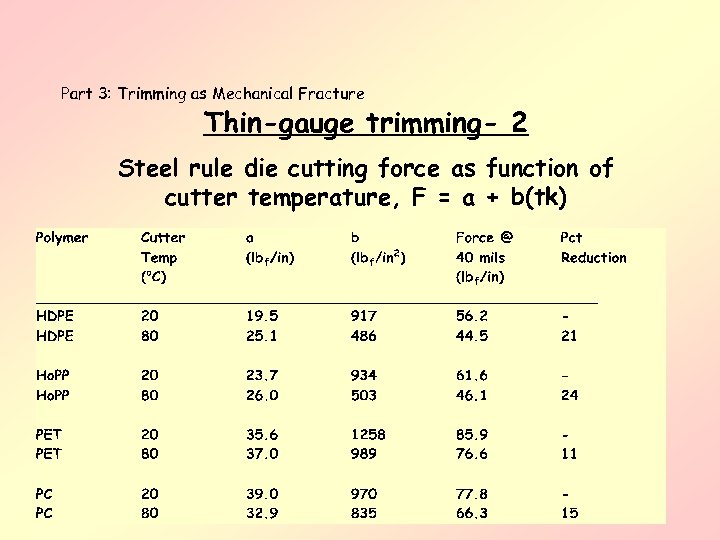 Part 3: Trimming as Mechanical Fracture Thin-gauge trimming- 2 Steel rule die cutting force as function of cutter temperature, F = a + b(tk)
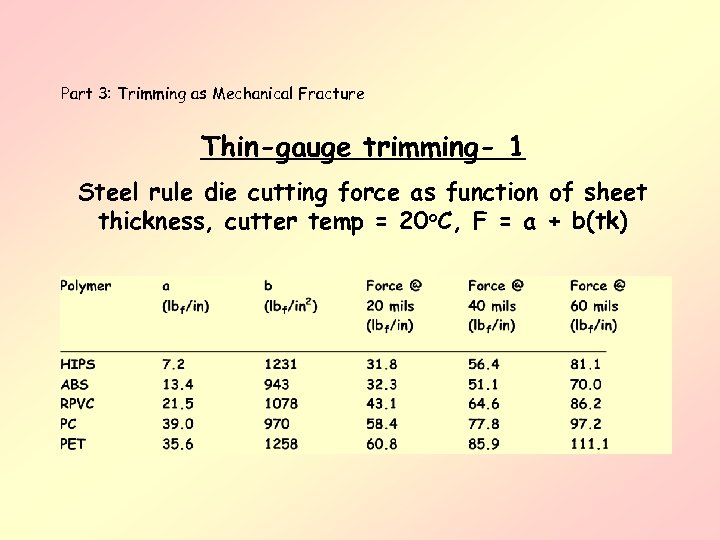 Part 3: Trimming as Mechanical Fracture Thin-gauge trimming- 1 Steel rule die cutting force as function of sheet thickness, cutter temp = 20 o. C, F = a + b(tk)
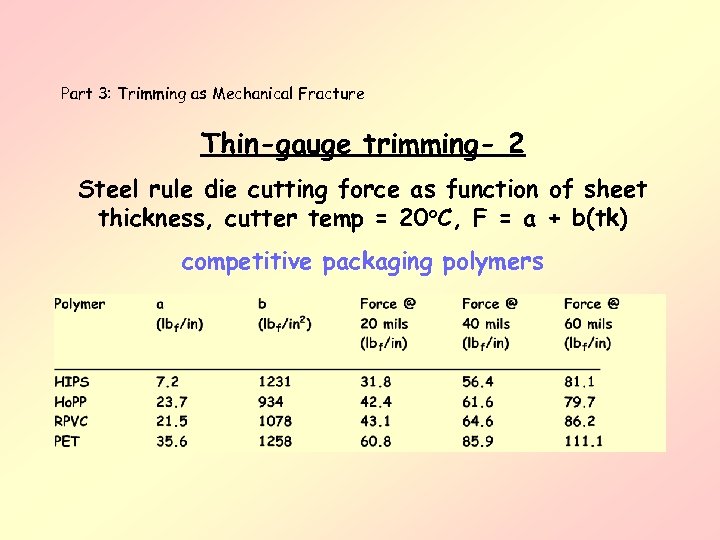 Part 3: Trimming as Mechanical Fracture Thin-gauge trimming- 2 Steel rule die cutting force as function of sheet thickness, cutter temp = 20 o. C, F = a + b(tk) competitive packaging polymers
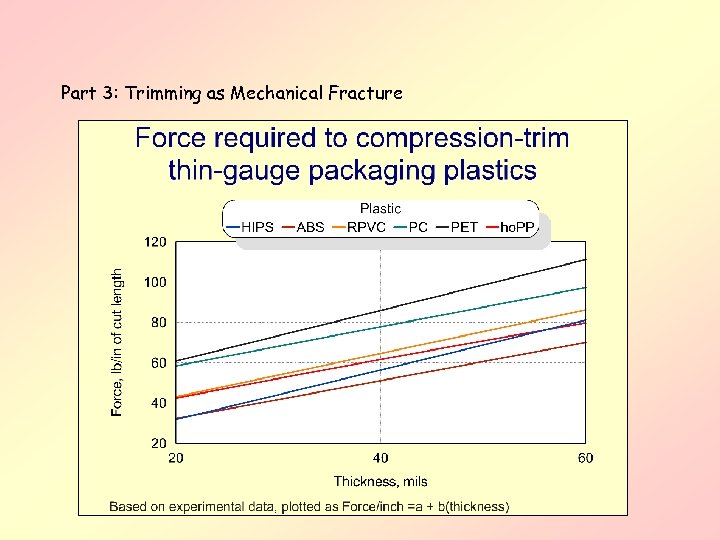 Part 3: Trimming as Mechanical Fracture
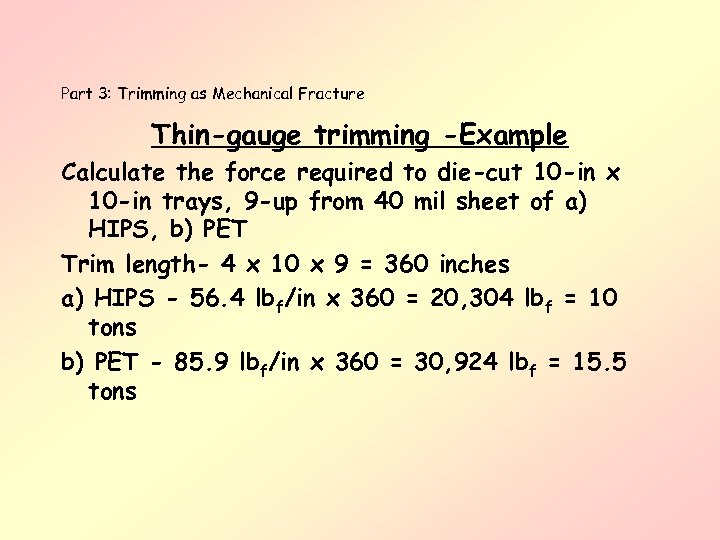 Part 3: Trimming as Mechanical Fracture Thin-gauge trimming -Example Calculate the force required to die-cut 10 -in x 10 -in trays, 9 -up from 40 mil sheet of a) HIPS, b) PET Trim length- 4 x 10 x 9 = 360 inches a) HIPS - 56. 4 lbf/in x 360 = 20, 304 lbf = 10 tons b) PET - 85. 9 lbf/in x 360 = 30, 924 lbf = 15. 5 tons
 Part 3: Trimming as Mechanical Fracture Heavy-gauge trimming • Hand-trimming using saws, routers • Automated, programmable multiaxial routers that include saws, drills
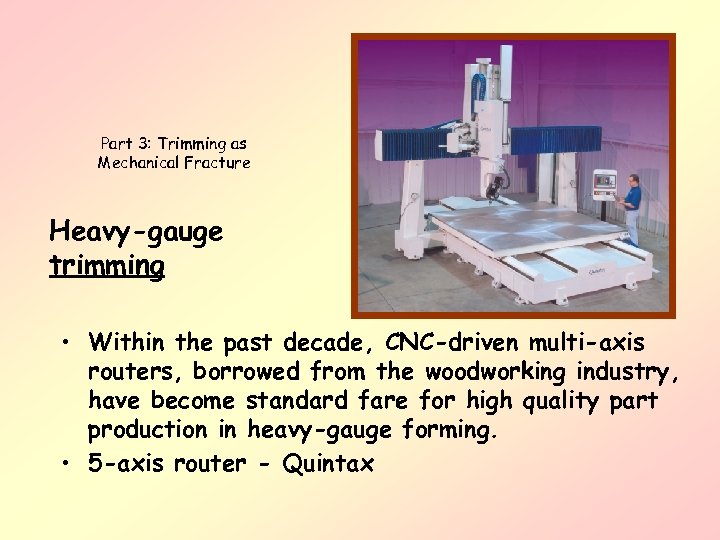 Part 3: Trimming as Mechanical Fracture Heavy-gauge trimming • Within the past decade, CNC-driven multi-axis routers, borrowed from the woodworking industry, have become standard fare for high quality part production in heavy-gauge forming. • 5 -axis router - Quintax
 Part 3: Trimming as Mechanical Fracture Heavy-gauge trimming • “Three-Dimensional Trimming & Machining - The Five Axis CNC Router”, K. J. Susnajara, Thermwood Corporation, 1999 • Contents – – – – Machine Basics CNC Router Design Holding the Part Tooling Programming Accuracy Economics
 Part 3: Trimming as Mechanical Fracture Accuracy Heavy-gauge trimming • First Layer – Single v. multiple axis repeatability – Absolute positioning accuracy - Single v. multiple axis – Loaded v. unloaded repeatability, accuracy – Machine considerations • Lead screw backlash • Rotary resolution of servomotor • Encoder resolution and stepping interval • Rail linearity • Machine alignment [square and perpendicular]
 Part 3: Trimming as Mechanical Fracture Accuracy Heavy-gauge trimming • First Layer – Machine Design • Lead screw backlash • Rotary resolution of servomotor • Encoder resolution and stepping interval • Rail linearity • Machine alignment [square and perpendicular] • Head alignment - effect of crashes • Head worm spur gear tooth accuracy, backlash
 Part 3: Trimming as Mechanical Fracture Accuracy Heavy-gauge trimming • Second Layer – Servo System Tracking – Inertia during acceleration, deceleration – Vibration, push-off, flexing – Speed – Tool length accuracy – Tool-to-collet tightening – CAD/CAM interpretation of curves [splines] – Trimming of part v. computer trim path
 Part 3: Trimming as Mechanical Fracture Accuracy Heavy-gauge trimming • Third Layer – Overall part size variability • Molding temperature • Raw material formulation • Cooling characteristics – Polymer flexing under trim load – Bridge flexing during carriage movement – Dynamic flexing and bending v. speed – Polymer reaction to push-off – Bending, flexing of tool under load
 Part 3: Trimming as Mechanical Fracture Accuracy Heavy-gauge trimming • Third Layer – Thermal exansion, contraction • Different materials in router • Polymers being trimmed • Tool dimensional change during trimming – Polymer warping, distortion during trimming – Trim direction v. “grain” in polymer
 Part 3: Trimming as Mechanical Fracture Accuracy Heavy-gauge trimming • Conclusion - Repeating an accurate position in space is far easier than achieving that accurate position in space.
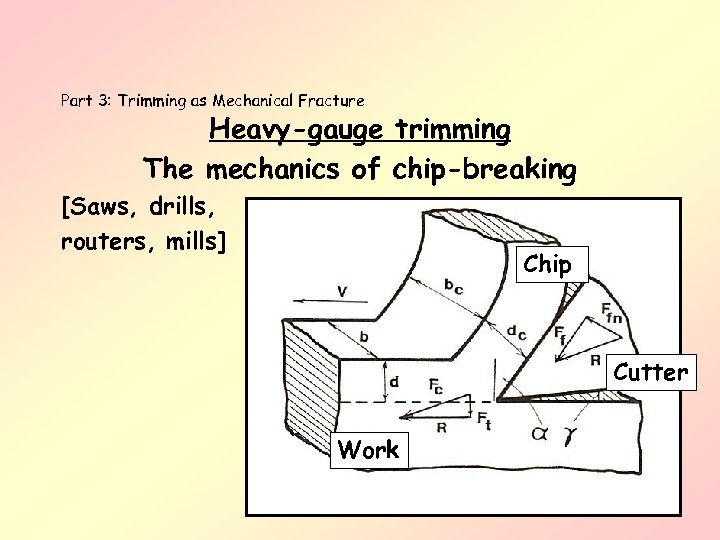 Part 3: Trimming as Mechanical Fracture Heavy-gauge trimming The mechanics of chip-breaking [Saws, drills, routers, mills] Chip Cutter Work
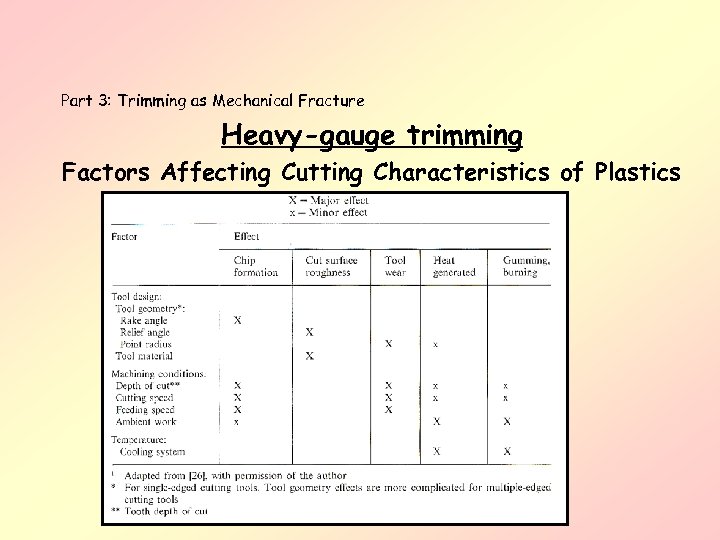 Part 3: Trimming as Mechanical Fracture Heavy-gauge trimming Factors Affecting Cutting Characteristics of Plastics
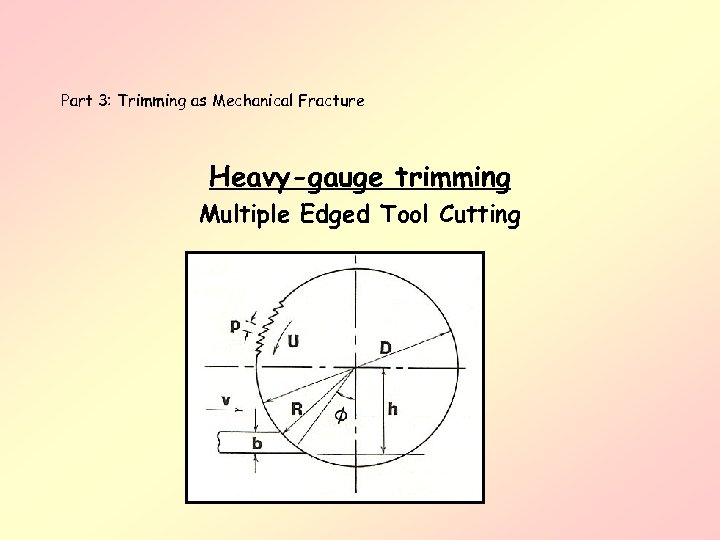 Part 3: Trimming as Mechanical Fracture Heavy-gauge trimming Multiple Edged Tool Cutting
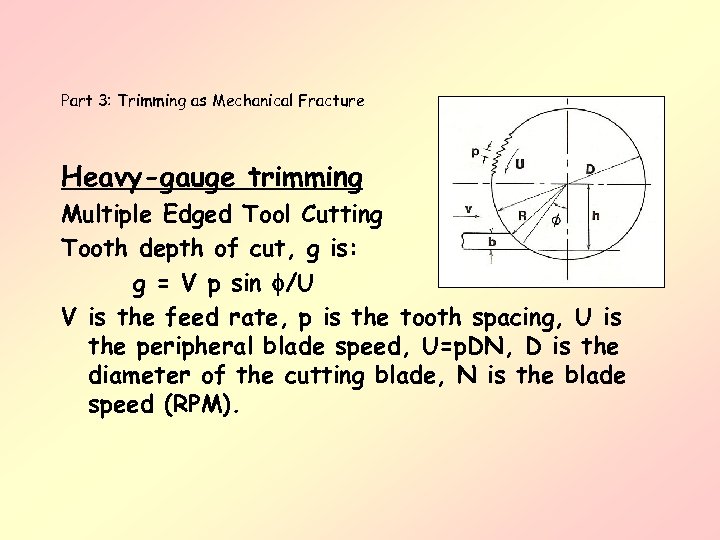 Part 3: Trimming as Mechanical Fracture Heavy-gauge trimming Multiple Edged Tool Cutting Tooth depth of cut, g is: g = V p sin f/U V is the feed rate, p is the tooth spacing, U is the peripheral blade speed, U=p. DN, D is the diameter of the cutting blade, N is the blade speed (RPM).
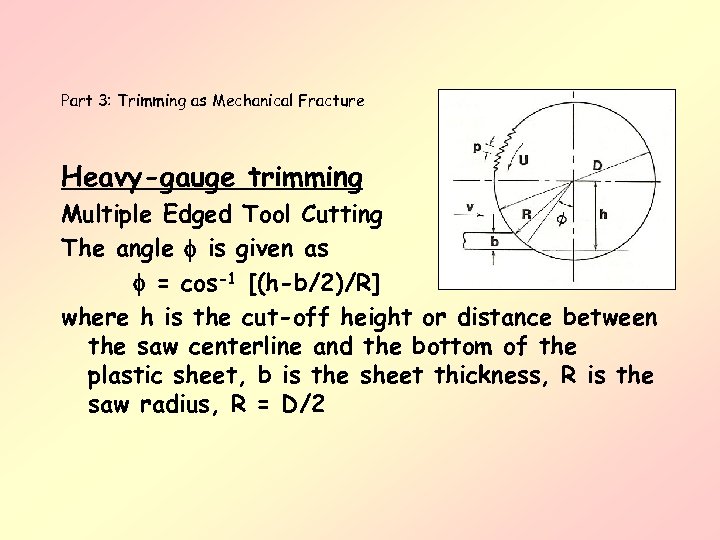 Part 3: Trimming as Mechanical Fracture Heavy-gauge trimming Multiple Edged Tool Cutting The angle f is given as f = cos-1 [(h-b/2)/R] where h is the cut-off height or distance between the saw centerline and the bottom of the plastic sheet, b is the sheet thickness, R is the saw radius, R = D/2
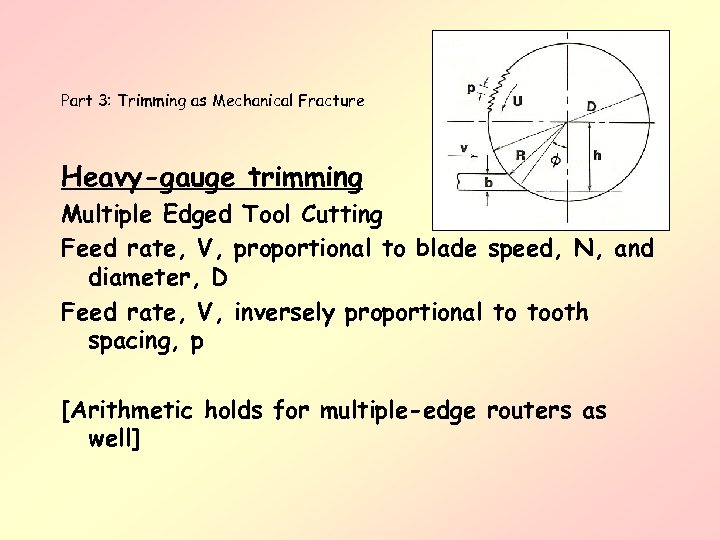 Part 3: Trimming as Mechanical Fracture Heavy-gauge trimming Multiple Edged Tool Cutting Feed rate, V, proportional to blade speed, N, and diameter, D Feed rate, V, inversely proportional to tooth spacing, p [Arithmetic holds for multiple-edge routers as well]
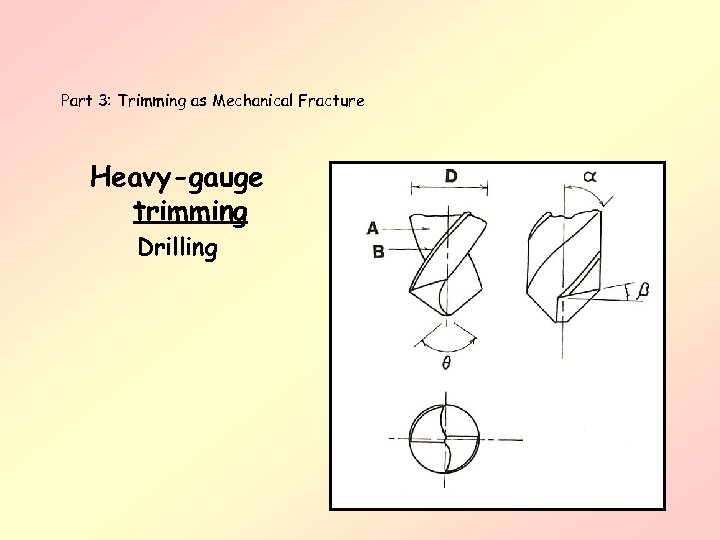 Part 3: Trimming as Mechanical Fracture Heavy-gauge trimming Drilling
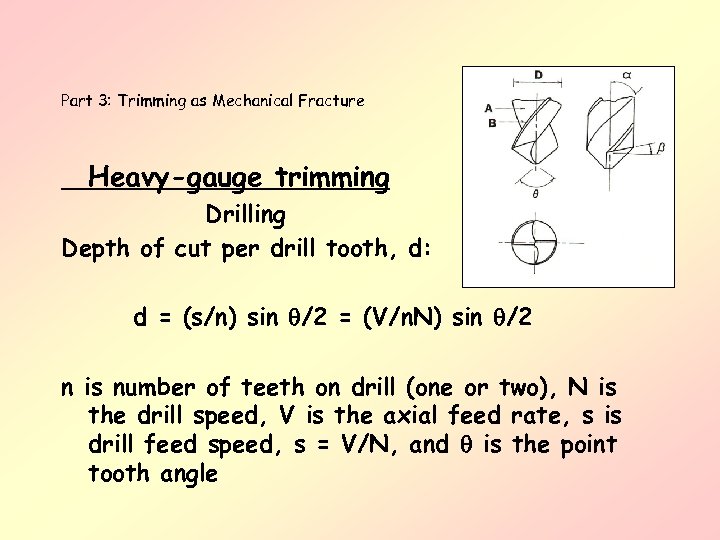 Part 3: Trimming as Mechanical Fracture Heavy-gauge trimming Drilling Depth of cut per drill tooth, d: d = (s/n) sin q/2 = (V/n. N) sin q/2 n is number of teeth on drill (one or two), N is the drill speed, V is the axial feed rate, s is drill feed speed, s = V/N, and q is the point tooth angle
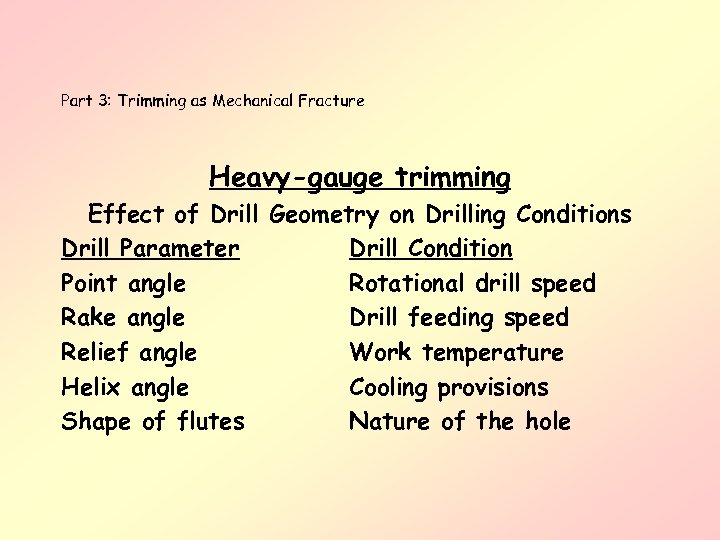 Part 3: Trimming as Mechanical Fracture Heavy-gauge trimming Effect of Drill Geometry on Drilling Conditions Drill Parameter Drill Condition Point angle Rotational drill speed Rake angle Drill feeding speed Relief angle Work temperature Helix angle Cooling provisions Shape of flutes Nature of the hole
 Part 3: Trimming as Mechanical Fracture End of Part 3 Trimming as Mechanical Fracture
 Part 3: Trimming as Mechanical Fracture End of Mini-Seminar
 Mini-Seminar Advanced Topics in Thermoforming THANK YOU FOR YOUR ATTENTION!