


 Скачать презентацию Millions of years ago Australia was part of
Австралия.pptx
- Количество слайдов: 15
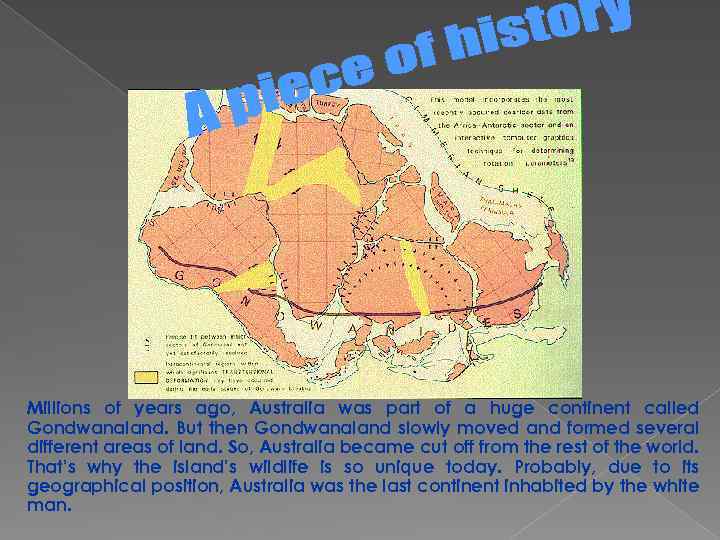 Millions of years ago, Australia was part of a huge continent called Gondwanaland. But then Gondwanaland slowly moved and formed several different areas of land. So, Australia became cut off from the rest of the world. That’s why the island’s wildlife is so unique today. Probably, due to its geographical position, Australia was the last continent inhabited by the white man.
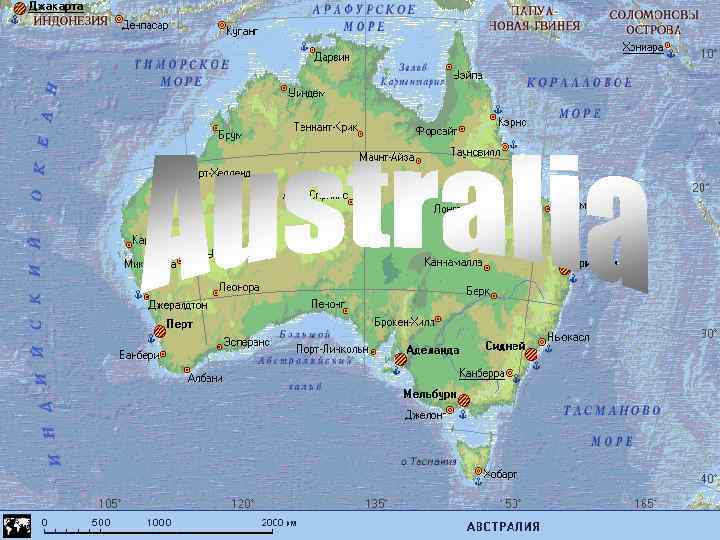
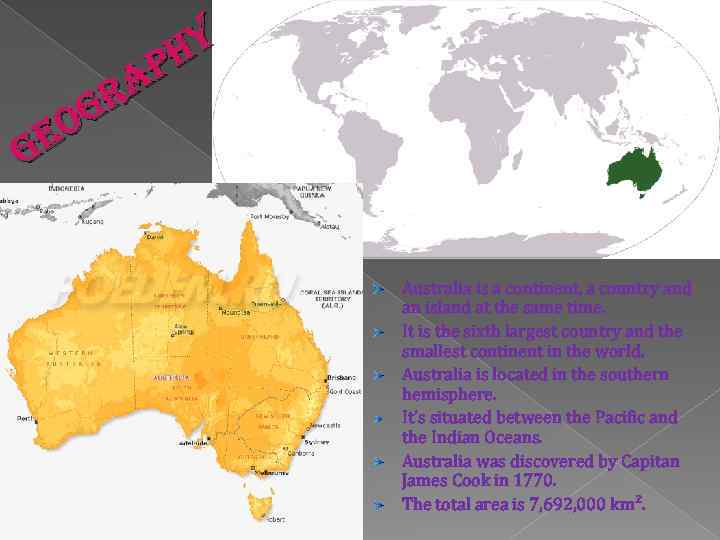 hy p ra og e g Australia is a continent, a country and an island at the same time. It is the sixth largest country and the smallest continent in the world. Australia is located in the southern hemisphere. It’s situated between the Pacific and the Indian Oceans. Australia was discovered by Capitan James Cook in 1770. The total area is 7, 692, 000 km².
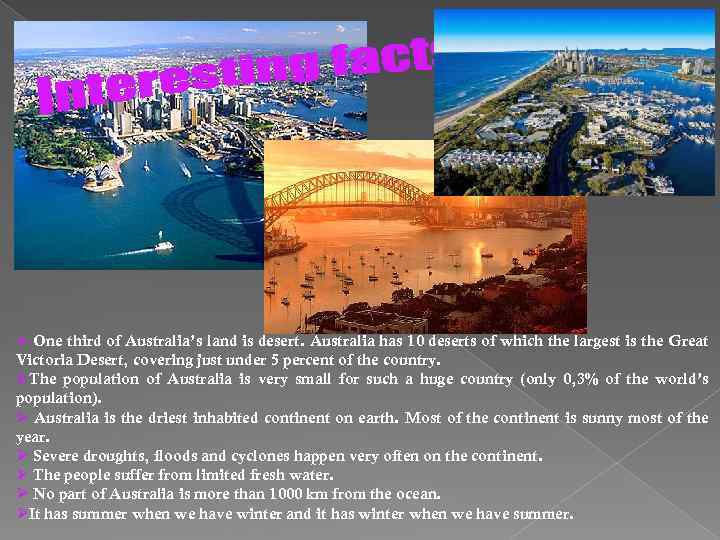 Ø One third of Australia’s land is desert. Australia has 10 deserts of which the largest is the Great Victoria Desert, covering just under 5 percent of the country. ØThe population of Australia is very small for such a huge country (only 0, 3% of the world’s population). Ø Australia is the driest inhabited continent on earth. Most of the continent is sunny most of the year. Ø Severe droughts, floods and cyclones happen very often on the continent. Ø The people suffer from limited fresh water. Ø No part of Australia is more than 1000 km from the ocean. ØIt has summer when we have winter and it has winter when we have summer.
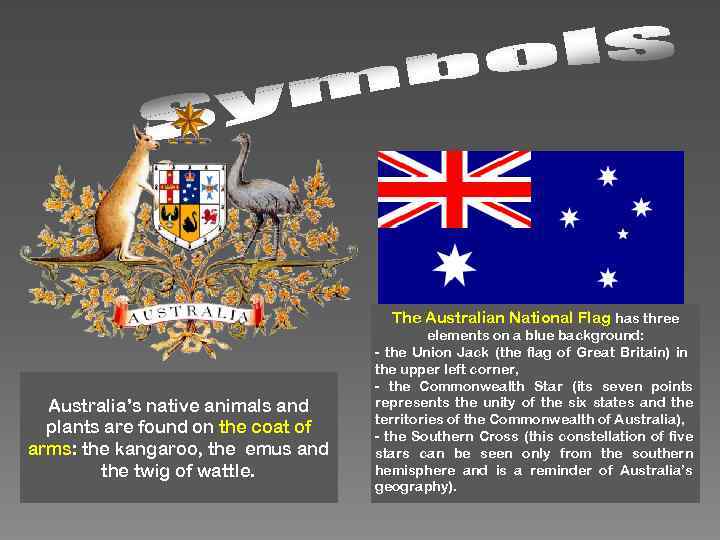 The Australian National Flag has three Australia’s native animals and plants are found on the coat of arms: the kangaroo, the emus and the twig of wattle. elements on a blue background: - the Union Jack (the flag of Great Britain) in the upper left corner, - the Commonwealth Star (its seven points represents the unity of the six states and the territories of the Commonwealth of Australia), - the Southern Cross (this constellation of five stars can be seen only from the southern hemisphere and is a reminder of Australia’s geography).
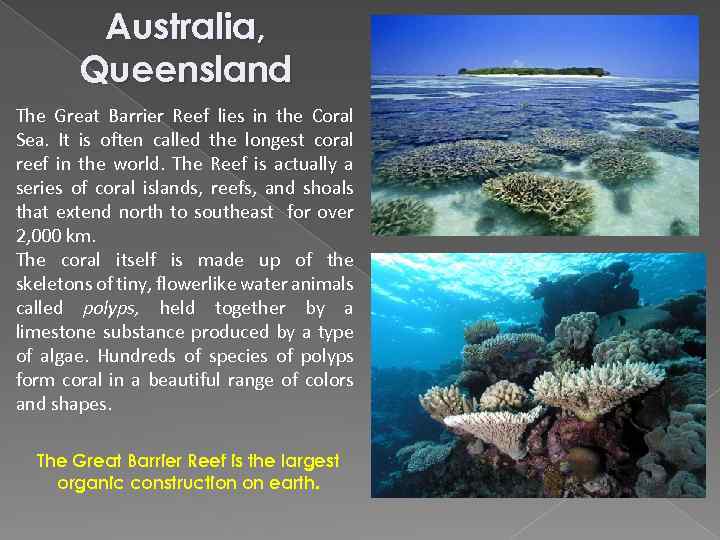 Australia, Queensland The Great Barrier Reef lies in the Coral Sea. It is often called the longest coral reef in the world. The Reef is actually a series of coral islands, reefs, and shoals that extend north to southeast for over 2, 000 km. The coral itself is made up of the skeletons of tiny, flowerlike water animals called polyps, held together by a limestone substance produced by a type of algae. Hundreds of species of polyps form coral in a beautiful range of colors and shapes. The Great Barrier Reef is the largest organic construction on earth.
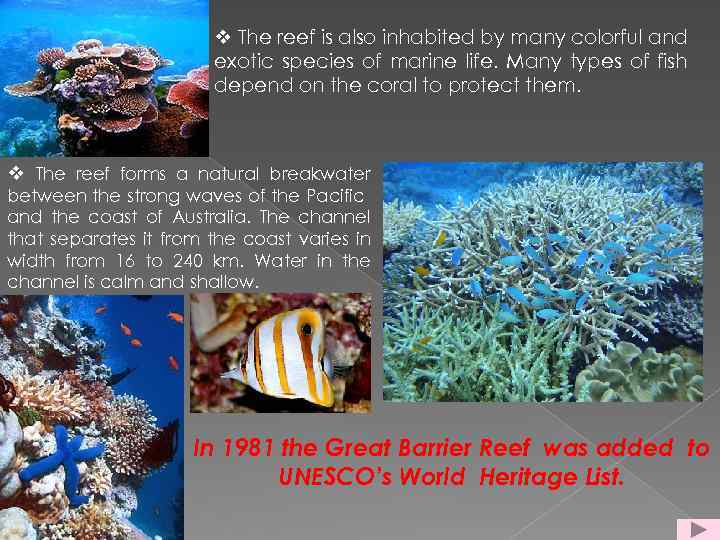 v The reef is also inhabited by many colorful and exotic species of marine life. Many types of fish depend on the coral to protect them. v The reef forms a natural breakwater between the strong waves of the Pacific and the coast of Australia. The channel that separates it from the coast varies in width from 16 to 240 km. Water in the channel is calm and shallow. In 1981 the Great Barrier Reef was added to UNESCO’s World Heritage List.
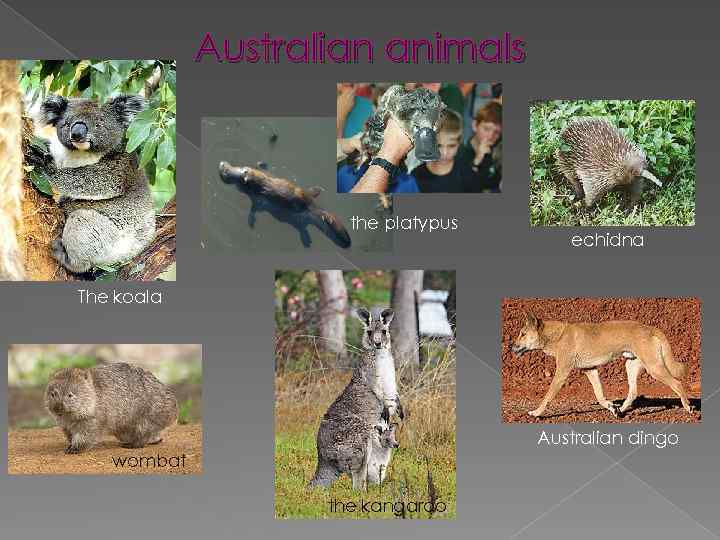 Australian animals the platypus echidna The koala Australian dingo wombat the kangaroo
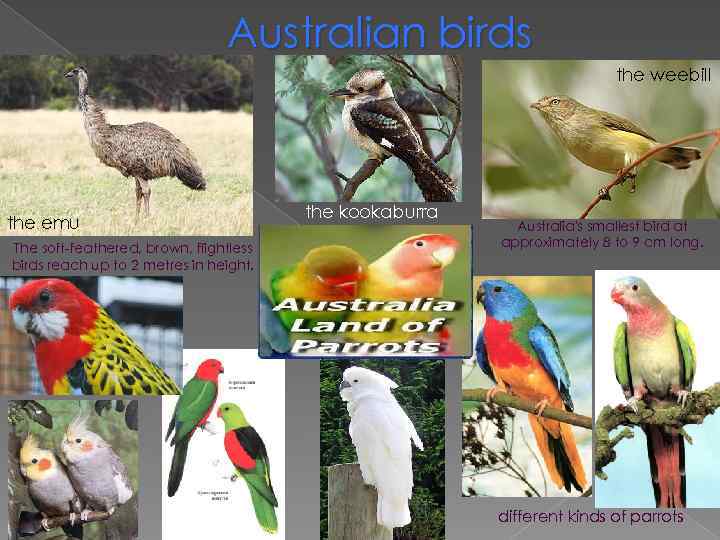 Australian birds the weebill the emu The soft-feathered, brown, flightless birds reach up to 2 metres in height. the kookaburra Australia's smallest bird at approximately 8 to 9 cm long. different kinds of parrots
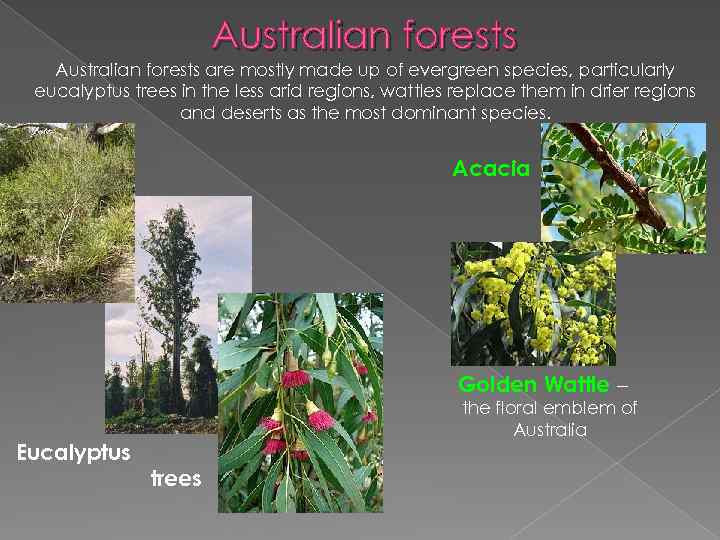 Australian forests are mostly made up of evergreen species, particularly eucalyptus trees in the less arid regions, wattles replace them in drier regions and deserts as the most dominant species. Acacia Golden Wattle – Eucalyptus the floral emblem of Australia trees
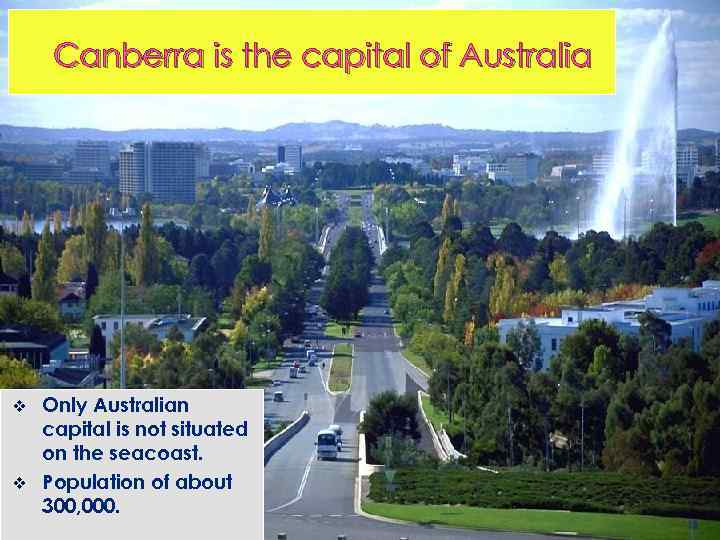 Canberra is the capital of Australia Only Australian capital is not situated on the seacoast. v Population of about 300, 000. v
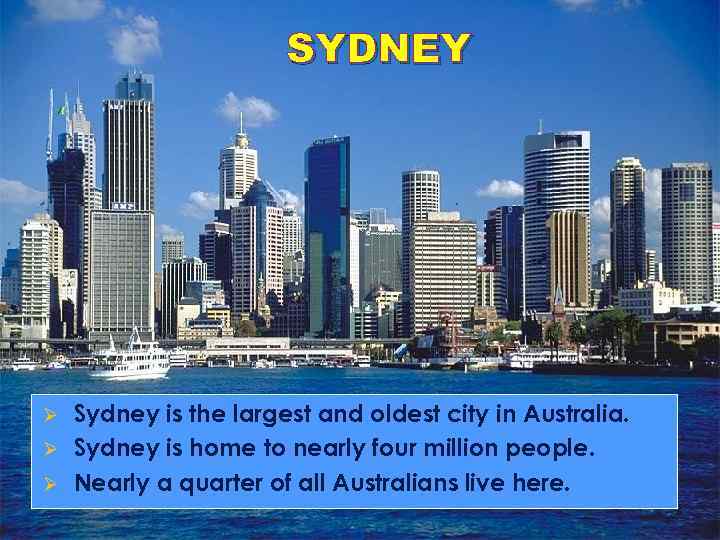 SYDNEY Sydney is the largest and oldest city in Australia. Ø Sydney is home to nearly four million people. Ø Nearly a quarter of all Australians live here. Ø
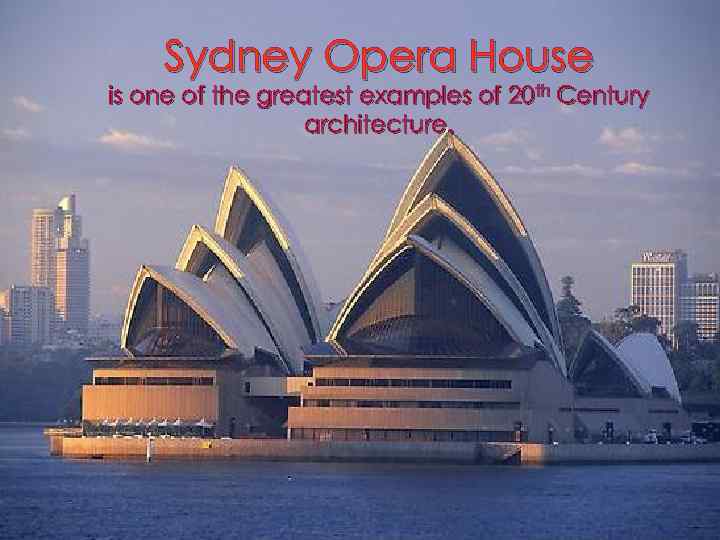 Sydney Opera House is one of the greatest examples of 20 th Century architecture.
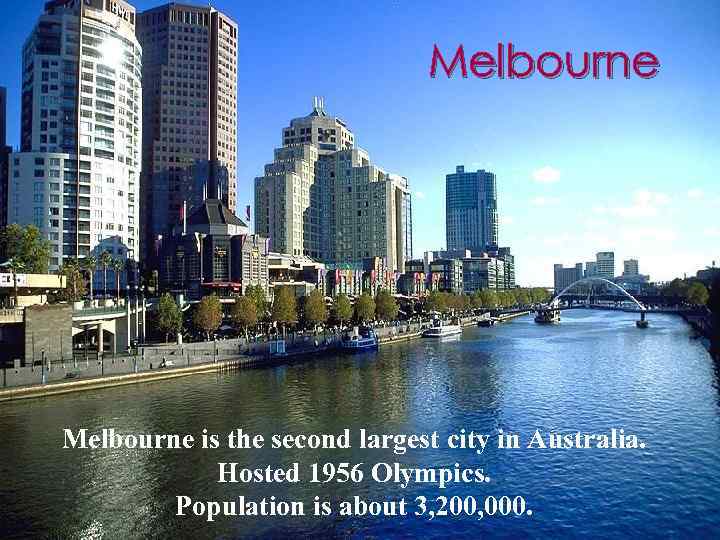 Melbourne is the second largest city in Australia. Hosted 1956 Olympics. Population is about 3, 200, 000.
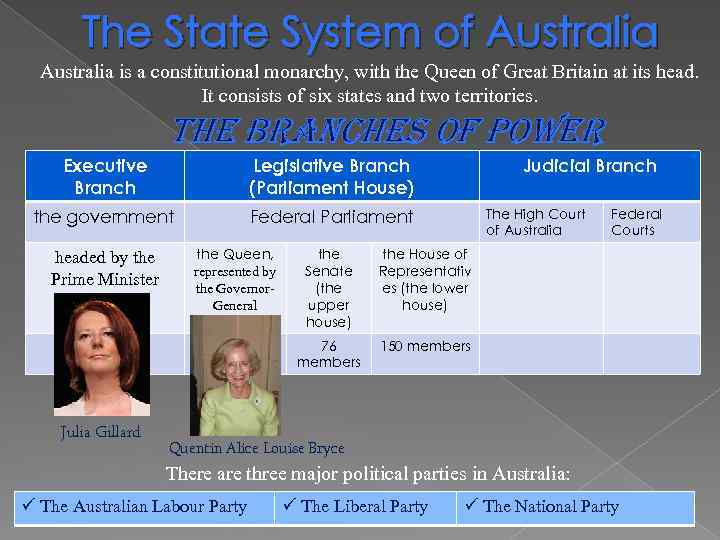 The State System of Australia is a constitutional monarchy, with the Queen of Great Britain at its head. It consists of six states and two territories. The Branches of power Executive Branch Legislative Branch (Parliament House) the government Federal Parliament The High Court of Australia Julia Gillard the Senate (the upper house) Federal Courts the House of Representativ es (the lower house) 76 members headed by the Prime Minister the Queen, represented by the Governor. General Judicial Branch 150 members Quentin Alice Louise Bryce There are three major political parties in Australia: ü The Australian Labour Party ü The Liberal Party ü The National Party