


 Скачать презентацию Military aspects of hydrogeology an introduction and overview
8d7d29228205de91feb602931c498f13.ppt
- Количество слайдов: 5
 Military aspects of hydrogeology: an introduction and overview by John D. Mather, and Edward P. F. Rose Geological Society, London, Special Publications Volume 362(1): 1 -18 February 28, 2012 © The Geological Society of London 2012
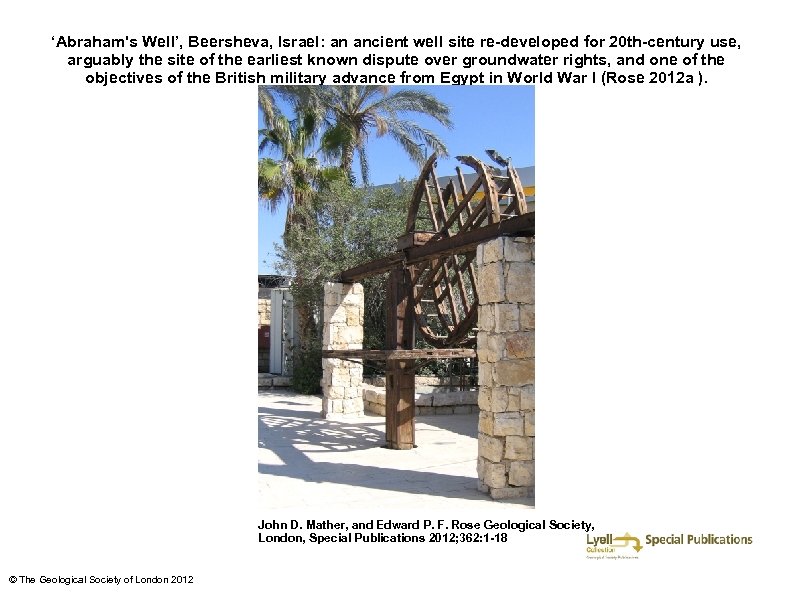 ‘Abraham's Well’, Beersheva, Israel: an ancient well site re-developed for 20 th-century use, arguably the site of the earliest known dispute over groundwater rights, and one of the objectives of the British military advance from Egypt in World War I (Rose 2012 a ). John D. Mather, and Edward P. F. Rose Geological Society, London, Special Publications 2012; 362: 1 -18 © The Geological Society of London 2012
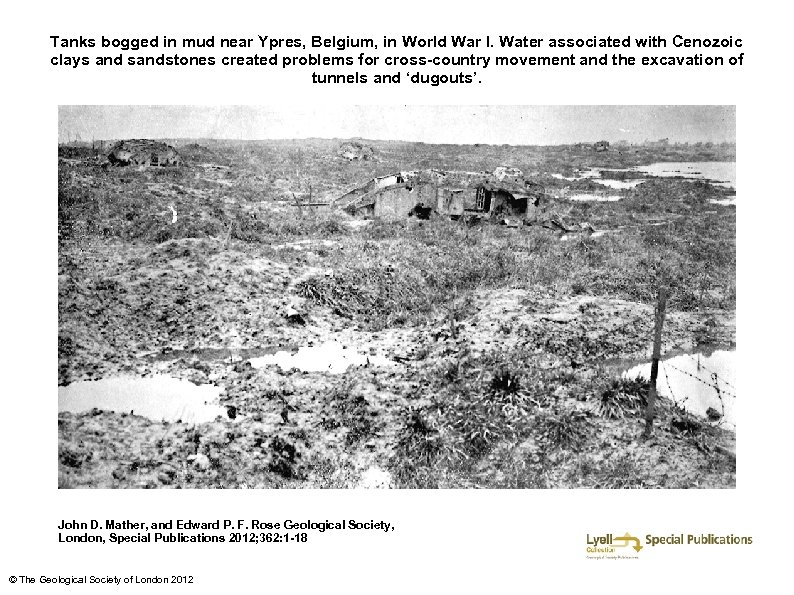 Tanks bogged in mud near Ypres, Belgium, in World War I. Water associated with Cenozoic clays and sandstones created problems for cross-country movement and the excavation of tunnels and ‘dugouts’. John D. Mather, and Edward P. F. Rose Geological Society, London, Special Publications 2012; 362: 1 -18 © The Geological Society of London 2012
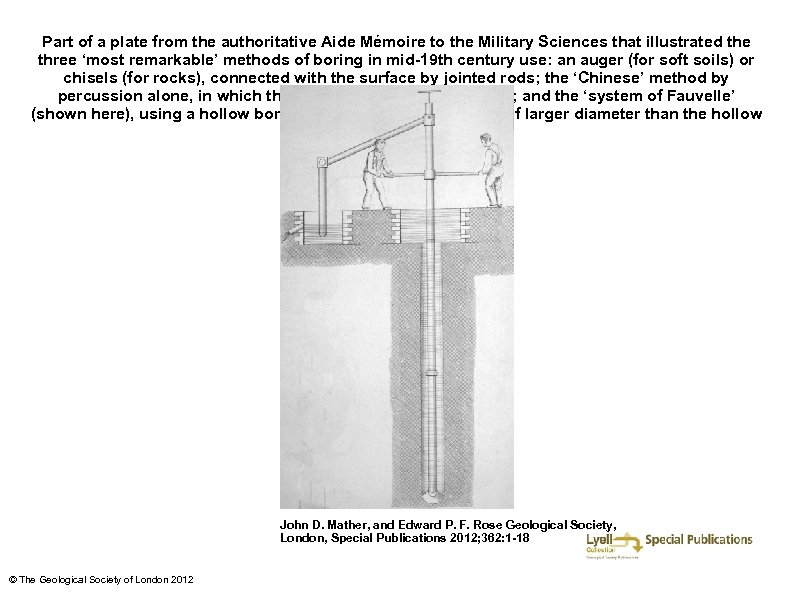 Part of a plate from the authoritative Aide Mémoire to the Military Sciences that illustrated the three ‘most remarkable’ methods of boring in mid-19 th century use: an auger (for soft soils) or chisels (for rocks), connected with the surface by jointed rods; the ‘Chinese’ method by percussion alone, in which the tool is suspended by a cable; and the ‘system of Fauvelle’ (shown here), using a hollow borer in which the cutting tool is of larger diameter than the hollow stem. John D. Mather, and Edward P. F. Rose Geological Society, London, Special Publications 2012; 362: 1 -18 © The Geological Society of London 2012
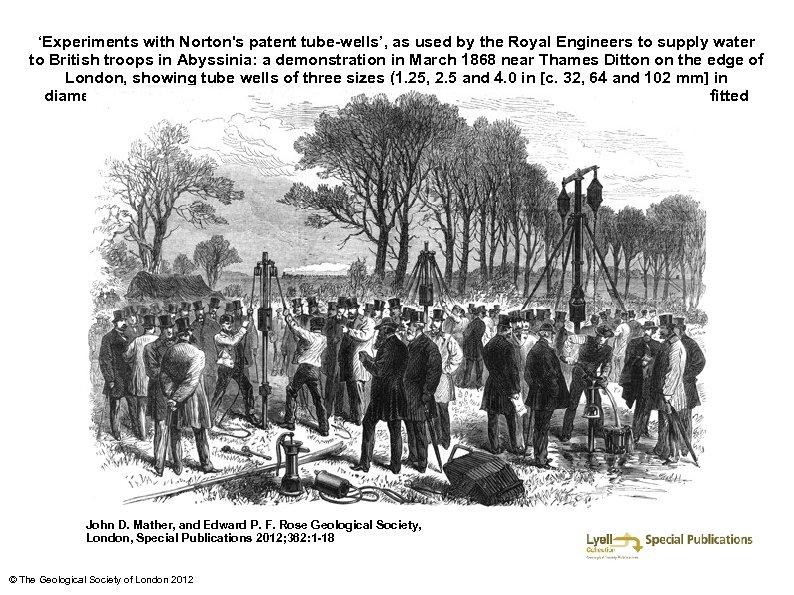 ‘Experiments with Norton's patent tube-wells’, as used by the Royal Engineers to supply water to British troops in Abyssinia: a demonstration in March 1868 near Thames Ditton on the edge of London, showing tube wells of three sizes (1. 25, 2. 5 and 4. 0 in [c. 32, 64 and 102 mm] in diameter) being driven some 14 ft (c. 4. 27 m) into the ground, one completed and pump fitted (foreground, right), and another as component parts (foreground, left). John D. Mather, and Edward P. F. Rose Geological Society, London, Special Publications 2012; 362: 1 -18 © The Geological Society of London 2012