 Скачать презентацию Military Aerospace Applications of Programmable Devices and
52a77052d9408c38e3572393cd89c86d.ppt
- Количество слайдов: 15




Military & Aerospace Applications of Programmable Devices and Technologies Conference Goddard Space Flight Center 1998 JPL’s Commercial Off-The-Shelf (COTS) Program A Step Towards Infusion of Reliable COTS Plastic Parts in NASA Flight Hardware Mike Sandor & Shri Agarwal 4800 Oak Grove Drive Pasadena, CA 91109 Phone: (818) 354 -0681 FAX: (818) 393 -4559
JET PROPULSION LABORATORY Electronic Parts Engineering Office The Meaning of COTS • “Buy and Fly” • “Procuring via catalog part number to QML-V standards” • “Procurement is performed without formal specification” • “The usage of any COTS equipment does not constitute any waiver to fundamental applicable requirements” JPL Interpretation: COTS are parts whose specification is manufacturer -controlled as opposed to traditional “Hi-Rel”parts whose specification was Government or customer-controlled
JET PROPULSION LABORATORY Electronic Parts Engineering Office Why Put COTS Plastic Parts in Space ? 1. The availability of COTS plastic parts is proliferating. 2. COTS plastic parts performance capabilities continue to increase (e. g. processing power & high density memories) 3. COTS plastic parts enable reduction of hardware weight and volume 4. COTS plastic parts typically cost much less than ceramic 5. COTS plastic parts have been reported to demonstrate good to excellent reliability in commercial and aerospace applications 6. Often they are the only option available to using state-of-the-art technologies
JET PROPULSION LABORATORY Electronic Parts Engineering Office JPL’s Concerns About Using COTS Plastic Parts • Reliability/RH of Plastic in Space Applications • Non Rad Hard Designed (maybe Rad Tolerant) • Narrow Temperature Range for Commercial Grade • Process/Designs Change Frequently • Lack of Lot Traceability & Uniformity
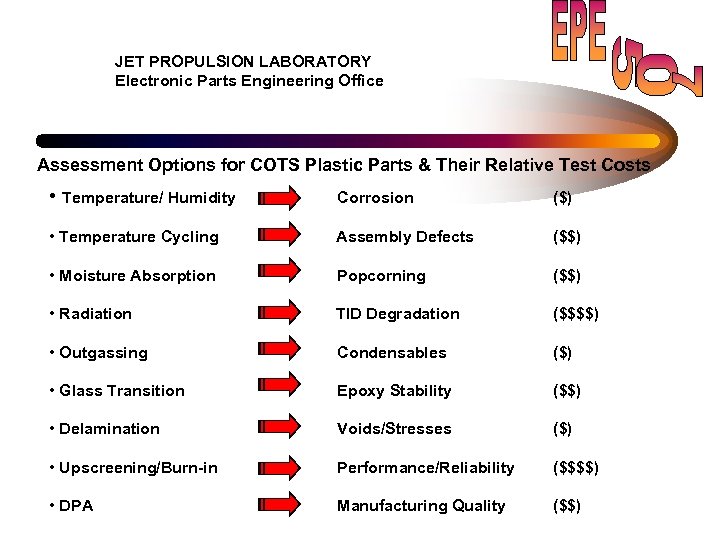
JET PROPULSION LABORATORY Electronic Parts Engineering Office Assessment Options for COTS Plastic Parts & Their Relative Test Costs • Temperature/ Humidity Corrosion ($) • Temperature Cycling Assembly Defects ($$) • Moisture Absorption Popcorning ($$) • Radiation TID Degradation ($$$$) • Outgassing Condensables ($) • Glass Transition Epoxy Stability ($$) • Delamination Voids/Stresses ($) • Upscreening/Burn-in Performance/Reliability ($$$$) • DPA Manufacturing Quality ($$)
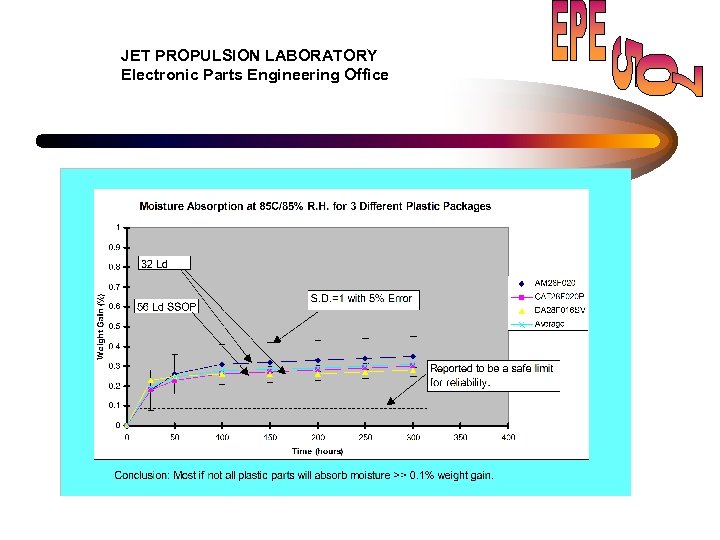
JET PROPULSION LABORATORY Electronic Parts Engineering Office
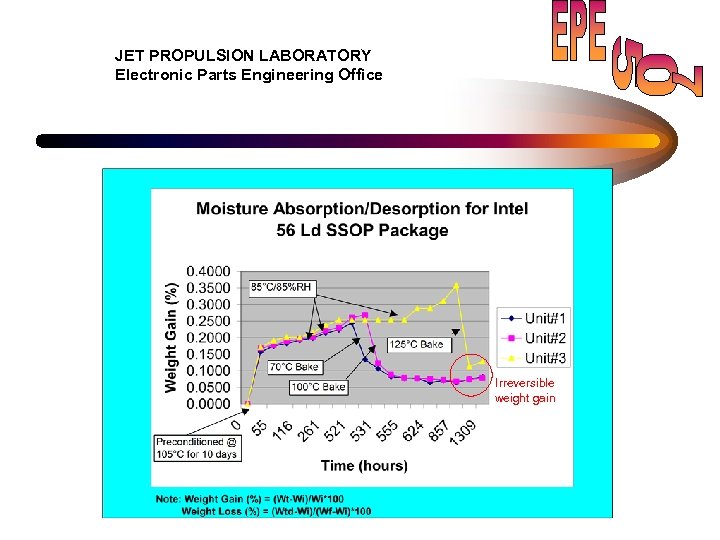
JET PROPULSION LABORATORY Electronic Parts Engineering Office Irreversible weight gain
JET PROPULSION LABORATORY Electronic Parts Engineering Office
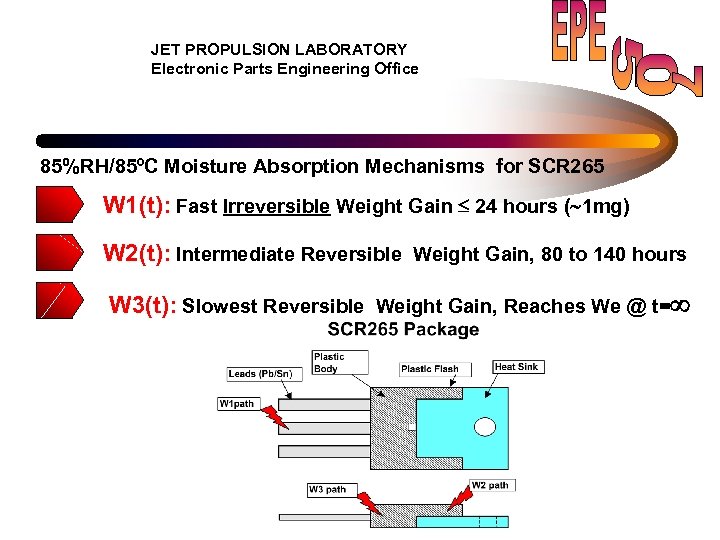
JET PROPULSION LABORATORY Electronic Parts Engineering Office 85%RH/85ºC Moisture Absorption Mechanisms for SCR 265 W 1(t): Fast Irreversible Weight Gain 24 hours ( 1 mg) W 2(t): Intermediate Reversible Weight Gain, 80 to 140 hours W 3(t): Slowest Reversible Weight Gain, Reaches We @ t=
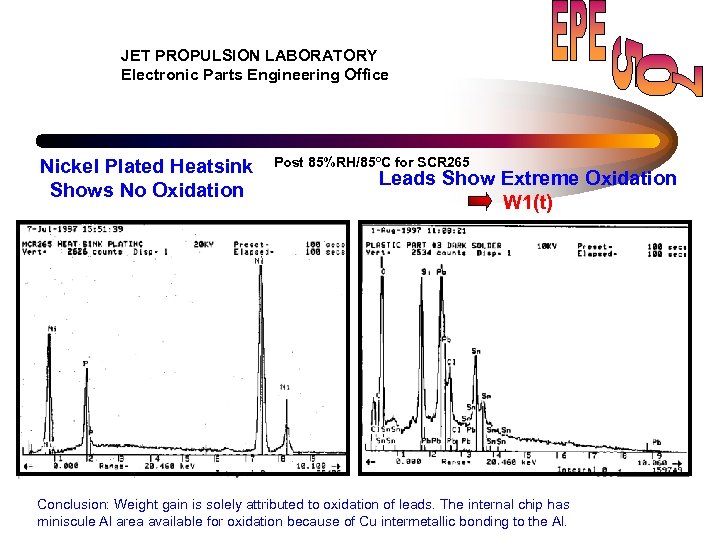
JET PROPULSION LABORATORY Electronic Parts Engineering Office Nickel Plated Heatsink Shows No Oxidation Post 85%RH/85ºC for SCR 265 Leads Show Extreme Oxidation W 1(t) Conclusion: Weight gain is solely attributed to oxidation of leads. The internal chip has miniscule Al area available for oxidation because of Cu intermetallic bonding to the Al.
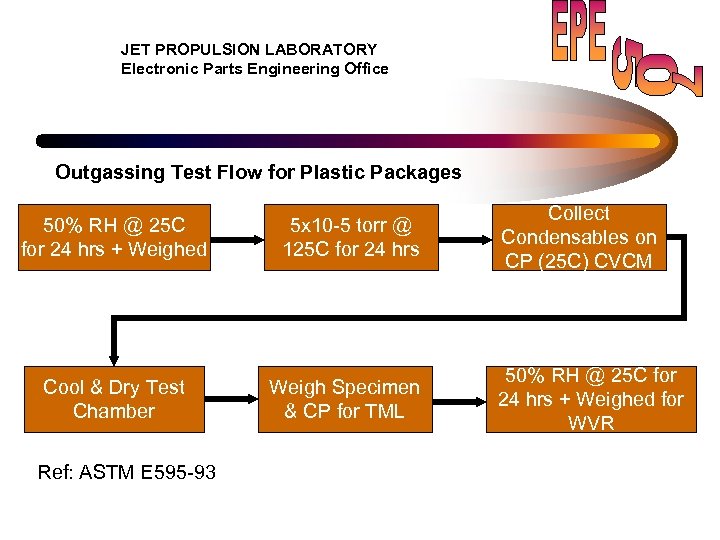
JET PROPULSION LABORATORY Electronic Parts Engineering Office Outgassing Test Flow for Plastic Packages 50% RH @ 25 C for 24 hrs + Weighed 5 x 10 -5 torr @ 125 C for 24 hrs Cool & Dry Test Chamber Weigh Specimen & CP for TML Ref: ASTM E 595 -93 Collect Condensables on CP (25 C) CVCM 50% RH @ 25 C for 24 hrs + Weighed for WVR
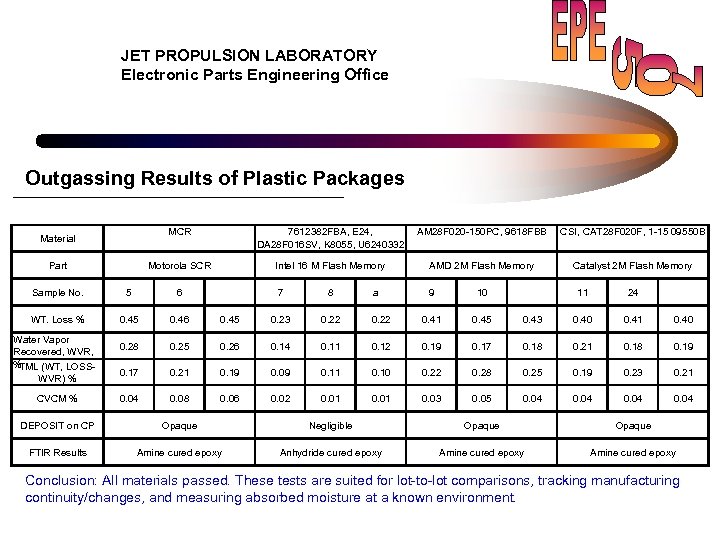
JET PROPULSION LABORATORY Electronic Parts Engineering Office Outgassing Results of Plastic Packages MCR Part 7612382 FBA, E 24, DA 28 F 016 SV, K 8055, U 6240332 AM 28 F 020 -150 PC, 9618 FBB CSI, CAT 28 F 020 F, 1 -15 09550 B Motorola SCR Material Intel 16 M Flash Memory AMD 2 M Flash Memory Catalyst 2 M Flash Memory 7 8 9 10 Sample No. 5 6 WT. Loss % 0. 45 0. 46 0. 45 0. 23 0. 22 0. 41 0. 45 0. 28 0. 25 0. 26 0. 14 0. 11 0. 12 0. 19 0. 17 0. 21 0. 19 0. 09 0. 11 0. 10 0. 04 0. 08 0. 06 0. 02 0. 01 Water Vapor Recovered, WVR, % TML (WT, LOSSWVR) % CVCM % a 11 24 0. 43 0. 40 0. 41 0. 40 0. 17 0. 18 0. 21 0. 18 0. 19 0. 22 0. 28 0. 25 0. 19 0. 23 0. 21 0. 03 0. 05 0. 04 DEPOSIT on CP Opaque Negligible Opaque FTIR Results Amine cured epoxy Anhydride cured epoxy Amine cured epoxy Conclusion: All materials passed. These tests are suited for lot-to-lot comparisons, tracking manufacturing continuity/changes, and measuring absorbed moisture at a known environment.
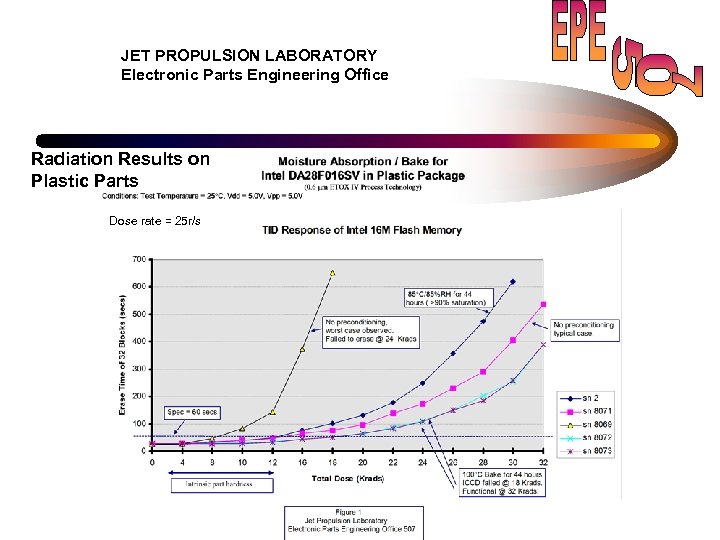
JET PROPULSION LABORATORY Electronic Parts Engineering Office Radiation Results on Plastic Parts Dose rate = 25 r/s
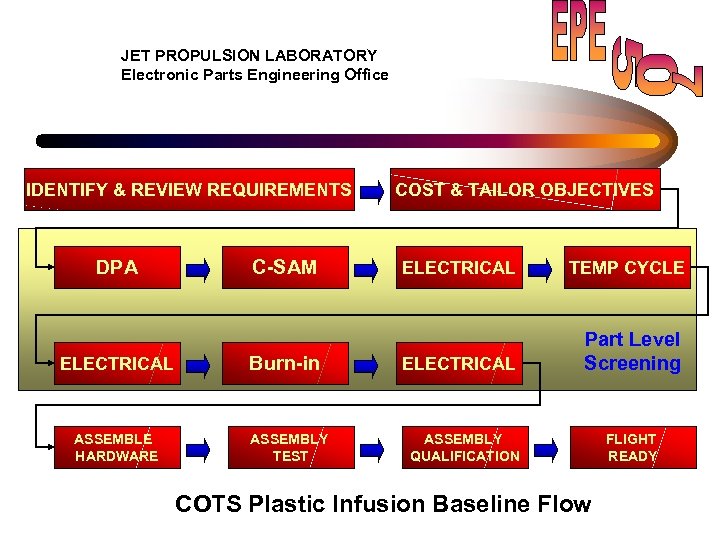
JET PROPULSION LABORATORY Electronic Parts Engineering Office IDENTIFY & REVIEW REQUIREMENTS DPA C-SAM ELECTRICAL Burn-in ASSEMBLE HARDWARE ASSEMBLY TEST COST & TAILOR OBJECTIVES ELECTRICAL TEMP CYCLE ELECTRICAL Part Level Screening ASSEMBLY QUALIFICATION COTS Plastic Infusion Baseline Flow FLIGHT READY
JET PROPULSION LABORATORY Electronic Parts Engineering Office In Summary • Using COTS plastic parts without understanding their pedigree can lead to mission delay or worst Mission Failure • A methodology is in place in Office 507 to help JPL users of plastic parts ascertain their risk and acceptance for Space Application • Work is underway in Office 507 to evaluate all risk factors when using COTS plastic parts (quality, reliability, radiation, package). • JPL is currently infusing plastic parts into flight hardware utilizing a Better-Faster-Cheaper Program tailored individually for each Project
Скачать презентацию Military Aerospace Applications of Programmable Devices and
52a77052d9408c38e3572393cd89c86d.ppt