


 Скачать презентацию Milestones in the Corpus of Cameroon English CCE
e6aeda16f4b80686ad0c5eb4ef72ed25.ppt
- Количество слайдов: 20
 Milestones in the Corpus of Cameroon English (CCE): research possibilities in an ESL Context Outline Dr. Daniel A. Nkemleke Department of English Ecole Normale Supérieure University of Yaounde I (Festschrift for Paul Mbangwaba, June 2008) p Introduction: Key dates in the CCE p Objective of the corpus p Current state of corpus p Envisaged parallel corpus p Research possibilities p Concluding remarks
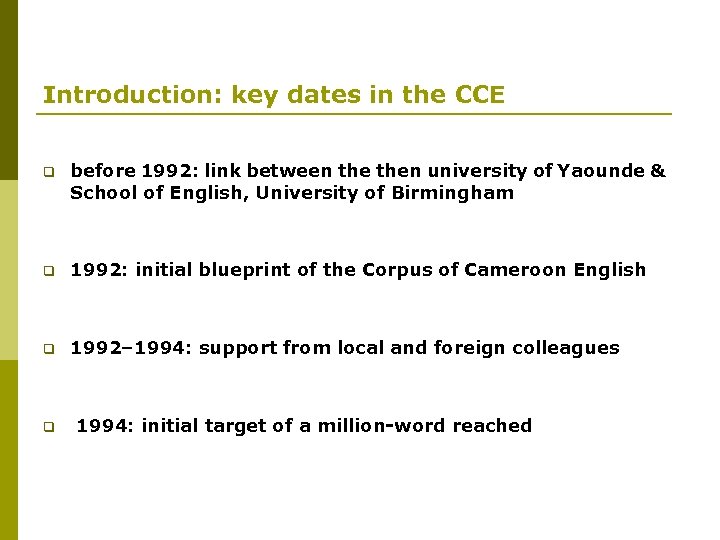 Introduction: key dates in the CCE q before 1992: link between then university of Yaounde & School of English, University of Birmingham q 1992: initial blueprint of the Corpus of Cameroon English q 1992– 1994: support from local and foreign colleagues q 1994: initial target of a million-word reached
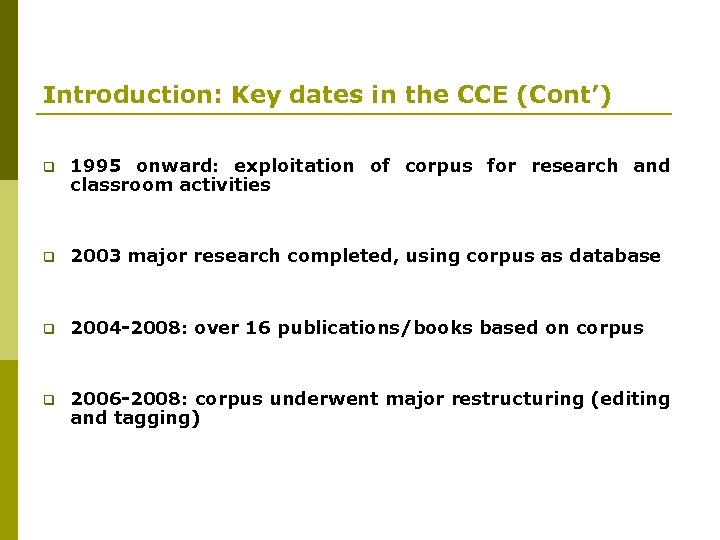 Introduction: Key dates in the CCE (Cont’) q 1995 onward: exploitation of corpus for research and classroom activities q 2003 major research completed, using corpus as database q 2004 -2008: over 16 publications/books based on corpus q 2006 -2008: corpus underwent major restructuring (editing and tagging)
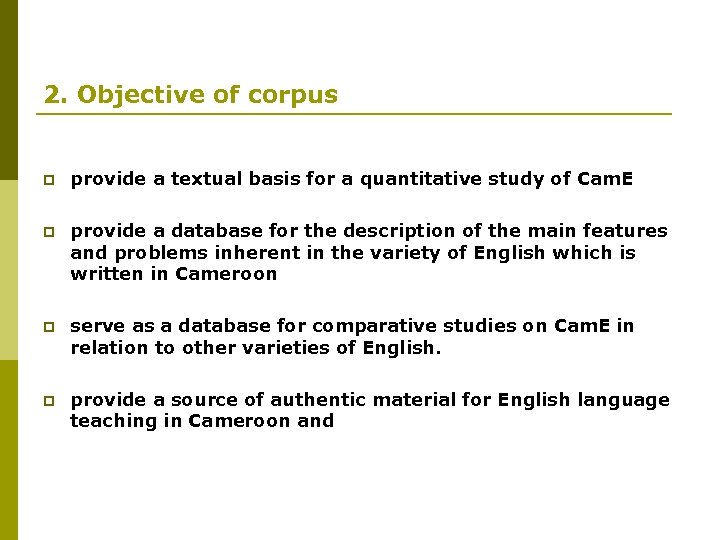 2. Objective of corpus p provide a textual basis for a quantitative study of Cam. E p provide a database for the description of the main features and problems inherent in the variety of English which is written in Cameroon p serve as a database for comparative studies on Cam. E in relation to other varieties of English. p provide a source of authentic material for English language teaching in Cameroon and
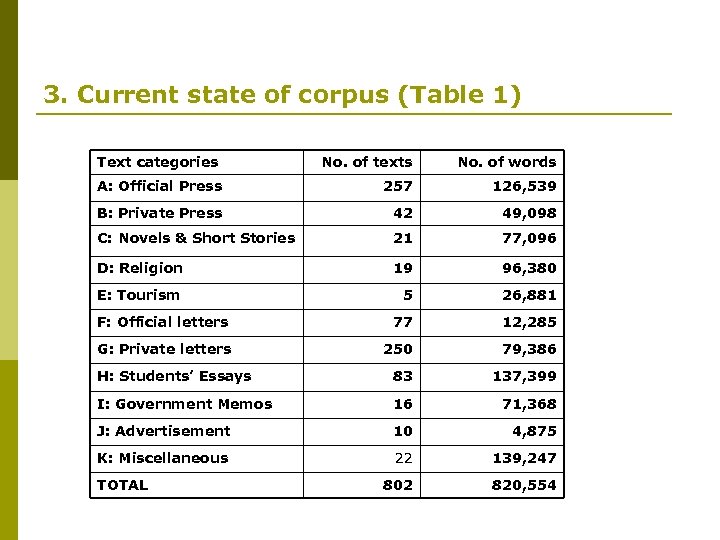 3. Current state of corpus (Table 1) Text categories No. of texts No. of words A: Official Press 257 126, 539 B: Private Press 42 49, 098 C: Novels & Short Stories 21 77, 096 D: Religion 19 96, 380 E: Tourism 5 26, 881 F: Official letters 77 12, 285 G: Private letters 250 79, 386 H: Students’ Essays 83 137, 399 I: Government Memos 16 71, 368 J: Advertisement 10 4, 875 K: Miscellaneous 22 139, 247 802 820, 554 TOTAL
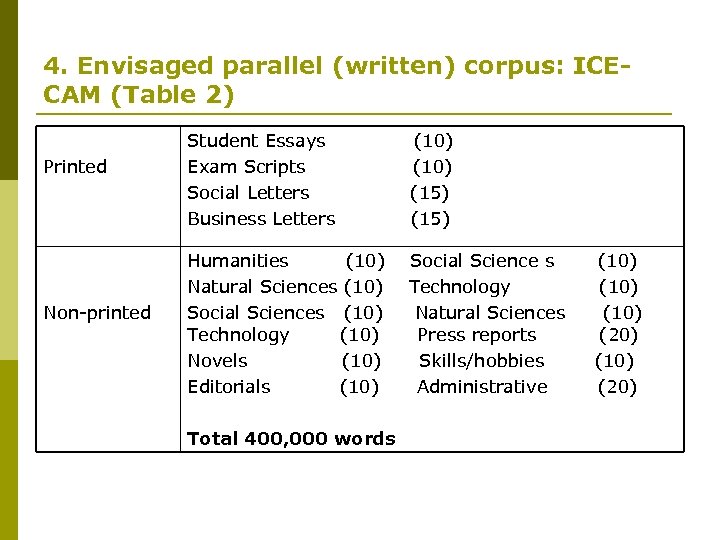 4. Envisaged parallel (written) corpus: ICECAM (Table 2) Printed Non-printed Student Essays Exam Scripts Social Letters Business Letters (10) (15) Humanities (10) Natural Sciences (10) Social Sciences (10) Technology (10) Novels (10) Editorials (10) Social Science s Technology Natural Sciences Press reports Skills/hobbies Administrative Total 400, 000 words (10) (20)
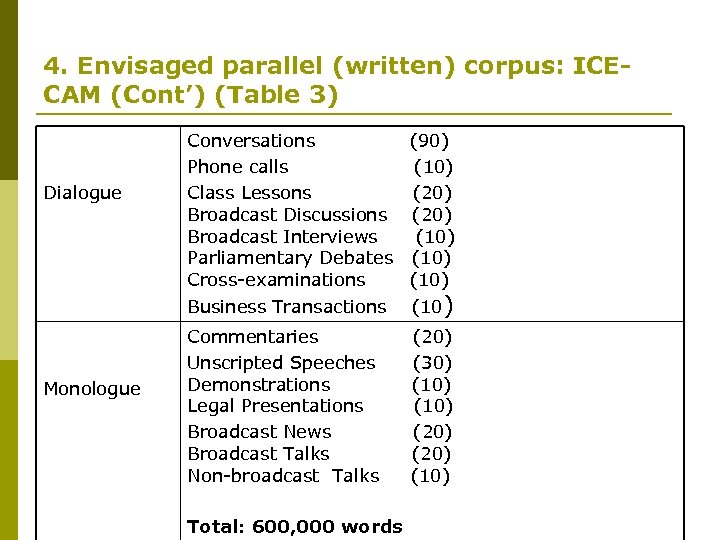 4. Envisaged parallel (written) corpus: ICECAM (Cont’) (Table 3) Dialogue Conversations (90) Phone calls (10) Class Lessons (20) Broadcast Discussions (20) Broadcast Interviews (10) Parliamentary Debates (10) Cross-examinations (10) Business Transactions Monologue (10) Commentaries Unscripted Speeches Demonstrations Legal Presentations Broadcast News Broadcast Talks Non-broadcast Talks (20) (30) (10) (20) (10) Total: 600, 000 words
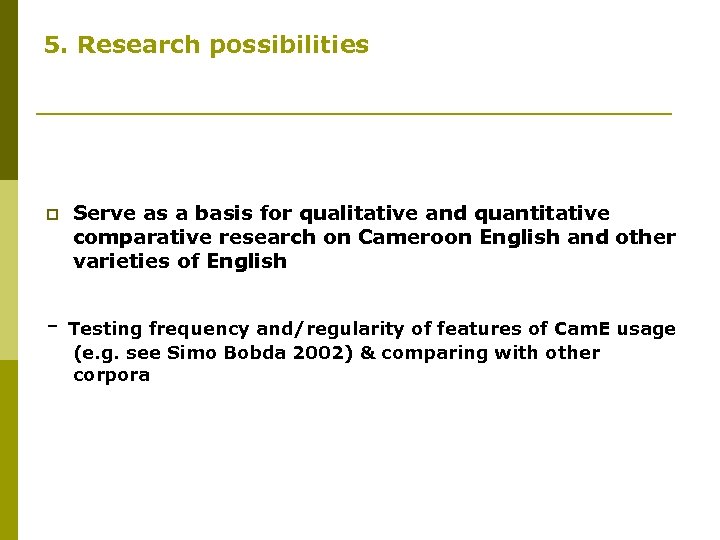 5. Research possibilities p - Serve as a basis for qualitative and quantitative comparative research on Cameroon English and other varieties of English Testing frequency and/regularity of features of Cam. E usage (e. g. see Simo Bobda 2002) & comparing with other corpora
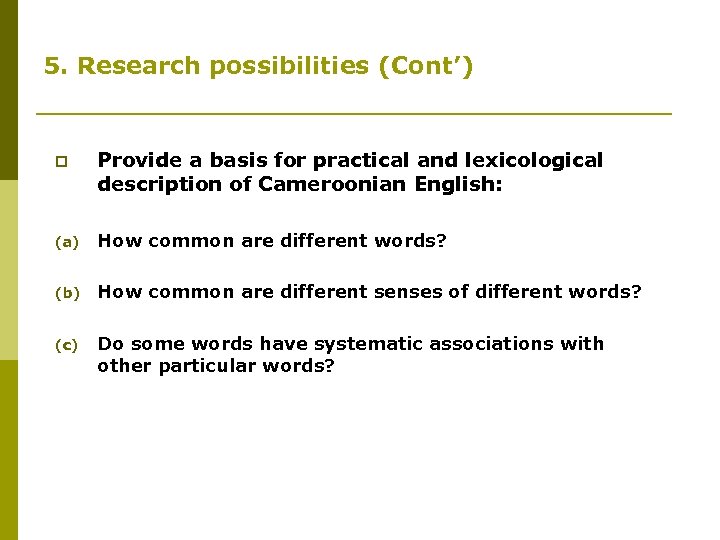 5. Research possibilities (Cont’) p Provide a basis for practical and lexicological description of Cameroonian English: (a) How common are different words? (b) How common are different senses of different words? (c) Do some words have systematic associations with other particular words?
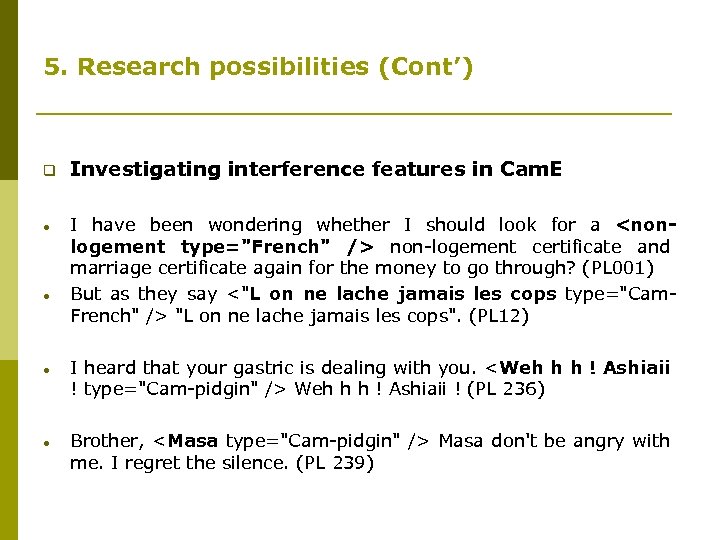 5. Research possibilities (Cont’) q Investigating interference features in Cam. E I have been wondering whether I should look for a
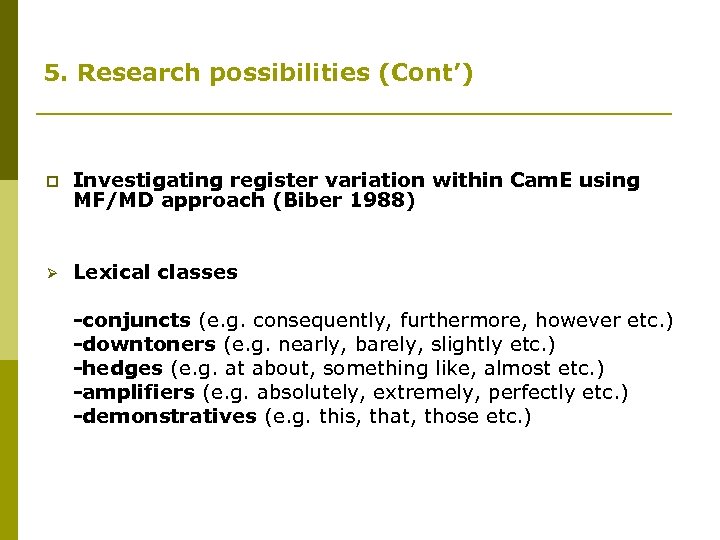 5. Research possibilities (Cont’) p Investigating register variation within Cam. E using MF/MD approach (Biber 1988) Ø Lexical classes -conjuncts (e. g. consequently, furthermore, however etc. ) -downtoners (e. g. nearly, barely, slightly etc. ) -hedges (e. g. at about, something like, almost etc. ) -amplifiers (e. g. absolutely, extremely, perfectly etc. ) -demonstratives (e. g. this, that, those etc. )
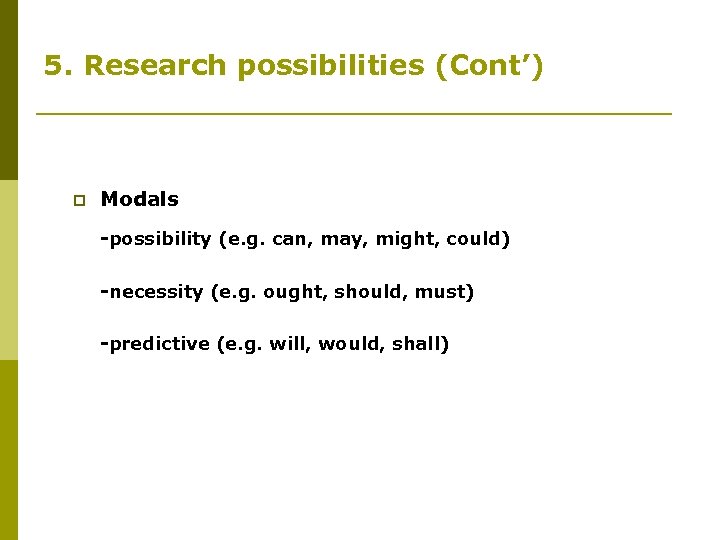 5. Research possibilities (Cont’) p Modals -possibility (e. g. can, may, might, could) -necessity (e. g. ought, should, must) -predictive (e. g. will, would, shall)
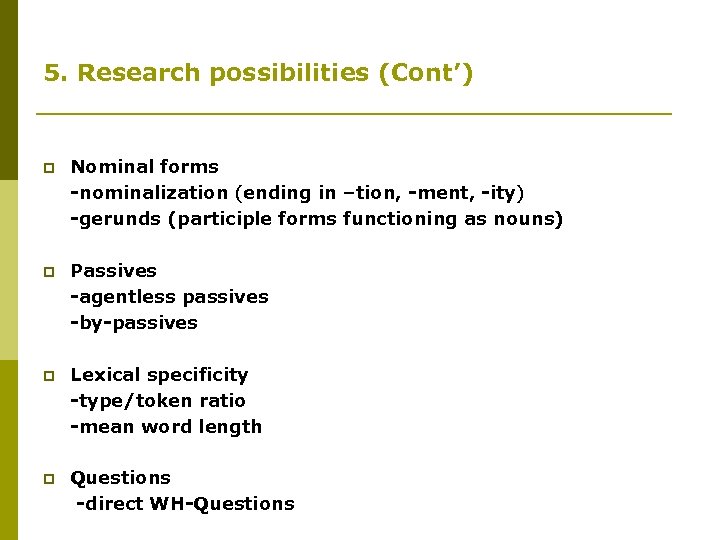 5. Research possibilities (Cont’) p Nominal forms -nominalization (ending in –tion, -ment, -ity) -gerunds (participle forms functioning as nouns) p Passives -agentless passives -by-passives p Lexical specificity -type/token ratio -mean word length p Questions -direct WH-Questions
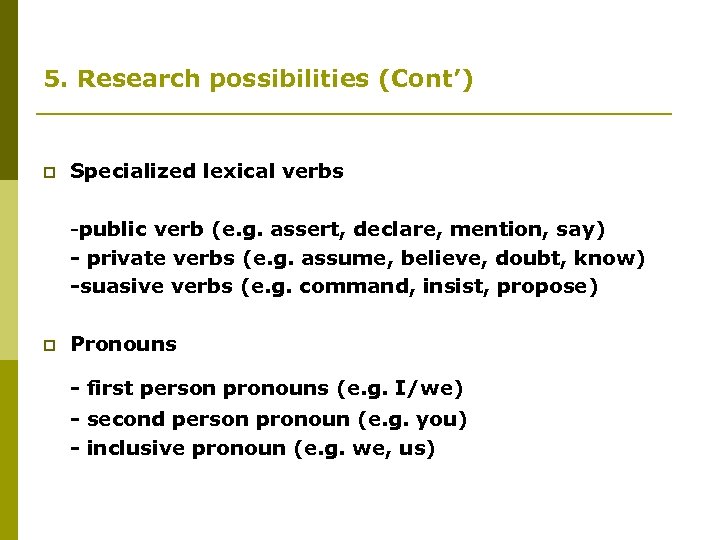 5. Research possibilities (Cont’) p Specialized lexical verbs -public verb (e. g. assert, declare, mention, say) - private verbs (e. g. assume, believe, doubt, know) -suasive verbs (e. g. command, insist, propose) p Pronouns - first person pronouns (e. g. I/we) - second person pronoun (e. g. you) - inclusive pronoun (e. g. we, us)
 5. Research possibilities (Cont‘) q Investigating features of spoken English (a distant possibility? ? ) -corpus phonology
 6. Concluding remarks q the CCE is brainchild of Professor Paul Mbangwana q prospects • students’ participation crucial • the spoken component, an immediate challenge
 Appendix I: some research undertaken on the CCE so far p p p Nkemleke, Daniel (2008) Modality in novice academic writing: the case of African and German university students. English Projects in Teaching and Research in Central Europe. Göttingen: Cuvillier Nkemleke, Daniel (2007) Frequency and use of modals in Cameroon English. Lagos Papers in English Studies, vol. 1(2), 4761. Nkemleke, Daniel (2007) Frequency and use of modals in Cameroon English and application to language education. Indian Journal of Applied Linguistics, vol. 33, No. 1, 87 -105. Nkemleke, Daniel (2005) Must and Should in Cameroon English. Nordic Journal for African Studies, vol. 14 No. 1, 27 -67. Nkemleke, Daniel (2004) Context and Function of Need and Be able to in Cameroon English. Indian Journal of Applied Linguistics, vol. 12 No. 2, 23 -34.
 Appendix I: some research undertaken on the CCE (Cont‘) p Nkemleke, Daniel (2004) A corpus-based study of the modal verbs in Cameroonian and British English. CASTALIA: Ibadan Journal of Multicultural & Multidisciplinary Studies, vol. 19, 1 -23. p Nkemleke, Daniel and Paul Mbangwana (2001) The modals of and Obligation and Necessity in Cameroon English. CASTALIA: Ibadan Journal of Multicultural & Multidisciplinary Studies vol. 6, 1 -14. p Tiomajou, David (1993) Designing the Corpus of Cameroon English. ICAME Journal, 17, 119 -124. p Note: Hans-Georg Wolf used data from the corpus in his book English in Cameroon, published in 2001 by Mouton de Gruyter (Berlin/New York).
 Appendix I: some research undertaken on the CCE (Cont‘) p p p Nkemleke, Daniel (2008) Please-requests in Cameroonian and East-African private (social) letters”. Discourse and Interaction 1/2. Brno: Masaryk University. 10. Nkemleke, Daniel (2008) Frequency and variety of ifconstructions in Cameroon English. In: English Studies and Language Teaching 3, Department of English, University of Pilsen. 11. Schmied Josef and Nkemleke, Daniel (2008) Prepositions in Cameroon and Kenyan English: corpus-linguistic comparisons of simplification and expressivity. World Englishes: Problems. Properties-Prospects, to be published by John Benjamins. 12. Schmied, Josef and Nkemleke, Daniel (2008) Reference, coherence and complexity in students’ academic writing: examples from Cameroon and East-Africa corpus. Pragmatics, Language and Literature: A Festschrift for Efurisibina Adegbija. 13. Nkemleke, Daniel (2008) The Expression of Modality in Cameroon English”. Approaches to Cameroon English: Features, Structure, and New Perspectives, for the series Varieties of English around the World (John Benjamins) Edited by Edgar W. Schneider.
 END THANK YOU !