


 Скачать презентацию Mike Urwin RORC Rating Office Technical Director
774d0e05380e25db2eb8c0c0d2ca6c82.ppt
- Количество слайдов: 19
 Mike Urwin RORC Rating Office Technical Director
 Outline • • • • Demographics and Growth Rating, not Handicap IRC Philosophy Secret! Development ‘Motor Boats’. Water Ballast and Canting Keels ‘Motor Boats’. Rig and Sail Handling Code Zeros – Headsails or Spinnakers? Race Management. Trucks and Ferraris. Little and Large His Rating’s Wrong. . . Rule Changes Process 2007 IRC Rule. Significant Changes National IRC Associations
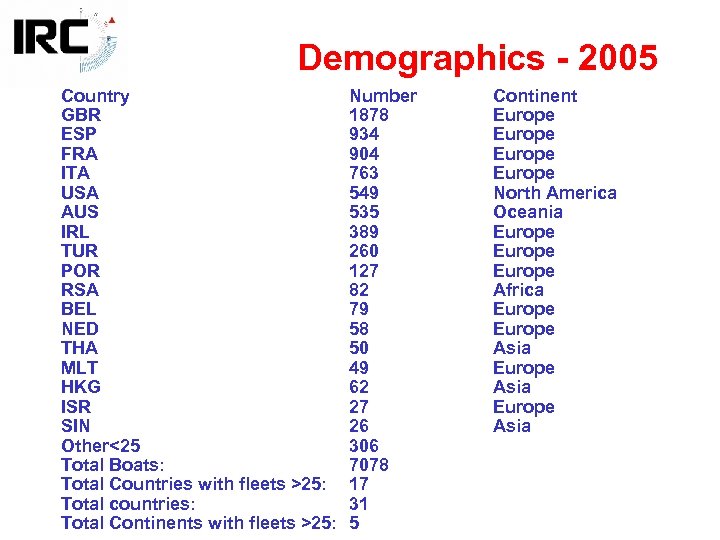 Demographics - 2005 Country GBR ESP FRA ITA USA AUS IRL TUR POR RSA BEL NED THA MLT HKG ISR SIN Other<25 Total Boats: Total Countries with fleets >25: Total countries: Total Continents with fleets >25: Number 1878 934 904 763 549 535 389 260 127 82 79 58 50 49 62 27 26 306 7078 17 31 5 Continent Europe North America Oceania Europe Africa Europe Asia
 Growth The number of IRC rated boats has increased from c 4, 600 10 years ago to in excess of 7000 today, ie more than 50% growth. New countries in 2006 include Argentina, Japan, and New Zealand. We anticipate The Netherlands adopting IRC in 2007. Growth continues at a compound annual rate of c 4%.
 Rating, not Handicap IRC is a rating rule, not a handicap rule. So each Boat’s TCC is calculated from her measured and rated data. Only ‘assessment’ element is the three IRC factors: Hull, Rig and Overhang. Each IRC factor is however objectively assessed using a standard agreed methodology. Unless therefore IRC is generically (ie to affect ALL boats) modified, or something changes on a boat, there is essentially NO room for ‘negotiation’! But make sure that we have the full facts.
 IRC Philosophy IRC Rules 2. 2 – 2. 4: 2. 2 • • We want owners to be able to buy boats in the reasonable knowledge that they will retain value. IRC must be stable. That does not mean no change; it means we must (try to!) react to innovation and developments on the race course. 2. 3 • • • IRC encourages design innovation consistent with stability, rounded performance, seaworthiness and safety. IRC is permissive. Bowsprits, asymmetric spinnakers, composite spars and rigging, water ballast, canting keels, etc. Undesirable features (eg low stability) will be discouraged. 2. 4 • • • The IRC concept protects the existing IRC fleet. IRC discourages unnecessary expense at all levels. Difficult – yacht racing is not a cheap game! Eg rudder post position a few years ago, tungsten last year. Cost to no sensible gain.
 Secret! IRC is a secret rule. The maths and methodologies used in the calculation of TCCs are not disclosed. And they will not be! The prime purpose is to mitigate against (no, we can never prevent!) design optimisation and hence rapid design obsolescence. Yes, of course designers have a pretty good general idea. But they still trip themselves up from time to time. . . The proof is that it works. Races are won by new and old, large and small, light and heavy, etc.
 Development IRC is maintained and developed to take account of: – – – Actual race results Technical developments Design advances Materials Etc Any resulting changes are applied generically to ALL boats in the IRC fleet at annual revalidation. We want to hear from sailors to help with development. But through your local IRC Owners Association and/or IRC Rule Authority (ie, Yachting Australia) please.
 ‘Motor Boats’ Water Ballast and Canting Keels IRC is permissive. So we do not want to ‘ban’ boats except in extreme circumstances. IRC has permitted the use of stored power for the operation of water ballast and canting keel systems ever since they first appeared in the early ’ 90 s. This is consistent with other rules such as the Open 60 s and Volvo Open 70 s. For larger boats (c 50’ and upwards) it is physically impractical to manually pump the water or cant the keel. We do not see any need to directly rate the use of stored power for these purposes. It is to all intents and purposes implicit in the calculation of rating for these boats.
 ‘Motor Boats’ Rig and Sail Handling IRC Rules on the use of stored power for the operation of rig and sails were relaxed to encompass all boats 2 years ago. Recognising the increased use of powered winches etc and the wish for IRC to be inclusive. For the vast majority of boats, the use of stored power for rig and sail handling is no advantage whatsoever; it is probably a disadvantage in speed terms but suits the style of sailing of the boats’ owners. For a few large, fast, modern boats, equipped with special purpose high power/high line speed systems, there is now a potentially significant advantage. From 1 st January 2007 (1 st June in Australia) powered sail handling systems will be rated under IRC. For the great majority of boats, the effects will be very small.
 Code Zeros Headsail or Spinnaker? IRC Rule 26. 3. 4: A spinnaker is defined as a sail set forward of the foremost mast with half width (measured as a spinnaker) greater than 75% of foot. Any other sail tacked down forward of the foremost mast is a headsail. There is no such thing as a ‘code zero’. It is either a headsail or a spinnaker. IRC treatment of ‘code zero headsails’ has changed slightly for 2007. Sailmakers/designers will still want boats to have ‘code zero spinnakers’. There are no (current) restrictions on battens in spinnakers or setting a spinnaker attached to the headfoil. But that position is under review.
 Race Management Trucks and Ferraris Little and Large Nobody would try and race an 18’ skiff against an Oppie! But we try and race 40. 7 s against Farr 40 s. And Mumm 30 s against Super maxis! In theory, IRC should work. But. . Inevitably the conditions and the course have an effect. And the wider the spread of boat types and speeds, the more significant the effect. A new super maxi won the 2005 Sydney/Hobart; a 1978 Nicholson 33 the 2005 Fastnet! And a J/105 is RORC Yacht of the Year 2006.
 Race Management Trucks and Ferraris Little and Large So proactive race management can have significant effects on the quality of racing. The real answer is separating boats into classes appropriate to type and speed. But that is not possible for major races, or where fleets are small. Perhaps the organisers of major events such as Sydney/Hobart, Fastnet, etc. , should consult on possible common entry conditions?
 His Rating’s Wrong. . . IRC Rule 19 offers the option of a rating review. That is not formally a protest. And Rule 20 addresses rating protests. But. . Why not talk to the other owner first? Buy him a beer! As often as not, misunderstandings are at the heart of these issues; You have not got the full facts or have misinterpreted what is happening. Somebody has misunderstood the rules. We will not generally get involved on the basis of ‘hearsay’. Only when a formal request for review has been filed or a protest lodged.
 Rule Changes Process The International IRC Owners’ Association Constitution defines governance. See IRC Yearbook. Proposed rule changes may come from: - National IRC Owners Associations The IRC Rating Authority - IRC Rule Authorities The IRC Technical Committee Proposed changes are circulated to all Rule Authorities in September each year for discussion. The IRC Congress meets each year in October and agrees changes. The IRC Policy Steering Group (RORC and UNCL Commodores) have the final say. This is an ultimate backstop to prevent IRC being hi-jacked. Rule changes become effective on 1 st January (1 st June in Aus).
 IRC 2007 Rules Significant Changes • The changes to Rule 9. 2 permit a boat to hold a second, concurrently valid IRC certificate for use in short handed races only. • New Rule 14. 2 recognises the effect of novel high powered sail handling systems which will in future be rated. • New Rules 24. 5 and 24. 6 formally incorporate IRC Notice 001 from 2006 related to the materials used in keels. • The definition of headsail half width, HHW, is amended to be consistent with other definitions. The change has no practical affect. • The definition of mainsail hoist, P, is amended to remove ambiguity without changing the actual meaning. • Definitions of Backstays, Runners, and Checkstays are now included to assist with understanding. • The definition of headsail top width, HHB, is introduced and Rule 26. 7 amended to prevent abuse of the simplicity of IRC sail measurement. For the great majority of boats, the change will have zero effect.
 IRC Administration Countries are encouraged to form National IRC Owners Associations. To act as focal points for IRC issues. To contribute to the growth and technical development of IRC. To contribute to debate on classes and conditions for race entry such as moveable/variable ballast, stored power, etc. To contribute to discussion at the annual IRC Congress meeting. Etc. I hope that this forum might be the starting point for an Australian National IRC Owners Association.
 Summary IRC numbers are increasing. The number of countries and major events using IRC is increasing. IRC satisfies the majority of racing keelboat sailors. But IRC is not perfect. No rating rule every will be! We wish to continue to develop IRC into the future in the interests of all. We wish owners and sailors to be involved in that process.
 Thankyou Discussion and Questions