 Скачать презентацию Migration intentions of pharmacy students A global study
116d6ae9ef7403555f294659d242f60c.ppt
- Количество слайдов: 30



Migration intentions of pharmacy students A global study of root drivers Tana Wuliji Project Coordinator, FIP; Chair Moving On III Project IPSF Ian Bates, David Taylor, Sarah Carter School of Pharmacy, University of London 14/09/2007 Third Global Forum on International QA, Accreditation and the Recognition of Qualifications in Higher Education, UNESCO; Dar es Salaam 1
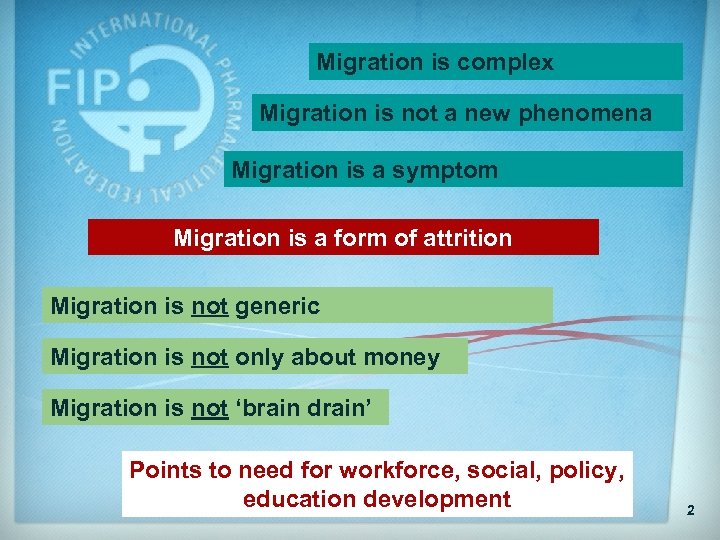
Migration is complex Migration is not a new phenomena Migration is a symptom Migration is a form of attrition Migration is not generic Migration is not only about money Migration is not ‘brain drain’ Points to need for workforce, social, policy, education development 2
Overview • • • Migration is a symptom, not the cause Workforce trends Migration intention study Questions for higher education providers 3
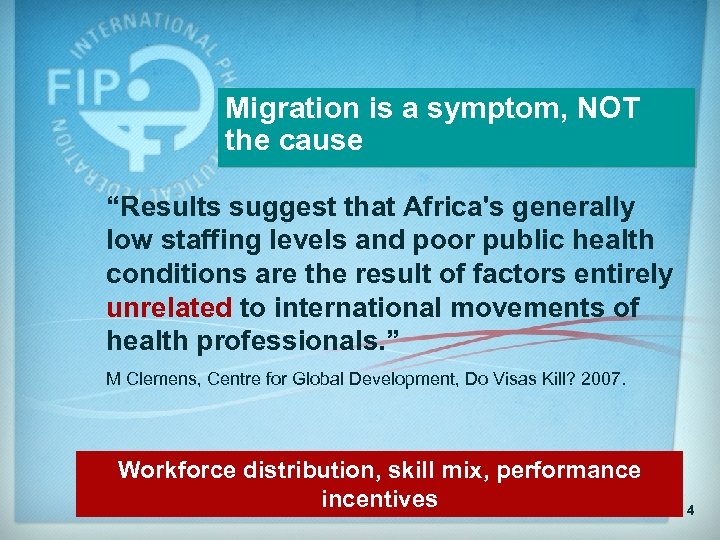
Migration is a symptom, NOT the cause “Results suggest that Africa's generally low staffing levels and poor public health conditions are the result of factors entirely unrelated to international movements of health professionals. ” M Clemens, Centre for Global Development, Do Visas Kill? 2007. Workforce distribution, skill mix, performance incentives 4
Migration is a symptom, NOT the cause “International migration is neither the main cause nor would its reduction be the solution to the worldwide health human resources crisis. ” J Dumont, P Zurn. OECD. Immigrant health workers in OECD countries in the broader context of highly skilled migration. 2007. Training capacity, employment opportunities, workforce distribution, 5
Migration is a symptom, NOT the cause “Attitudes towards professional practice, social and political environment at home coupled with perception of opportunities for economic and professional development abroad drive migration intentions” IPSF, FIP, School of Pharmacy University of London, 2007 Quality of education, working environment, learning and professional opportunities, social development 6
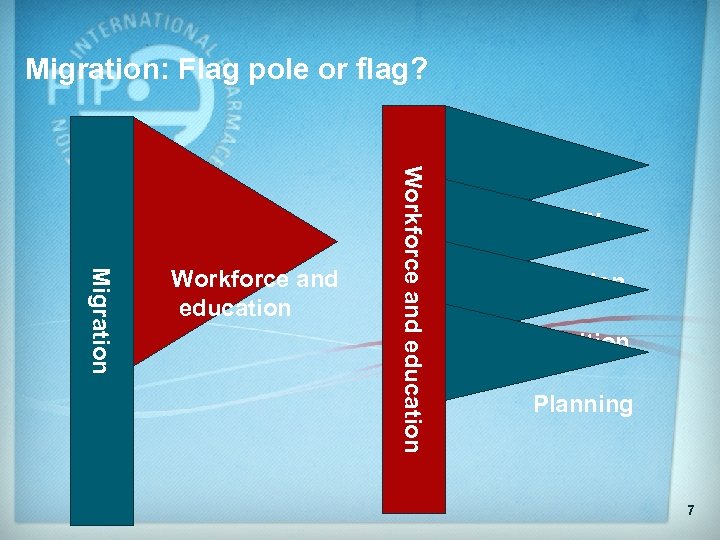
Migration: Flag pole or flag? Workforce and education Migration Workforce and education Entry Retention Attrition Planning 7
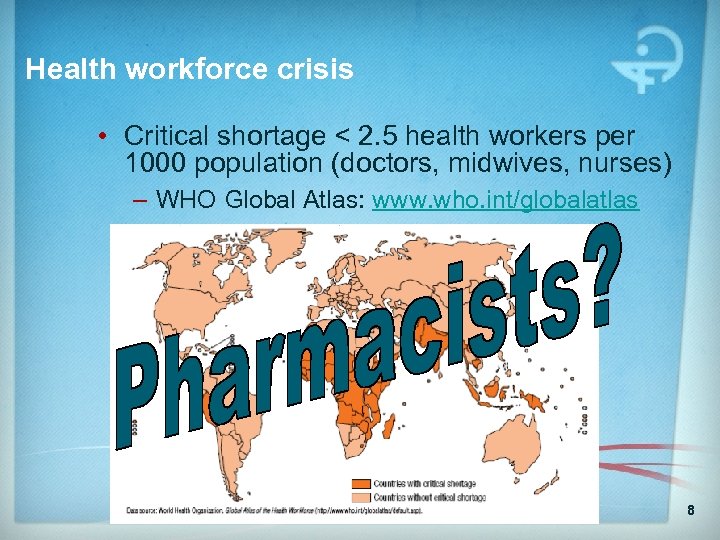
Health workforce crisis • Critical shortage < 2. 5 health workers per 1000 population (doctors, midwives, nurses) – WHO Global Atlas: www. who. int/globalatlas 8
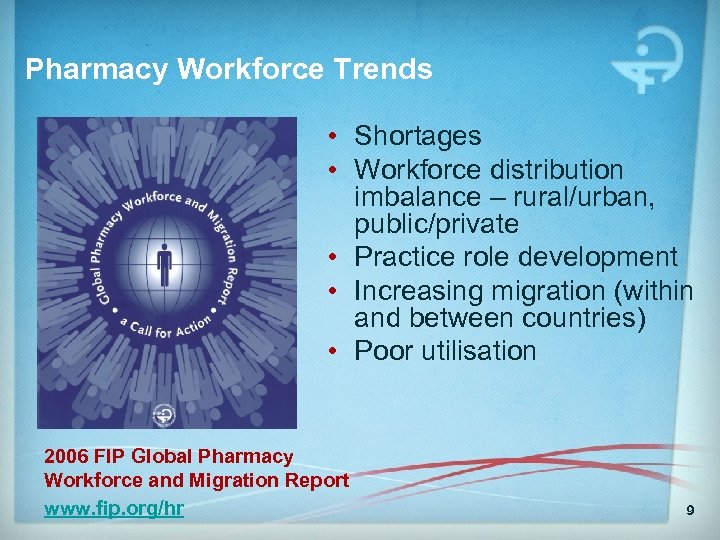
Pharmacy Workforce Trends • Shortages • Workforce distribution imbalance – rural/urban, public/private • Practice role development • Increasing migration (within and between countries) • Poor utilisation 2006 FIP Global Pharmacy Workforce and Migration Report www. fip. org/hr 9

Drivers of migration 10
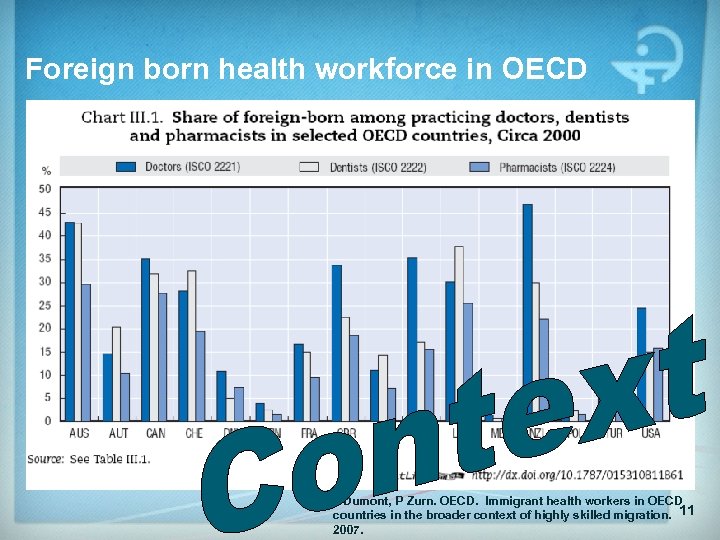
Foreign born health workforce in OECD J Dumont, P Zurn. OECD. Immigrant health workers in OECD countries in the broader context of highly skilled migration. 11 2007.
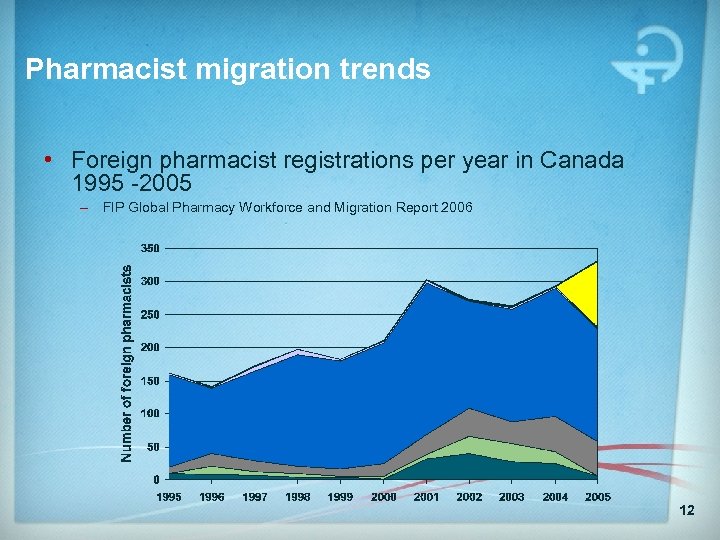
Pharmacist migration trends • Foreign pharmacist registrations per year in Canada 1995 -2005 – FIP Global Pharmacy Workforce and Migration Report 2006 12
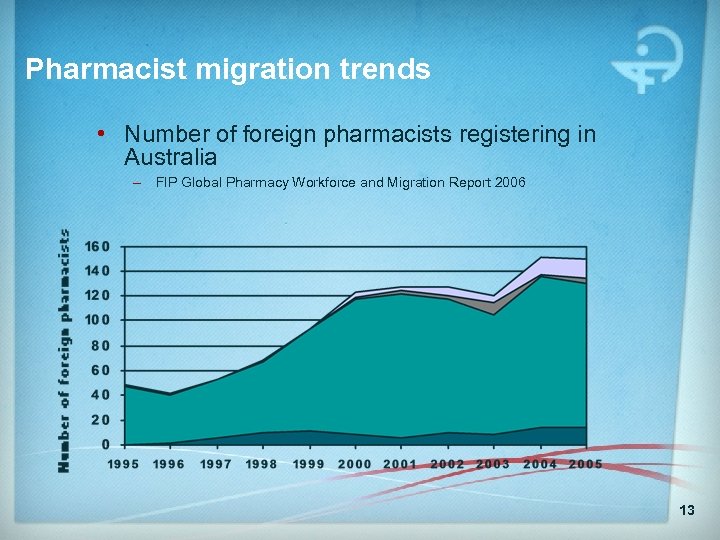
Pharmacist migration trends • Number of foreign pharmacists registering in Australia – FIP Global Pharmacy Workforce and Migration Report 2006 13
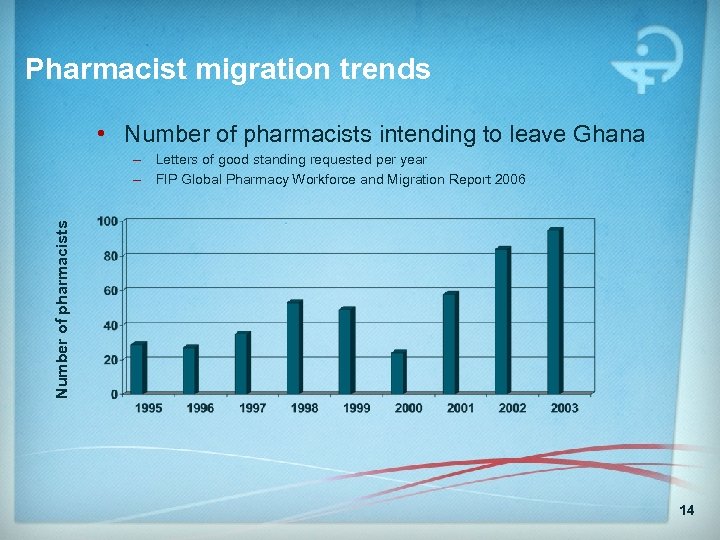
Pharmacist migration trends • Number of pharmacists intending to leave Ghana Number of pharmacists – Letters of good standing requested per year – FIP Global Pharmacy Workforce and Migration Report 2006 14
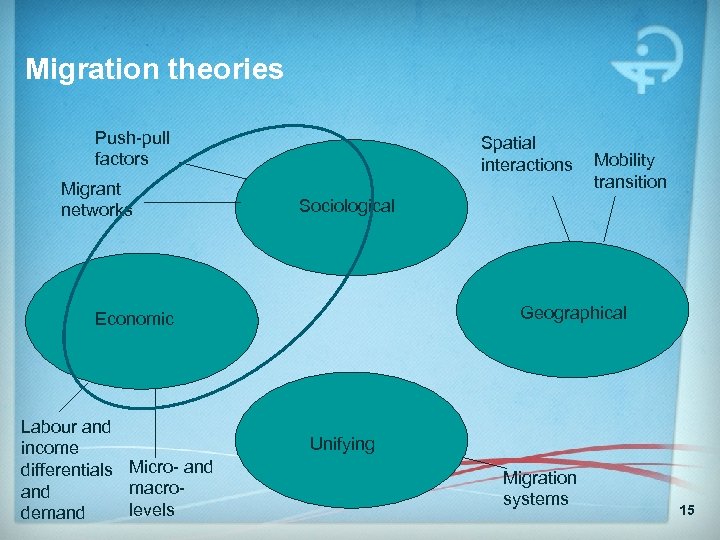
Migration theories Push-pull factors Migrant networks Spatial interactions Sociological Geographical Economic Labour and income differentials Micro- and macroand levels demand Mobility transition Unifying Migration systems 15
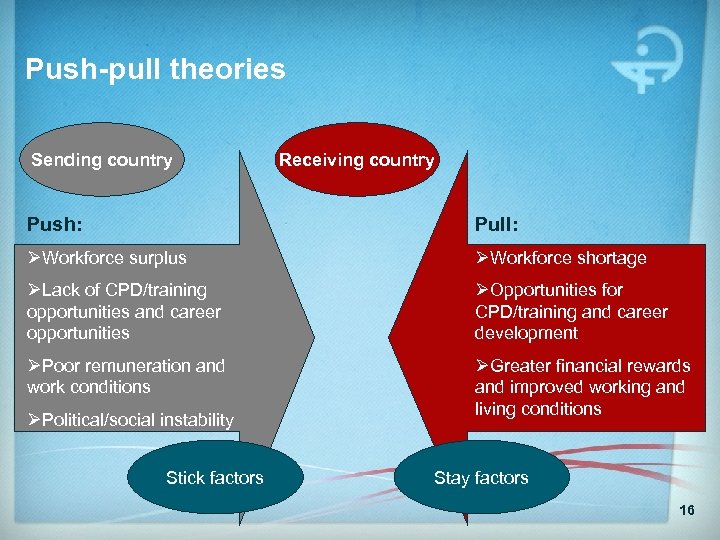
Push-pull theories Sending country Receiving country Push: Pull: ØWorkforce surplus ØWorkforce shortage ØLack of CPD/training opportunities and career opportunities ØOpportunities for CPD/training and career development ØPoor remuneration and work conditions ØGreater financial rewards and improved working and living conditions ØPolitical/social instability Stick factors Stay factors 16
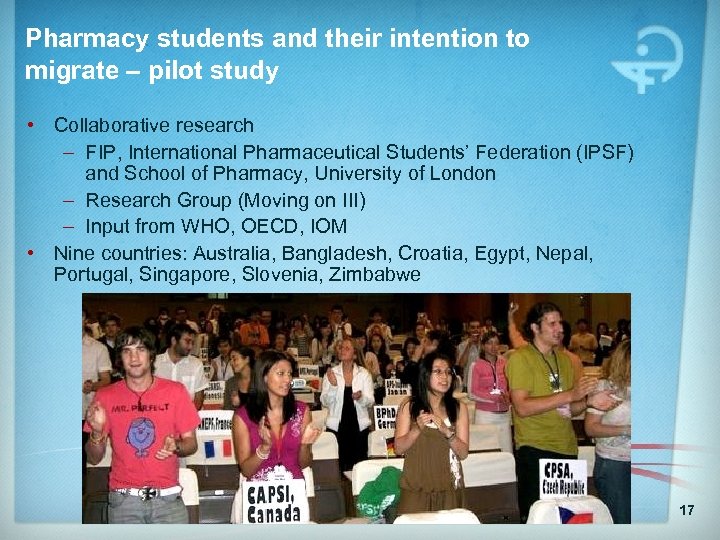
Pharmacy students and their intention to migrate – pilot study • Collaborative research – FIP, International Pharmaceutical Students’ Federation (IPSF) and School of Pharmacy, University of London – Research Group (Moving on III) – Input from WHO, OECD, IOM • Nine countries: Australia, Bangladesh, Croatia, Egypt, Nepal, Portugal, Singapore, Slovenia, Zimbabwe 17
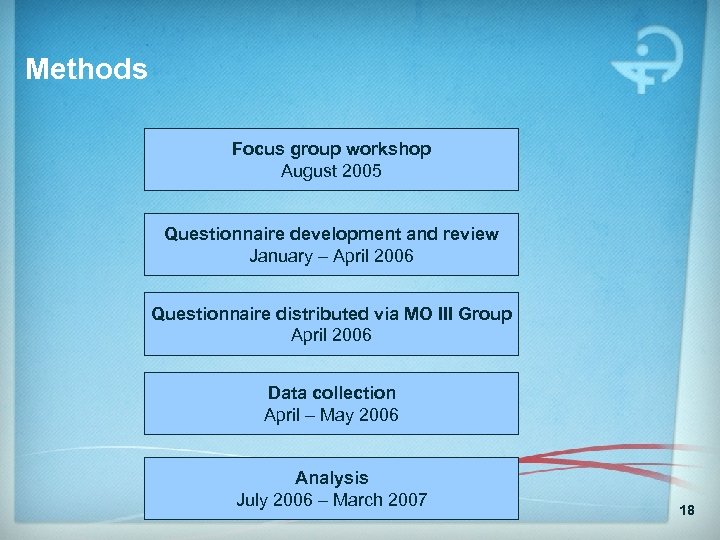
Methods Focus group workshop August 2005 Questionnaire development and review January – April 2006 Questionnaire distributed via MO III Group April 2006 Data collection April – May 2006 Analysis July 2006 – March 2007 18
Results • 791 final year pharmacy student respondents • 9 countries: – Australia (336), Croatia (96), Singapore (60), Portugal (55), Zimbabwe (37), Bangladesh (58), Nepal (31), Egypt (103), Slovenia (25) • Mean age: 22 years • 61% respondents female • Top destination countries: UK, USA, Australia 19
Intention to migrate • 52% respondents plan to migrate – 2/3 plan long-term migration (> 2 years) • 80% of international students plan to migrate – 80% plan long-term migration – Implications for cross-border education? • Students with past experience abroad are more likely to migrate (79% vs 49%, p<0. 001). • Variation in % planning to migrate between and within countries – 13% (Croatia) – 90% (Bangladesh) – Influence of education on attitudes & intention? 20
Drivers of Migration • Factor 1: professional practice environment and status in own country – 10 items, α= 0. 8 • Factor 2: opportunity to develop career and resources abroad – 4 items, α= 0. 7 • Factor 3: social and political environment in own country – 5 items, α= 0. 7 21
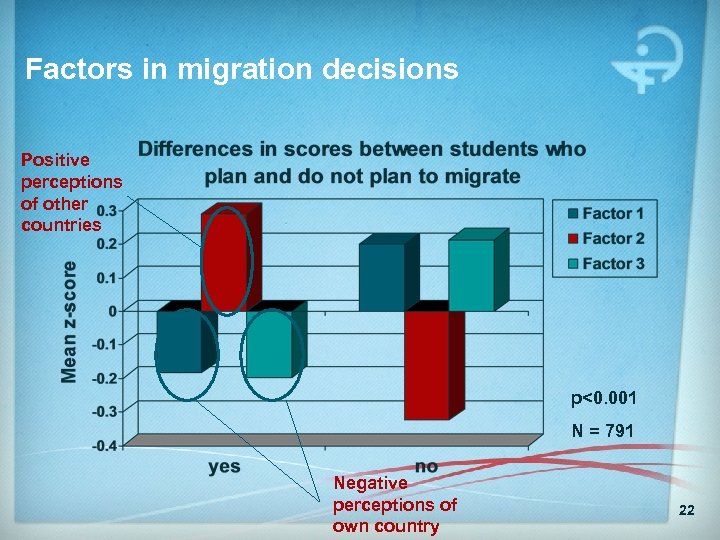
Factors in migration decisions Positive perceptions of other countries p<0. 001 N = 791 Negative perceptions of own country 22
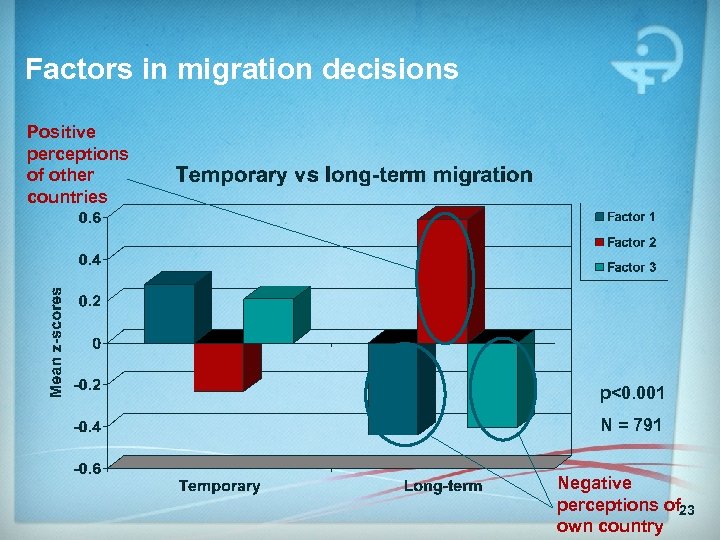
Factors in migration decisions Positive perceptions of other countries p<0. 001 N = 791 Negative perceptions of 23 own country
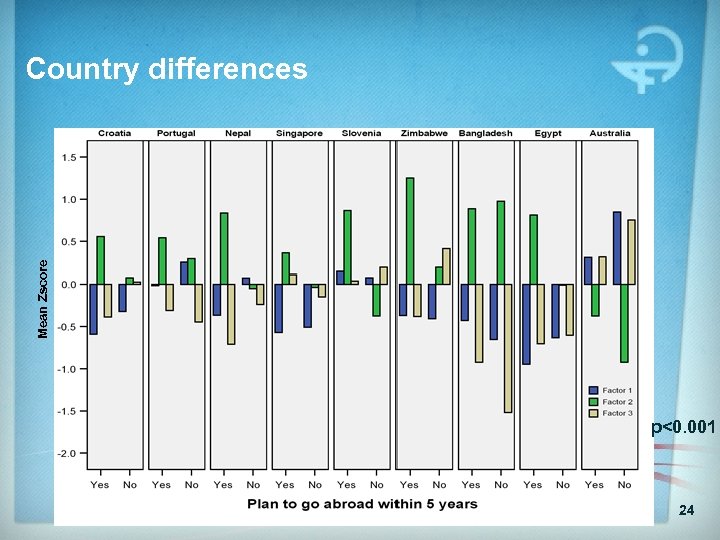
Mean Zscore Country differences p<0. 001 24
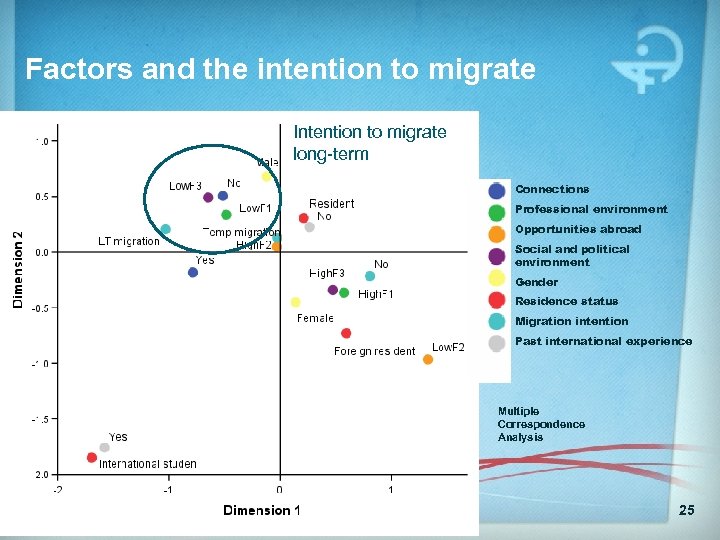
Factors and the intention to migrate Intention to migrate long-term Connections Professional environment Opportunities abroad Social and political environment Gender Residence status Migration intention Past international experience Multiple Correspondence Analysis 25
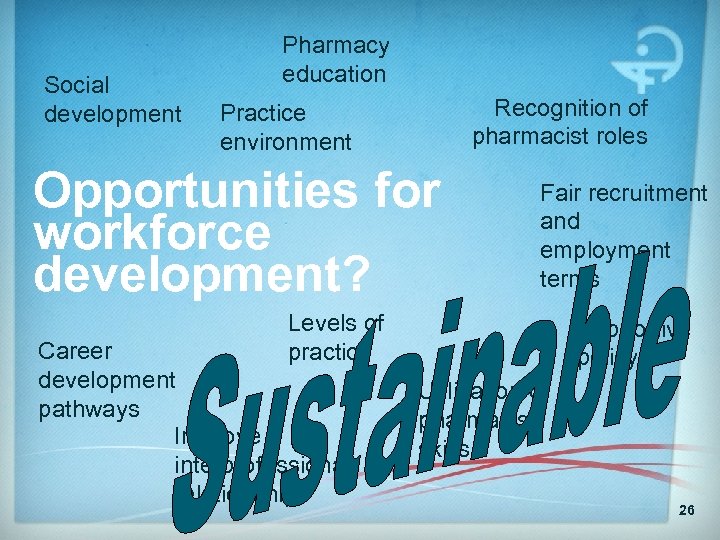
Social development Pharmacy education Recognition of pharmacist roles Practice environment Opportunities for workforce development? Fair recruitment and employment terms Levels of practice Career development pathways Improve interprofessional relationships Supportive policy Utilisation of pharmacist skills 26
Questions for higher education What is the influence of the quality of education on attitudes that drive the intention to migrate? What is the responsibility of higher education providers to produce and support a workforce catered for local needs? What is the role of life long learning and local post-graduate learning opportunities? Migration = attrition 27
Stepping up global and national action • Drivers of migration study (20+ countries) • 2007 pharmacy workforce study (2008 report) • FIP-WHO Pharmacy Education Taskforce – Global Pharmacy Education Consultation (2007) – Competency, academic workforce, quality • FIP Global Conference on the Future of Hospital Pharmacy – workshop on HRH • Global Health Workforce Alliance – scaling up education and training, migration • Country case study and pharmacy human resource policy development – Zambia • And more……. 28
More information • • FIP Human Resources for Health: www. fip. org/hr WHO World Health Report 2006: www. who. int/whr/2006/en Global Atlas of the Health Workforce: www. who. int/globalatlas Human Resources for Health Journal: www. human-resourceshealth. com • International Organization for Migration: www. iom. int • HRH Global Resource Center: http: //www. hrhresourcecenter. org Acknowledgements: • • IPSF Moving On III Research Group and Executive Mr Ton Hoek, CEO and General Secretary, FIP Mr Xuan Hao Chan, Project Coordinator, FIP Prof Hugo Mercer, HRH Department, WHO 29

www. fip. org/hr tana@fip. org 30
Скачать презентацию Migration intentions of pharmacy students A global study
116d6ae9ef7403555f294659d242f60c.ppt