


 Скачать презентацию Migration Chapter 3 Field Note Risking Lives
a44307816560e1bc3d89daaae2218ec3.ppt
- Количество слайдов: 63
 Migration Chapter 3
 Field Note: Risking Lives for Remittances • Boat People – Where? Why? Results? • “Wet Foot - Dry Foot”---name given to a consequence of the 1995 revision of the Cuban Adjustment Act of 1966 that essentially says that anyone who fled Cuba and entered the United States would be allowed to pursue residency a year later. • Haitian v Cuban immigration • Remittance: – What is it? How Much? (30% of Haiti’s GNP) • Legal vs. Illegal (11, 000 illegals in U. S. ) • Globalization (vast majority of legal ag workers in Canada are Mexican) • Carter v Reagan imm policy – NAFTA (Clinton initiative)
 Key Question: What is Migration?
 MOVEMENT • Cyclic Movement – movement away from home for a short period… – Commuting – Seasonal movement – Nomadism • Periodic Movement – movement away from home for a longer period. – Migrant labor – Transhumance--system of pastoral farming whereby livestock and their keepers adjust their location to the seasonal availability of pastures – Military service Both involve returning home. What are their activity spaces? Who has the largest activity space? D. C. commuters travel up to 100 mi. each way
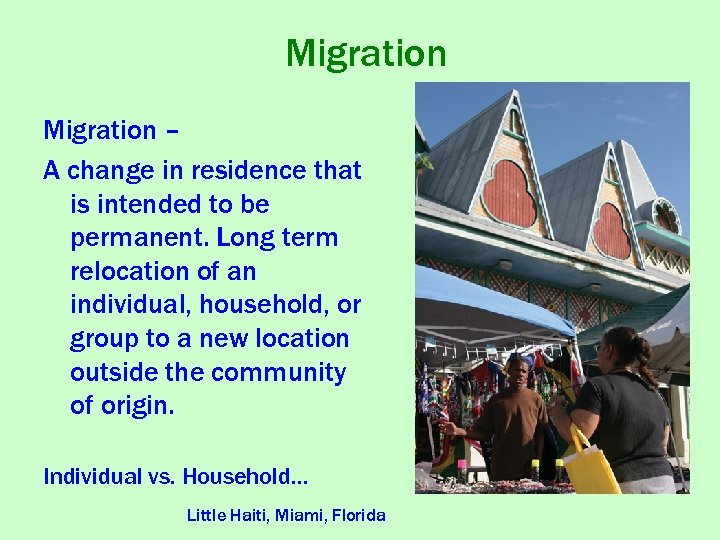 Migration – A change in residence that is intended to be permanent. Long term relocation of an individual, household, or group to a new location outside the community of origin. Individual vs. Household… Little Haiti, Miami, Florida
 Nomadism • Type of cyclic movement that is still found in parts of Asia and Africa but dwindling. Takes place according to travel patterns and is repeated time and time again.
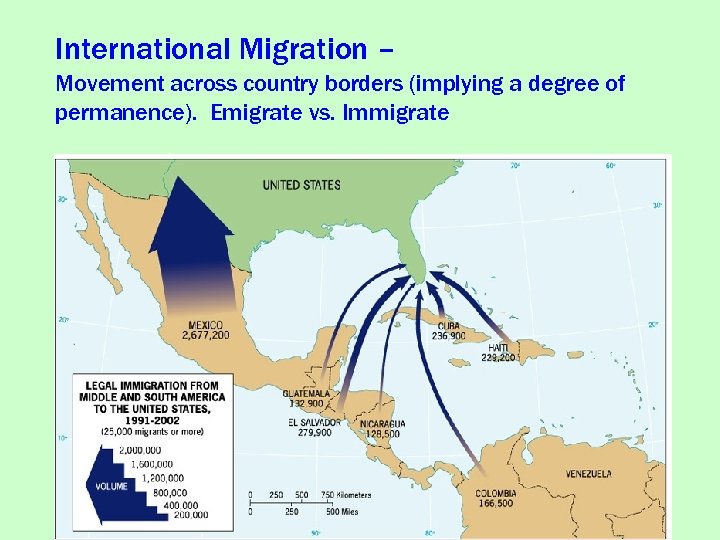 International Migration – Movement across country borders (implying a degree of permanence). Emigrate vs. Immigrate
 Immigration Reform and Control Act (1986) US law that gave amnesty and permanent residence to 2. 6 million migrants who were living in the US. Under IRCA, legal migrants could move anywhere, most moved to Great Plains, Midwest, and South
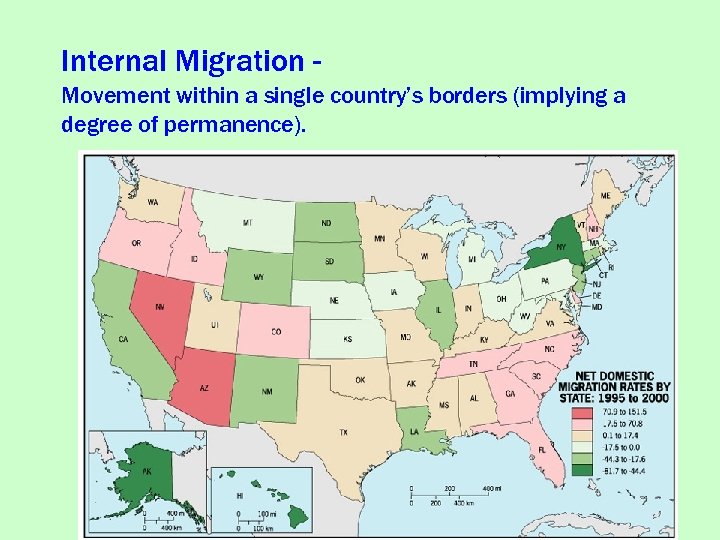 Internal Migration Movement within a single country’s borders (implying a degree of permanence).
 Peru Less mobile society than US, pattern of internal migration is generally from rural to urban (Lima) where global and national investment capital is concentrated.
 Common Flows of Americans • 1900 -1980 Black in America South to Northern cities… Now returning to the South. • Americans moving to Sunbelt and Far West • Most Place migration is rural to urban • Most migrants in poor places move short distance • Individuals move farther and easier than families • All Migrations have a counter migration • Men are mobile than women (more employment opportunities for men & earn more)
 Net-In Migration v Net-Out Migration NI--number of immigrants greater than the number of emigrants NO--number of emigrants greater than the number of immigrants
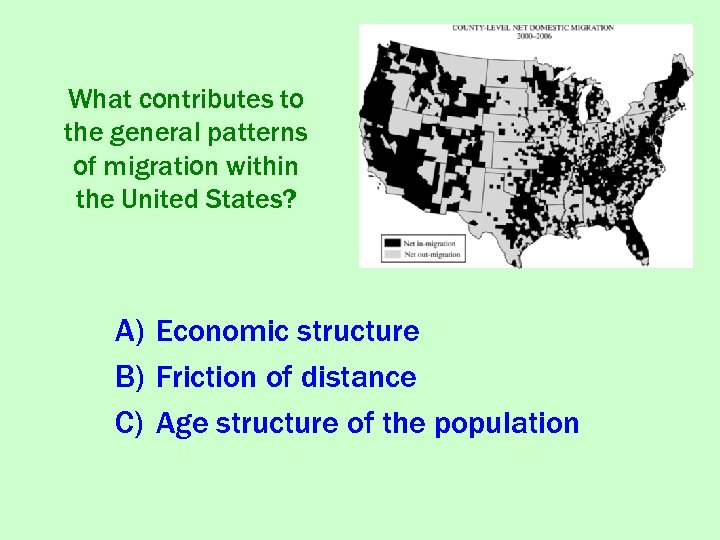 What contributes to the general patterns of migration within the United States? A) Economic structure B) Friction of distance C) Age structure of the population
 Economic Structure 1. Changing techniques and/or practices in primary sector activities (mechanization, corporate farms): loss of primary sector jobs leads to out-migration from rural areas. 2. Deindustrialization: loss of secondary sector jobs leads to out-migration from rural areas. 3. Shift to tertiary (service oriented) and quarternary (high tech, recreation/resort, health care) sector jobs. Leads to inmigration to those areas. 4. Suburbanization: Growth of jobs in suburban areas at the expense of the city leads to in-migration to the suburbs.
 Friction of Distance--the notion that distance usually requires some amount of effort (energy) and/or money to overcome; the increase in time and cost that usually comes with increasing distance 1. 2. 3. 4. Gravity model (areas of in-migration may be related to the amount of interaction between places) Telecommuting: no longer necessary to live close to work; people can locate outside of main employment sources---i. e. suburbs or beyond where friction of distance is not as important as it used to be. Suburbanization/sprawl/interregional migration: people are willing to commute or move greater distances because of improved transportation and/or communication Change in locational decision making: footloose industries (ind that can be placed and located at any location without effect from factors such as resources or transport) are more flexible about where they locate, including areas that were not previously part of the ec heartland---leads to net in-migration for these jobs.
 Age Structure 1. Retirees move to retirement areas such as the Sun Belt or Fla to take adv of weather, amenities, etc. 2. Young people move to areas for more employment choices or for greater social or cultural opp 3. Young couples with children move toward suburban locations to provide amenity-rich envir for their family
 Choose one type of cyclic or periodic movement and then think of a specific example of the kind of movement changes both the home and the destination. How do these places change as a result of this cyclic or periodic movement?
 Key Question: Why do People Migrate?
 Why do People Migrate? • Forced Migration – Human migration flows in which the movers have no choice but to relocate… Causes? – Forces = Safety, environmental, starvation, & warfare • Big ones in History – Jews out of Israel, African Slave trade, Trail of Tears, Vietnamese boat people, Irish Potato Famine, Convicts from UK to Aust, Haitians, Afghans
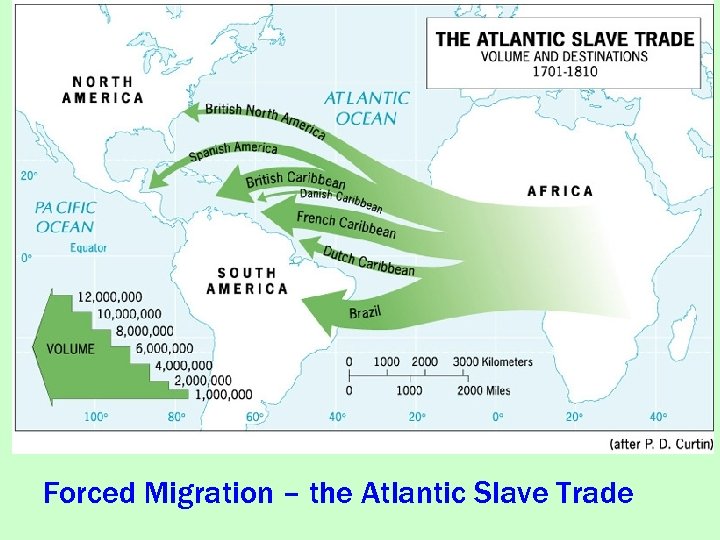 Forced Migration – the Atlantic Slave Trade
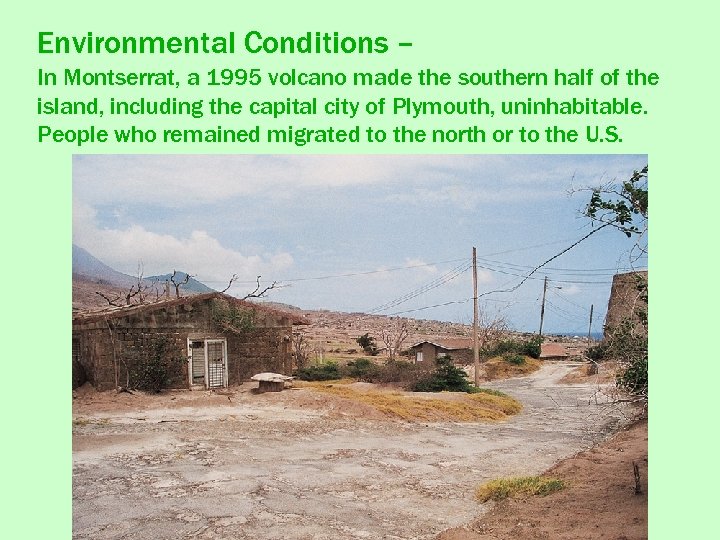 Environmental Conditions – In Montserrat, a 1995 volcano made the southern half of the island, including the capital city of Plymouth, uninhabitable. People who remained migrated to the north or to the U. S.
 Why do People Migrate? • Voluntary Migration – Human migration flows in which the movers respond to perceived opportunity, not force. – Jobs, Freedom • Migrants weigh push and pull factors to decide first, to emigrate from the home country and second, where to go.
 *Push Factors---the conditions and perceptions that help the migrant decide to leave a place *Pull Factors---circumstances that attract the migrant to certain locales from other places Types of Push and Pull Factors: • Legal Status • Economic Conditions • Political Circumstances • Armed Conflict and Civil War • Environmental Conditions • Culture and Traditions • Technological Advances
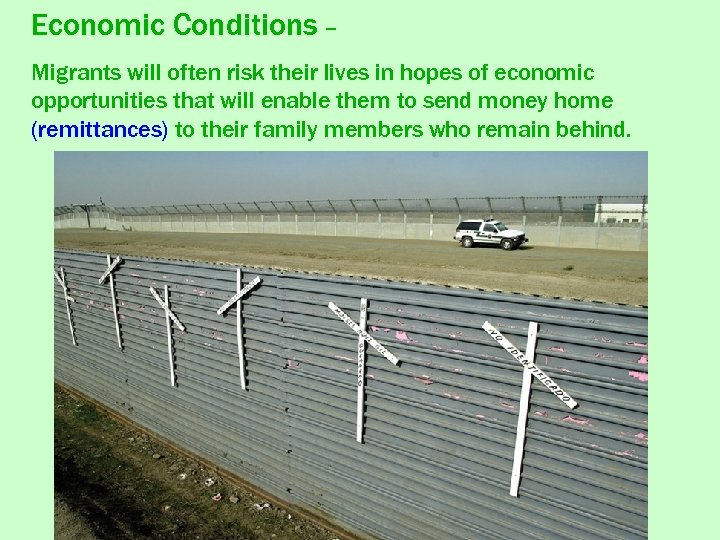 Economic Conditions – Migrants will often risk their lives in hopes of economic opportunities that will enable them to send money home (remittances) to their family members who remain behind.
 Kinds of Voluntary Migration • Step Migration – When a migrant follows a path of a series of stages, or steps toward a final destination. i. e. Brazilian peasants * intervening opportunity –at one of the steps along the path, pull factors encourage the migrant to settle there. i. e. Great Migration • Chain Migration – When a migrant communicates to family and friends at home, encouraging further migration along the same path, along kinship links.
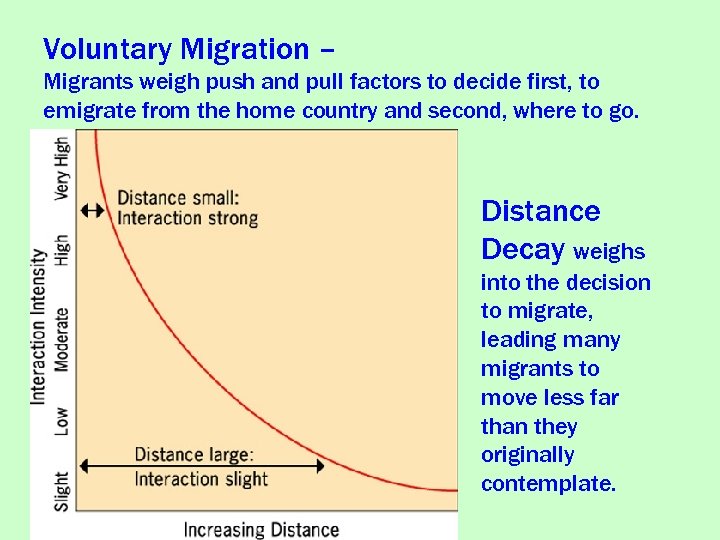 Voluntary Migration – Migrants weigh push and pull factors to decide first, to emigrate from the home country and second, where to go. Distance Decay weighs into the decision to migrate, leading many migrants to move less far than they originally contemplate.
 Gravity Model Ernst Ravenstien • Since larger places attract people, ideas, and commodities more than smaller places and places closer together have a greater attraction, the gravity model incorporates these two features. • The relative strength of a bond between two places is determined by multiplying the population of city A by the population of city B and then dividing the product by the distance between the two cities squared.
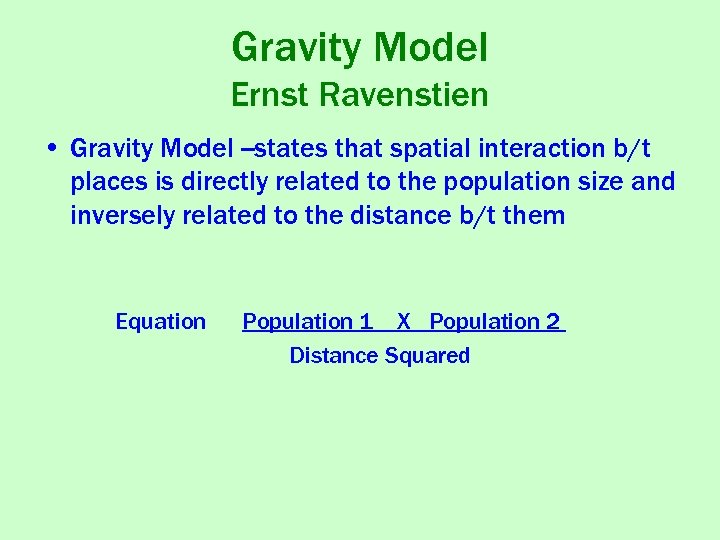 Gravity Model Ernst Ravenstien • Gravity Model --states that spatial interaction b/t places is directly related to the population size and inversely related to the distance b/t them Equation Population 1 X Population 2 Distance Squared
 Laws of Migration Ernst Ravenstien • http: //www. slideshare. net/geographyallthe way/geography-ravensteins-laws-ofmigration
 Think about a migration flow within your family, whether internal, international, voluntary, or forced. The flow can be one you experienced or one you only heard about through family. List the push and pull factors. Then, write a letter in the first person (if you were not involved, pretend you were your grandmother or whomever) to another family member at “home” describing how you came to migrate to your destination.
 Key Question: Where do People Migrate?
 Global Migration Flows • Between 1500 and 1950, major global migration flows were influenced largely by: – Exploration – Colonization (Eur migration to colonies peaked 1700 -1800) – Br colonial auth stimulated migration from S Asia to Singapore, Fiji, Trinidad – The Atlantic Slave Trade Impacts the place the migrants leave and where the migrants go.
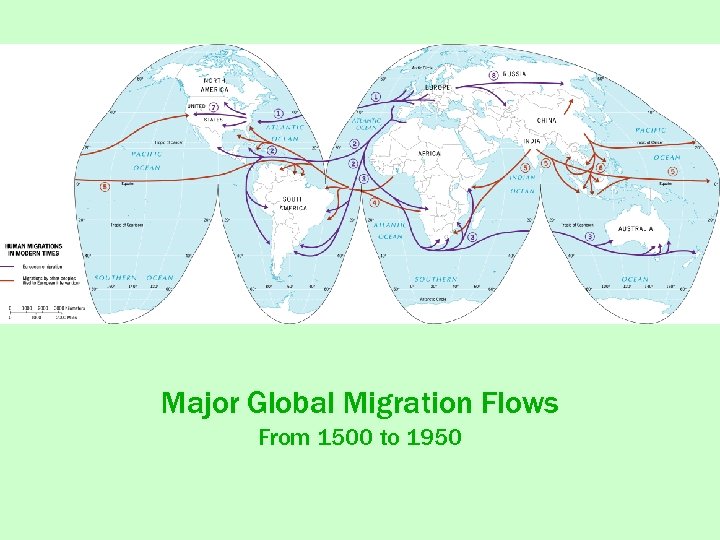 Major Global Migration Flows From 1500 to 1950
 Regional Migration Flows • Migrants go to neighboring countries: - for short term economic opportunities. (Remittance) - to reconnect with cultural groups across borders. - to flee political conflict or war.
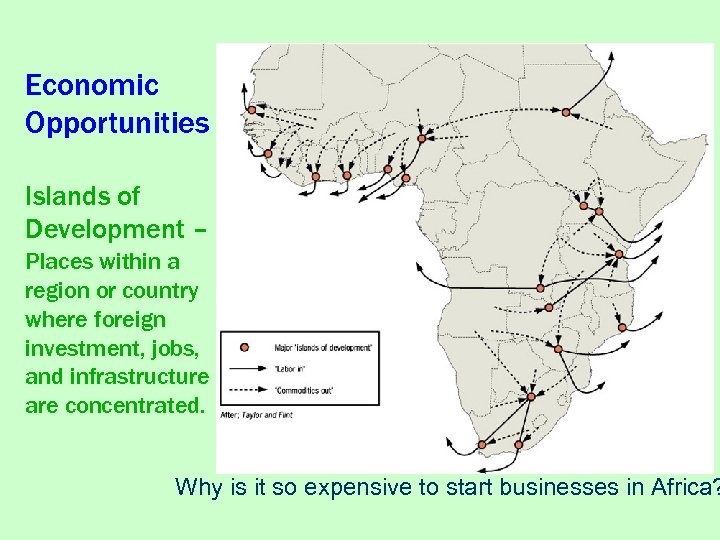 Economic Opportunities Islands of Development – Places within a region or country where foreign investment, jobs, and infrastructure are concentrated. Why is it so expensive to start businesses in Africa?
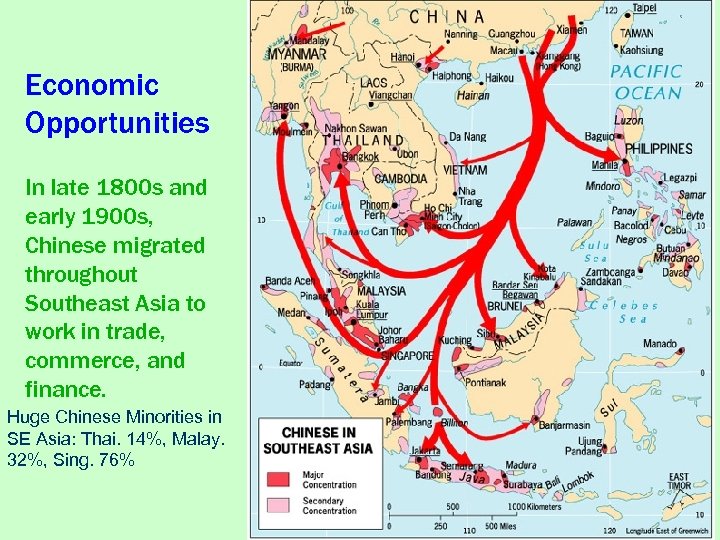 Economic Opportunities In late 1800 s and early 1900 s, Chinese migrated throughout Southeast Asia to work in trade, commerce, and finance. Huge Chinese Minorities in SE Asia: Thai. 14%, Malay. 32%, Sing. 76%
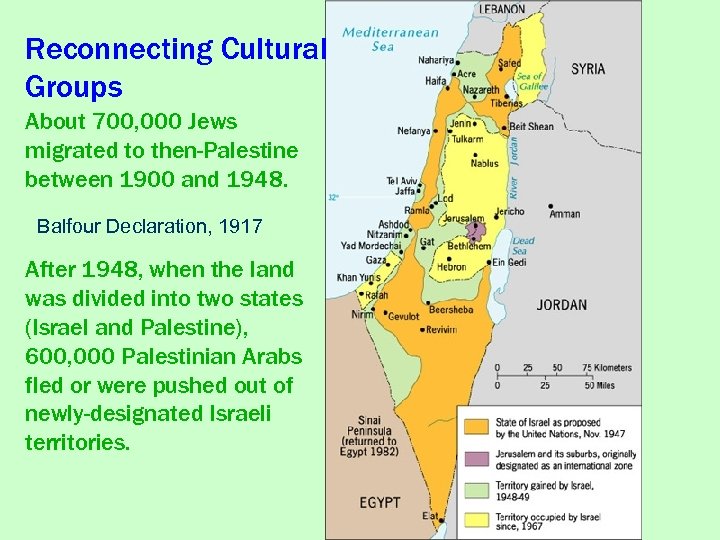 Reconnecting Cultural Groups About 700, 000 Jews migrated to then-Palestine between 1900 and 1948. Balfour Declaration, 1917 After 1948, when the land was divided into two states (Israel and Palestine), 600, 000 Palestinian Arabs fled or were pushed out of newly-designated Israeli territories.
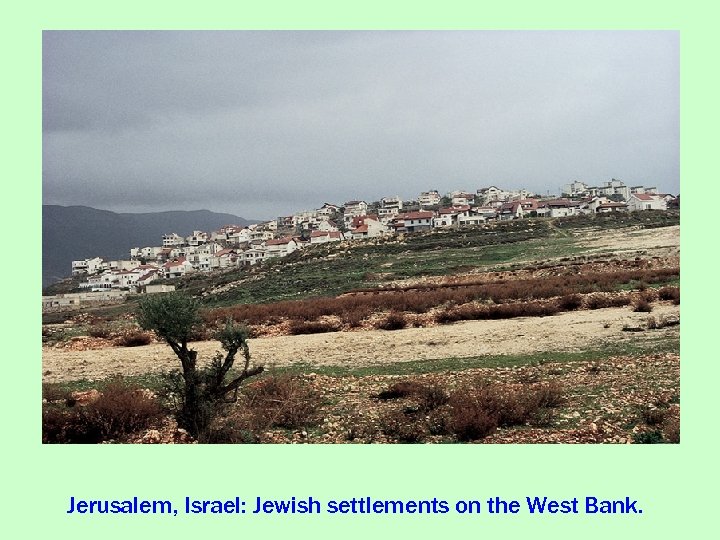 Jerusalem, Israel: Jewish settlements on the West Bank.
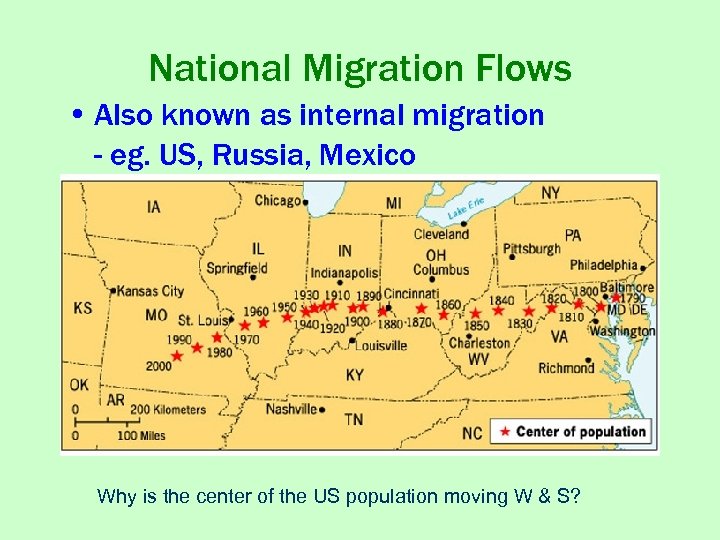 National Migration Flows • Also known as internal migration - eg. US, Russia, Mexico Why is the center of the US population moving W & S?
 Guest Workers • Guest workers – migrants whom a country allows in to fill a labor need, assuming the workers will go “home” once the labor need subsides. - have short term work visas - send remittances to home country
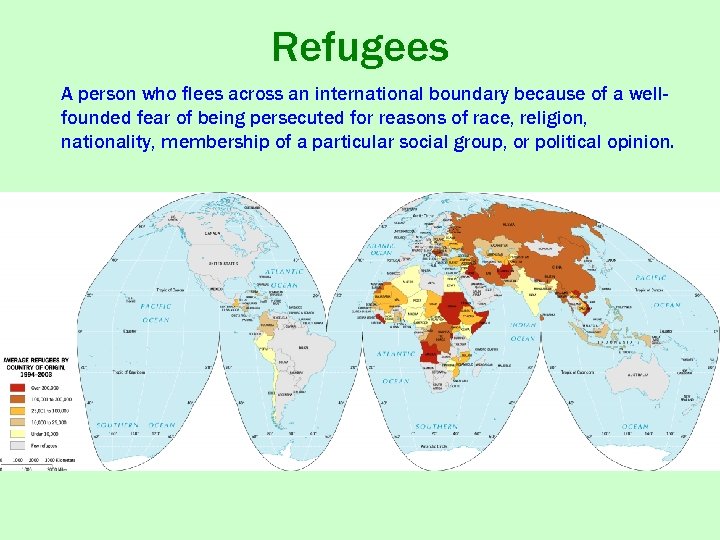 Refugees A person who flees across an international boundary because of a wellfounded fear of being persecuted for reasons of race, religion, nationality, membership of a particular social group, or political opinion.
 Reasons for Leaving A) Political Fear of life during conflict or war; pol. Persecution or pol. Imprisonment; forcibly evicted by gov or military. B) Social Religious, ethnic, or racial persecution; rights or opp denied based on gender or sexuality. C) Environmental Natural disaster; pollution or human-caused disaster; epidemics/disease; food insecurity/famine
 Afghanistan War (Taliban v. NATO or Taliban v Afghanis) Religious/Ethnic/Gender Persecution (Taliban Wahhabis persecuting other Sunnis or Shiites; Pashtun dominance over other ethnic groups like Hazara, Uzbeks, Tajiks; rights or opp denied based on gender or sexuality) Poverty (food insecurity, lack of water, little infrastructure, education, med care)
 Somalia War (Between warlords; warlords or militants like Al-Shabaab v UN-backed gov) Religious/Ethnic/Gender Persecution (Militant Wahhabis like the Salafist persecuting other Sunnis, Animists or Christians; tribal conflicts; rights or opp denied based on gender or sexuality) Poverty/Famine (Food insecurity, lack of water, little infrastructure, education, or med care)
 Iraq War (U. S. invasion in 2003; flight or exclusion of Baathists; fear of U. S. collaborators) Religious/Ethnic/Gender Persecution (Sunni or ISIS v Shia; Muslim v non-Muslim like Christians, Jews or Chaldeans; Arabs v Kurds; rights or opp denied based on gender or sexuality) Poverty (Food insecurity, lack of water, little infrastructure, education, or med care)
 Syria War (Internal civil war between Baathists led by Assad gov and opposition Free Syrian Army or ISIS) Religious/Ethnic/Gender Persecution (Sunni v Alawite or Shia; Muslim v Non-Muslim like Christians or Druze; Arabs v Kurds or other non. Arabs; rights or opp denied based on gender or sexuality) Poverty (Food insecurity, lack of water, little infrastructure, education, or med care)
 Sudan War (Gov forces or militias like Janjaweed v minorities) Religious/Ethnic/Gender Persecution (Muslim v non-Muslim like Christians or Animists; Arabic African v sub-Saharan African; tribal differences; rights or opp denied based on gender or sexuality) Poverty (Food insecurity, lack of water, little infrastructure, education, or med care)
 Regions of Dislocation – (DP’s) What regions generate the most refugees? • Subsaharan Africa (Rwanda) • North Africa and Southwest Asia (Sudan & Somalia, Afghanistan) • South Asia (India, Sri Lanka) • Southeast Asia (Myanmar, Cambodia, Vietnam) • Europe (Yugoslav Republics) What are the characteristics of a Refugee?
 Economic Impact of Refugees 1. 2. 3. 4. 5. 6. 7. 8. 9. Adds to available low-wage labor pool. Competition with locals for limited jobs. Additional cost on receiving country to provide services (e. g. housing, food, education, health care) May result in higher taxes. Increased demand for goods and services that may result in price increases. Increased strain on natural resources. Refugee camps financially depend on receiving country. May pose costly security risks for receiving country. Refugees may provide skills and knowledge.
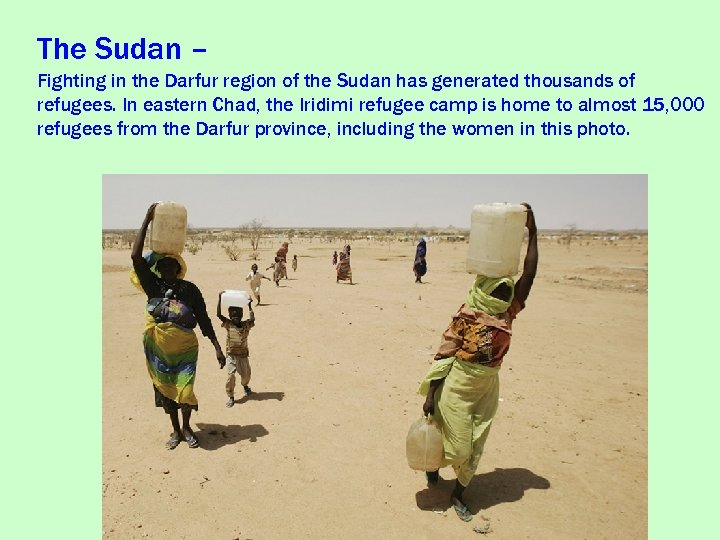 The Sudan – Fighting in the Darfur region of the Sudan has generated thousands of refugees. In eastern Chad, the Iridimi refugee camp is home to almost 15, 000 refugees from the Darfur province, including the women in this photo.
 Afghanistan The Soviet intervention in the Afghan civil war (1979) caused double migration stream to Iran and Pakistan. The Afghan Taliban (Islamic fundamentalists), spawned in Pakistan, created a counter migration of 2. 5 million Afghanis to Iran when Taliban came to power.
 Gulf War (1991) and Iraqi War (2003 -14) • Millions of refugees • Signif % of Kurds of no. Iraq forced to leave their villages and flee across the Turkish/Iraqi border (1991). • Recent war in Iraq generated over 2 million refugees most turning to Syria and Jordan.
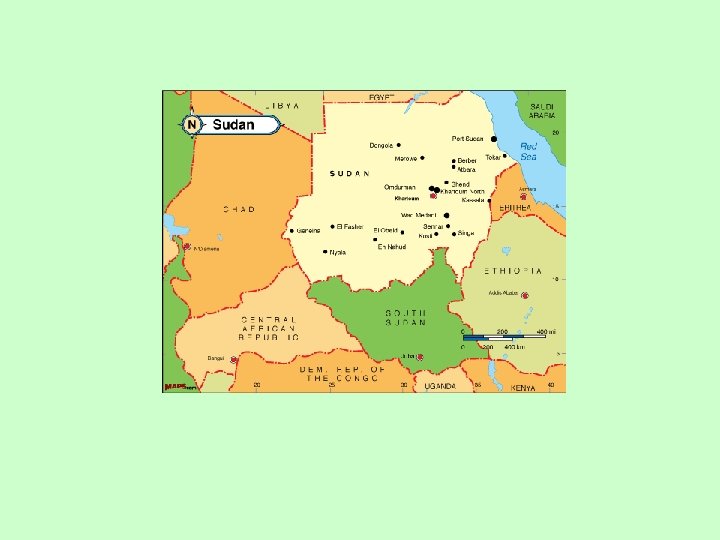
 Subsaharan Africa • Among the highest refugee flows in the world but pales in comparison to numbers of refugees in North Africa and Southwest Asia. • Most from Central and East Africa (DRC, Sudan, Somalia) • Sudanese Civil War (1999) b/t Arab and non -Arab Muslims led to South Sudan independence (2011).
 Imagine you are from an extremely poor country, and you earn less than $1 a day. Choose a country to be from, and look for it on a map. Assume you are a voluntary migrant. You look at your access to transportation and the opportunities you have to go elsewhere. Be realistic, and describe how you determine where you will go, how you get there, and what you do once you get there.
 Genocide The 1948 Convention on Genocide “acts committed with intent to destroy, in whole or in part, a national, ethnical, racial, or religious group. ” i. e. Janjaweed in Darfur, Sudan
 Yugoslavia • Collapse (devolution) in 1990 s produced largest refugee crisis (over 6, 000) in Europe since the end of WWII (before Syria 2011 -15).
 Colombia • Only country in the Western Hemisphere that had a serious refugee problem (3. 4 -4. 9 million) before 2000.
 Key Question: How do Governments Affect Migration?
 Governments Place Legal Restrictions on Migration • Immigration laws – laws that restrict or allow migration of certain groups into a country. i. e. U. S. laws (1882 -1907) vs. Chinese – Quotas limit the number of migrants from each region into a country. – A country uses selective immigration to bar people with certain backgrounds from entering. Why do countries chooses to limit immigration?
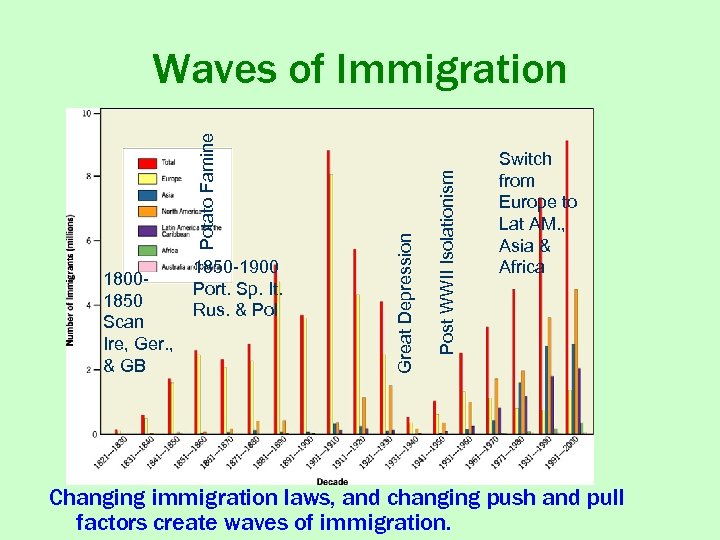 1850 -1900 Port. Sp. It. Rus. & Pol Post WWII Isolationism 18001850 Scan Ire, Ger. , & GB Great Depression Potato Famine Waves of Immigration Switch from Europe to Lat AM. , Asia & Africa Changing immigration laws, and changing push and pull factors create waves of immigration.
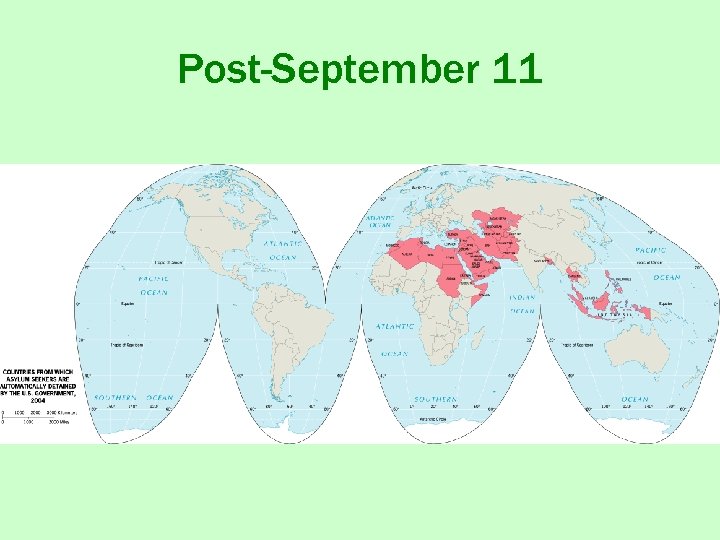 Post-September 11
 One goal of international organizations involved in aiding refugees is repatriation – return of the refugees to their home countries once threat against them has passed. Take the example of Sudanese refugees. Think about how their land their lives have changed since they became refugees. You are assigned the daunting task of repatriating Sudanese from Uganda once a peace solution is reached. What steps would you have to take to re-discover a home for these refugees?