


 Скачать презентацию Migration and Institutional Quality the case of Romania
08d6b4ac8f126d0294c753d18b522554.ppt
- Количество слайдов: 36
 Migration and Institutional Quality: the case of Romania Boris Najman Raluca Prelipceanu CES (University of Paris 1) European Population Conference, Barcelone 9 th-12 th July 2008
 Background (1) • Romania is the second largest populated country among the new EU members (21. 7 million inhabitants) • Romania and Poland are the main migrant sending countries within the E. U • Romania is the source country for about 2. 5 million temporary migrants and over 3 million permanent migrants (2002)
 Background (2) • Continuous population decrease between 1992 and 2002 (1. 1 mln or 5 % of the population; EBRD, 2007). • Internal migration trajectories : rural to urban (in the 70 s-80 s and early 90 s), urban to rural (mid 90 s) • From commuters to international migrants
 Background (3) • Dramatic fall of the GDP in the beginning of • • the 90 th Increasing level of poverty and high inequality in its distribution High levels of unemployment correlated with urban to rural migration Increasing weakness of institutions unable to provide public goods to all citizens Spread of corruption at all levels
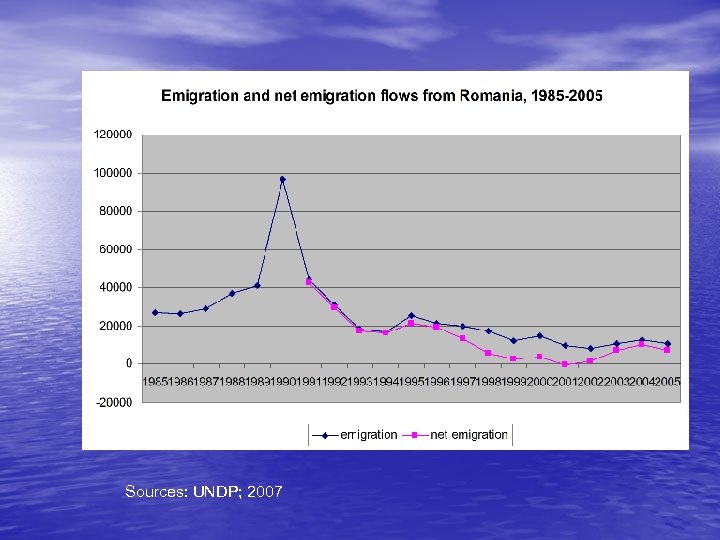
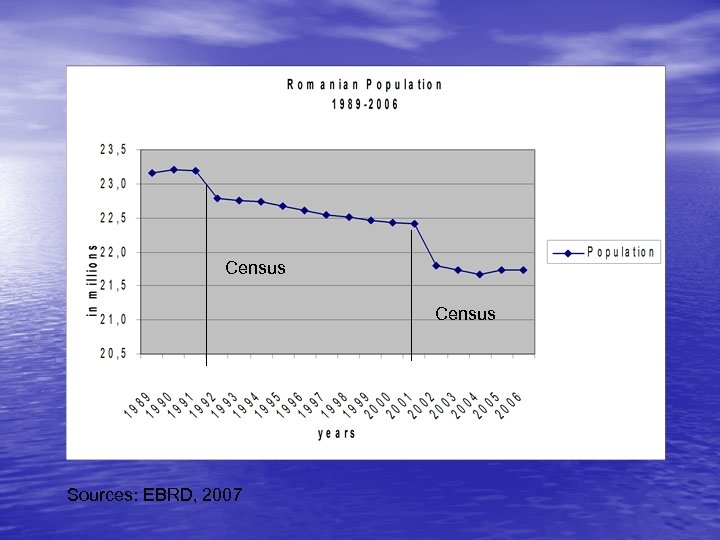 Census Sources: EBRD, 2007
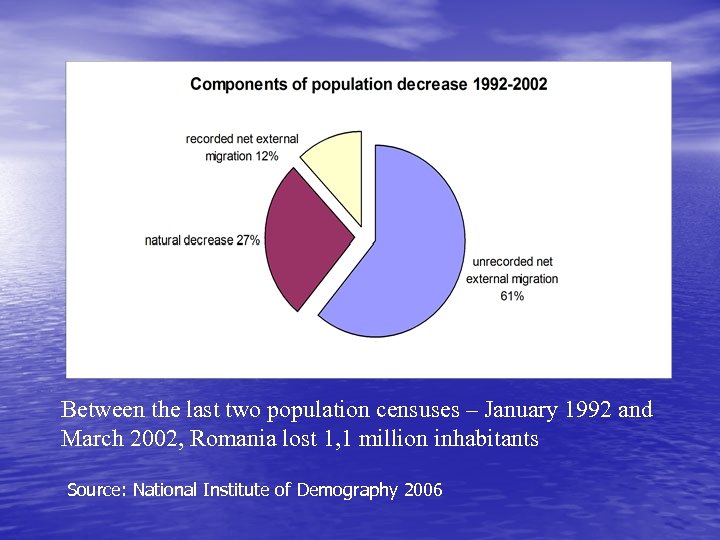 Between the last two population censuses – January 1992 and March 2002, Romania lost 1, 1 million inhabitants Source: National Institute of Demography 2006
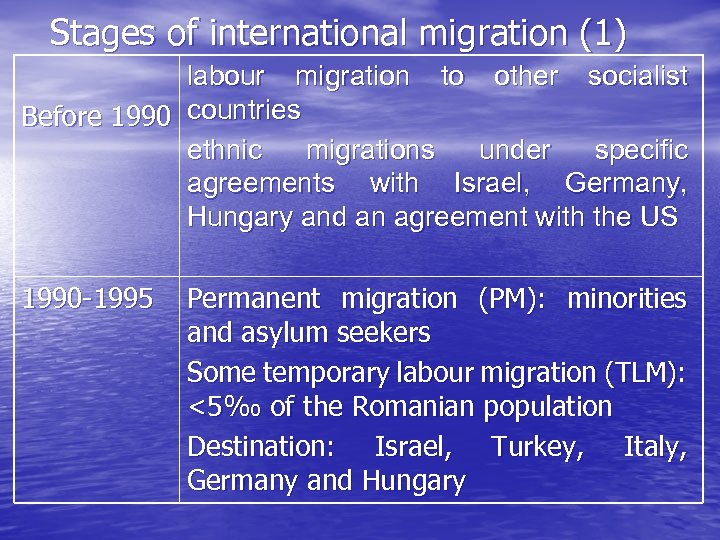 Stages of international migration (1) labour migration to other socialist Before 1990 countries ethnic migrations under specific agreements with Israel, Germany, Hungary and an agreement with the US 1990 -1995 Permanent migration (PM): minorities and asylum seekers Some temporary labour migration (TLM): <5‰ of the Romanian population Destination: Israel, Turkey, Italy, Germany and Hungary
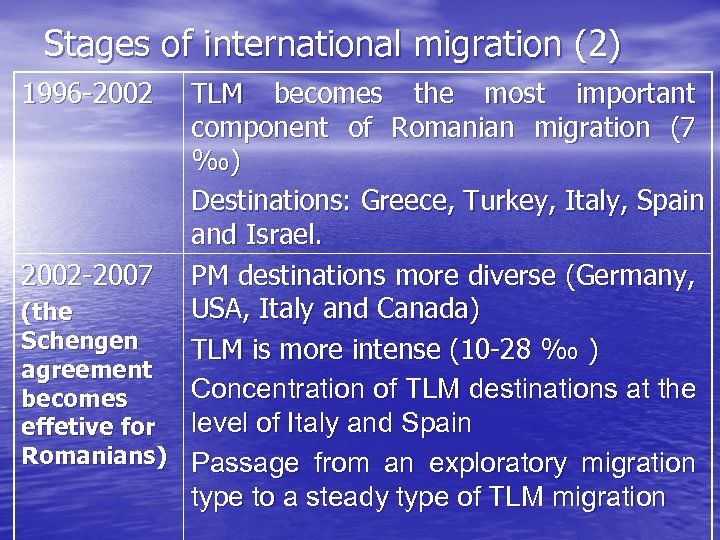 Stages of international migration (2) 1996 -2002 TLM becomes the most important component of Romanian migration (7 ‰) Destinations: Greece, Turkey, Italy, Spain and Israel. 2002 -2007 PM destinations more diverse (Germany, USA, Italy and Canada) (the Schengen TLM is more intense (10 -28 ‰ ) agreement Concentration of TLM destinations at the becomes level of Italy and Spain effetive for Romanians) Passage from an exploratory migration type to a steady type of TLM migration
 Sources: UNDP; 2007
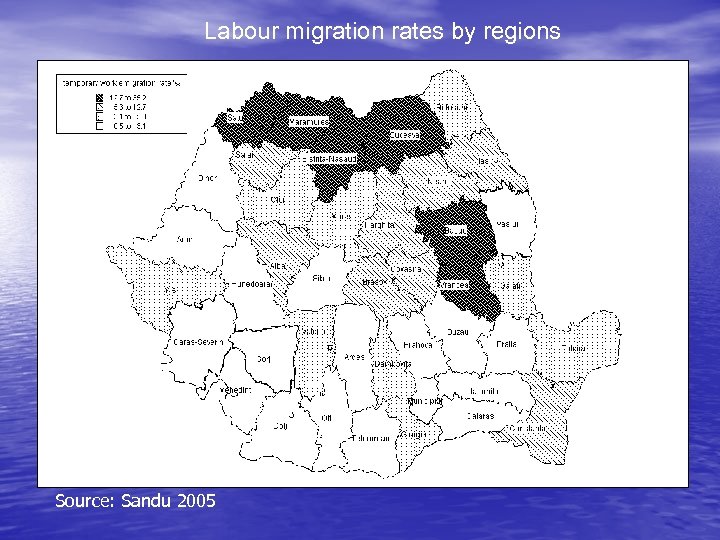 Labour migration rates by regions Source: Sandu 2005
 Motivations (1) first supplier country in the EU along with Poland • only a few papers deal with economic analysis of the Romanian migration • No comparison between international and internal migration • Our results will be significant at national level
 Main Questions • What are the generic determinants of the Romanian temporary labour migration? • Does local institutional quality influence migration? • Do migration determinants differ according to destination (internal and international)?
 Research Hypotheses (1) • Main hypothesis: The quality of local institutions has an impact on migration • When good quality public goods are not provided by local institutions, households need to pay to gain access to these goods • individuals recurr to migration in order to alleviate their budgetary constraint • The effect of local institutional quality on the decision to migrate is not linear but passes by the household’s level of wealth
 Research hypotheses (2) Additional hypothesis: • Individuals make their decision to migrate differently according to destination (international and internal migration)
 Literature Review Harris and Todaro (1970): individual decision making migration is due to labour market segmentation, shortage and wage inequality. Mincer (1978): migration decision at the level of the family The New Economics of Labour Migration: capital, credit and insurance market imperfections, relative deprivation (Stark and Levhari 1992, Stark and Taylor 1990) The social capital approach: Massey & Garcia Espana 1987, Massey 1999, Winters & al. 2001, Rapoport & Mc. Kenzie 2007 The influence of the level of local development (Beauchemin and Schoumaker 2004) Comparative approaches: Taylor &Mora (2005) and Stark (1991)
 Data Description 10 % of the Romanian 2002 Census The database contains 2. 136 million observations out of which 841. 056 workers individual, household and regional level data Data on local institutional quality and public goods provision: computed from UNDP, IPP and the National Institute of Statistics
 Data Limitations • We do not have panel data, the study is in cross-section (cannot account for the forth and back movements: circularity) • Census data not very adequate to study migration: no record for permanent migration (specific link in case of Romanian migration) • For temporary migration: filters - location of workplace - reason of absence - duration of absence
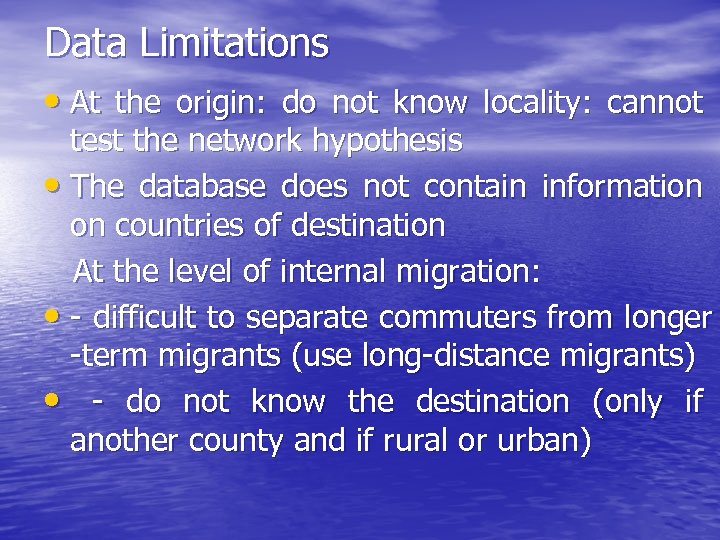 Data Limitations • At the origin: do not know locality: cannot test the network hypothesis • The database does not contain information on countries of destination At the level of internal migration: • - difficult to separate commuters from longer -term migrants (use long-distance migrants) • - do not know the destination (only if another county and if rural or urban)
 Data Limitations Difficulties in testing the institutional quality hypothesis: • no indications on the actual income of the households (we build a Living Conditions Indicator instead) • no indications on the actual household expenditures for education and healthcare
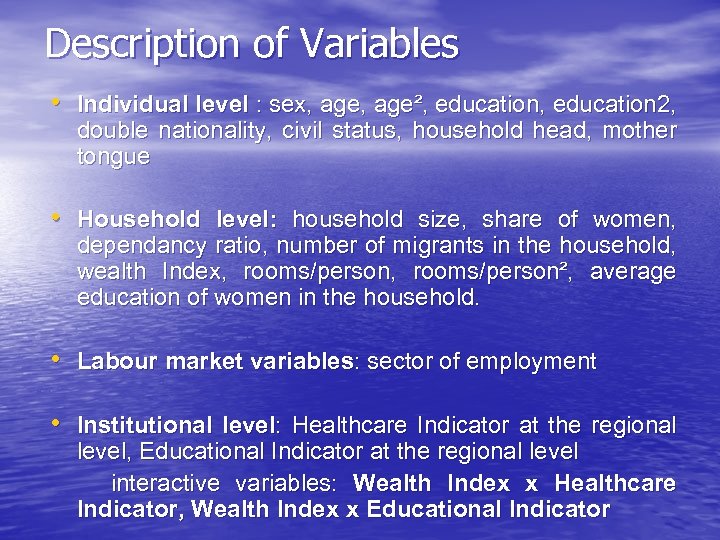 Description of Variables • Individual level : sex, age², education 2, double nationality, civil status, household head, mother tongue • Household level: household size, share of women, dependancy ratio, number of migrants in the household, wealth Index, rooms/person², average education of women in the household. • Labour market variables: sector of employment • Institutional level: Healthcare Indicator at the regional level, Educational Indicator at the regional level interactive variables: Wealth Index x Healthcare Indicator, Wealth Index x Educational Indicator
 Public goods provision Healthcare Index = (infant mortality rate lagged + ln (number of persons/hospital bed) + ln (number of persons/doctor))/public expenditure on healthcare at the local level Educational Index = (number of pupils/teacher in primary and secondary education + number of children not attending school in primary and secondary)/ public expenditure on education at the local level
 Labour Migration Strategies International labour mobility Internal labour mobility No mobility
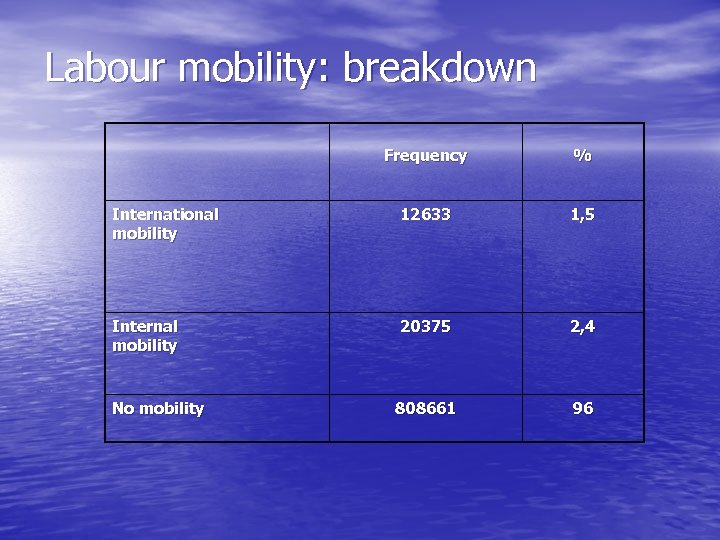 Labour mobility: breakdown Frequency % International mobility 12633 1, 5 Internal mobility 20375 2, 4 808661 96 No mobility
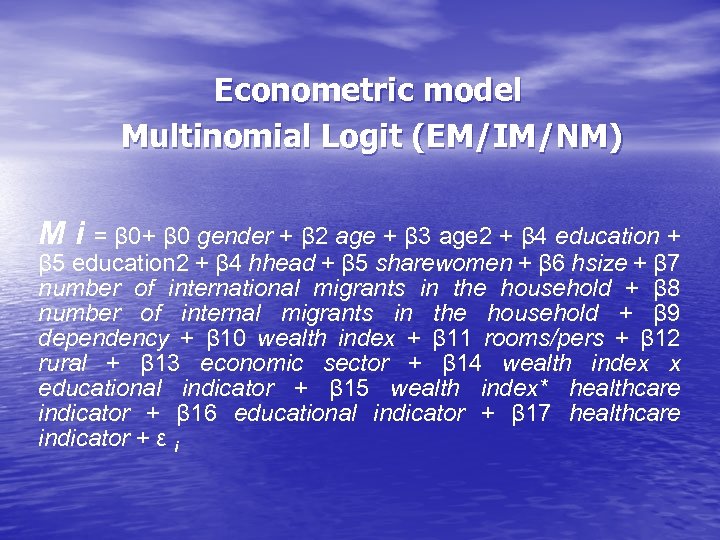 Econometric model Multinomial Logit (EM/IM/NM) M i = β 0+ β 0 gender + β 2 age + β 3 age 2 + β 4 education + β 5 education 2 + β 4 hhead + β 5 sharewomen + β 6 hsize + β 7 number of international migrants in the household + β 8 number of internal migrants in the household + β 9 dependency + β 10 wealth index + β 11 rooms/pers + β 12 rural + β 13 economic sector + β 14 wealth index x educational indicator + β 15 wealth index* healthcare indicator + β 16 educational indicator + β 17 healthcare indicator + ε i
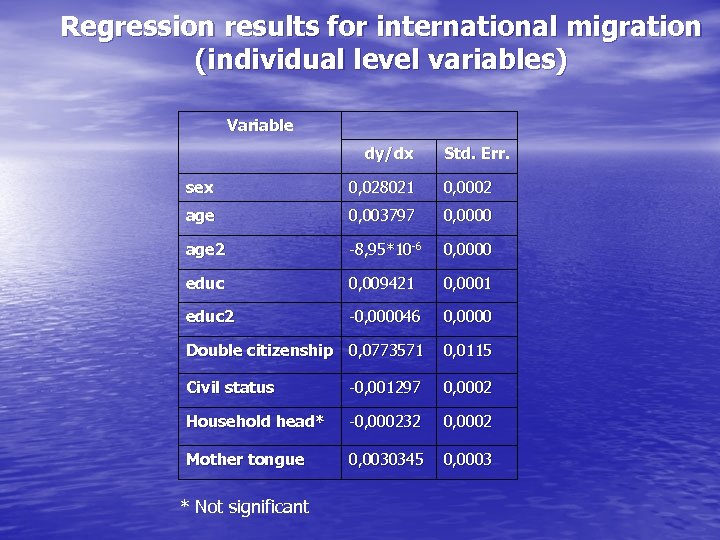 Regression results for international migration (individual level variables) Variable dy/dx Std. Err. sex 0, 028021 0, 0002 age 0, 003797 0, 0000 age 2 -8, 95*10 -6 0, 0000 educ 0, 009421 0, 0001 educ 2 -0, 000046 0, 0000 Double citizenship 0, 0773571 0, 0115 Civil status -0, 001297 0, 0002 Household head* -0, 000232 0, 0002 Mother tongue 0, 0030345 0, 0003 * Not significant
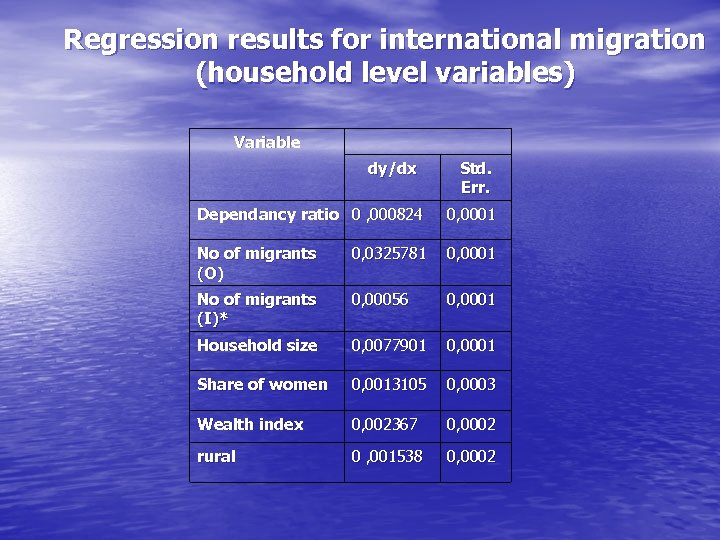 Regression results for international migration (household level variables) Variable dy/dx Std. Err. Dependancy ratio 0 , 000824 0, 0001 No of migrants (O) 0, 0325781 0, 0001 No of migrants (I)* 0, 00056 0, 0001 Household size 0, 0077901 0, 0001 Share of women 0, 0013105 0, 0003 Wealth index 0, 002367 0, 0002 rural 0 , 001538 0, 0002
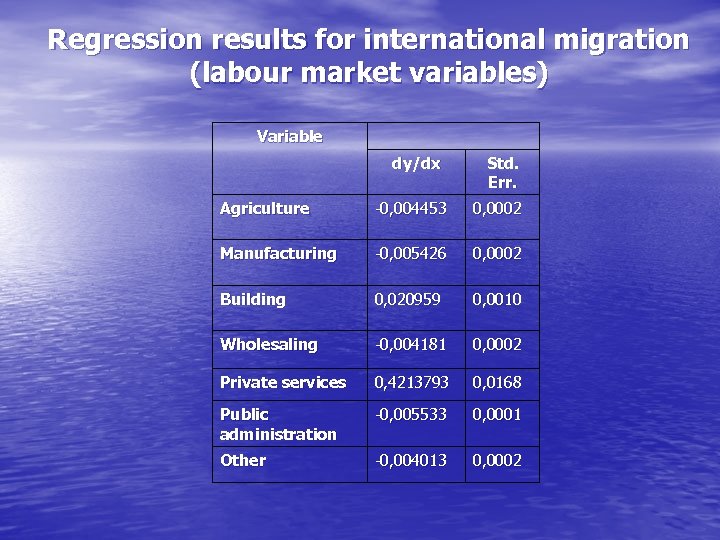 Regression results for international migration (labour market variables) Variable dy/dx Std. Err. Agriculture -0, 004453 0, 0002 Manufacturing -0, 005426 0, 0002 Building 0, 020959 0, 0010 Wholesaling -0, 004181 0, 0002 Private services 0, 4213793 0, 0168 Public administration -0, 005533 0, 0001 Other -0, 004013 0, 0002
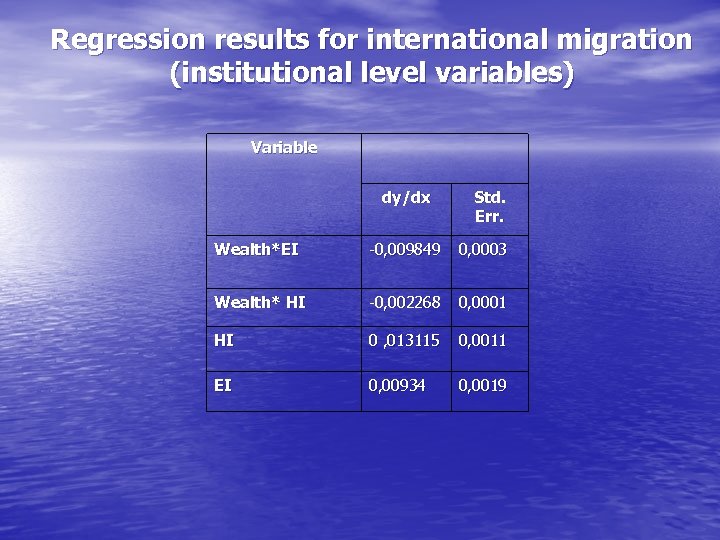 Regression results for international migration (institutional level variables) Variable dy/dx Std. Err. Wealth*EI -0, 009849 0, 0003 Wealth* HI -0, 002268 0, 0001 HI 0 , 013115 0, 0011 EI 0, 00934 0, 0019
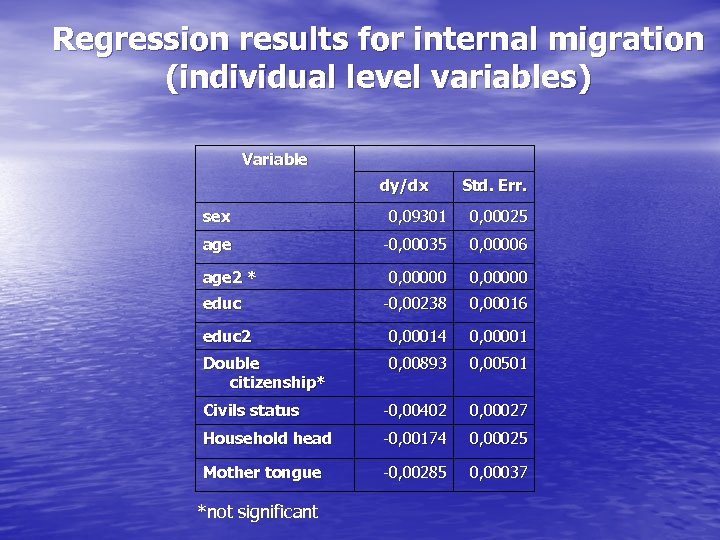 Regression results for internal migration (individual level variables) Variable dy/dx Std. Err. sex 0, 09301 0, 00025 age -0, 00035 0, 00006 0, 00000 -0, 00238 0, 00016 educ 2 0, 00014 0, 00001 Double citizenship* 0, 00893 0, 00501 Civils status -0, 00402 0, 00027 Household head -0, 00174 0, 00025 Mother tongue -0, 00285 0, 00037 age 2 * educ *not significant
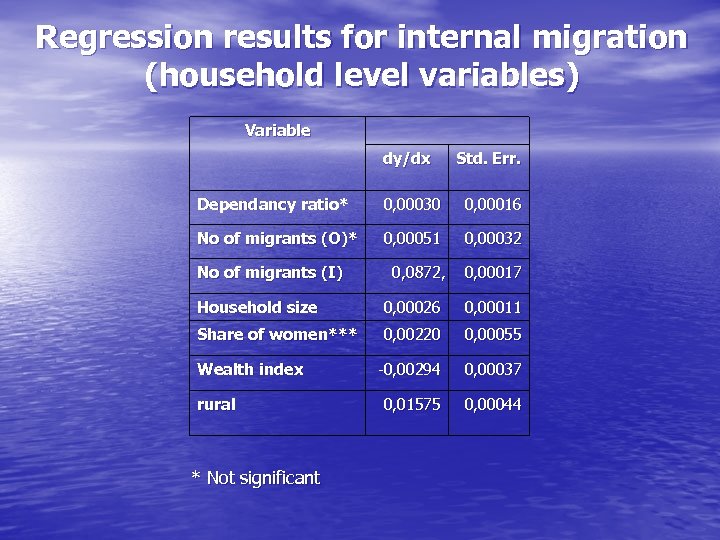 Regression results for internal migration (household level variables) Variable dy/dx Std. Err. Dependancy ratio* 0, 00030 0, 00016 No of migrants (O)* 0, 00051 0, 00032 No of migrants (I) 0, 0872, 0, 00017 Household size 0, 00026 0, 00011 Share of women*** 0, 00220 0, 00055 -0, 00294 0, 00037 0, 01575 0, 00044 Wealth index rural * Not significant
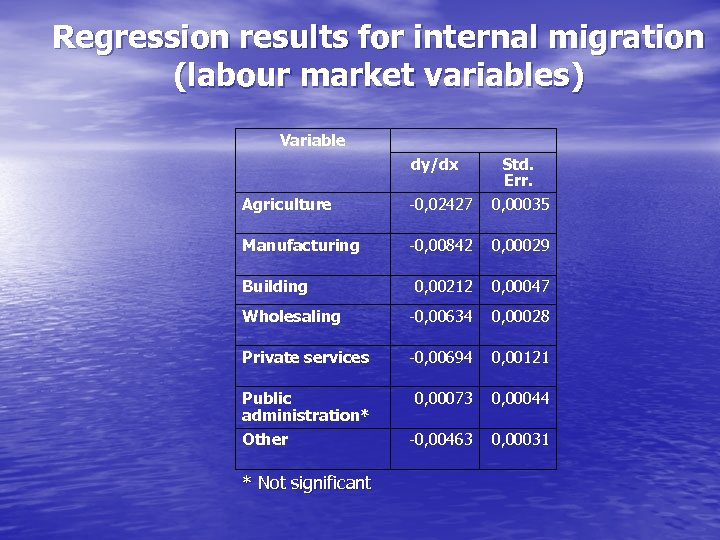 Regression results for internal migration (labour market variables) Variable dy/dx Agriculture -0, 02427 Std. Err. 0, 00035 Manufacturing -0, 00842 0, 00029 0, 00212 0, 00047 Wholesaling -0, 00634 0, 00028 Private services -0, 00694 0, 00121 Public administration* 0, 00073 0, 00044 -0, 00463 0, 00031 Building Other * Not significant
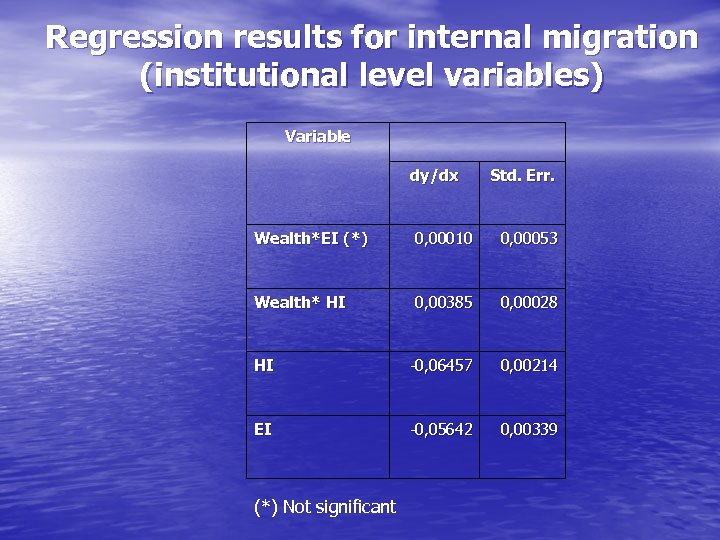 Regression results for internal migration (institutional level variables) Variable dy/dx Std. Err. Wealth*EI (*) 0, 00010 0, 00053 Wealth* HI 0, 00385 0, 00028 HI -0, 06457 0, 00214 EI -0, 05642 0, 00339 (*) Not significant
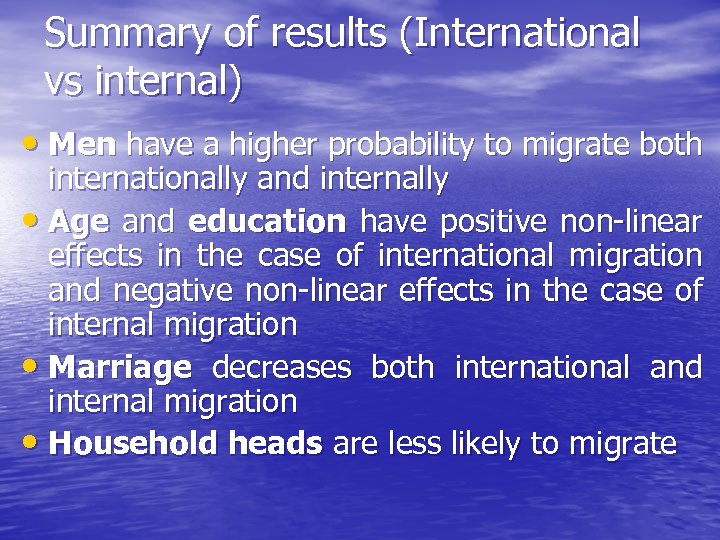 Summary of results (International vs internal) • Men have a higher probability to migrate both internationally and internally • Age and education have positive non-linear effects in the case of international migration and negative non-linear effects in the case of internal migration • Marriage decreases both international and internal migration • Household heads are less likely to migrate
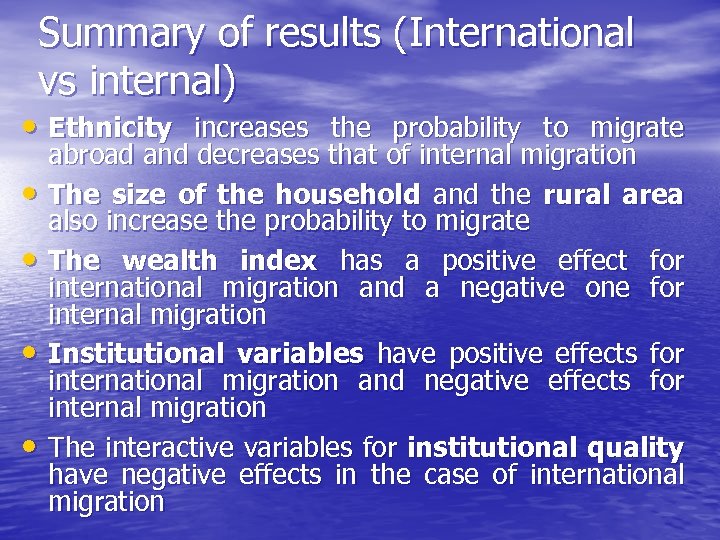 Summary of results (International vs internal) • Ethnicity increases the probability to migrate • • abroad and decreases that of internal migration The size of the household and the rural area also increase the probability to migrate The wealth index has a positive effect for international migration and a negative one for internal migration Institutional variables have positive effects for international migration and negative effects for internal migration The interactive variables for institutional quality have negative effects in the case of international migration
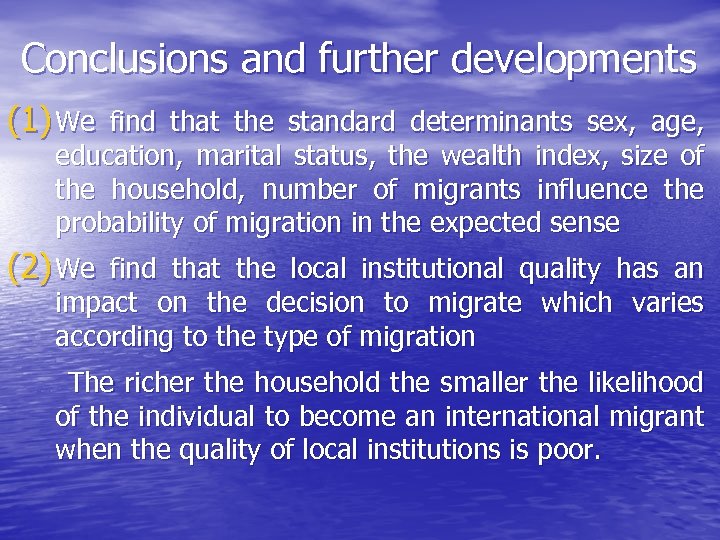 Conclusions and further developments (1) We find that the standard determinants sex, age, education, marital status, the wealth index, size of the household, number of migrants influence the probability of migration in the expected sense (2) We find that the local institutional quality has an impact on the decision to migrate which varies according to the type of migration The richer the household the smaller the likelihood of the individual to become an international migrant when the quality of local institutions is poor.
 Conclusions and further developments (3) We find differences between international and internal migration Their response to local institutional quality We underline the importance to have local institutions able to provide good quality public goods equally to all individuals: equity Policies to promote the mobility of women and their access on the labour market