 Скачать презентацию Migrating Embedded Systems from Assembler to C Using
03d80acb8a5bc859e656b7cddd41bfc6.ppt
- Количество слайдов: 21



Migrating Embedded Systems from Assembler to C Using the Fermat Transformation System
Pigs from Sausages? • Extracting the logic and business rules from evolved legacy systems • Automatically migrate them to a new High Level Language • Re-host them
Why bother? • • Increased Speed/Capacity Better Price/Performance Larger, more complex systems Cost per function point: – Assembler: £ 48. 00 – PL/1: £ 39. 00 – C: £ 21. 00 • Pressure to Migrate to HLL
Case Study – Tenovis Gmbh & Co. • Specialists in Convergent Networking • 200, 000 Clients • 6000 Employees • Revenues over 950 million euros
Tenovis Challenge • • • Private Branch e. Xchange (PBX) system Four Hardware Platforms Installed in 18 countries 800, 000 lines of C 544, 000 lines of 186 assembler in 318 source files • Problems: – Backlog of enhancements – Availability and functionality of the processor
SML’s Challenge • To migrate the assembler to high-level structured, maintainable C code suitable for porting to more modern processor and also suitable for implementing the backlog of enhancements. • The migrated code should meet the coding standards used within the existing C code.
Ferma. T Transformation System • Nearly 20 years research and development (> 120 man years) • Core technology research @ Oxford and Durham University • Migration projects to validate this research funded by IBM, CAA & DTI • Used extensively in Y 2 K projects • Ferma. T Workbench • Transformation System
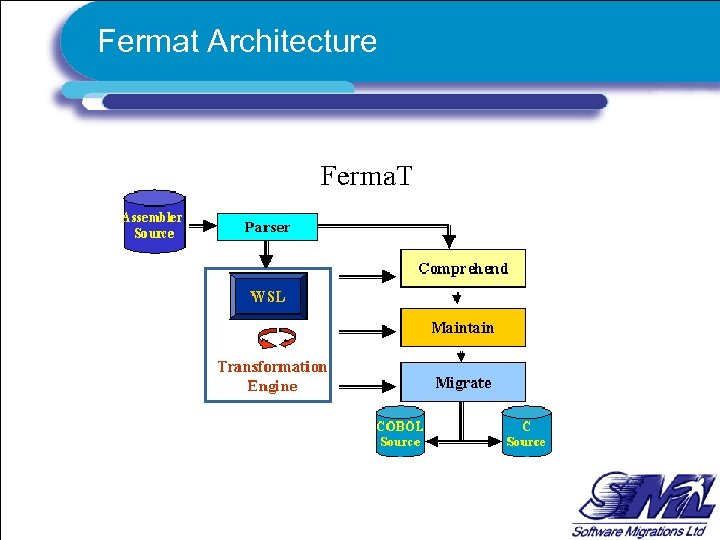
Fermat Architecture
What is WSL • Wide Spectrum Language – From low-level constructs to high-level abstract specifications – Unique transform capability • Fermat product set is implemented in Meta. WSL • WSL is now in the Public Domain under a GUL licence
Case Study – Phase 1 • Migration of a single 3, 000 line source file – Develop a 186 to WSL parser – Modify the existing WSL to C parser – Implement 186 -specific WSL transformations
Case Study – Phase 2 • Mini Call Control – Self contained subsystem – 67, 000 lines of assembler – 41 source files
Phase 2 - Requirements • Use existing C header files where available • Use of the “function parameter table” • Translate selected subroutines directly to HLL code • Translate bitfield operations into C record fields • Eliminate stack usage where possible • Detect jump tables and generate appropriate switch statements • Generate switch statements instead of nested if statements • Can ignore segment addressing for this application
Phase 2 - Process • • • 5 iterations of the Mini Call Control Customer feedback on each iteration Update the parsers or transformations Regenerate the C code automatically Final iteration C code was compiled installed and tested
Final Migration • 2. 6 Ghz PC with 512 Mb of RAM • All 318 source files processed in 1. 5 hours • 1, 436, 031 transformations: – 4, 500 transformations per source file – 275 transformations per second • Largest source file was 8, 348 lines – 73, 393 transformations – 370 seconds CPU time – 42 Mb RAM • 506, 672 lines of C code plus 37, 047 lines of header files generated
Results • At least 6 bugs were discovered in the system via the migration process • “Hey, this really looks like C!” • Test environment: “soft switch” between C and Assembler Versions on a PC linked to the hardware.
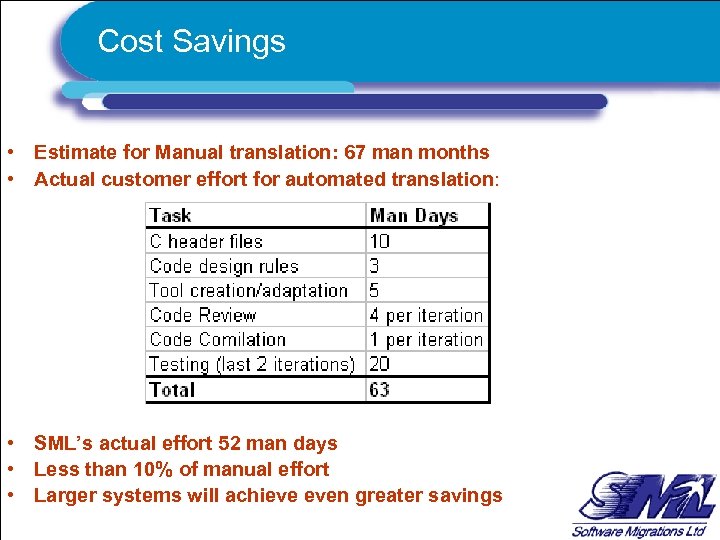
Cost Savings • Estimate for Manual translation: 67 man months • Actual customer effort for automated translation: • SML’s actual effort 52 man days • Less than 10% of manual effort • Larger systems will achieve even greater savings
Advantages of Automated Reengineering • • • Scalability Rapid turnaround of the subsystem Customisability Low resource requirements Low Impact on ongoing development Enables porting to different hardware and/or software platform • Removes dependence on limited resources
Conclusion • Assembler to C using the Ferma. T Migration System and Workbench is a practical solution to the high costs and skills shortage in assembler maintenance and to the problem of migrating legacy assembler systems to a more modern platform.
The future for Fermat • • • Currently assembler to C and COBOL Pascal to C Assembler/Pascal to C Output to Java Joint 3 year research project with De. Montfort University to extend the use of WSL and Fermat
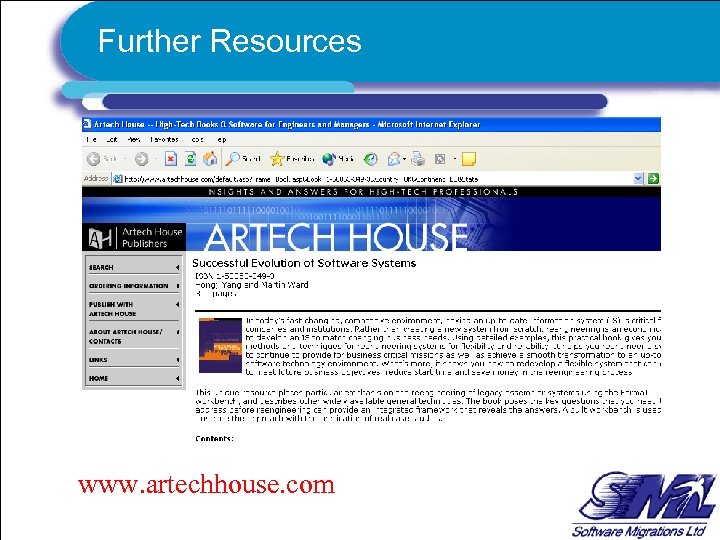
Further Resources www. artechhouse. com
Further Resources • The Fermat Transformation System is available under GNU GPL (General Public Licence) • www. dur. ac. uk/~dcs 0 mpw/fermat. html • www. cse. dmu. ac. uk/~mward/fermat. ht ml
Скачать презентацию Migrating Embedded Systems from Assembler to C Using
03d80acb8a5bc859e656b7cddd41bfc6.ppt