


 Скачать презентацию Midlothian Health and Social Care Partnership Anthea Fraser
6118b39c98f6998070baba85531fd79d.ppt
- Количество слайдов: 14
 Midlothian Health and Social Care Partnership Anthea Fraser – Service Manager – Older people Using data to inform planning Tableau Mosaic CM 2000 io. RN
 Tableau is a business intelligence software that helps people see and understand their data. In Midlothian H & SCP we have used Tableau to illustrate care at home carer capacity and support the review of care at home. It provides data that illustrates the efficiencies and inefficiencies of carers planned visits to clients.
 Tableau
 Tableau
 Mosaic and CM 2000 Mosaic – client information system that can produce many reports – such as number of hours for individual sheltered housing complexes. Number of hours provided by in house care at home service. This data has enabled us to plan dedicated hours to sheltered housing complexes having a dedicated group of carers for the sheltered housing services.
 CM 2000 We have introduced CM 2000 into our care at home service in Midlothian which has provided a range of reports that has influenced care at home analysis and planning. This includes having accurate reports on planned versus actual delivery of care, missed visits, medication errors. It provides an opportunity to plan and deliver carer visits more efficiently reducing down time.
 Use of io. RN in Midlothian In Midlothian we use a range of io. RN tools. We use the enhanced community io. RN (io. RN 2)within our fieldwork services alongside the community care assessment. It is used in the joint dementia team. It is used in Reablement at the beginning and end of the 6 week Reablement pathway. We use the Care home io. RN to determine staffing levels in the care homes.
 Use of io. RN Midlothian H&SCP in house day care service also uses the community io. RN (io. RN 2) to provide an overview of level of need using day care provision. We have started to use the community io. RN (io. RN 2) for all admissions into Intermediate care. It is a very useful planning and evaluation tool for service delivery.
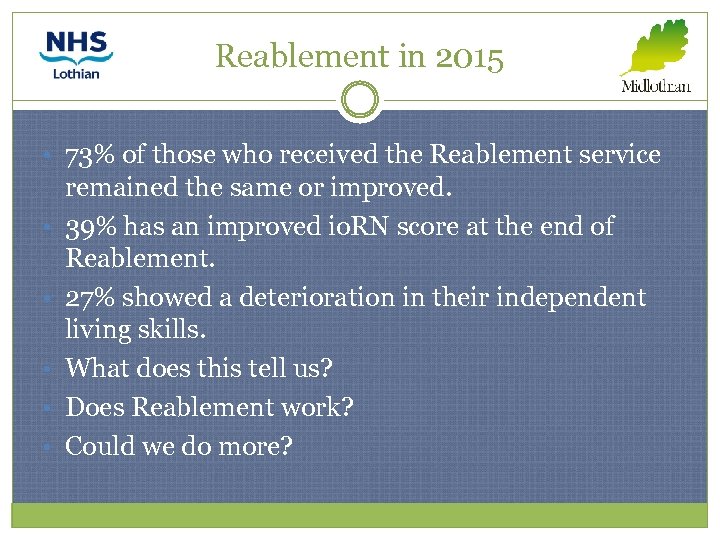 Reablement in 2015 • 73% of those who received the Reablement service • • • remained the same or improved. 39% has an improved io. RN score at the end of Reablement. 27% showed a deterioration in their independent living skills. What does this tell us? Does Reablement work? Could we do more?
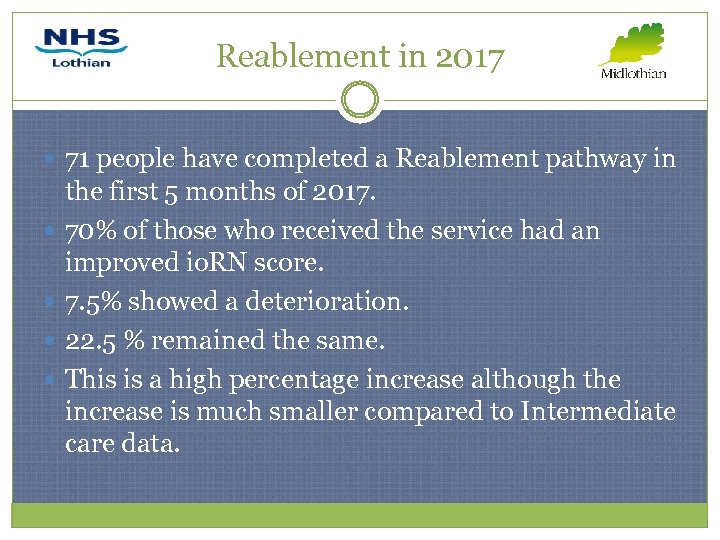 Reablement in 2017 71 people have completed a Reablement pathway in the first 5 months of 2017. 70% of those who received the service had an improved io. RN score. 7. 5% showed a deterioration. 22. 5 % remained the same. This is a high percentage increase although the increase is much smaller compared to Intermediate care data.
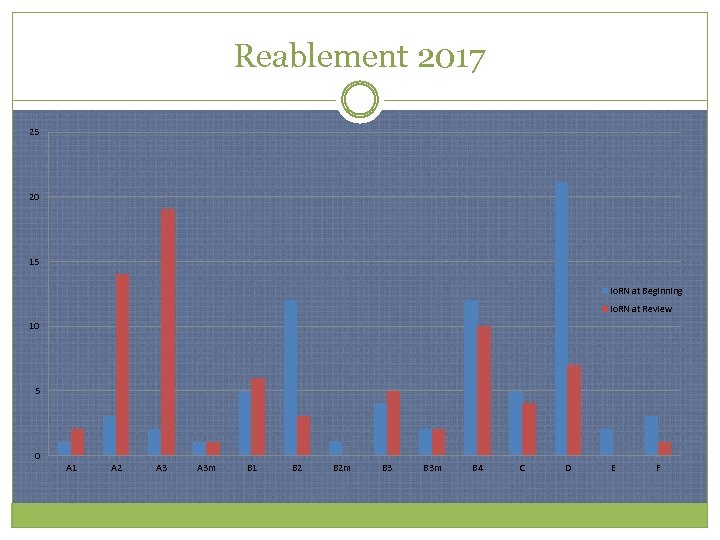 Reablement 2017 25 20 15 Io. RN at Beginning Io. RN at Review 10 5 0 A 1 A 2 A 3 m B 1 B 2 m B 3 m B 4 C D E F
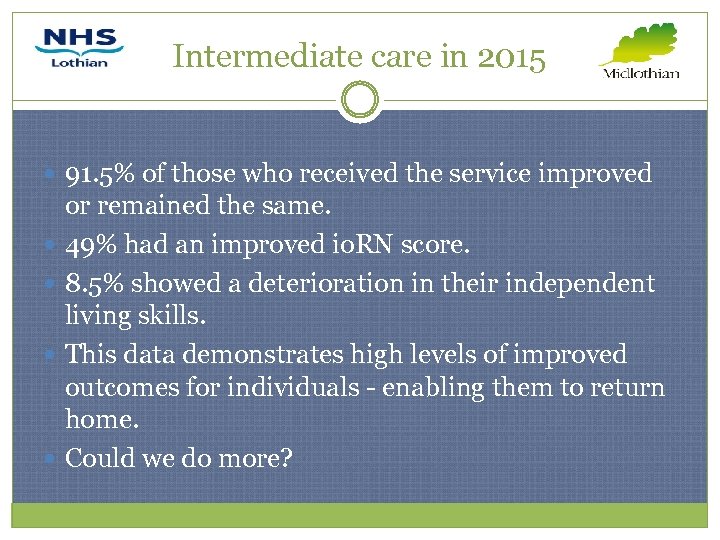 Intermediate care in 2015 91. 5% of those who received the service improved or remained the same. 49% had an improved io. RN score. 8. 5% showed a deterioration in their independent living skills. This data demonstrates high levels of improved outcomes for individuals - enabling them to return home. Could we do more?
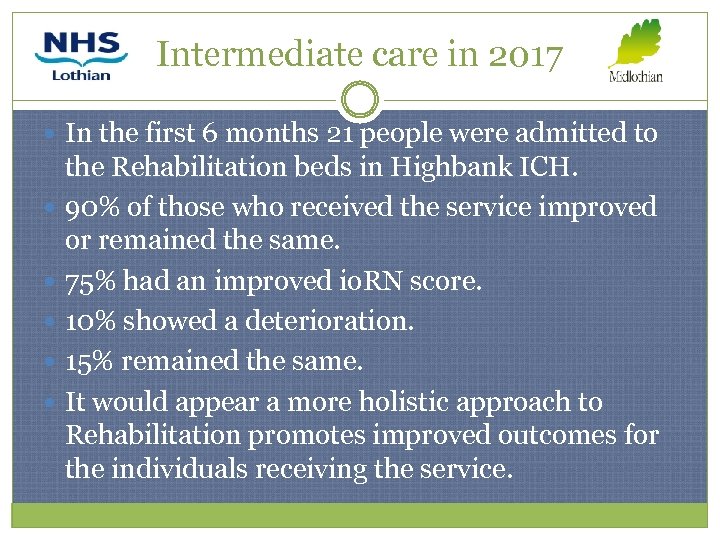 Intermediate care in 2017 In the first 6 months 21 people were admitted to the Rehabilitation beds in Highbank ICH. 90% of those who received the service improved or remained the same. 75% had an improved io. RN score. 10% showed a deterioration. 15% remained the same. It would appear a more holistic approach to Rehabilitation promotes improved outcomes for the individuals receiving the service.
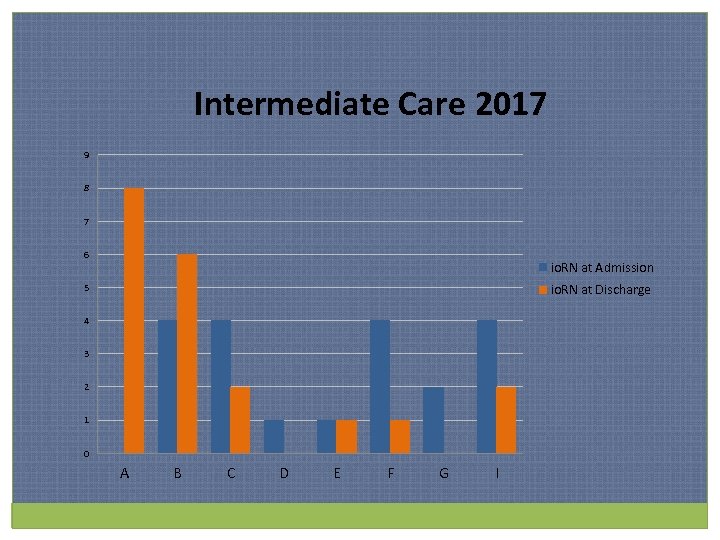 Intermediate Care 2017 9 8 7 6 io. RN at Admission io. RN at Discharge 5 4 3 2 1 0 A B C D E F G I