 Скачать презентацию Middle Eastern territories of the Ottoman Empire before
090558ad98765d43e99b671ec063c35c.ppt
- Количество слайдов: 39



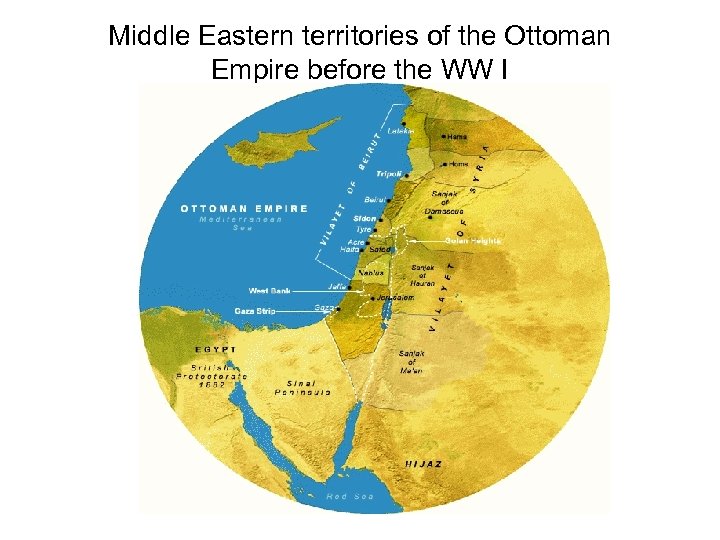
Middle Eastern territories of the Ottoman Empire before the WW I
Arab – Israeli Conflict • Biblical enmity between Abraham’s two sons, Isaac and Ishmael • Advent of Islam • Prophet Mohammed’s quarrel with the Jews of Medina • Emergence of Zionism in the 19 th century • British colonial policy in the early 20 th century • Advent of nationalism in the Middle East
Classical Zionism • Traditional ties Jews in the Diaspora (term for dispersion of the Jews) proclaimed to the Land of Israel • Belief that Jewish independence would be restored with the coming of the Messiah • European enlightenment and the French Revolution • new concepts of citizenship and political life • centuries of inequality and persecution
Ideological foundations for modern political Zionism • The Jewish people constituted a nation and this nationhood needed to be reaffirmed • Assimilation was rejected as it was neither desirable not was it deemed to be possible • Anti-Semitism could only be overcome by physical separation from Europe and by self-determination • Religious and cultural ties to the Land of Israel made Palestine the logical territorial claim
Theodor Herzl (1860 -1904) • Journalist and playwright from Vienna • One of the key Zionist thinkers • Book Der Judenstaat (The Jewish State), published in 1896 • advocated independent statehood
• Establishment of the Zionist Organization and the convening of the First Zionist Congress in 1897 in Basle, Switzerland Main objectives • promotion of Jewish immigration to Palestine • acquisition of land
• Bilu group in 1882 - considered to be the first Aliyah (immigration wave) • Yishuv (Jewish settlement) in Palestine • Second Aliyah started in 1904 and lasted until 1913 • Most of the new immigrants were of Russian and East European origin • agricultural operative of kibbutz (collective agricultural settlement in Israel based upon equal sharing of both production and consumption; product of the difficult living conditions in Palestine at the beginning of the 20 th century as well as the socialism adhered to by the Zionist leaders at that time)
Arab nationalism • Belief that the Arab people constitute a single political community or nation • Independent and united under a common government • • Set of independent allied Arab states Modern Arab nationalism - end of the 18 th century response to the challenge of modernization engagement with European nationalist ideas of freedom, independence, equality and progress • embracing modernization while stressing that European colonialism was instrumental in introducing this process
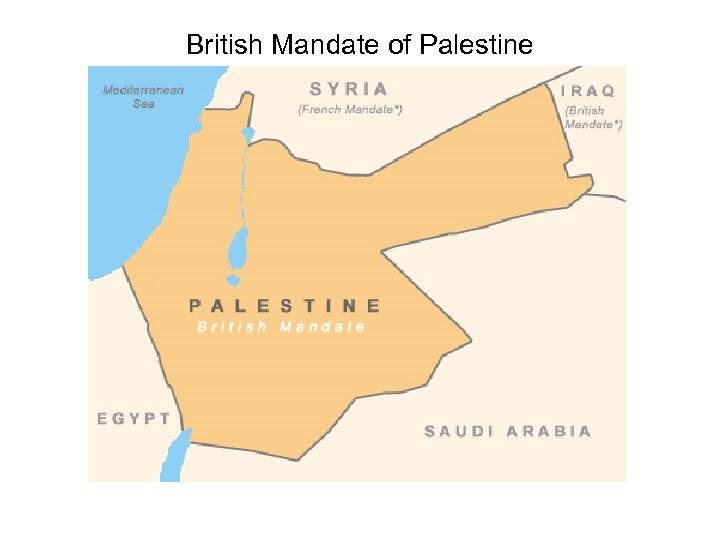
British Mandate of Palestine
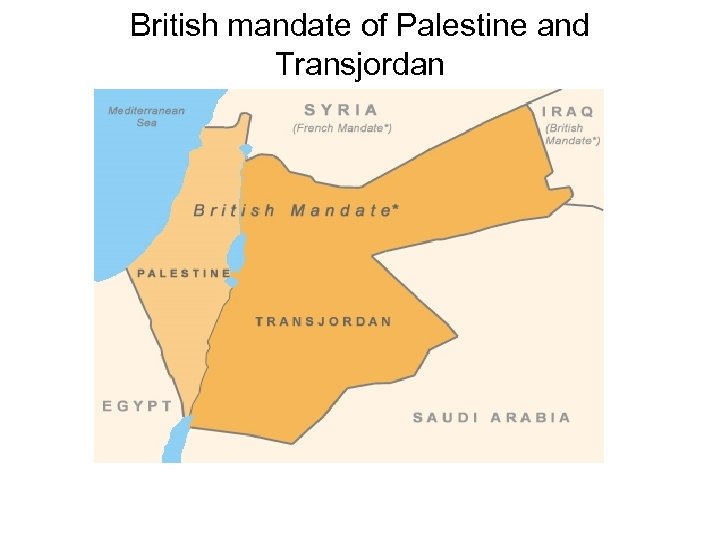
British mandate of Palestine and Transjordan
• Arab nationalism started to develop in intellectual circles • The first Arab nationalist party was a small secret society founded around 1875 by graduates of the American University in Beirut • At the core of Arab nationalism, like any other nationalism, was the concept of self-determination • 3 elements in Arab nationalism: – a strong anti-Turkish sentiment – anti-colonial and anti-imperial element – anti-Zionist ideology
• the First Arab Congress was organized in 1913 in Paris – not in the Middle East • The aims - all still within the framework of the already existing Ottoman Empire: – – the establishment of administrative autonomy Arab participation in the Ottoman central government making Arabic an official language striving towards unity
The Impact of the First World War • Britain started to cultivate local Arab allies who would aid its war effort • In 1915 the British High Commissioner in Cairo, Sir Henry Mc. Mahon, negotiated the support of the Hashemite leader and the Amir of Mecca, Sharif Hussein • Hussein-Mc. Mahon Correspondence is the promise that the Arab territory of the Ottoman Empire be returned to Arab sovereignty, with the exception of the districts of Mersina and Alexandretta as well as the districts of Damascus, Homs, Hama and Aleppo, which were not purely Arab
• Arab interpretation: the excluded territory referred to present-day Lebanon and parts of Syria • British interpretation: it included Palestine
• Summer 1917: the British government had started to consider the Zionist movement as a potential ally • Chaim Weizmann - Russian-born chemist • convinced Britain’s decision - makers that Zionists were important for Britain’s war effort – the Zionists could help sustain the Russian front – help galvanize the desperately needed American was effort
Balfour Declaration • Issued by Foreign Secretary Balfour on 2 November, 1917 • Stated that “His majesty’s Government viewed with favour the establishment in Palestine of a national home for the Jewish people”. – The Balfour Declaration did not state that Palestine should be turned into a Jewish state – The word ‘state’ had initially appeared in the earlier drafts of the statement but was changed – Not specific about the actual borders of the territory promised to both Jews and Arabs – The result: that both Zionists and Arab nationalists believed Palestine had been promised to them
• British troops entered Palestine in 1918 • Set up a provisional military government in Jerusalem • British military presence from 1918 onwards was formalized by the League of Nations in 1922 (granting to Britain the mandate over Palestine) • The mandate provided Britain with the responsibility for placing the country under “such political, administrative and economic conditions as will secure the establishment of the Jewish national home…. and the development of self-governing institutions, and also for safeguarding the civil and religious rights of all the inhabitants of Palestine, irrespective of race and religion”.
• Britain fulfilled its strategic aims: – assuring access to the Suez Canal and the East – preventing French ambitions in Lebanon and Syria from drifting South – creating a land bridge from the Mediterranean Sea to the oil fields of Iraq
Conflicting promises and fears • In the international arena Britain tended to support Zionism • In Palestine, British officials favored the Arabs • Many Arabs believed that Britain was planning to hold on to Palestine until a Jewish majority had been achieved • Many Jews believed that Britain was secretly aiding and arming the Arabs as well as restricting Jewish immigration and land purchases in order to prevent the creation of the Jewish state
Inter-War Period • Institution building in Palestine • Britain’s first civilian governor, Sir Herbert Samuel • The Zionist Commission which had been established after the Balfour Declaration evolved into the Palestine Zionist Executive in 1920 and became the Jewish Agency in 1928 -29 • Arab or indeed Palestinian institution building did not take place at the same rate • The formation of the Arab Executive in 1920 • The Arabs remained divided by religious, family and regional loyalties
• • • 1929 - the Wailing Wall incident The fighting erupted in response to benches being set up in front of the Wailing Wall 133 Jewish deaths 116 Arab deaths Followed by the massacre of most of the Jewish residence of Hebron The British attempt to calm the situation: – Colonial Secretary Lord Passfield issued a White Paper blaming the Jewish Agency land purchases for the disturbances. The Jewish reaction was outrage. – British Prime Minster Ramsay Mac. Donald then issued a letter explaining away the White Paper, which, in turn, angered the Arabs.
Second World War • The Mufti of Jerusalem, Hajj Amin al-Husseini, had made contacts with Germany, seeing the Nazis as a tool to free Palestine from both the British and the Zionists • Palestinian Jews enlisted in the British Army in large numbers despite their resentment against British policy in Palestine • Zionist leader and future prime minister of Israel, David Ben Gurion: “ We must assist the British in the war as if there were no White Paper and we must resist the White Paper as if there were no war. ”
The 1948 War • For Israelis it was the War of Independence • For the Arab states it was the Palestine War • For the Palestinians it became know as ‘the disaster’ an-Nakba • Israel’s declaration of independence on May 14, 1948 was immediately followed by th declaration of war by five Arab states • The ongoing Zionist-Palestinian civil war was turned into an Arab-Israeli inter-state conflict
• Arab Liberation Army - 6, 000 – 7, 000 volunteers • From the outbreak of the war on 30 November 1947 until June 1948, Israel was fighting for survival • Plan D or Delet: the battle against the local and foreign irregulars had to be won first if there was to be a chance of defeating the invading regular Arab armies. • Haganah: (Hebrew: defense). Jewish underground organization established in 1920 • The core of the Israeli Defense Force upon the declaration of the State of Israel in 1948 • Question: to what extent the plan constituted a blueprint for the expulsion of the Palestinian Arabs and can be seen as the cause of the Palestinian refugee problem
• The turning point in the war came on 11 June 1948 • The first truce ordered by the United Nations Security Council. • The UN proposed a new political compromise, calling for a Palestine union to consist of separate Jewish, Palestinian, and Transjordanian units • not acceptable to any party in the conflict • during the truce Israel was able to import a significant amount of arms and ammunition despite the UN embargo • By December 1948 Israel was able to break the Egyptian blockade and size most of the Galilee, and cross the border into southern Lebanon • Armistice negotiations began in January 1949
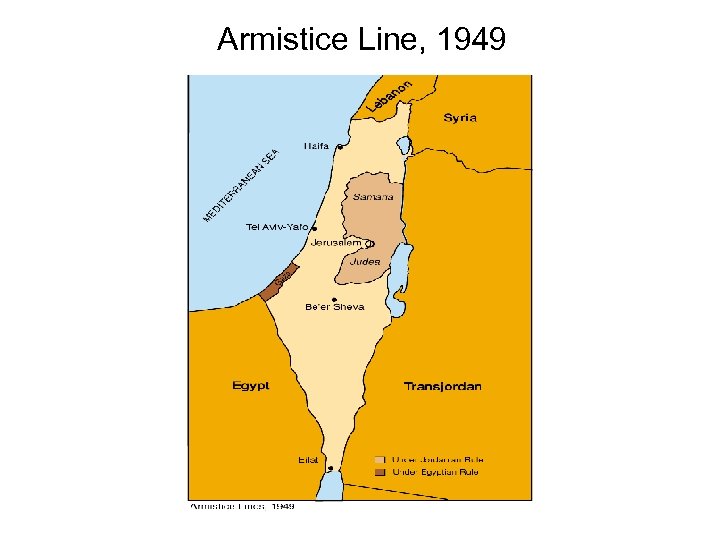
Armistice Line, 1949
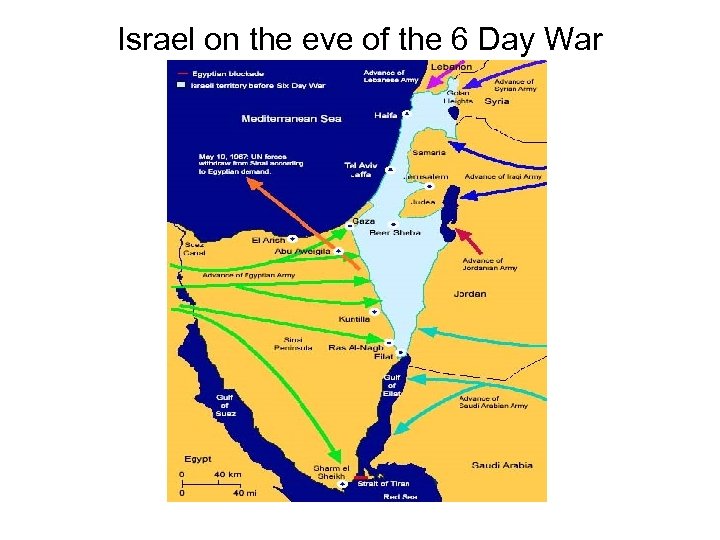
Israel on the eve of the 6 Day War
The 1967 Six Day War • Neither Israel, Egypt, Syria, and Jordan, nor the United States and the Soviet Union claim to have wanted this conflict • Israeli historiography (First version) – blame for the war clearly rests with then the Egyptian president Nasser – He closed the Straits if Tiran – Israel had no alternative but to fight
Second version: – Nasser did not intend to go to war – Impressing his Arab neighbors – The champion of pan-Arabism – Misplaced Israeli reaction that led to war
Third Version : So-called accident’ theory • lays the blame for the conflict on regional dynamics as a whole rather than on particular player
• 13 May 1967, Soviet President Nikolai Podgorny told Anwar Sadat, that Israeli troops had mobilized and intended to invade Syria • Nasser was bound by the mutual defense pact • 14 May 1967 Egyptian troops moved into the Sinai Peninsula • Demanded that the UN forces leave the region, which they promptly did • 22 May, Nasser proceeded to close the Straits of Tiran – casus belli
• 5 June 1967 - Israel launched its pre-emptive attack • The IDF (Israeli Defense Force) crossed into the Sinai and into the West Bank • Syria, Jordan and Egypt counterattacked on the same day • • 7 June - Israeli forces captured East Jerusalem 7 June – Jordan agreed to the cease-fire 8 June - Egypt agreed to a cease-fire 9 June - after midnight, Syria agreed to a cease-fire
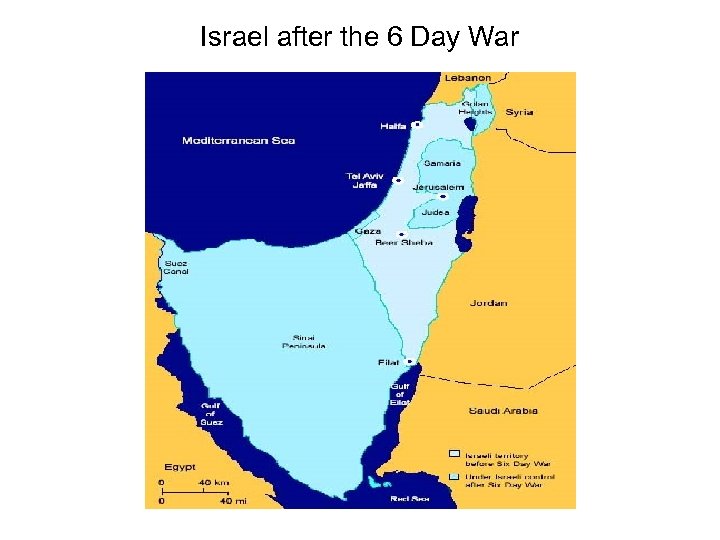
Israel after the 6 Day War
Yom Kippur War • Known also as the 1973 War or the October War • At 4 a. m. on 6 October 1973, the Israeli Defense Minister, Moshe Dayan, was informed that Egypt and Syria were going to attack • A pre-emptive strike was ruled out • Full mobilization was also ruled out
• At 2 p. m. on 6 October 1973, Egypt and Syria attacked Israel • Egypt launched a massive air-strike and artillery assault on Israel • Syria invaded the Golan Heights • Egyptian forces crossed the Suez Canal and pushed back Israeli troops
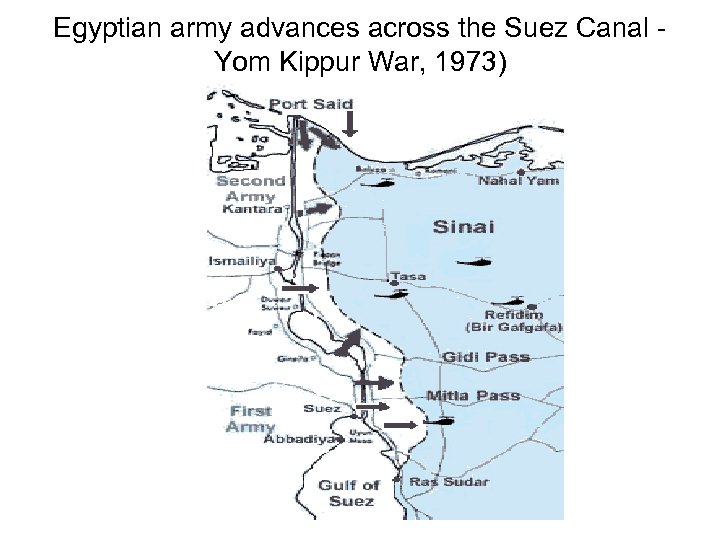
Egyptian army advances across the Suez Canal Yom Kippur War, 1973)
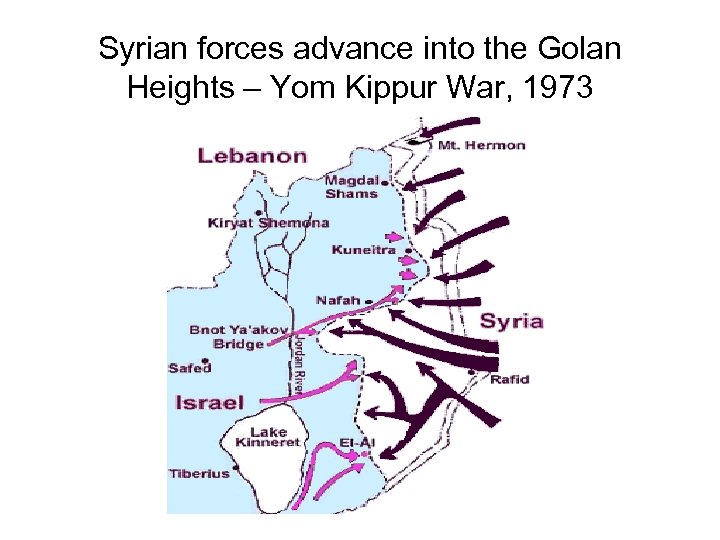
Syrian forces advance into the Golan Heights – Yom Kippur War, 1973
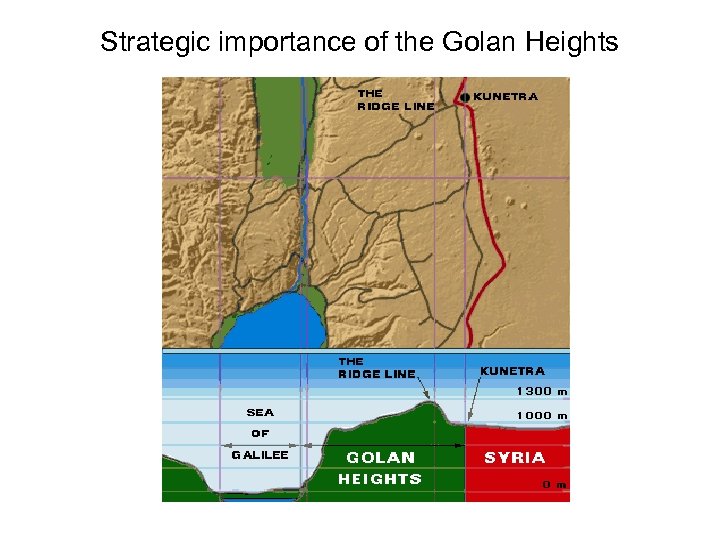
Strategic importance of the Golan Heights
• • In the north, Syria took Mount Hermon Syrian forces were repelled by 11 October Israeli forces had crossed the Suez Canal by 18 October The United States and the Soviet Union decided to impose a cease-fire • 20 October, Henry Kissinger flew to Moscow and drafted a cease-fire agreement with Communist Party Chairman Leonid Brezhnev • The cease-fire was accepted by all sided on 22 October • Politically, the Arabs had won the war • Despite the Israeli military victory, confidence had been shaken
Скачать презентацию Middle Eastern territories of the Ottoman Empire before
090558ad98765d43e99b671ec063c35c.ppt