


 Скачать презентацию Middle East Governments Review Match the word
f354dc245ae7d9820adc4a2a1c6aec36.ppt
- Количество слайдов: 85
 Middle East Governments
 Review! Match the word and definition. 1. 2. 3. 4. 5. 6. 7. 8. Unitary Confederation Federal Autocracy Oligarchy Democracy Parliamentary Democracy Presidential Democracy A. People vote for Parliamentary members B. Local governments hold the power- 0. P. E. C. C. Rule by the people D. Rule by a few E. Rule by one F. The central government holds all the power G. Power is shared by central and local governments H. People vote for the president separately from the legislature.
 Vocabulary: write voc words on your voc. cards. • Knesset: The Israeli Parliament • Monarchy: Rule by a king or a queen • Absolute Monarchy: type of government in which the King, queen, or emperor has unlimited power • Theocracy: a type of government in which God is seen as the true leader and religious leaders serve as the political leaders • Theocratic Republic: a type of government which has both religious leaders serving as political leaders and a popularly elected president and legislature • Autocracy: a type of government in which the ruler has absolute power to do whatever he wishes and make and enforce whatever laws he chooses; rule by one
 Vocabulary • Oligarchy: type of government in which a political party or other small group takes over a government and makes all the major decisions; government by the few • Democracy: a type of government in which people play a much greater role in deciding who the leaders are and what decisions are made; rule by the people • Unicameral: One legislative house • Federal: a political system in which power is shared between the national (central) and local governments • Sharia Law: The law as stated in Islam's holy book, the Qur'an • Constitutional Monarchy: type of government in which the power of the king or queen is limited by a constitution
 Vocabulary • Presidential: In this type of democratic government, people elect the president and the legislature separately. • Totalitarian Dictatorship: The ideas of a single leader are glorified; the government is not responsible to the people and tries to control all aspects of citizens' lives. • Confederation: a political system in which the local governments hold all the power and the central government depends on the local governments for its existence • Unitary: in this political system, the central government holds all the power; local governments are under the control of the central government. • Parliamentary: a democratic form of government in which the people vote for those who represent the political party they feel best represents their views of how the government should operate (member of parliament) • Ayatollah: a Shi’a religious leader
 GPS and E. Q. • GPS SS 7 CG 4 a. Describe the ways government systems distribute power: unitary, confederation, federal. • E. Q. How do government systems distribute power?
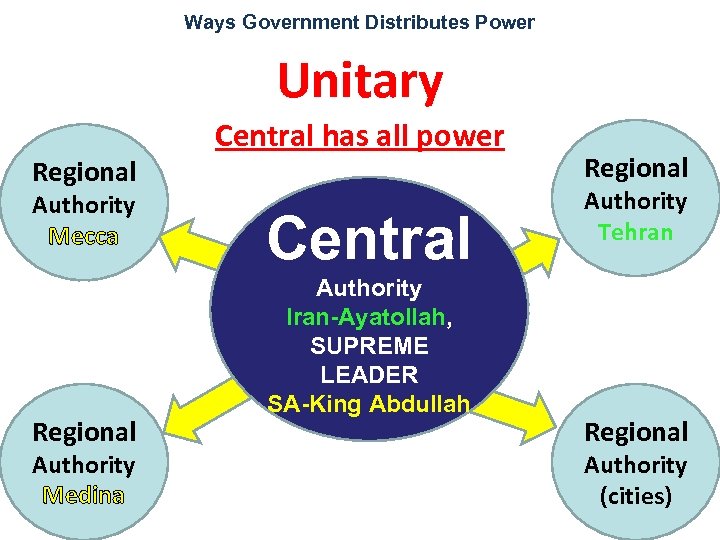 Ways Government Distributes Power Unitary Regional Authority Mecca Regional Authority Medina Central has all power Central Authority Iran-Ayatollah, SUPREME LEADER SA-King Abdullah Regional Authority Tehran Regional Authority (cities)
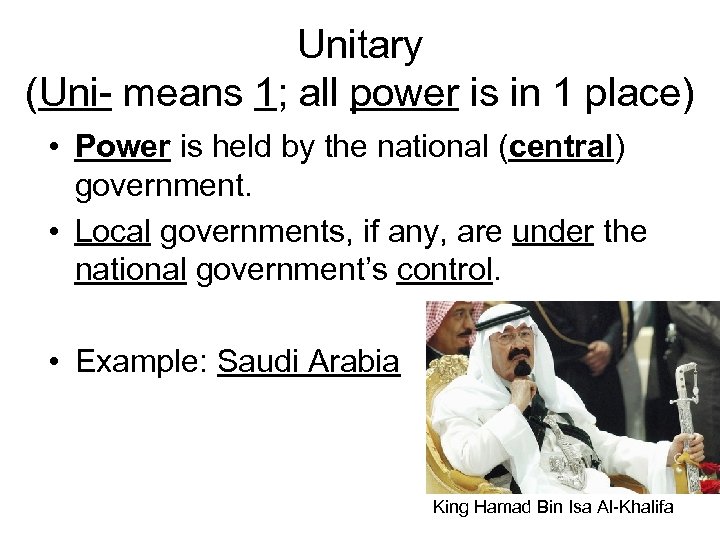 Unitary (Uni- means 1; all power is in 1 place) • Power is held by the national (central) government. • Local governments, if any, are under the national government’s control. • Example: Saudi Arabia King Hamad Bin Isa Al-Khalifa
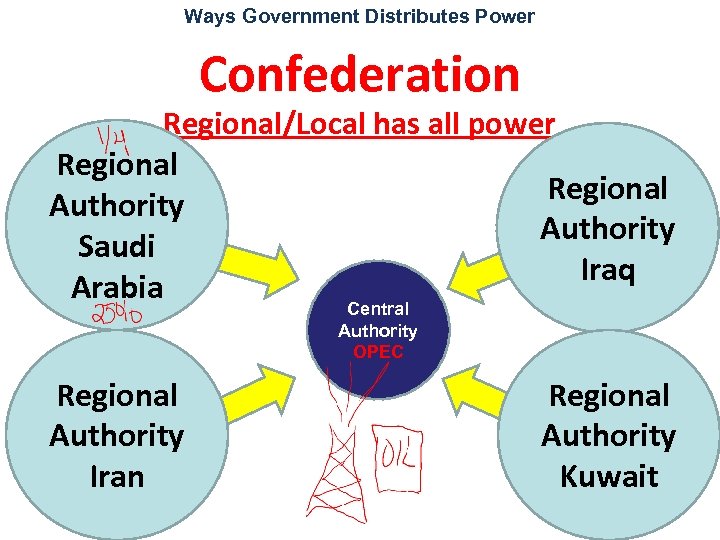 Ways Government Distributes Power Confederation Regional/Local has all power Regional Authority Saudi Iraq Arabia Central Authority OPEC Regional Authority Iran Regional Authority Kuwait
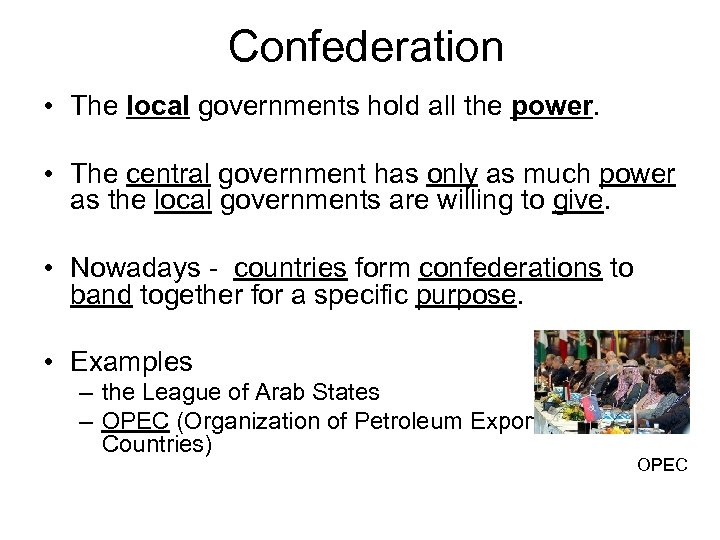 Confederation • The local governments hold all the power. • The central government has only as much power as the local governments are willing to give. • Nowadays - countries form confederations to band together for a specific purpose. • Examples – the League of Arab States – OPEC (Organization of Petroleum Exporting Countries) OPEC
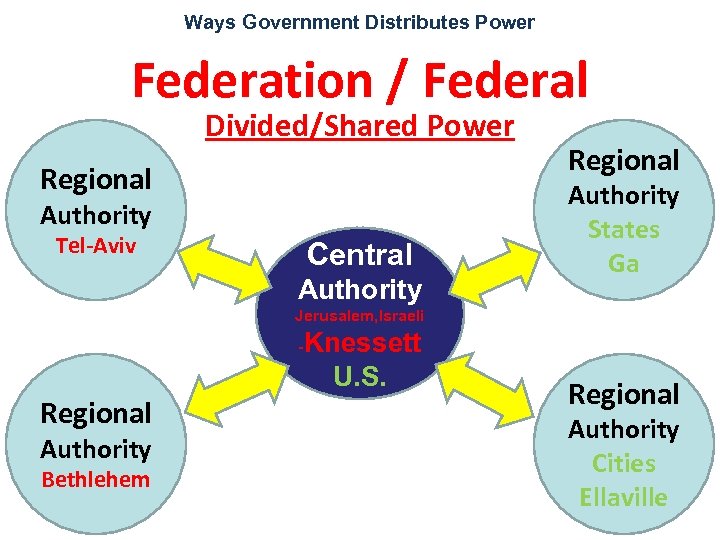 Ways Government Distributes Power Federation / Federal Divided/Shared Power Regional Authority Tel-Aviv Central Authority Regional Authority States Ga Jerusalem, Israeli - Regional Authority Bethlehem Knessett U. S. Regional Authority Cities Ellaville
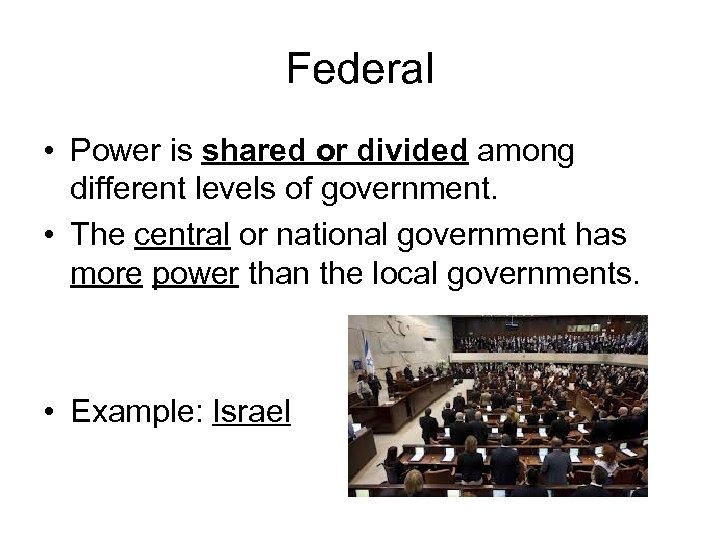 Federal • Power is shared or divided among different levels of government. • The central or national government has more power than the local governments. • Example: Israel
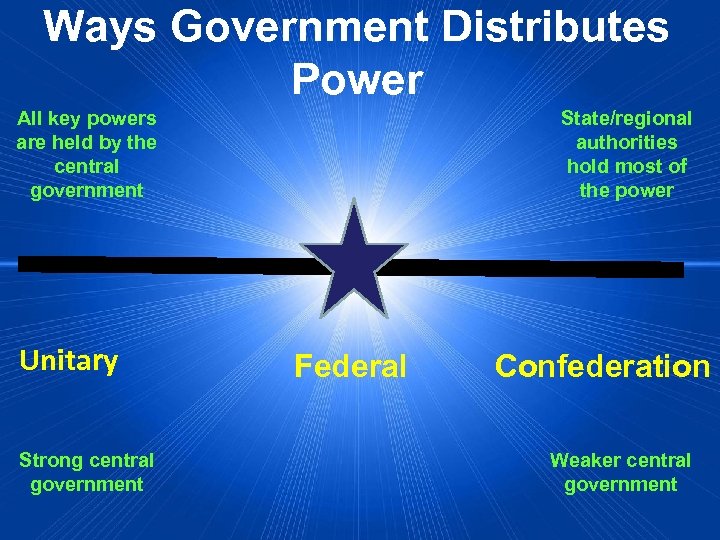 Ways Government Distributes Power All key powers are held by the central government Unitary Strong central government State/regional authorities hold most of the power Federal Confederation Weaker central government
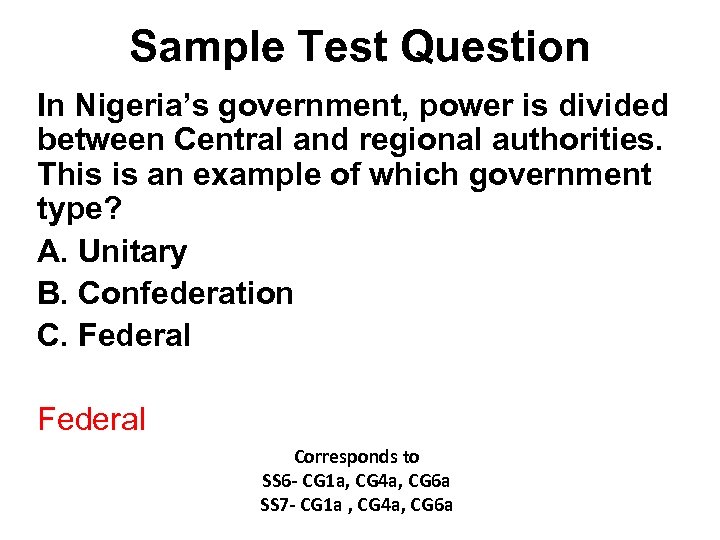 Sample Test Question In Nigeria’s government, power is divided between Central and regional authorities. This is an example of which government type? A. Unitary B. Confederation C. Federal Corresponds to SS 6 - CG 1 a, CG 4 a, CG 6 a SS 7 - CG 1 a , CG 4 a, CG 6 a
 CRCT Test Prep pages 98 -99 282. In a unitary government system, most of the power is in the hands of the A. individual voters B. king and advisors C. local governments D. central government D. Central government
 CRCT Test Prep pages 98 -99 283. Which of the following countries would be a good example of a unitary government? A. Israel B. Lebanon C. Saudi Arabia D. the United States C. Saudi Arabia
 CRCT Test Prep pages 98 -99 284. In a confederation government system, most of the power is in the hands of the A. legislature B. Individual voters C. Local governments D. Central government C. Local governments
 CRCT Test Prep pages 98 -99 285. What is a weakness of a confederation government system? A. A confederation is very expensive. B. Confederations are too large to rule effectively. C. A confederation does not share power with its members. D. The central government has only as much power as the local governments are willing to give.
 CRCT Test Prep pages 98 -99 286. Which Southwest Asian country would be a good example of a federal system of government? A. Iran B. Israel C. Kuwait D. Saudi Arabia B. Israel
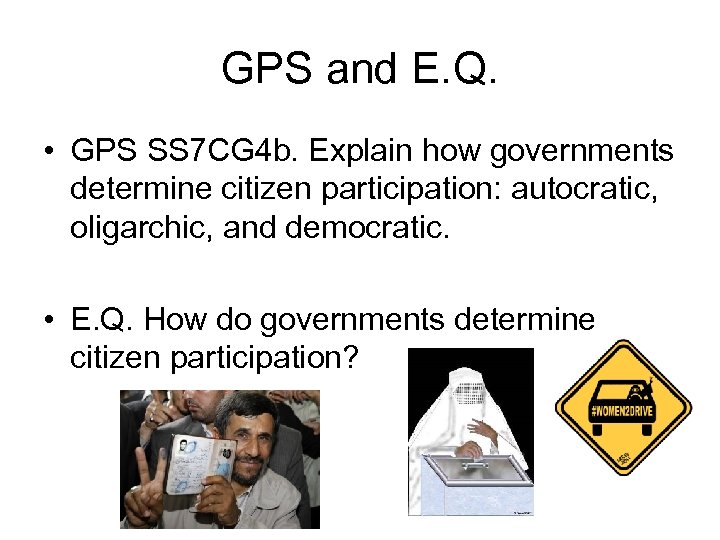 GPS and E. Q. • GPS SS 7 CG 4 b. Explain how governments determine citizen participation: autocratic, oligarchic, and democratic. • E. Q. How do governments determine citizen participation?
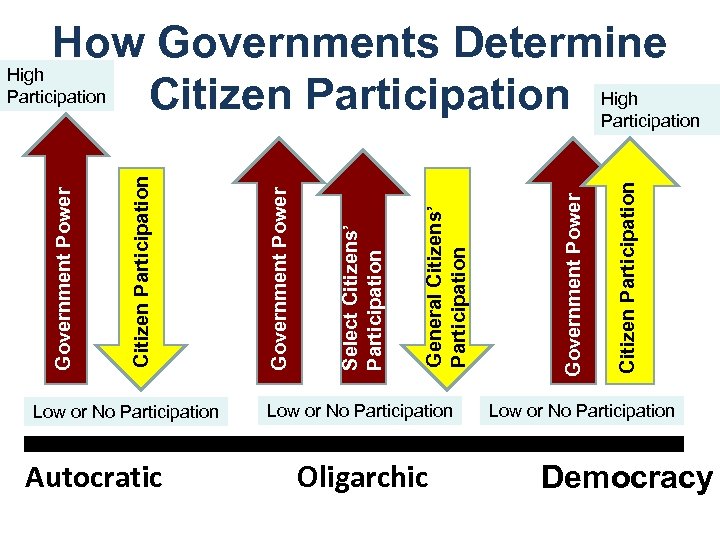 Low or No Participation Autocratic Low or No Participation Oligarchic Citizen Participation Government Power General Citizens’ Participation Select Citizens’ Participation Government Power Citizen Participation Government Power How Governments Determine High Participation Citizen Participation High Participation Low or No Participation Democracy
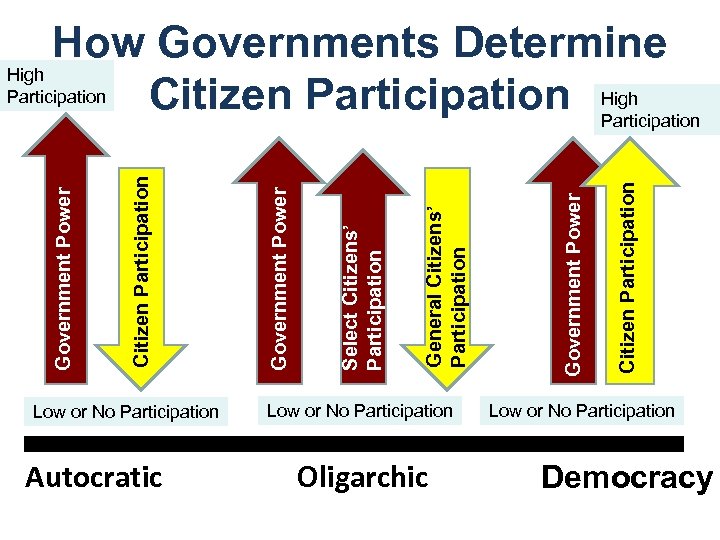 Low or No Participation Autocratic Low or No Participation Oligarchic Citizen Participation Government Power General Citizens’ Participation Select Citizens’ Participation Government Power Citizen Participation Government Power How Governments Determine High Participation Citizen Participation High Participation Low or No Participation Democracy
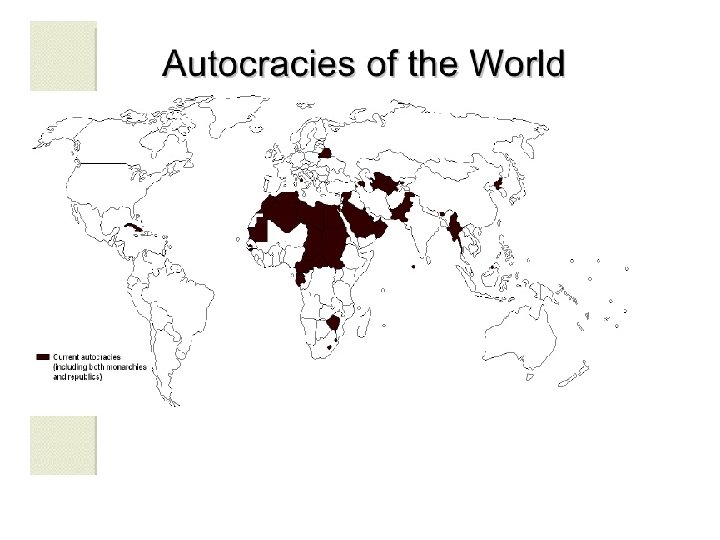
 How Governments Determine Citizen Participation Autocratic One person possesses unlimited power. The citizen has limited, if any, role in government.
 How Governments Determine Citizen Participation Autocratic • The oldest form of government. • One of the most common forms of government. • Maintain power through inheritance or ruthless use of military and police power.
 How Governments Determine Citizen Participation Forms of Autocratic Govts. • Absolute or Totalitarian Dictatorship • Ideas of a single leader glorified. • Government tries to control all aspects of social and economic life. • Government is not responsible to the people. • People lack the power to limit their rulers. Examples- Hitler, Mussolini, Stalin
 How Governments Determine Citizen Participation Forms of Autocratic Govts. • Absolute Monarchy • King, queen, or emperor exercises the supreme powers of government/unlimited power. • Position is usually inherited. • People lack the power to limit their rulers. • Absolute monarchs are rare today but from the 1400 s to the 1700 s they ruled most of Western Europe. • Examples- King of Saudi Arabia.
 How Governments Determine Citizen Participation Oligarchy Government by the few. Sometimes a small group exercises control, especially for corrupt and selfish purposes. The citizen has a very limited role.
 How Governments Determine Citizen Participation Oligarchy • The group gets its power from military power, social power, wealth, religion or a combination. • Political opposition is usually suppressedsometimes violently. • Examples: • Syria – ruling political party makes most decisions • Iran – small group of religious and political leaders makes many of the decisions
 How Governments Determine Citizen Participation Autocracy & Oligarchy • Sometimes claim they rule for the people. • In reality, the people have very little say in both types of government. • Examples- May hold elections with only one candidate or control the results in various ways. • Examples- Even when these governments have a legislature or national assembly, they often only approve decisions made by the leaders.
 How Governments Determine Citizen Participation Democracy • People play a greater role in deciding who the leaders are and what decisions are made. • Decisions are often made by majority vote, but laws are in place to protect individuals. • Examples- Israel
 Sample Test Question What is a basic way citizens of a democratic nation can influence the government? A. voting B. working C. obeying laws D. consuming goods voting OAS Database Question - Corresponds to SS 6 - CG 1 b, CG 4 b, CG 6 b SS 7 - CG 1 b , CG 4 b, CG 6 b
 CRCT Test Prep pages 99 -100 287. Who makes most of the important governmental decisions in an autocracy? A. the ruler B. the people C. the court system D. the elected legislature A. The ruler
 CRCT Test Prep pages 99 -100 288. Which Southwest Asian country could be described as an autocracy? A. Iraq B. Israel C. Turkey D. Saudi Arabia
 CRCT Test Prep pages 99 -100 289. Who makes most of the important governmental decisions in an oligarchy? A. the king B. the people C. the legislature D. a small group of powerful leaders D. A small group of powerful leaders
 CRCT Test Prep pages 99 -100 290. Why do the individual voters have more power in a democracy than they do in an autocracy or an oligarchy? A. kings are always cruel rulers. B. The voters get to choose the people who make the laws. C. All of the power stays in the hands of the local governments. D. Voters in democratic countries always choose qualified leaders. B. The voters get to choose the people who make the laws.
 CRCT Test Prep pages 99 -100 291. Which Southwest Asian country has a democratic form of government? A. Iran B. Israel C. Kuwait D. Saudi Arabia B. Israel
 CRCT Test Prep pages 99 -100 292. If the Saudi royal family controls the government of Saudi Arabia, and the king is the ruler, what type of government is this? A. unitary B. federation C. confederation D. parliamentary A. unitary
 CRCT Test Prep pages 99 -100 293. If the Saudi royal family controls the government of Saudi Arabia, and the king is the ruler, which best describes Saudi Arabia’s government? A. democracy B. dictatorship C. monarchy D. oligarchy C. monarchy
 GPS and E. Q. • GPS SS 7 CG 4 c. Describe the 2 predominate forms of democratic governments: parliamentary and presidential. • E. Q. How do parliamentary and presidential democracies compare?
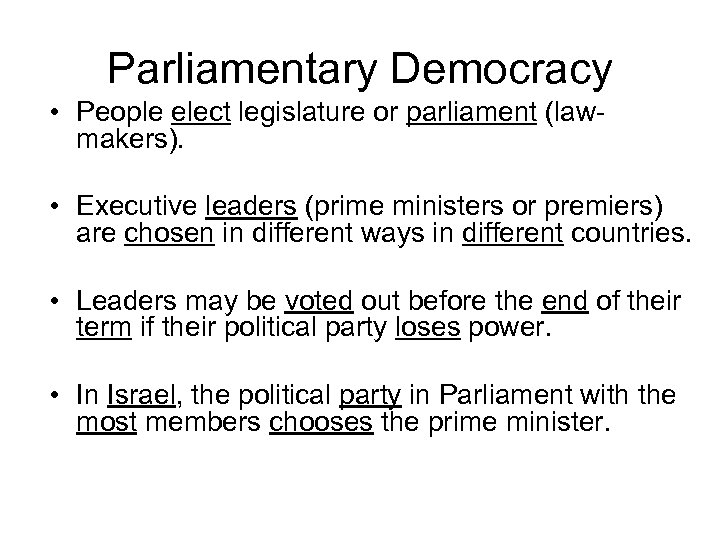 Parliamentary Democracy • People elect legislature or parliament (lawmakers). • Executive leaders (prime ministers or premiers) are chosen in different ways in different countries. • Leaders may be voted out before the end of their term if their political party loses power. • In Israel, the political party in Parliament with the most members chooses the prime minister.
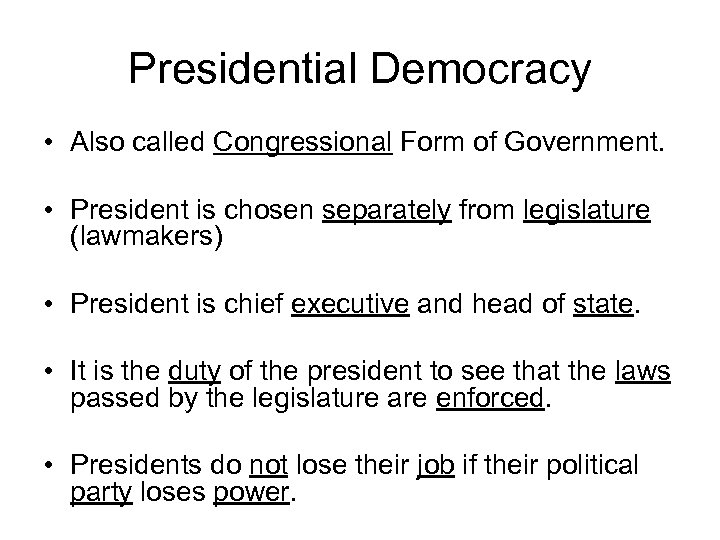 Presidential Democracy • Also called Congressional Form of Government. • President is chosen separately from legislature (lawmakers) • President is chief executive and head of state. • It is the duty of the president to see that the laws passed by the legislature are enforced. • Presidents do not lose their job if their political party loses power.
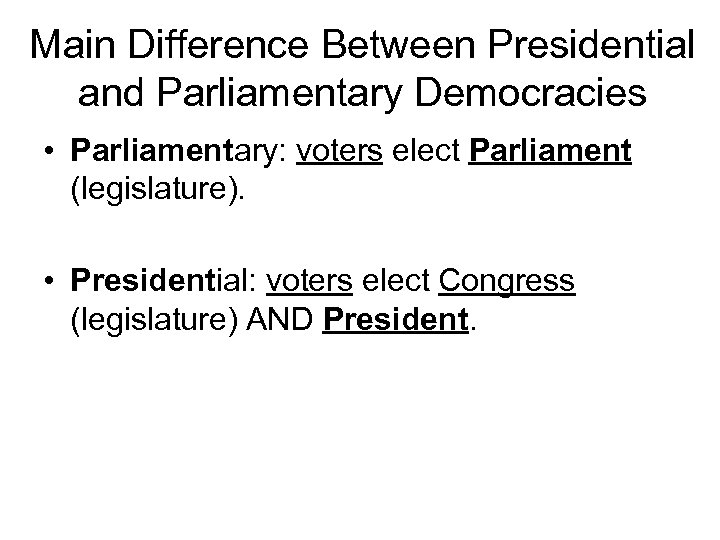 Main Difference Between Presidential and Parliamentary Democracies • Parliamentary: voters elect Parliament (legislature). • Presidential: voters elect Congress (legislature) AND President.
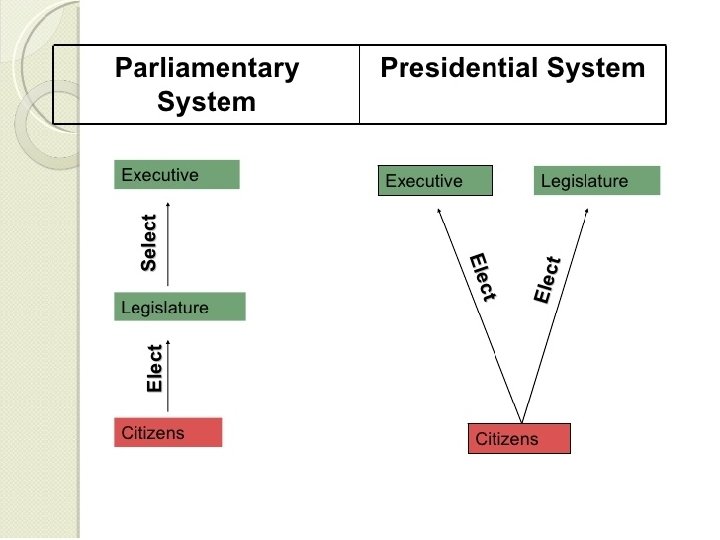
 Sample Test Question In which system of government does the legislature select the executive leader of the government? A. democratic B. communist C. parliamentary D. Totalitarian parliamentary OAS Database Question - Corresponds to SS 6 - CG 1 c, CG 4 c, CG 6 c SS 7 - CG 1 c , CG 4 c, CG 6 c
 Sample Test Question Which statement about Israel’s parliamentary system of government today is true? A. Members of both houses of Parliament are elected for life. B. The queen decides which laws Parliament will debate. C. Members of Parliament do not belong to political parties. D. The prime minister is not directly chosen by voters. OAS Database Question - Corresponds to D SS 6 - CG 1 c, CG 4 c, CG 6 c SS 7 - CG 1 c , CG 4 c, CG 6 c
 CRCT Test Prep pages 101 -102 294. Which branch of government is responsible for making and carrying out the laws in a parliamentary system of government? A. executive B. judicial C. legislative D. the monarch C. legislative
 CRCT Test Prep pages 101 -102 295. The leader of a parliamentary system is often called the A. king B. president. C. governor. D. prime minister. D. Prime minister.
 CRCT Test Prep pages 101 -102 296. The leader of a parliamentary system is chosen by? A. the king B. a popular vote of the people C. a decision of the national courts D. the political party with the most representatives in the legislature D. The political party with the most representatives in the legislature
 CRCT Test Prep pages 101 -102 297. The Head of State in a parliamentary system is often a person who has A. no actual power. B. a veto for laws passed by the legislature. C. the most power in the national government. D. a ceremonial role without much actual power. D. A ceremonial role without much actual power.
 CRCT Test Prep pages 101 -102 298. In a presidential system of government, how is a president chosen? A. by a decision of the national courts B. by a majority vote of the legislature C. in a separate vote from the one that chooses the legislature D. by the political party with the most representatives in the legislature C. In a separate vote from the one that chooses the legislature
 CRCT Test Prep pages 101 -102 299. What is the role of the president regarding the laws passed by the legislature? A. The president must enforce those laws. B. The president can change the laws he doesn’t like. C. The president sends the laws to the states for approval. D. Laws passed by the legislature do not have to go to the president for approval. A. The president must enforce those laws.
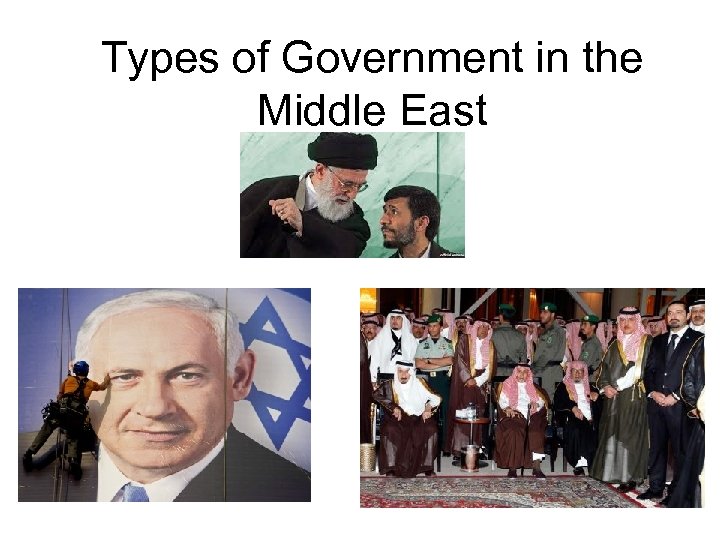 Types of Government in the Middle East
 GPS and E. Q. • GPS: SS 7 CG 5 a. The student will compare the parliamentary democracy of the State of Israel, the monarchy of the Kingdom of Saudi Arabia, and theocracy of the Islamic Republic of Iran. • E. Q. : How do the governments of Israel, Saudi Arabia, and Iran compare?
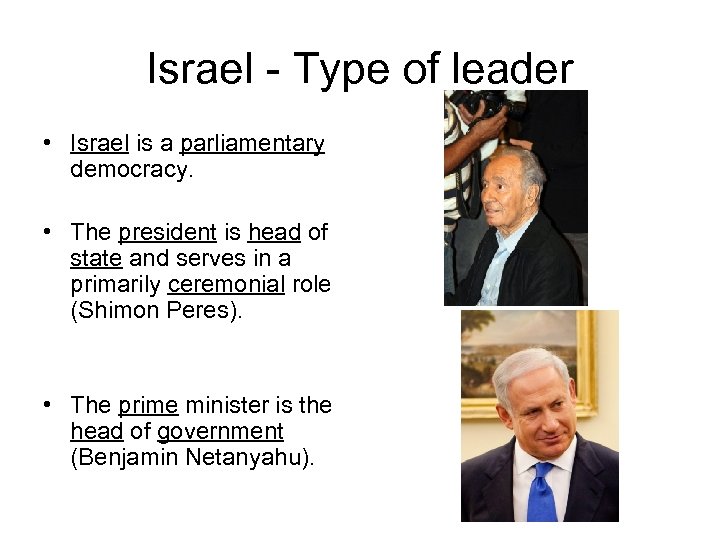 Israel - Type of leader • Israel is a parliamentary democracy. • The president is head of state and serves in a primarily ceremonial role (Shimon Peres). • The prime minister is the head of government (Benjamin Netanyahu).
 Israel – Becoming the leader • President is elected by the Knesset (parliament). • After election, President nominates a member of the Knesset to become the Prime Minister (following a vote of confidence from the Knesset)
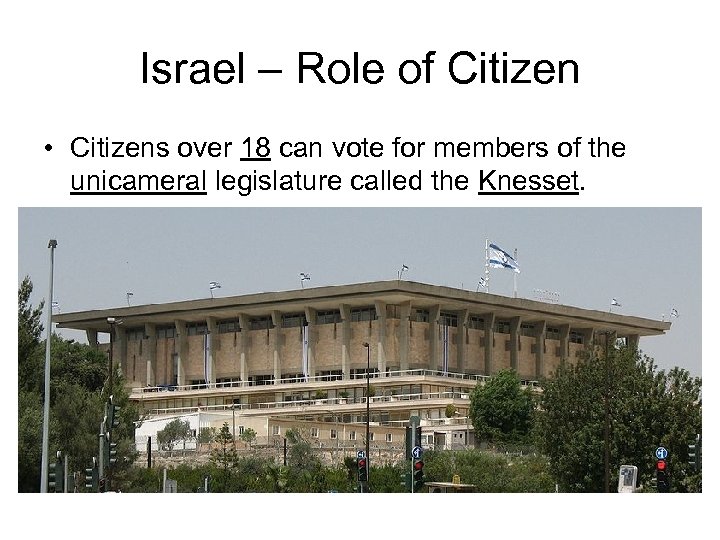 Israel – Role of Citizen • Citizens over 18 can vote for members of the unicameral legislature called the Knesset.
 Israel – Personal Freedoms • Freedom of Speech – Yes • Freedom of the Press - Yes
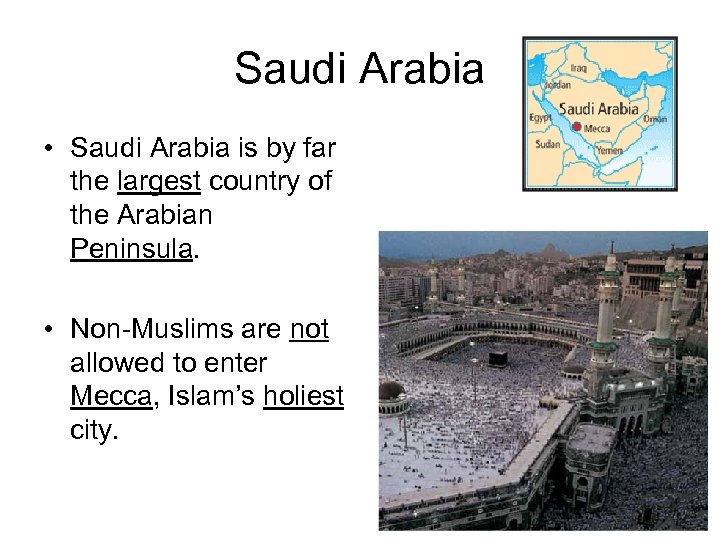 Saudi Arabia • Saudi Arabia is by far the largest country of the Arabian Peninsula. • Non-Muslims are not allowed to enter Mecca, Islam’s holiest city.
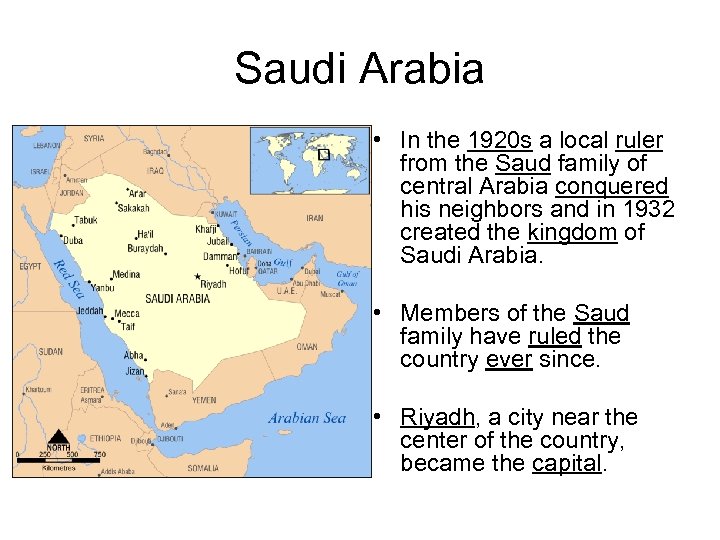 Saudi Arabia • In the 1920 s a local ruler from the Saud family of central Arabia conquered his neighbors and in 1932 created the kingdom of Saudi Arabia. • Members of the Saud family have ruled the country ever since. • Riyadh, a city near the center of the country, became the capital.
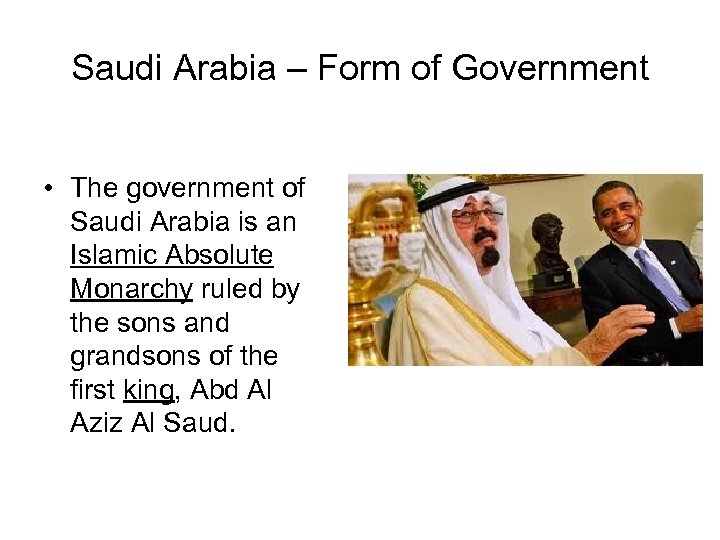 Saudi Arabia – Form of Government • The government of Saudi Arabia is an Islamic Absolute Monarchy ruled by the sons and grandsons of the first king, Abd Al Aziz Al Saud.
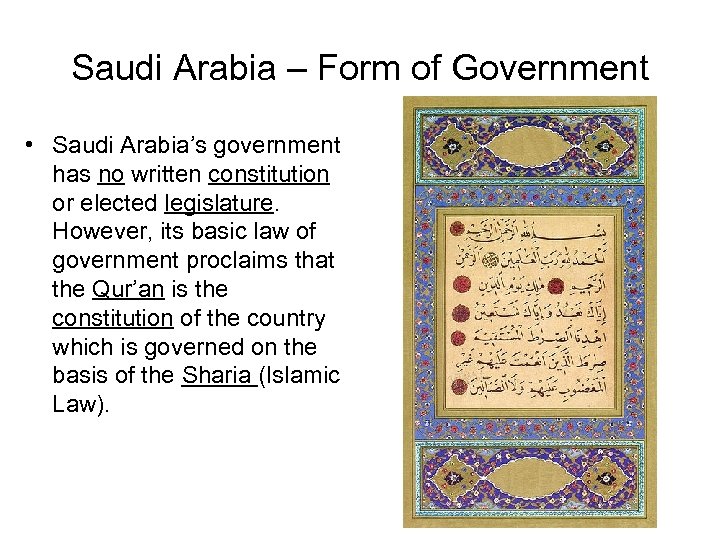 Saudi Arabia – Form of Government • Saudi Arabia’s government has no written constitution or elected legislature. However, its basic law of government proclaims that the Qur’an is the constitution of the country which is governed on the basis of the Sharia (Islamic Law).
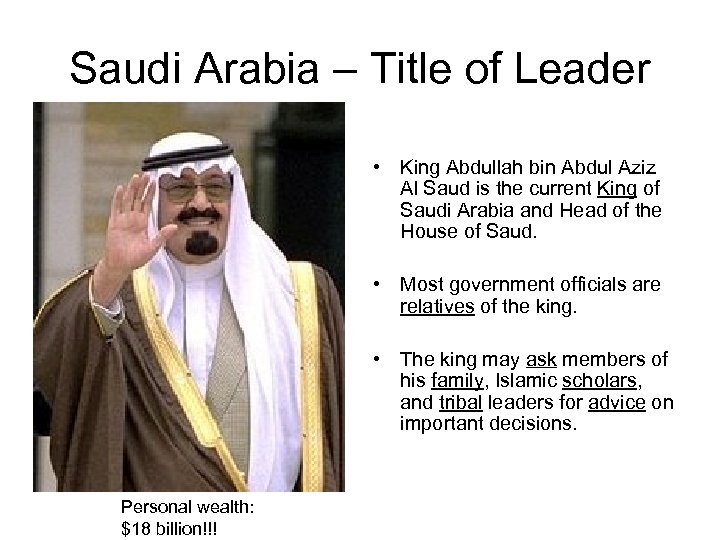 Saudi Arabia – Title of Leader • King Abdullah bin Abdul Aziz Al Saud is the current King of Saudi Arabia and Head of the House of Saud. • Most government officials are relatives of the king. • The king may ask members of his family, Islamic scholars, and tribal leaders for advice on important decisions. Personal wealth: $18 billion!!!
 Saudi Arabia – Becoming the Leader • The right of succession is hereditary (passed down through the family). • A newly established council selects a successor among the crown princes of the Saudi royal family. • The King’s power is limited by Islamic law and he must build consensus among religious leaders and other influential Saudis.
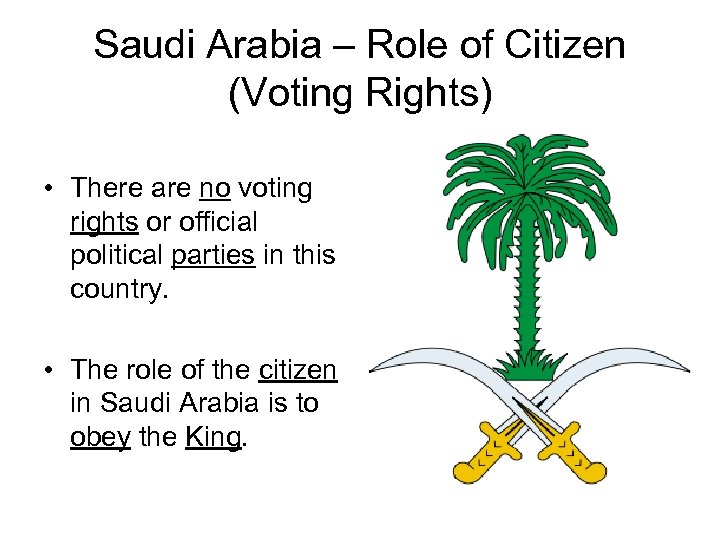 Saudi Arabia – Role of Citizen (Voting Rights) • There are no voting rights or official political parties in this country. • The role of the citizen in Saudi Arabia is to obey the King.
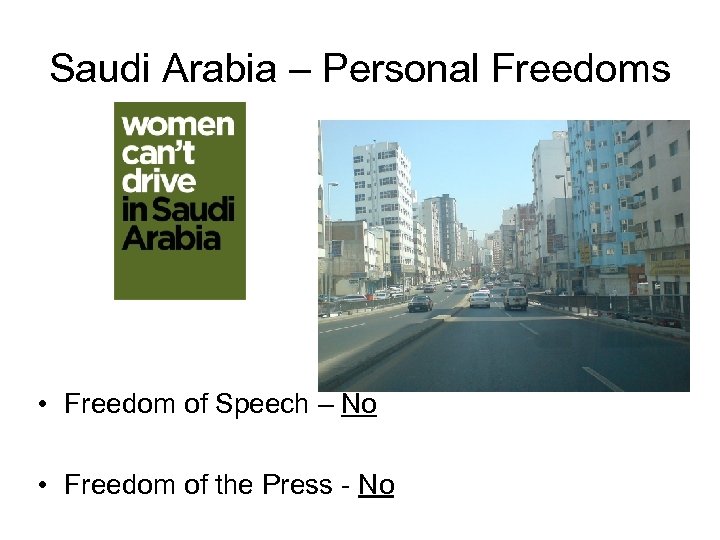 Saudi Arabia – Personal Freedoms • Freedom of Speech – No • Freedom of the Press - No
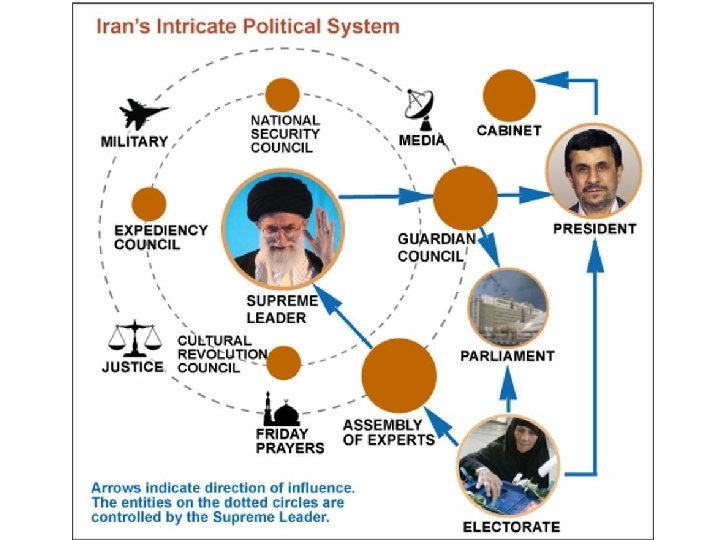
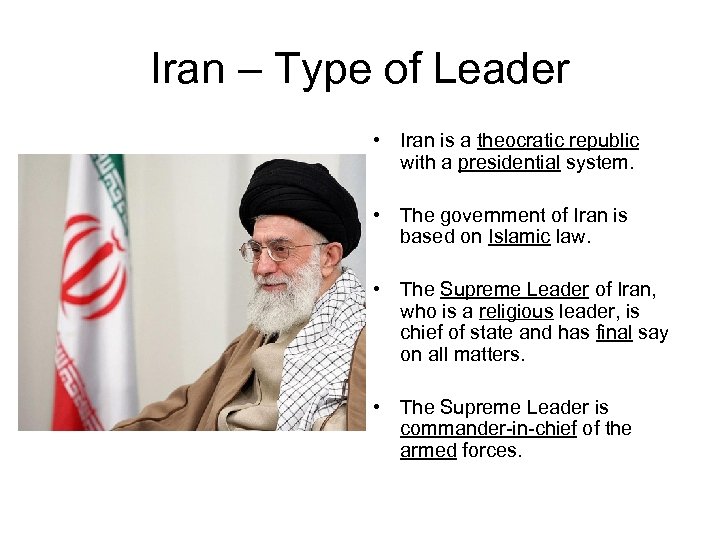 Iran – Type of Leader • Iran is a theocratic republic with a presidential system. • The government of Iran is based on Islamic law. • The Supreme Leader of Iran, who is a religious leader, is chief of state and has final say on all matters. • The Supreme Leader is commander-in-chief of the armed forces.
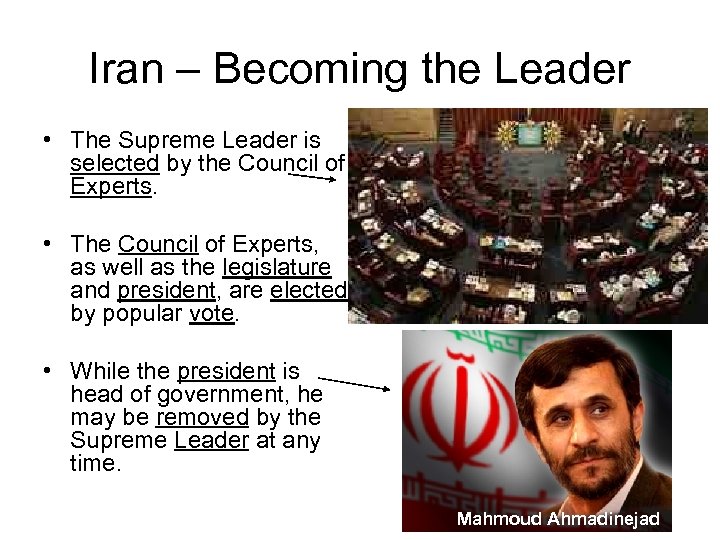 Iran – Becoming the Leader • The Supreme Leader is selected by the Council of Experts. • The Council of Experts, as well as the legislature and president, are elected by popular vote. • While the president is head of government, he may be removed by the Supreme Leader at any time. Mahmoud Ahmadinejad
 Iran – Role of Citizen • There is universal suffrage (voting) for everyone over 18. • The role of the citizen in Iran is to obey the Supreme Leader.
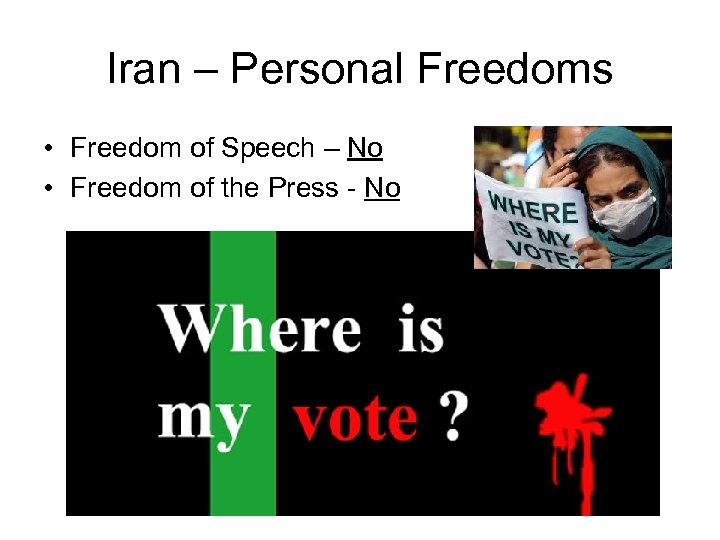 Iran – Personal Freedoms • Freedom of Speech – No • Freedom of the Press - No
 • Copy following chart onto your DRC (Data Retrieval Chart): “Compare Governments”
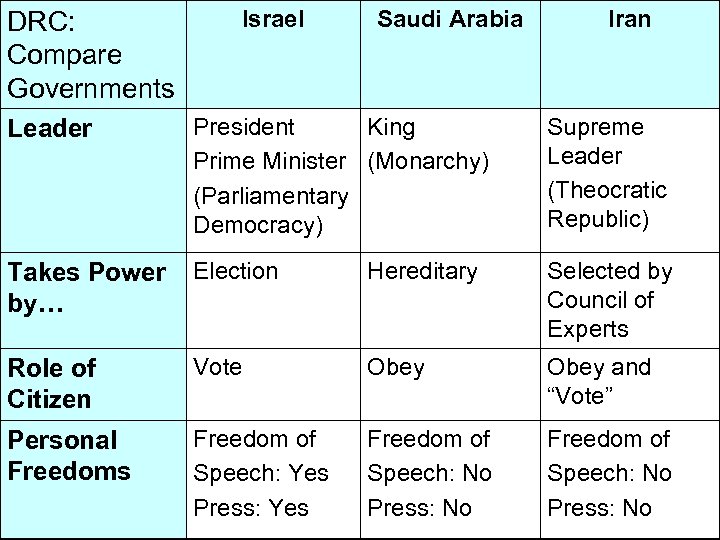 DRC: Compare Governments Israel Saudi Arabia Iran Leader President King Prime Minister (Monarchy) (Parliamentary Democracy) Supreme Leader (Theocratic Republic) Takes Power by… Election Hereditary Selected by Council of Experts Role of Citizen Vote Obey and “Vote” Personal Freedoms Freedom of Speech: Yes Press: Yes Freedom of Speech: No Press: No
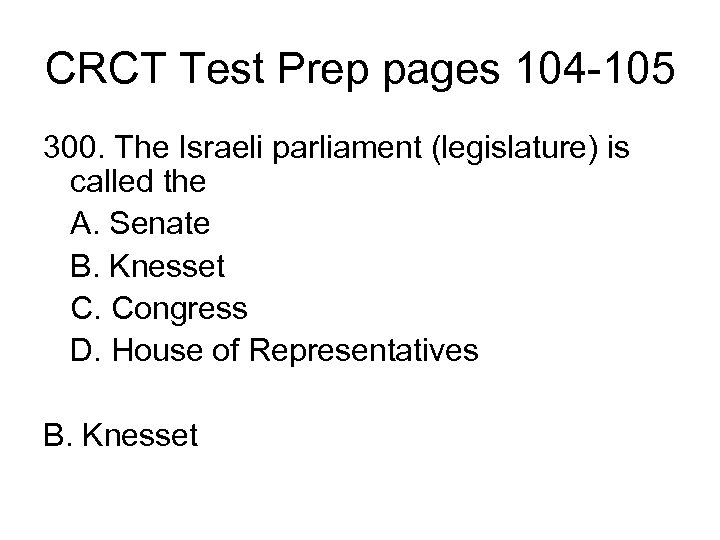 CRCT Test Prep pages 104 -105 300. The Israeli parliament (legislature) is called the A. Senate B. Knesset C. Congress D. House of Representatives B. Knesset
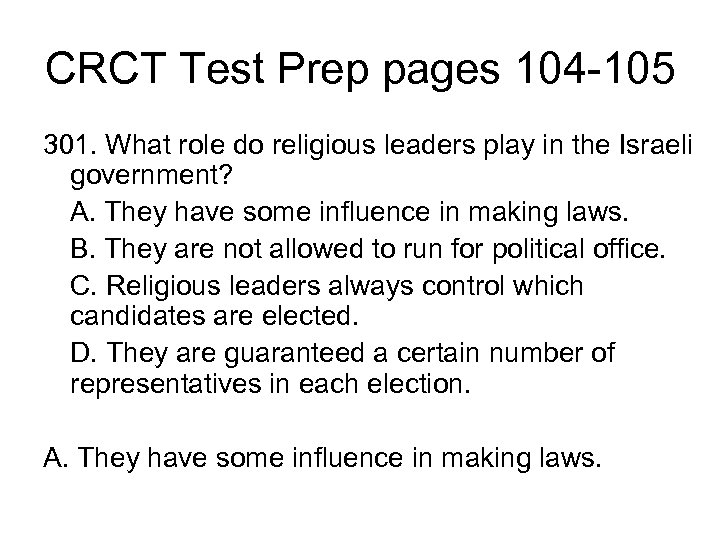 CRCT Test Prep pages 104 -105 301. What role do religious leaders play in the Israeli government? A. They have some influence in making laws. B. They are not allowed to run for political office. C. Religious leaders always control which candidates are elected. D. They are guaranteed a certain number of representatives in each election. A. They have some influence in making laws.
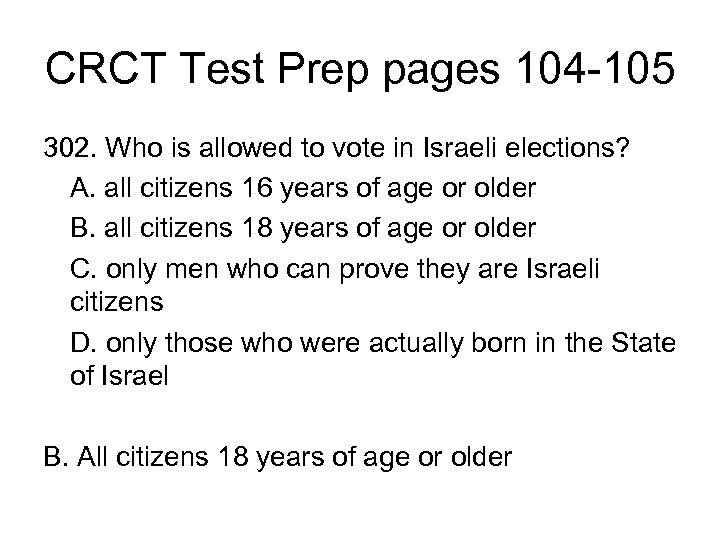 CRCT Test Prep pages 104 -105 302. Who is allowed to vote in Israeli elections? A. all citizens 16 years of age or older B. all citizens 18 years of age or older C. only men who can prove they are Israeli citizens D. only those who were actually born in the State of Israel B. All citizens 18 years of age or older
 CRCT Test Prep pages 104 -105 303. How often are elections for the national government held in Israel? A. Elections are held every 6 years. B. Party members are elected for life. C. Religious leaders can require new elections whenever they like. D. Elections are held every 4 years unless the ruling party calls for them to be held sooner.
 CRCT Test Prep pages 104 -105 304. Saudi Arabia is ruled by a A. king. B. popularly elected president. C. representative government. D. group of leading religious leaders. A. king
 CRCT Test Prep pages 104 -105 305. How long does a monarch rule? A. one elected term B. a term of 10 years C. as long as Parliament allows him to rule D. until he dies or chooses to give up power D. Until he dies or chooses to give up power
 CRCT Test Prep pages 104 -105 306. What role do the people play in a government that is a monarchy like that of Saudi Arabia? A. They have the power to vote a ruler out of office. B. The people get to approve the laws made by the ruler. C. They are guaranteed certain rights by their written constitution. D. They have little influence, as the ruler makes most decisions.
 CRCT Test Prep pages 104 -105 307. What is Sharia law? A. laws made by the king alone B. laws based on Parliamentary democracy C. laws based on the teachings of the Qur’an D. laws calling for a separation of church and state C. laws based on the teachings of the Qur’an
 CRCT Test Prep pages 104 -105 308. What is the definition of a “theocracy”? ? A. a government that sees God as the supreme ruler B. a government that allows people to choose the leaders C. a system in which religious law and civil law are separate D. a system in which only religious leaders are allowed to vote A. a government that sees God as the supreme ruler
 CRCT Test Prep pages 104 -105 309. Why is Iran sometimes called a theocratic republic? A. Iran’s religious leaders make all the laws for the country. B. Religious leaders decide which Iranian citizens can vote. C. The people of Iran have no say in choosing their government leaders. D. Iran’s government is led by both an elected parliament and powerful religious leaders.
 CRCT Test Prep pages 104 -105 310. What is an Ayatollah? A. a Christian priest B. a Shi’a religious leader C. The title of a local governor D. a leader of a Jewish congregation D. a Shi’a religious leader
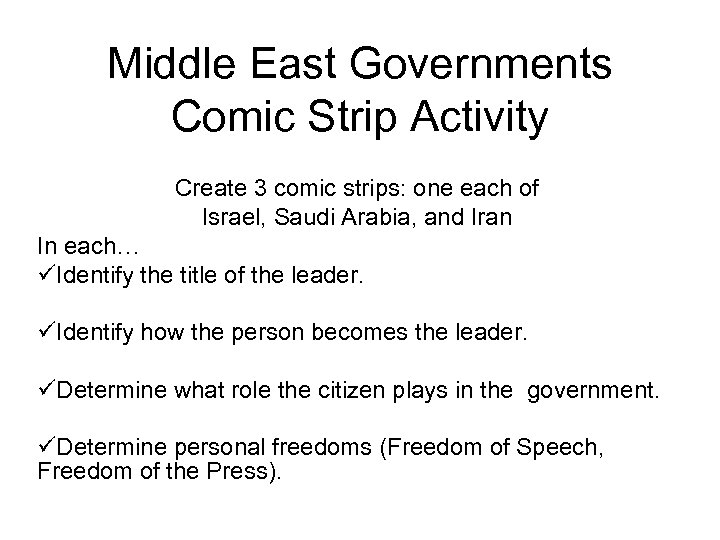 Middle East Governments Comic Strip Activity Create 3 comic strips: one each of Israel, Saudi Arabia, and Iran In each… üIdentify the title of the leader. üIdentify how the person becomes the leader. üDetermine what role the citizen plays in the government. üDetermine personal freedoms (Freedom of Speech, Freedom of the Press).