


 Скачать презентацию Mid Western Regional Drugs Taskforce Action Plan June
d8a18b3a68d4d4f7c562ef61d230bb9c.ppt
- Количество слайдов: 35
 Mid Western Regional Drugs Taskforce Action Plan June 2005 © 2005 1
 Agenda · · Background and Context · Consultation Process · Key Issues · © 2005 Chairperson’s Foreword Action Plan 2
 A Statement from the Chairperson Drug misuse is a major issue in the Mid Western Area and is the source of significant social and personal problems for individuals, families and the community in general. We all must face up to the many issues and develop effective, practical actions to improve the lives of those impacted. This document, therefore, is critically important in establishing the prioirty actions needed within the Region to tackle the problem. The plan was developed in the context of a comprehensive consultation process involving all the key stakeholders including statutory agencies, community and voluntary groups and individuals from the Region. Their valuable insight was greatly appreciated and has led to the development of this plan. I would like to personally thank all of those that participated in the various consultation sessions and also thank the members of the Regional Drugs Taskforce that selflessly gave up so much of their time to produce this document. This plan will not be delivered without the close co-operation and partnership of all the stakeholders involved. The RDTF on it’s own does not have the capacity to tackle the issues single-handedly. Collectively, we have a duty and responsibility to ensure that we now work together to achieve the aims and objectives set out in this plan. I am confident that the taskforce can be a useful force of change and focus in how we tackle the problems. I call on all those involved to work with us to make the difference in the lives of those impacted. Tom Gleeson, Chairperson Mid Western Regional Drugs Taskforce © 2005 3
 Agenda · · Background and Context · Consultation Process · Key Issues · © 2005 Chairperson’s Foreword Action Plan 4
 Background Context Mid Western Regional Drugs Taskforce · · The formation of the Regional Drugs Taskforces was on foot of recommendations within the National Drugs Strategy 20012008 and was further supported by findings from a Health Research Board report which showed that drug abuse outside Dublin had increased three-fold over a four year period. · It is acknowledged that there are ‘huge gaps’ in service provision for drug users in the area. · © 2005 The Mid Western RDTF was convened in May 2003. With collaboration from the local community, voluntary groups, relevant agencies, and the public in general the Mid Western Regional Task Force hopes to develop an integrated plan to tackle the drugs problem and to identify the gaps in services to best provide care for drug users. 5
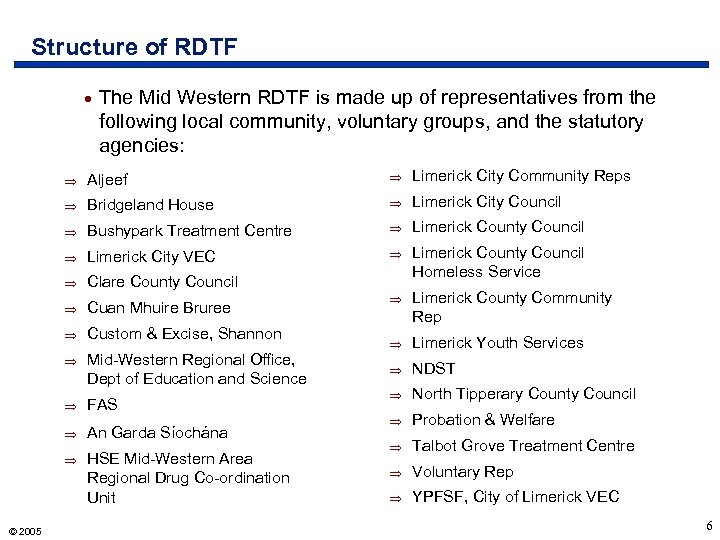 Structure of RDTF · The Mid Western RDTF is made up of representatives from the following local community, voluntary groups, and the statutory agencies: Þ Þ Limerick City Community Reps Þ Bridgeland House Þ Limerick City Council Þ Bushypark Treatment Centre Þ Limerick County Council Þ Limerick City VEC Þ Þ Clare County Council Limerick County Council Homeless Service Þ Cuan Mhuire Bruree Þ Custom & Excise, Shannon Limerick County Community Rep Þ Mid-Western Regional Office, Dept of Education and Science Þ Limerick Youth Services Þ Þ NDST Þ FAS Þ North Tipperary County Council Þ An Garda Síochána Þ Probation & Welfare Þ © 2005 Aljeef HSE Mid-Western Area Regional Drug Co-ordination Unit Þ Talbot Grove Treatment Centre Þ Voluntary Rep Þ YPFSF, City of Limerick VEC 6
 Agenda · · Background and Context · Consultation Process · Key Issues · © 2005 Chairperson’s Foreword Action Plan 7
 Consultation Process · · · The RDTF decided to consult with a variety of stakeholders in the Region in order to develop a detailed action plan. These consultations sessions, facilitated by external consultants, were held over a period of three weeks across the region. There were two primary methods of consultation: Þ 1. Public consultation sessions * Þ 2. Sub-group meetings * · · · Four public consultation meetings were held in Newcastle Western, Limerick City, Nenagh, and Ennis. In each location, meetings were also held with local community groups separate to the public meetings. In total, over 80 people attended these public consultation sessions and they contributed a large range of ideas and suggested actions for the plan. A number of sub-group meetings were convened with specific special interest groups. For example, meetings were conducted with treatment & rehabilitation service providers, education & prevention workers including school representatives, youth workers, community representatives, Gardaí and a meeting was also held with service users. Separate to this a number of individuals and groups provided submissions to the task force on their views with respect to the action plan. Having gathered all of the inputs from these sessions three working groups were established within the task force to develop the detailed action plan itself. These groups meet on a number of occasions and a final draft action plan was developed by the task force. This draft plan will be submitted to the National Drug Strategy Team (NDST) for assessment. Recommendations on funding will then made to the Inter-Departmental Group on Drugs and the Cabinet Committee on Social Inclusion. The taskforce would like to thank all those who attended the various meetings. The Action plan has been developed on the back of the valuable input provided by these individuals and groups. © 2005 8
 Agenda · · Background and Context · Consultation Process · Key Issues · © 2005 Chairperson’s Foreword Action Plan 9
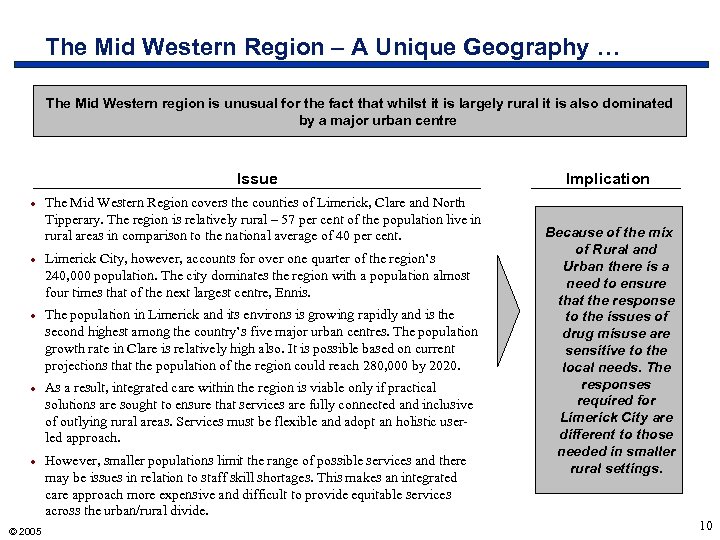 The Mid Western Region – A Unique Geography … The Mid Western region is unusual for the fact that whilst it is largely rural it is also dominated by a major urban centre Issue · The Mid Western Region covers the counties of Limerick, Clare and North Tipperary. The region is relatively rural – 57 per cent of the population live in rural areas in comparison to the national average of 40 per cent. · Limerick City, however, accounts for over one quarter of the region’s 240, 000 population. The city dominates the region with a population almost four times that of the next largest centre, Ennis. · The population in Limerick and its environs is growing rapidly and is the second highest among the country’s five major urban centres. The population growth rate in Clare is relatively high also. It is possible based on current projections that the population of the region could reach 280, 000 by 2020. · As a result, integrated care within the region is viable only if practical solutions are sought to ensure that services are fully connected and inclusive of outlying rural areas. Services must be flexible and adopt an holistic userled approach. · However, smaller populations limit the range of possible services and there may be issues in relation to staff skill shortages. This makes an integrated care approach more expensive and difficult to provide equitable services across the urban/rural divide. © 2005 Implication Because of the mix of Rural and Urban there is a need to ensure that the response to the issues of drug misuse are sensitive to the local needs. The responses required for Limerick City are different to those needed in smaller rural settings. 10
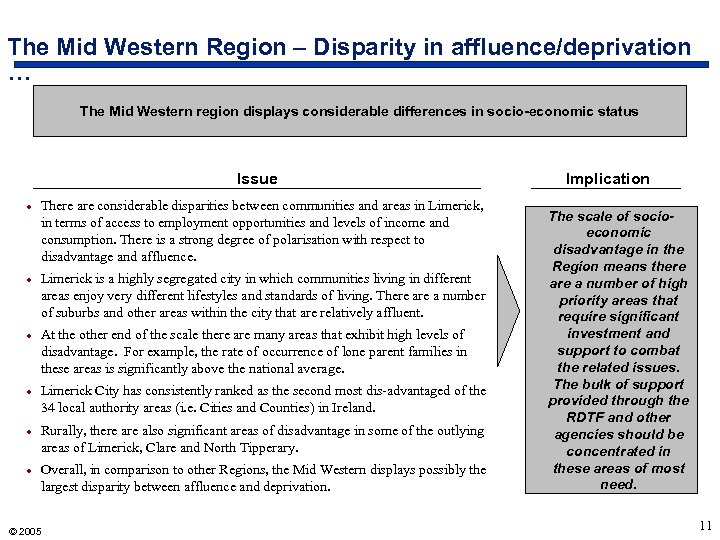 The Mid Western Region – Disparity in affluence/deprivation … The Mid Western region displays considerable differences in socio-economic status Issue · There are considerable disparities between communities and areas in Limerick, in terms of access to employment opportunities and levels of income and consumption. There is a strong degree of polarisation with respect to disadvantage and affluence. · Limerick is a highly segregated city in which communities living in different areas enjoy very different lifestyles and standards of living. There a number of suburbs and other areas within the city that are relatively affluent. · At the other end of the scale there are many areas that exhibit high levels of disadvantage. For example, the rate of occurrence of lone parent families in these areas is significantly above the national average. · Limerick City has consistently ranked as the second most dis-advantaged of the 34 local authority areas (i. e. Cities and Counties) in Ireland. · Rurally, there also significant areas of disadvantage in some of the outlying areas of Limerick, Clare and North Tipperary. · Overall, in comparison to other Regions, the Mid Western displays possibly the largest disparity between affluence and deprivation. © 2005 Implication The scale of socioeconomic disadvantage in the Region means there a number of high priority areas that require significant investment and support to combat the related issues. The bulk of support provided through the RDTF and other agencies should be concentrated in these areas of most need. 11
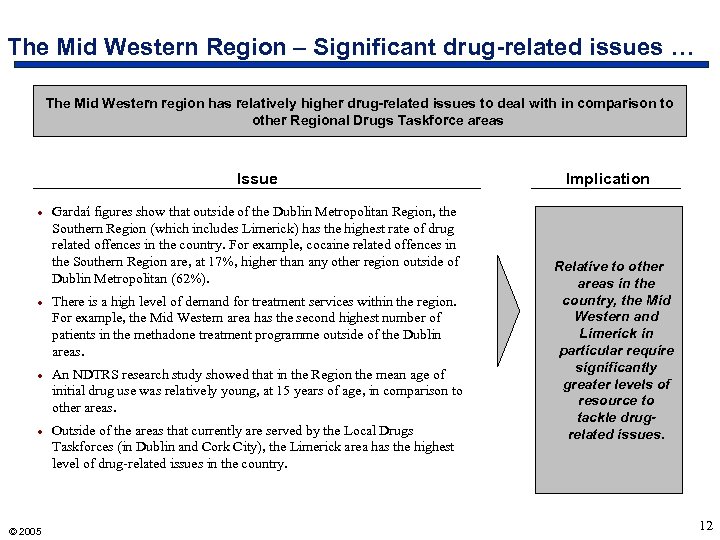 The Mid Western Region – Significant drug-related issues … The Mid Western region has relatively higher drug-related issues to deal with in comparison to other Regional Drugs Taskforce areas Issue · Gardaí figures show that outside of the Dublin Metropolitan Region, the Southern Region (which includes Limerick) has the highest rate of drug related offences in the country. For example, cocaine related offences in the Southern Region are, at 17%, higher than any other region outside of Dublin Metropolitan (62%). · There is a high level of demand for treatment services within the region. For example, the Mid Western area has the second highest number of patients in the methadone treatment programme outside of the Dublin areas. · An NDTRS research study showed that in the Region the mean age of initial drug use was relatively young, at 15 years of age, in comparison to other areas. · Outside of the areas that currently are served by the Local Drugs Taskforces (in Dublin and Cork City), the Limerick area has the highest level of drug-related issues in the country. © 2005 Implication Relative to other areas in the country, the Mid Western and Limerick in particular require significantly greater levels of resource to tackle drugrelated issues. 12
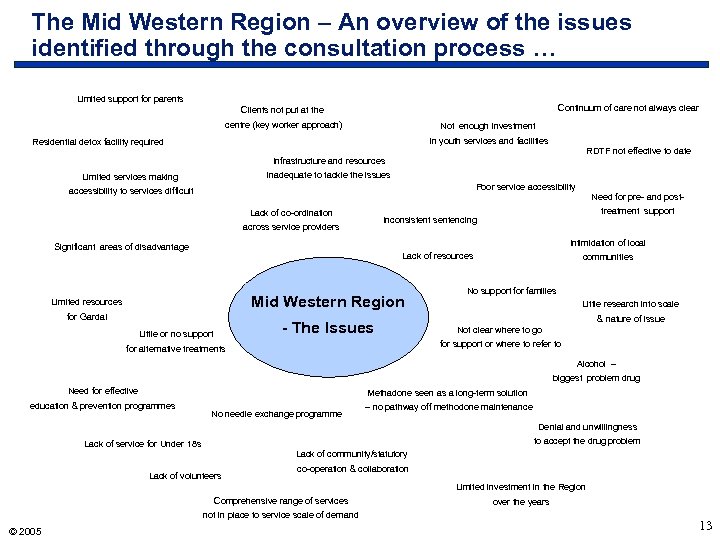 The Mid Western Region – An overview of the issues identified through the consultation process … Limited support for parents Continuum of care not always clear Clients not put at the centre (key worker approach) Not enough investment in youth services and facilities Residential detox facility required RDTF not effective to date Infrastructure and resources inadequate to tackle the issues Limited services making Poor service accessibility to services difficult Need for pre- and post. Lack of co-ordination treatment support Inconsistent sentencing across service providers Intimidation of local Significant areas of disadvantage Lack of resources Mid Western Region Limited resources for Gardaí - The Issues Little or no support communities No support for families Little research into scale & nature of issue Not clear where to go for support or where to refer to for alternative treatments Alcohol – biggest problem drug Need for effective Methadone seen as a long-term solution education & prevention programmes No needle exchange programme – no pathway off methodone maintenance Denial and unwillingness to accept the drug problem Lack of service for Under 18 s Lack of community/statutory Lack of volunteers co-operation & collaboration Limited investment in the Region Comprehensive range of services not in place to service scale of demand © 2005 over the years 13
 Agenda · · Background and Context · Consultation Process · Key Issues · © 2005 Chairperson’s Foreword Action Plan 14
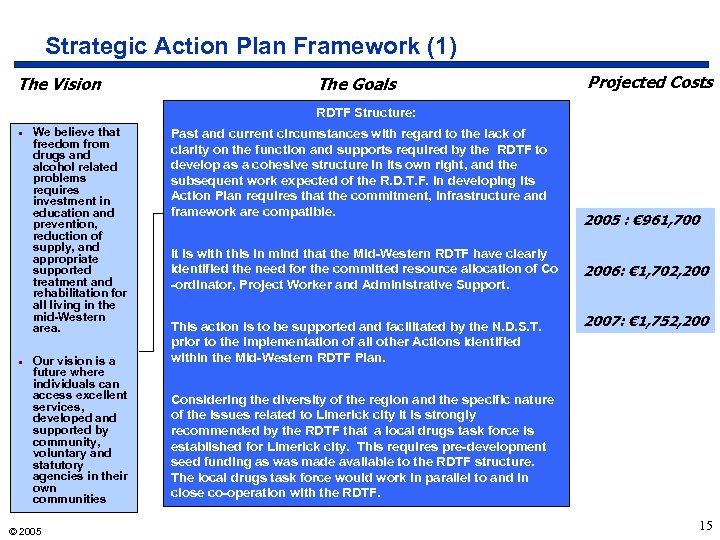 Strategic Action Plan Framework (1) The Vision The Goals Projected Costs RDTF Structure: · · We believe that freedom from drugs and alcohol related problems requires investment in education and prevention, reduction of supply, and appropriate supported treatment and rehabilitation for all living in the mid-Western area. Our vision is a future where individuals can access excellent services, developed and supported by community, voluntary and statutory agencies in their own communities © 2005 Past and current circumstances with regard to the lack of clarity on the function and supports required by the RDTF to develop as a cohesive structure in its own right, and the subsequent work expected of the R. D. T. F. in developing its Action Plan requires that the commitment, infrastructure and framework are compatible. It is with this in mind that the Mid-Western RDTF have clearly identified the need for the committed resource allocation of Co -ordinator, Project Worker and Administrative Support. This action is to be supported and facilitated by the N. D. S. T. prior to the implementation of all other Actions identified within the Mid-Western RDTF Plan. 2005 : € 961, 700 2006: € 1, 702, 2007: € 1, 752, 200 Considering the diversity of the region and the specific nature of the issues related to Limerick city it is strongly recommended by the RDTF that a local drugs task force is established for Limerick city. This requires pre-development seed funding as was made available to the RDTF structure. The local drugs task force would work in parallel to and in close co-operation with the RDTF. 15
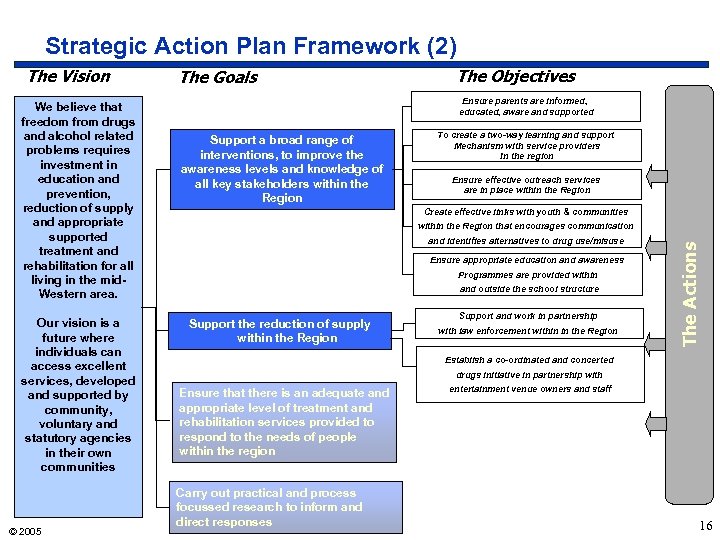 Strategic Action Plan Framework (2) We believe that freedom from drugs and alcohol related problems requires investment in education and prevention, reduction of supply and appropriate supported treatment and rehabilitation for all living in the mid. Western area. Our vision is a future where individuals can access excellent services, developed and supported by community, voluntary and statutory agencies in their own communities © 2005 The Goals The Objectives Ensure parents are informed, educated, aware and supported Support a broad range of interventions, to improve the awareness levels and knowledge of all key stakeholders within the Region To create a two-way learning and support Mechanism with service providers In the region Ensure effective outreach services are in place within the Region Create effective links with youth & communities within the Region that encourages communication and identifies alternatives to drug use/misuse Ensure appropriate education and awareness Programmes are provided within and outside the school structure Support the reduction of supply within the Region Support and work in partnership with law enforcement within in the Region The Actions The Vision Establish a co-ordinated and concerted drugs initiative in partnership with Ensure that there is an adequate and appropriate level of treatment and rehabilitation services provided to respond to the needs of people within the region Carry out practical and process focussed research to inform and direct responses entertainment venue owners and staff 16
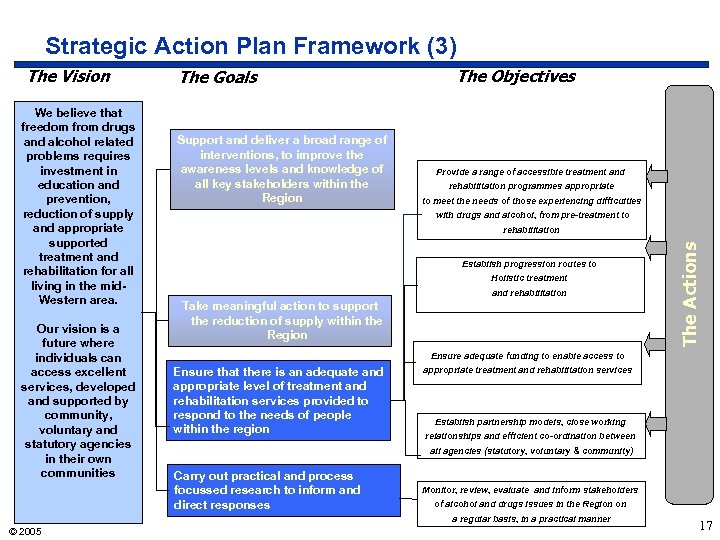 Strategic Action Plan Framework (3) We believe that freedom from drugs and alcohol related problems requires investment in education and prevention, reduction of supply and appropriate supported treatment and rehabilitation for all living in the mid. Western area. Our vision is a future where individuals can access excellent services, developed and supported by community, voluntary and statutory agencies in their own communities The Goals Support and deliver a broad range of interventions, to improve the awareness levels and knowledge of all key stakeholders within the Region The Objectives Provide a range of accessible treatment and rehabilitation programmes appropriate to meet the needs of those experiencing difficulties with drugs and alcohol, from pre-treatment to rehabilitation Establish progression routes to Holistic treatment and rehabilitation Take meaningful action to support the reduction of supply within the Region Ensure adequate funding to enable access to Ensure that there is an adequate and appropriate level of treatment and rehabilitation services provided to respond to the needs of people within the region appropriate treatment and rehabilitation services Establish partnership models, close working relationships and efficient co-ordination between all agencies (statutory, voluntary & community) Carry out practical and process focussed research to inform and direct responses Monitor, review, evaluate and inform stakeholders of alcohol and drugs issues in the Region on a regular basis, in a practical manner © 2005 The Actions The Vision 17
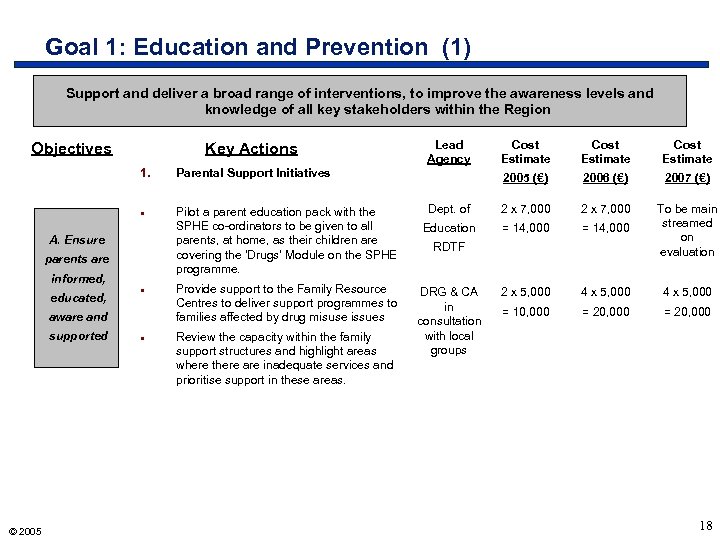 Goal 1: Education and Prevention (1) Support and deliver a broad range of interventions, to improve the awareness levels and knowledge of all key stakeholders within the Region Key Actions Objectives 1. Pilot a parent education pack with the SPHE co-ordinators to be given to all parents, at home, as their children are covering the ‘Drugs’ Module on the SPHE programme. A. Ensure parents are informed, educated, · aware and supported © 2005 Cost Estimate 2005 (€) 2006 (€) 2007 (€) Dept. of 2 x 7, 000 Education = 14, 000 To be main streamed on evaluation 2 x 5, 000 4 x 5, 000 = 10, 000 = 20, 000 Parental Support Initiatives · Lead Agency · Provide support to the Family Resource Centres to deliver support programmes to families affected by drug misuse issues Review the capacity within the family support structures and highlight areas where there are inadequate services and prioritise support in these areas. RDTF DRG & CA in consultation with local groups 18
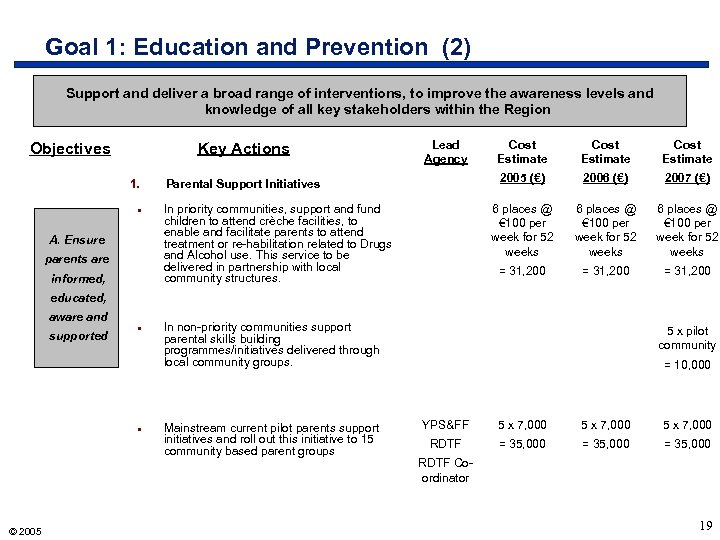 Goal 1: Education and Prevention (2) Support and deliver a broad range of interventions, to improve the awareness levels and knowledge of all key stakeholders within the Region Key Actions Objectives 1. · A. Ensure parents are informed, Lead Agency Cost Estimate 2006 (€) 2007 (€) 6 places @ € 100 per week for 52 weeks = 31, 200 In priority communities, support and fund children to attend crèche facilities, to enable and facilitate parents to attend treatment or re-habilitation related to Drugs and Alcohol use. This service to be delivered in partnership with local community structures. Cost Estimate 2005 (€) Parental Support Initiatives Cost Estimate = 31, 200 educated, aware and supported · · © 2005 In non-priority communities support parental skills building programmes/initiatives delivered through local community groups. Mainstream current pilot parents support initiatives and roll out this initiative to 15 community based parent groups 5 x pilot community = 10, 000 YPS&FF 5 x 7, 000 RDTF = 35, 000 RDTF Coordinator 19
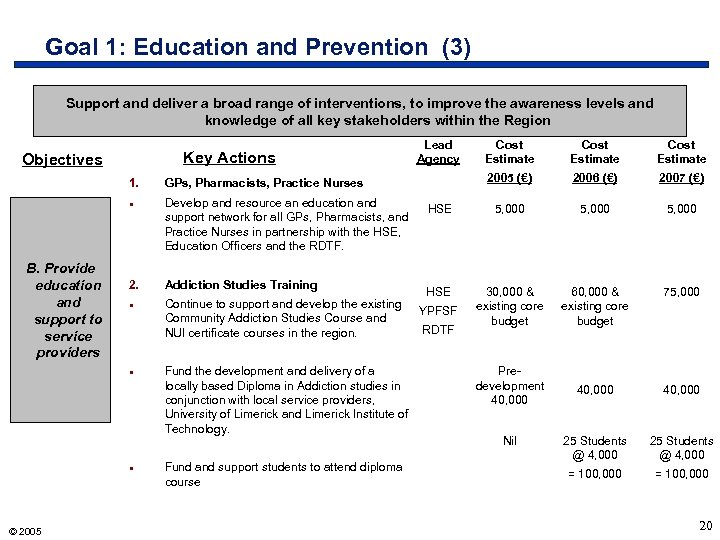 Goal 1: Education and Prevention (3) Support and deliver a broad range of interventions, to improve the awareness levels and knowledge of all key stakeholders within the Region Key Actions Objectives 1. B. Provide education and support to service providers Develop and resource an education and support network for all GPs, Pharmacists, and Practice Nurses in partnership with the HSE, Education Officers and the RDTF. 2. Addiction Studies Training · Continue to support and develop the existing Community Addiction Studies Course and NUI certificate courses in the region. · · © 2005 Cost Estimate 2005 (€) 2006 (€) 2007 (€) HSE 5, 000 HSE 30, 000 & existing core budget 60, 000 & existing core budget 75, 000 Predevelopment 40, 000 25 Students @ 4, 000 = 100, 000 GPs, Pharmacists, Practice Nurses · Lead Agency Fund the development and delivery of a locally based Diploma in Addiction studies in conjunction with local service providers, University of Limerick and Limerick Institute of Technology. Fund and support students to attend diploma course YPFSF RDTF Nil 20
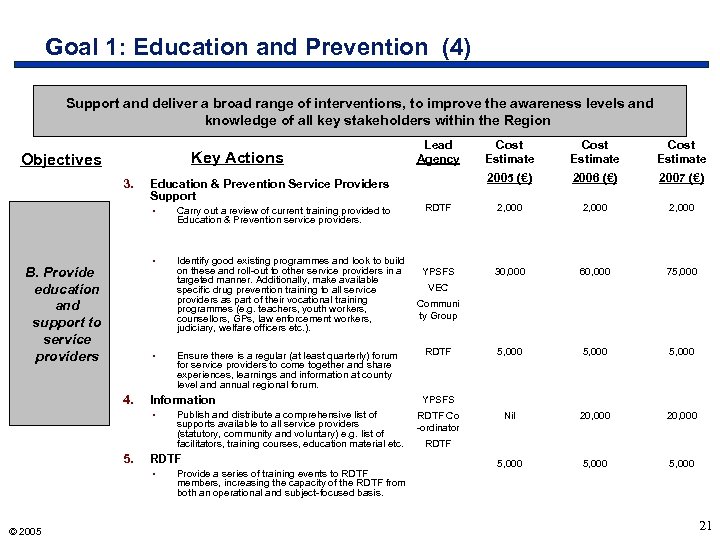 Goal 1: Education and Prevention (4) Support and deliver a broad range of interventions, to improve the awareness levels and knowledge of all key stakeholders within the Region Key Actions Objectives 3. Education & Prevention Service Providers Support • • B. Provide education and support to service providers Carry out a review of current training provided to Education & Prevention service providers. Identify good existing programmes and look to build on these and roll-out to other service providers in a targeted manner. Additionally, make available specific drug prevention training to all service providers as part of their vocational training programmes (e. g. teachers, youth workers, counsellors, GPs, law enforcement workers, judiciary, welfare officers etc. ). • 4. Information • 5. Publish and distribute a comprehensive list of supports available to all service providers (statutory, community and voluntary) e. g. list of facilitators, training courses, education material etc. RDTF • © 2005 Ensure there is a regular (at least quarterly) forum for service providers to come together and share experiences, learnings and information at county level and annual regional forum. Provide a series of training events to RDTF members, increasing the capacity of the RDTF from both an operational and subject-focused basis. Lead Agency Cost Estimate 2005 (€) 2006 (€) 2007 (€) RDTF 2, 000 YPSFS 30, 000 60, 000 75, 000 Nil 20, 000 5, 000 VEC Communi ty Group RDTF YPSFS RDTF Co -ordinator RDTF 21
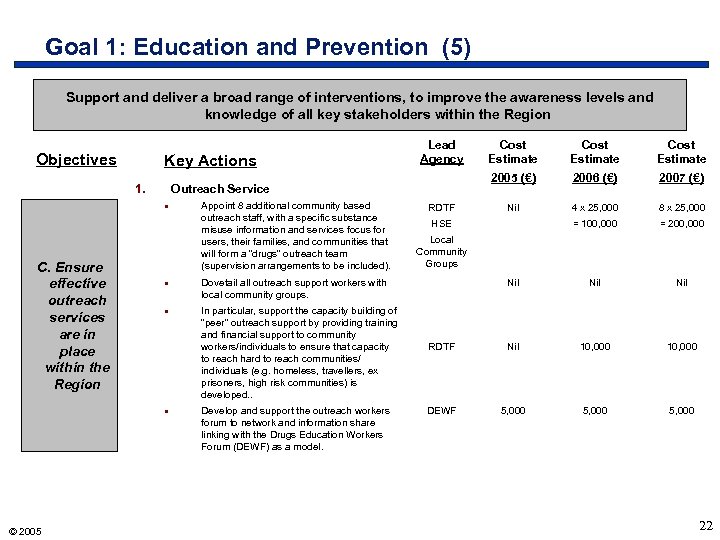 Goal 1: Education and Prevention (5) Support and deliver a broad range of interventions, to improve the awareness levels and knowledge of all key stakeholders within the Region Objectives Key Actions 1. Appoint 8 additional community based outreach staff, with a specific substance misuse information and services focus for users, their families, and communities that will form a “drugs” outreach team (supervision arrangements to be included). · Cost Estimate 2005 (€) 2006 (€) 2007 (€) Nil 4 x 25, 000 8 x 25, 000 = 100, 000 = 200, 000 Nil Nil · In particular, support the capacity building of “peer” outreach support by providing training and financial support to community workers/individuals to ensure that capacity to reach hard to reach communities/ individuals (e. g. homeless, travellers, ex prisoners, high risk communities) is developed. . RDTF Nil 10, 000 DEWF 5, 000 RDTF HSE Local Community Groups Dovetail all outreach support workers with local community groups. · © 2005 Cost Estimate Outreach Service · C. Ensure effective outreach services are in place within the Region Lead Agency Develop and support the outreach workers forum to network and information share linking with the Drugs Education Workers Forum (DEWF) as a model. 22
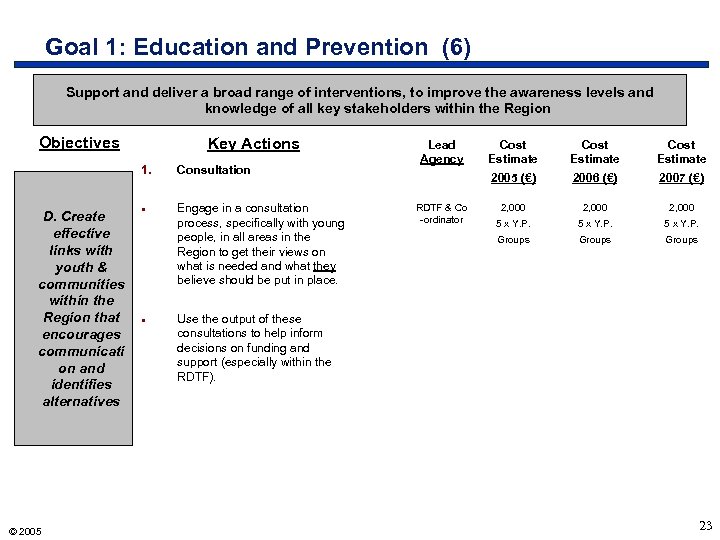 Goal 1: Education and Prevention (6) Support and deliver a broad range of interventions, to improve the awareness levels and knowledge of all key stakeholders within the Region Objectives Key Actions 1. D. Create effective links with youth & communities within the Region that encourages communicati on and identifies alternatives © 2005 Consultation · Engage in a consultation process, specifically with young people, in all areas in the Region to get their views on what is needed and what they believe should be put in place. · Lead Agency Cost Estimate 2005 (€) RDTF & Co -ordinator Cost Estimate 2006 (€) 2007 (€) 2, 000 5 x Y. P. Groups Use the output of these consultations to help inform decisions on funding and support (especially within the RDTF). 23
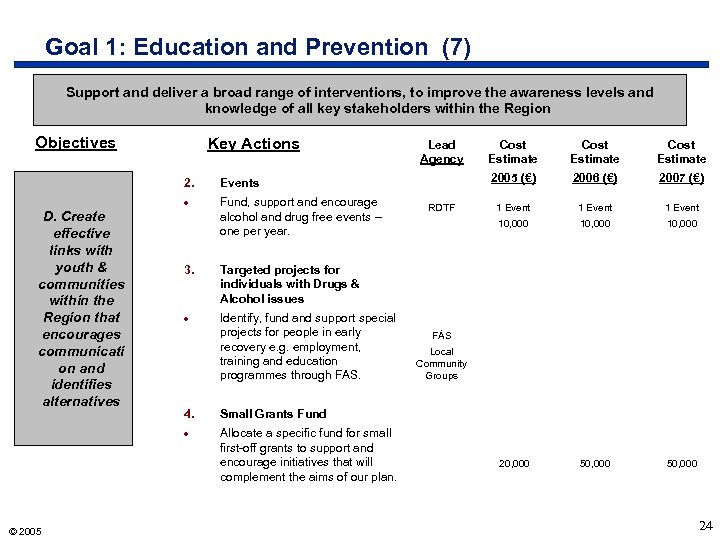 Goal 1: Education and Prevention (7) Support and deliver a broad range of interventions, to improve the awareness levels and knowledge of all key stakeholders within the Region Objectives Key Actions 2. D. Create effective links with youth & communities within the Region that encourages communicati on and identifies alternatives Fund, support and encourage alcohol and drug free events – one per year. 3. Identify, fund and support special projects for people in early recovery e. g. employment, training and education programmes through FAS. 4. 2006 (€) 2007 (€) 1 Event 10, 000 Allocate a specific fund for small first-off grants to support and encourage initiatives that will complement the aims of our plan. 20, 000 50, 000 FÁS Local Community Groups Small Grants Fund · © 2005 Cost Estimate Targeted projects for individuals with Drugs & Alcohol issues · Cost Estimate 10, 000 RDTF Cost Estimate 2005 (€) Events · Lead Agency 24
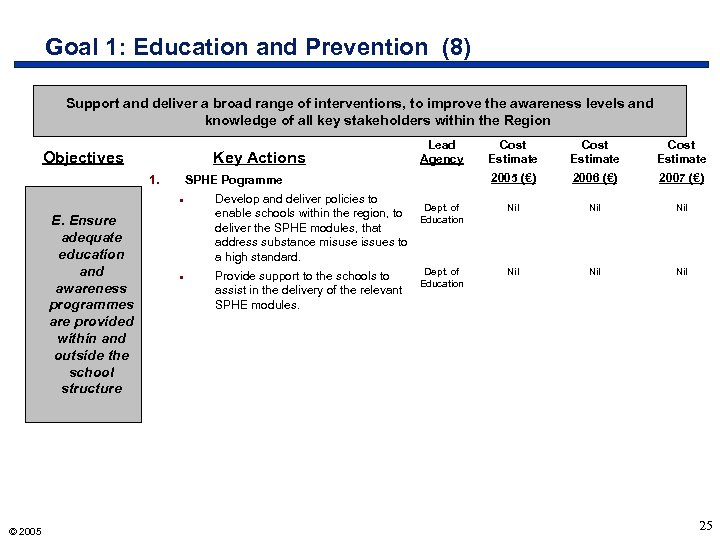 Goal 1: Education and Prevention (8) Support and deliver a broad range of interventions, to improve the awareness levels and knowledge of all key stakeholders within the Region Objectives Key Actions 1. Lead Agency · E. Ensure adequate education and awareness programmes are provided within and outside the school structure © 2005 Develop and deliver policies to Dept. of enable schools within the region, to Education deliver the SPHE modules, that address substance misuse issues to a high standard. · Provide support to the schools to assist in the delivery of the relevant SPHE modules. Dept. of Education Cost Estimate 2005 (€) SPHE Pogramme Cost Estimate 2006 (€) 2007 (€) Nil Nil Nil 25
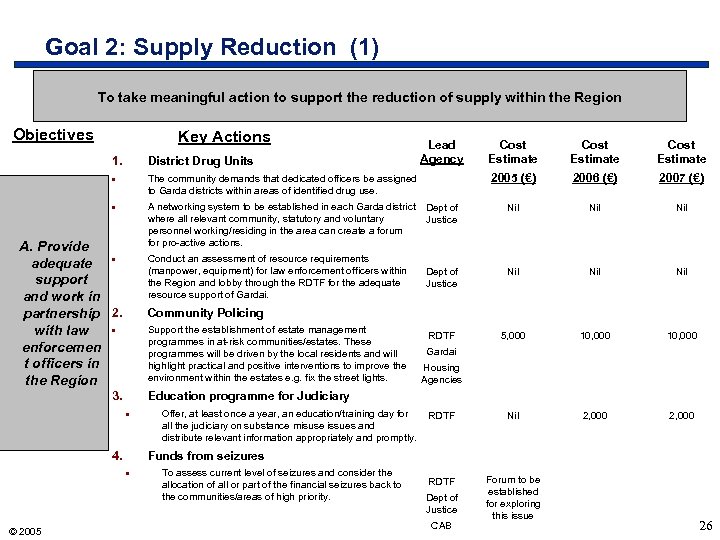 Goal 2: Supply Reduction (1) To take meaningful action to support the reduction of supply within the Region Objectives Key Actions 1. District Drug Units · A networking system to be established in each Garda district where all relevant community, statutory and voluntary personnel working/residing in the area can create a forum for pro-active actions. A. Provide adequate · support and work in partnership 2. · with law enforcemen t officers in the Region Conduct an assessment of resource requirements (manpower, equipment) for law enforcement officers within the Region and lobby through the RDTF for the adequate resource support of Gardaí. Cost Estimate 2005 (€) 2006 (€) 2007 (€) Dept of Justice Nil Nil Nil RDTF 5, 000 10, 000 RDTF Nil 2, 000 RDTF Forum to be established for exploring this issue Community Policing Support the establishment of estate management programmes in at-risk communities/estates. These programmes will be driven by the local residents and will highlight practical and positive interventions to improve the environment within the estates e. g. fix the street lights. 3. Gardaí Housing Agencies Education programme for Judiciary · 4. Offer, at least once a year, an education/training day for all the judiciary on substance misuse issues and distribute relevant information appropriately and promptly. Funds from seizures · © 2005 Cost Estimate The community demands that dedicated officers be assigned to Garda districts within areas of identified drug use. · Lead Agency To assess current level of seizures and consider the allocation of all or part of the financial seizures back to the communities/areas of high priority. Dept of Justice CAB 26
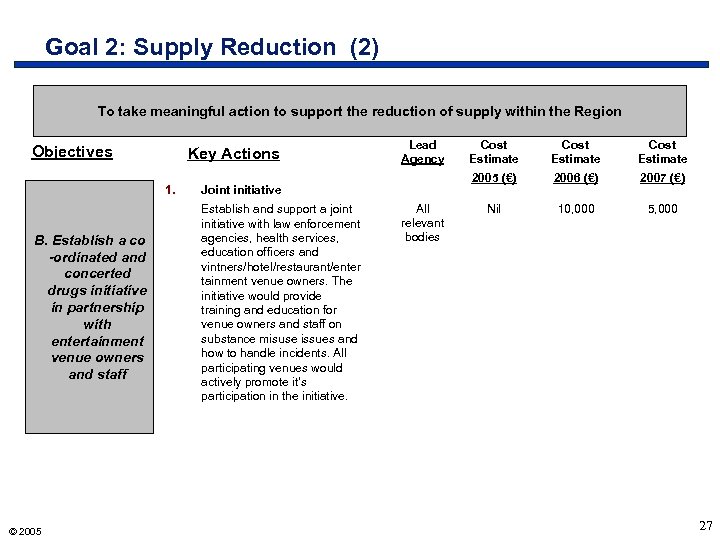 Goal 2: Supply Reduction (2) To take meaningful action to support the reduction of supply within the Region Objectives Key Actions 1. B. Establish a co -ordinated and concerted drugs initiative in partnership with entertainment venue owners and staff © 2005 Lead Agency Establish and support a joint initiative with law enforcement agencies, health services, education officers and vintners/hotel/restaurant/enter tainment venue owners. The initiative would provide training and education for venue owners and staff on substance misuse issues and how to handle incidents. All participating venues would actively promote it’s participation in the initiative. All relevant bodies Cost Estimate 2005 (€) Joint initiative Cost Estimate 2006 (€) 2007 (€) Nil 10, 000 5, 000 27
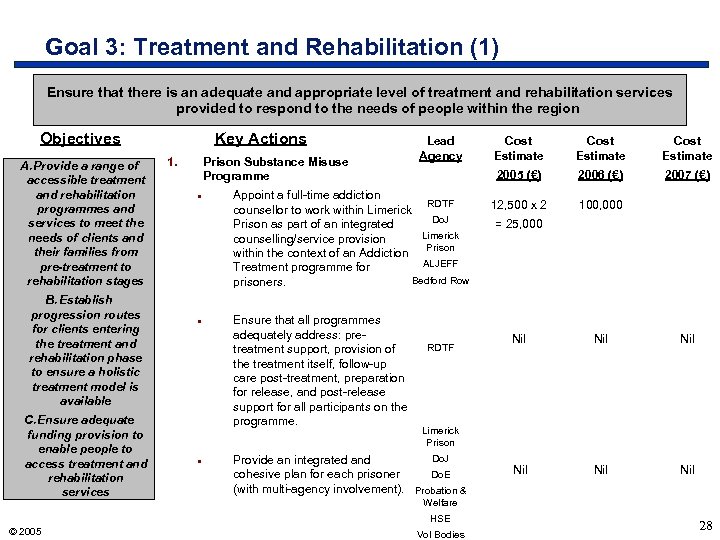 Goal 3: Treatment and Rehabilitation (1) Ensure that there is an adequate and appropriate level of treatment and rehabilitation services provided to respond to the needs of people within the region Objectives A. Provide a range of accessible treatment and rehabilitation programmes and services to meet the needs of clients and their families from pre-treatment to rehabilitation stages B. Establish progression routes for clients entering the treatment and rehabilitation phase to ensure a holistic treatment model is available C. Ensure adequate funding provision to enable people to access treatment and rehabilitation services Key Actions 1. Prison Substance Misuse Programme · · · Lead Agency Ensure that all programmes adequately address: pretreatment support, provision of the treatment itself, follow-up care post-treatment, preparation for release, and post-release support for all participants on the programme. RDTF Cost Estimate 2006 (€) 2007 (€) 12, 500 x 2 100, 000 = 25, 000 Nil Nil Nil Limerick Prison Do. J Provide an integrated and Do. E cohesive plan for each prisoner (with multi-agency involvement). Probation & Welfare HSE © 2005 Cost Estimate 2005 (€) Appoint a full-time addiction RDTF counsellor to work within Limerick Do. J Prison as part of an integrated Limerick counselling/service provision within the context of an Addiction Prison ALJEFF Treatment programme for Bedford Row prisoners. Cost Estimate Vol Bodies 28
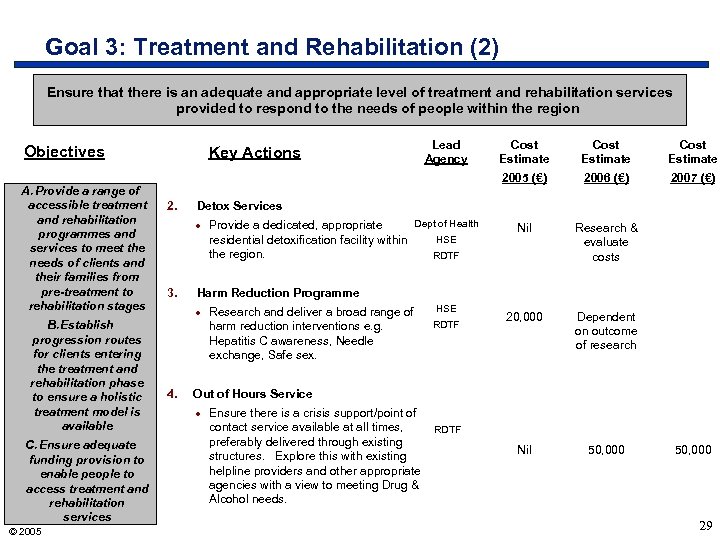 Goal 3: Treatment and Rehabilitation (2) Ensure that there is an adequate and appropriate level of treatment and rehabilitation services provided to respond to the needs of people within the region A. Provide a range of accessible treatment and rehabilitation programmes and services to meet the needs of clients and their families from pre-treatment to rehabilitation stages B. Establish progression routes for clients entering the treatment and rehabilitation phase to ensure a holistic treatment model is available C. Ensure adequate funding provision to enable people to access treatment and rehabilitation services © 2005 Key Actions 2. Cost Estimate 2006 (€) 2007 (€) Dept of Health Provide a dedicated, appropriate HSE residential detoxification facility within the region. RDTF Nil Research & evaluate costs 20, 000 Dependent on outcome of research Nil 50, 000 Harm Reduction Programme · 4. Cost Estimate Detox Services · 3. Lead Agency Cost Estimate 2005 (€) Objectives Research and deliver a broad range of harm reduction interventions e. g. Hepatitis C awareness, Needle exchange, Safe sex. HSE RDTF Out of Hours Service · Ensure there is a crisis support/point of contact service available at all times, preferably delivered through existing structures. Explore this with existing helpline providers and other appropriate agencies with a view to meeting Drug & Alcohol needs. RDTF 50, 000 29
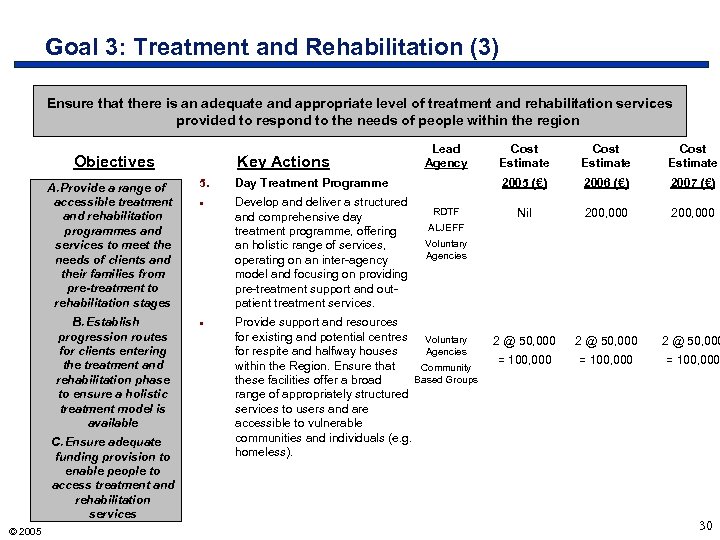 Goal 3: Treatment and Rehabilitation (3) Ensure that there is an adequate and appropriate level of treatment and rehabilitation services provided to respond to the needs of people within the region Objectives A. Provide a range of accessible treatment and rehabilitation programmes and services to meet the needs of clients and their families from pre-treatment to rehabilitation stages B. Establish progression routes for clients entering the treatment and rehabilitation phase to ensure a holistic treatment model is available C. Ensure adequate funding provision to enable people to access treatment and rehabilitation services © 2005 Key Actions 5. Develop and deliver a structured and comprehensive day treatment programme, offering an holistic range of services, operating on an inter-agency model and focusing on providing pre-treatment support and outpatient treatment services. · RDTF Cost Estimate 2005 (€) Day Treatment Programme · Lead Agency 2006 (€) 2007 (€) Nil 200, 000 2 @ 50, 000 = 100, 000 ALJEFF Voluntary Agencies Provide support and resources for existing and potential centres Voluntary Agencies for respite and halfway houses within the Region. Ensure that Community Based Groups these facilities offer a broad range of appropriately structured services to users and are accessible to vulnerable communities and individuals (e. g. homeless). 30
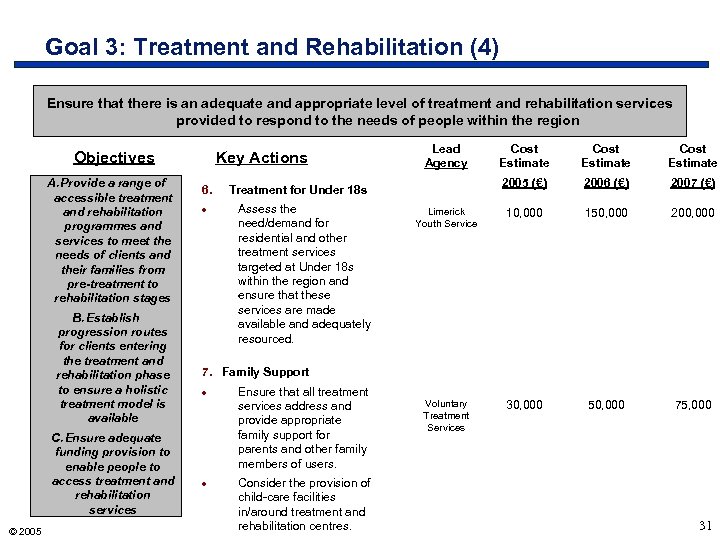 Goal 3: Treatment and Rehabilitation (4) Ensure that there is an adequate and appropriate level of treatment and rehabilitation services provided to respond to the needs of people within the region Objectives A. Provide a range of accessible treatment and rehabilitation programmes and services to meet the needs of clients and their families from pre-treatment to rehabilitation stages B. Establish progression routes for clients entering the treatment and rehabilitation phase to ensure a holistic treatment model is available C. Ensure adequate funding provision to enable people to access treatment and rehabilitation services © 2005 Key Actions 6. · Lead Agency Cost Estimate 2005 (€) 2006 (€) 2007 (€) Limerick Youth Service 10, 000 150, 000 200, 000 Voluntary Treatment Services 30, 000 50, 000 75, 000 Treatment for Under 18 s Assess the need/demand for residential and other treatment services targeted at Under 18 s within the region and ensure that these services are made available and adequately resourced. 7. Family Support · · Ensure that all treatment services address and provide appropriate family support for parents and other family members of users. Consider the provision of child-care facilities in/around treatment and rehabilitation centres. 31
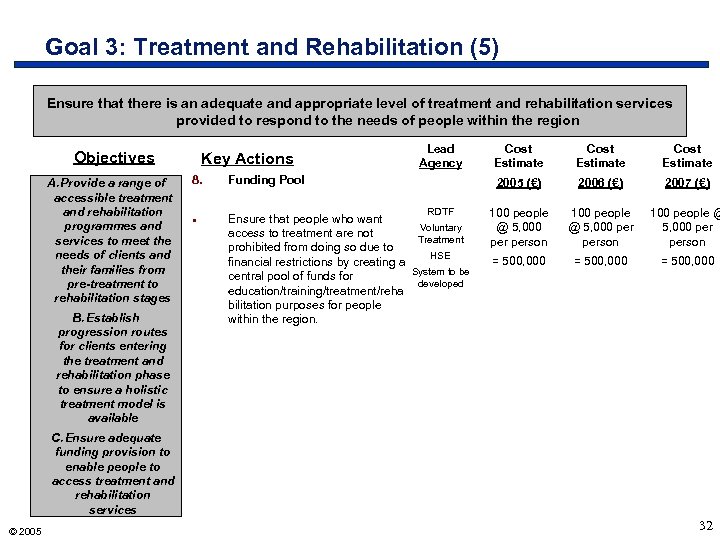 Goal 3: Treatment and Rehabilitation (5) Ensure that there is an adequate and appropriate level of treatment and rehabilitation services provided to respond to the needs of people within the region Objectives A. Provide a range of accessible treatment and rehabilitation programmes and services to meet the needs of clients and their families from pre-treatment to rehabilitation stages B. Establish progression routes for clients entering the treatment and rehabilitation phase to ensure a holistic treatment model is available Key Actions Lead Agency Funding Pool · Ensure that people who want Voluntary access to treatment are not Treatment prohibited from doing so due to HSE financial restrictions by creating a System to be central pool of funds for developed education/training/treatment/reha bilitation purposes for people within the region. RDTF Cost Estimate 2005 (€) 8. Cost Estimate 2006 (€) 2007 (€) 100 people @ 5, 000 per person 100 people @ 5, 000 person = 500, 000 C. Ensure adequate funding provision to enable people to access treatment and rehabilitation services © 2005 32
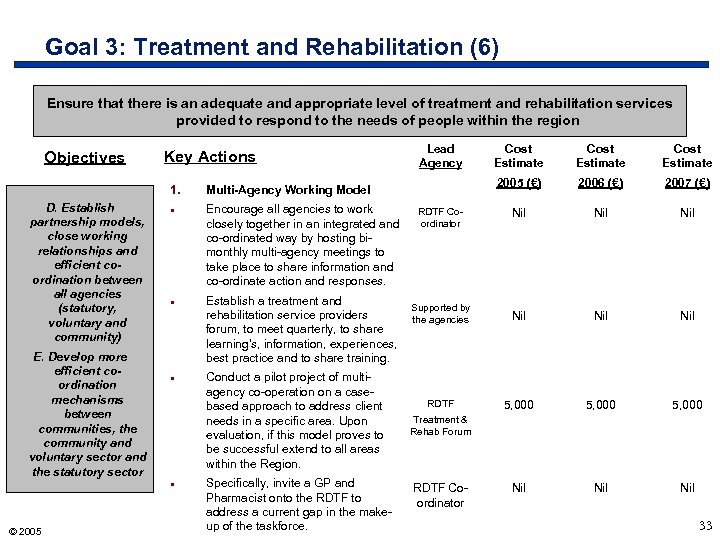 Goal 3: Treatment and Rehabilitation (6) Ensure that there is an adequate and appropriate level of treatment and rehabilitation services provided to respond to the needs of people within the region Objectives Key Actions 1. D. Establish partnership models, close working relationships and efficient coordination between all agencies (statutory, voluntary and community) E. Develop more efficient coordination mechanisms between communities, the community and voluntary sector and the statutory sector © 2005 Encourage all agencies to work closely together in an integrated and co-ordinated way by hosting bimonthly multi-agency meetings to take place to share information and co-ordinate action and responses. · Establish a treatment and rehabilitation service providers forum, to meet quarterly, to share learning's, information, experiences, best practice and to share training. Cost Estimate 2005 (€) 2006 (€) 2007 (€) RDTF Coordinator Nil Nil Supported by the agencies Nil Nil RDTF 5, 000 Nil Nil Multi-Agency Working Model · Lead Agency · · Conduct a pilot project of multiagency co-operation on a casebased approach to address client needs in a specific area. Upon evaluation, if this model proves to be successful extend to all areas within the Region. Specifically, invite a GP and Pharmacist onto the RDTF to address a current gap in the makeup of the taskforce. Treatment & Rehab Forum RDTF Coordinator 33
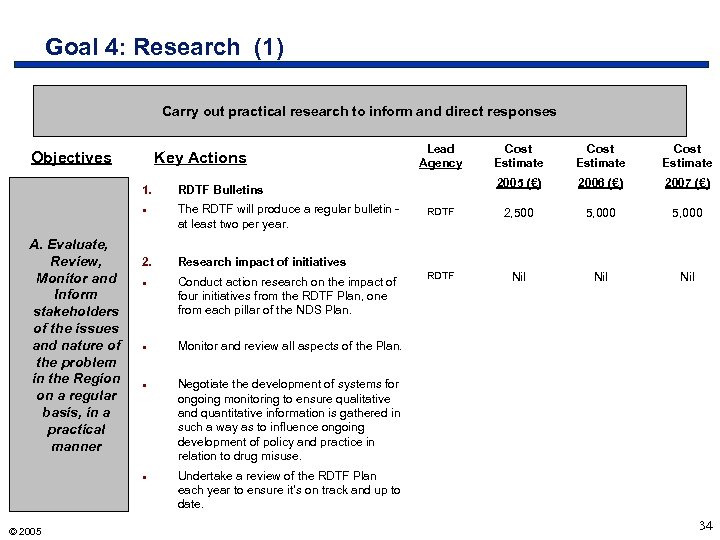 Goal 4: Research (1) Carry out practical research to inform and direct responses Objectives Key Actions 1. © 2005 2. · Conduct action research on the impact of four initiatives from the RDTF Plan, one from each pillar of the NDS Plan. · Cost Estimate 2005 (€) 2006 (€) 2007 (€) RDTF 2, 500 5, 000 RDTF Nil Nil Monitor and review all aspects of the Plan. · Cost Estimate Research impact of initiatives Negotiate the development of systems for ongoing monitoring to ensure qualitative and quantitative information is gathered in such a way as to influence ongoing development of policy and practice in relation to drug misuse. · A. Evaluate, Review, Monitor and Inform stakeholders of the issues and nature of the problem in the Region on a regular basis, in a practical manner The RDTF will produce a regular bulletin at least two per year. Cost Estimate RDTF Bulletins · Lead Agency Undertake a review of the RDTF Plan each year to ensure it’s on track and up to date. 34
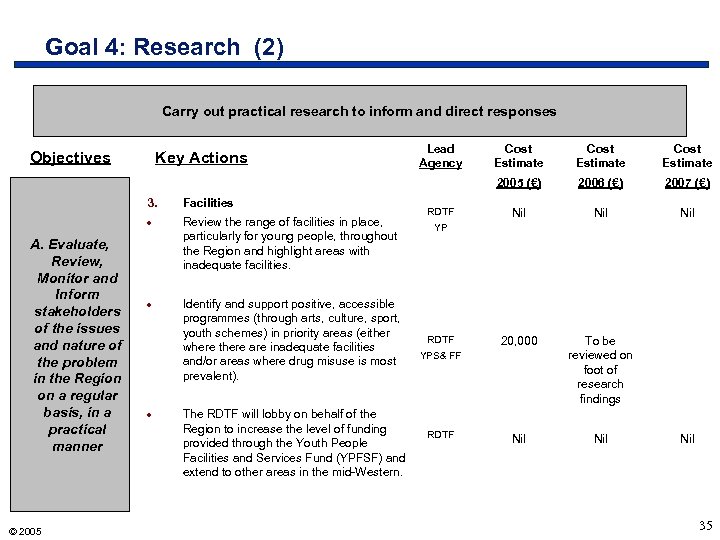 Goal 4: Research (2) Carry out practical research to inform and direct responses Key Actions 3. · A. Evaluate, Review, Monitor and Inform stakeholders of the issues and nature of the problem in the Region on a regular basis, in a practical manner © 2005 Facilities Review the range of facilities in place, particularly for young people, throughout the Region and highlight areas with inadequate facilities. · Identify and support positive, accessible programmes (through arts, culture, sport, youth schemes) in priority areas (either where there are inadequate facilities and/or areas where drug misuse is most prevalent). · The RDTF will lobby on behalf of the Region to increase the level of funding provided through the Youth People Facilities and Services Fund (YPFSF) and extend to other areas in the mid-Western. Lead Agency RDTF Cost Estimate 2005 (€) Objectives 2006 (€) 2007 (€) Nil Nil 20, 000 To be reviewed on foot of research findings Nil YP RDTF YPS& FF RDTF Nil 35