 Скачать презентацию Mid-Decadal Global Land Survey Status Update Jeff Masek
edd15e9e4cc1f48387d96327ebaab7fe.ppt
- Количество слайдов: 23



Mid-Decadal Global Land Survey: Status Update Jeff Masek Biospheric Sciences Branch, NASA GSFC Steve Covington Aerospace Corporation / USGS EROS June 12, 2007
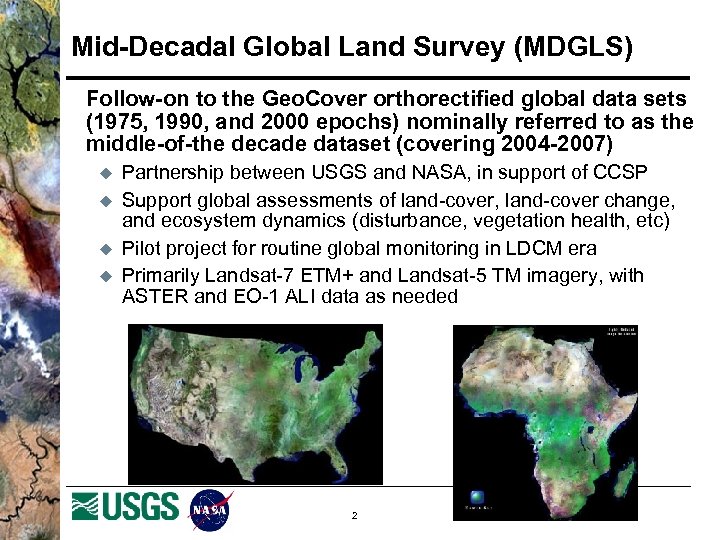
Mid-Decadal Global Land Survey (MDGLS) Follow-on to the Geo. Cover orthorectified global data sets (1975, 1990, and 2000 epochs) nominally referred to as the middle-of-the decade dataset (covering 2004 -2007) u u Partnership between USGS and NASA, in support of CCSP Support global assessments of land-cover, land-cover change, and ecosystem dynamics (disturbance, vegetation health, etc) Pilot project for routine global monitoring in LDCM era Primarily Landsat-7 ETM+ and Landsat-5 TM imagery, with ASTER and EO-1 ALI data as needed 2
MDGLS Development Phase 1: assure global coverage by Landsat or Landsat-like observations. Identify all candidate scenes and ingest into the USGS archive Phase 2: Process selected data into an orthorectified dataset compatible with previous surveys - orthorectification - gap filling for Landsat-7 - EROS to carry out processing Phase 3: Develop LCLUC products. Analyze data set to quantify trends in land cover and vegetation dynamics 3
New Developments l l l Phase I Update Analysis of Geocover 2000 geodetic problems LASSI Scene Selection Tool Production Schedule and Funding Phase III Science Initiative The Next Decadal Survey (2010) 4
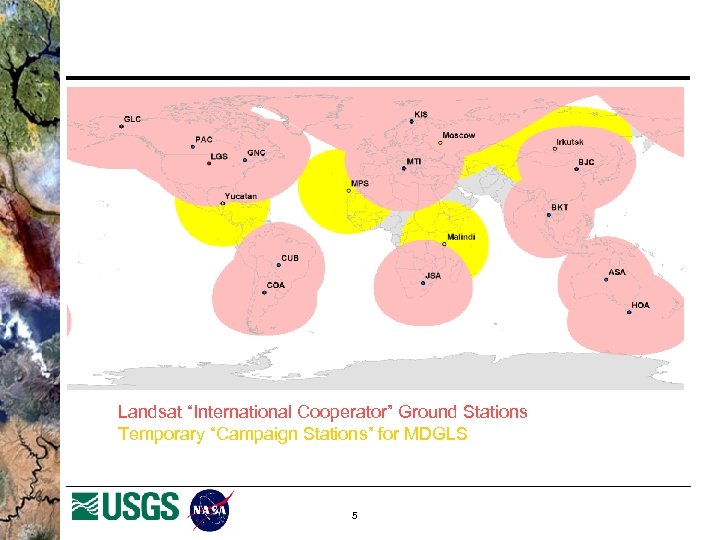
Landsat “International Cooperator” Ground Stations Temporary “Campaign Stations” for MDGLS 5
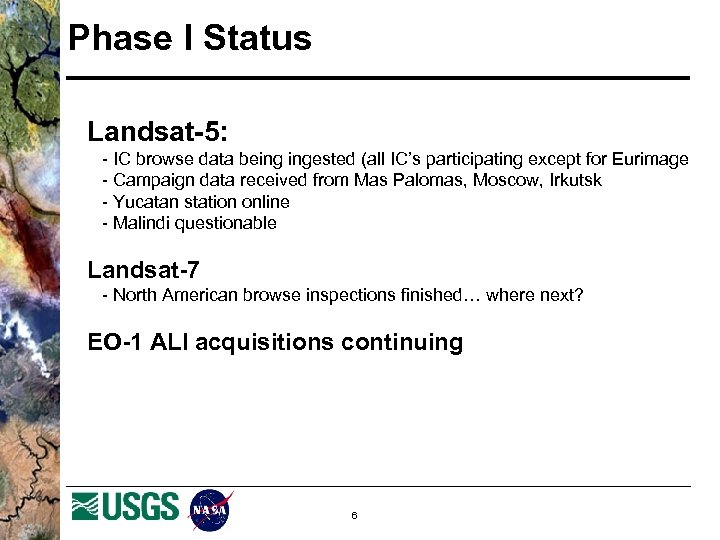
Phase I Status Landsat-5: - IC browse data being ingested (all IC’s participating except for Eurimage - Campaign data received from Mas Palomas, Moscow, Irkutsk - Yucatan station online - Malindi questionable Landsat-7 - North American browse inspections finished… where next? EO-1 ALI acquisitions continuing 6
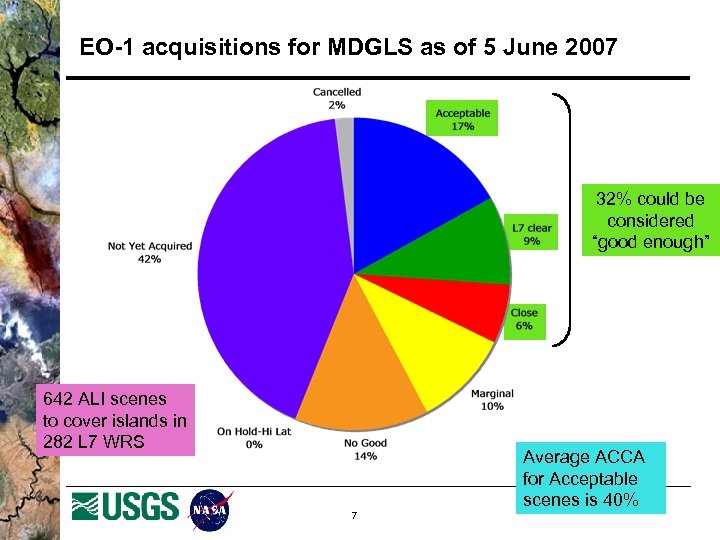
EO-1 acquisitions for MDGLS as of 5 June 2007 32% could be considered “good enough” 642 ALI scenes to cover islands in 282 L 7 WRS 7 Average ACCA for Acceptable scenes is 40%
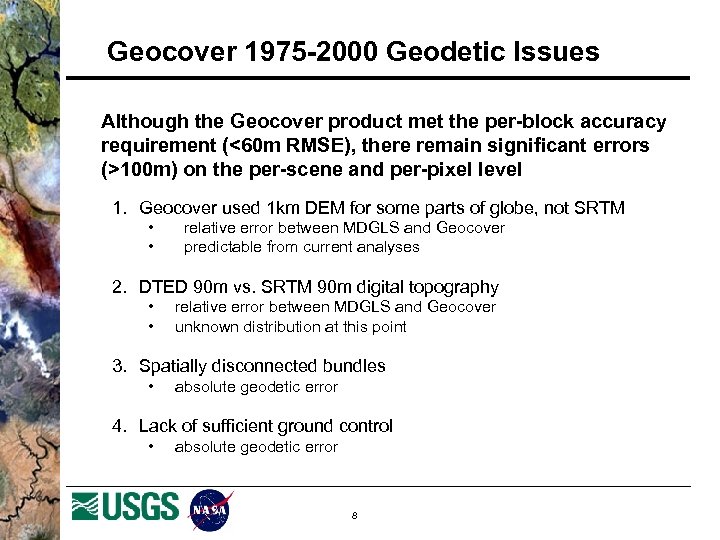
Geocover 1975 -2000 Geodetic Issues Although the Geocover product met the per-block accuracy requirement (<60 m RMSE), there remain significant errors (>100 m) on the per-scene and per-pixel level 1. Geocover used 1 km DEM for some parts of globe, not SRTM • • relative error between MDGLS and Geocover predictable from current analyses 2. DTED 90 m vs. SRTM 90 m digital topography • • relative error between MDGLS and Geocover unknown distribution at this point 3. Spatially disconnected bundles • absolute geodetic error 4. Lack of sufficient ground control • absolute geodetic error 8
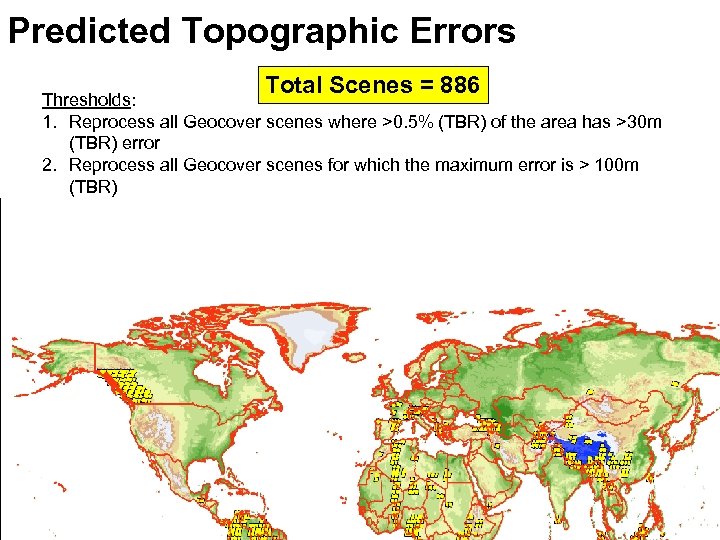
Predicted Topographic Errors Total Scenes = 886 Thresholds: 1. Reprocess all Geocover scenes where >0. 5% (TBR) of the area has >30 m (TBR) error 2. Reprocess all Geocover scenes for which the maximum error is > 100 m (TBR) 9
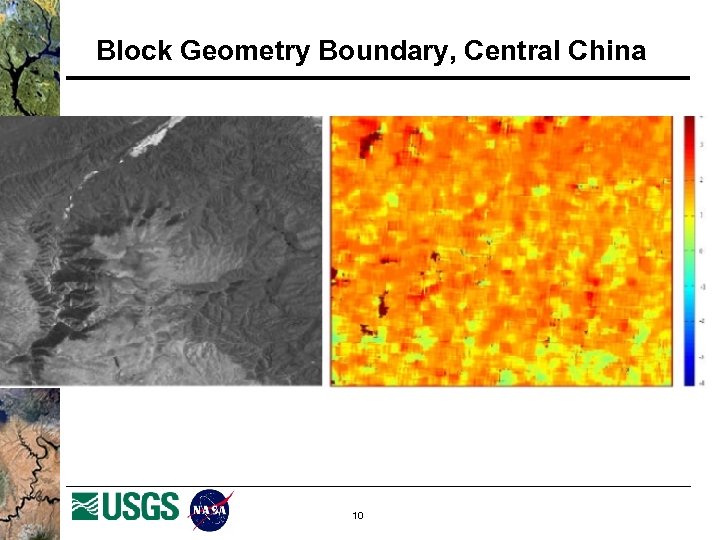
Block Geometry Boundary, Central China 10
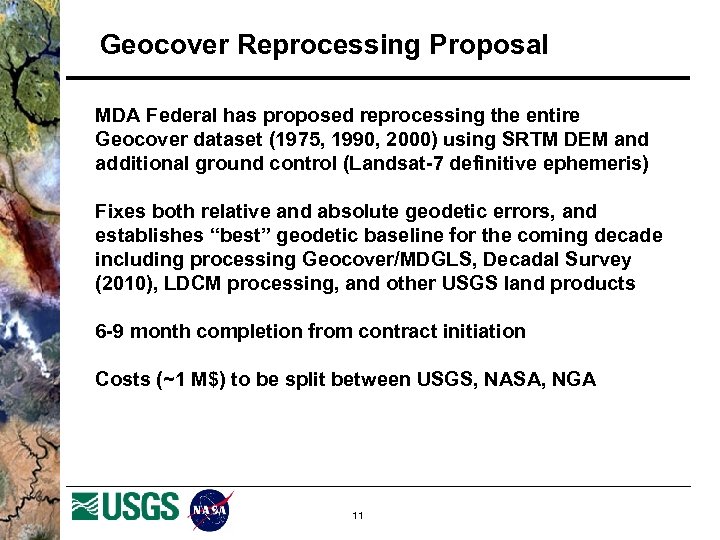
Geocover Reprocessing Proposal MDA Federal has proposed reprocessing the entire Geocover dataset (1975, 1990, 2000) using SRTM DEM and additional ground control (Landsat-7 definitive ephemeris) Fixes both relative and absolute geodetic errors, and establishes “best” geodetic baseline for the coming decade including processing Geocover/MDGLS, Decadal Survey (2010), LDCM processing, and other USGS land products 6 -9 month completion from contract initiation Costs (~1 M$) to be split between USGS, NASA, NGA 11
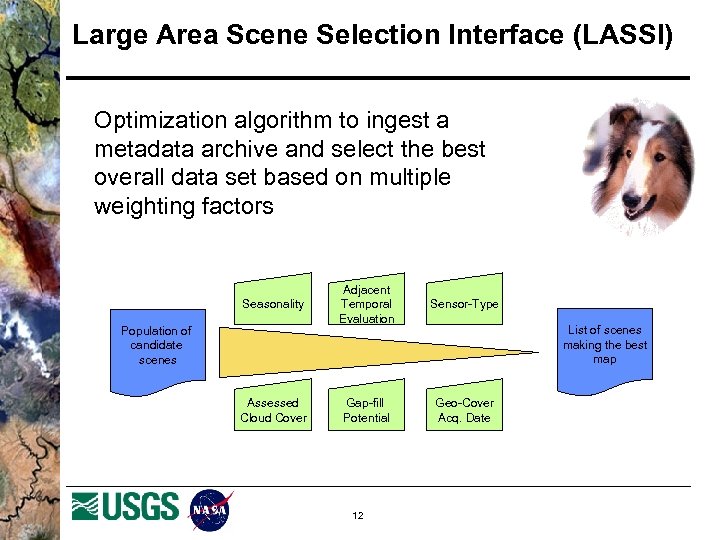
Large Area Scene Selection Interface (LASSI) Optimization algorithm to ingest a metadata archive and select the best overall data set based on multiple weighting factors Seasonality Population of candidate scenes Assessed Cloud Cover Adjacent Temporal Evaluation Sensor-Type Gap-fill Potential Geo-Cover Acq. Date 12 List of scenes making the best map
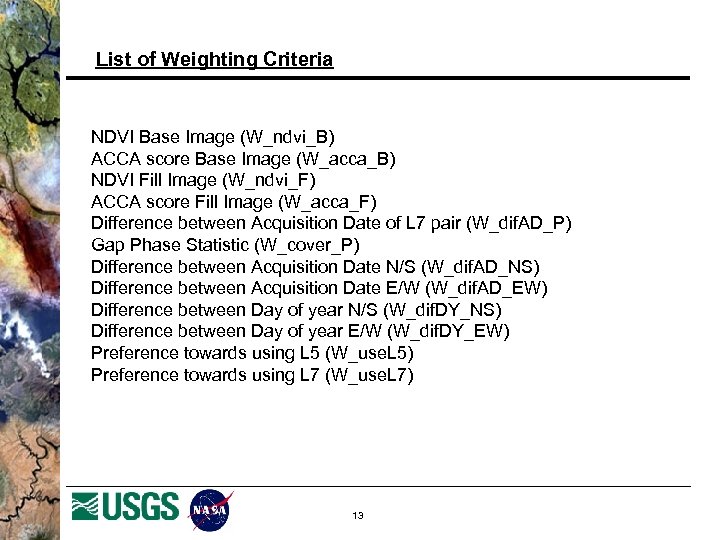
List of Weighting Criteria NDVI Base Image (W_ndvi_B) ACCA score Base Image (W_acca_B) NDVI Fill Image (W_ndvi_F) ACCA score Fill Image (W_acca_F) Difference between Acquisition Date of L 7 pair (W_dif. AD_P) Gap Phase Statistic (W_cover_P) Difference between Acquisition Date N/S (W_dif. AD_NS) Difference between Acquisition Date E/W (W_dif. AD_EW) Difference between Day of year N/S (W_dif. DY_NS) Difference between Day of year E/W (W_dif. DY_EW) Preference towards using L 5 (W_use. L 5) Preference towards using L 7 (W_use. L 7) 13
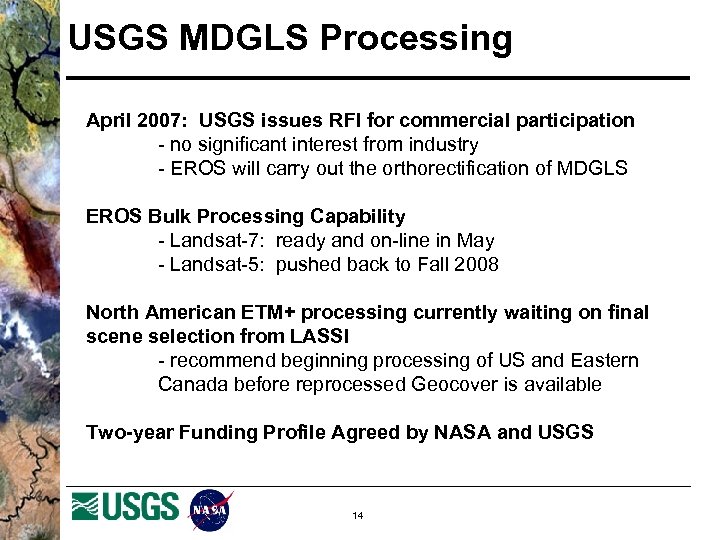
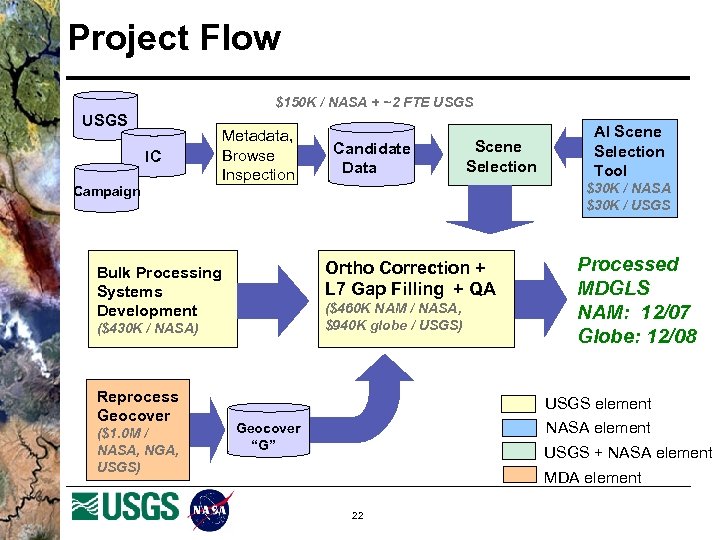
USGS MDGLS Processing April 2007: USGS issues RFI for commercial participation - no significant interest from industry - EROS will carry out the orthorectification of MDGLS EROS Bulk Processing Capability - Landsat-7: ready and on-line in May - Landsat-5: pushed back to Fall 2008 North American ETM+ processing currently waiting on final scene selection from LASSI - recommend beginning processing of US and Eastern Canada before reprocessed Geocover is available Two-year Funding Profile Agreed by NASA and USGS 14
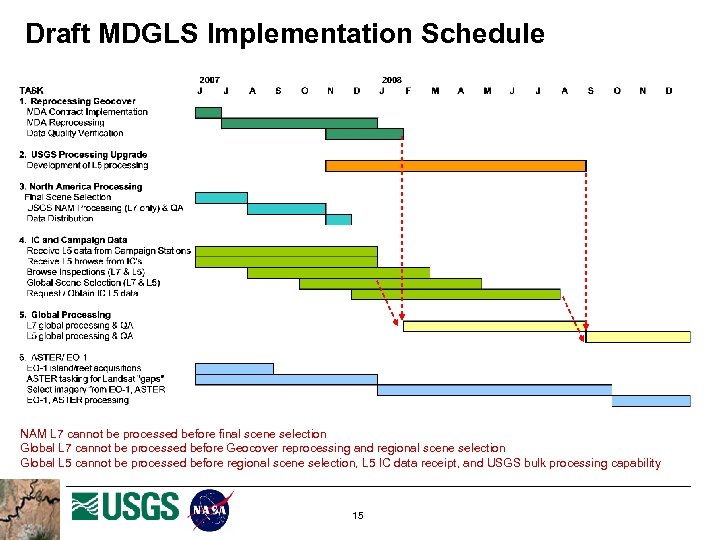
Draft MDGLS Implementation Schedule NAM L 7 cannot be processed before final scene selection Global L 7 cannot be processed before Geocover reprocessing and regional scene selection Global L 5 cannot be processed before regional scene selection, L 5 IC data receipt, and USGS bulk processing capability 15
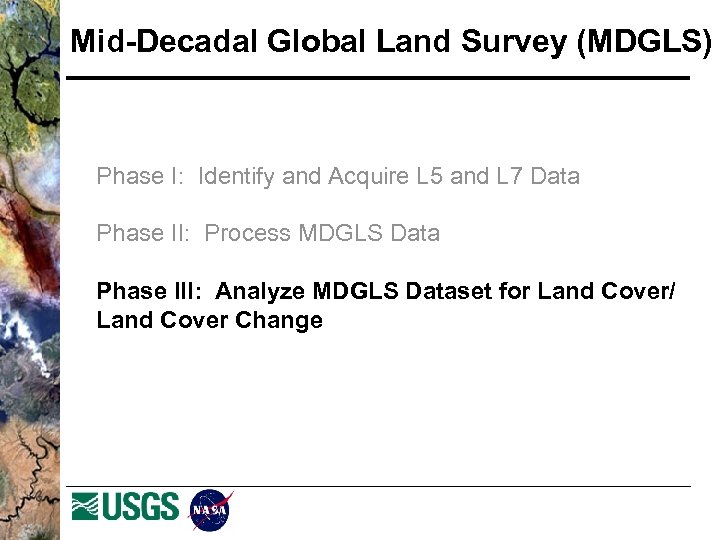
Mid-Decadal Global Land Survey (MDGLS) Phase I: Identify and Acquire L 5 and L 7 Data Phase II: Process MDGLS Data Phase III: Analyze MDGLS Dataset for Land Cover/ Land Cover Change
Community Recommendations Meeting on Phase III Strategy – Feb 27 -28, 2007 in Annapolis MD. Findings include: MDGLS critically important for LC Science and Assessments Highest priority for global estimates of land cover change - forest cover change, disturbance - irrigated agriculture extent - global standing water - arctic hydrology (bogs, permafrost) - urbanization - focus on products that meet societal needs Distributed implementation ok, but harmonization essential Open archive would advance science utility of MDGLS 17
Community Recommendations (2) FAO LCCS (Land Cover Classification Scheme) is appropriate for MDGLS, with some modification - reduce emphasis on land use - need comparable effort for land cover change products Validation of land cover change needs to be integrated into Phase III from the start - work with GOFC Validation Team and CEOS CVWG - validation of land cover change a new topic Phase III activities represent a pathfinder for 2010 assessment, and annual assessments in LDCM era 18
Phase 3 Funding Prospects l The ROSES-2007 NASA LCLUC call gives opportunity for investigators to develop LCLUC products from both GEOCOVER & MDGLS u Expect 3 -4 selected projects, 300 -400 K/yr u Anticipated starts in Mar’ 08 l Next year an additional call to complement what’s needed based on the 2007 selections 19
Toward 2010 Global Land Survey Put plans in place *now* to start collecting data in 2009 Obtain institutional buy-in *now* - recognize that costs should be lower with current processing capabilities What if there are no Landsat assets in orbit? - rely on AWIFS, CBERS, other international assets - begin plans to target ASTER What if Landsat-5 and Landsat-7 are still operational? - evaluate possibility of campaign stations - multiscene compositing? - augment capability using AWIFS and/or CBERS? 20
Backup 21
Project Flow $150 K / NASA + ~2 FTE USGS IC Campaign Metadata, Browse Inspection $30 K / NASA $30 K / USGS ($460 K NAM / NASA, $940 K globe / USGS) ($430 K / NASA) ($1. 0 M / NASA, NGA, USGS) Scene Selection Ortho Correction + L 7 Gap Filling + QA Bulk Processing Systems Development Reprocess Geocover Candidate Data AI Scene Selection Tool Processed MDGLS NAM: 12/07 Globe: 12/08 USGS element NASA element Geocover “G” USGS + NASA element MDA element 22
MDGLS Web Site (draft) http: //lcluc. umd. edu/mdgls/index. html 23
Скачать презентацию Mid-Decadal Global Land Survey Status Update Jeff Masek
edd15e9e4cc1f48387d96327ebaab7fe.ppt