 Скачать презентацию Mid-Decadal Global Land Survey Jeff Masek Biospheric Sciences
2a76d32722539ea07cbd12a5ddf4fe66.ppt
- Количество слайдов: 38



Mid-Decadal Global Land Survey Jeff Masek Biospheric Sciences Branch, NASA GSFC Steve Covington Aerospace Corporation / USGS January 10, 2007
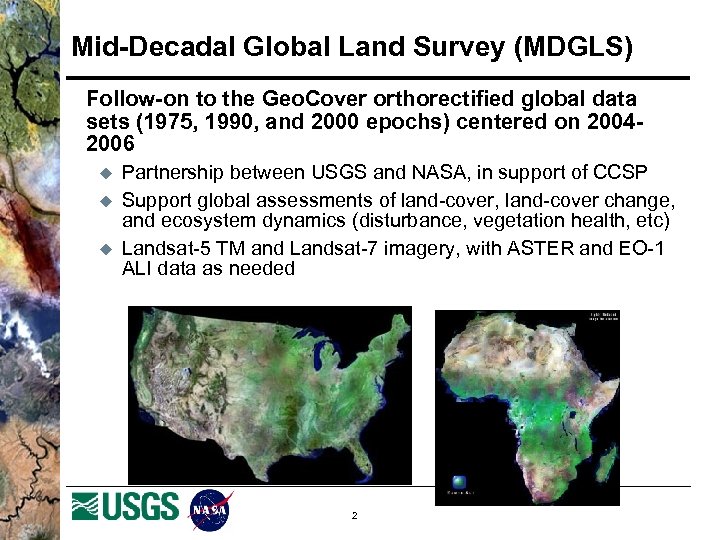
Mid-Decadal Global Land Survey (MDGLS) Follow-on to the Geo. Cover orthorectified global data sets (1975, 1990, and 2000 epochs) centered on 20042006 u u u Partnership between USGS and NASA, in support of CCSP Support global assessments of land-cover, land-cover change, and ecosystem dynamics (disturbance, vegetation health, etc) Landsat-5 TM and Landsat-7 imagery, with ASTER and EO-1 ALI data as needed 2
Land Cover Change Earth Science Data Record Routine monitoring of global land cover conditions on 1 -5 year time scales has been a documented science priority: • US Climate Change Science Program (CCSP) • NASA Earth Science Research Strategy • CEOS GOFC/GOLD Program • Global Land Program (GLP) The MDGLS dataset offers a “pilot” opportunity to assess global rates of land cover change for 20002005 3
MDGLS Development Phase 1: identify all candidate scenes and ingest into the USGS archive (USGS lead) Phase 2: Process selected data into an orthorectified dataset compatible with previous surveys (NASA lead) Phase 3: Analyze data set to quantify trends in land cover and vegetation dynamics (NASA LCLUC) 4
Mid-Decadal Global Land Survey (MDGLS) Phase I: Identify and Acquire L 5 and L 7 Data Phase II: Process MDGLS Data Phase III: Analyze MDGLS Dataset for Land Cover/ Land Cover Change 5
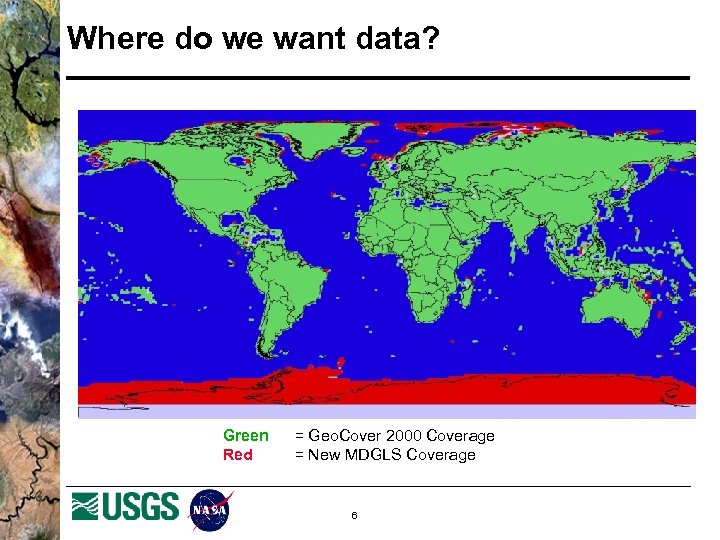
Where do we want data? Green Red = Geo. Cover 2000 Coverage = New MDGLS Coverage 6
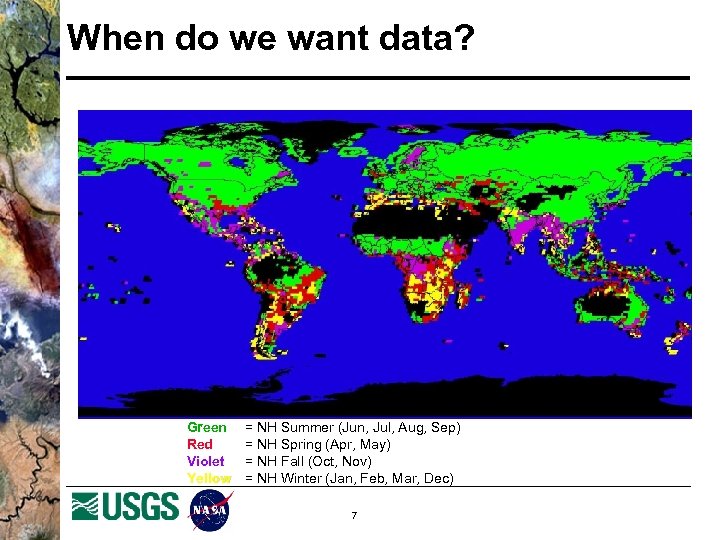
When do we want data? Green Red Violet Yellow = NH Summer (Jun, Jul, Aug, Sep) = NH Spring (Apr, May) = NH Fall (Oct, Nov) = NH Winter (Jan, Feb, Mar, Dec) 7
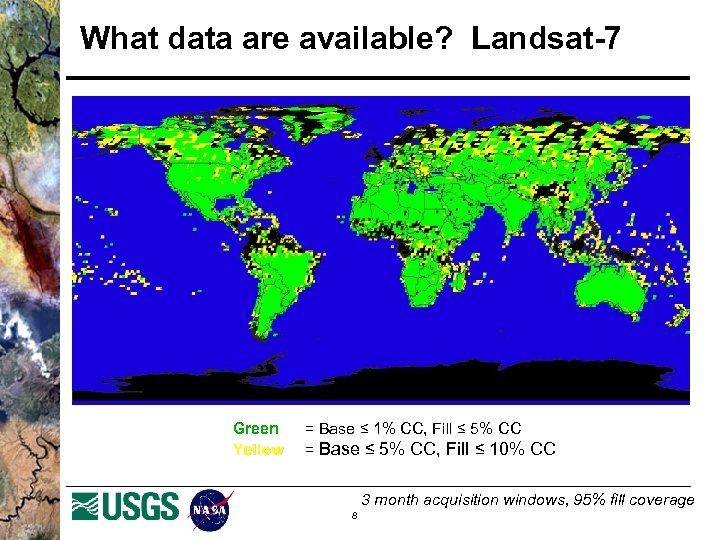
What data are available? Landsat-7 Green Yellow = Base ≤ 1% CC, Fill ≤ 5% CC = Base ≤ 5% CC, Fill ≤ 10% CC 3 month acquisition windows, 95% fill coverage 8
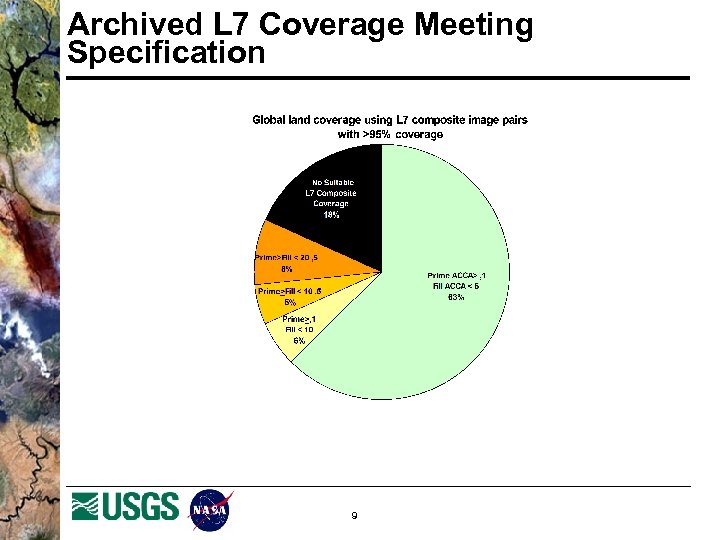
Archived L 7 Coverage Meeting Specification 9
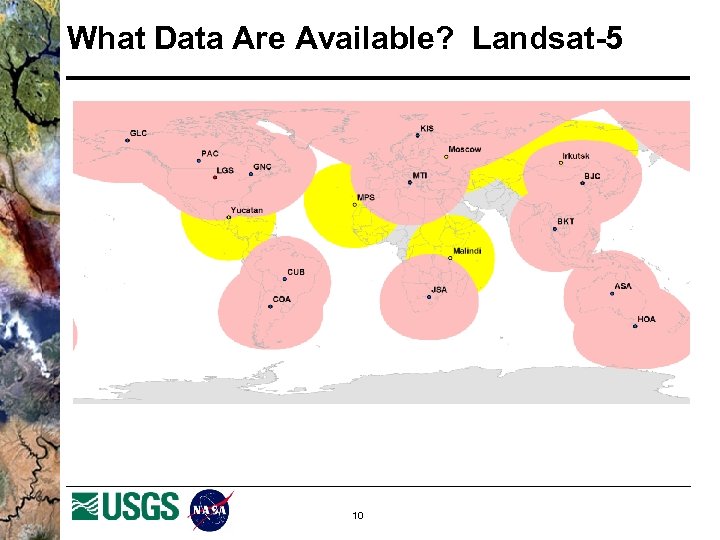
What Data Are Available? Landsat-5 10
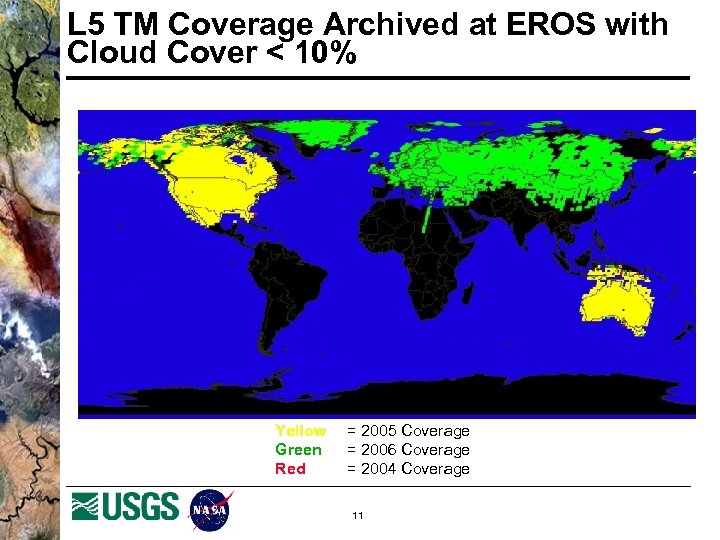
L 5 TM Coverage Archived at EROS with Cloud Cover < 10% Yellow Green Red = 2005 Coverage = 2006 Coverage = 2004 Coverage 11
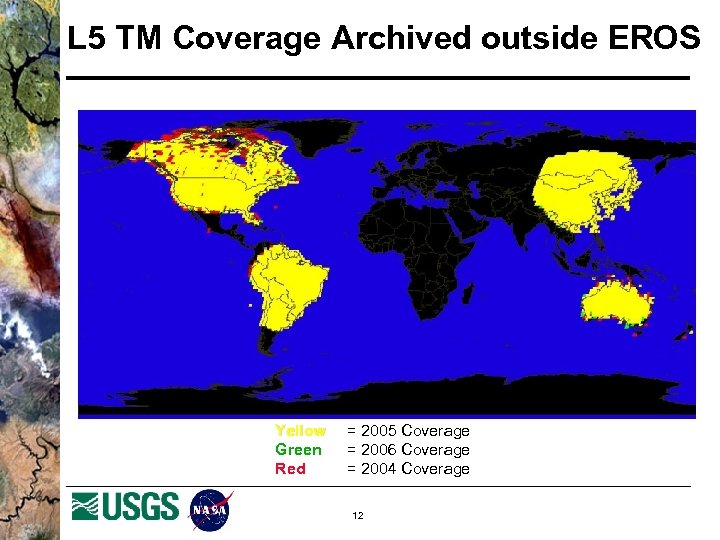
L 5 TM Coverage Archived outside EROS Yellow Green Red = 2005 Coverage = 2006 Coverage = 2004 Coverage 12
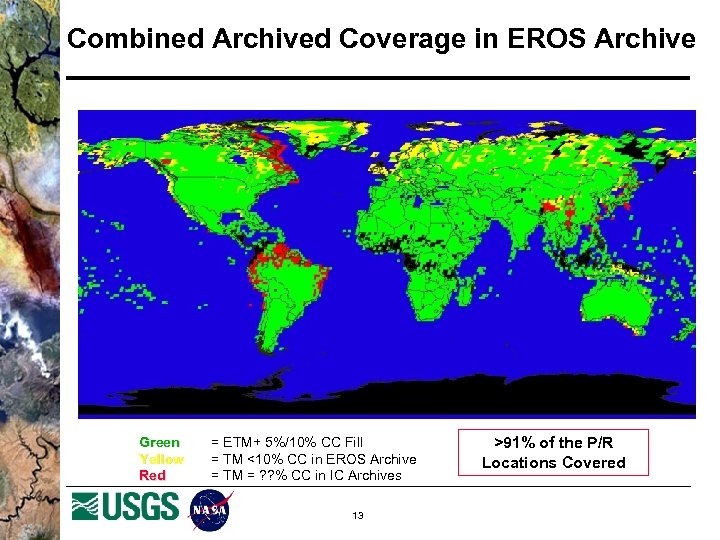
Combined Archived Coverage in EROS Archive Green Yellow Red = ETM+ 5%/10% CC Fill = TM <10% CC in EROS Archive = TM = ? ? % CC in IC Archives 13 >91% of the P/R Locations Covered
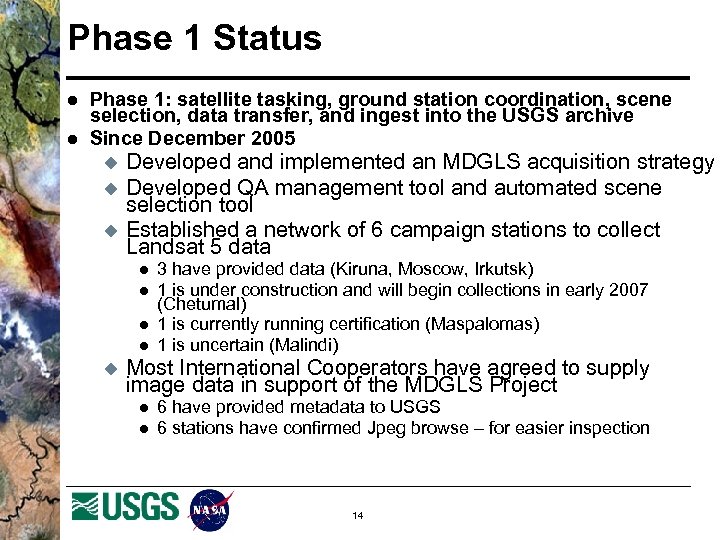
Phase 1 Status l l Phase 1: satellite tasking, ground station coordination, scene selection, data transfer, and ingest into the USGS archive Since December 2005 u u u Developed and implemented an MDGLS acquisition strategy Developed QA management tool and automated scene selection tool Established a network of 6 campaign stations to collect Landsat 5 data l l u 3 have provided data (Kiruna, Moscow, Irkutsk) 1 is under construction and will begin collections in early 2007 (Chetumal) 1 is currently running certification (Maspalomas) 1 is uncertain (Malindi) Most International Cooperators have agreed to supply image data in support of the MDGLS Project l l 6 have provided metadata to USGS 6 stations have confirmed Jpeg browse – for easier inspection 14
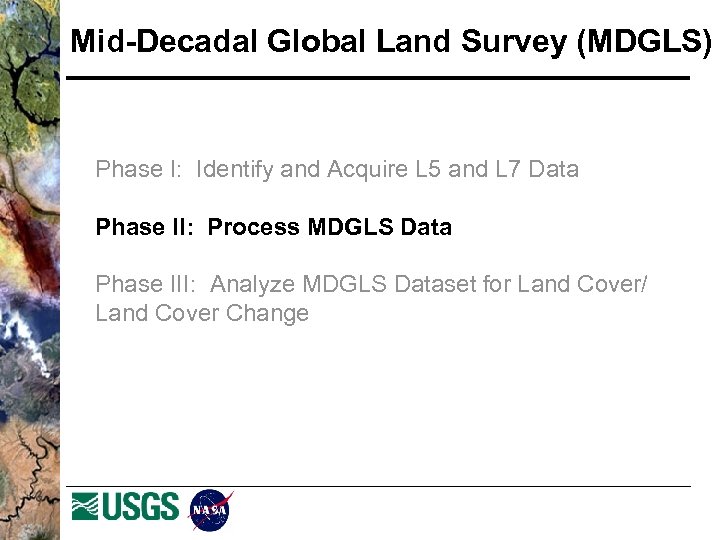
Mid-Decadal Global Land Survey (MDGLS) Phase I: Identify and Acquire L 5 and L 7 Data Phase II: Process MDGLS Data Phase III: Analyze MDGLS Dataset for Land Cover/ Land Cover Change
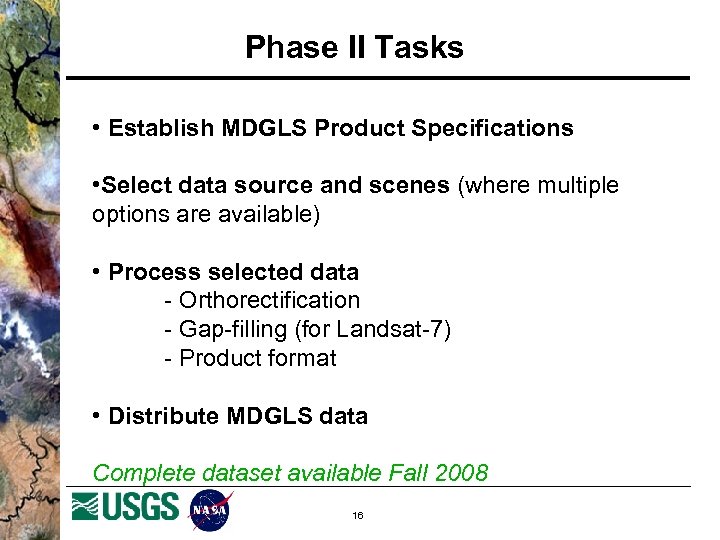
Phase II Tasks • Establish MDGLS Product Specifications • Select data source and scenes (where multiple options are available) • Process selected data - Orthorectification - Gap-filling (for Landsat-7) - Product format • Distribute MDGLS data Complete dataset available Fall 2008 16
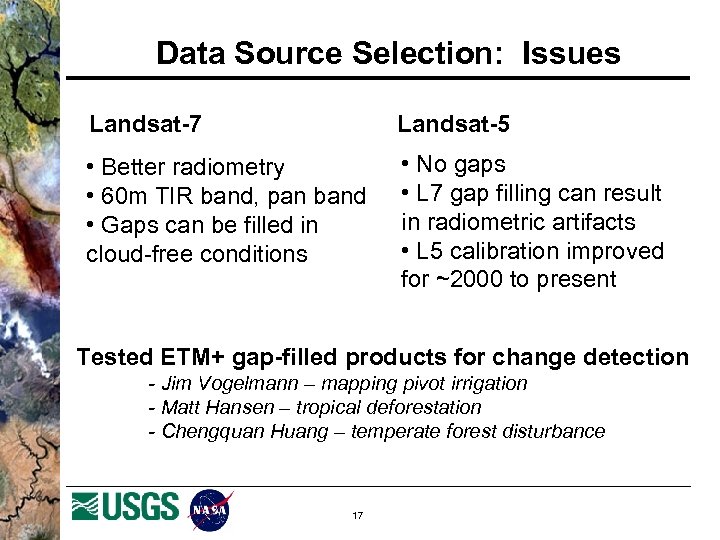
Data Source Selection: Issues Landsat-7 Landsat-5 • Better radiometry • 60 m TIR band, pan band • Gaps can be filled in cloud-free conditions • No gaps • L 7 gap filling can result in radiometric artifacts • L 5 calibration improved for ~2000 to present Tested ETM+ gap-filled products for change detection - Jim Vogelmann – mapping pivot irrigation - Matt Hansen – tropical deforestation - Chengquan Huang – temperate forest disturbance 17
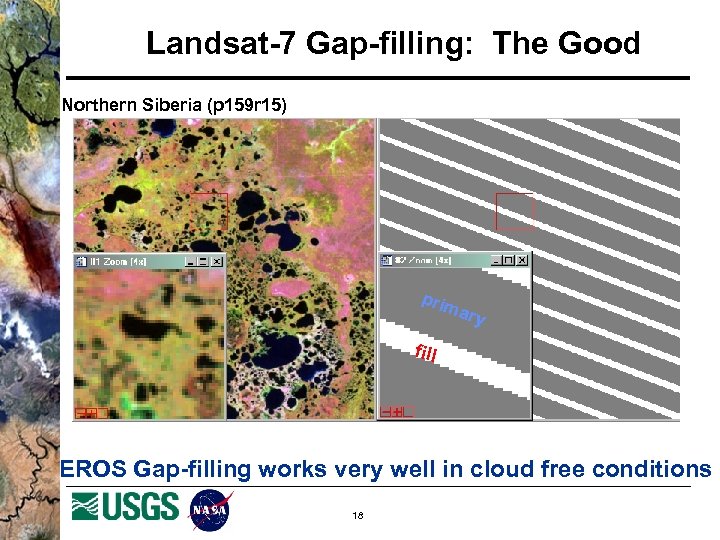
Landsat-7 Gap-filling: The Good Northern Siberia (p 159 r 15) prim ary fill EROS Gap-filling works very well in cloud free conditions 18
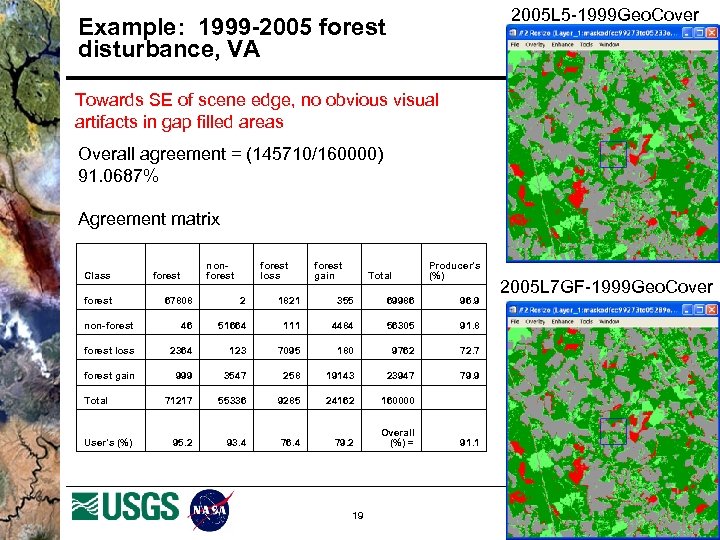
2005 L 5 -1999 Geo. Cover Example: 1999 -2005 forest disturbance, VA Towards SE of scene edge, no obvious visual artifacts in gap filled areas Overall agreement = (145710/160000) 91. 0687% Agreement matrix Class forest nonforest loss forest gain Producer's (%) Total 67808 2 1821 355 69986 96. 9 non-forest 46 51664 111 4484 56305 91. 8 forest loss 2364 123 7095 180 9762 72. 7 forest gain 999 3547 258 19143 23947 79. 9 71217 55336 9285 24162 160000 95. 2 93. 4 76. 4 79. 2 Overall (%) = Total User's (%) 19 91. 1 2005 L 7 GF-1999 Geo. Cover
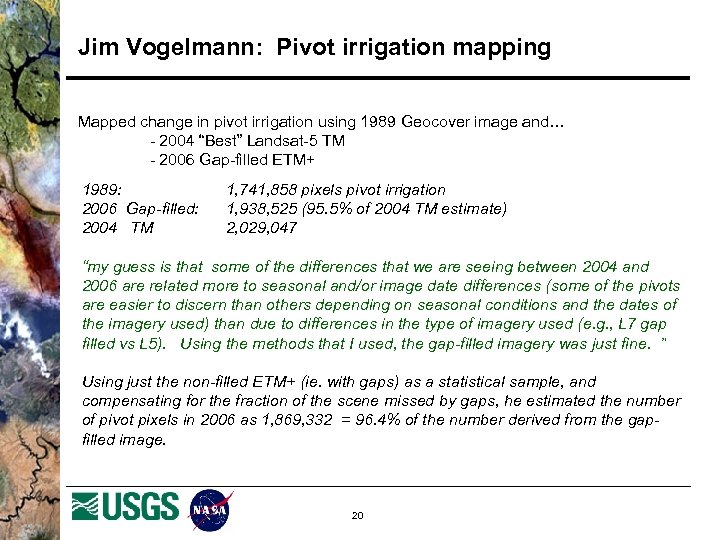
Jim Vogelmann: Pivot irrigation mapping Mapped change in pivot irrigation using 1989 Geocover image and… - 2004 “Best” Landsat-5 TM - 2006 Gap-filled ETM+ 1989: 2006 Gap-filled: 2004 TM 1, 741, 858 pixels pivot irrigation 1, 938, 525 (95. 5% of 2004 TM estimate) 2, 029, 047 “my guess is that some of the differences that we are seeing between 2004 and 2006 are related more to seasonal and/or image date differences (some of the pivots are easier to discern than others depending on seasonal conditions and the dates of the imagery used) than due to differences in the type of imagery used (e. g. , L 7 gap filled vs L 5). Using the methods that I used, the gap-filled imagery was just fine. ” Using just the non-filled ETM+ (ie. with gaps) as a statistical sample, and compensating for the fraction of the scene missed by gaps, he estimated the number of pivot pixels in 2006 as 1, 869, 332 = 96. 4% of the number derived from the gapfilled image. 20
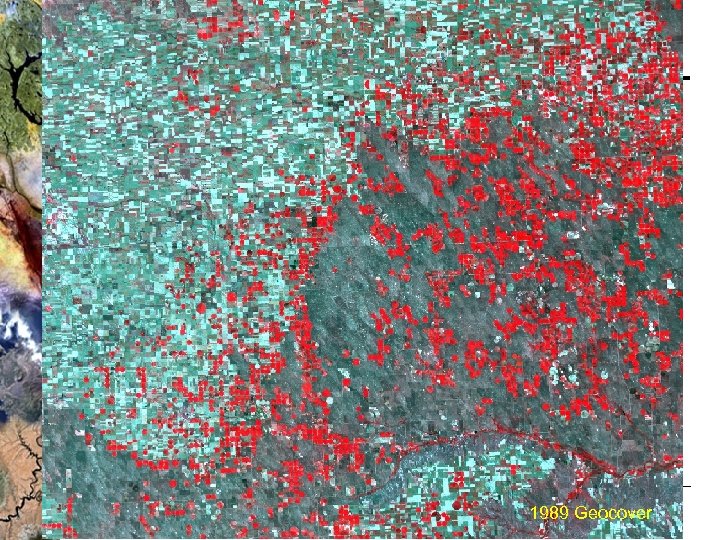
21 1989 Geocover
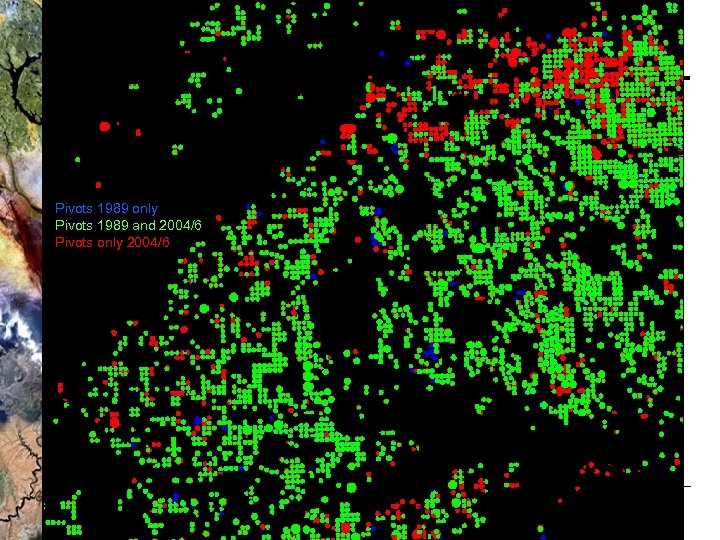
Pivots 1989 only Pivots 1989 and 2004/6 Pivots only 2004/6 22
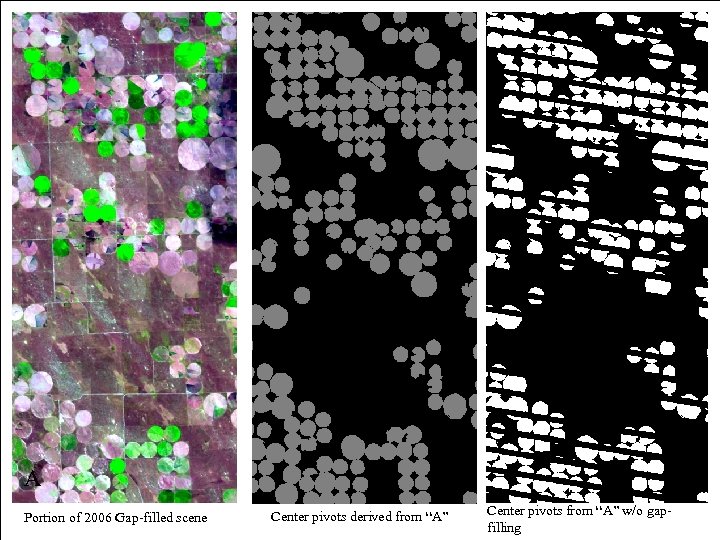
A Portion of 2006 Gap-filled scene 23 Center pivots derived from “A” Center pivots from “A” w/o gapfilling
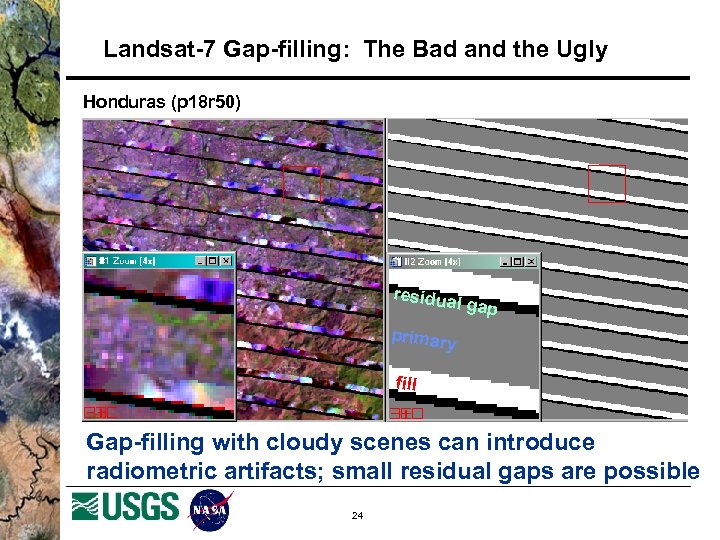
Landsat-7 Gap-filling: The Bad and the Ugly Honduras (p 18 r 50) residua l gap primary fill Gap-filling with cloudy scenes can introduce radiometric artifacts; small residual gaps are possible 24
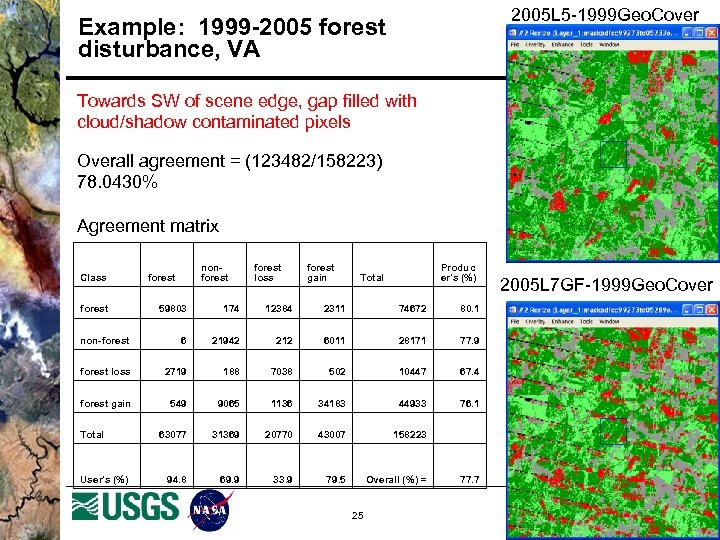
2005 L 5 -1999 Geo. Cover Example: 1999 -2005 forest disturbance, VA Towards SW of scene edge, gap filled with cloud/shadow contaminated pixels Overall agreement = (123482/158223) 78. 0430% Agreement matrix Class forest nonforest loss forest gain Produc er's (%) Total 59803 174 12384 2311 74672 80. 1 non-forest 6 21942 212 6011 28171 77. 9 forest loss 2719 188 7038 502 10447 67. 4 forest gain 549 9065 1136 34183 44933 76. 1 63077 31369 20770 43007 158223 94. 8 69. 9 33. 9 79. 5 Overall (%) = Total User's (%) 25 77. 7 2005 L 7 GF-1999 Geo. Cover
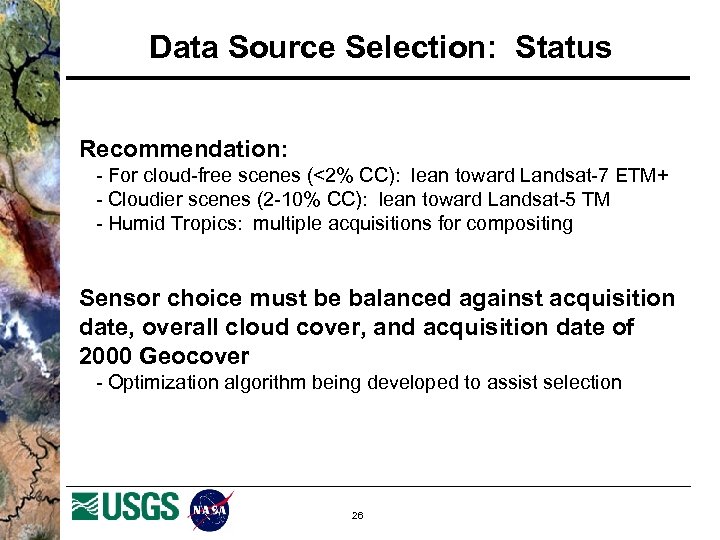
Data Source Selection: Status Recommendation: - For cloud-free scenes (<2% CC): lean toward Landsat-7 ETM+ - Cloudier scenes (2 -10% CC): lean toward Landsat-5 TM - Humid Tropics: multiple acquisitions for compositing Sensor choice must be balanced against acquisition date, overall cloud cover, and acquisition date of 2000 Geocover - Optimization algorithm being developed to assist selection 26
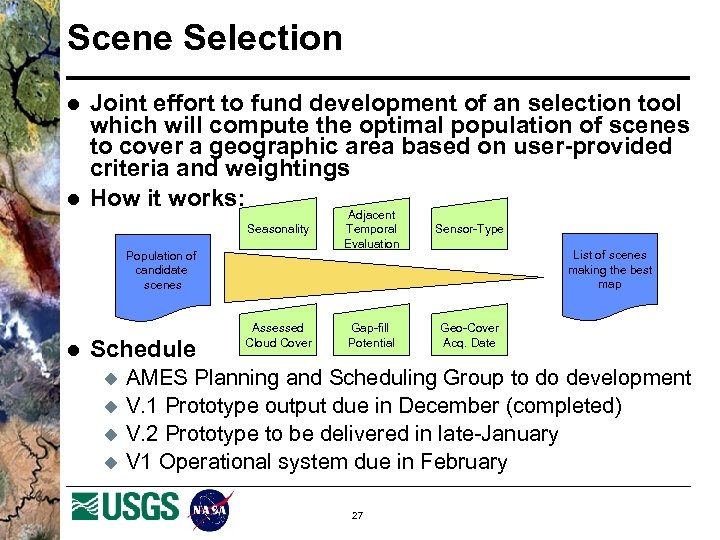
Scene Selection l l Joint effort to fund development of an selection tool which will compute the optimal population of scenes to cover a geographic area based on user-provided criteria and weightings How it works: Seasonality Population of candidate scenes l Schedule u u Assessed Cloud Cover Adjacent Temporal Evaluation Sensor-Type Gap-fill Potential Geo-Cover Acq. Date List of scenes making the best map AMES Planning and Scheduling Group to do development V. 1 Prototype output due in December (completed) V. 2 Prototype to be delivered in late-January V 1 Operational system due in February 27
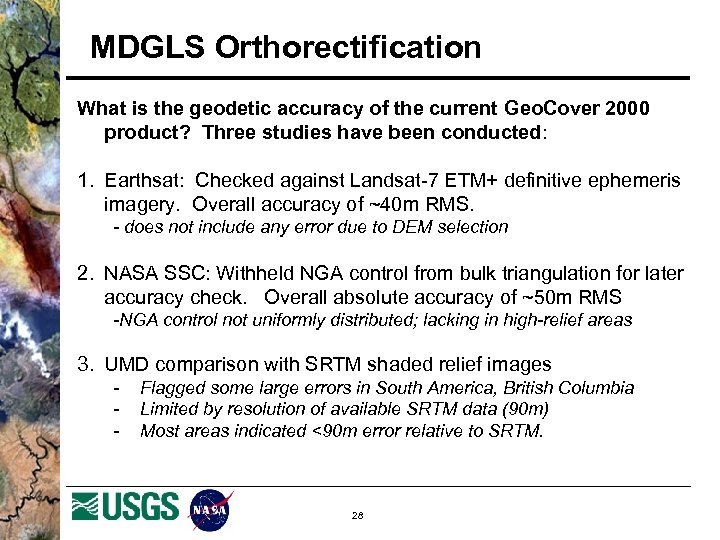
MDGLS Orthorectification What is the geodetic accuracy of the current Geo. Cover 2000 product? Three studies have been conducted: 1. Earthsat: Checked against Landsat-7 ETM+ definitive ephemeris imagery. Overall accuracy of ~40 m RMS. - does not include any error due to DEM selection 2. NASA SSC: Withheld NGA control from bulk triangulation for later accuracy check. Overall absolute accuracy of ~50 m RMS -NGA control not uniformly distributed; lacking in high-relief areas 3. UMD comparison with SRTM shaded relief images - Flagged some large errors in South America, British Columbia Limited by resolution of available SRTM data (90 m) Most areas indicated <90 m error relative to SRTM. 28
MDGLS Orthorectification Need to reprocess previous Geo. Cover datasets in highrelief areas to maintain continuity with MDGLS - model absolute error due to Geocover DEM choice - reprocess locations with errors >15 m using SRTM Use 2000 Geo. Cover chips as geodetic control, SRTM DEM for terrain correction - L 7 automated 1 Gt processing available Feb 2007 (? ) - L 5 automated 1 Gt processing available late 2007 (? ) Geodetic accuracy relative to 2000 Geocover of 30 m RMSE (or better). Maximum absolute geodetic error of 100 m. 29
MDGLS Product Specification (Draft) • UTM / WGS-84 projection • 14. 25 / 28. 5/ 57 meter resolution • Cubic Convolution resampling (1 step) • Geo. Tiff format • Orthorectified, Gap-filled Processing by USGS EROS FTP distribution of individual MDGLS scenes at no cost, with limited provision for bulk distribution of entire dataset (e. g. via hard disk transfer). 30
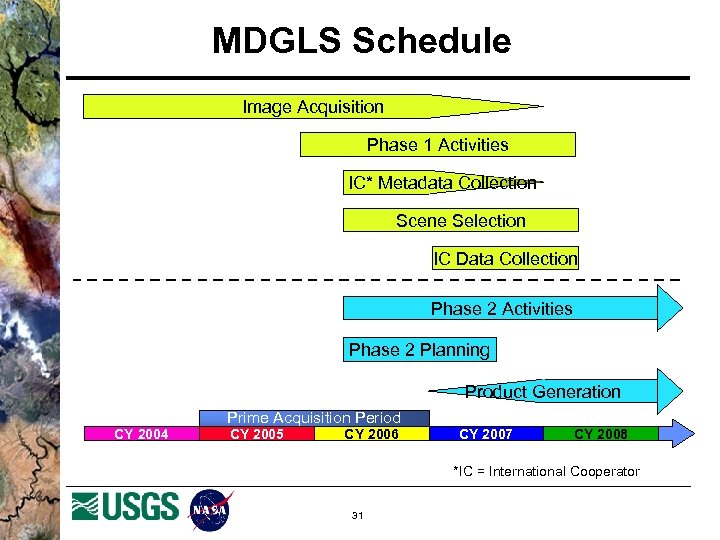
MDGLS Schedule Image Acquisition Phase 1 Activities IC* Metadata Collection Scene Selection IC Data Collection Phase 2 Activities Phase 2 Planning Product Generation CY 2004 Prime Acquisition Period CY 2005 CY 2006 CY 2007 CY 2008 *IC = International Cooperator 31
MDGLS Processing Issues 1. Cost 2. Schedule 32
Mid-Decadal Global Land Survey (MDGLS) Phase I: Identify and Acquire L 5 and L 7 Data Phase II: Process MDGLS Data Phase III: Analyze MDGLS Dataset for Land Cover/ Land Cover Change
Recommended Approaches Produce products via independent teams, but coordinate tools and class definitions - regional to continental scales - thematic products Prioritize regions with known LC dynamics of critical import for carbon, water, biodiversity, and societal services Land cover is necessary but not sufficient; include vegetation dynamics (disturbance, recovery, fragmentation, biome migration, etc). Establish concurrent validation program Workshop in Annapolis Maryland, February 27 -28 2007 34
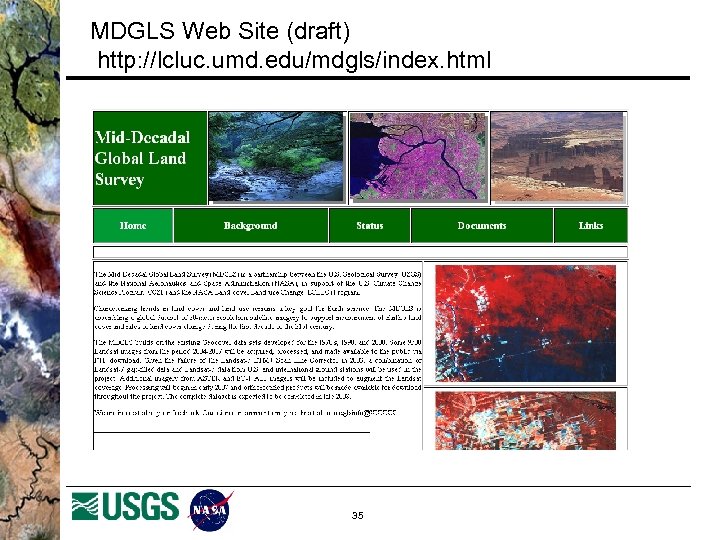
MDGLS Web Site (draft) http: //lcluc. umd. edu/mdgls/index. html 35
Back-up 36
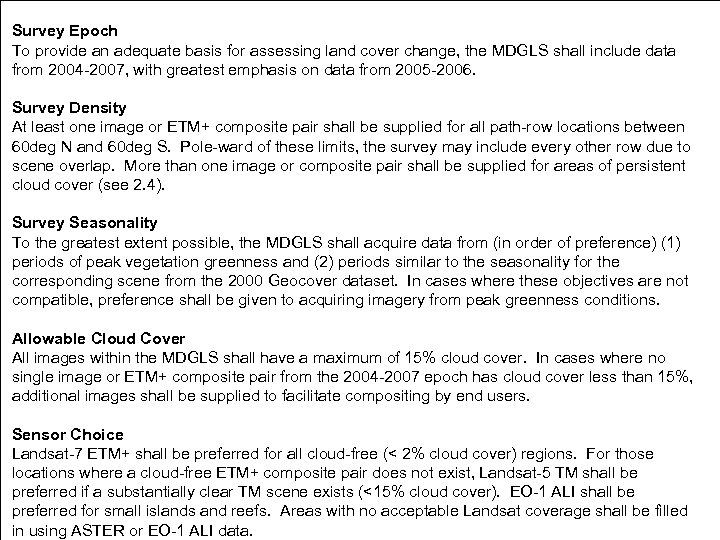
Survey Epoch To provide an adequate basis for assessing land cover change, the MDGLS shall include data from 2004 -2007, with greatest emphasis on data from 2005 -2006. Survey Density At least one image or ETM+ composite pair shall be supplied for all path-row locations between 60 deg N and 60 deg S. Pole-ward of these limits, the survey may include every other row due to scene overlap. More than one image or composite pair shall be supplied for areas of persistent cloud cover (see 2. 4). Survey Seasonality To the greatest extent possible, the MDGLS shall acquire data from (in order of preference) (1) periods of peak vegetation greenness and (2) periods similar to the seasonality for the corresponding scene from the 2000 Geocover dataset. In cases where these objectives are not compatible, preference shall be given to acquiring imagery from peak greenness conditions. Allowable Cloud Cover All images within the MDGLS shall have a maximum of 15% cloud cover. In cases where no single image or ETM+ composite pair from the 2004 -2007 epoch has cloud cover less than 15%, additional images shall be supplied to facilitate compositing by end users. Sensor Choice Landsat-7 ETM+ shall be preferred for all cloud-free (< 2% cloud cover) regions. For those locations where a cloud-free ETM+ composite pair does not exist, Landsat-5 TM shall be preferred if a substantially clear TM scene exists (<15% cloud cover). EO-1 ALI shall be preferred for small islands and reefs. Areas with 37 acceptable Landsat coverage shall be filled no in using ASTER or EO-1 ALI data.
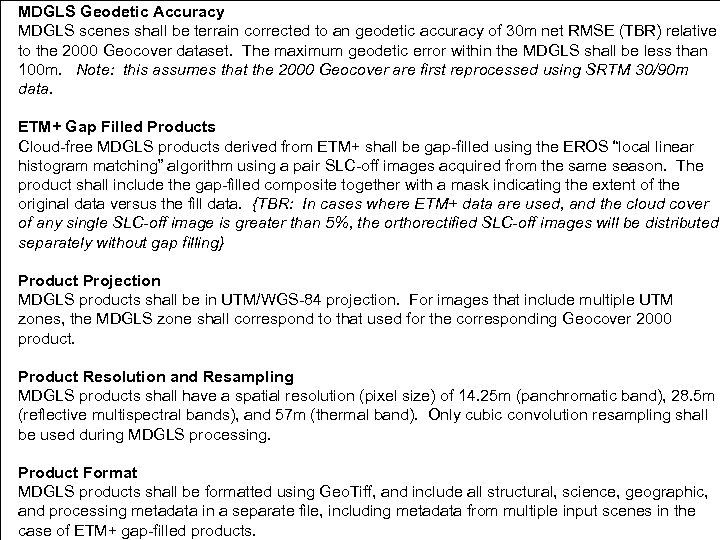
MDGLS Geodetic Accuracy MDGLS scenes shall be terrain corrected to an geodetic accuracy of 30 m net RMSE (TBR) relative to the 2000 Geocover dataset. The maximum geodetic error within the MDGLS shall be less than 100 m. Note: this assumes that the 2000 Geocover are first reprocessed using SRTM 30/90 m data. ETM+ Gap Filled Products Cloud-free MDGLS products derived from ETM+ shall be gap-filled using the EROS “local linear histogram matching” algorithm using a pair SLC-off images acquired from the same season. The product shall include the gap-filled composite together with a mask indicating the extent of the original data versus the fill data. {TBR: In cases where ETM+ data are used, and the cloud cover of any single SLC-off image is greater than 5%, the orthorectified SLC-off images will be distributed separately without gap filling} Product Projection MDGLS products shall be in UTM/WGS-84 projection. For images that include multiple UTM zones, the MDGLS zone shall correspond to that used for the corresponding Geocover 2000 product. Product Resolution and Resampling MDGLS products shall have a spatial resolution (pixel size) of 14. 25 m (panchromatic band), 28. 5 m (reflective multispectral bands), and 57 m (thermal band). Only cubic convolution resampling shall be used during MDGLS processing. Product Format MDGLS products shall be formatted using Geo. Tiff, and include all structural, science, geographic, and processing metadata in a separate file, including metadata from multiple input scenes in the 38 case of ETM+ gap-filled products.
Скачать презентацию Mid-Decadal Global Land Survey Jeff Masek Biospheric Sciences
2a76d32722539ea07cbd12a5ddf4fe66.ppt