


 Скачать презентацию Mid Continent Intensive Campaign Kenneth Davis 1 and
4e1b540e4658cc6c3066f626af3aee66.ppt
- Количество слайдов: 28
 Mid Continent Intensive Campaign Kenneth Davis 1 and Stephen M. Ogle 2 Co-Coordinators of MCI Campaign Task Force 1 Penn State University 2 Natural Resource Ecology Laboratory, Colorado State University
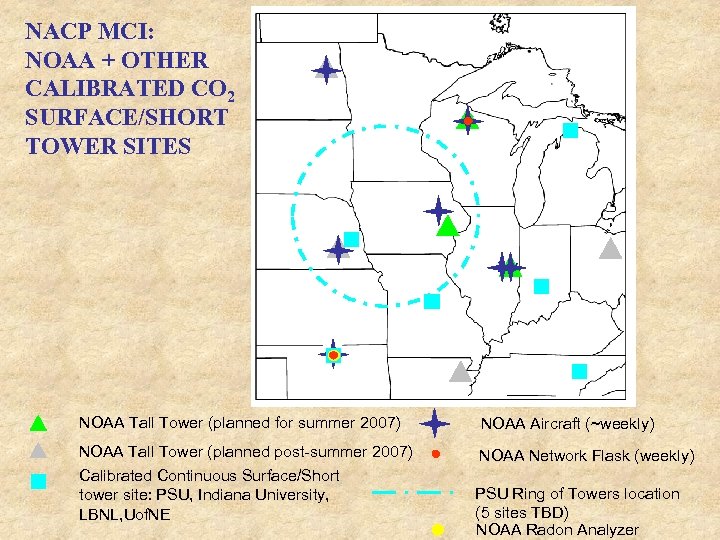 NACP MCI: NOAA + OTHER CALIBRATED CO 2 SURFACE/SHORT TOWER SITES NOAA Tall Tower (planned for summer 2007) NOAA Aircraft (~weekly) NOAA Tall Tower (planned post-summer 2007) Calibrated Continuous Surface/Short tower site: PSU, Indiana University, LBNL, Uof. NE NOAA Network Flask (weekly) PSU Ring of Towers location (5 sites TBD) NOAA Radon Analyzer
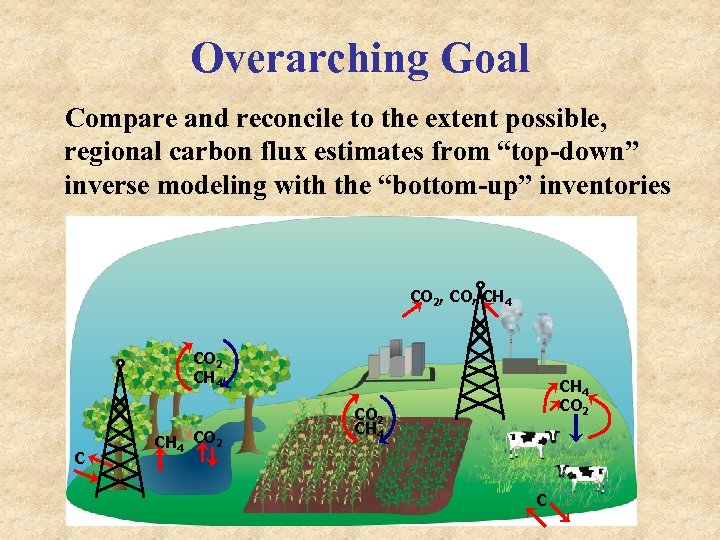 Overarching Goal Compare and reconcile to the extent possible, regional carbon flux estimates from “top-down” inverse modeling with the “bottom-up” inventories CO 2, CO, CH 4 CO 2 CH 4 C
 Primary Objectives • Develop approaches to estimate fluxes using “top-down” atmospheric budgets and “bottomup” inventories – Individual studies • Provide both “top-down” and “bottom-up” flux estimates and associated uncertainties – MCI data products • Evaluate results with independent validation data for both approaches – Additional measurements • Evaluate differences in results between “topdown” and “bottom-up” approaches, diagnose problems, and improve estimates – Synthesis activity
 Secondary Objectives • Provide the basis for optimization of field, satellite and atmospheric sampling schemes • Determine mechanisms driving regional net fluxes patterns in the MCI region • Assemble data products required for the “bottom-up” and “top-down” approaches • Provide guidance to future intensives
 Science Team • Voluntary Membership – Investigators with funded projects have been solicited to register relevant studies at NACP website • Currently includes 34 funded studies and 145 investigators • Topic groups have been established to focus on specific objectives
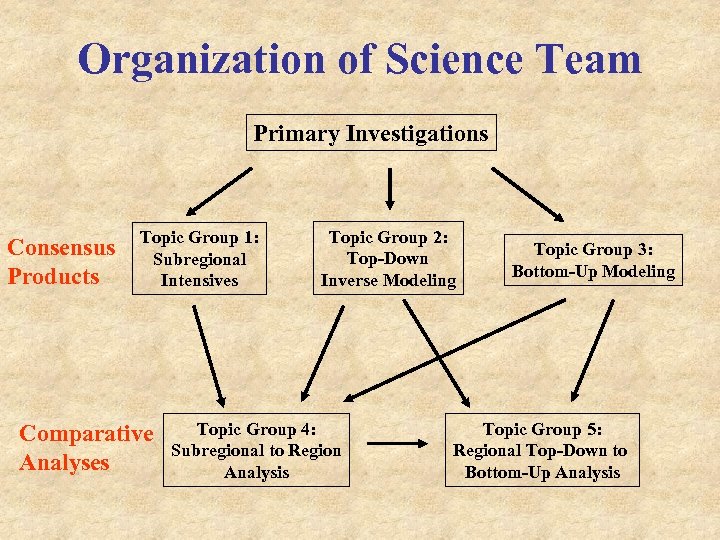 Organization of Science Team Primary Investigations Consensus Products Topic Group 1: Subregional Intensives Comparative Analyses Topic Group 2: Top-Down Inverse Modeling Topic Group 4: Subregional to Region Analysis Topic Group 3: Bottom-Up Modeling Topic Group 5: Regional Top-Down to Bottom-Up Analysis
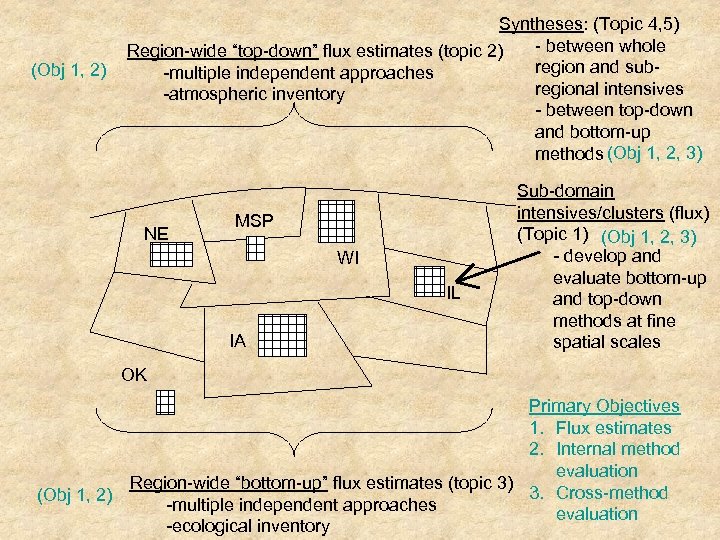 (Obj 1, 2) Syntheses: (Topic 4, 5) - between whole Region-wide “top-down” flux estimates (topic 2) region and sub-multiple independent approaches regional intensives -atmospheric inventory - between top-down and bottom-up methods (Obj 1, 2, 3) NE MSP WI IL IA Sub-domain intensives/clusters (flux) (Topic 1) (Obj 1, 2, 3) - develop and evaluate bottom-up and top-down methods at fine spatial scales OK Primary Objectives 1. Flux estimates 2. Internal method evaluation Region-wide “bottom-up” flux estimates (topic 3) 3. Cross-method (Obj 1, 2) -multiple independent approaches evaluation -ecological inventory
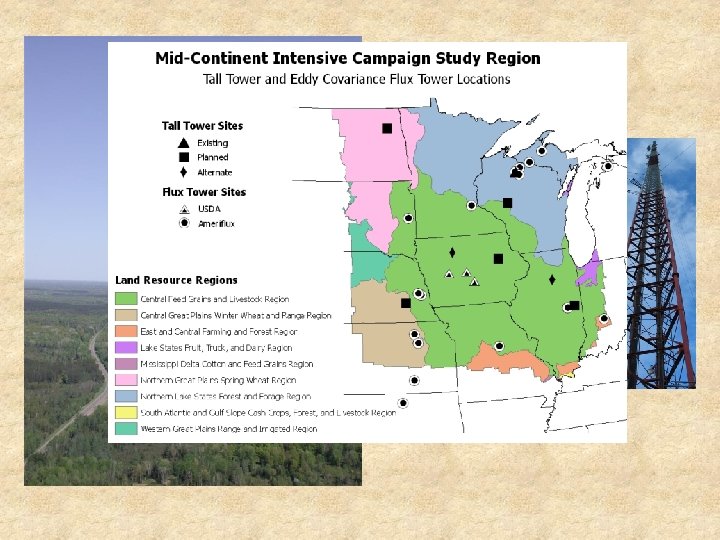
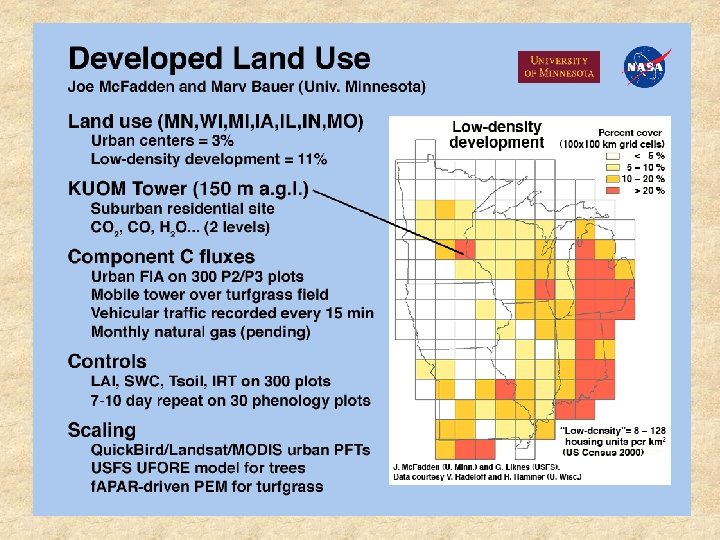
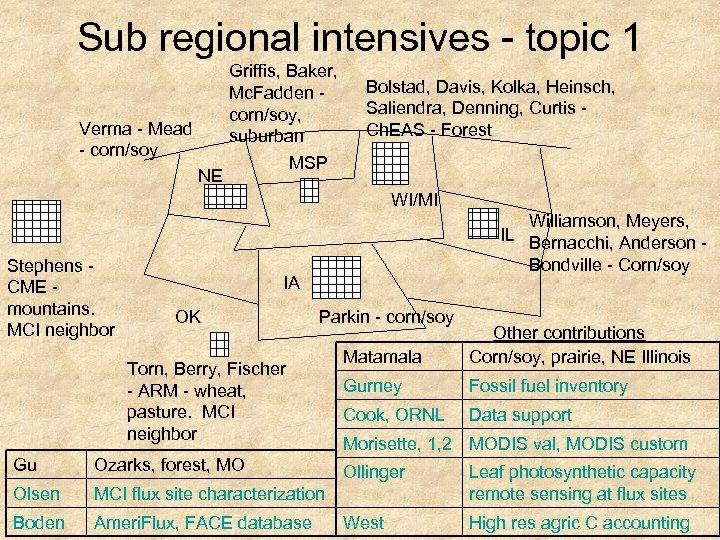 Sub regional intensives - topic 1 Griffis, Baker, Mc. Fadden corn/soy, suburban Verma - Mead - corn/soy Bolstad, Davis, Kolka, Heinsch, Saliendra, Denning, Curtis Ch. EAS - Forest MSP NE WI/MI Stephens CME mountains. MCI neighbor Williamson, Meyers, IL Bernacchi, Anderson Bondville - Corn/soy IA OK Parkin - corn/soy Torn, Berry, Fischer - ARM - wheat, pasture. MCI neighbor Gu Ozarks, forest, MO Olsen Ameri. Flux, FACE database Gurney Fossil fuel inventory Cook, ORNL Data support Morisette, 1, 2 MODIS val, MODIS custom MCI flux site characterization Boden Matamala Other contributions Corn/soy, prairie, NE Illinois Ollinger Leaf photosynthetic capacity remote sensing at flux sites West High res agric C accounting
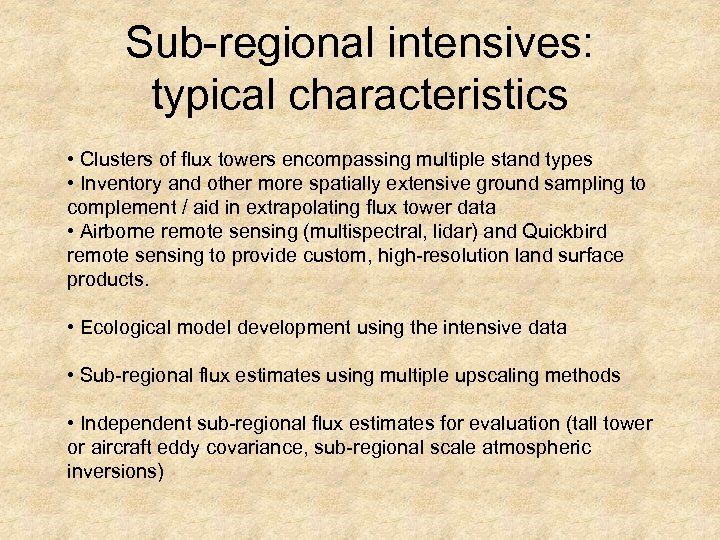 Sub-regional intensives: typical characteristics • Clusters of flux towers encompassing multiple stand types • Inventory and other more spatially extensive ground sampling to complement / aid in extrapolating flux tower data • Airborne remote sensing (multispectral, lidar) and Quickbird remote sensing to provide custom, high-resolution land surface products. • Ecological model development using the intensive data • Sub-regional flux estimates using multiple upscaling methods • Independent sub-regional flux estimates for evaluation (tall tower or aircraft eddy covariance, sub-regional scale atmospheric inversions)
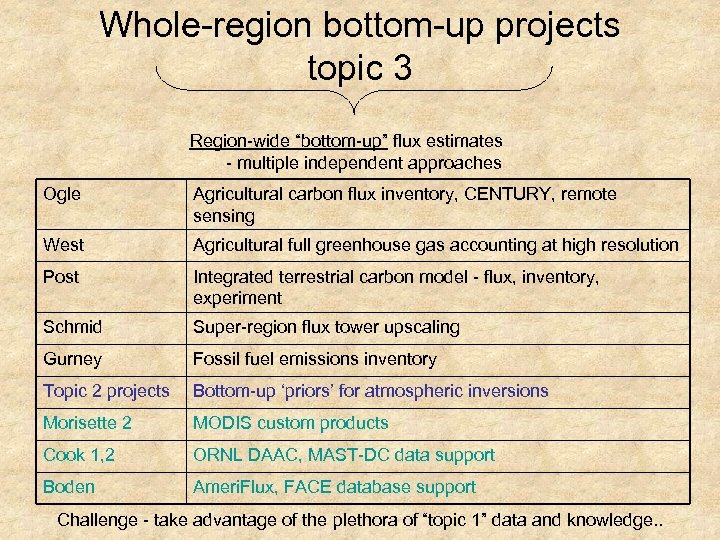 Whole-region bottom-up projects topic 3 Region-wide “bottom-up” flux estimates - multiple independent approaches Ogle Agricultural carbon flux inventory, CENTURY, remote sensing West Agricultural full greenhouse gas accounting at high resolution Post Integrated terrestrial carbon model - flux, inventory, experiment Schmid Super-region flux tower upscaling Gurney Fossil fuel emissions inventory Topic 2 projects Bottom-up ‘priors’ for atmospheric inversions Morisette 2 MODIS custom products Cook 1, 2 ORNL DAAC, MAST-DC data support Boden Ameri. Flux, FACE database support Challenge - take advantage of the plethora of “topic 1” data and knowledge. .
 Whole-region top-down projects - topic 2 Region-wide “top-down” flux estimates (topic 2) - multiple independent approaches Berry Advanced ABL budget methods at N. American towers Andrews et al NOAA tall tower and aircraft network and associated analyses Davis/Denning Ring of Towers II and associated inverse analyses, flux. CO 2 data syntheses Wofsy et al Model data fusion framework - regional flux-co 2 -inventory data syntheses Denning/Zupanski Regional inversion methods development Morisette 2 MODIS custom products Cook 1, 2 ORNL DAAC, MAST-DC data support Boden Ameri. Flux, FACE database support Many atmospheric inversions have region-wide terrestrial carbon flux priors
 Examples - sub-regional intensives
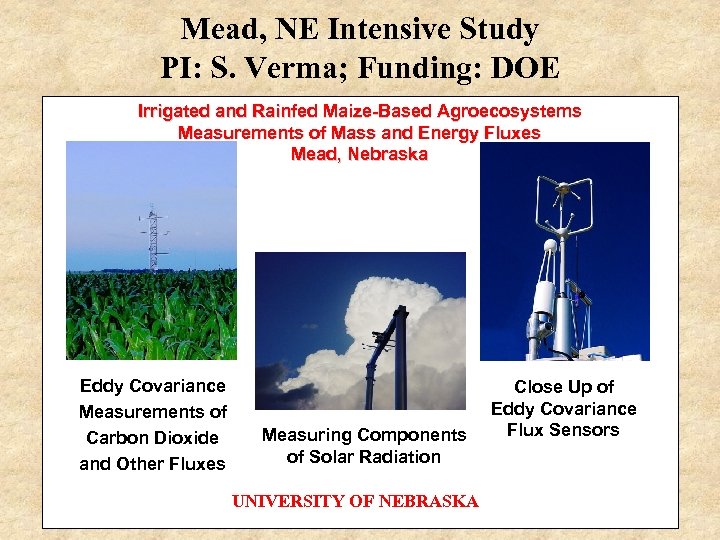 Mead, NE Intensive Study PI: S. Verma; Funding: DOE Irrigated and Rainfed Maize-Based Agroecosystems Measurements of Mass and Energy Fluxes Mead, Nebraska Eddy Covariance Measurements of Carbon Dioxide and Other Fluxes Measuring Components of Solar Radiation UNIVERSITY OF NEBRASKA Close Up of Eddy Covariance Flux Sensors
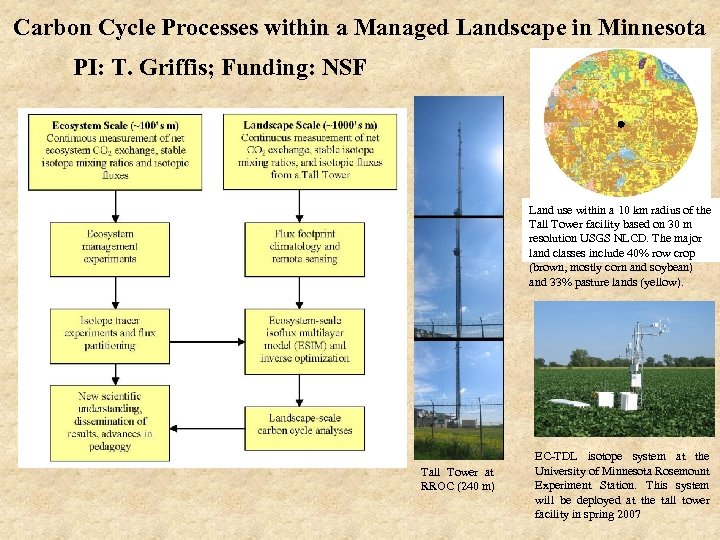 Carbon Cycle Processes within a Managed Landscape in Minnesota PI: T. Griffis; Funding: NSF Land use within a 10 km radius of the Tall Tower facility based on 30 m resolution USGS NLCD. The major land classes include 40% row crop (brown, mostly corn and soybean) and 33% pasture lands (yellow). Tall Tower at RROC (240 m) EC-TDL isotope system at the University of Minnesota Rosemount Experiment Station. This system will be deployed at the tall tower facility in spring 2007
 Examples - bottom-up
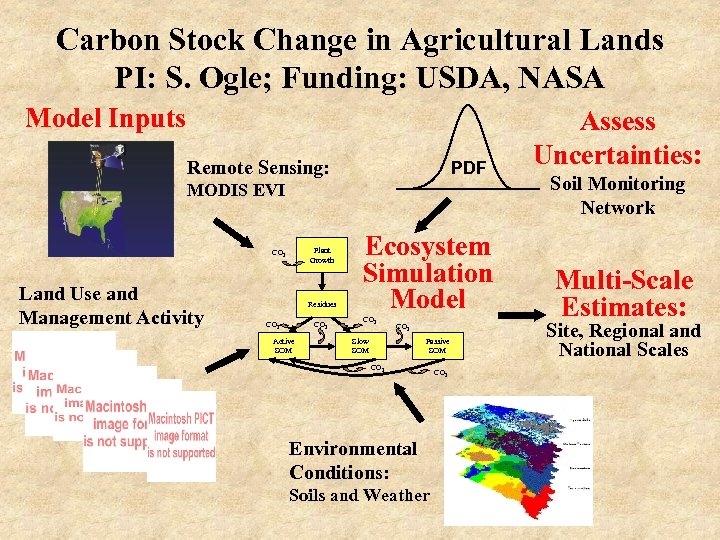 Carbon Stock Change in Agricultural Lands PI: S. Ogle; Funding: USDA, NASA Model Inputs Remote Sensing: PDF MODIS EVI Plant Growth CO 2 Land Use and Management Activity Residues CO 2 Active SOM Ecosystem Simulation Model CO 2 Slow SOM Passive SOM CO 2 Environmental Conditions: Soils and Weather CO 2 Assess Uncertainties: Soil Monitoring Network Multi-Scale Estimates: Site, Regional and National Scales
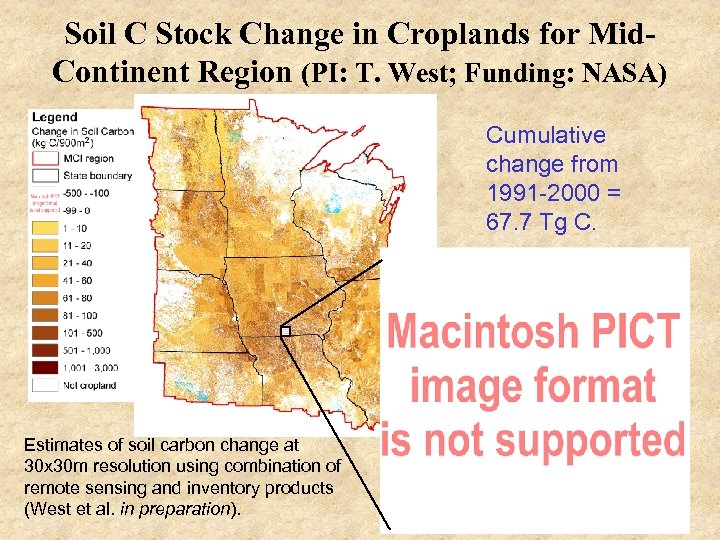 Soil C Stock Change in Croplands for Mid. Continent Region (PI: T. West; Funding: NASA) Cumulative change from 1991 -2000 = 67. 7 Tg C. Estimates of soil carbon change at 30 x 30 m resolution using combination of remote sensing and inventory products (West et al. in preparation).
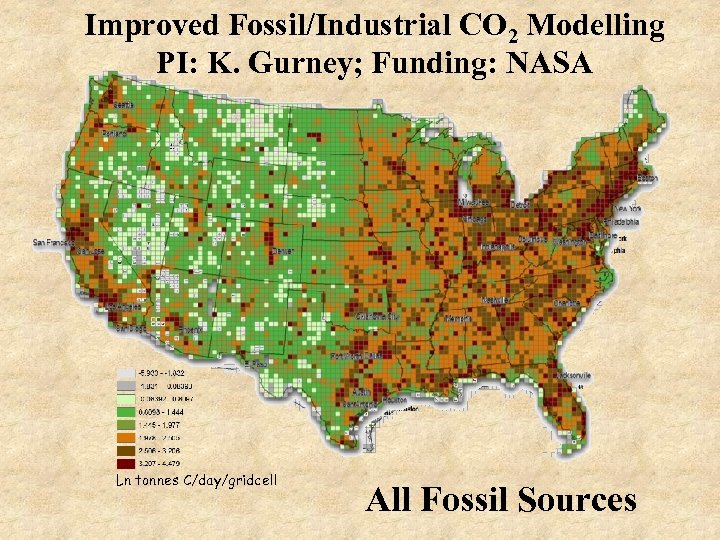 Improved Fossil/Industrial CO 2 Modelling PI: K. Gurney; Funding: NASA Ln tonnes C/day/gridcell All Fossil Sources
 Examples - top-down
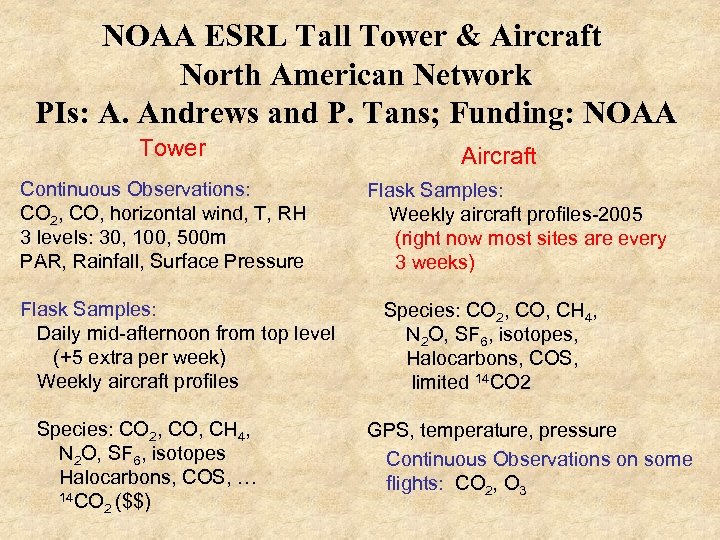 NOAA ESRL Tall Tower & Aircraft North American Network PIs: A. Andrews and P. Tans; Funding: NOAA Tower Continuous Observations: CO 2, CO, horizontal wind, T, RH 3 levels: 30, 100, 500 m PAR, Rainfall, Surface Pressure Flask Samples: Daily mid-afternoon from top level (+5 extra per week) Weekly aircraft profiles Species: CO 2, CO, CH 4, N 2 O, SF 6, isotopes Halocarbons, COS, … 14 CO ($$) 2 Aircraft Flask Samples: Weekly aircraft profiles-2005 (right now most sites are every 3 weeks) Species: CO 2, CO, CH 4, N 2 O, SF 6, isotopes, Halocarbons, COS, limited 14 CO 2 GPS, temperature, pressure Continuous Observations on some flights: CO 2, O 3
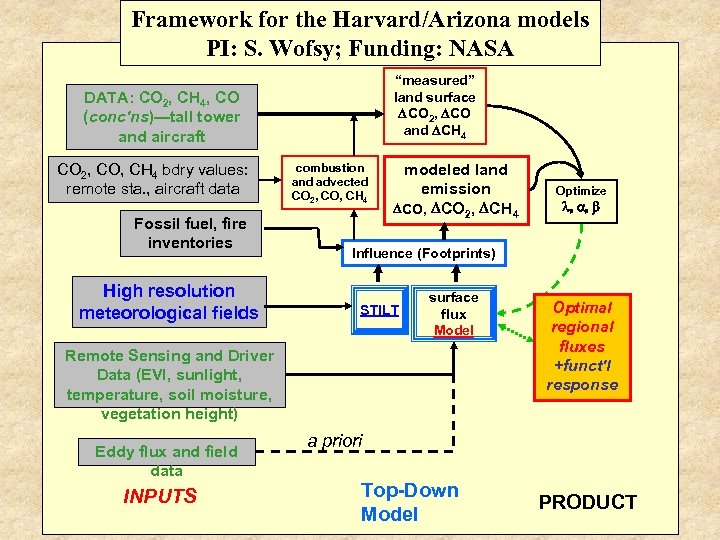 Framework for the Harvard/Arizona models PI: S. Wofsy; Funding: NASA “measured” land surface DCO 2, DCO and DCH 4 DATA: CO 2, CH 4, CO (conc'ns)—tall tower and aircraft CO 2, CO, CH 4 bdry values: remote sta. , aircraft data Fossil fuel, fire inventories High resolution meteorological fields combustion and advected CO 2, CO, CH 4 modeled land emission DCO, DCO 2, DCH 4 INPUTS , a, b Influence (Footprints) STILT surface flux Model Remote Sensing and Driver Data (EVI, sunlight, temperature, soil moisture, vegetation height) Eddy flux and field data Optimize Optimal regional fluxes +funct'l response a priori Top-Down Model PRODUCT
 Example - support
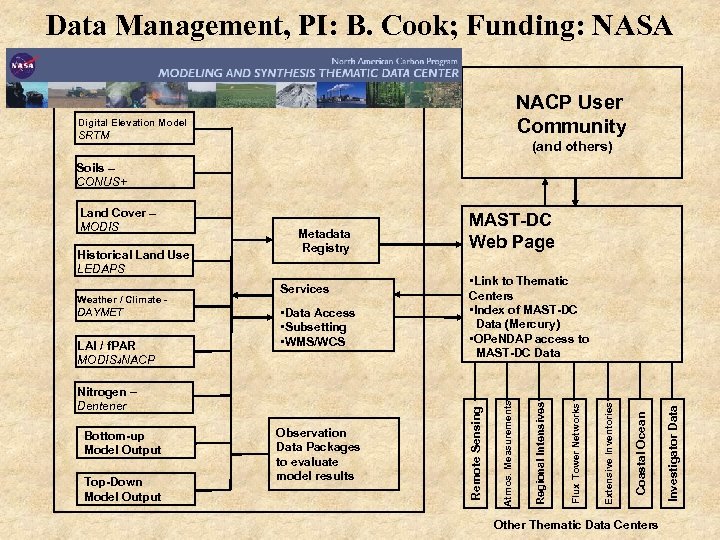 Data Management, PI: B. Cook; Funding: NASA NACP User Community Digital Elevation Model SRTM (and others) Soils – CONUS+ Top-Down Model Output Observation Data Packages to evaluate model results Other Thematic Data Centers Investigator Data Bottom-up Model Output Coastal Ocean Nitrogen – Dentener Extensive Inventories LAI / f. PAR MODIS 4 NACP • Data Access • Subsetting • WMS/WCS Flux Tower Networks DAYMET • Link to Thematic Centers • Index of MAST-DC Data (Mercury) • OPe. NDAP access to MAST-DC Data Regional Intensives Weather / Climate - Services MAST-DC Web Page Atmos. Measurements Historical Land Use LEDAPS Metadata Registry Remote Sensing Land Cover – MODIS
 Progress, concerns • Progress - making the whole more than the sum of its parts – MCI investigators’ community is tangible - Feb 2006 meeting in Boulder, this meeting. Define specific goals for future meetings. – NACP support group - metadata of projects - excellent resource. – MAST-DC, ORNL-DAAC. • Concerns – Slow tall tower build out. Still only one site for MCI. – Several MCI flux towers unsupported for 2007. – Synthesis topics (4, 5) need attention, possibly additional support (e. g. must compare top-down - data not yet collected - to bottom-up - many projects nearing completion).
 Shameless promotion of an upcoming (relevant) event Attention: Graduate students involved in research on regional-scale terrestrial biogeochemical cycles of carbon, water and nitrogen: Apply for the National Center for Atmospheric Research's (NCAR), 2007 Advanced Study Program's Summer Colloquium, "Regional Biogeochemistry: Needs and Methodologies" to be held June 4 -15, 2007 in Boulder , CO. Desai et al. NCAR-ASP and Ch. EAS RCN (NSF). http: //www. asp. ucar. edu/colloquium/2007/index. jsp • Application deadline is March 1, 2007 For questions regarding the colloquium email: asp-coll 1@asp. ucar. edu