


 Скачать презентацию Mid-Century Washington State War and Hard Times
af9af67c2d936de5ec19ca5af92f61bb.ppt
- Количество слайдов: 26
 Mid-Century Washington State War and Hard Times
 Overview l Textbook: l l l Chapter 7 – Anti-Chinese Movement Chapter 8 – Progressive Movement, Labor reform and World War I Chapter 9 – Great Depression, World War II and the Japanese Internment
 Social Reform l Populists 1892 l l l l Reducing railroad and utility costs lowering salaries of public officials stopping foreclosures starting a state income tax silver and god basis of monetary system Socialism Progressive Movement l l l Believed world could be made better – Government more in touch with people Improve quality of life Initiative and referendum – people can pass laws Recall – people can remove elected officials from office Women become able to vote and run for office in 1910
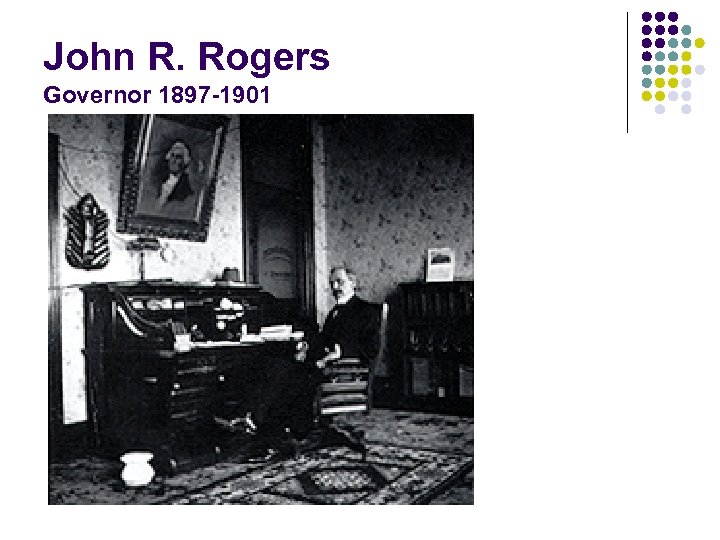 John R. Rogers Governor 1897 -1901
 Knights of Labor l l 1869 Focused on mining and smelting industries First priority was to make sure jobs went to white workers Died out in only a few years, but influence later labor movements
 Agriculture l l Storage and shipping costs controlled by the railroads Farm product prices stayed low Land prices and interest rates kept high by banks Organized into granges and farmers alliances in 1870’s
 Industrial Workers of the World l l l l l Established in 1905 Made marxism understandable to the uneducated worker Appealed to workers in mining, fishing, railroad, logging, milling, and farming Goal to organize many industries into one large union Three purposes: Union seeking better pay and working conditions Political party trying to overthrow capitalism Social organization Spokane free speech fight – the typical strategy Links: UW Libraries Digital Collection: http: //content. lib. washington. edu/index. html
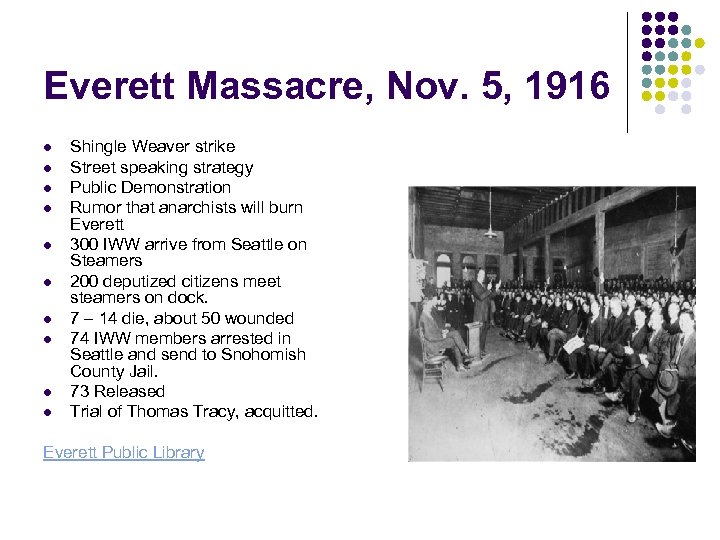 Everett Massacre, Nov. 5, 1916 l l l l l Shingle Weaver strike Street speaking strategy Public Demonstration Rumor that anarchists will burn Everett 300 IWW arrive from Seattle on Steamers 200 deputized citizens meet steamers on dock. 7 – 14 die, about 50 wounded 74 IWW members arrested in Seattle and send to Snohomish County Jail. 73 Released Trial of Thomas Tracy, acquitted. Everett Public Library
 Centralia Massacre Nov. 11, 1919 l l l l l Rumors of Armistice Day raid on IWW hall. Wobblies arm themselves in preparation. 7 men to remain in hall during parade. Centralia Legionnaires raid hall and are met with gunfire. IWW member Wesley Everest kills one man while exiting and one when trapped by the Skookumchuck River. 4 men total were killed. Everest arrested, mob takes him from jail and lynches him from the Centralia River Bridge. Hysteria results in suspected IWW members across the nation being arrested. Washington State passes law making it illegal to be a member of the IWW. 10 men tried and convicted of crime, continued to fight legal battle and were eventually paroled. UW Libraries Digital Collection – Special Collections
 Anti-Chinese Movement l l l l Dual Labor System Chinese Sojourners – earn money and then return to China Chinese Exclusion Act – 1 major piece of legislation limiting immigration and to identify an entire group of people. Media contributes to racism (quote next slide) Tacoma, Fall 1885 l Chinese evicted from Tacoma and sent to Portland by train. Seattle, Feb 1886 l Chinese evicted from Seattle onto a Steamer l Mob met by white protestors l All Chinese expelled by March. l Returned to help rebuild after Seattle Fire 1889. Port Townsend l Illegal smuggling l Chinese important part of economy.
 Newspaper Account from Tacoma Why permit an army of leprous, prosperity-sucking, progress-blasting Asiatics befoul our thoroughfares, degrade the city, repel immigration, drive out our people, break up our homes, take employment from our countrymen, corrupt the morals of our youth, establish opium joints, buy or steal the babe of poverty or slave, and taint with their brothels the lives of our young men? . . . If no other method of keeping them at a distance from our people can be found, let the citizens furnish them with lots on the waterfront, three fathoms below tide.
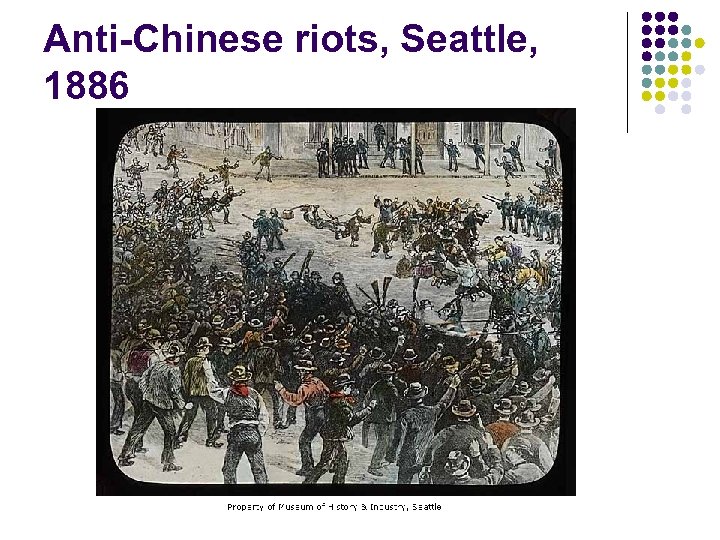 Anti-Chinese riots, Seattle, 1886
 World War I l Shipbuilding: l l l Wooden hulled boats at first Change to steel hulls with federal funding Spruce Division Drafting men for armed forces Food and energy conservation Raised money through savings bonds (Liberty bonds) Fort Lewis and other bases built or enlarges Citizens of German background prove patriotism Chance for workers to strike because workers are scarce Unions lose political support – Red Scare Ends era of political and labor reform Rise in “nativism” – anti-immigration, “true Americanism”
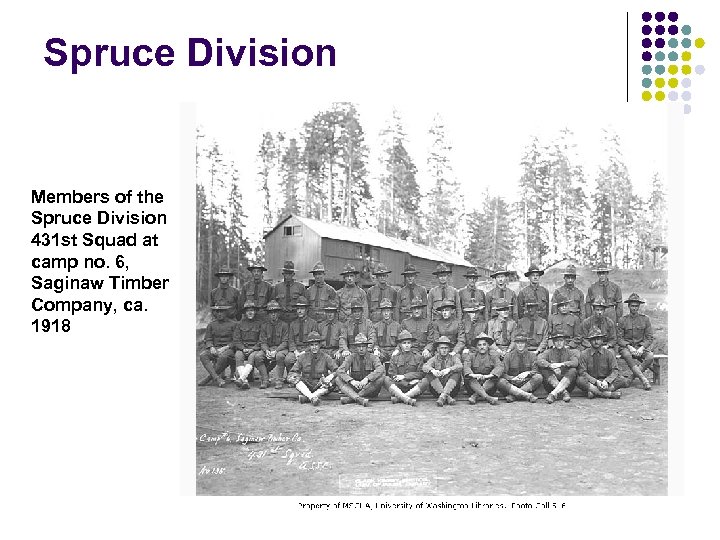 Spruce Division Members of the Spruce Division 431 st Squad at camp no. 6, Saginaw Timber Company, ca. 1918
 Great Depression: Effects l l l l l Washington’s economy was not well balanced so it was hurt badly Cutbacks in government war contracts Between 1926 and 1933, working force was cut in half, income levels cut in half Tensions were high, violence Labor unions strike because workers are being laid off and not paid Lumber exports cut in half between 1929 and 1933 Agriculture prices so low that apple growers burned trees for fuel Mining output in Idaho -- $32 Million in 1929, $9 Million in 1933 Population grows, immigrants moving from Midwest (Dust Bowl)
 Great Depression: Response l l l l Emergency Relief Act – help unemployed Government regulates prices of goods 1935 – Our state sales tax was adopted Civilian Conservation Corps (CCC)– employed men to work on conservation projects in the PNW Wilderness Unemployed Citizens League (UCL) – “self help” programs Washington Commonwealth Federation (WCF) – thought government should own banks, utilities, natural resources Federal Aid and Projects: Columbia Basin Irrigation Project, Grand Coulee Dam, Other Dams, Parks, Bridges, Highways, Public Buildings
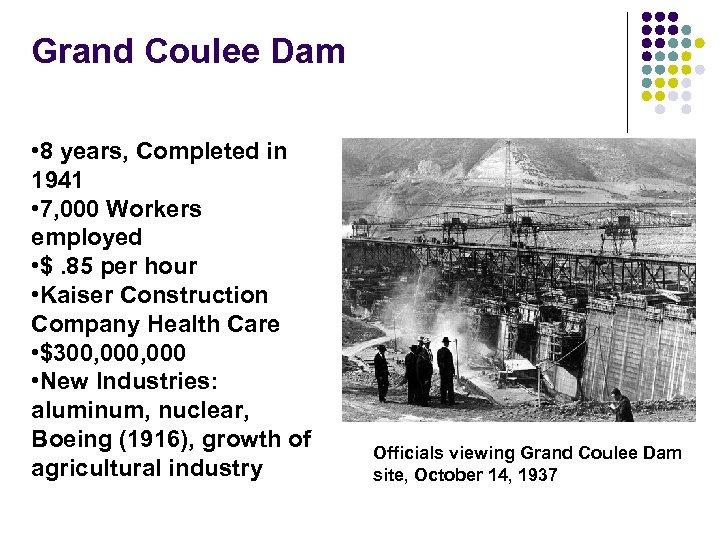 Grand Coulee Dam • 8 years, Completed in 1941 • 7, 000 Workers employed • $. 85 per hour • Kaiser Construction Company Health Care • $300, 000 • New Industries: aluminum, nuclear, Boeing (1916), growth of agricultural industry Officials viewing Grand Coulee Dam site, October 14, 1937
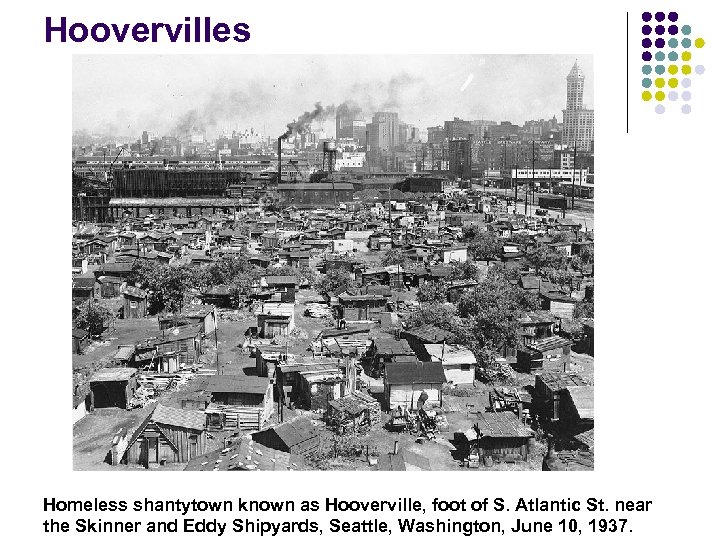 Hoovervilles Homeless shantytown known as Hooverville, foot of S. Atlantic St. near the Skinner and Eddy Shipyards, Seattle, Washington, June 10, 1937.
 World War II l l l l l Lifted the PNW out of the Great Depression Shipbuilding industry grows – Puget Sound Naval Shipyard (Bremerton) Boeing Airplane Company starts making war planes Aluminum Production becomes a new industry Hanford Atomic Energy Plant is established Washington fears attacks Japanese Americans are sent to internment camps Military bases are expanded or built – Fort Lewis, Mc. Cord Air Force Base, Whidbey Island, Moses Lake, Fairchild Air Force Base Food production and packing industry increases
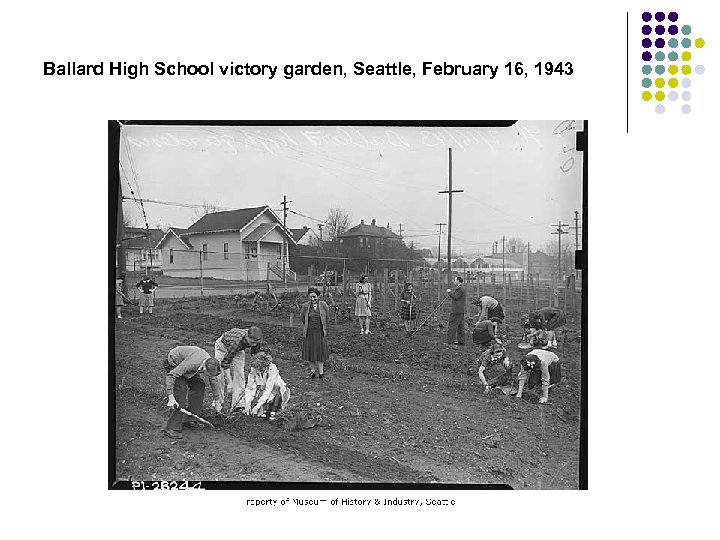 Ballard High School victory garden, Seattle, February 16, 1943
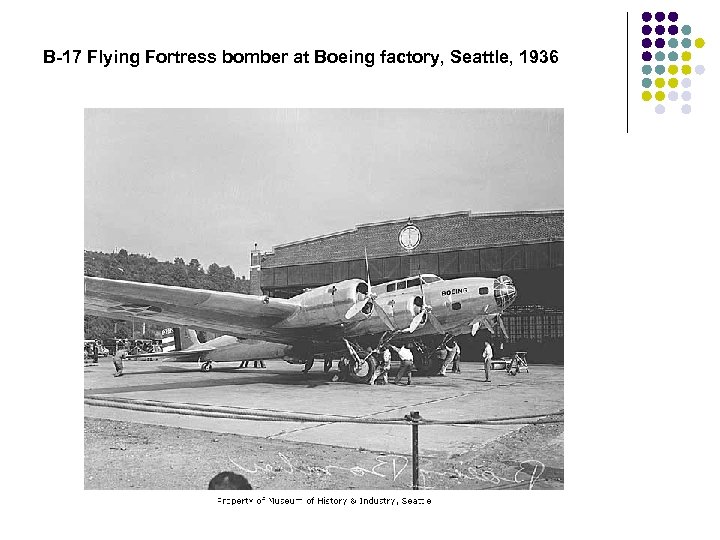 B-17 Flying Fortress bomber at Boeing factory, Seattle, 1936
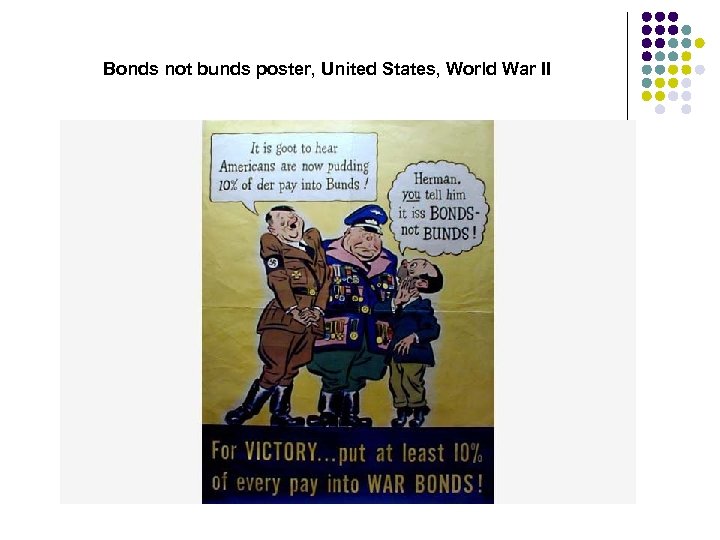 Bonds not bunds poster, United States, World War II
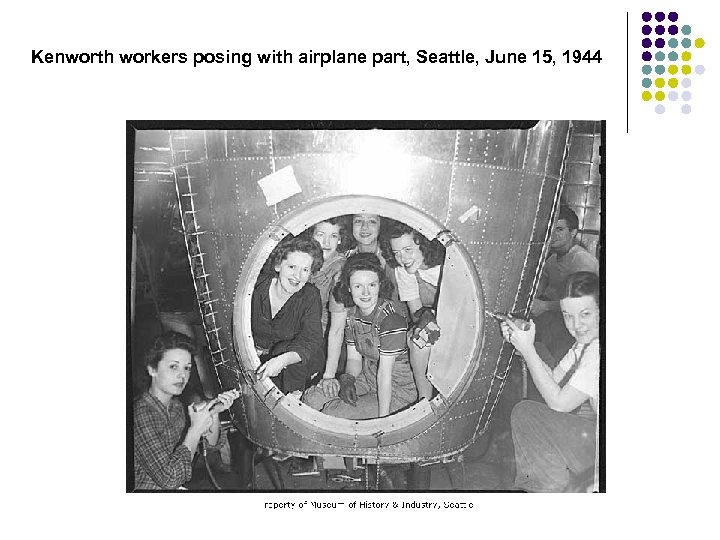 Kenworth workers posing with airplane part, Seattle, June 15, 1944
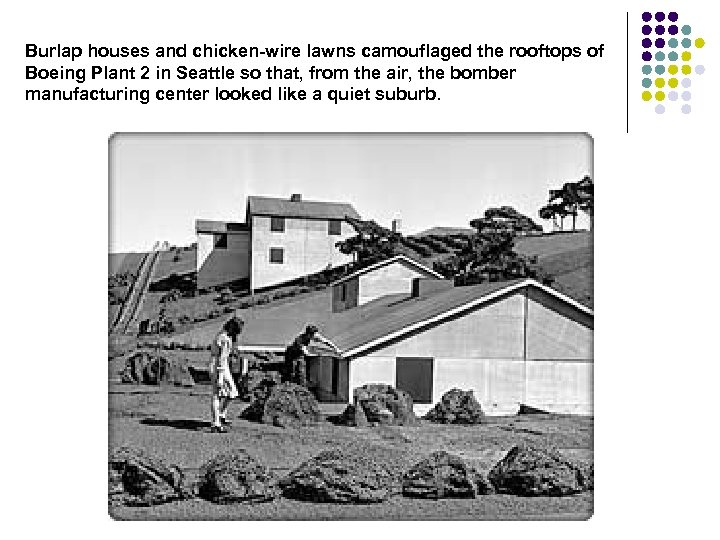 Burlap houses and chicken-wire lawns camouflaged the rooftops of Boeing Plant 2 in Seattle so that, from the air, the bomber manufacturing center looked like a quiet suburb.
 Japanese Internment www. densho. org
 Long Term effect of WWI, Great Depression, and WWII l Federal government influence grows. This starts 6 decades of U. S. government support for economic development in the region.