Скачать презентацию Microscope A microscope is an instrument used
physics.pptx
- Количество слайдов: 50
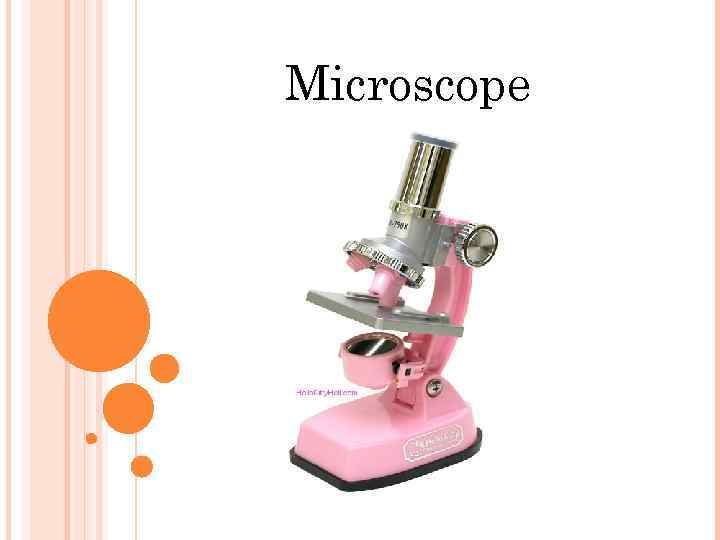 Microscope
 A microscope is an instrument used to see objects that are too small for the naked eye. There are many types of microscopes, the most common and first to be invented is the optical microscope which uses light to image the sample. Other major types of microscopes are the electron microscope and the various types of scanning probe microscope. History The first microscope to be developed was the optical microscope, although the original inventor is not easy to identify. An early microscope was made in 1590 in Middelburg, Netherlands. Two eyeglass makers are variously given credit: Hans Lippershey (who developed an early telescope) and Zacharias Janssen. Giovanni Faber coined the name microscope for Galileo Galilei's compound microscope in 1625
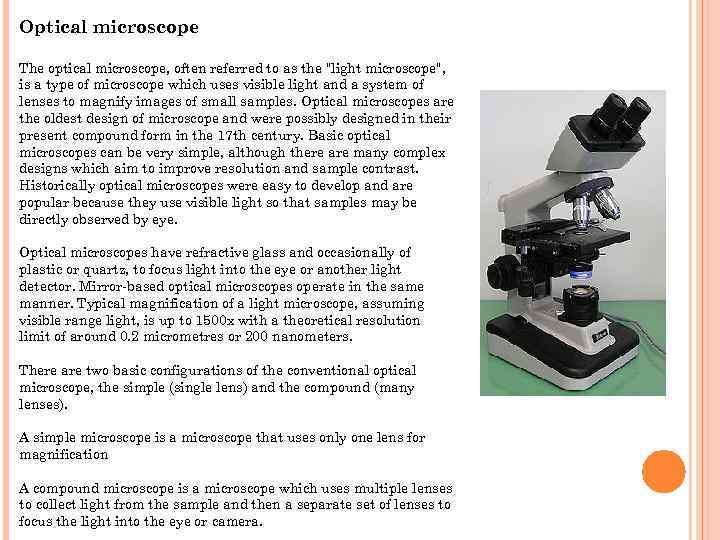 Optical microscope The optical microscope, often referred to as the "light microscope", is a type of microscope which uses visible light and a system of lenses to magnify images of small samples. Optical microscopes are the oldest design of microscope and were possibly designed in their present compound form in the 17 th century. Basic optical microscopes can be very simple, although there are many complex designs which aim to improve resolution and sample contrast. Historically optical microscopes were easy to develop and are popular because they use visible light so that samples may be directly observed by eye. Optical microscopes have refractive glass and occasionally of plastic or quartz, to focus light into the eye or another light detector. Mirror-based optical microscopes operate in the same manner. Typical magnification of a light microscope, assuming visible range light, is up to 1500 x with a theoretical resolution limit of around 0. 2 micrometres or 200 nanometers. There are two basic configurations of the conventional optical microscope, the simple (single lens) and the compound (many lenses). A simple microscope is a microscope that uses only one lens for magnification A compound microscope is a microscope which uses multiple lenses to collect light from the sample and then a separate set of lenses to focus the light into the eye or camera.
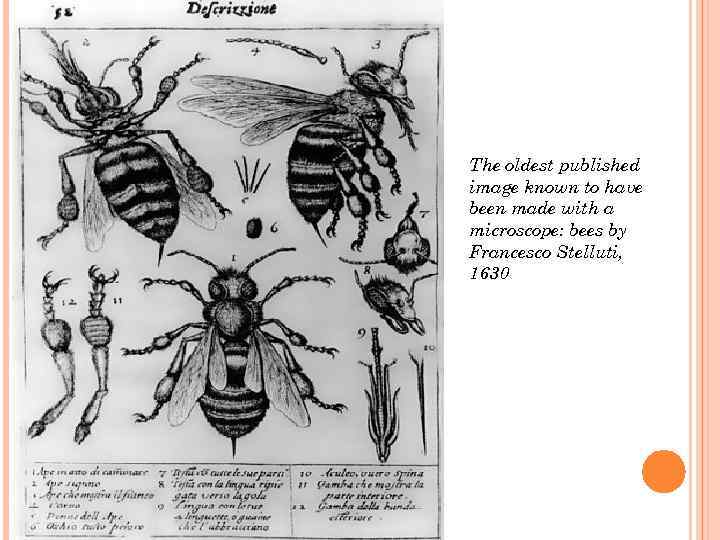 The oldest published image known to have been made with a microscope: bees by Francesco Stelluti, 1630
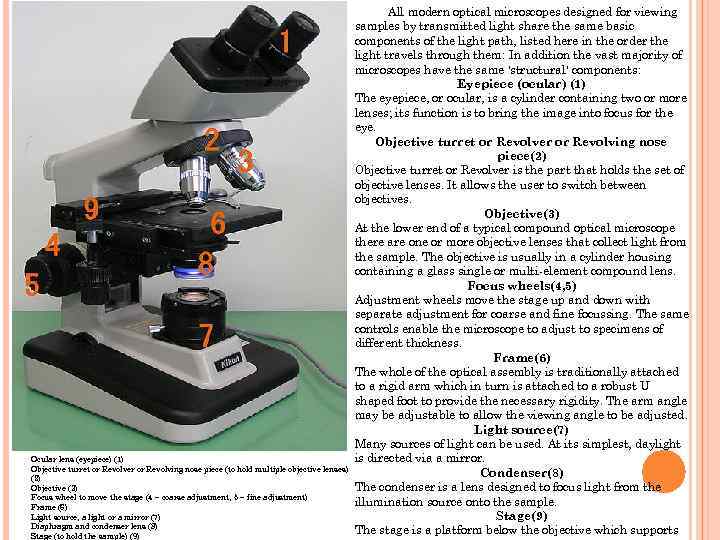 Ocular lens (eyepiece) (1) Objective turret or Revolver or Revolving nose piece (to hold multiple objective lenses) (2) Objective (3) Focus wheel to move the stage (4 – coarse adjustment, 5 – fine adjustment) Frame (6) Light source, a light or a mirror (7) Diaphragm and condenser lens (8) Stage (to hold the sample) (9) All modern optical microscopes designed for viewing samples by transmitted light share the same basic components of the light path, listed here in the order the light travels through them: In addition the vast majority of microscopes have the same 'structural' components: Eyepiece (ocular) (1) The eyepiece, or ocular, is a cylinder containing two or more lenses; its function is to bring the image into focus for the eye. Objective turret or Revolver or Revolving nose piece(2) Objective turret or Revolver is the part that holds the set of objective lenses. It allows the user to switch between objectives. Objective(3) At the lower end of a typical compound optical microscope there are one or more objective lenses that collect light from the sample. The objective is usually in a cylinder housing containing a glass single or multi-element compound lens. Focus wheels(4, 5) Adjustment wheels move the stage up and down with separate adjustment for coarse and fine focussing. The same controls enable the microscope to adjust to specimens of different thickness. Frame(6) The whole of the optical assembly is traditionally attached to a rigid arm which in turn is attached to a robust U shaped foot to provide the necessary rigidity. The arm angle may be adjustable to allow the viewing angle to be adjusted. Light source(7) Many sources of light can be used. At its simplest, daylight is directed via a mirror. Condenser(8) The condenser is a lens designed to focus light from the illumination source onto the sample. Stage(9) The stage is a platform below the objective which supports
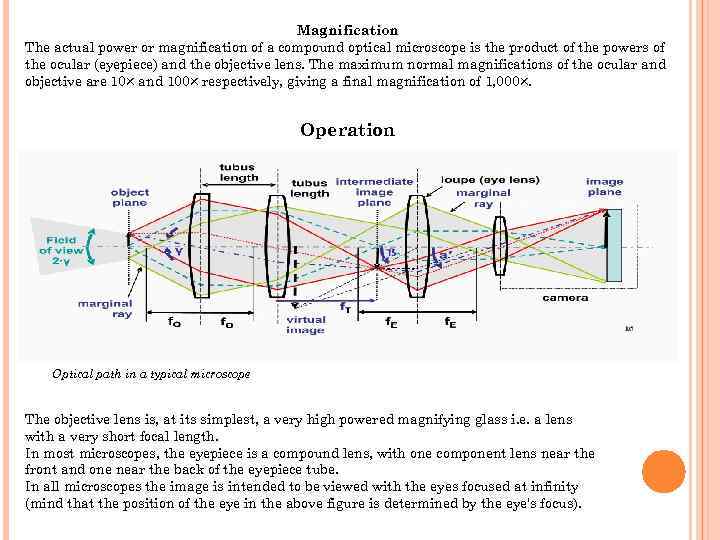 Magnification The actual power or magnification of a compound optical microscope is the product of the powers of the ocular (eyepiece) and the objective lens. The maximum normal magnifications of the ocular and objective are 10× and 100× respectively, giving a final magnification of 1, 000×. Operation Optical path in a typical microscope The objective lens is, at its simplest, a very high powered magnifying glass i. e. a lens with a very short focal length. In most microscopes, the eyepiece is a compound lens, with one component lens near the front and one near the back of the eyepiece tube. In all microscopes the image is intended to be viewed with the eyes focused at infinity (mind that the position of the eye in the above figure is determined by the eye's focus).
 Optical aberration
 Optical aberration An optical aberration is a departure of the performance of an optical system from the predictions of paraxial optics. In an imaging system, it occurs when light from one point of an object does not converge into (or does not diverge from) a single point after transmission through the system. Aberrations occur because the simple paraxial theory is not a completely accurate model of the effect of an optical system on light, rather than due to flaws in the optical elements. Aberration leads to blurring of the image produced by an image-forming optical system. Makers of optical instruments need to correct optical systems to compensate for aberration. The articles on reflection, refraction and caustics discuss the general features of reflected and refracted rays. Aberrations fall into two classes: monochromatic and chromatic. Monochromatic aberrations are caused by the geometry of the lens and occur both when light is reflected and when it is refracted. They appear even when using monochromatic light, hence the name. Chromatic aberrations are caused by dispersion, the variation of a lens's refractive index with wavelength. They do not appear when monochromatic light is used.
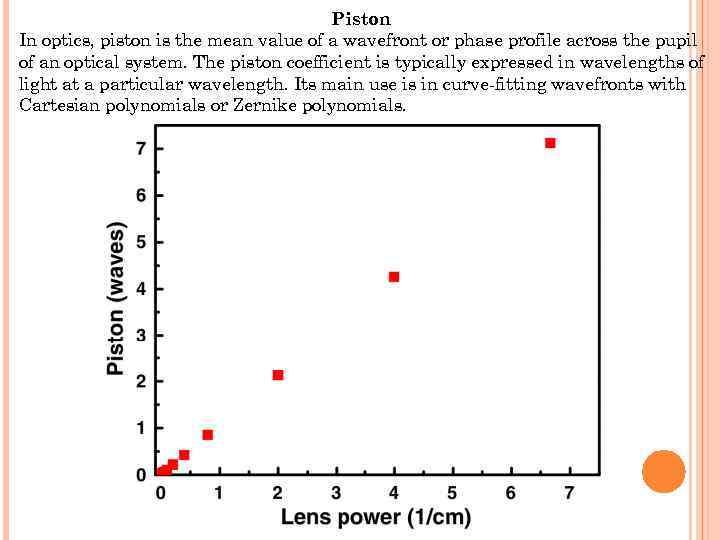 Piston In optics, piston is the mean value of a wavefront or phase profile across the pupil of an optical system. The piston coefficient is typically expressed in wavelengths of light at a particular wavelength. Its main use is in curve-fitting wavefronts with Cartesian polynomials or Zernike polynomials.
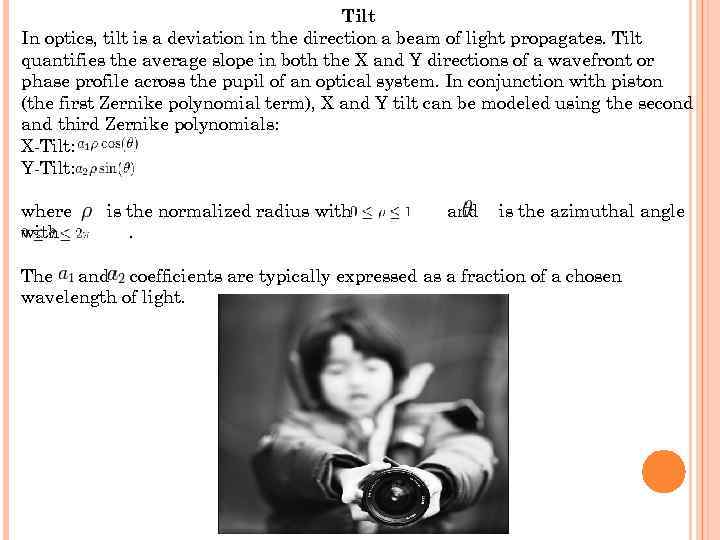 Tilt In optics, tilt is a deviation in the direction a beam of light propagates. Tilt quantifies the average slope in both the X and Y directions of a wavefront or phase profile across the pupil of an optical system. In conjunction with piston (the first Zernike polynomial term), X and Y tilt can be modeled using the second and third Zernike polynomials: X-Tilt: Y-Tilt: where with is the normalized radius with. and is the azimuthal angle The and coefficients are typically expressed as a fraction of a chosen wavelength of light.
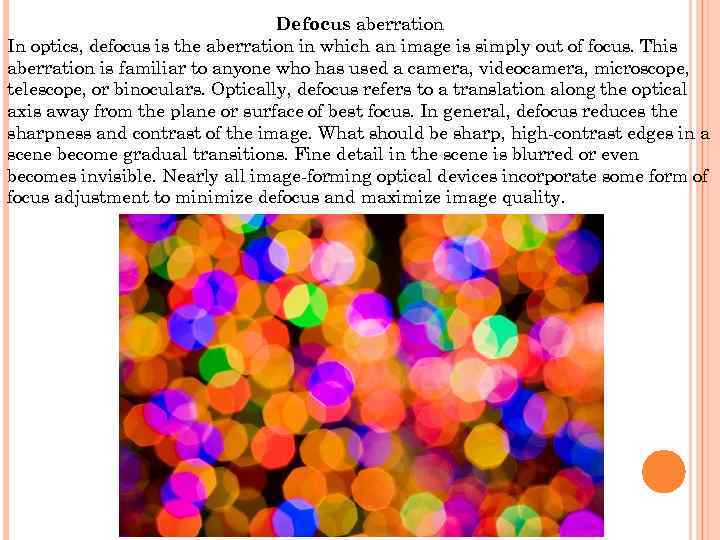 Defocus aberration In optics, defocus is the aberration in which an image is simply out of focus. This aberration is familiar to anyone who has used a camera, videocamera, microscope, telescope, or binoculars. Optically, defocus refers to a translation along the optical axis away from the plane or surface of best focus. In general, defocus reduces the sharpness and contrast of the image. What should be sharp, high-contrast edges in a scene become gradual transitions. Fine detail in the scene is blurred or even becomes invisible. Nearly all image-forming optical devices incorporate some form of focus adjustment to minimize defocus and maximize image quality.
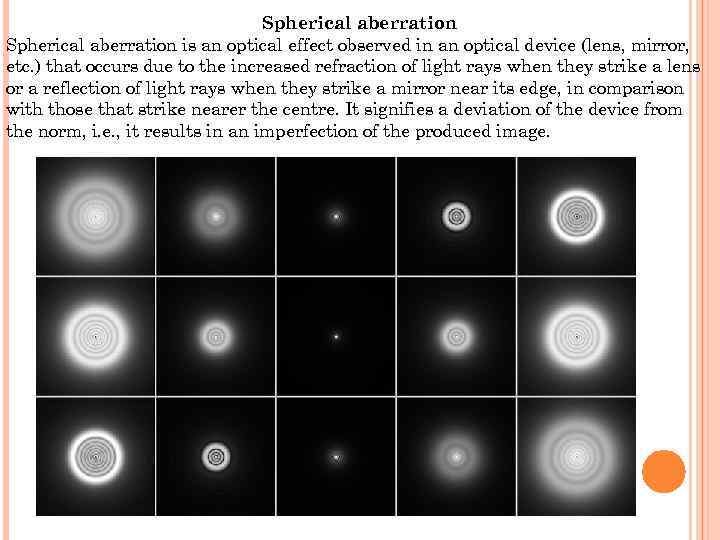 Spherical aberration is an optical effect observed in an optical device (lens, mirror, etc. ) that occurs due to the increased refraction of light rays when they strike a lens or a reflection of light rays when they strike a mirror near its edge, in comparison with those that strike nearer the centre. It signifies a deviation of the device from the norm, i. e. , it results in an imperfection of the produced image.
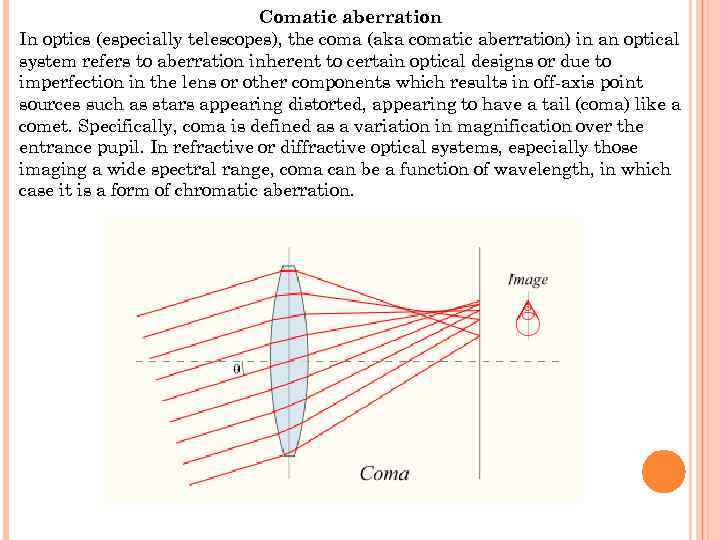 Comatic aberration In optics (especially telescopes), the coma (aka comatic aberration) in an optical system refers to aberration inherent to certain optical designs or due to imperfection in the lens or other components which results in off-axis point sources such as stars appearing distorted, appearing to have a tail (coma) like a comet. Specifically, coma is defined as a variation in magnification over the entrance pupil. In refractive or diffractive optical systems, especially those imaging a wide spectral range, coma can be a function of wavelength, in which case it is a form of chromatic aberration.
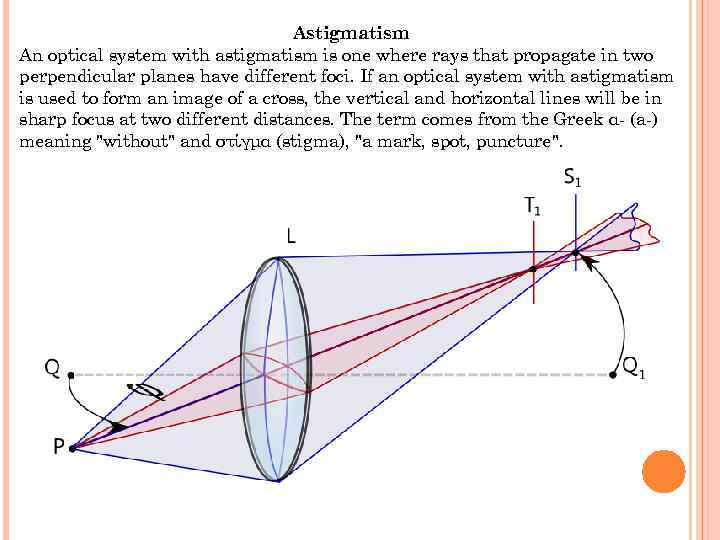 Astigmatism An optical system with astigmatism is one where rays that propagate in two perpendicular planes have different foci. If an optical system with astigmatism is used to form an image of a cross, the vertical and horizontal lines will be in sharp focus at two different distances. The term comes from the Greek α- (a-) meaning "without" and στίγμα (stigma), "a mark, spot, puncture".
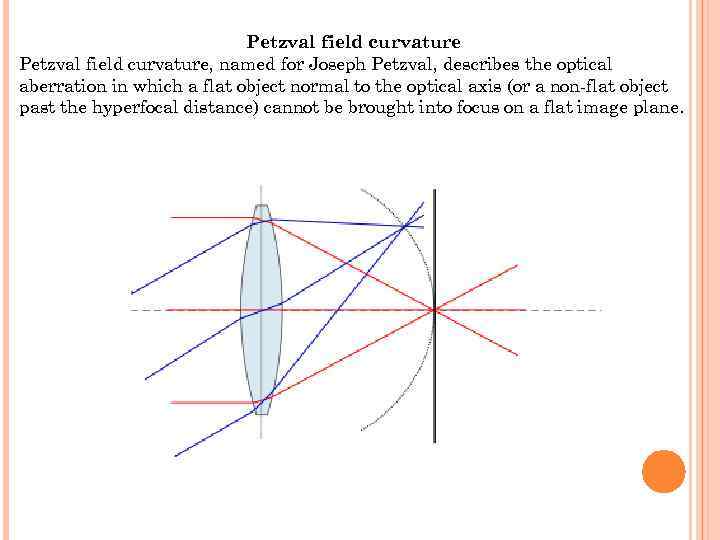 Petzval field curvature, named for Joseph Petzval, describes the optical aberration in which a flat object normal to the optical axis (or a non-flat object past the hyperfocal distance) cannot be brought into focus on a flat image plane.
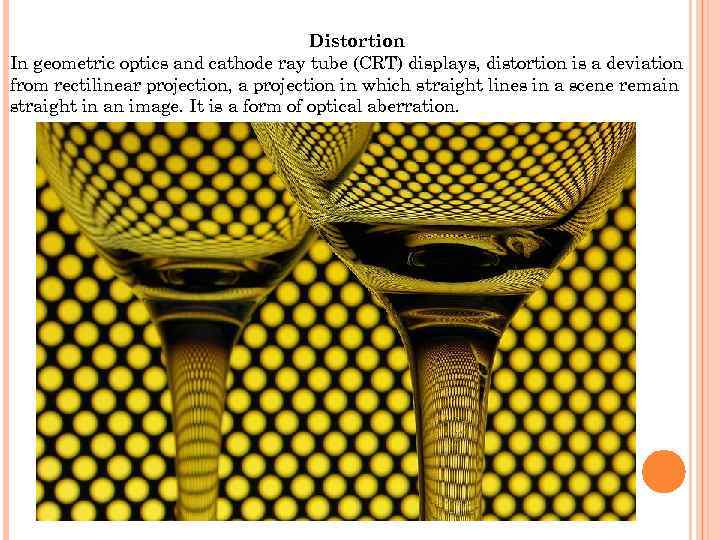 Distortion In geometric optics and cathode ray tube (CRT) displays, distortion is a deviation from rectilinear projection, a projection in which straight lines in a scene remain straight in an image. It is a form of optical aberration.
 OPTICAL FIBER
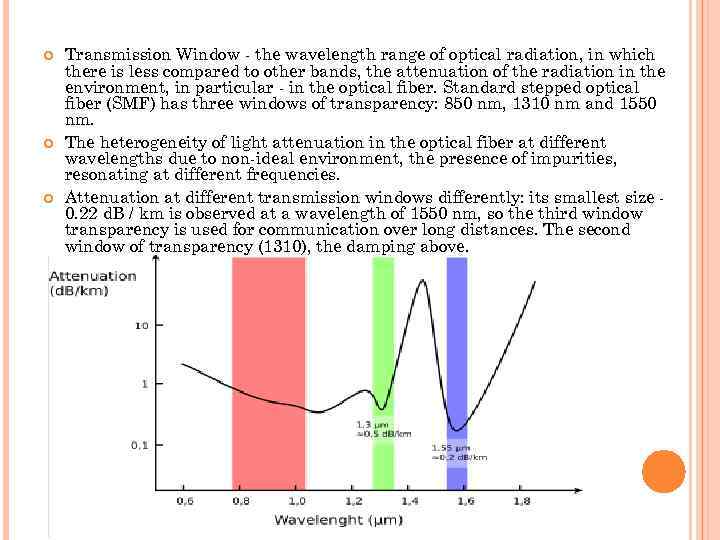 Transmission Window - the wavelength range of optical radiation, in which there is less compared to other bands, the attenuation of the radiation in the environment, in particular - in the optical fiber. Standard stepped optical fiber (SMF) has three windows of transparency: 850 nm, 1310 nm and 1550 nm. The heterogeneity of light attenuation in the optical fiber at different wavelengths due to non-ideal environment, the presence of impurities, resonating at different frequencies. Attenuation at different transmission windows differently: its smallest size 0. 22 d. B / km is observed at a wavelength of 1550 nm, so the third window transparency is used for communication over long distances. The second window of transparency (1310), the damping above.
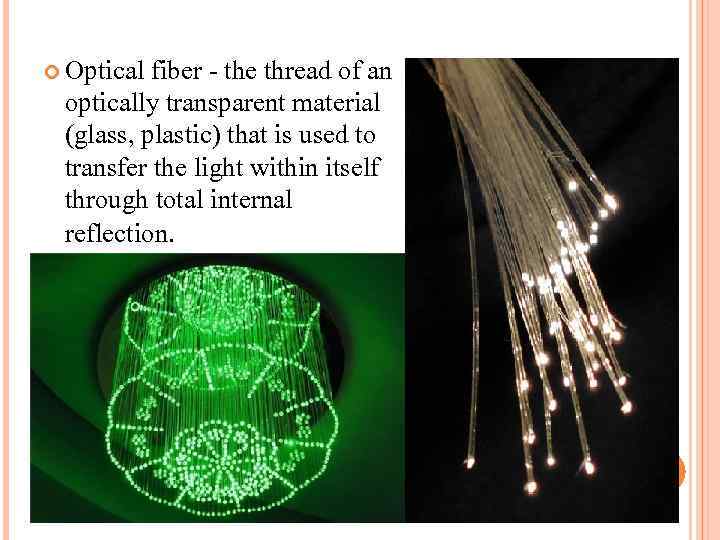 Optical fiber - the thread of an optically transparent material (glass, plastic) that is used to transfer the light within itself through total internal reflection.
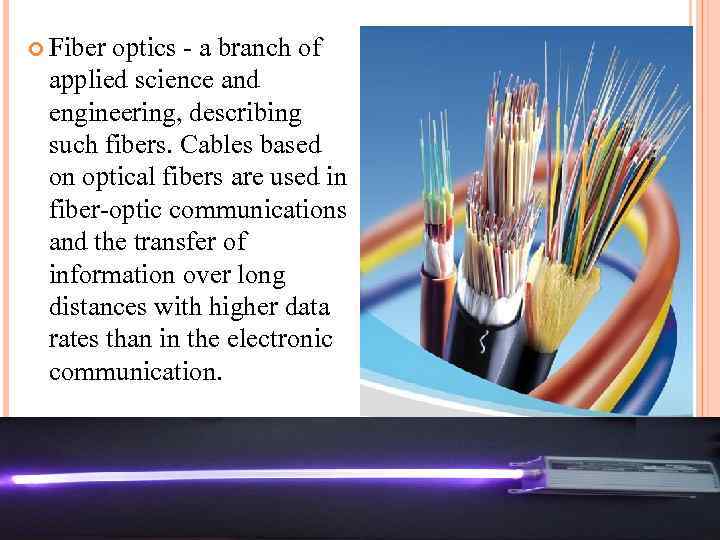 Fiber optics - a branch of applied science and engineering, describing such fibers. Cables based on optical fibers are used in fiber-optic communications and the transfer of information over long distances with higher data rates than in the electronic communication.
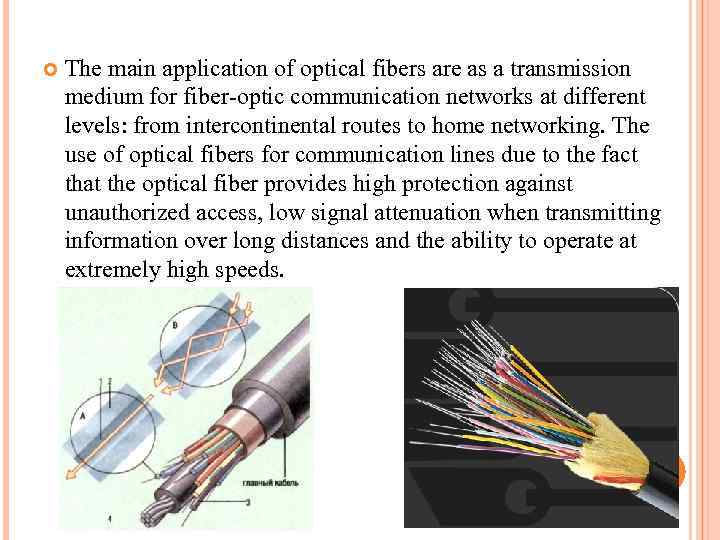 The main application of optical fibers are as a transmission medium for fiber-optic communication networks at different levels: from intercontinental routes to home networking. The use of optical fibers for communication lines due to the fact that the optical fiber provides high protection against unauthorized access, low signal attenuation when transmitting information over long distances and the ability to operate at extremely high speeds.
 Already by 2006, the year reached 111 GHz modulation speed, while the rates of 10 and 40 Gbit / s are now standard data rates on a single channel optical fiber. In addition, each fiber using wavelengthdivision multiplexing technology can transmit up to several hundreds of channels simultaneously, providing a total data rate, calculated terabits per second.
 EYE
EYE
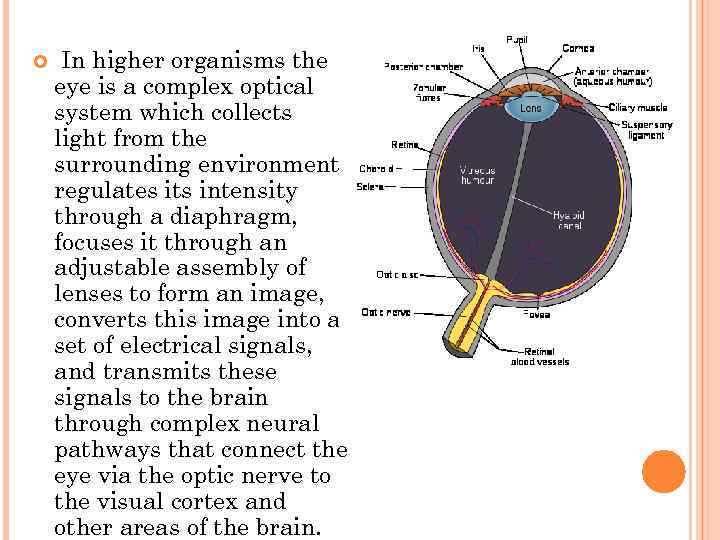 In higher organisms the eye is a complex optical system which collects light from the surrounding environment, regulates its intensity through a diaphragm, focuses it through an adjustable assembly of lenses to form an image, converts this image into a set of electrical signals, and transmits these signals to the brain through complex neural pathways that connect the eye via the optic nerve to the visual cortex and other areas of the brain.
 LENS The crystalline lens is a transparent, biconvex structure in the eye that, along with the cornea, helps to refract light to be focused on the retina. The lens, by changing shape, functions to change the focal distance of the eye so that it can focus on objects at various distances, thus allowing a sharp real image of the object of interest to be formed on the retina. This adjustment of the lens is known as accommodation. It is similar to the focusing of a photographic camera via movement of its lenses.
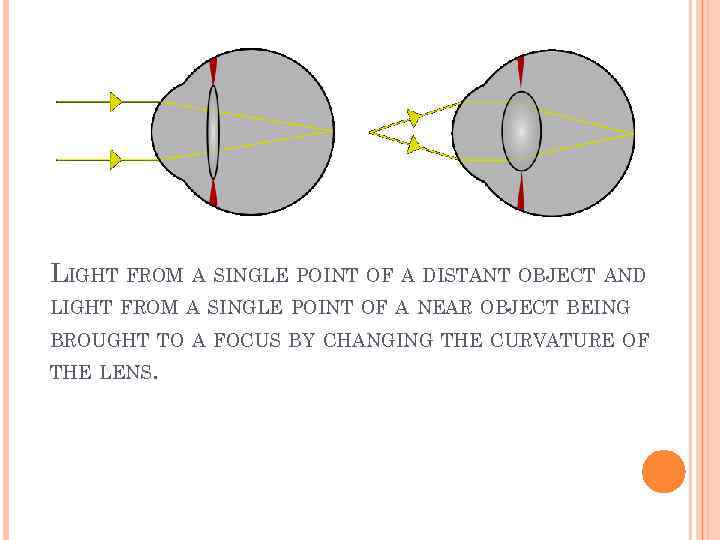 LIGHT FROM A SINGLE POINT OF A DISTANT OBJECT AND LIGHT FROM A SINGLE POINT OF A NEAR OBJECT BEING BROUGHT TO A FOCUS BY CHANGING THE CURVATURE OF THE LENS.
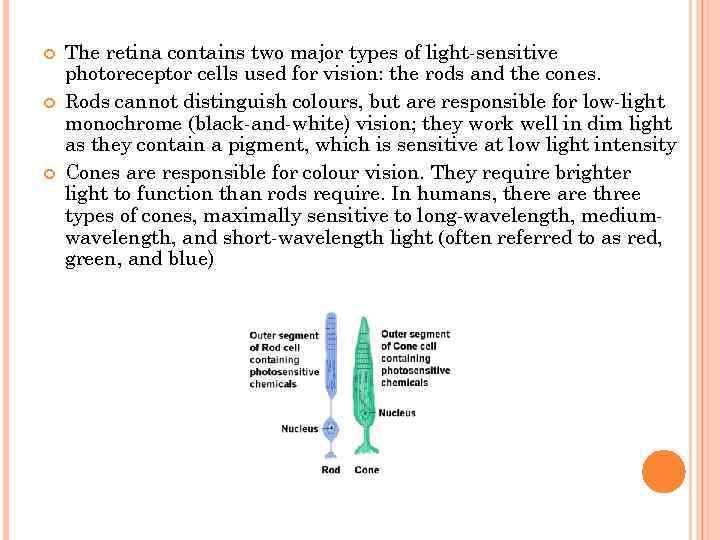 The retina contains two major types of light-sensitive photoreceptor cells used for vision: the rods and the cones. Rods cannot distinguish colours, but are responsible for low-light monochrome (black-and-white) vision; they work well in dim light as they contain a pigment, which is sensitive at low light intensity Cones are responsible for colour vision. They require brighter light to function than rods require. In humans, there are three types of cones, maximally sensitive to long-wavelength, mediumwavelength, and short-wavelength light (often referred to as red, green, and blue)
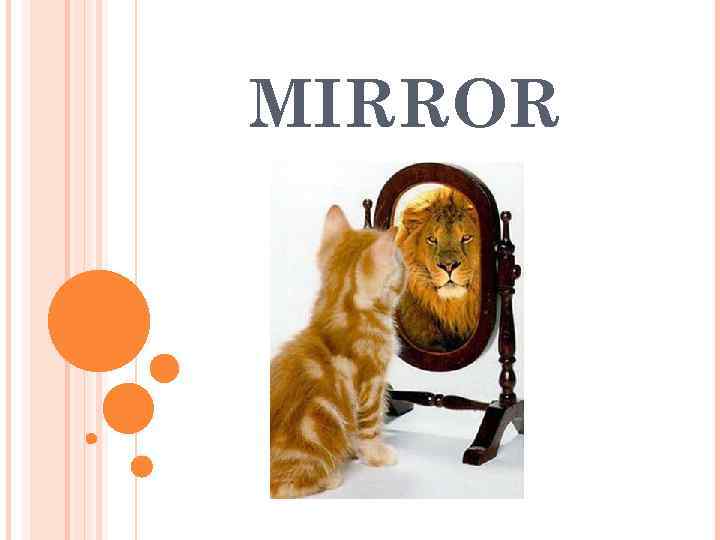 MIRROR
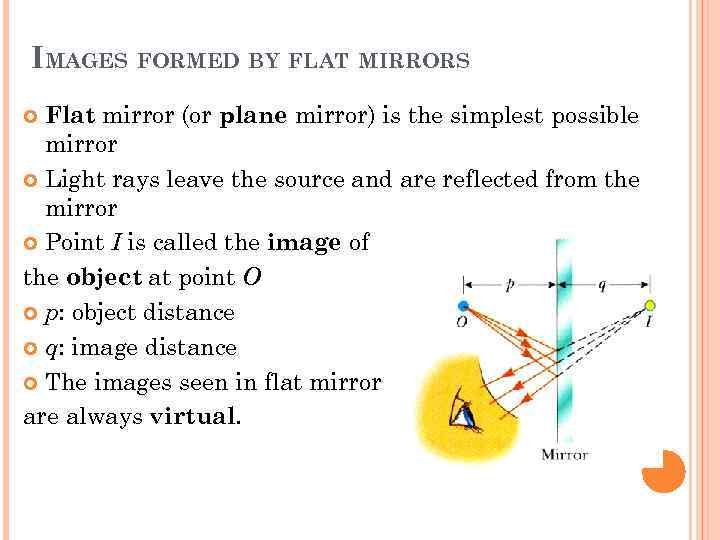 IMAGES FORMED BY FLAT MIRRORS Flat mirror (or plane mirror) is the simplest possible mirror Light rays leave the source and are reflected from the mirror Point I is called the image of the object at point O p: object distance q: image distance The images seen in flat mirror are always virtual.
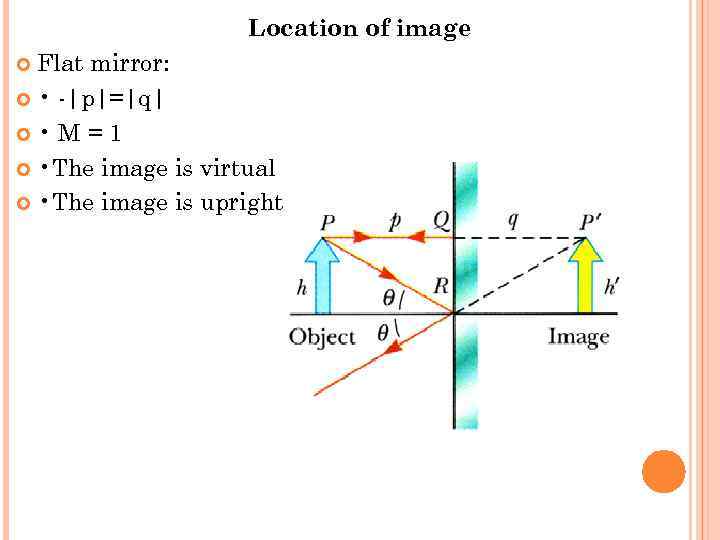 Location of image Flat mirror: • -|p|=|q| • M=1 • The image is virtual • The image is upright
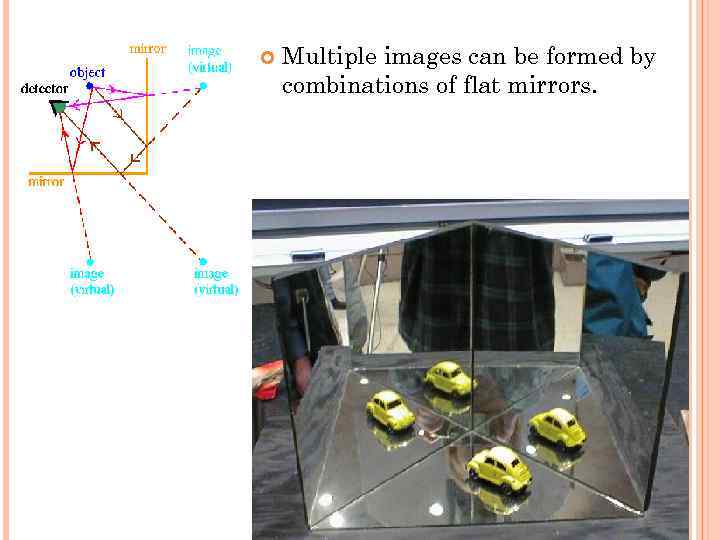 Multiple images can be formed by combinations of flat mirrors.
 CONCAVE MIRRORS
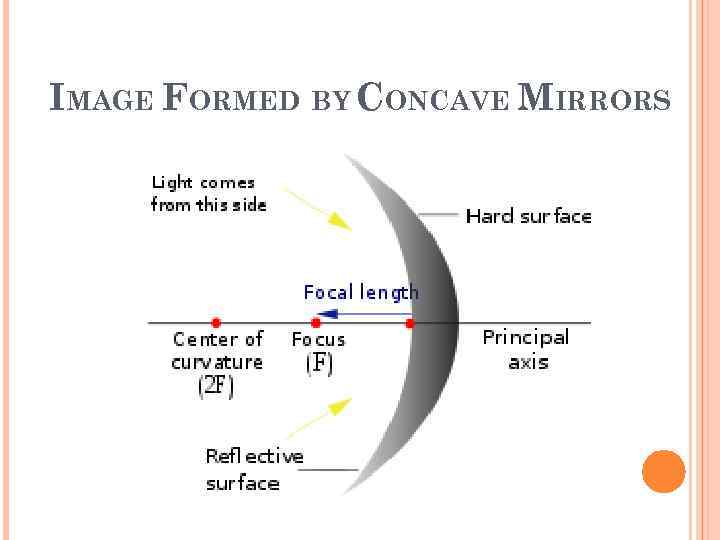 IMAGE FORMED BY CONCAVE MIRRORS
 THERE ARE TWO ALTERNATIVE METHODS OF LOCATING THE IMAGE FORMED BY A CONCAVE MIRROR: Graphical Using simple algebraic analysis
 THE GRAPHICAL METHOD: An incident ray which is parallel to the principal axis is reflected through the focus F of the mirror; An incident ray which passes through the focus F of the mirror is reflected parallel to the principal axis; An incident ray which passes through the centre of curvature C of the mirror is reflected back along its own path (since it is normally incident on the mirror); An incident ray which strikes the mirror at its vertex V is reflected such that its angle of incidence with respect to the principal axis is equal to its angle of reflection.
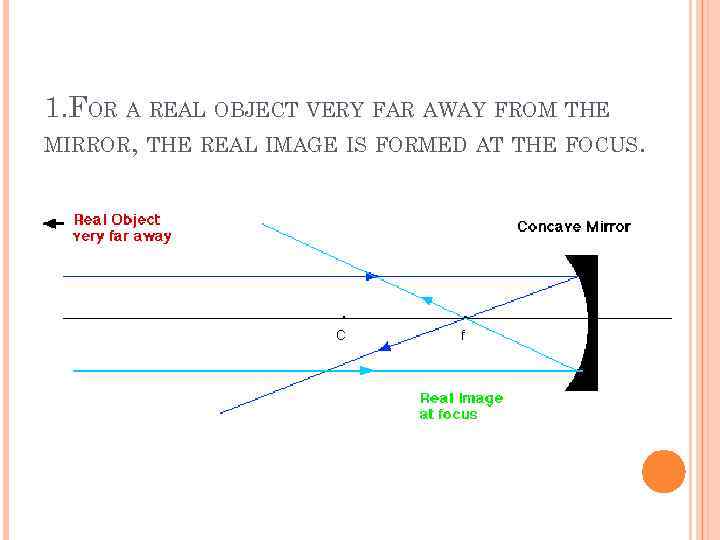 1. FOR A REAL OBJECT VERY FAR AWAY FROM THE MIRROR, THE REAL IMAGE IS FORMED AT THE FOCUS.
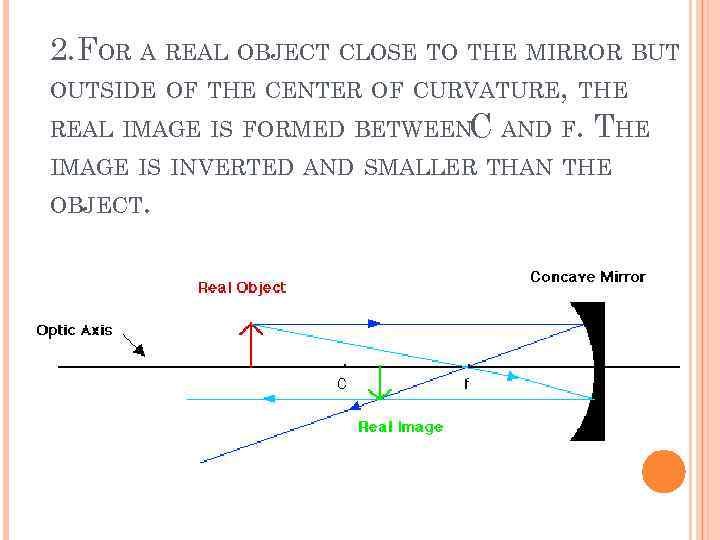 2. FOR A REAL OBJECT CLOSE TO THE MIRROR BUT OUTSIDE OF THE CENTER OF CURVATURE, THE REAL IMAGE IS FORMED BETWEEN AND F. THE C IMAGE IS INVERTED AND SMALLER THAN THE OBJECT.
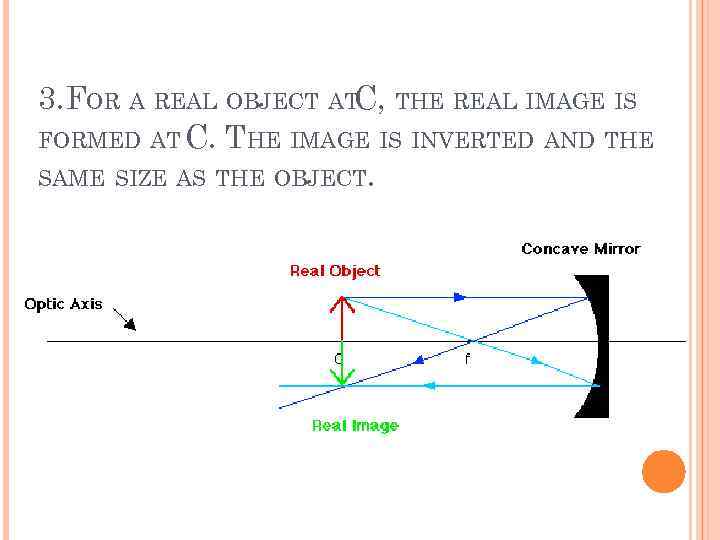 3. FOR A REAL OBJECT ATC, THE REAL IMAGE IS FORMED AT C. THE IMAGE IS INVERTED AND THE SAME SIZE AS THE OBJECT.
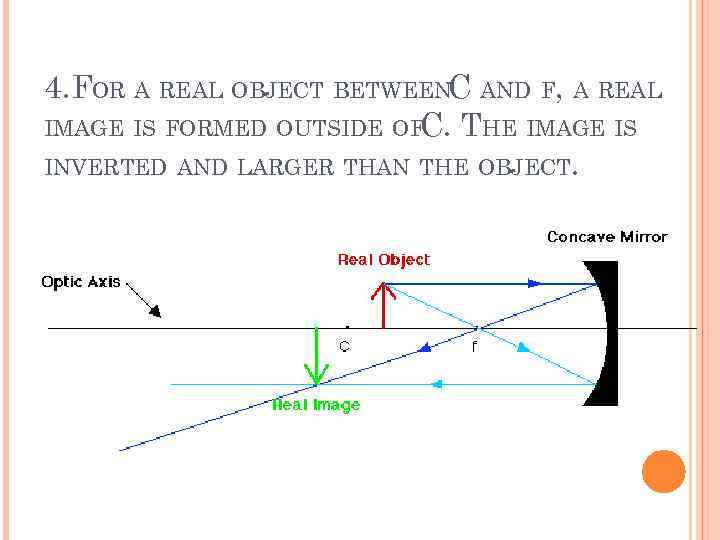 4. FOR A REAL OBJECT BETWEENC AND F, A REAL IMAGE IS FORMED OUTSIDE OF C. THE IMAGE IS INVERTED AND LARGER THAN THE OBJECT.
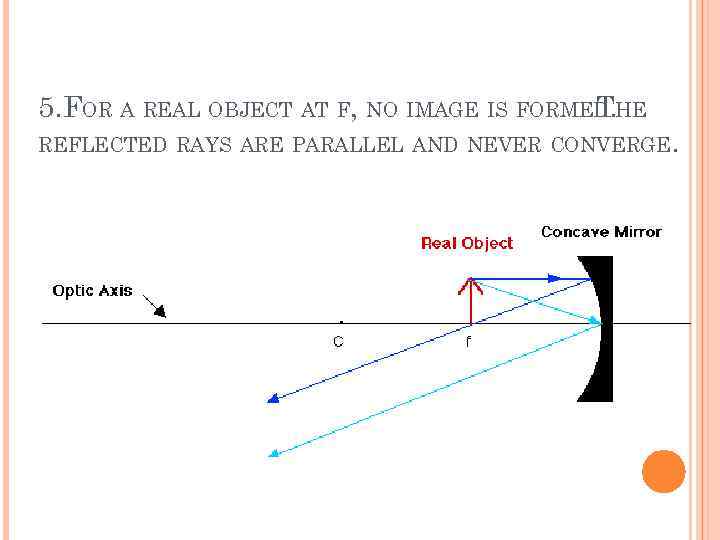 5. FOR A REAL OBJECT AT F, NO IMAGE IS FORMED. HE T REFLECTED RAYS ARE PARALLEL AND NEVER CONVERGE.
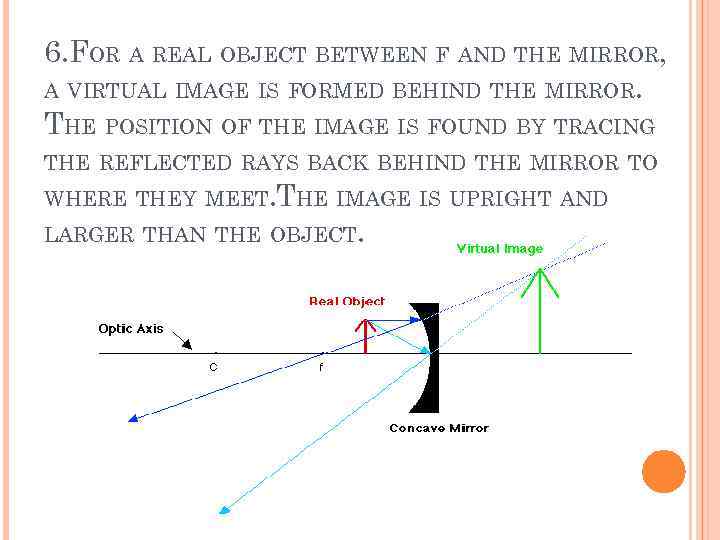 6. FOR A REAL OBJECT BETWEEN F AND THE MIRROR, A VIRTUAL IMAGE IS FORMED BEHIND THE MIRROR. THE POSITION OF THE IMAGE IS FOUND BY TRACING THE REFLECTED RAYS BACK BEHIND THE MIRROR TO WHERE THEY MEET. THE IMAGE IS UPRIGHT AND LARGER THAN THE OBJECT.
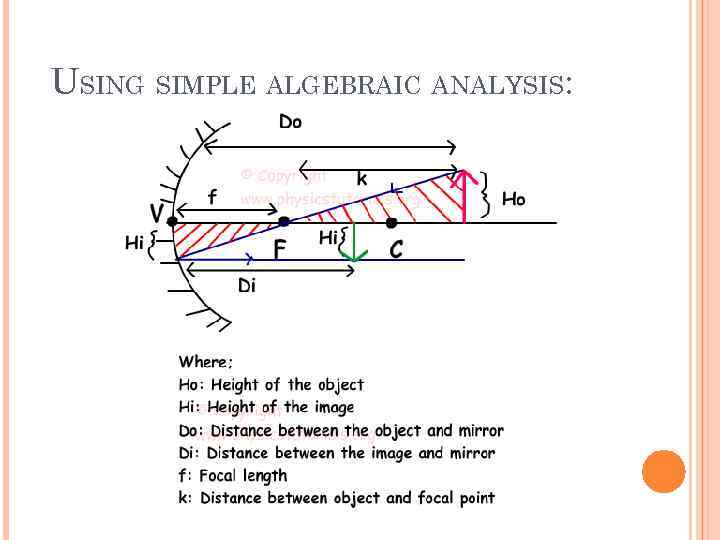 USING SIMPLE ALGEBRAIC ANALYSIS:
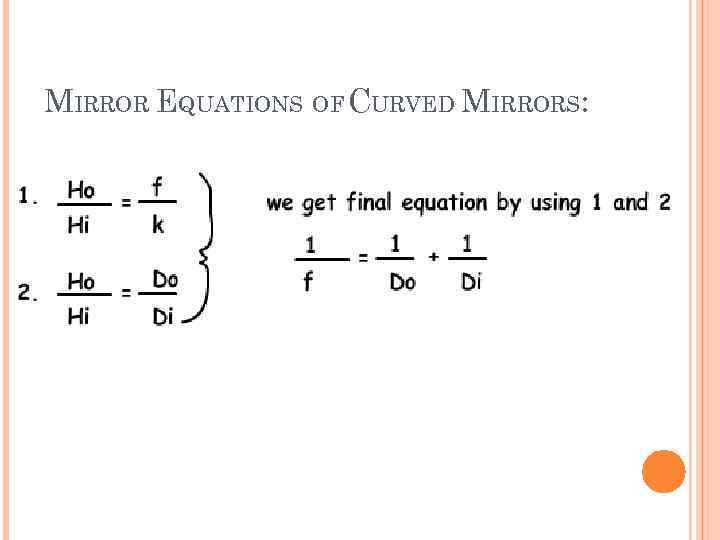 MIRROR EQUATIONS OF CURVED MIRRORS:
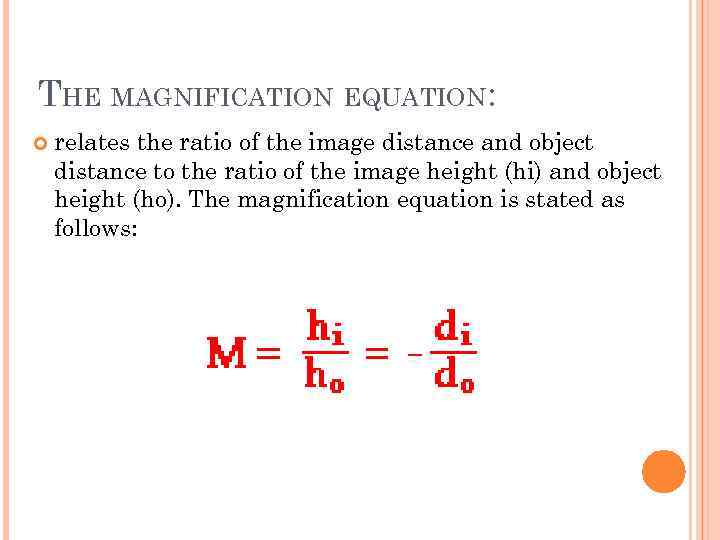 THE MAGNIFICATION EQUATION: relates the ratio of the image distance and object distance to the ratio of the image height (hi) and object height (ho). The magnification equation is stated as follows:
 CAMERA
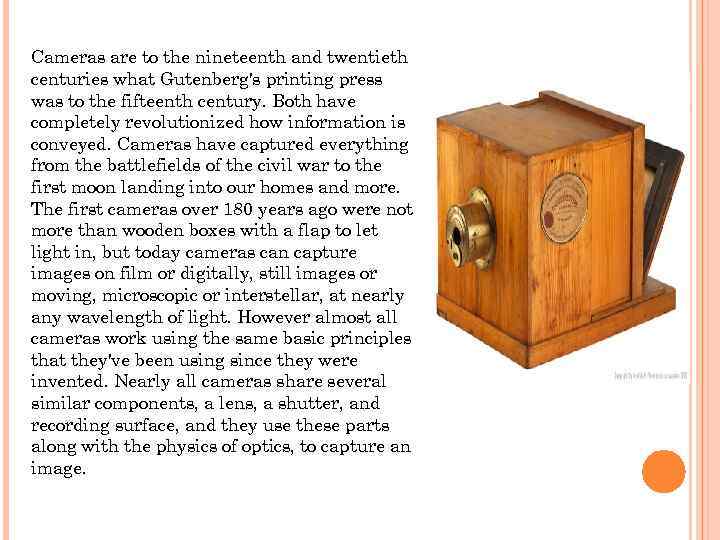 Cameras are to the nineteenth and twentieth centuries what Gutenberg's printing press was to the fifteenth century. Both have completely revolutionized how information is conveyed. Cameras have captured everything from the battlefields of the civil war to the first moon landing into our homes and more. The first cameras over 180 years ago were not more than wooden boxes with a flap to let light in, but today cameras can capture images on film or digitally, still images or moving, microscopic or interstellar, at nearly any wavelength of light. However almost all cameras work using the same basic principles that they've been using since they were invented. Nearly all cameras share several similar components, a lens, a shutter, and recording surface, and they use these parts along with the physics of optics, to capture an image.
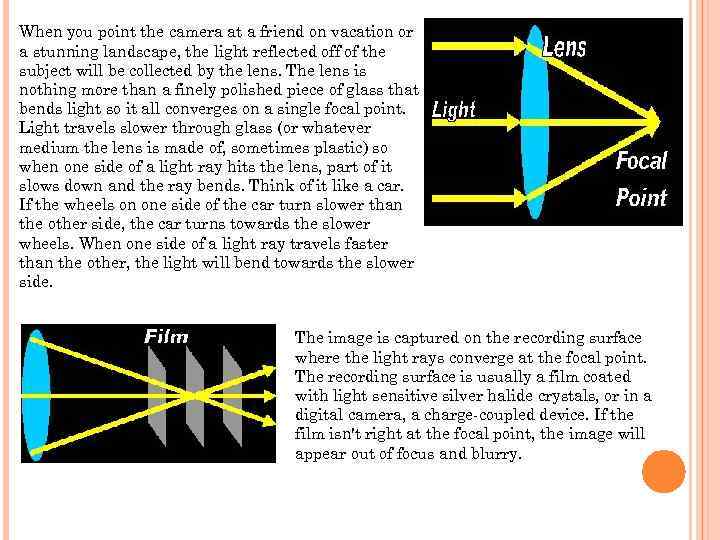 When you point the camera at a friend on vacation or a stunning landscape, the light reflected off of the subject will be collected by the lens. The lens is nothing more than a finely polished piece of glass that bends light so it all converges on a single focal point. Light travels slower through glass (or whatever medium the lens is made of, sometimes plastic) so when one side of a light ray hits the lens, part of it slows down and the ray bends. Think of it like a car. If the wheels on one side of the car turn slower than the other side, the car turns towards the slower wheels. When one side of a light ray travels faster than the other, the light will bend towards the slower side. The image is captured on the recording surface where the light rays converge at the focal point. The recording surface is usually a film coated with light sensitive silver halide crystals, or in a digital camera, a charge-coupled device. If the film isn't right at the focal point, the image will appear out of focus and blurry.
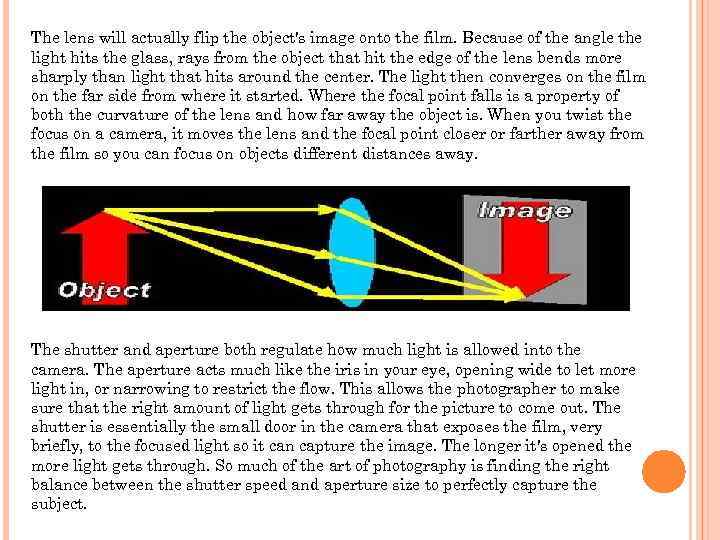 The lens will actually flip the object's image onto the film. Because of the angle the light hits the glass, rays from the object that hit the edge of the lens bends more sharply than light that hits around the center. The light then converges on the film on the far side from where it started. Where the focal point falls is a property of both the curvature of the lens and how far away the object is. When you twist the focus on a camera, it moves the lens and the focal point closer or farther away from the film so you can focus on objects different distances away. The shutter and aperture both regulate how much light is allowed into the camera. The aperture acts much like the iris in your eye, opening wide to let more light in, or narrowing to restrict the flow. This allows the photographer to make sure that the right amount of light gets through for the picture to come out. The shutter is essentially the small door in the camera that exposes the film, very briefly, to the focused light so it can capture the image. The longer it's opened the more light gets through. So much of the art of photography is finding the right balance between the shutter speed and aperture size to perfectly capture the subject.