


 Скачать презентацию Microlicensing towards more effective mechanisms to support copyright
fb25768ed7748eefdc89cb64e9d3ad98.ppt
- Количество слайдов: 37
 “Microlicensing”: towards more effective mechanisms to support copyright compliance on the network A workshop session for UKSG 2009 – Torquay Mark Bide, Executive Director, EDIt. EUR
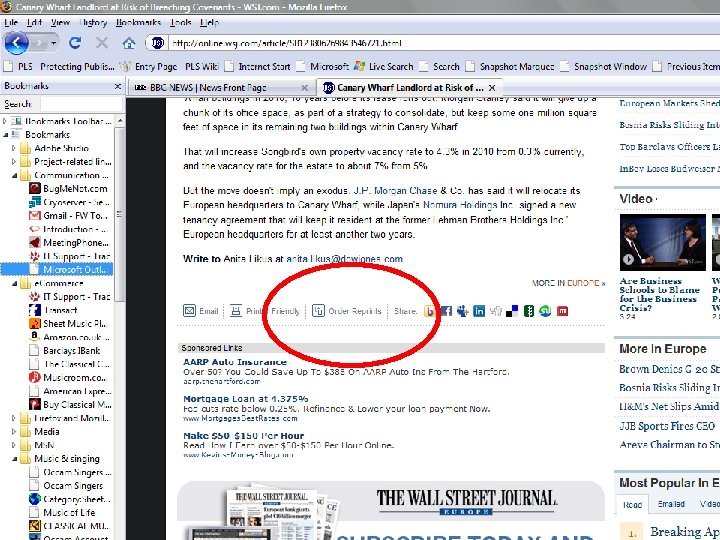
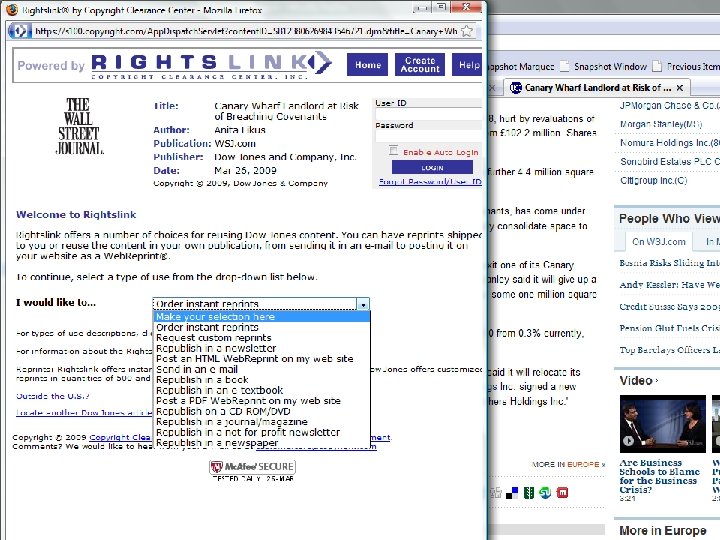
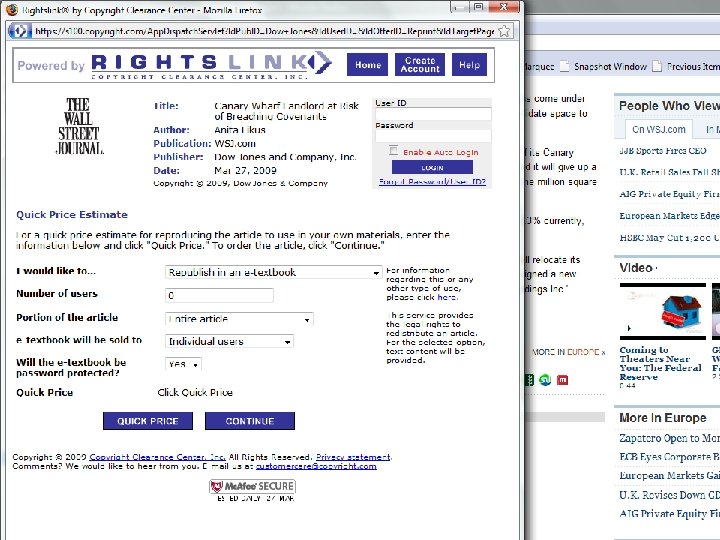
 Agenda Standards for permissions communication 1. Services 2. Rights. Link i. Copyright OZMO Registries 3. 4. Creative Commons PLUS ACAP ONIX-PL The Book Rights Registry ARROW Drawing it all together – what have we got, what do we need to manage copyright effectively on the network?
 Standards developments 3
 The nice thing about standards is that there are so many of them to choose from…* * Andrew S. Tanenbaum 4
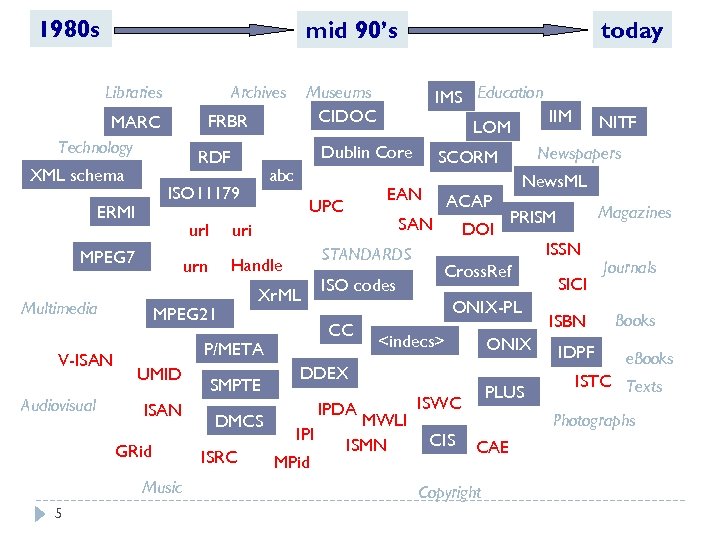 1980 s mid 90’s Libraries Archives XML schema url MPEG 7 V-ISAN Audiovisual ISAN Music SAN STANDARDS Xr. ML SMPTE DMCS ISRC ACAP ISO codes DOI ONIX DDEX IPDA IPI MPid MWLI ISMN PLUS ISWC CIS CAE Copyright Magazines PRISM Cross. Ref
 The nice thing about standards is that there are so many of them to choose from… A major task for the standards community in 2009 and beyond…. 6
 http: //creativecommons. org/ Creative Commons A not for profit, founded in the US in 2001 Lawrence Lessig (a lawyer) “Some Rights Reserved” – a more appropriate model for the network? A movement as much as a standardisation organisation Committed to a vision of how content should be made available for reuse An adjunct to, and to some extent a challenge to, conventional commercial thinking about copyright Supported by volunteers and well as paid staff Can be applied to any type of resource 7 Text, music, photographs
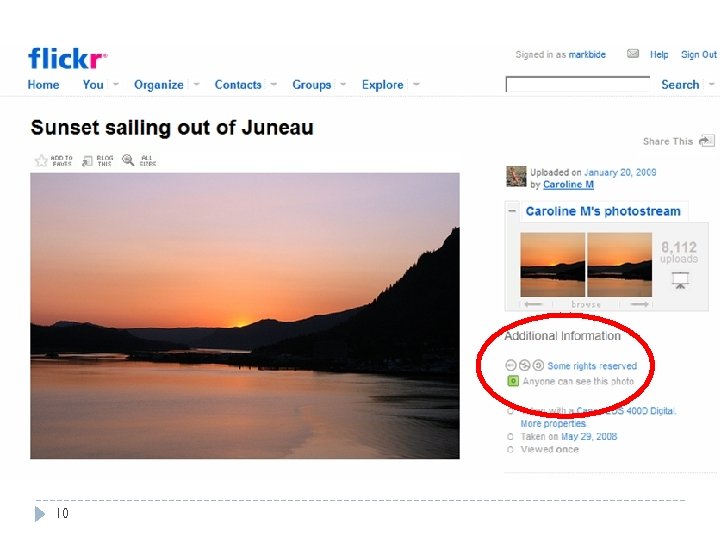
 The Creative Commons licences Standard licences in 3 formats Commons Deed (human-readable code) Legal Code (“lawyer-readable code”) Metadata (machine-readable code). Different variants for different jurisdictions 8 Local Creative Commons organisations in many different countries including the UK.
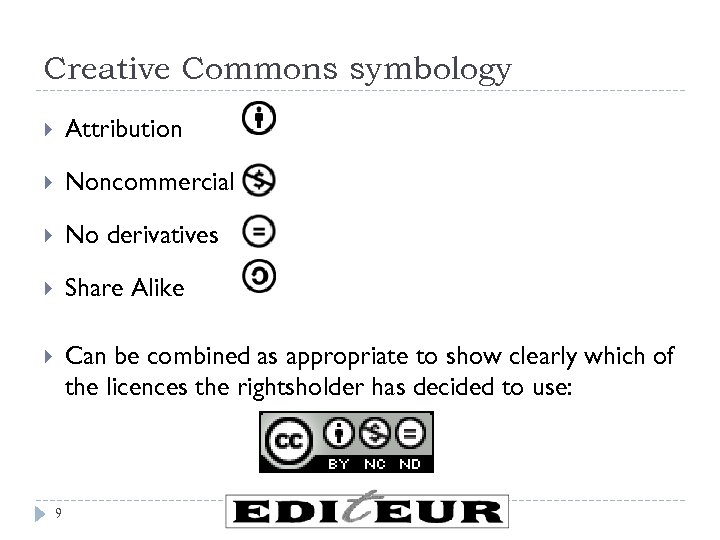 Creative Commons symbology Attribution Noncommercial No derivatives Share Alike Can be combined as appropriate to show clearly which of the licences the rightsholder has decided to use: 9
 10
10
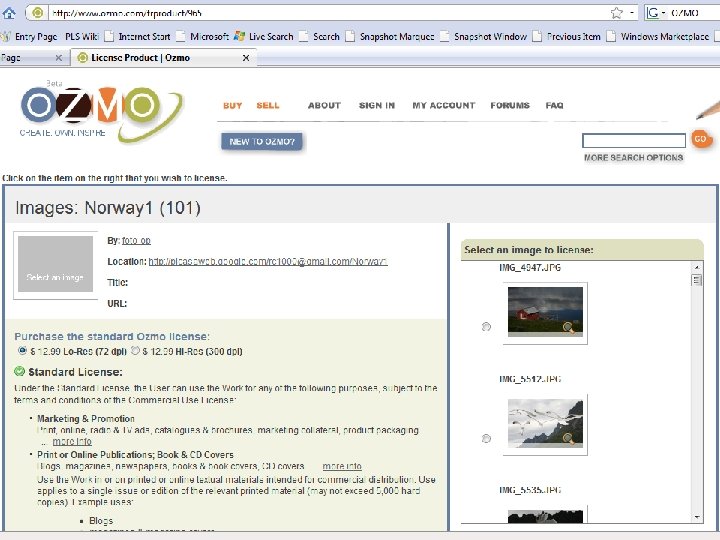
 http: //www. ozmo. com/ CC+ An extension to the original Creative Commons concept Expressing permissions which go beyond the basic CC licence eg providing terms paid-for permission for commercial use for a CC “nc” licence A syntactic standard, not a semantic standard Being used by the Copyright Clearance Center for is OZMO service 11
 http: //www. useplus. com The PLUS Coalition US-based not for profit, founded in 2004 “To simplify and facilitate the communication and management of image rights” UK based company too, but currently dormant Photography poorly served by standards Licensing very complex Easy for works to be orphaned online Broad based coalition Photographers and photo libraries Users of photographs (publishers, advertising agencies etc) Relevant technology companies
 PLUS Standardisation Licence format Glossary A model for what a licence should contain “PLUS Packs” – model licences for specific applications A “licence generator” Definitions of terms to be used in licences 1000 terms, but not (yet? ) formally structured Media matrix Standard encoding system for licence terms |PLUS|V 0120|U 001|1 IAK 1 UNA 2 EBF 3 PRS 4 SJB 5 VUG 6 QEE 7 DWE 8 RCE 8 IAL 8 LAF 9 EIN| Machine readable – machine interpretable?
 PLUS implementation Some large (book) publishers have adopted PLUS approach for licensing photographs PLUS licences PLUS terminology Implementations of Media Matrix for microlicensing not yet identified Recognition of requirement for identity; planning for registries For parties (buyers and sellers) For photographic works
 www. the-acap. org ACAP – Automated Content Access Protocol Launched as a project in 2007 Funded and led by three trade associations European Publishers Council World Association of Newspapers International Publishers Association Participation from all types of publishing Newspapers, magazines, books, scientific journals Very broad membership Currently substantially focused on influencing the political debate 15
 ACAP – Origins Concern about “the search engine problem” Considerable confusion in publishing, particularly news, about the role of the search engines: driving online traffic becoming major “media businesses” Only response – law suits Status quo unsustainable Positive: Negative: Online presence impossible in absence of sustainable business model Cost of infringement actions too high Difficulties of inconsistency in international law, jurisprudence Not anti-search or anti-search-engine 16 …in favour of allowing content owners to make choices
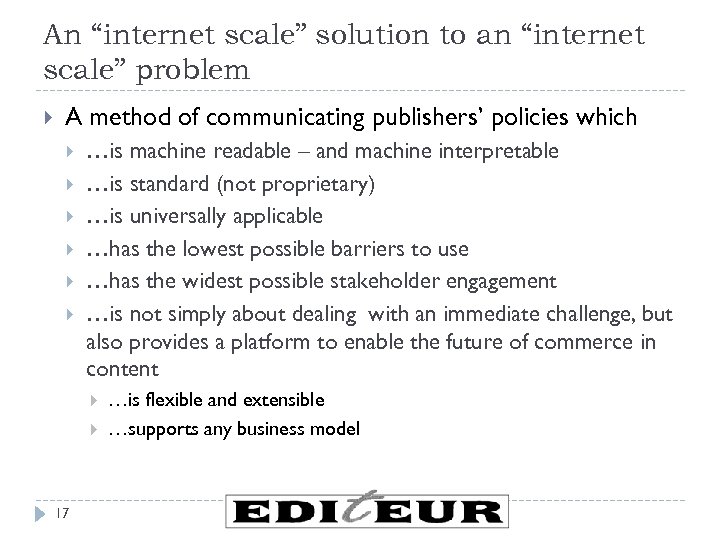 An “internet scale” solution to an “internet scale” problem A method of communicating publishers’ policies which …is machine readable – and machine interpretable …is standard (not proprietary) …is universally applicable …has the lowest possible barriers to use …has the widest possible stakeholder engagement …is not simply about dealing with an immediate challenge, but also provides a platform to enable the future of commerce in content 17 …is flexible and extensible …supports any business model
 ACAP as an enabler To the extent ACAP can develop into an enabler of content flow…and not become an inhibitor like some failed experiments with digital rights management, it has the potential to be an important element of more vibrant business models for publishers in the future. Thomas C. Rubin: Chief Counsel for Intellectual Property Strategy, Microsoft Corporation November 2008 18
 www. editeur. org EDIt. EUR’s family of ONIX standards Book trade standards organisation with its origins in developing EDI messages for use internationally The ONIX family can trace its origins to the requirement for “rich product metadata” created by online book retail Established 1991 90+ members in 40+ countries: publishing, supply chain, libraries The purchase experience wholly dependent on metadata Now a family of XML messages, covering both books and serial publications Related (but separate) standards for XML-EDI, RFID 19
 ONIX-PL: origins Institutions facing a number of issues: Managing an ever increasing number of resources/licences Correct interpretation of licences Exploiting negotiated licence terms and conditions Populating licence elements in ERM systems Communicating licence terms to users Goals 20 Express licence terms in machine-readable form Communicate electronically, typically from licensor to licensee Enable licence terms to be loaded into computer systems Not for purposes of “control” (DRM), but to provide accurate information at the point of use Better management of licence templates and individual agreements?
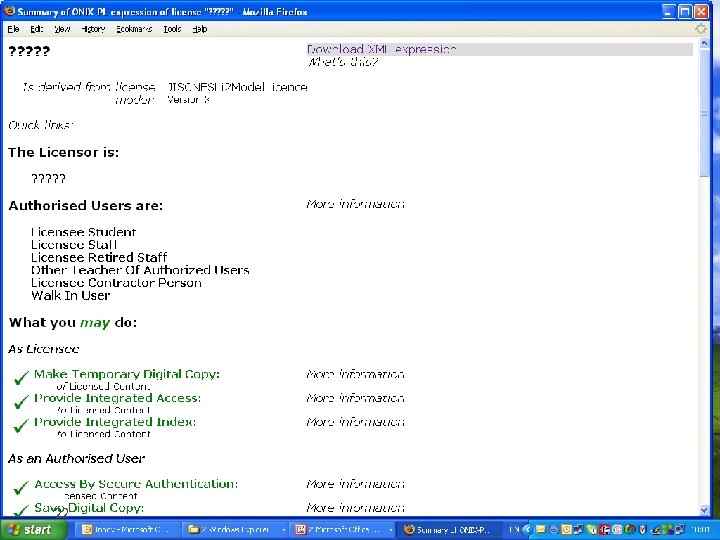
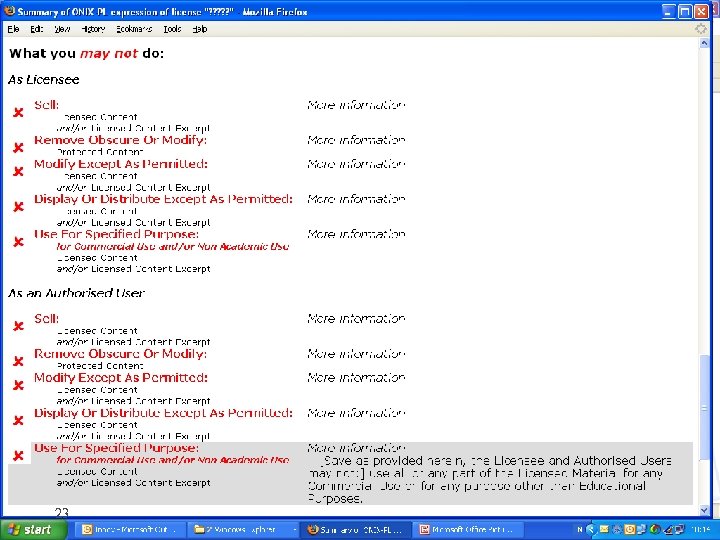
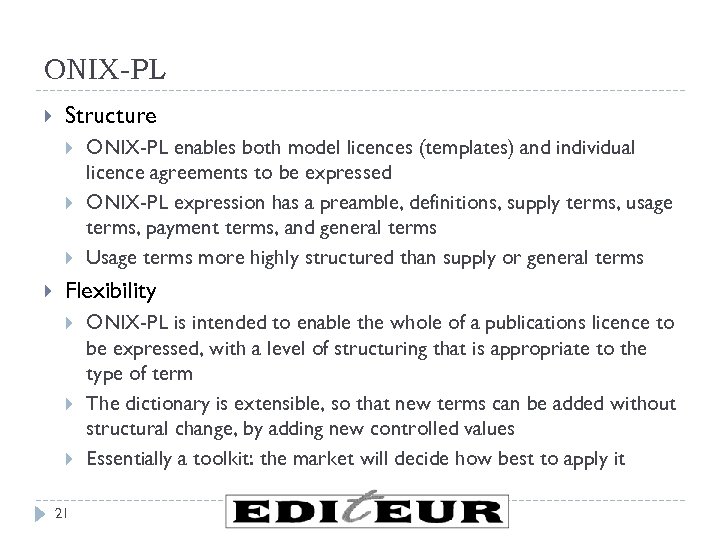 ONIX-PL Structure ONIX-PL enables both model licences (templates) and individual licence agreements to be expressed ONIX-PL expression has a preamble, definitions, supply terms, usage terms, payment terms, and general terms Usage terms more highly structured than supply or general terms Flexibility 21 ONIX-PL is intended to enable the whole of a publications licence to be expressed, with a level of structuring that is appropriate to the type of term The dictionary is extensible, so that new terms can be added without structural change, by adding new controlled values Essentially a toolkit: the market will decide how best to apply it
 22
22
 23
23
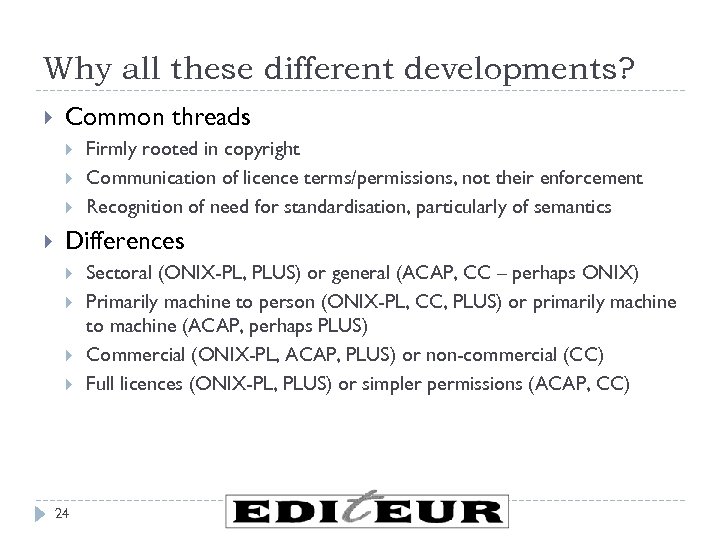 Why all these different developments? Common threads Firmly rooted in copyright Communication of licence terms/permissions, not their enforcement Recognition of need for standardisation, particularly of semantics Differences 24 Sectoral (ONIX-PL, PLUS) or general (ACAP, CC – perhaps ONIX) Primarily machine to person (ONIX-PL, CC, PLUS) or primarily machine to machine (ACAP, perhaps PLUS) Commercial (ONIX-PL, ACAP, PLUS) or non-commercial (CC) Full licences (ONIX-PL, PLUS) or simpler permissions (ACAP, CC)
 Some copyright clearance services 25
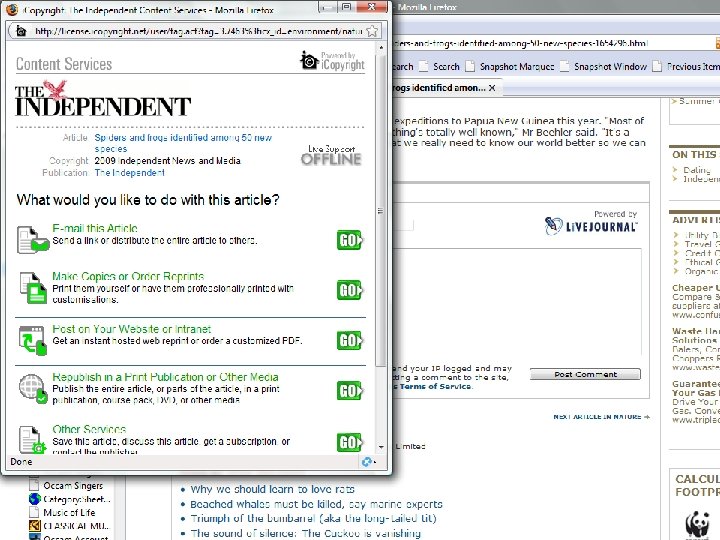
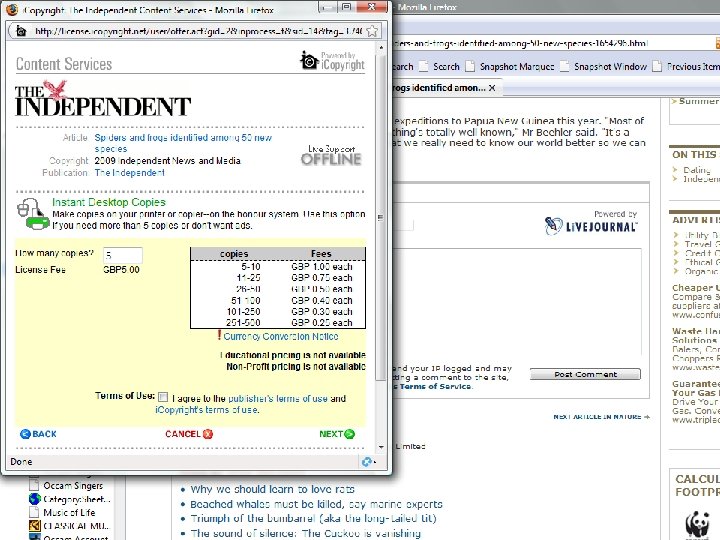
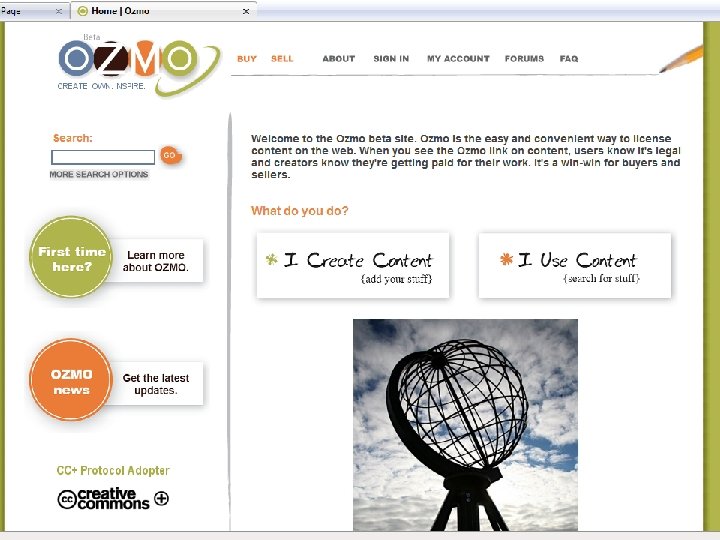 31
31
 Next steps – Registries 33
 Registry projects The Book Rights Registry ARROW To be established to support Google settlement Identifies books and their rightsholders (or the absence of rightsholders) Accessible Registries of Rights Information and Orphan Works towards Europeana European project, led by AIE; publishers, rights management organisations (including CLA, ALCS, PLS), libraries (including the British Library) Network of distributed registries PLUS registries
 And now its over to you…
 The question That’s what we’ve got (or what we are getting)… …what do we still need to develop to manage copyright on the network?
 mark@editeur. org A workshop session for UKSG 2009 – Torquay Mark Bide, Executive Director, EDIt. EUR