 Скачать презентацию Microlearning in C PL Zhaparov Meirambek Kazimovich Engineering
intro.pptx(С++)
- Количество слайдов: 14



Microlearning in C++ PL Zhaparov Meirambek Kazimovich Engineering faculty Suleyman Demirel University 2012 -2013
Overview Introduction Contact Information Course Description Course Design Grading Policy
Introduction C++ (pronounced "see plus") is a statically typed, free-form, multi-paradigm, compiled, general-purpose programming language. Developed by Bjarne Stroustrup starting in 1979 at Bell Labs. It has object oriented features, such as classes, and other enhancements to the C programming language. Originally named C with Classes, the language was renamed C++ in 1983, as a pun involving the increment operator. C++ is one of the most popular programming languages and is implemented on a wide variety of hardware and operating system platforms. http: //en. wikipedia. org/wiki/C%2 B%2 B
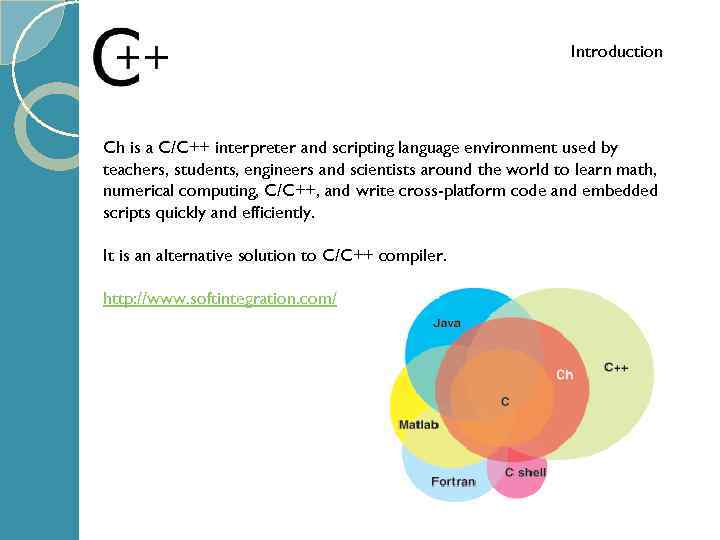
Introduction Ch is a C/C++ interpreter and scripting language environment used by teachers, students, engineers and scientists around the world to learn math, numerical computing, C/C++, and write cross-platform code and embedded scripts quickly and efficiently. It is an alternative solution to C/C++ compiler. http: //www. softintegration. com/
Contact Information Lecturer: - Meirambek Zhaparov Kazimovich - meirambek. zhaparov@gmail. com - 4 floor Engineering faculty -+7 707 7410283 - @meirambek_zh - Office hours: by appointment Course page: www. meirambek. com
Course Description • Microlearning in C++ PL • Lecture 1 hours • Practice 2 hours • Credit 3
Objectives • A primary objective is to give students general knowledge of C++ programming language. • Another primary objective is to practice general programming techniques in C++ programming language
Course Design Text Books (Additional) • C++ How to program. Deitel & Deitel • C++ without fear. Brian Overland Internet Resources • www. cplus. com • www. learncpp. com
Course Design Organization Lectures - Introduces students to the techniques and practices of C++. - Using flashcards in lectures - Attendance check -English speech only Lab sessions - Part of many labs is reserved for individual work, where everyone works to make progress on exercises. -Tools (preferred): Dev. CPP for Windows, Genuine for Linux - No resubmit after practice - English speech only - Student must have its own laptop
Course Design Organization http: //www. knowledgepulse. com/ Knowledge. Pulse® is a new and pioneering learning technology developed by Research Studios Austria FG. The Knowledge. Pulse® supports knowledge acquisition by a smart system of repetition, using intelligent learning cards.
Course Design List of Topics Introduction to courses Introduction to C++ Operators, Compare Loop Pointer, Array Character Sequence, Functions, Class Overloading, friend Template Inheritance, polymorphism STL Standard library of C++ Ch, plotting
Course Design Course Policies Attendance – Student who has more than 20% of absence will automatically receive “F” grade for the COURSE. - Attendance. In lectures and practices you must be in class (your soul and body and thought). Academic Honesty – Do all assignments by yourself – UNLESS otherwise instructed. – Do not talk or peek at others papers or cheat sheets during exams. Cheating is O. – Develop your own code for practice (can look at others codes). – University has strict guidelines and we will simply enforce these
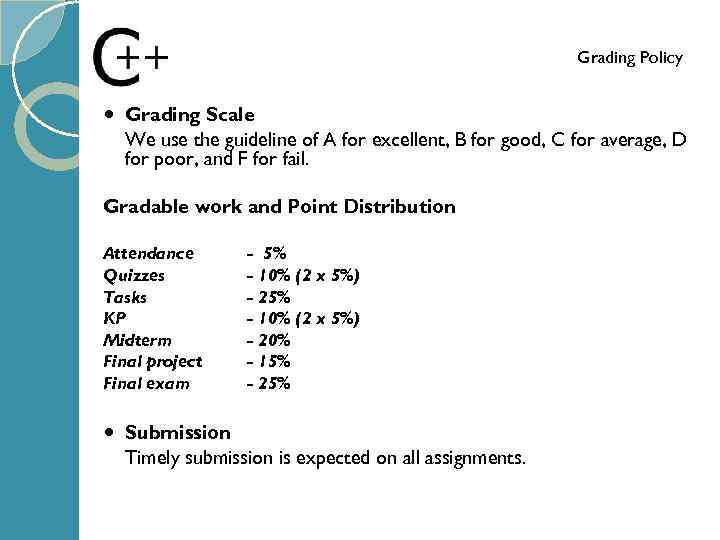
Grading Policy Grading Scale We use the guideline of A for excellent, B for good, C for average, D for poor, and F for fail. Gradable work and Point Distribution Attendance Quizzes Tasks KP Midterm Final project Final exam - 5% - 10% (2 x 5%) - 20% - 15% - 25% Submission Timely submission is expected on all assignments.

That’s all. Thank you!
Скачать презентацию Microlearning in C PL Zhaparov Meirambek Kazimovich Engineering
intro.pptx(С++)