


 Скачать презентацию Microkelvin Networking Activities 4 Networking Activities
729b4e8b6ac0bbec3b4ff2fa17029873.ppt
- Количество слайдов: 14
 Microkelvin Networking Activities
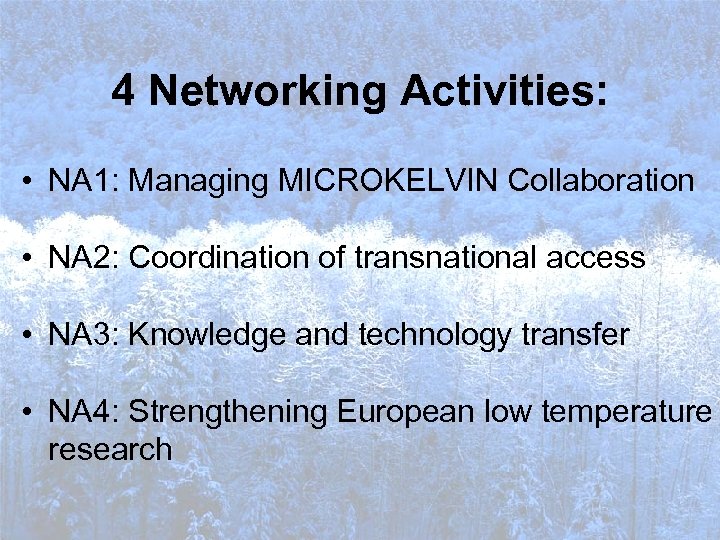 4 Networking Activities: • NA 1: Managing MICROKELVIN Collaboration • NA 2: Coordination of transnational access • NA 3: Knowledge and technology transfer • NA 4: Strengthening European low temperature research
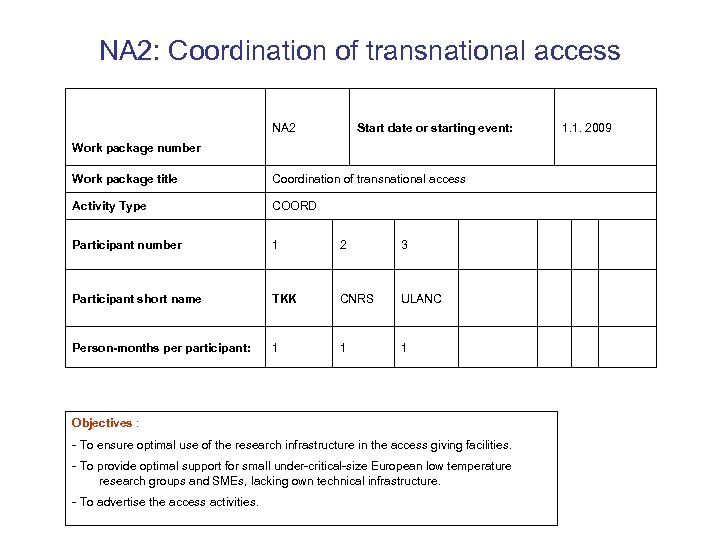 NA 2: Coordination of transnational access NA 2 Start date or starting event: Work package number Work package title Coordination of transnational access Activity Type COORD Participant number 1 2 3 Participant short name TKK CNRS ULANC Person-months per participant: 1 1 1 Objectives : - To ensure optimal use of the research infrastructure in the access giving facilities. - To provide optimal support for small under-critical-size European low temperature research groups and SMEs, lacking own technical infrastructure. - To advertise the access activities. 1. 1. 2009
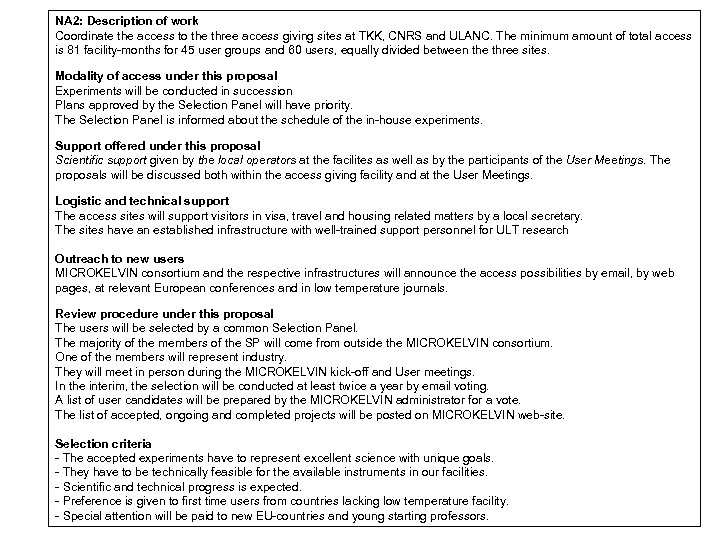 NA 2: Description of work Coordinate the access to the three access giving sites at TKK, CNRS and ULANC. The minimum amount of total access is 81 facility-months for 45 user groups and 60 users, equally divided between the three sites. Modality of access under this proposal Experiments will be conducted in succession Plans approved by the Selection Panel will have priority. The Selection Panel is informed about the schedule of the in-house experiments. Support offered under this proposal Scientific support given by the local operators at the facilites as well as by the participants of the User Meetings. The proposals will be discussed both within the access giving facility and at the User Meetings. Logistic and technical support The access sites will support visitors in visa, travel and housing related matters by a local secretary. The sites have an established infrastructure with well-trained support personnel for ULT research Outreach to new users MICROKELVIN consortium and the respective infrastructures will announce the access possibilities by email, by web pages, at relevant European conferences and in low temperature journals. Review procedure under this proposal The users will be selected by a common Selection Panel. The majority of the members of the SP will come from outside the MICROKELVIN consortium. One of the members will represent industry. They will meet in person during the MICROKELVIN kick-off and User meetings. In the interim, the selection will be conducted at least twice a year by email voting. A list of user candidates will be prepared by the MICROKELVIN administrator for a vote. The list of accepted, ongoing and completed projects will be posted on MICROKELVIN web-site. Selection criteria - The accepted experiments have to represent excellent science with unique goals. - They have to be technically feasible for the available instruments in our facilities. - Scientific and technical progress is expected. - Preference is given to first time users from countries lacking low temperature facility. - Special attention will be paid to new EU-countries and young starting professors.
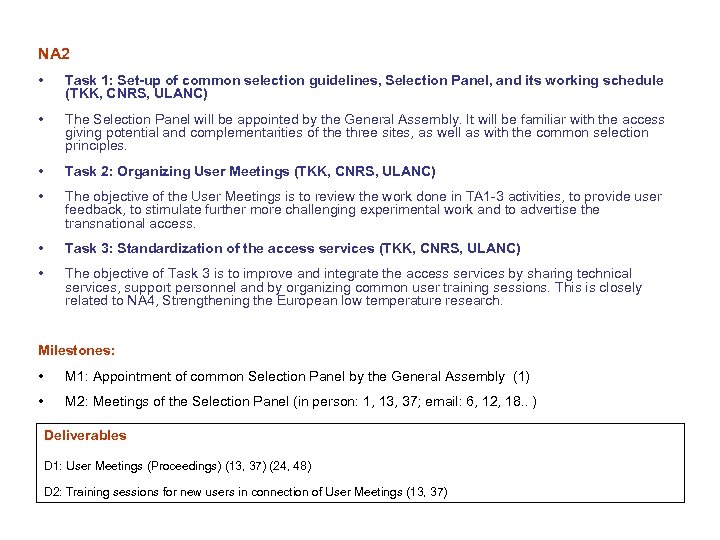 NA 2 • Task 1: Set-up of common selection guidelines, Selection Panel, and its working schedule (TKK, CNRS, ULANC) • The Selection Panel will be appointed by the General Assembly. It will be familiar with the access giving potential and complementarities of the three sites, as well as with the common selection principles. • Task 2: Organizing User Meetings (TKK, CNRS, ULANC) • The objective of the User Meetings is to review the work done in TA 1 -3 activities, to provide user feedback, to stimulate further more challenging experimental work and to advertise the transnational access. • Task 3: Standardization of the access services (TKK, CNRS, ULANC) • The objective of Task 3 is to improve and integrate the access services by sharing technical services, support personnel and by organizing common user training sessions. This is closely related to NA 4, Strengthening the European low temperature research. Milestones: • M 1: Appointment of common Selection Panel by the General Assembly (1) • M 2: Meetings of the Selection Panel (in person: 1, 13, 37; email: 6, 12, 18. . ) Deliverables D 1: User Meetings (Proceedings) (13, 37) (24, 48) D 2: Training sessions for new users in connection of User Meetings (13, 37)
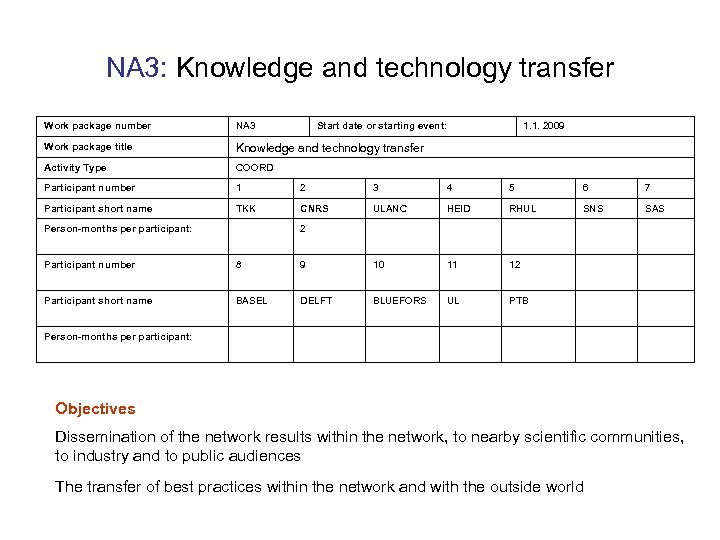 NA 3: Knowledge and technology transfer Work package number NA 3 Work package title Knowledge and technology transfer Activity Type COORD Participant number 1 2 3 4 5 6 7 Participant short name TKK CNRS ULANC HEID RHUL SNS SAS Person-months per participant: Start date or starting event: 1. 1. 2009 2 Participant number 8 9 10 11 12 Participant short name BASEL DELFT BLUEFORS UL PTB Person-months per participant: Objectives Dissemination of the network results within the network, to nearby scientific communities, to industry and to public audiences The transfer of best practices within the network and with the outside world
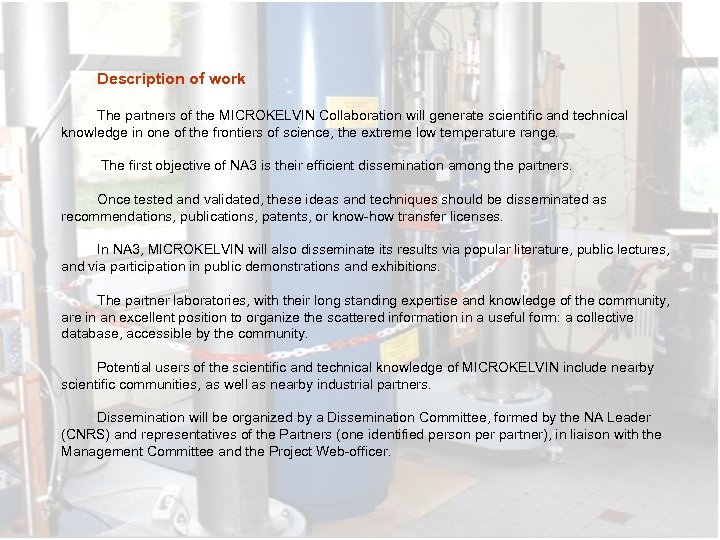 Description of work The partners of the MICROKELVIN Collaboration will generate scientific and technical knowledge in one of the frontiers of science, the extreme low temperature range. The first objective of NA 3 is their efficient dissemination among the partners. Once tested and validated, these ideas and techniques should be disseminated as recommendations, publications, patents, or know-how transfer licenses. In NA 3, MICROKELVIN will also disseminate its results via popular literature, public lectures, and via participation in public demonstrations and exhibitions. The partner laboratories, with their long standing expertise and knowledge of the community, are in an excellent position to organize the scattered information in a useful form: a collective database, accessible by the community. Potential users of the scientific and technical knowledge of MICROKELVIN include nearby scientific communities, as well as nearby industrial partners. Dissemination will be organized by a Dissemination Committee, formed by the NA Leader (CNRS) and representatives of the Partners (one identified person per partner), in liaison with the Management Committee and the Project Web-officer.
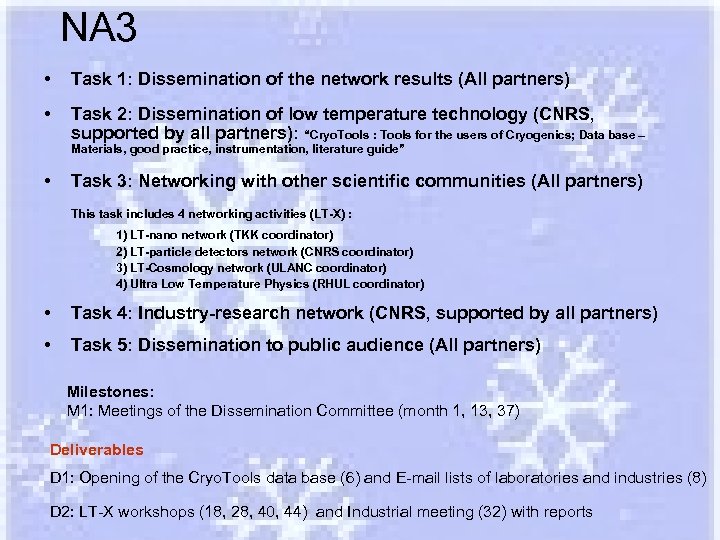 NA 3 • Task 1: Dissemination of the network results (All partners) • Task 2: Dissemination of low temperature technology (CNRS, supported by all partners): “Cryo. Tools : Tools for the users of Cryogenics; Data base – Materials, good practice, instrumentation, literature guide” • Task 3: Networking with other scientific communities (All partners) This task includes 4 networking activities (LT-X) : 1) LT-nano network (TKK coordinator) 2) LT-particle detectors network (CNRS coordinator) 3) LT-Cosmology network (ULANC coordinator) 4) Ultra Low Temperature Physics (RHUL coordinator) • Task 4: Industry-research network (CNRS, supported by all partners) • Task 5: Dissemination to public audience (All partners) Milestones: M 1: Meetings of the Dissemination Committee (month 1, 13, 37) Deliverables D 1: Opening of the Cryo. Tools data base (6) and E-mail lists of laboratories and industries (8) D 2: LT-X workshops (18, 28, 40, 44) and Industrial meeting (32) with reports
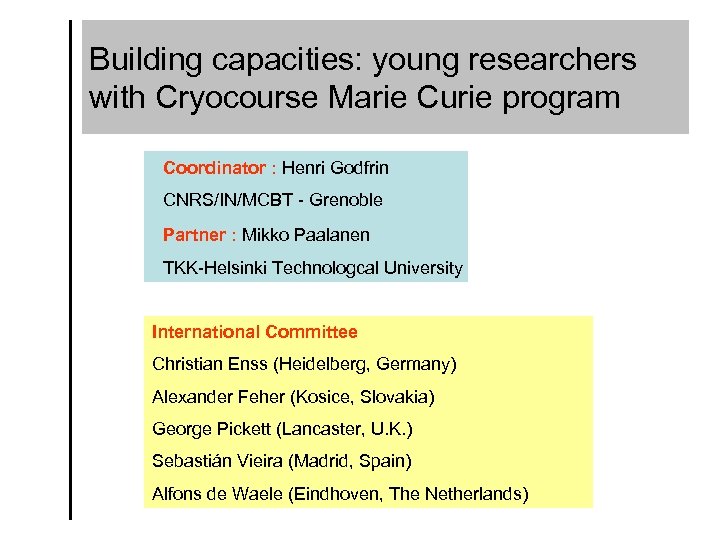 Building capacities: young researchers with Cryocourse Marie Curie program Coordinator : Henri Godfrin CNRS/IN/MCBT - Grenoble Partner : Mikko Paalanen TKK-Helsinki Technologcal University International Committee Christian Enss (Heidelberg, Germany) Alexander Feher (Kosice, Slovakia) George Pickett (Lancaster, U. K. ) Sebastián Vieira (Madrid, Spain) Alfons de Waele (Eindhoven, The Netherlands)
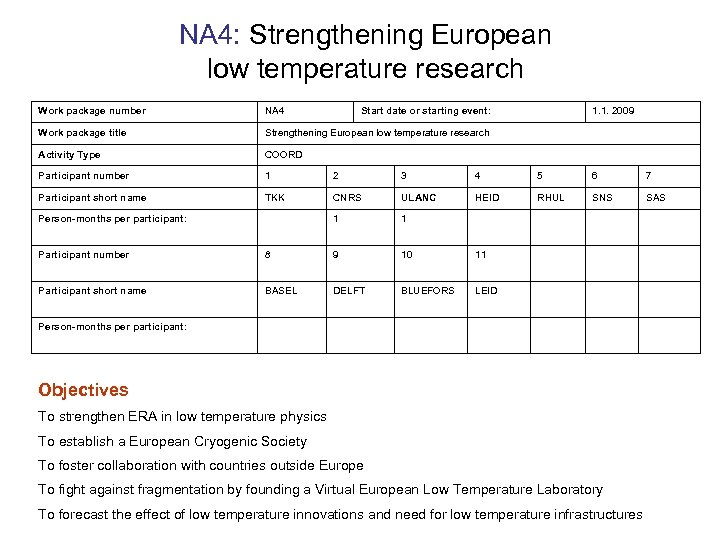 NA 4: Strengthening European low temperature research Work package number NA 4 Work package title Strengthening European low temperature research Activity Type COORD Participant number 1 2 3 4 5 6 7 Participant short name TKK CNRS ULANC HEID RHUL SNS SAS 1 1 Person-months per participant: Start date or starting event: Participant number 8 9 10 11 Participant short name BASEL DELFT BLUEFORS 1. 1. 2009 LEID Person-months per participant: Objectives To strengthen ERA in low temperature physics To establish a European Cryogenic Society To foster collaboration with countries outside Europe To fight against fragmentation by founding a Virtual European Low Temperature Laboratory To forecast the effect of low temperature innovations and need for low temperature infrastructures
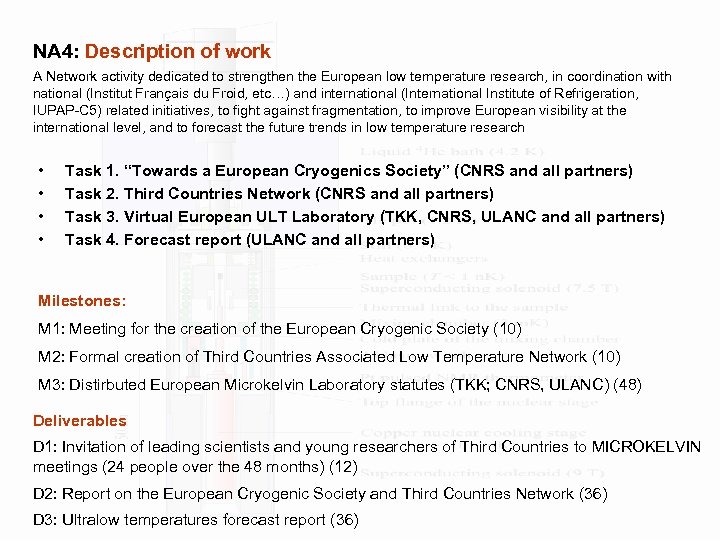 NA 4: Description of work A Network activity dedicated to strengthen the European low temperature research, in coordination with national (Institut Français du Froid, etc…) and international (International Institute of Refrigeration, IUPAP-C 5) related initiatives, to fight against fragmentation, to improve European visibility at the international level, and to forecast the future trends in low temperature research • • Task 1. “Towards a European Cryogenics Society” (CNRS and all partners) Task 2. Third Countries Network (CNRS and all partners) Task 3. Virtual European ULT Laboratory (TKK, CNRS, ULANC and all partners) Task 4. Forecast report (ULANC and all partners) Milestones: M 1: Meeting for the creation of the European Cryogenic Society (10) M 2: Formal creation of Third Countries Associated Low Temperature Network (10) M 3: Distirbuted European Microkelvin Laboratory statutes (TKK; CNRS, ULANC) (48) Deliverables D 1: Invitation of leading scientists and young researchers of Third Countries to MICROKELVIN meetings (24 people over the 48 months) (12) D 2: Report on the European Cryogenic Society and Third Countries Network (36) D 3: Ultralow temperatures forecast report (36)
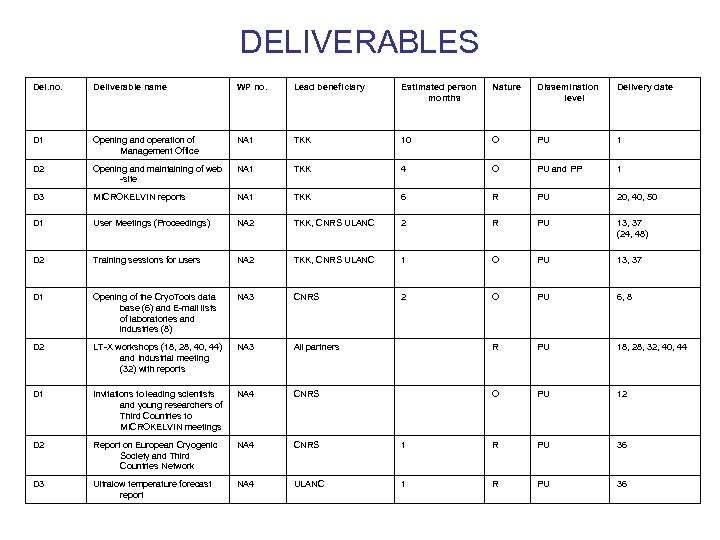 DELIVERABLES Del. no. Deliverable name WP no. Lead beneficiary Estimated person months Nature Dissemination level Delivery date D 1 Opening and operation of Management Office NA 1 TKK 10 O PU 1 D 2 Opening and maintaining of web -site NA 1 TKK 4 O PU and PP 1 D 3 MICROKELVIN reports NA 1 TKK 6 R PU 20, 40, 50 D 1 User Meetings (Proceedings) NA 2 TKK, CNRS ULANC 2 R PU 13, 37 (24, 48) D 2 Training sessions for users NA 2 TKK, CNRS ULANC 1 O PU 13, 37 D 1 Opening of the Cryo. Tools data base (6) and E-mail lists of laboratories and industries (8) NA 3 CNRS 2 O PU 6, 8 D 2 LT-X workshops (18, 28, 40, 44) and Industrial meeting (32) with reports NA 3 All partners R PU 18, 28, 32, 40, 44 D 1 Invitations to leading scientists and young researchers of Third Countries to MICROKELVIN meetings NA 4 CNRS O PU 12 D 2 Report on European Cryogenic Society and Third Countries Network NA 4 CNRS 1 R PU 36 D 3 Ultralow temperature forecast report NA 4 ULANC 1 R PU 36
 Thanks!
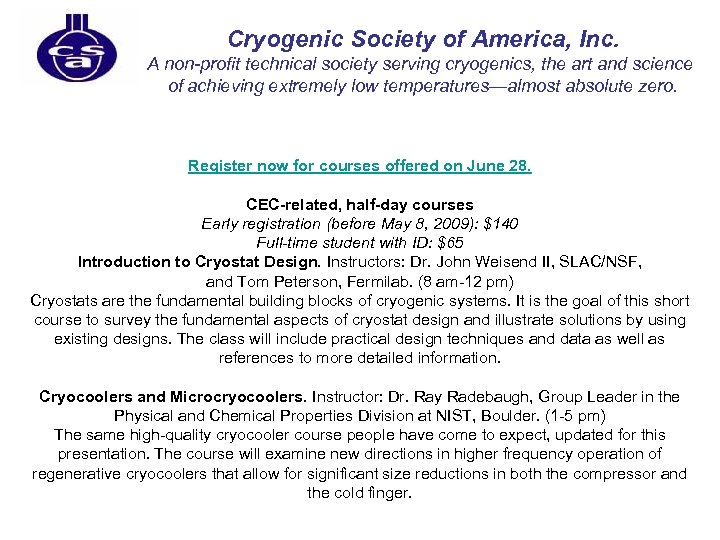 Cryogenic Society of America, Inc. A non-profit technical society serving cryogenics, the art and science of achieving extremely low temperatures—almost absolute zero. Register now for courses offered on June 28. CEC-related, half-day courses Early registration (before May 8, 2009): $140 Full-time student with ID: $65 Introduction to Cryostat Design. Instructors: Dr. John Weisend II, SLAC/NSF, and Tom Peterson, Fermilab. (8 am-12 pm) Cryostats are the fundamental building blocks of cryogenic systems. It is the goal of this short course to survey the fundamental aspects of cryostat design and illustrate solutions by using existing designs. The class will include practical design techniques and data as well as references to more detailed information. Cryocoolers and Microcryocoolers. Instructor: Dr. Ray Radebaugh, Group Leader in the Physical and Chemical Properties Division at NIST, Boulder. (1 -5 pm) The same high-quality cryocooler course people have come to expect, updated for this presentation. The course will examine new directions in higher frequency operation of regenerative cryocoolers that allow for significant size reductions in both the compressor and the cold finger.