 Скачать презентацию MICROINSURANCE IN BRAZIL OPPORTUNITIES FOR MARKET DEVELOPMENT CNSeg
c1119c368589e49f4f1ae0bea5c2339f.ppt
- Количество слайдов: 58




MICROINSURANCE IN BRAZIL OPPORTUNITIES FOR MARKET DEVELOPMENT CNSeg & Funenseg Presentation Rio de Janeiro, 2 December 2009
Agenda 1. Market assessment Coffee break 2. Drivers of market development 3. Strategy
“Microinsurance is not microbusiness!” Armando Vergilio
Our brief Objectives Assess the market Propose a strategy Consider regulation Methodology Consultations Focus groups Analyse SUSEP database IETS & FGV data analyses Consider Funenseg research Consider Consultative Commission reports & activities
Market assessment Who’s the target market? Current insurance usage Demand insights Industry analysis Product analysis Distribution channels
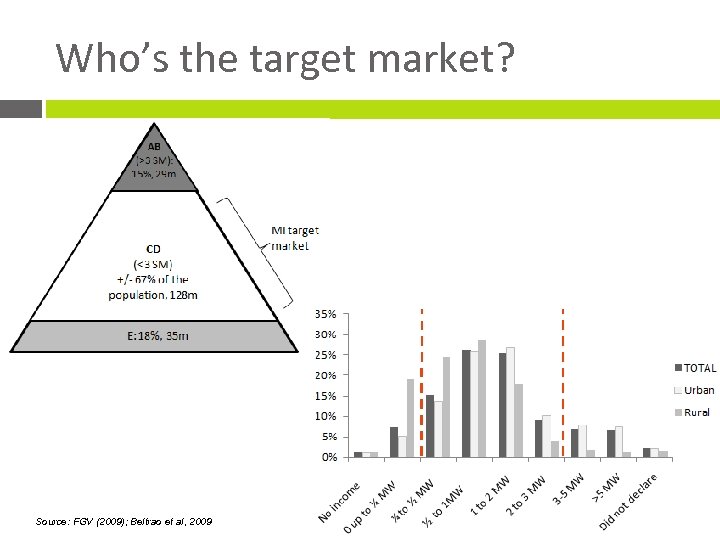
Who’s the target market? Source: FGV (2009); Beltrao et al, 2009
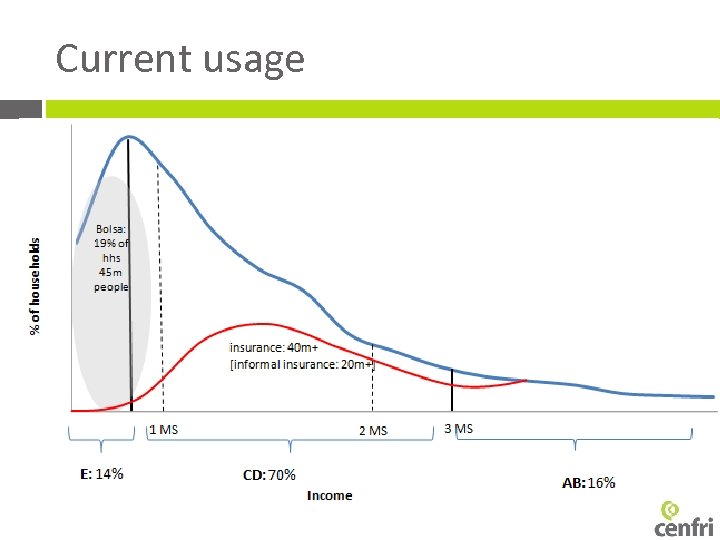
Current usage
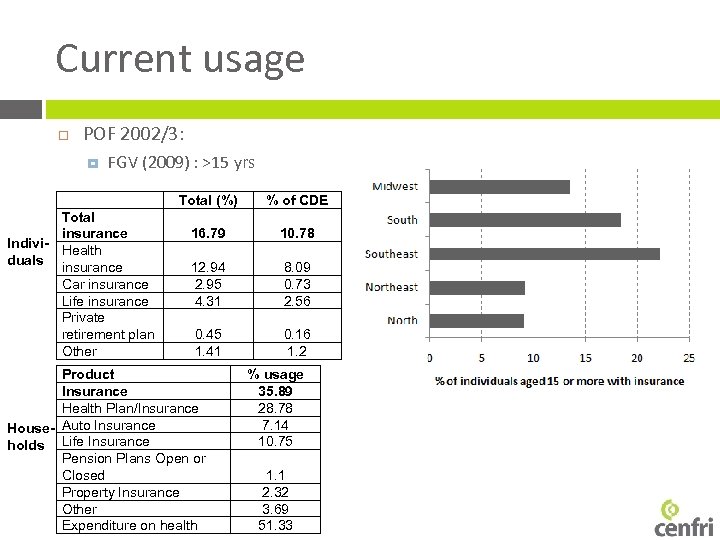
Current usage POF 2002/3: FGV (2009) : >15 yrs Total insurance Indivi. Health duals insurance Car insurance Life insurance Private retirement plan Other Total (%) % of CDE 16. 79 10. 78 12. 94 2. 95 4. 31 8. 09 0. 73 2. 56 0. 45 1. 41 0. 16 1. 2 Product Insurance Health Plan/Insurance House- Auto Insurance holds Life Insurance Pension Plans Open or Closed Property Insurance Other Expenditure on health % usage 35. 89 28. 78 7. 14 10. 75 1. 1 2. 32 3. 69 51. 33
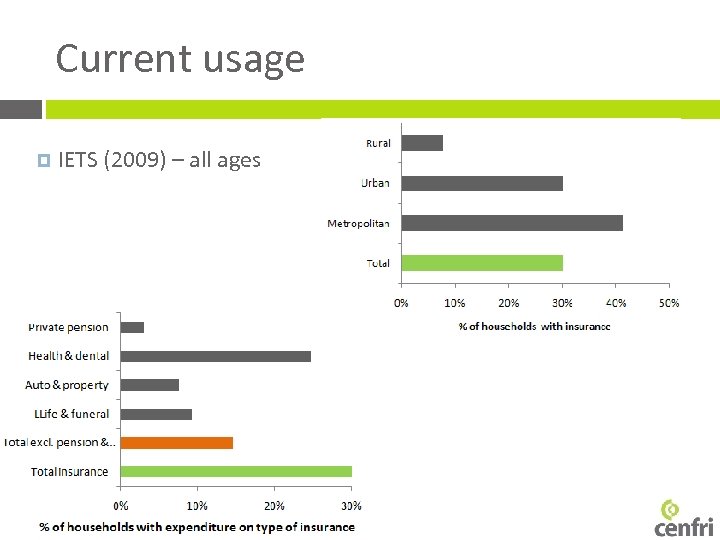
Current usage IETS (2009) – all ages
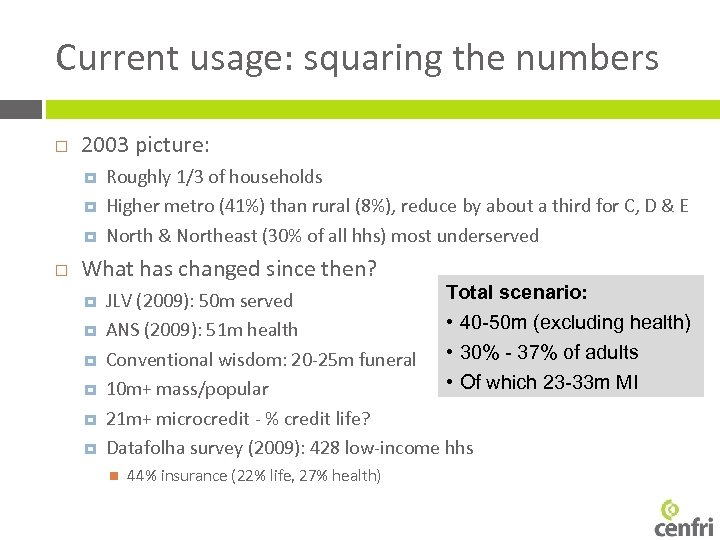
Current usage: squaring the numbers 2003 picture: Roughly 1/3 of households Higher metro (41%) than rural (8%), reduce by about a third for C, D & E North & Northeast (30% of all hhs) most underserved What has changed since then? Total scenario: JLV (2009): 50 m served • 40 -50 m (excluding health) ANS (2009): 51 m health Conventional wisdom: 20 -25 m funeral • 30% - 37% of adults • Of which 23 -33 m MI 10 m+ mass/popular 21 m+ microcredit - % credit life? Datafolha survey (2009): 428 low-income hhs 44% insurance (22% life, 27% health)
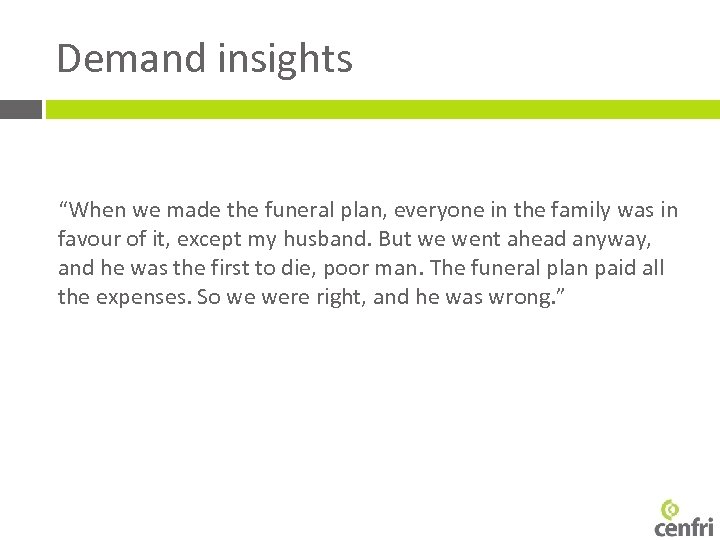
Demand insights “When we made the funeral plan, everyone in the family was in favour of it, except my husband. But we went ahead anyway, and he was the first to die, poor man. The funeral plan paid all the expenses. So we were right, and he was wrong. ”
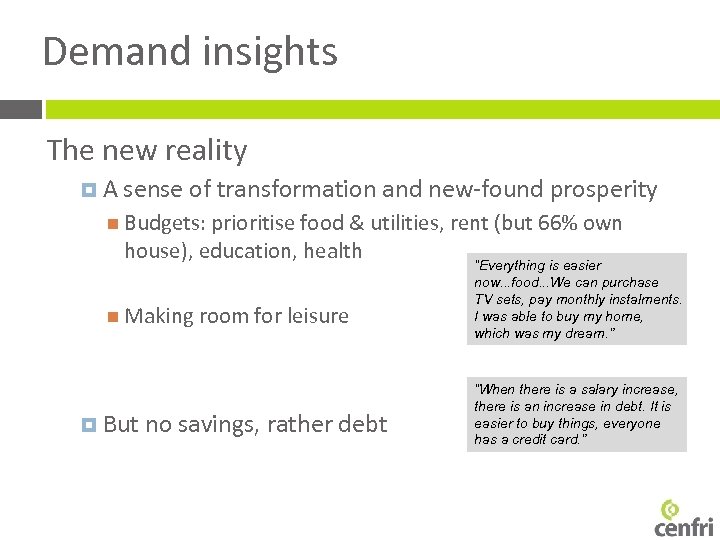
Demand insights The new reality A sense of transformation and new-found prosperity Budgets: prioritise food & utilities, rent (but 66% own house), education, health Making room for leisure But no savings, rather debt “Everything is easier now. . . food. . . We can purchase TV sets, pay monthly instalments. I was able to buy my home, which was my dream. ” “When there is a salary increase, there is an increase in debt. It is easier to buy things, everyone has a credit card. ”
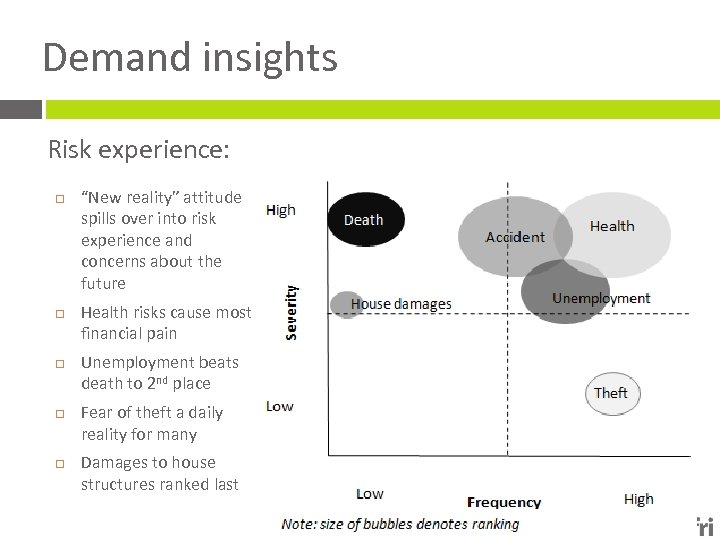
Demand insights Risk experience: “New reality” attitude spills over into risk experience and concerns about the future Health risks cause most financial pain Unemployment beats death to 2 nd place Fear of theft a daily reality for many Damages to house structures ranked last
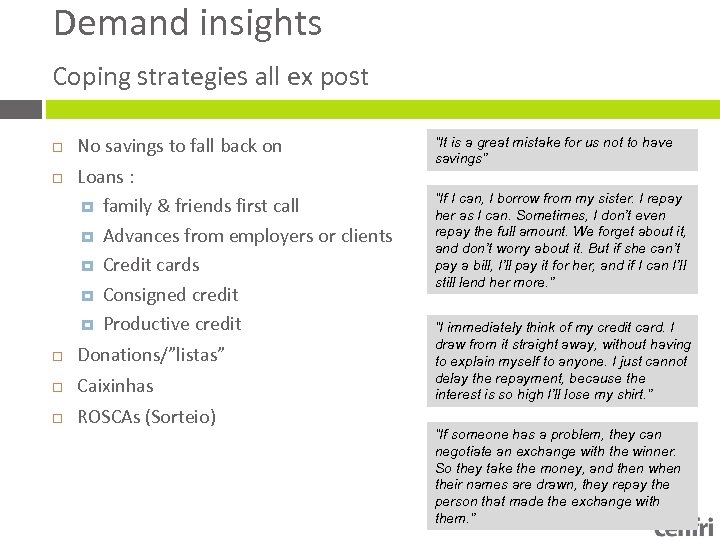
Demand insights Coping strategies all ex post No savings to fall back on Loans : family & friends first call Advances from employers or clients Credit cards Consigned credit Productive credit Donations/”listas” Caixinhas ROSCAs (Sorteio) “It is a great mistake for us not to have savings” “If I can, I borrow from my sister. I repay her as I can. Sometimes, I don’t even repay the full amount. We forget about it, and don’t worry about it. But if she can’t pay a bill, I’ll pay it for her, and if I can I’ll still lend her more. ” “I immediately think of my credit card. I draw from it straight away, without having to explain myself to anyone. I just cannot delay the repayment, because the interest is so high I’ll lose my shirt. ” “If someone has a problem, they can negotiate an exchange with the winner. So they take the money, and then when their names are drawn, they repay the person that made the exchange with them. ”
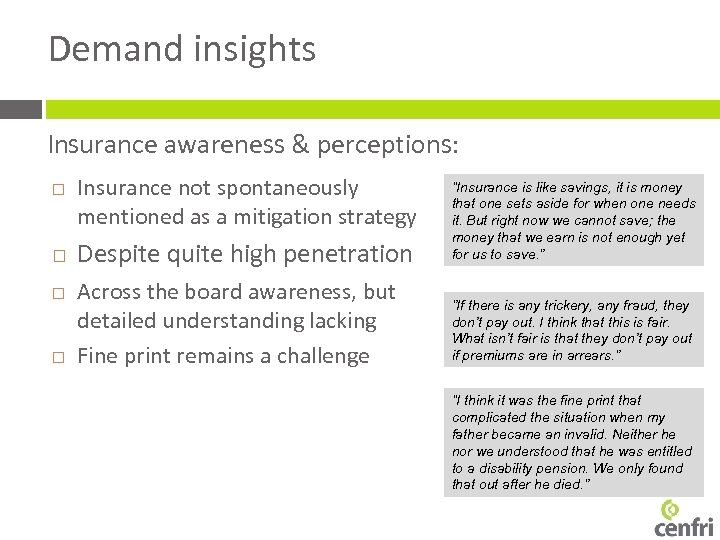
Demand insights Insurance awareness & perceptions: Insurance not spontaneously mentioned as a mitigation strategy Despite quite high penetration Across the board awareness, but detailed understanding lacking Fine print remains a challenge “Insurance is like savings, it is money that one sets aside for when one needs it. But right now we cannot save; the money that we earn is not enough yet for us to save. ” ”If there is any trickery, any fraud, they don’t pay out. I think that this is fair. What isn’t fair is that they don’t pay out if premiums are in arrears. ” “I think it was the fine print that complicated the situation when my father became an invalid. Neither he nor we understood that he was entitled to a disability pension. We only found that out after he died. ”
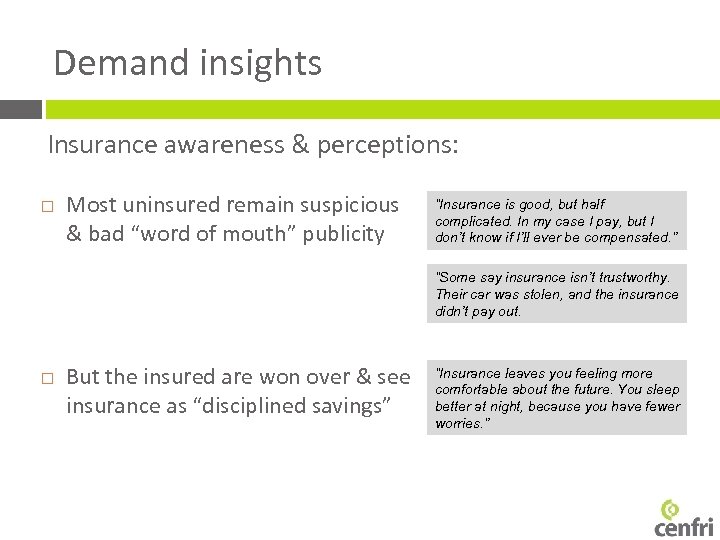
Demand insights Insurance awareness & perceptions: Most uninsured remain suspicious & bad “word of mouth” publicity “Insurance is good, but half complicated. In my case I pay, but I don’t know if I’ll ever be compensated. ” “Some say insurance isn’t trustworthy. Their car was stolen, and the insurance didn’t pay out. But the insured are won over & see insurance as “disciplined savings” “Insurance leaves you feeling more comfortable about the future. You sleep better at night, because you have fewer worries. ”
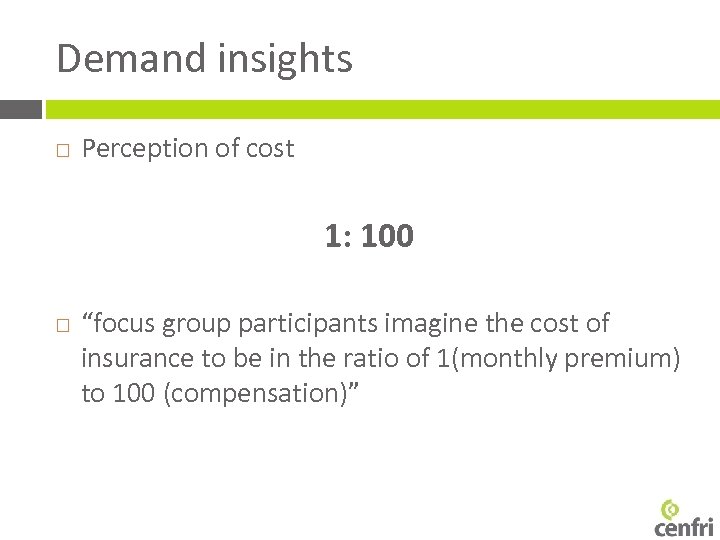
Demand insights Perception of cost 1: 100 “focus group participants imagine the cost of insurance to be in the ratio of 1(monthly premium) to 100 (compensation)”
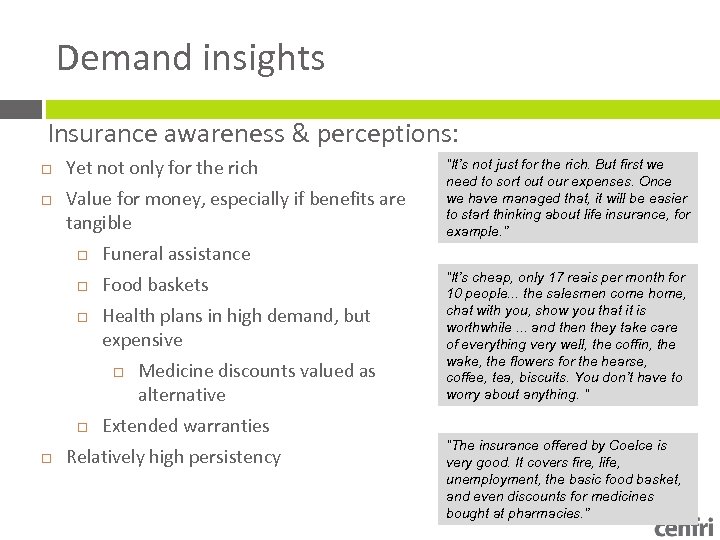
Demand insights Insurance awareness & perceptions: Yet not only for the rich Value for money, especially if benefits are tangible Funeral assistance Food baskets Health plans in high demand, but expensive “It’s not just for the rich. But first we need to sort our expenses. Once we have managed that, it will be easier to start thinking about life insurance, for example. ” Medicine discounts valued as alternative “It’s cheap, only 17 reais per month for 10 people. . . the salesmen come home, chat with you, show you that it is worthwhile. . . and then they take care of everything very well, the coffin, the wake, the flowers for the hearse, coffee, tea, biscuits. You don’t have to worry about anything. “ Extended warranties Relatively high persistency “The insurance offered by Coelce is very good. It covers fire, life, unemployment, the basic food basket, and even discounts for medicines bought at pharmacies. ”
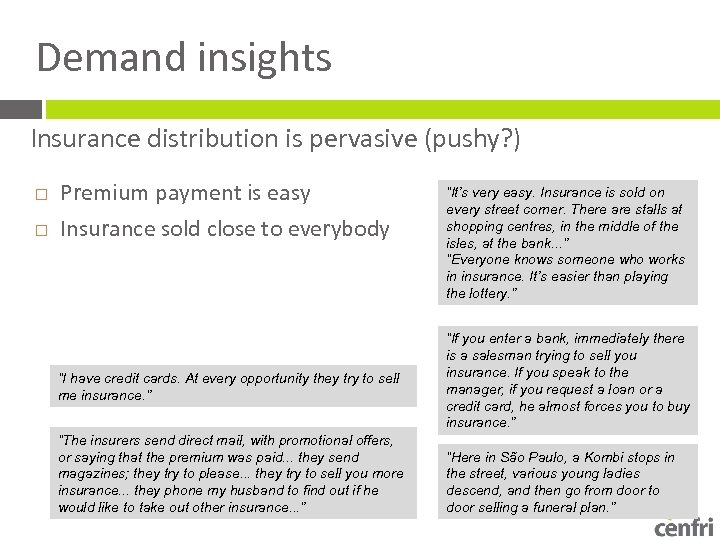
Demand insights Insurance distribution is pervasive (pushy? ) Premium payment is easy Insurance sold close to everybody “I have credit cards. At every opportunity they try to sell me insurance. ” “The insurers send direct mail, with promotional offers, or saying that the premium was paid. . . they send magazines; they try to please. . . they try to sell you more insurance. . . they phone my husband to find out if he would like to take out other insurance. . . ” “It’s very easy. Insurance is sold on every street corner. There are stalls at shopping centres, in the middle of the isles, at the bank. . . ” “Everyone knows someone who works in insurance. It’s easier than playing the lottery. ” “If you enter a bank, immediately there is a salesman trying to sell you insurance. If you speak to the manager, if you request a loan or a credit card, he almost forces you to buy insurance. ” “Here in São Paulo, a Kombi stops in the street, various young ladies descend, and then go from door to door selling a funeral plan. ”
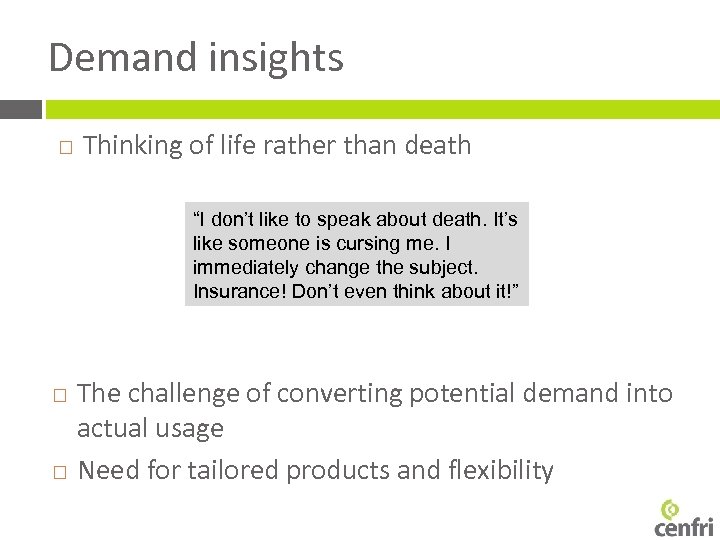
Demand insights Thinking of life rather than death “I don’t like to speak about death. It’s like someone is cursing me. I immediately change the subject. Insurance! Don’t even think about it!” The challenge of converting potential demand into actual usage Need for tailored products and flexibility
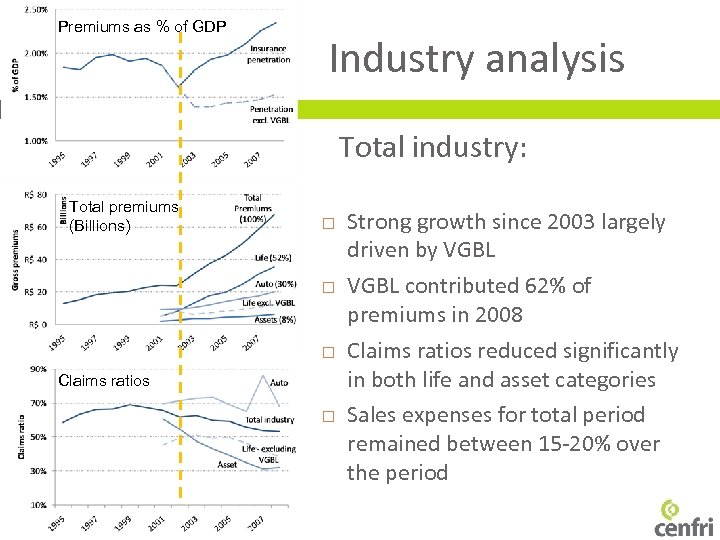
Premiums as % of GDP Industry analysis Total industry: Total premiums (Billions) Claims ratios Strong growth since 2003 largely driven by VGBL contributed 62% of premiums in 2008 Claims ratios reduced significantly in both life and asset categories Sales expenses for total period remained between 15 -20% over the period
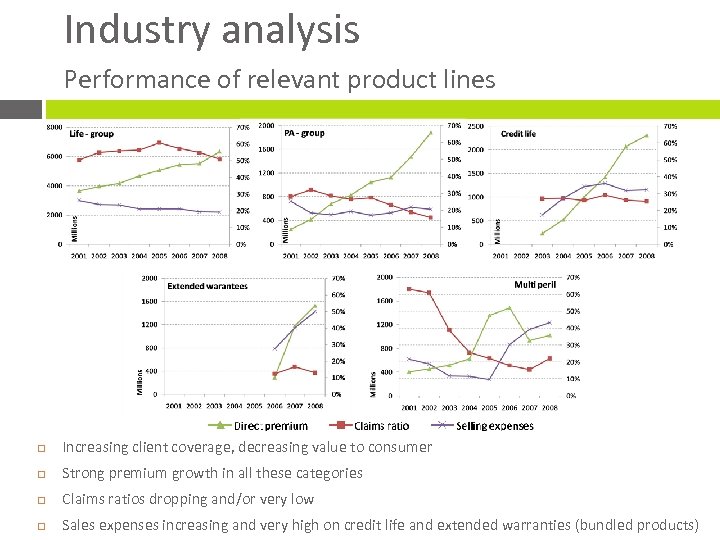
Industry analysis Performance of relevant product lines Increasing client coverage, decreasing value to consumer Strong premium growth in all these categories Claims ratios dropping and/or very low Sales expenses increasing and very high on credit life and extended warranties (bundled products)
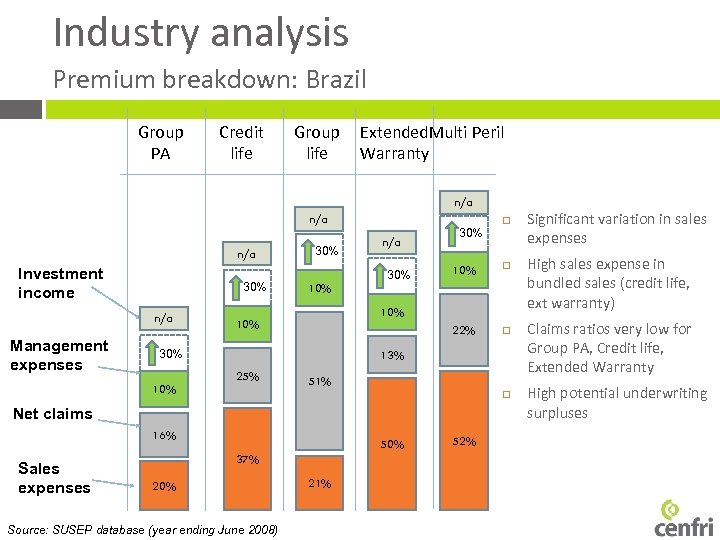
Industry analysis Premium breakdown: Brazil Group PA Credit life Group life Extended. Multi Peril Warranty n/a n/a Investment income 30% n/a Management expenses 30% n/a 30% 10% 22% 30% 10% 10% 30% 13% 25% 10% 51% Net claims 16% Sales expenses 50% 37% 20% Source: SUSEP database (year ending June 2008) 21% 52% Significant variation in sales expenses High sales expense in bundled sales (credit life, ext warranty) Claims ratios very low for Group PA, Credit life, Extended Warranty High potential underwriting surpluses
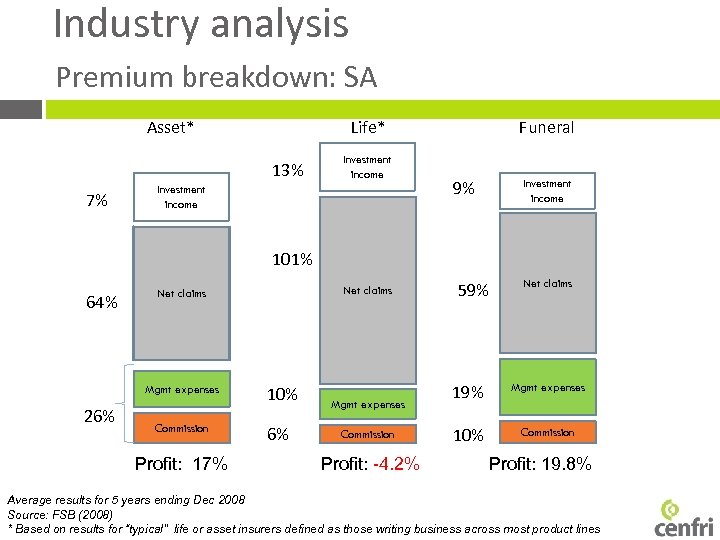
Industry analysis Premium breakdown: SA Asset* Life* 13% 7% Investment income Funeral 9% Investment income 101% 64% Mgmt expenses 26% Net claims Commission Profit: 17% 10% 6% Mgmt expenses Commission Profit: -4. 2% 59% Net claims 19% Mgmt expenses 10% Commission Profit: 19. 8% Average results for 5 years ending Dec 2008 Source: FSB (2008) * Based on results for “typical” life or asset insurers defined as those writing business across most product lines
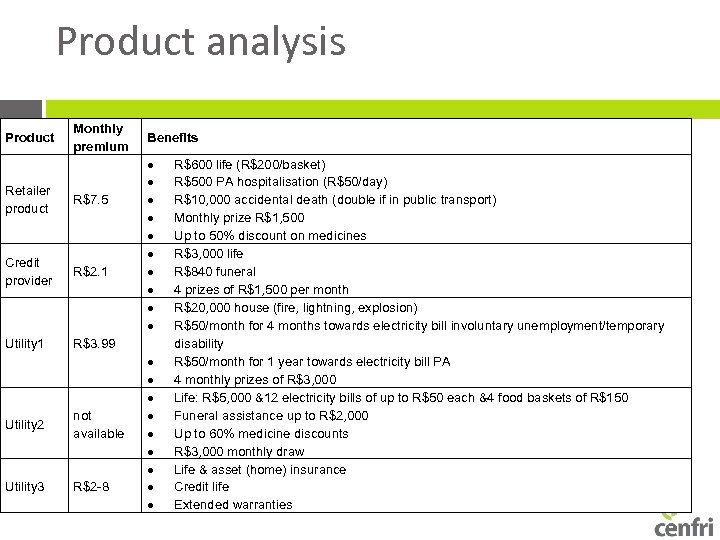
Product analysis Product Monthly premium Retailer product R$7. 5 Credit provider R$2. 1 Utility 1 Benefits R$3. 99 Utility 2 not available Utility 3 R$2 -8 R$600 life (R$200/basket) R$500 PA hospitalisation (R$50/day) R$10, 000 accidental death (double if in public transport) Monthly prize R$1, 500 Up to 50% discount on medicines R$3, 000 life R$840 funeral 4 prizes of R$1, 500 per month R$20, 000 house (fire, lightning, explosion) R$50/month for 4 months towards electricity bill involuntary unemployment/temporary disability R$50/month for 1 year towards electricity bill PA 4 monthly prizes of R$3, 000 Life: R$5, 000 &12 electricity bills of up to R$50 each &4 food baskets of R$150 Funeral assistance up to R$2, 000 Up to 60% medicine discounts R$3, 000 monthly draw Life & asset (home) insurance Credit life Extended warranties
![Product analysis Product Monthly premium Funeral insurer R$12 -30 per family? ] Affinity R$10](https://present5.com/presentation/c1119c368589e49f4f1ae0bea5c2339f/image-26.jpg "Product analysis Product Monthly premium Funeral insurer R$12 -30 per family? ] Affinity R$10")
Product analysis Product Monthly premium Funeral insurer R$12 -30 per family? ] Affinity R$10 (telemarketing) R$1 -4 (direct mail) Employee groups R$5 (average); R$15 (max) [per family] Bank R$15 -50 [per family(? )] Funeral home R$18 ave. [per family] Benefits Funeral +/- R$1, 200 Optional life (income protection) R$10, 000 monthly draw Financial protection for unemployment Home insurance Assistance call centre Capitalisation component Natural & accidental death Disability Birth (with congenital disease) Work-related illnesses Maternity food assistance Funeral cover in case of accident at work Credit life Unemployment Home & house assistance (services support) Personal accident Funeral Educational insurance for children Funeral assistance R$2500 Food aid Discounts on medical consultations at own clinic Discounts on pharmaceuticals Legal advice
Distribution channels Overview Innovative mass distribution models 75, 000 individual brokers; 35, 000 corporate brokers Insurance proposals sourced through (Decree-Law 73/66): Clients directly Their legal representatives Brokers 7 main channels have evolved
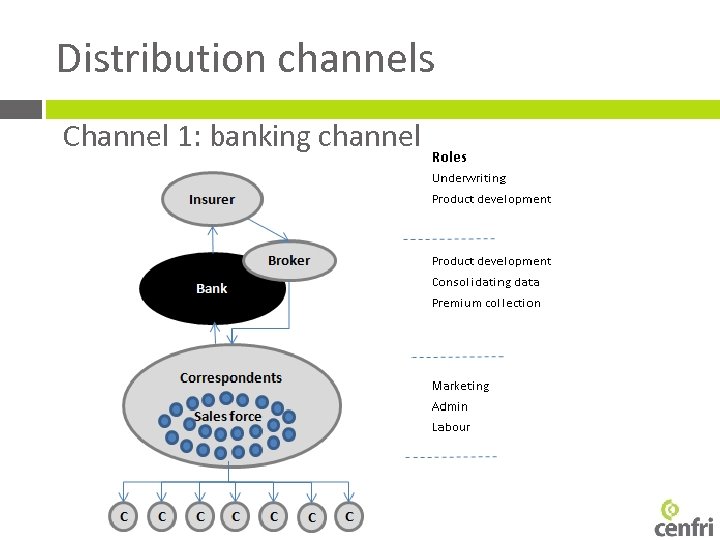
Distribution channels Channel 1: banking channel
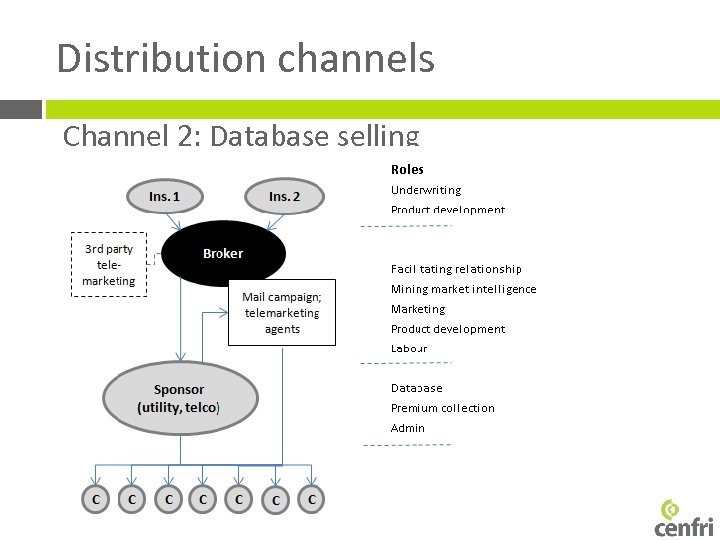
Distribution channels Channel 2: Database selling
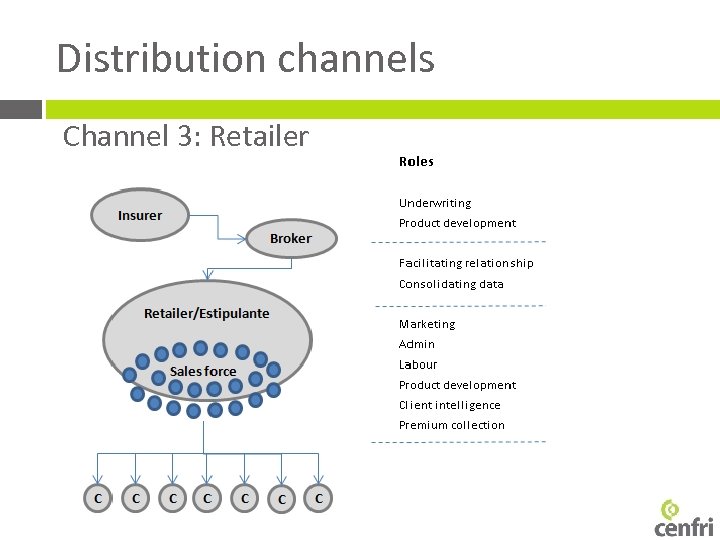
Distribution channels Channel 3: Retailer
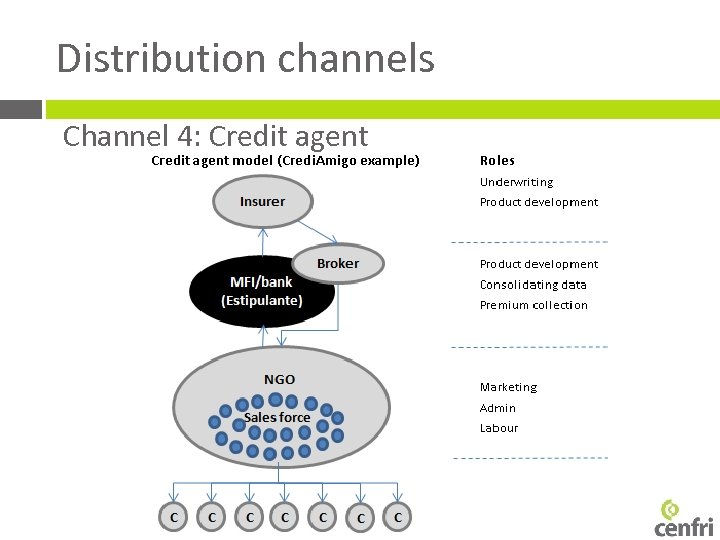
Distribution channels Channel 4: Credit agent
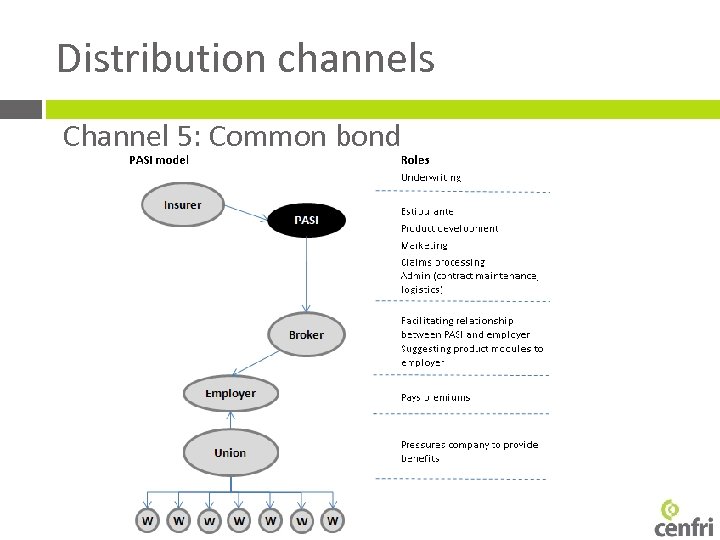
Distribution channels Channel 5: Common bond
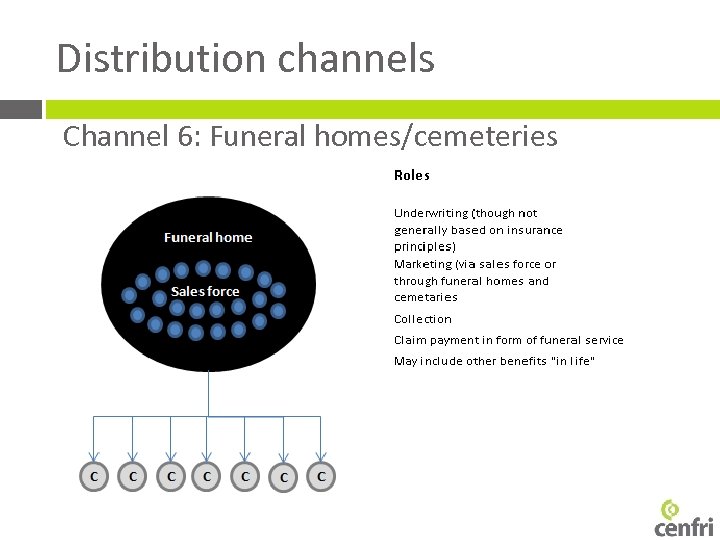
Distribution channels Channel 6: Funeral homes/cemeteries
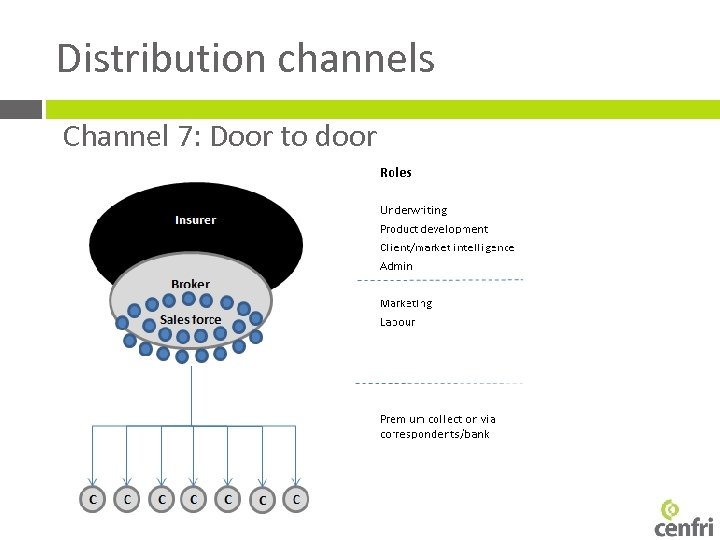
Distribution channels Channel 7: Door to door
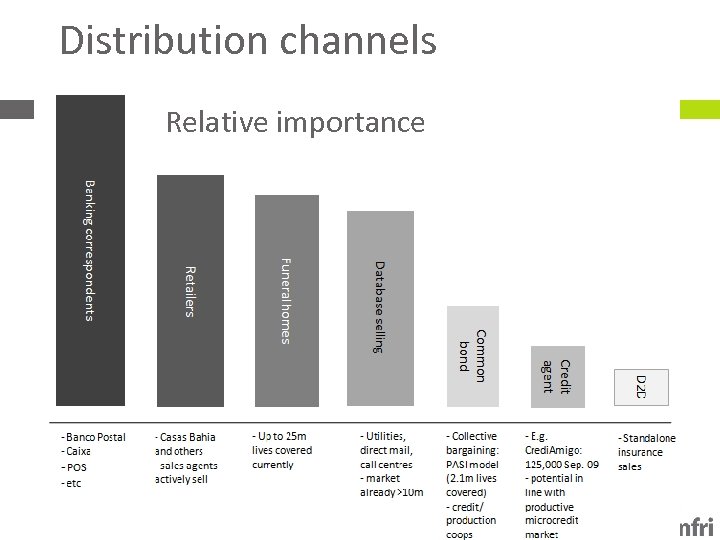
Distribution channels Relative importance
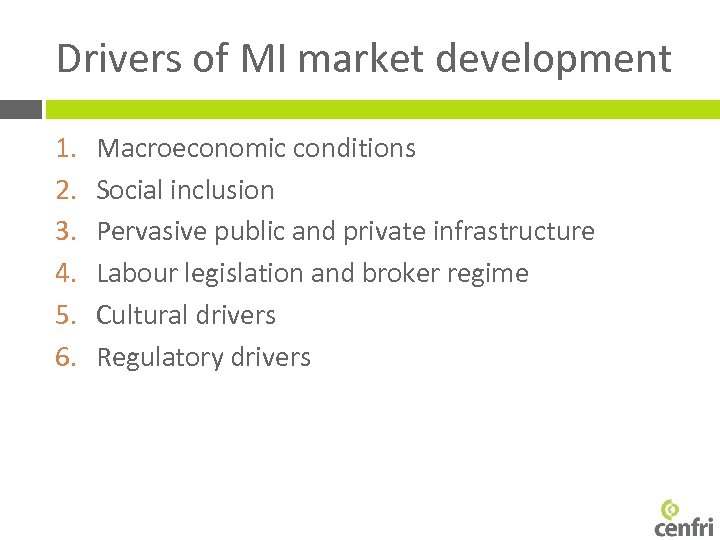
Drivers of MI market development 1. 2. 3. 4. 5. 6. Macroeconomic conditions Social inclusion Pervasive public and private infrastructure Labour legislation and broker regime Cultural drivers Regulatory drivers
Macroeconomic conditions 1. Economic growth increases income 2. Stability: regaining trust in long-term financial products 3. But inflation expectations persist 4. The need to rebuild cash-savings (VGBL)
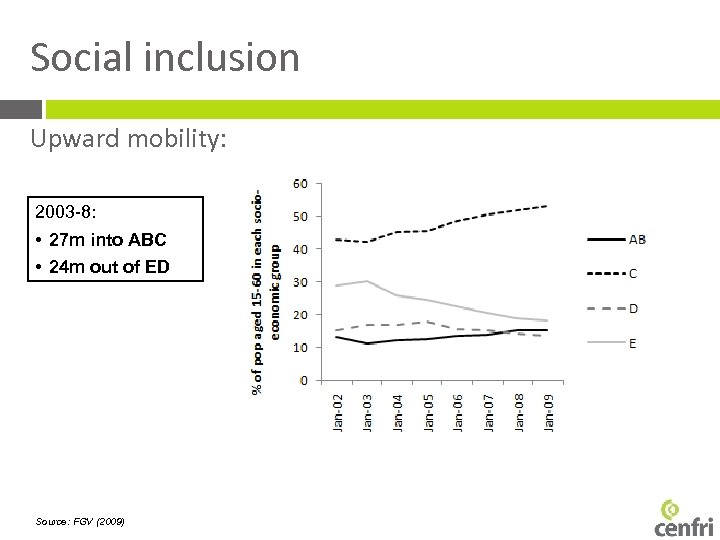
Social inclusion Upward mobility: 2003 -8: • 27 m into ABC • 24 m out of ED Source: FGV (2009)
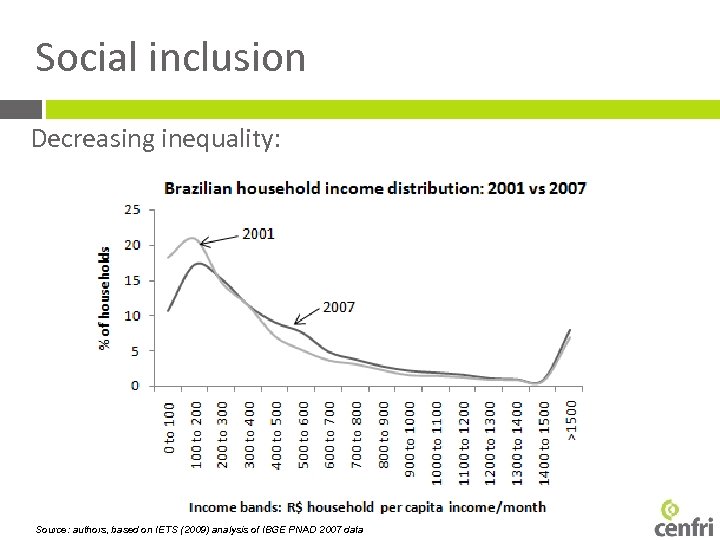
Social inclusion Decreasing inequality: Source: authors, based on IETS (2009) analysis of IBGE PNAD 2007 data
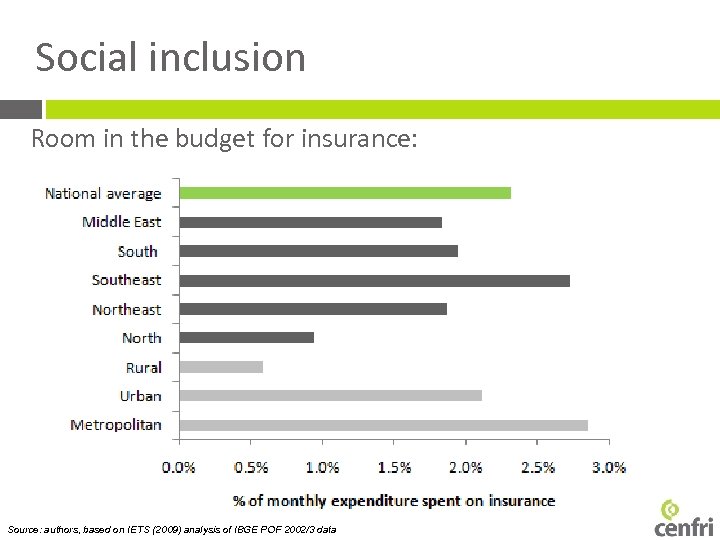
Social inclusion Room in the budget for insurance: Source: authors, based on IETS (2009) analysis of IBGE POF 2002/3 data
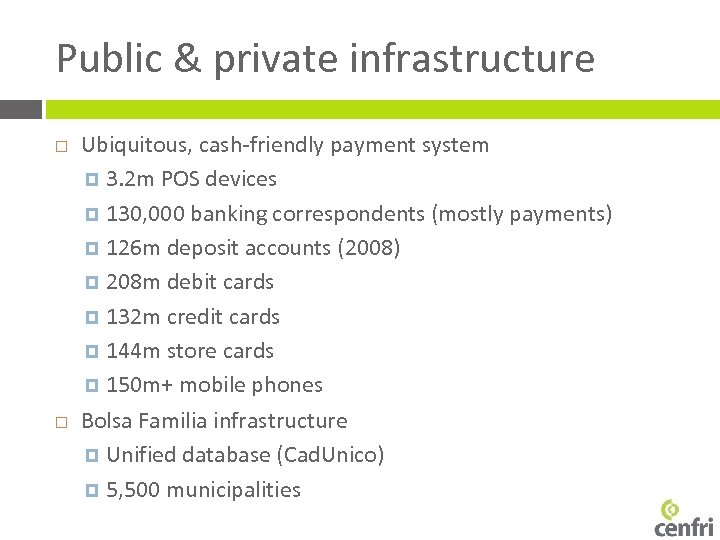
Public & private infrastructure Ubiquitous, cash-friendly payment system 3. 2 m POS devices 130, 000 banking correspondents (mostly payments) 126 m deposit accounts (2008) 208 m debit cards 132 m credit cards 144 m store cards 150 m+ mobile phones Bolsa Familia infrastructure Unified database (Cad. Unico) 5, 500 municipalities
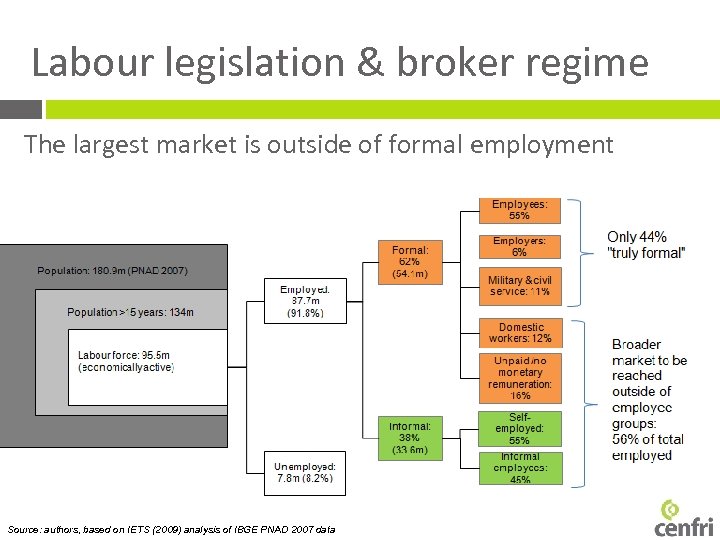
Labour legislation & broker regime The largest market is outside of formal employment Source: authors, based on IETS (2009) analysis of IBGE PNAD 2007 data
Labour legislation & broker regime Longer distribution chains & larger costs Disproportionate power to aggregators Product design driven by aggregator interests
Cultural drivers Aspiring poor – the growth of consumerism Brazilians are passionate about life, not death
Regulatory drivers 1. 2. 3. 4. Flexibility to adjust regulation Increased compliance costs Restrictive health regulation Large tax burden
Regulatory drivers Flexibility to adjust regulation Modular capital requirements Demarcation not restrictive Ability to change registration and compliance requirements based on semi-standardised product categories Scope for ticket sales Can facilitate new distribution models
Regulatory drivers Compliance costs Bank-based premium collection Registration requirements Reporting & other requirements
Regulatory drivers Restrictive health regulation Prescribed minimum benefits Price controls Micro health plans not allowed
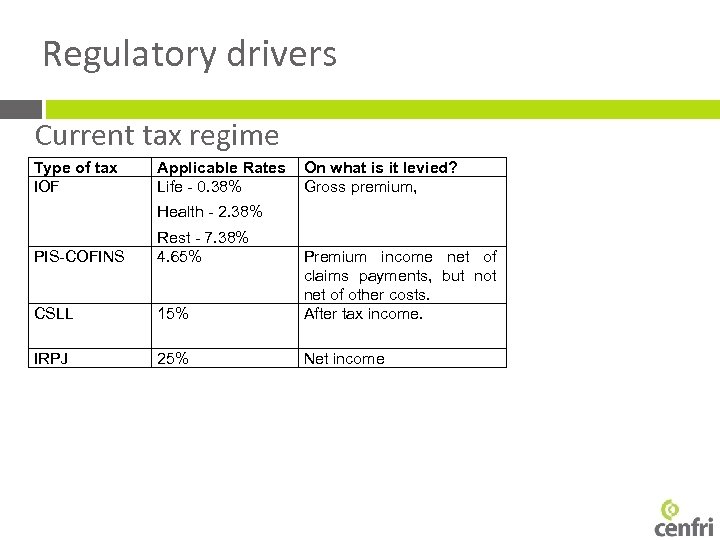
Regulatory drivers Current tax regime Type of tax IOF Applicable Rates Life - 0. 38% On what is it levied? Gross premium, Health - 2. 38% PIS-COFINS Rest - 7. 38% 4. 65% CSLL 15% Premium income net of claims payments, but not net of other costs. After tax income. IRPJ 25% Net income
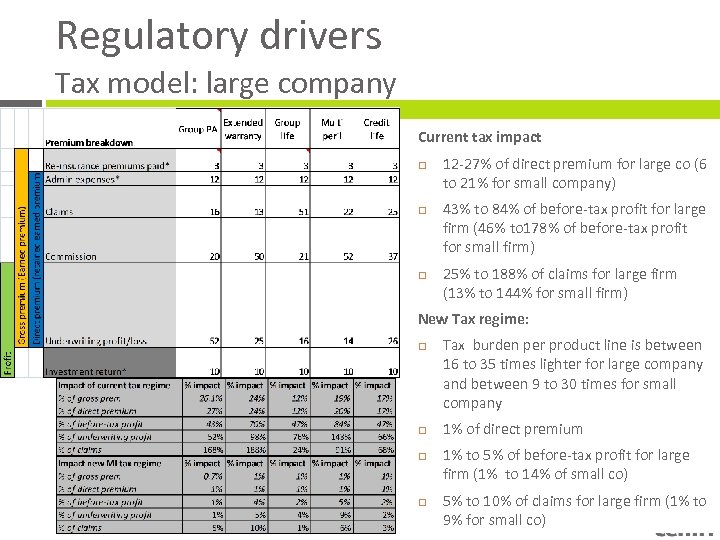
Regulatory drivers Tax model: large company Current tax impact 12 -27% of direct premium for large co (6 to 21% for small company) 43% to 84% of before-tax profit for large firm (46% to 178% of before-tax profit for small firm) 25% to 188% of claims for large firm (13% to 144% for small firm) New Tax regime: Tax burden per product line is between 16 to 35 times lighter for large company and between 9 to 30 times for small company 1% of direct premium 1% to 5% of before-tax profit for large firm (1% to 14% of small co) 5% to 10% of claims for large firm (1% to 9% for small co)
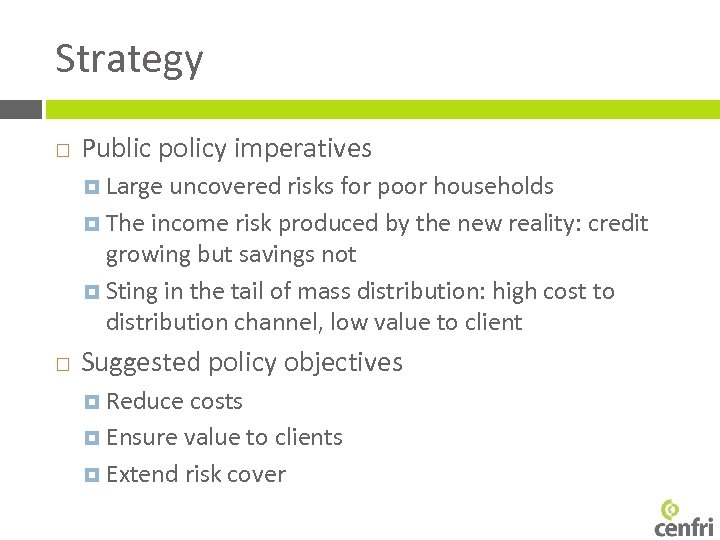
Strategy Public policy imperatives Large uncovered risks for poor households The income risk produced by the new reality: credit growing but savings not Sting in the tail of mass distribution: high cost to distribution channel, low value to client Suggested policy objectives Reduce costs Ensure value to clients Extend risk cover
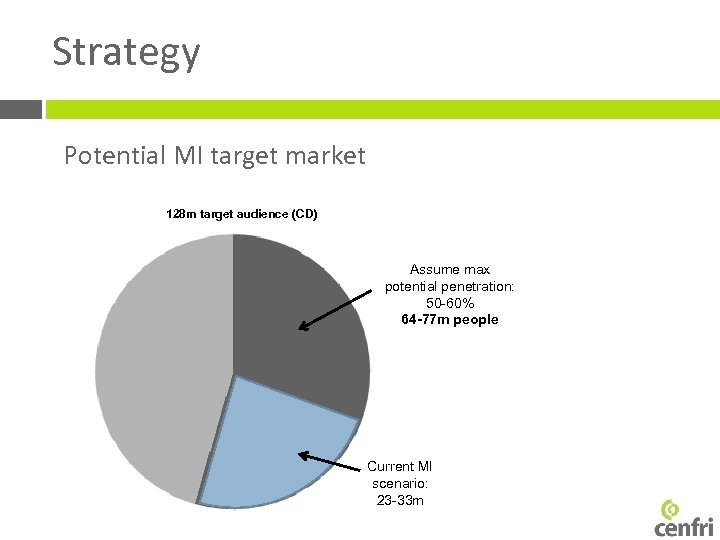
Strategy Potential MI target market 128 m target audience (CD) Assume max potential penetration: 50 -60% 64 -77 m people Current MI scenario: 23 -33 m
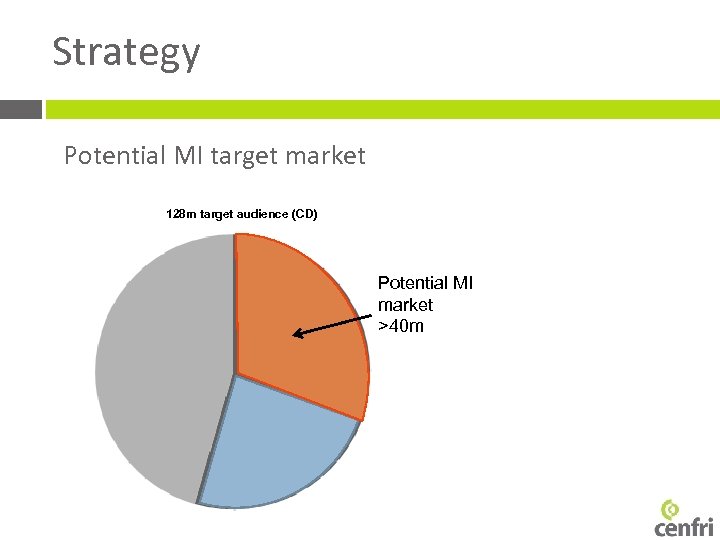
Strategy Potential MI target market 128 m target audience (CD) Potential MI market >40 m
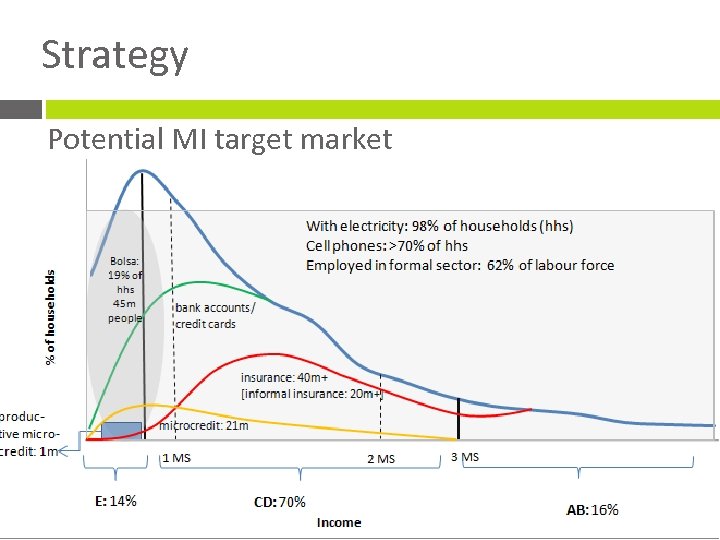
Strategy Potential MI target market
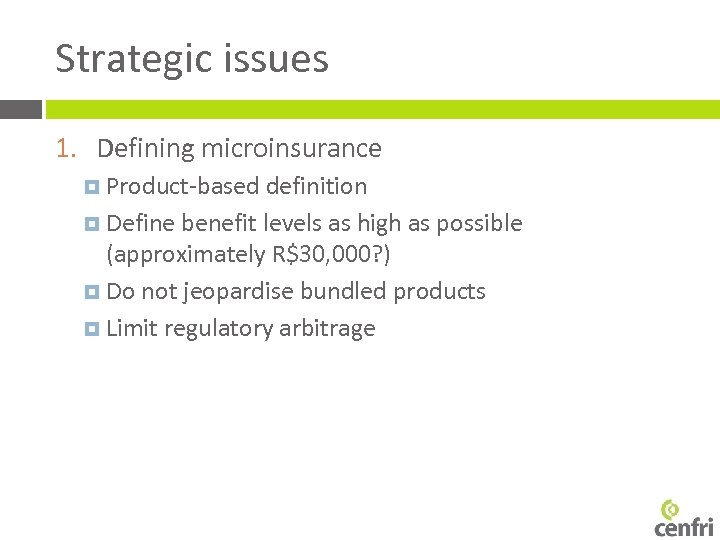
Strategic issues 1. Defining microinsurance Product-based definition Define benefit levels as high as possible (approximately R$30, 000? ) Do not jeopardise bundled products Limit regulatory arbitrage
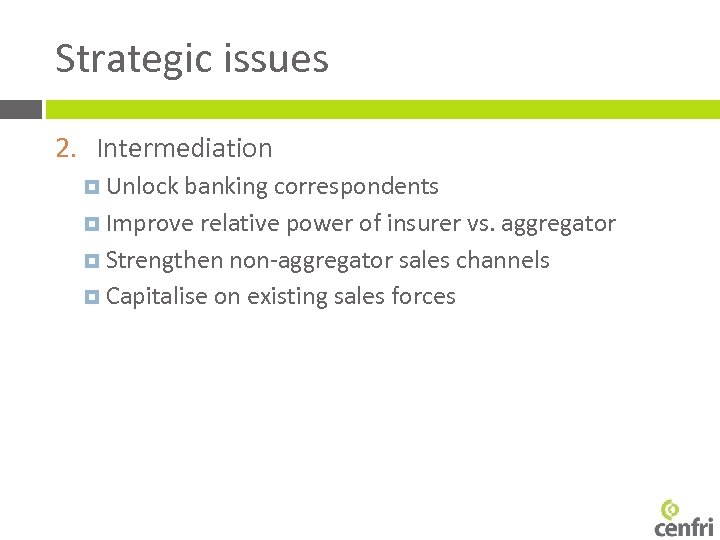
Strategic issues 2. Intermediation Unlock banking correspondents Improve relative power of insurer vs. aggregator Strengthen non-aggregator sales channels Capitalise on existing sales forces
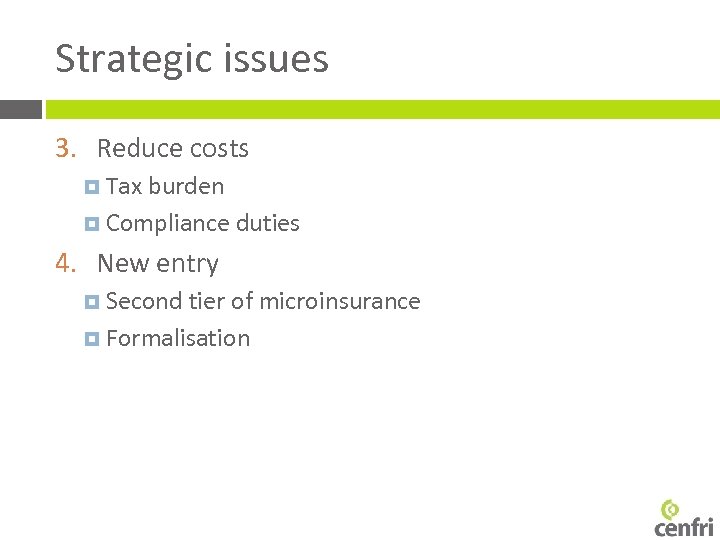
Strategic issues 3. Reduce costs Tax burden Compliance duties 4. New entry Second tier of microinsurance Formalisation
Thank you Questions or comments: hennie@cenfri. org christine@cenfri. org
Скачать презентацию MICROINSURANCE IN BRAZIL OPPORTUNITIES FOR MARKET DEVELOPMENT CNSeg
c1119c368589e49f4f1ae0bea5c2339f.ppt