


 Скачать презентацию Microgravity Analysis Software System MASS Software of the
c3bf76d01de33375e915151df12ba8e0.ppt
- Количество слайдов: 31
 Microgravity Analysis Software System (MASS) Software of the Year Presentation NASA Glenn Research Center Kevin M. Mc. Pherson June 19, 2002 19 -Jun-2002 1
 Microgravity Analysis Software System (MASS) Presentation Outline • MASS Video • Introduction to MASS • MASS Technical Overview • Usability • Quality • Innovation • Impacts on the Microgravity Scientific Community 19 -Jun-2002 2
 Microgravity Analysis Software System (MASS) Introduction • MASS provides a one of a kind capability throughout the world in microgravity acceleration data processing and analysis “One of two prime requirements for NASA’s ISS is to provide a microgravity platform as a controlled laboratory environment for experimentation by life and physical science researchers. In order to utilize this laboratory and analyze any experimental data, one must measure and provide acceleration environment levels both through a predictive historical database and as real-time data to experimenters. The on-board acceleration measurements and MASS are the only system that provide this service to the ISS partners. ” • • Dr. Carlos Grodsinsky Director of Technology/Microgravity Environment Program Manager, Zin Technologies, Inc. • MASS provides excellent support to the international microgravity research community and its world class recognition continues to grow within the international microgravity community • • • 19 -Jun-2002 Microgravity Advanced Research and Support Center (MARS) European Space Agency (ESA) Russian Academy of Sciences Canadian Space Agency (CSA) National Space Development Agency of Japan (NASDA) Brazilian Space Agency 3
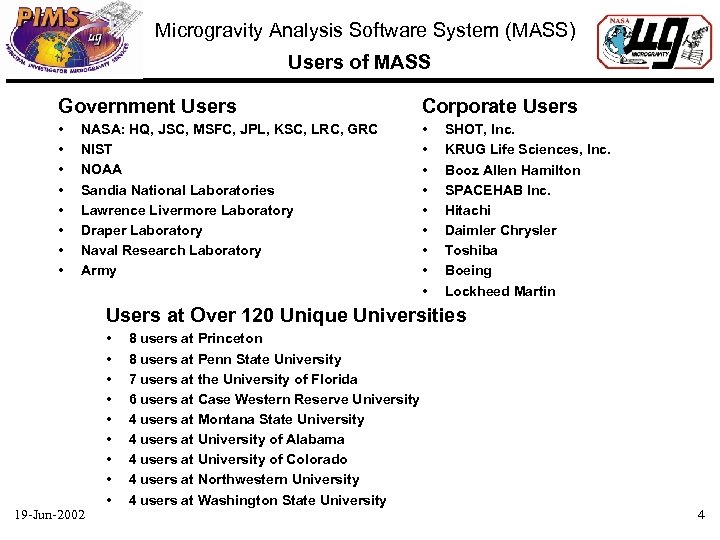 Microgravity Analysis Software System (MASS) Users of MASS Government Users Corporate Users • • • • • NASA: HQ, JSC, MSFC, JPL, KSC, LRC, GRC NIST NOAA Sandia National Laboratories Lawrence Livermore Laboratory Draper Laboratory Naval Research Laboratory Army SHOT, Inc. KRUG Life Sciences, Inc. Booz Allen Hamilton SPACEHAB Inc. Hitachi Daimler Chrysler Toshiba Boeing Lockheed Martin Users at Over 120 Unique Universities 19 -Jun-2002 • • • 8 users at Princeton 8 users at Penn State University 7 users at the University of Florida 6 users at Case Western Reserve University 4 users at Montana State University 4 users at University of Alabama 4 users at University of Colorado 4 users at Northwestern University 4 users at Washington State University 4
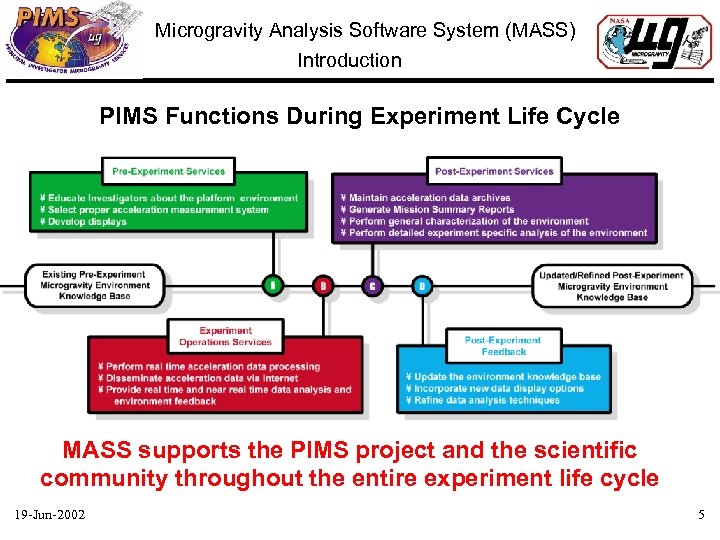 Microgravity Analysis Software System (MASS) Introduction PIMS Functions During Experiment Life Cycle MASS supports the PIMS project and the scientific community throughout the entire experiment life cycle 19 -Jun-2002 5
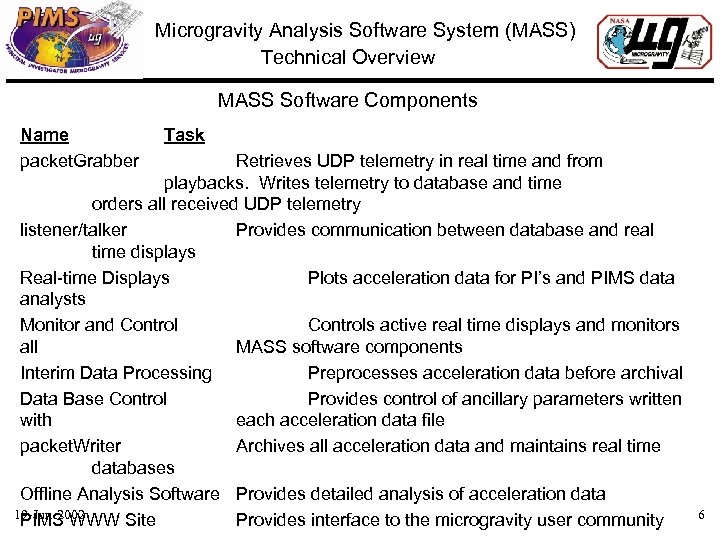 Microgravity Analysis Software System (MASS) Technical Overview MASS Software Components Name packet. Grabber Task Retrieves UDP telemetry in real time and from playbacks. Writes telemetry to database and time orders all received UDP telemetry listener/talker Provides communication between database and real time displays Real-time Displays Plots acceleration data for PI’s and PIMS data analysts Monitor and Controls active real time displays and monitors all MASS software components Interim Data Processing Preprocesses acceleration data before archival Data Base Control Provides control of ancillary parameters written with each acceleration data file packet. Writer Archives all acceleration data and maintains real time databases Offline Analysis Software Provides detailed analysis of acceleration data 19 -Jun-2002 PIMS WWW Site Provides interface to the microgravity user community 6
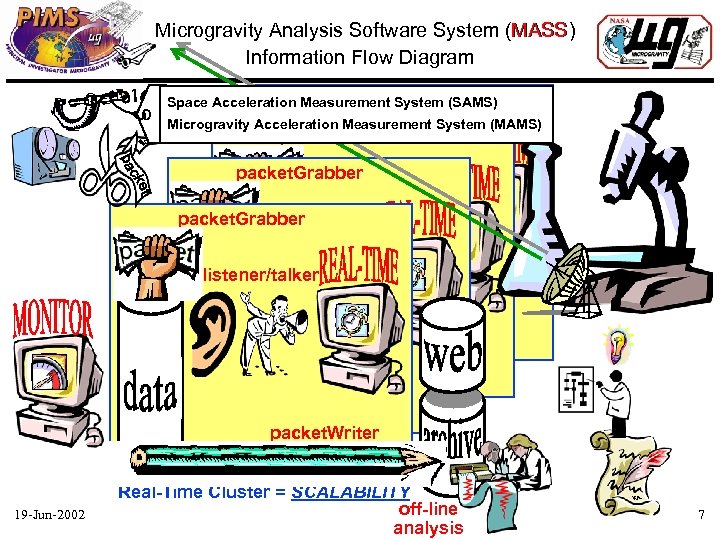 Microgravity Analysis Software System (MASS) MASS Information Flow Diagram packet. Grabber Space Acceleration Measurement System (SAMS) Microgravity Acceleration Measurement System (MAMS) packet. Grabber listener/talker packet. Writer 19 -Jun-2002 Real-Time Cluster = SCALABILITY off-line analysis 7
 Microgravity Analysis Software System (MASS) Usability • Flexibility and adaptability of MASS allows support of a microgravity community with a great deal of variability in their support requirements and their operational capabilities • Expertise in the analysis and interpretation of acceleration data make MASS software and MASS software products easy to use with excellent technical support “MASS has met and/or exceeded our user requirements in all areas, extending from ease of use, to both speed and diversity of data representation. We are able to review ISS accelerometer data using MASS and get a clear mental picture of what the ISS microgravity environment is, what the threats are, and how the environment is trending from Increment to Increment. ” • • 19 -Jun-2002 Dr. Roy Christofferson, Dr. Craig Schafer JSC - SAIC Technology Services Company 8
 Microgravity Analysis Software System (MASS) Usability • MASS user documentation and training is provided through an annual class called the Microgravity Environment Interpretation Tutorial (MEIT) Using data enabled by MASS, this 3 day class presents information about the acceleration environment of reduced gravity platforms • Previous year’s tutorials are accessible through the PIMS web site • Past attendees include scientists and researchers from the United States, Russia, The Netherlands, Italy, Brazil, Japan, England, and France • “I gained a solid understanding of the fundamentals/concerns/issues of designing – building – running an experiment in microgravity” • “Attending the tutorial was an exceptionally good experience for me. The tutorial was well organized, clear, and the collective expertise was impressive. The latter especially showed in the professional way all questions were answered. It was a pleasure to attend the tutorial and I will be happy to recommend it to my friends and colleagues. ” • “The information presented should help both Payload Developers and Principal Investigators to better understand the acceleration environment in which their experiment will be performed and correlate research results with the data representing the perturbations on the ISS. ” • 19 -Jun-2002 9
 Microgravity Analysis Software System (MASS) Usability • MASS user documentation and training is further provided for astronaut classes to educate the astronauts on the importance of maintaining a quiet microgravity environment Half day class targeted at crew impacts on the microgravity environment and educating the astronaut candidates on understanding the scientific sensitivities to variations in the microgravity environment • • MASS has developed a Microgravity Environment Description Handbook (MEDH) that summarizes various key disturbance sources on the Space Shuttle and Mir Space Station • A disturbance handbook for the International Space Station is currently in development 19 -Jun-2002 10
 Microgravity Analysis Software System (MASS) Quality • Maintainability Extensive use is made of Concurrent Versions System (CVS) for configuration management and software revision control • Used to maintain configuration management for all aspects of MASS, extending even to the operating system configuration files for the real time cluster • MASS offline subsystem designed in MATLAB in a modular fashion for ease of maintenance • • Code Reuse packet. Writer component uses an object-oriented class hierarchy to allow sharing of code between different packet types • Real time displays share common Lab. VIEW virtual instruments (VI) to minimize the effort to develop display applications • Offline analysis system employs a core infrastructure that is easily extended to allow new output formats with minimal impact to existing code • 19 -Jun-2002 11
 Microgravity Analysis Software System (MASS) Quality • Testability Testing program utilized known data from previous STS missions to verify the integrity of the offline and real time systems • Tested MASS response to a variety of packet delivery problems • Any software changes desired/required for the operational system are verified in the MASS development laboratory which has access to a real time data stream that is identical to the data stream routed to the operational real time systems • • Data Verification Independent predictive models generated by JSC and MSFC have been verified using acceleration data provided by MASS • - 19 -Jun-2002 MSFC – Microgravity Analysis Work Station (MAWS) JSC – Space Station Multi-Rigid Body Simulation Model (SSMRBS) 12
 Microgravity Analysis Software System (MASS) Quality • Data Integrity/Data Availability MASS products are publicly available through “mirroring” concept. Actual acceleration data files and plotted images are protected behind a separate firewall • Linux operating system employed on the real time cluster for its low maintenance and high reliability qualities. This keeps real time systems fully functional and available for the receipt and processing of new acceleration data packets • Have not required any data playbacks of acceleration data as a consequence of a problem with the real time systems. This means real time acceleration data plotted images are always available to the scientific community Data transfers between computers employ SSH encrypting and authenticating for images or binary data files • • Upgradability/Modifiability/Scalability MASS designed to easily accommodate additional acceleration measurement sensors and acceleration measurement systems • - MASS employs a cluster of computers for any acceleration data processing As required by the scientific community, new display applications and data manipulations can be added to MASS realtime and offline subsystems • 19 -Jun-2002 13
 Microgravity Analysis Software System (MASS) Innovation • MASS provides ground breaking capabilities in microgravity measurement processing, analysis, and interpretation • Analysis Techniques Thirteen major types of analysis techniques employed by MASS • Color spectrograms, Power Spectral Density, and time domain plots have been carefully developed to extract a maximum amount of useful information • New techniques such as Principal Component Spectral Analysis (PCSA) and Quasi -steady Three-dimensional Histogram (QTH) plots have been developed to provide meaningful data from long time intervals in a summary type fashion • • Development of Quasi-steady Virtual Accelerometer MASS is the only software capable of mapping quasi-steady accelerations to any point within an orbiting spacecraft • This novel concept is extremely useful for investigators who cannot accommodate an accelerometer at their experiment location, but still require the knowledge of the microgravity environment during experiment execution • 19 -Jun-2002 14
 Microgravity Analysis Software System (MASS) Innovation • Deployment Design MASS capability is designed to be easily deployed at the facility of a remotely located microgravity investigator • Specialized hardware and software license prerequisites are not required • MASS currently deployed only at the GRC TSC. ISS microgravity investigations started in May, 2001 and the acceleration measurement systems supported by MASS were among the first experiments on board the ISS • MASS was released for external use in January, 2002 and it may take some time for external experiments to ask for MASS to be deployed at their experiment locations • Individual MASS components packet. Grabber’s multithreaded design decouples critical network access routines (acceleration data packet reading) from database access routines to eliminate data loss • Talker/listener pair provides robust, high speed access to the real time databases used by Lab. VIEW display applications which are far superior in performance to the Lab. VIEW provided database access methodologies • 19 -Jun-2002 15
 Microgravity Analysis Software System (MASS) Innovation • Development of Standardized Storage Format PIMS Acceleration Data (PAD) file format developed to provide a standard data archive format to the microgravity community, regardless of accelerometer system or International affiliation • Each PAD file containing acceleration data has a sister meta file containing data describing the circumstances under which the acceleration data were obtained • As NASDA and ESA based acceleration measurement systems get deployed on the ISS, the PAD storage format will be invaluable to the microgravity scientific community • 19 -Jun-2002 16
 Microgravity Analysis Software System (MASS) Impacts on the Microgravity Scientific Community • Five user requirements/capabilities scenarios supported by MASS Scenario #1: Microgravity Scientist requires real time access to acceleration data displays and real time acceleration data analysis • Scenario #2: Microgravity Scientist requires real time acceleration data analysis • Scenario #3: Microgravity Scientist requires near real time acceleration data displays or access to near real time acceleration data • Scenario #4: Microgravity Scientist requires offline access to acceleration data archives for specialized analysis by the PI team • Scenario #5: Microgravity Scientist requires offline analysis of acceleration data by the MASS data analysts • • Examples of MASS support in real time, near real time, and offline Real time example for Scenario #1 – TEMPUS experiment during MSL-1 (STS 83/STS-94) • Near real time example for Scenario #3 – SOFBALL experiment during MSL-1 (STS -83/STS-94) • Offline examples for Scenario #5 – Examples of detailed analysis capabilities provide by the offline subsystem • 19 -Jun-2002 17
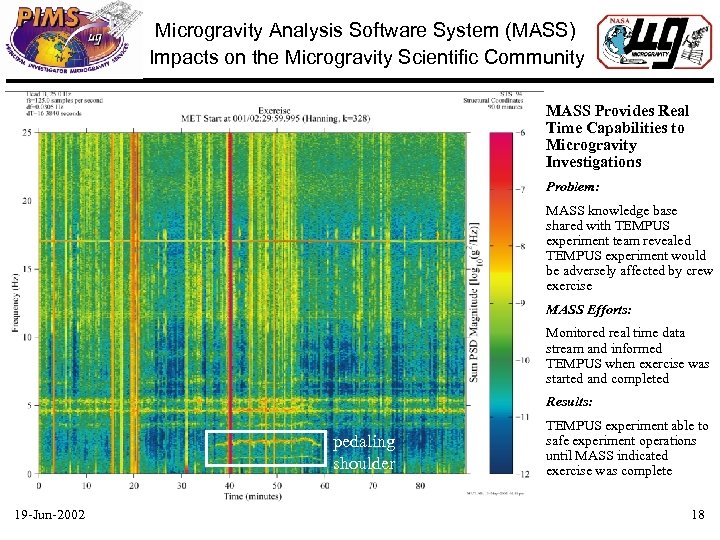 Microgravity Analysis Software System (MASS) Impacts on the Microgravity Scientific Community MASS Provides Real Time Capabilities to Microgravity Investigations Problem: MASS knowledge base shared with TEMPUS experiment team revealed TEMPUS experiment would be adversely affected by crew exercise MASS Efforts: Monitored real time data stream and informed TEMPUS when exercise was started and completed Results: pedaling shoulder sway 19 -Jun-2002 TEMPUS experiment able to safe experiment operations until MASS indicated exercise was complete 18
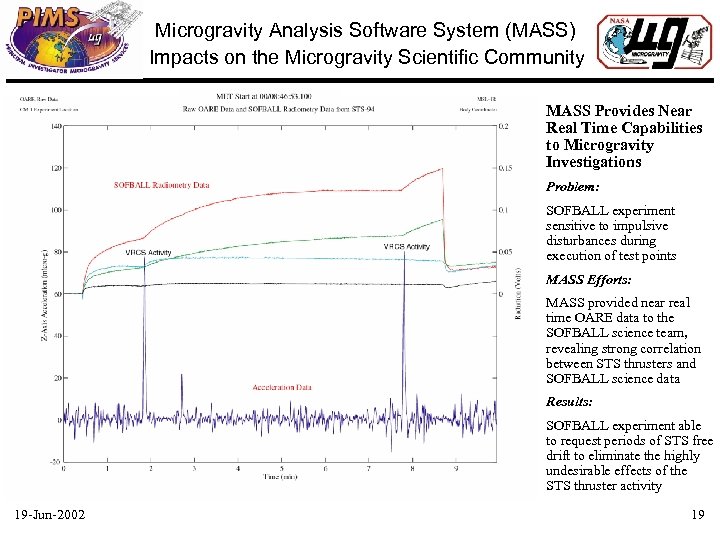 Microgravity Analysis Software System (MASS) Impacts on the Microgravity Scientific Community MASS Provides Near Real Time Capabilities to Microgravity Investigations Problem: SOFBALL experiment sensitive to impulsive disturbances during execution of test points MASS Efforts: MASS provided near real time OARE data to the SOFBALL science team, revealing strong correlation between STS thrusters and SOFBALL science data Results: SOFBALL experiment able to request periods of STS free drift to eliminate the highly undesirable effects of the STS thruster activity 19 -Jun-2002 19
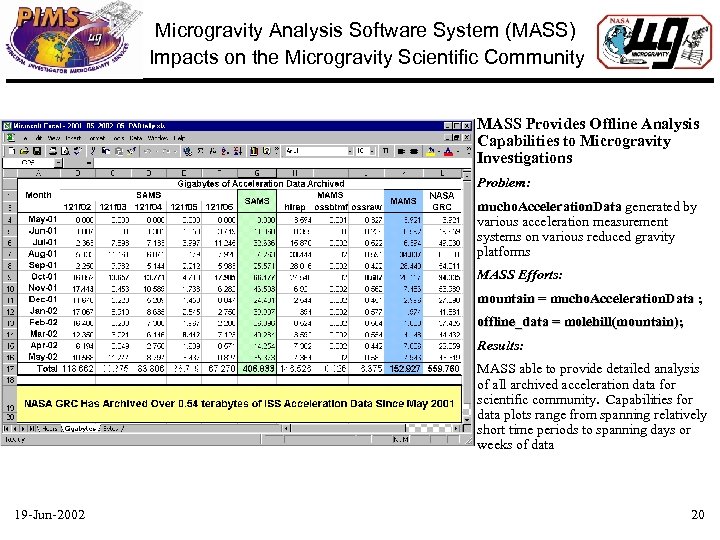 Microgravity Analysis Software System (MASS) Impacts on the Microgravity Scientific Community MASS Provides Offline Analysis Capabilities to Microgravity Investigations Problem: mucho. Acceleration. Data generated by various acceleration measurement systems on various reduced gravity platforms MASS Efforts: mountain = mucho. Acceleration. Data ; offline_data = molehill(mountain); Results: MASS able to provide detailed analysis of all archived acceleration data for scientific community. Capabilities for data plots range from spanning relatively short time periods to spanning days or weeks of data 19 -Jun-2002 20
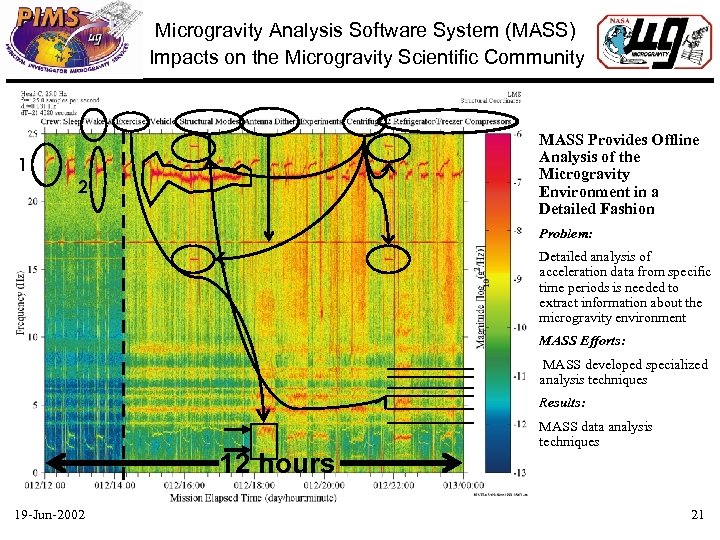 Microgravity Analysis Software System (MASS) Impacts on the Microgravity Scientific Community MASS Provides Offline Analysis of the Microgravity Environment in a Detailed Fashion 1 2 Problem: Detailed analysis of acceleration data from specific time periods is needed to extract information about the microgravity environment MASS Efforts: MASS developed specialized analysis techniques Results: 12 hours 19 -Jun-2002 MASS data analysis techniques 21
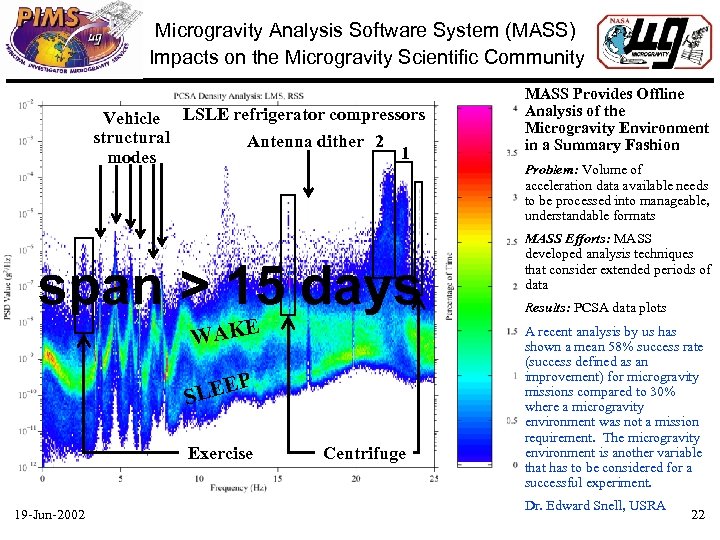 Microgravity Analysis Software System (MASS) Impacts on the Microgravity Scientific Community Vehicle LSLE refrigerator compressors structural Antenna dither 2 1 modes span > 15 days WAKE P E SLE Exercise 19 -Jun-2002 Centrifuge MASS Provides Offline Analysis of the Microgravity Environment in a Summary Fashion Problem: Volume of acceleration data available needs to be processed into manageable, understandable formats MASS Efforts: MASS developed analysis techniques that consider extended periods of data Results: PCSA data plots A recent analysis by us has shown a mean 58% success rate (success defined as an improvement) for microgravity missions compared to 30% where a microgravity environment was not a mission requirement. The microgravity environment is another variable that has to be considered for a successful experiment. Dr. Edward Snell, USRA 22
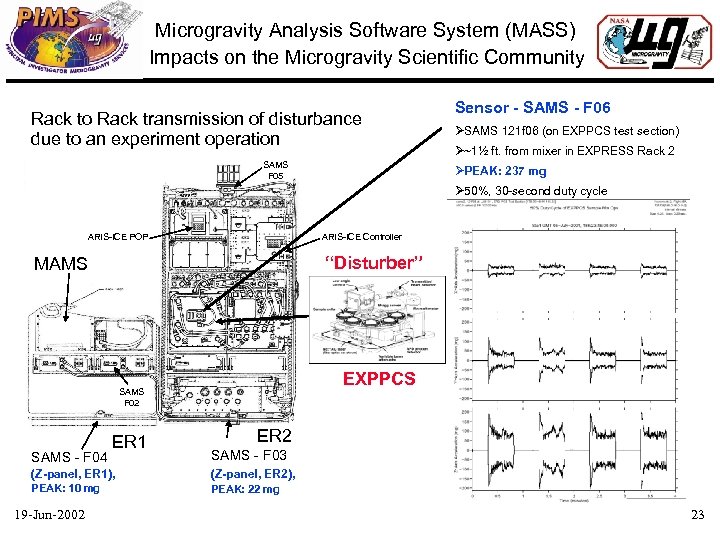 Microgravity Analysis Software System (MASS) Impacts on the Microgravity Scientific Community Rack to Rack transmission of disturbance due to an experiment operation SAMS F 05 Sensor - SAMS - F 06 ØSAMS 121 f 06 (on EXPPCS test section) Ø~1½ ft. from mixer in EXPRESS Rack 2 ØPEAK: 237 mg Ø 50%, 30 -second duty cycle ARIS-ICE POP ARIS-ICE Controller “Disturber” MAMS EXPPCS SAMS F 02 SAMS - F 04 ER 1 ER 2 SAMS - F 03 (Z-panel, ER 1), (Z-panel, ER 2), PEAK: 10 mg PEAK: 22 mg 19 -Jun-2002 23
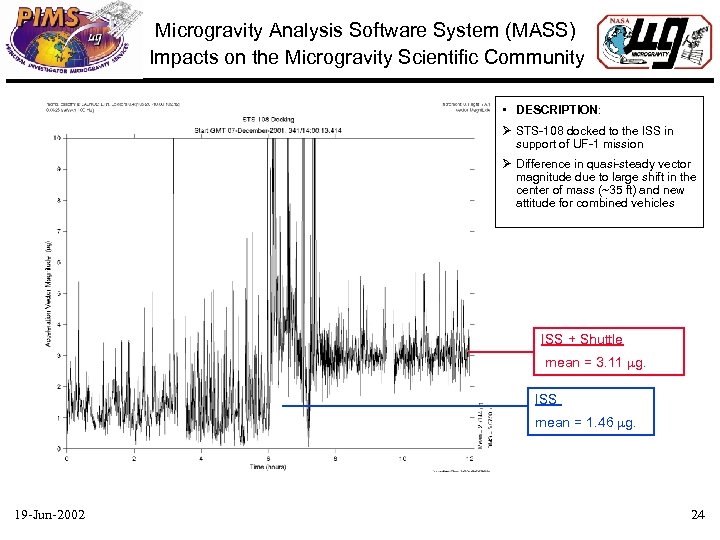 Microgravity Analysis Software System (MASS) Impacts on the Microgravity Scientific Community • DESCRIPTION: Ø STS-108 docked to the ISS in support of UF-1 mission Ø Difference in quasi-steady vector magnitude due to large shift in the center of mass (~35 ft) and new attitude for combined vehicles ISS + Shuttle mean = 3. 11 g. ISS mean = 1. 46 g. 19 -Jun-2002 24
 Microgravity Analysis Software System (MASS) Impacts on the Microgravity Scientific Community • “The information provided by MASS is crucially important for planning future experiments aboard the ISS. It is essential for determining what limits experiments must have due to the microgravity environment, and how to properly timeline experiments to avoid events that would be unfavorable…Overall, we have found the services provided by PIMS and MASS have not only been useful, but indispensable for our work. The information we need is readily accessible, well organized, and easy to understand. ” • David J. Rowenhorst, CSLM 2 Materials Science and Engineering, Northwestern University 19 -Jun-2002 25
 Microgravity Analysis Software System (MASS) Summary • MASS will continue to support the microgravity scientific community over the life of the International Space Station (> 10 years) • MASS will expand its support of various acceleration measurement systems by providing analysis and processing capabilities for NASDA and ESA provided ISS acceleration measurement systems as they are deployed on the ISS • MASS will expand services to the scientific community through additional WWW based services (including acceleration data neural network) and through deployment of MASS components outside of the GRC TSC as the International Space Station continues its development • MASS will continue to provide ground breaking capabilities in microgravity measurement processing, analysis, and interpretation to the national and international microgravity community 19 -Jun-2002 26
 Microgravity Analysis Software System (MASS) Backup Charts for MASS SOYA Presentation 19 -Jun-2002 27
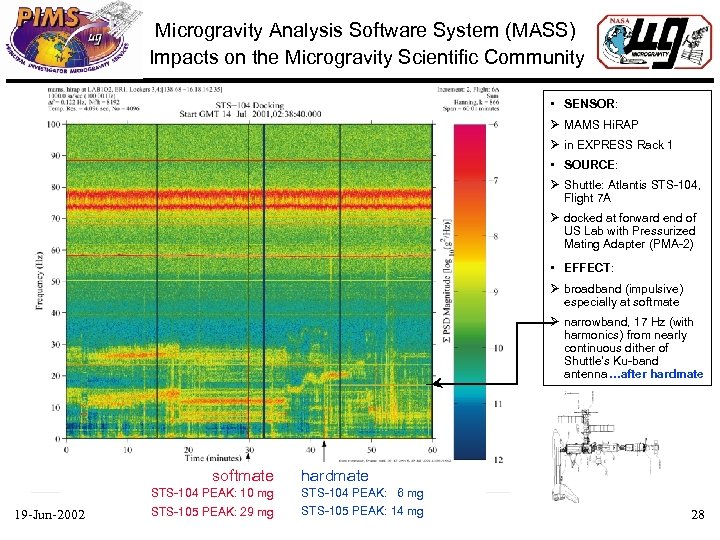 Microgravity Analysis Software System (MASS) Impacts on the Microgravity Scientific Community • SENSOR: Ø MAMS Hi. RAP Ø in EXPRESS Rack 1 • SOURCE: Ø Shuttle: Atlantis STS-104, Flight 7 A Ø docked at forward end of US Lab with Pressurized Mating Adapter (PMA-2) • EFFECT: Ø broadband (impulsive) especially at softmate Ø narrowband, 17 Hz (with harmonics) from nearly continuous dither of Shuttle’s Ku-band antenna …after hardmate softmate hardmate STS-104 PEAK: 10 mg 19 -Jun-2002 STS-104 PEAK: 6 mg STS-105 PEAK: 29 mg STS-105 PEAK: 14 mg 28
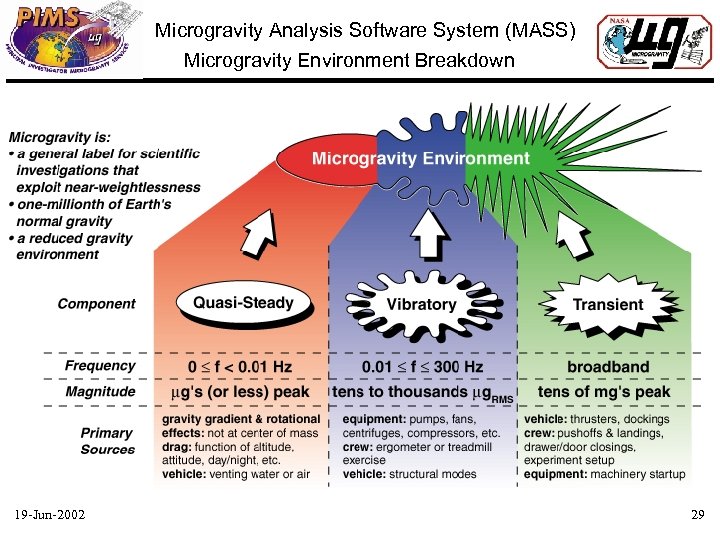 Microgravity Analysis Software System (MASS) Microgravity Environment Breakdown 19 -Jun-2002 29
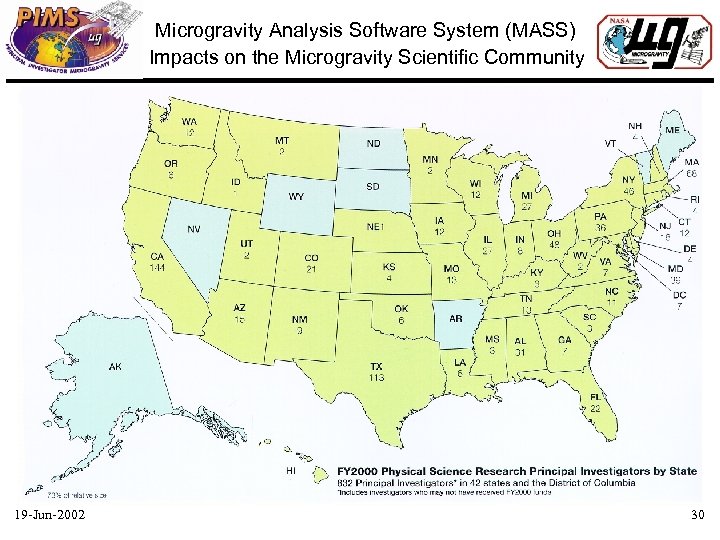 Microgravity Analysis Software System (MASS) Impacts on the Microgravity Scientific Community 19 -Jun-2002 30
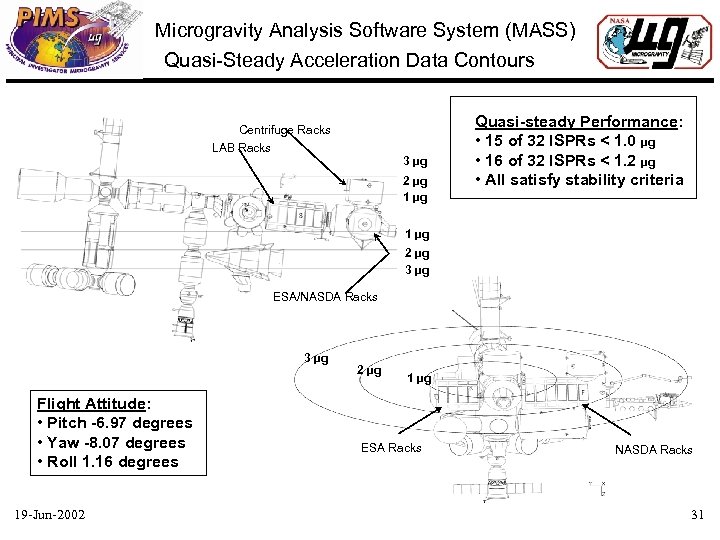 Microgravity Analysis Software System (MASS) Quasi-Steady Acceleration Data Contours Centrifuge Racks LAB Racks 3 µg 2 µg 1 µg Quasi-steady Performance: • 15 of 32 ISPRs < 1. 0 µg • 16 of 32 ISPRs < 1. 2 µg • All satisfy stability criteria 1 µg 2 µg 3 µg ESA/NASDA Racks 3 µg Flight Attitude: • Pitch -6. 97 degrees • Yaw -8. 07 degrees • Roll 1. 16 degrees 19 -Jun-2002 2 µg 1 µg ESA Racks NASDA Racks 31