 Скачать презентацию Microfluidic Devices for in situ Biological and Chemical
d013eb163a76579f80b34700160ef208.ppt
- Количество слайдов: 1



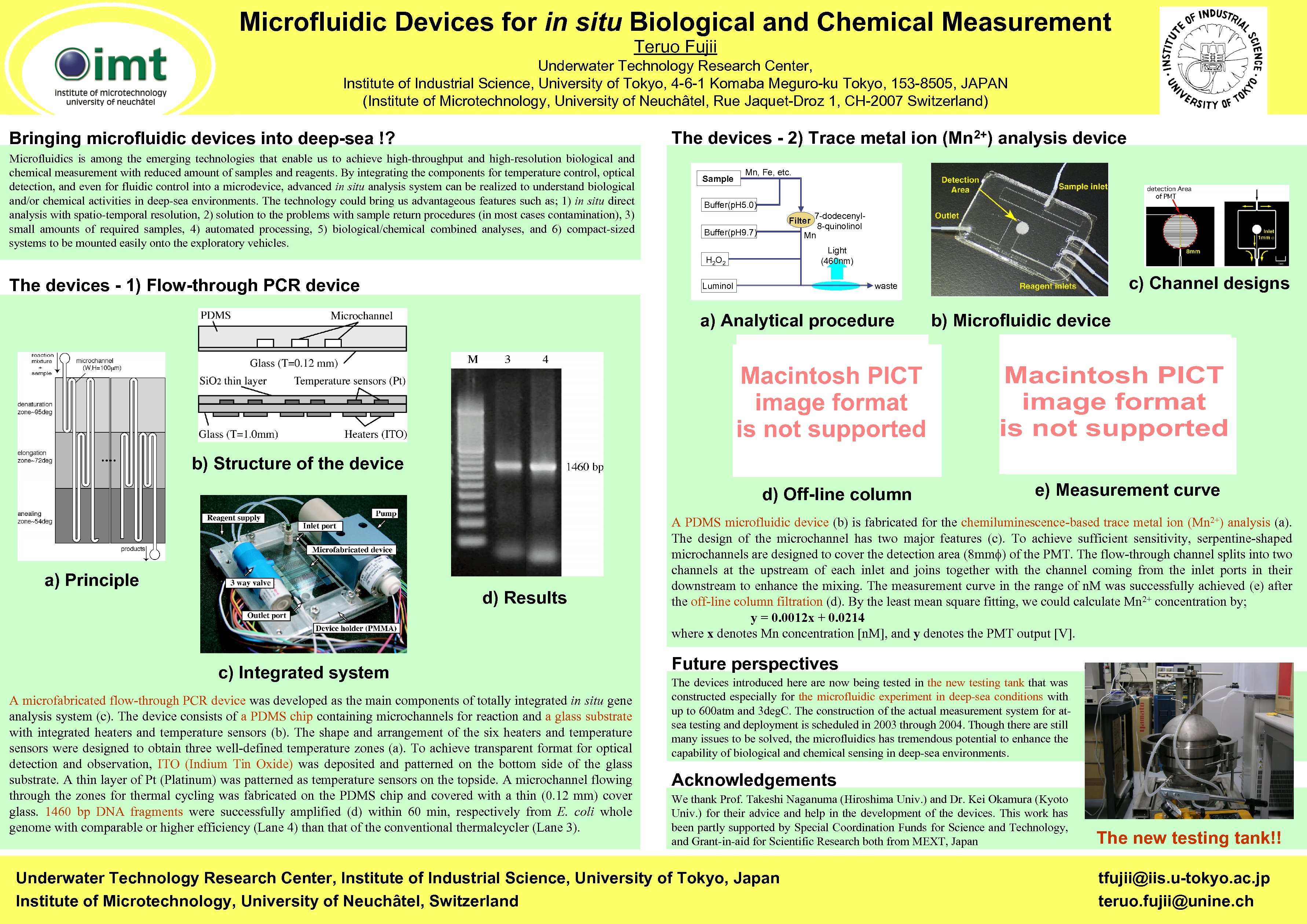
Microfluidic Devices for in situ Biological and Chemical Measurement Teruo Fujii Underwater Technology Research Center, Institute of Industrial Science, University of Tokyo, 4 -6 -1 Komaba Meguro-ku Tokyo, 153 -8505, JAPAN (Institute of Microtechnology, University of Neuchâtel, Rue Jaquet-Droz 1, CH-2007 Switzerland) The devices - 2) Trace metal ion Bringing microfluidic devices into deep-sea !? Microfluidics is among the emerging technologies that enable us to achieve high-throughput and high-resolution biological and chemical measurement with reduced amount of samples and reagents. By integrating the components for temperature control, optical detection, and even for fluidic control into a microdevice, advanced in situ analysis system can be realized to understand biological and/or chemical activities in deep-sea environments. The technology could bring us advantageous features such as; 1) in situ direct analysis with spatio-temporal resolution, 2) solution to the problems with sample return procedures (in most cases contamination), 3) small amounts of required samples, 4) automated processing, 5) biological/chemical combined analyses, and 6) compact-sized systems to be mounted easily onto the exploratory vehicles. Sample analysis device Mn, Fe, etc. Buffer(p. H 5. 0) 7 -dodecenyl 8 -quinol Mn Filter Buffer(p. H 9. 7) Light (460 nm) H 2 O 2 The devices - 1) Flow-through PCR device 2+) (Mn Luminol c) Channel designs waste a) Analytical procedure b) Microfluidic device b) Structure of the device d) Off-line column a) Principle d) Results c) Integrated system A microfabricated flow-through PCR device was developed as the main components of totally integrated in situ gene analysis system (c). The device consists of a PDMS chip containing microchannels for reaction and a glass substrate with integrated heaters and temperature sensors (b). The shape and arrangement of the six heaters and temperature sensors were designed to obtain three well-defined temperature zones (a). To achieve transparent format for optical detection and observation, ITO (Indium Tin Oxide) was deposited and patterned on the bottom side of the glass substrate. A thin layer of Pt (Platinum) was patterned as temperature sensors on the topside. A microchannel flowing through the zones for thermal cycling was fabricated on the PDMS chip and covered with a thin (0. 12 mm) cover glass. 1460 bp DNA fragments were successfully amplified (d) within 60 min, respectively from E. coli whole genome with comparable or higher efficiency (Lane 4) than that of the conventional thermalcycler (Lane 3). e) Measurement curve A PDMS microfluidic device (b) is fabricated for the chemiluminescence-based trace metal ion (Mn 2+) analysis (a). The design of the microchannel has two major features (c). To achieve sufficient sensitivity, serpentine-shaped microchannels are designed to cover the detection area (8 mmf) of the PMT. The flow-through channel splits into two channels at the upstream of each inlet and joins together with the channel coming from the inlet ports in their downstream to enhance the mixing. The measurement curve in the range of n. M was successfully achieved (e) after the off-line column filtration (d). By the least mean square fitting, we could calculate Mn 2+ concentration by; y = 0. 0012 x + 0. 0214 where x denotes Mn concentration [n. M], and y denotes the PMT output [V]. Future perspectives The devices introduced here are now being tested in the new testing tank that was constructed especially for the microfluidic experiment in deep-sea conditions with up to 600 atm and 3 deg. C. The construction of the actual measurement system for atsea testing and deployment is scheduled in 2003 through 2004. Though there are still many issues to be solved, the microfluidics has tremendous potential to enhance the capability of biological and chemical sensing in deep-sea environments. Acknowledgements We thank Prof. Takeshi Naganuma (Hiroshima Univ. ) and Dr. Kei Okamura (Kyoto Univ. ) for their advice and help in the development of the devices. This work has been partly supported by Special Coordination Funds for Science and Technology, and Grant-in-aid for Scientific Research both from MEXT, Japan Underwater Technology Research Center, Institute of Industrial Science, University of Tokyo, Japan Institute of Microtechnology, University of Neuchâtel, Switzerland The new testing tank!! tfujii@iis. u-tokyo. ac. jp teruo. fujii@unine. ch
Скачать презентацию Microfluidic Devices for in situ Biological and Chemical
d013eb163a76579f80b34700160ef208.ppt