 Скачать презентацию Microfinance Social Investor Roundtable Jordan June 5 2012
a215d668c3efeb3a7a4181a88dca103d.ppt
- Количество слайдов: 26



Microfinance Social Investor Roundtable Jordan, June 5, 2012
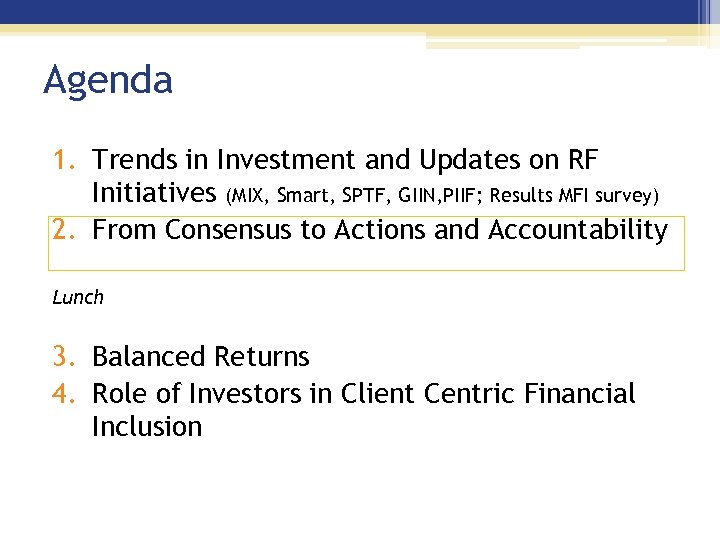
Agenda 1. Trends in Investment and Updates on RF Initiatives (MIX, Smart, SPTF, GIIN, PIIF; Results MFI survey) 2. From Consensus to Actions and Accountability Lunch 3. Balanced Returns 4. Role of Investors in Client Centric Financial Inclusion
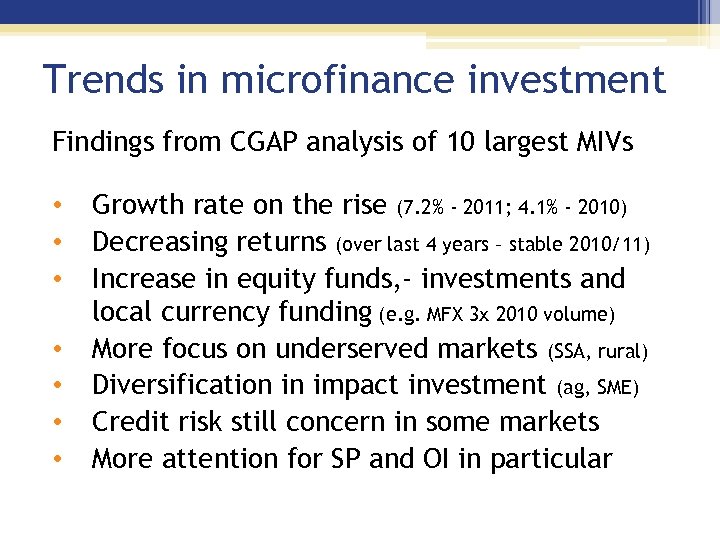
Trends in microfinance investment Findings from CGAP analysis of 10 largest MIVs • • Growth rate on the rise (7. 2% - 2011; 4. 1% - 2010) Decreasing returns (over last 4 years – stable 2010/11) Increase in equity funds, - investments and local currency funding (e. g. MFX 3 x 2010 volume) More focus on underserved markets (SSA, rural) Diversification in impact investment (ag, SME) Credit risk still concern in some markets More attention for SP and OI in particular
Updates from RF initiatives • • • MIX Smart Campaign Social Performance Task Force GIIN UNPRI/PIIF
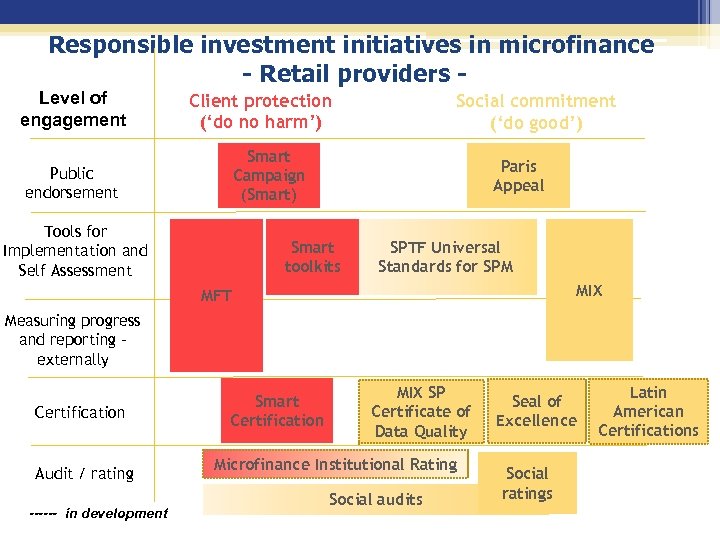
Responsible investment initiatives in microfinance - Retail providers Level of engagement Client protection (‘do no harm’) Smart Campaign (Smart) Public endorsement Tools for Implementation and Self Assessment Social commitment (‘do good’) MFT Paris Appeal Smart toolkits SPTF Universal Standards for SPM MIX MFT Measuring progress and reporting externally Certification Audit / rating ------ in development Smart Certification MIX SP Certificate of Data Quality Microfinance Institutional Rating Social audits Seal of Excellence Social ratings Latin American Certifications
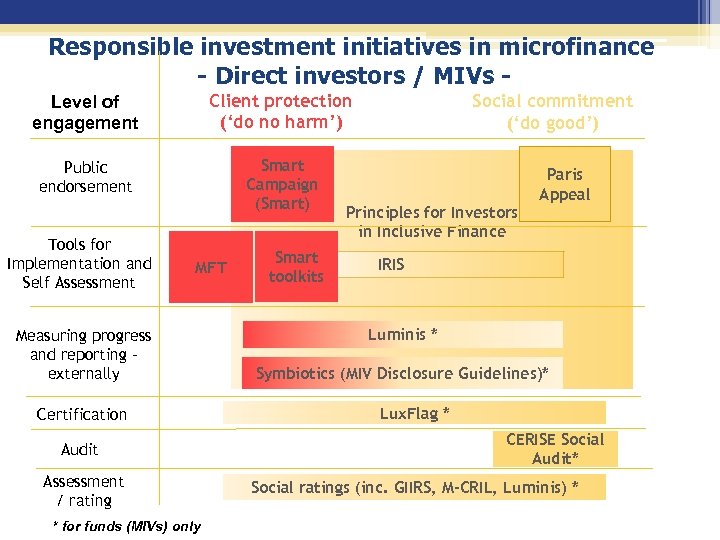
Responsible investment initiatives in microfinance - Direct investors / MIVs Level of engagement Client protection (‘do no harm’) Public endorsement Smart Campaign (Smart) Tools for Implementation and Self Assessment MFT Measuring progress and reporting externally Certification Audit Assessment / rating * for funds (MIVs) only Smart toolkits Social commitment (‘do good’) Principles for Investors in Inclusive Finance Paris Appeal IRIS Luminis * Symbiotics (MIV Disclosure Guidelines)* Lux. Flag * CERISE Social Audit* Social ratings (inc. GIIRS, M-CRIL, Luminis) *
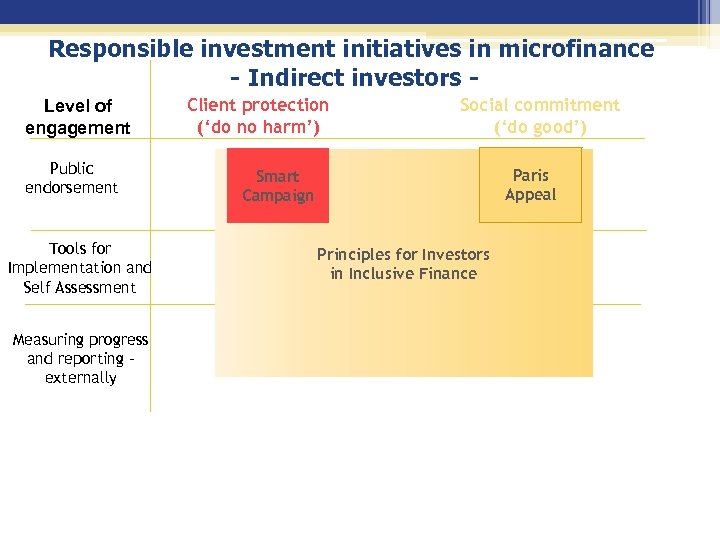
Responsible investment initiatives in microfinance - Indirect investors Level of engagement Public endorsement Tools for Implementation and Self Assessment Measuring progress and reporting externally Client protection (‘do no harm’) Social commitment (‘do good’) Paris Appeal Smart Campaign Principles for Investors in Inclusive Finance
Agenda 1. Trends in Investment and Updates on RF Initiatives (MIX, Smart, SPTF, GIIN, PIIF; Results MFI survey) 2. From Consensus to Actions and Accountability Lunch 3. Balanced Returns 4. Role of Investors in Client Centric Financial Inclusion
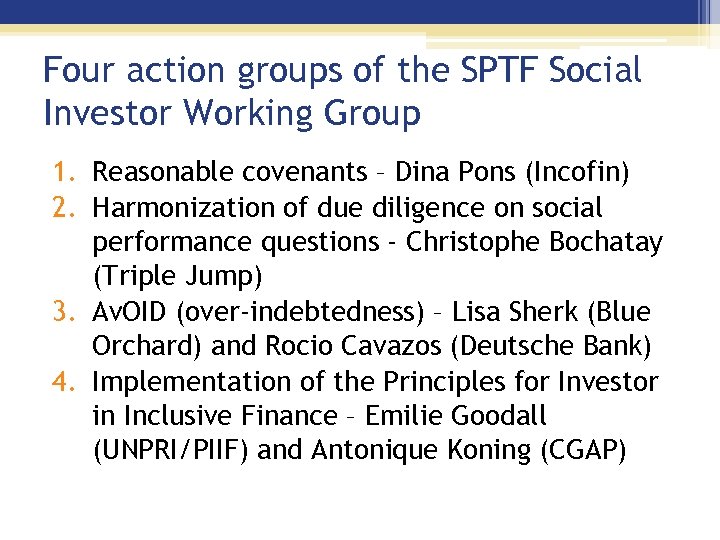
Four action groups of the SPTF Social Investor Working Group 1. Reasonable covenants – Dina Pons (Incofin) 2. Harmonization of due diligence on social performance questions - Christophe Bochatay (Triple Jump) 3. Av. OID (over-indebtedness) – Lisa Sherk (Blue Orchard) and Rocio Cavazos (Deutsche Bank) 4. Implementation of the Principles for Investor in Inclusive Finance – Emilie Goodall (UNPRI/PIIF) and Antonique Koning (CGAP)
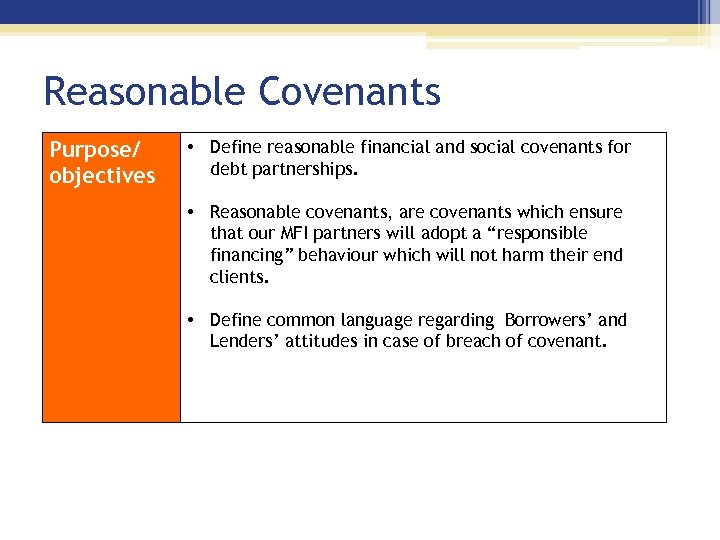
Reasonable Covenants Purpose/ objectives • Define reasonable financial and social covenants for debt partnerships. • Reasonable covenants, are covenants which ensure that our MFI partners will adopt a “responsible financing” behaviour which will not harm their end clients. • Define common language regarding Borrowers’ and Lenders’ attitudes in case of breach of covenant.
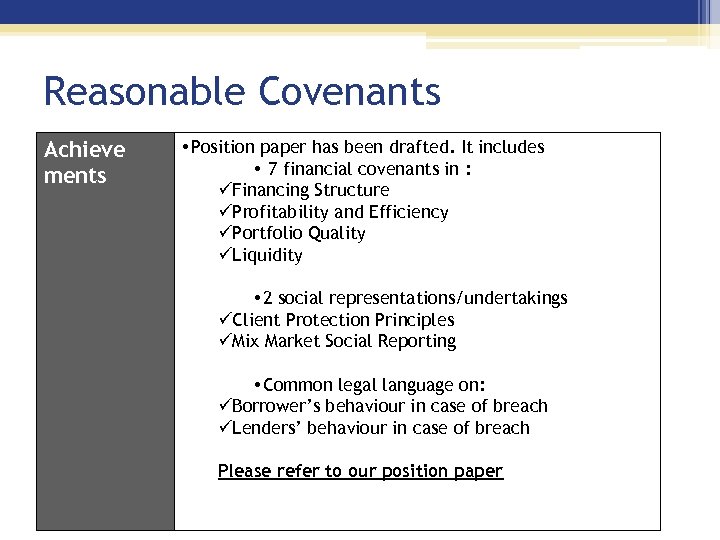
Reasonable Covenants Achieve ments • Position paper has been drafted. It includes • 7 financial covenants in : üFinancing Structure üProfitability and Efficiency üPortfolio Quality üLiquidity • 2 social representations/undertakings üClient Protection Principles üMix Market Social Reporting • Common legal language on: üBorrower’s behaviour in case of breach üLenders’ behaviour in case of breach Please refer to our position paper
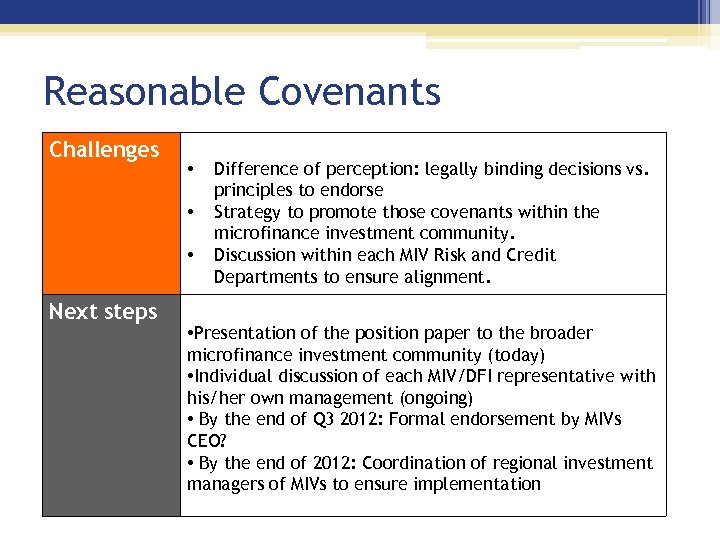
Reasonable Covenants Challenges • • • Next steps Difference of perception: legally binding decisions vs. principles to endorse Strategy to promote those covenants within the microfinance investment community. Discussion within each MIV Risk and Credit Departments to ensure alignment. • Presentation of the position paper to the broader microfinance investment community (today) • Individual discussion of each MIV/DFI representative with his/her own management (ongoing) • By the end of Q 3 2012: Formal endorsement by MIVs CEO? • By the end of 2012: Coordination of regional investment managers of MIVs to ensure implementation
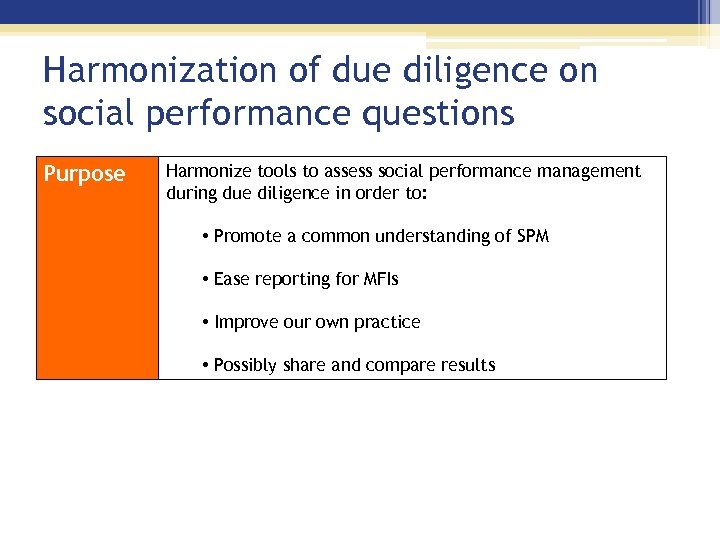
Harmonization of due diligence on social performance questions Purpose Harmonize tools to assess social performance management during due diligence in order to: • Promote a common understanding of SPM • Ease reporting for MFIs • Improve our own practice • Possibly share and compare results
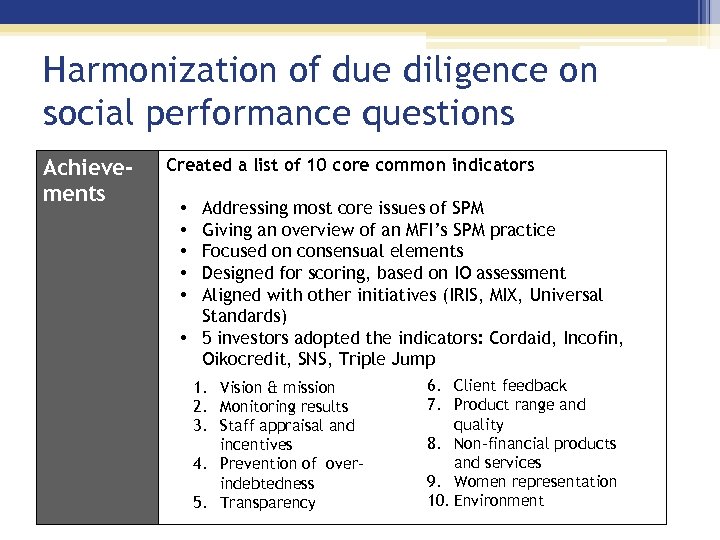
Harmonization of due diligence on social performance questions Achievements Created a list of 10 core common indicators Addressing most core issues of SPM Giving an overview of an MFI’s SPM practice Focused on consensual elements Designed for scoring, based on IO assessment Aligned with other initiatives (IRIS, MIX, Universal Standards) • 5 investors adopted the indicators: Cordaid, Incofin, Oikocredit, SNS, Triple Jump • • • 1. Vision & mission 2. Monitoring results 3. Staff appraisal and incentives 4. Prevention of overindebtedness 5. Transparency 6. Client feedback 7. Product range and quality 8. Non-financial products and services 9. Women representation 10. Environment
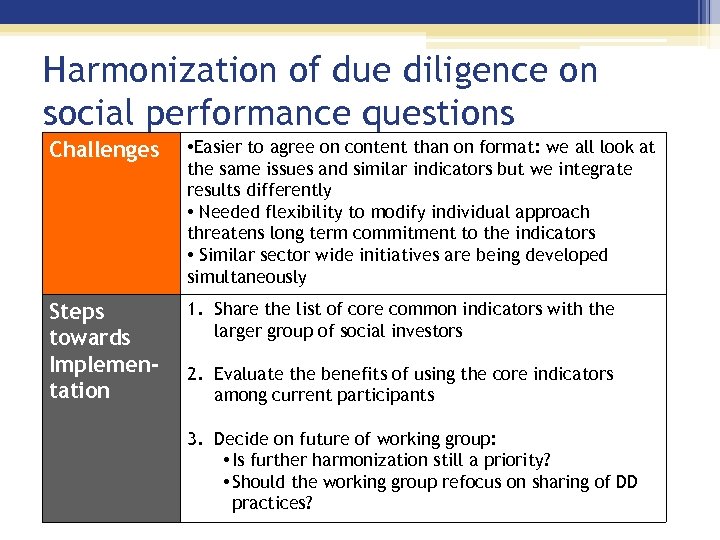
Harmonization of due diligence on social performance questions Challenges • Easier to agree on content than on format: we all look at the same issues and similar indicators but we integrate results differently • Needed flexibility to modify individual approach threatens long term commitment to the indicators • Similar sector wide initiatives are being developed simultaneously Steps towards Implementation 1. Share the list of core common indicators with the larger group of social investors 2. Evaluate the benefits of using the core indicators among current participants 3. Decide on future of working group: • Is further harmonization still a priority? • Should the working group refocus on sharing of DD practices?
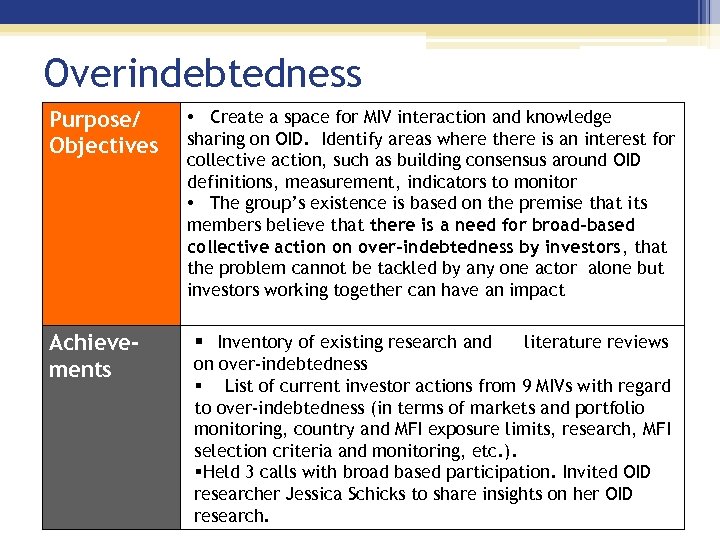
Overindebtedness Purpose/ Objectives Achievements • Create a space for MIV interaction and knowledge sharing on OID. Identify areas where there is an interest for collective action, such as building consensus around OID definitions, measurement, indicators to monitor • The group’s existence is based on the premise that its members believe that there is a need for broad-based collective action on over-indebtedness by investors, that the problem cannot be tackled by any one actor alone but investors working together can have an impact § Inventory of existing research and literature reviews on over-indebtedness § List of current investor actions from 9 MIVs with regard to over-indebtedness (in terms of markets and portfolio monitoring, country and MFI exposure limits, research, MFI selection criteria and monitoring, etc. ). §Held 3 calls with broad based participation. Invited OID researcher Jessica Schicks to share insights on her OID research.
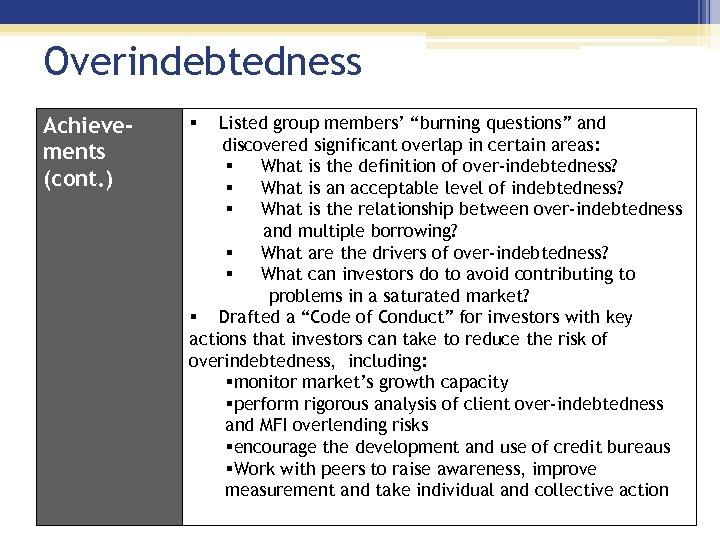
Overindebtedness Achievements (cont. ) Listed group members’ “burning questions” and discovered significant overlap in certain areas: § What is the definition of over-indebtedness? § What is an acceptable level of indebtedness? § What is the relationship between over-indebtedness and multiple borrowing? § What are the drivers of over-indebtedness? § What can investors do to avoid contributing to problems in a saturated market? § Drafted a “Code of Conduct” for investors with key actions that investors can take to reduce the risk of overindebtedness, including: §monitor market’s growth capacity §perform rigorous analysis of client over-indebtedness and MFI overlending risks §encourage the development and use of credit bureaus §Work with peers to raise awareness, improve measurement and take individual and collective action §
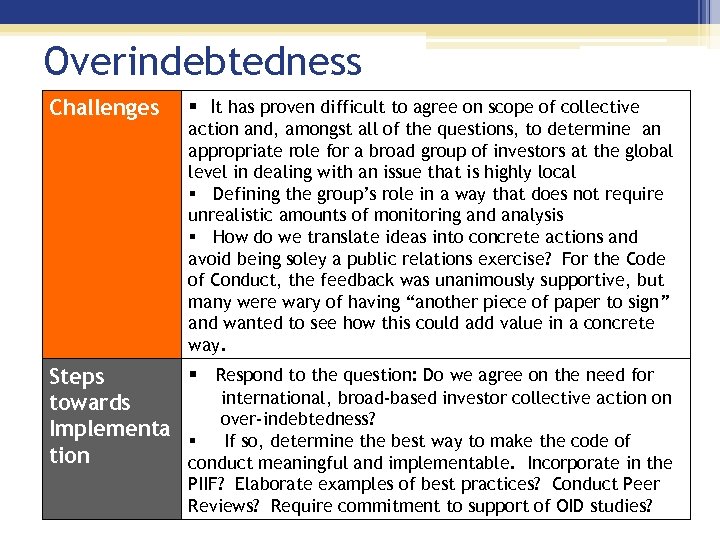
Overindebtedness Challenges § It has proven difficult to agree on scope of collective action and, amongst all of the questions, to determine an appropriate role for a broad group of investors at the global level in dealing with an issue that is highly local § Defining the group’s role in a way that does not require unrealistic amounts of monitoring and analysis § How do we translate ideas into concrete actions and avoid being soley a public relations exercise? For the Code of Conduct, the feedback was unanimously supportive, but many were wary of having “another piece of paper to sign” and wanted to see how this could add value in a concrete way. § Respond to the question: Do we agree on the need for Steps international, broad-based investor collective action on towards over-indebtedness? Implementa § If so, determine the best way to make the code of tion conduct meaningful and implementable. Incorporate in the PIIF? Elaborate examples of best practices? Conduct Peer Reviews? Require commitment to support of OID studies?
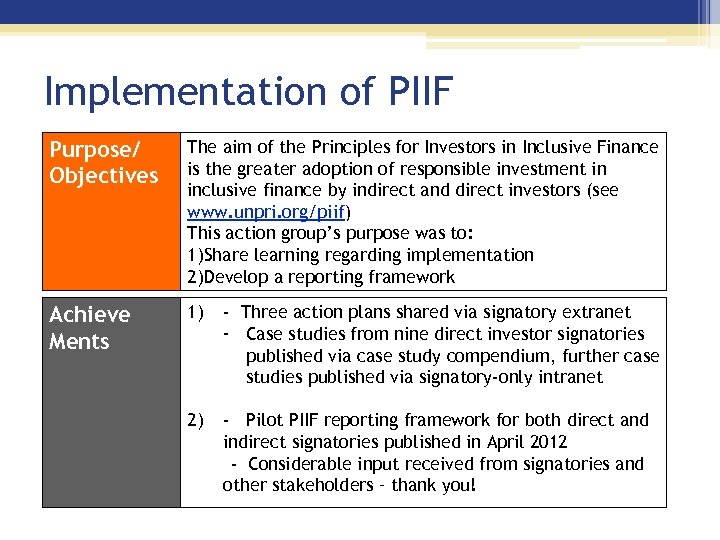
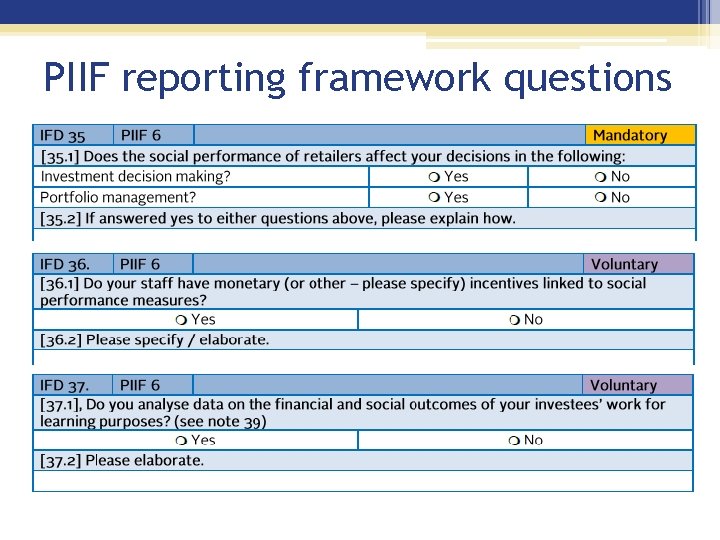
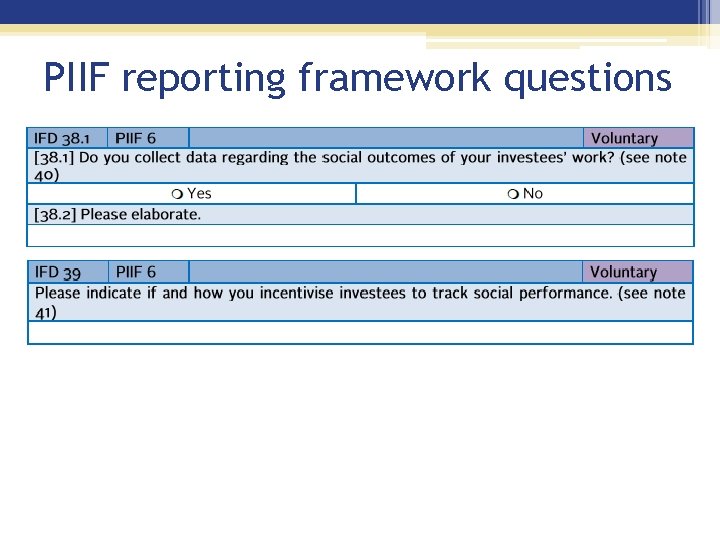
Implementation of PIIF Purpose/ Objectives The aim of the Principles for Investors in Inclusive Finance is the greater adoption of responsible investment in inclusive finance by indirect and direct investors (see www. unpri. org/piif) This action group’s purpose was to: 1)Share learning regarding implementation 2)Develop a reporting framework Achieve Ments 1) - Three action plans shared via signatory extranet - Case studies from nine direct investor signatories published via case study compendium, further case studies published via signatory-only intranet 2) - Pilot PIIF reporting framework for both direct and indirect signatories published in April 2012 - Considerable input received from signatories and other stakeholders – thank you!
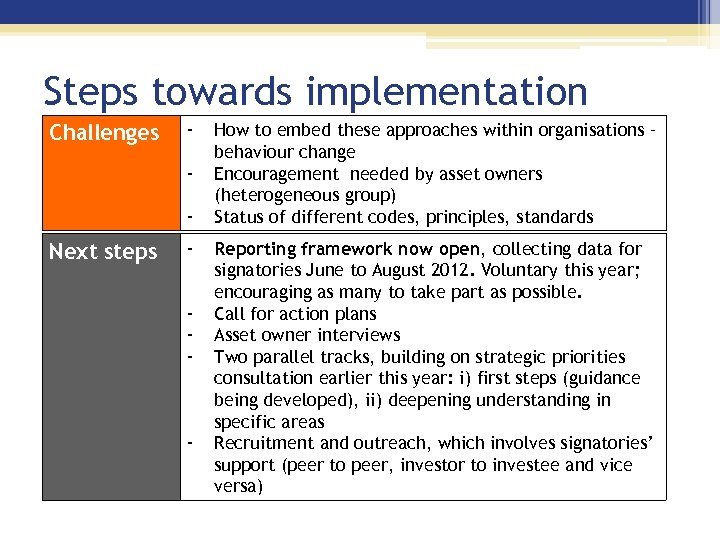
Steps towards implementation Challenges - Next steps - - How to embed these approaches within organisations – behaviour change Encouragement needed by asset owners (heterogeneous group) Status of different codes, principles, standards Reporting framework now open, collecting data for signatories June to August 2012. Voluntary this year; encouraging as many to take part as possible. Call for action plans Asset owner interviews Two parallel tracks, building on strategic priorities consultation earlier this year: i) first steps (guidance being developed), ii) deepening understanding in specific areas Recruitment and outreach, which involves signatories’ support (peer to peer, investor to investee and vice versa)
Agenda 1. Trends in Investment and Updates on RF Initiatives (MIX, Smart, SPTF, GIIN, PIIF; Results MFI survey) 2. From Consensus to Actions and Accountability Lunch 3. Balanced Returns 4. Role of Investors in Client Centric Financial Inclusion
Standards on Balanced Returns 1. For information: relationship between client protection and financial performance, research update 2. For discussion: exploring the Universal Standards for SPM, Section 6: Balance Financial and Social Performance 3. Linking to PIIF Principle 6: Balanced Returns
Universal Standards, Section 6 6. a. Growth rates are sustainable and appropriate for market conditions, allowing for high service quality. 6. b. The institution’s financing structure is appropriate to a double bottom line institution in its mix of sources, terms, and desired returns. 6. c. Pursuit of profits does not undermine the longterm sustainability of the institution or client wellbeing. 6. d. The institution offers compensation to senior managers that is appropriate to a double bottom line institution.
PIIF Principle 6: Balanced returns We will strive for a balanced long-term social and financial risk-adjusted return that recognizes the interests of clients, retail providers, and our investors. Possible actions: • Exercise voting rights when available. • When investing in equity, develop an engagement capability with investees to achieve a reasonable and fair alignment between the social impact and the financial return requirements of shareholders; i. e. focusing on long-term rather than short-term returns.
PIIF reporting framework questions
PIIF reporting framework questions
Скачать презентацию Microfinance Social Investor Roundtable Jordan June 5 2012
a215d668c3efeb3a7a4181a88dca103d.ppt