 Скачать презентацию Microeconomics Jan Fábry University of Economics Prague http
4ac711980c7bb12a85f7cba488c5be83.ppt
- Количество слайдов: 68




Microeconomics Jan Fábry University of Economics Prague http: //nb. vse. cz/~fabry ______________________________________ This project is co-financed by the European Union 1

Literature • Samuelson, P. , Nordhaus, W. D. Economics. • Mankiw, N. G. Principles of Microeconomics. www. swlearning. com/economics/mankiw/ mankiw 3 e/powerpoint_micro. html • Collander, D. Microeconomics. ______________________________________ This project is co-financed by the European Union 2
Course Information • Test in the middle of the course – at least 50% • Final Test – at least 50% • Presence – at least 60% ______________________________________ This project is co-financed by the European Union 3
Part 1 • Introduction into Economics • Macroeconomics & Microeconomics • Firm, Consumer, Market • Optimization & Equilibrium • Consumer Preferences • Utility, Consumer Surplus • Indifference Curves, Marginal Rate of Substitution • Budget Constraint • Consumer Optimum • Individual Demand • Market Demand ______________________________________ This project is co-financed by the European Union 4
Economics is the study of how people use their limited resources to satisfy unlimited wants Scarcity is a lack of available resources to satisfy all their desired uses ______________________________________ This project is co-financed by the European Union 5
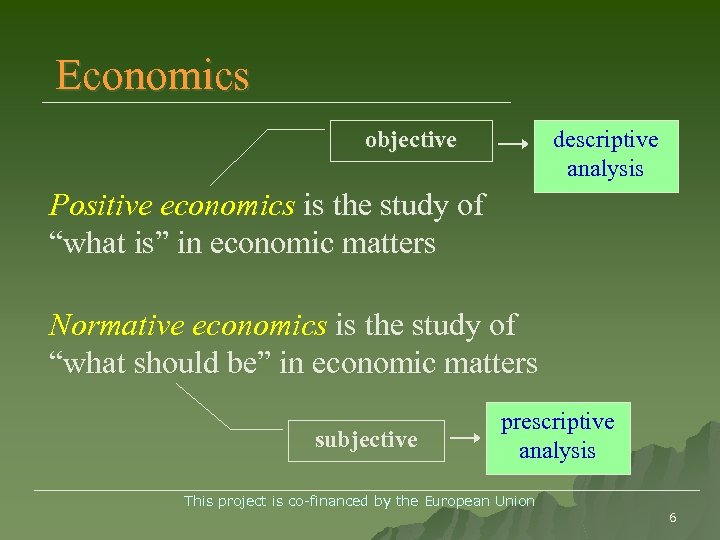
Economics objective descriptive analysis Positive economics is the study of “what is” in economic matters Normative economics is the study of “what should be” in economic matters subjective prescriptive analysis ______________________________________ This project is co-financed by the European Union 6
Economics Macroeconomics is the branch of economics that examines and explains the economy as a whole, i. e. in aggregate values Microeconomics is the part of economics that examines individual decisions and particular markets ______________________________________ This project is co-financed by the European Union 7
Microeconomics Firm Production Supply of Goods and Services Demand for Inputs Consumer Consumption Preferences Demand for Goods and Services Supply of Labour Market Product Supply Demand Price ______________________________________ This project is co-financed by the European Union 8
Market Competitive Market Large number of buyers or sellers No individual subject can influence the price Noncompetitive Market Small number of sellers Individual subject can influence the price ______________________________________ This project is co-financed by the European Union 9
Opportunity Cost The cost of a choice stated in terms of the value of other goods or services that must be given up ______________________________________ This project is co-financed by the European Union 10
Microeconomic Analysis Mathematical tools and models Simplification of the reality Optimum Best decision of the subject Equilibrium Interaction of subjects at the markets ______________________________________ This project is co-financed by the European Union 11
Optimization Producer Budget Limited resources & demand Technology Maximization of the profit, revenue Minimization of the cost Consumer Income Preferences Maximization of the utility ______________________________________ This project is co-financed by the European Union 12
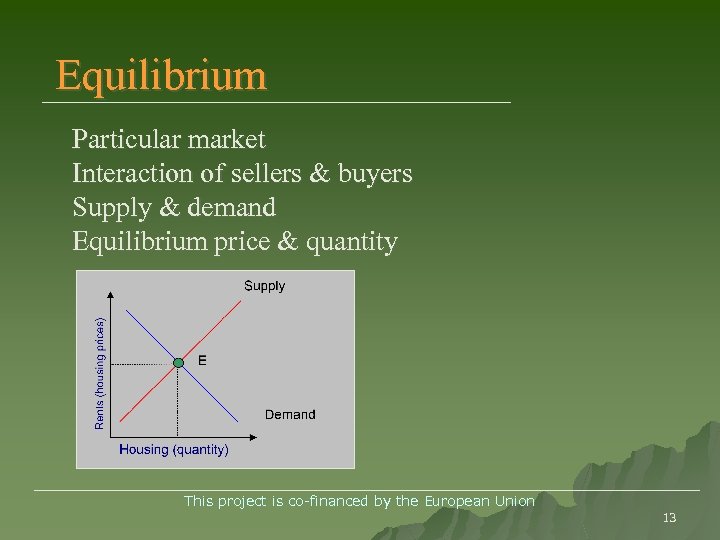
Equilibrium Particular market Interaction of sellers & buyers Supply & demand Equilibrium price & quantity ______________________________________ This project is co-financed by the European Union 13
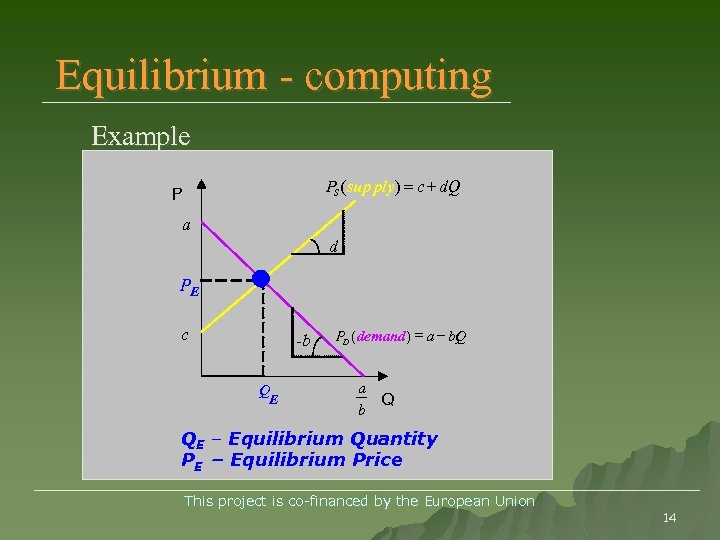
Equilibrium - computing Example PS (sup ply) = c + d. Q P a d PE c -b Q E PD ( demand) = a - b. Q a Q b QE – Equilibrium Quantity PE – Equilibrium Price ______________________________________ This project is co-financed by the European Union 14
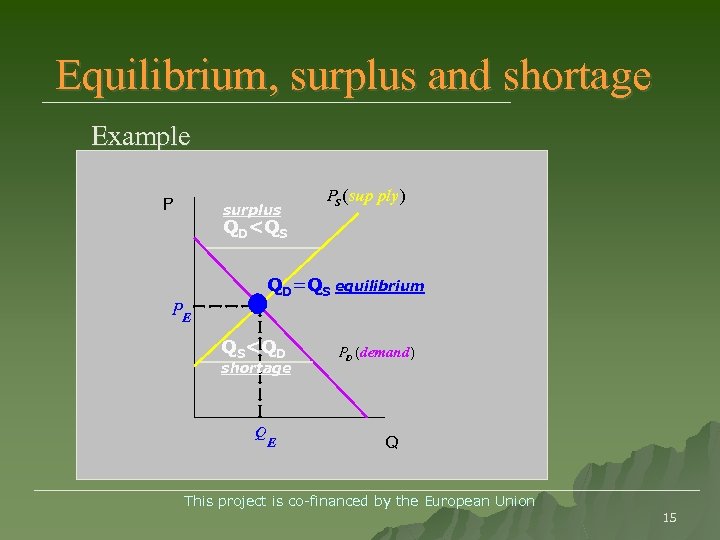
Equilibrium, surplus and shortage Example P surplus PS (sup ply ) QD<QS QD=QS equilibrium PE QS<QD shortage Q E PD ( demand) Q ______________________________________ This project is co-financed by the European Union 15
Equilibrium - computing Example: PS = 10 + Q PD = 20 – 4 Q Calculate 1) the equilibrium price 2) the equilibrium quantity 3) the surplus, if the price floor fixed by government is 14 CZK. The price floor – the minimum of the price fixed by government The price ceiling – the maximum a seller may charge for a product ______________________________________ This project is co-financed by the European Union 16
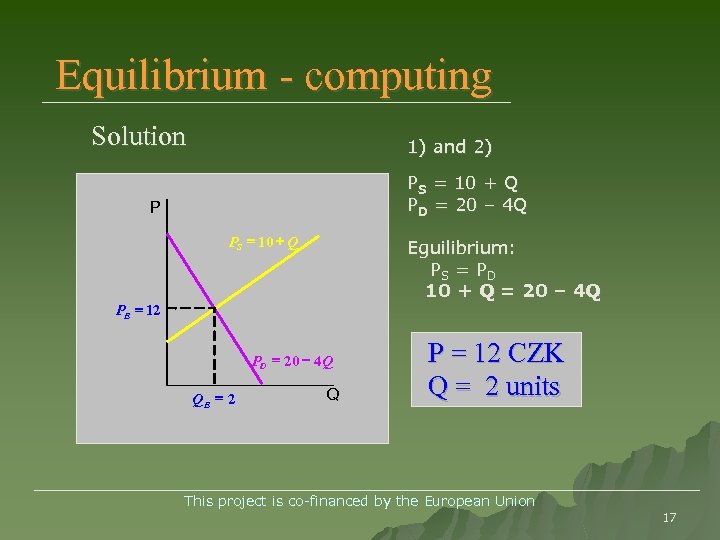
Equilibrium - computing Solution 1) and 2) PS = 10 + Q PD = 20 – 4 Q P PS = 10 + Q Eguilibrium: PS = P D 10 + Q = 20 – 4 Q PE = 12 PD = 20 - 4 Q QE = 2 Q P = 12 CZK Q = 2 units ______________________________________ This project is co-financed by the European Union 17
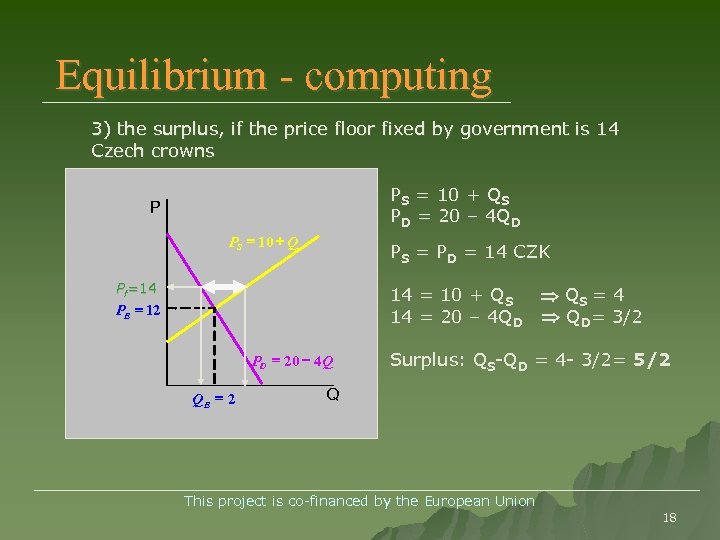
Equilibrium - computing 3) the surplus, if the price floor fixed by government is 14 Czech crowns PS = 10 + QS PD = 20 – 4 QD P PS = 10 + Q PS = PD = 14 CZK Pf=14 14 = 10 + QS = 4 14 = 20 – 4 QD QD= 3/2 PE = 12 PD = 20 - 4 Q QE = 2 Surplus: QS-QD = 4 - 3/2= 5/2 Q ______________________________________ This project is co-financed by the European Union 18
Consumer Theory 1. Consumer Preferences 2. Budget Constraints 3. Consumer Optimum 4. Individual and Market Demand ______________________________________ This project is co-financed by the European Union 19
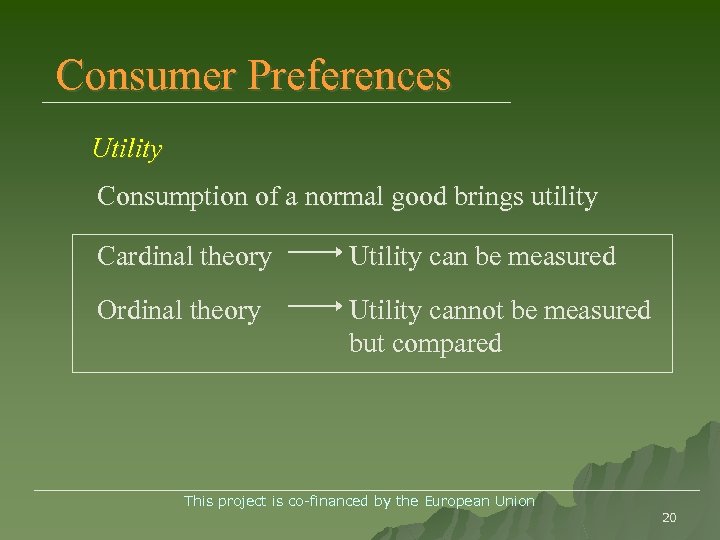
Consumer Preferences Utility Consumption of a normal good brings utility Cardinal theory Utility can be measured Ordinal theory Utility cannot be measured but compared ______________________________________ This project is co-financed by the European Union 20
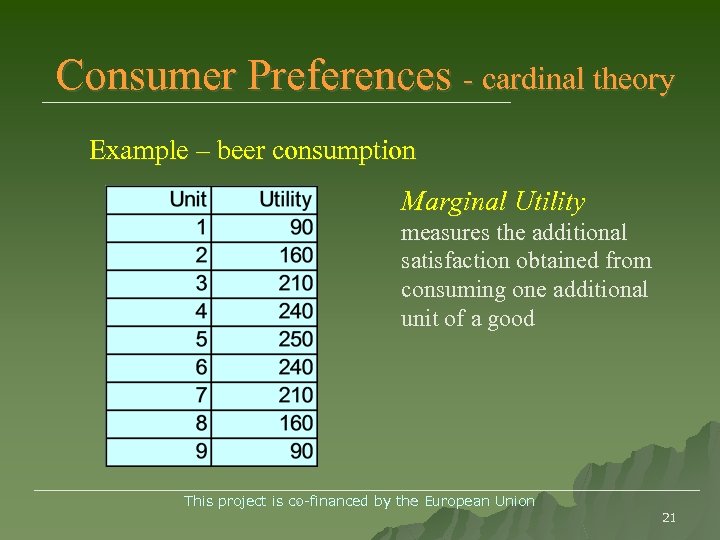
Consumer Preferences - cardinal theory Example – beer consumption Marginal Utility measures the additional satisfaction obtained from consuming one additional unit of a good ______________________________________ This project is co-financed by the European Union 21
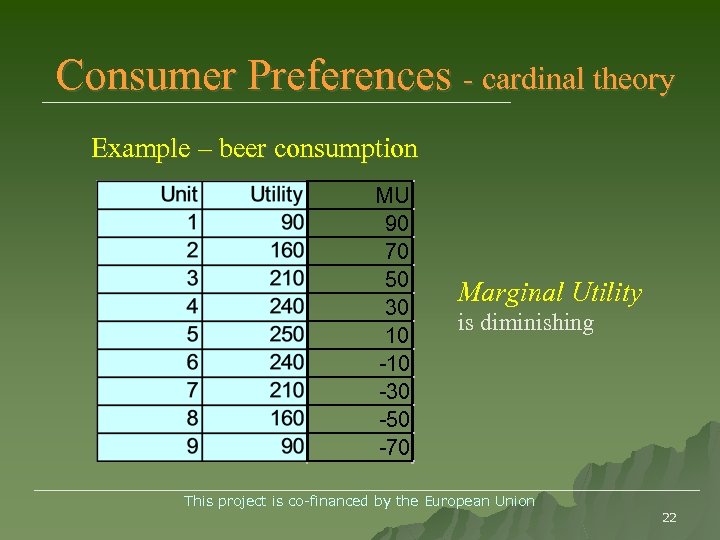
Consumer Preferences - cardinal theory Example – beer consumption MU 90 70 50 30 10 -30 -50 -70 Marginal Utility is diminishing ______________________________________ This project is co-financed by the European Union 22
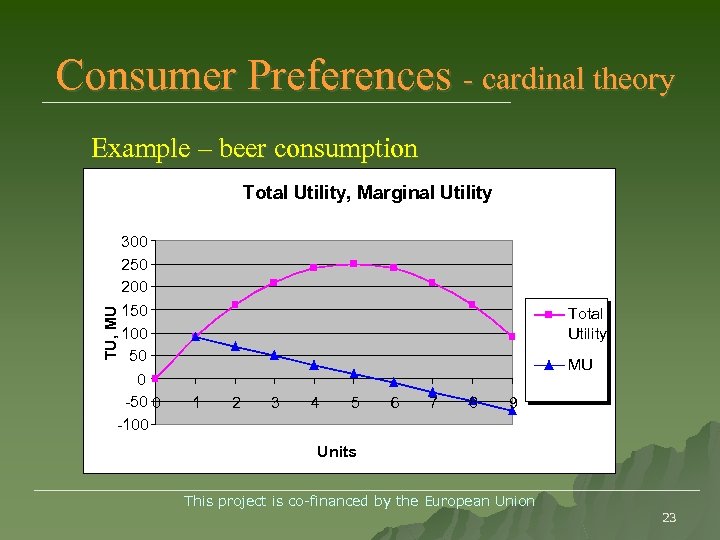
Consumer Preferences - cardinal theory Example – beer consumption Total Utility, Marginal Utility Total Utility TU, MU 300 250 200 150 100 50 0 -100 MU 1 2 3 4 5 6 7 8 9 Units ______________________________________ This project is co-financed by the European Union 23
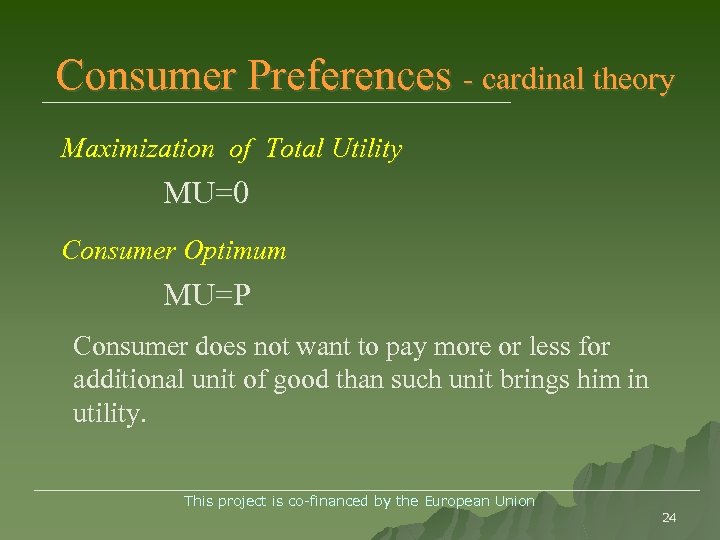
Consumer Preferences - cardinal theory Maximization of Total Utility MU=0 Consumer Optimum MU=P Consumer does not want to pay more or less for additional unit of good than such unit brings him in utility. ______________________________________ This project is co-financed by the European Union 24
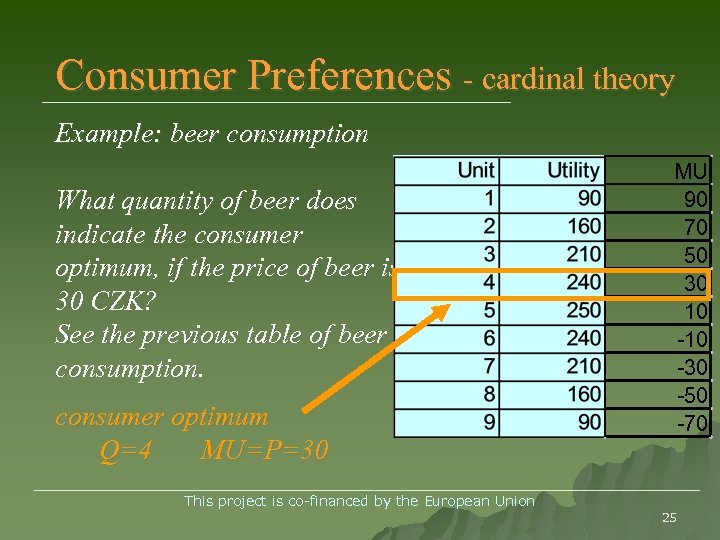
Consumer Preferences - cardinal theory Example: beer consumption What quantity of beer does indicate the consumer optimum, if the price of beer is 30 CZK? See the previous table of beer consumption. consumer optimum Q=4 MU=P=30 MU 90 70 50 30 10 -30 -50 -70 ______________________________________ This project is co-financed by the European Union 25
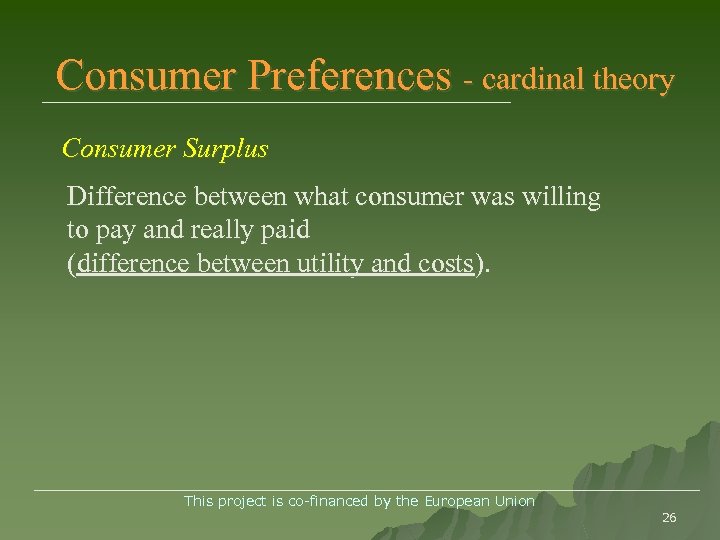
Consumer Preferences - cardinal theory Consumer Surplus Difference between what consumer was willing to pay and really paid (difference between utility and costs). ______________________________________ This project is co-financed by the European Union 26
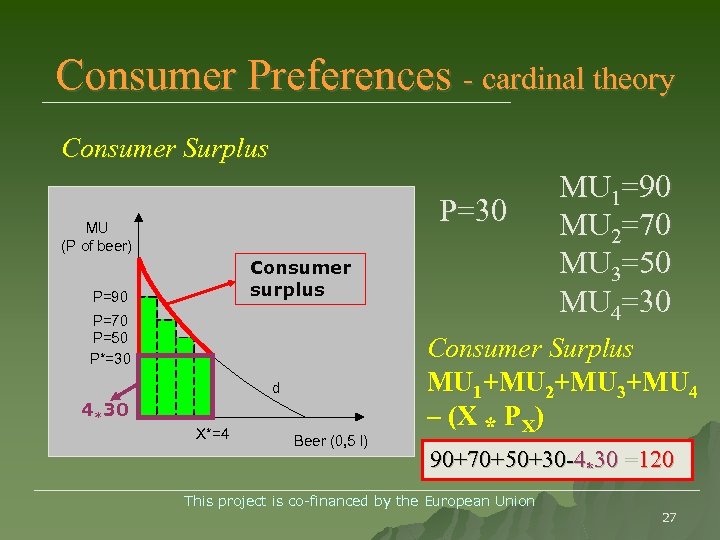
Consumer Preferences - cardinal theory Consumer Surplus P=30 MU (P of beer) Consumer surplus P=90 P=70 P=50 P*=30 d 4*30 X*=4 Beer (0, 5 l) MU 1=90 MU 2=70 MU 3=50 MU 4=30 Consumer Surplus MU 1+MU 2+MU 3+MU 4 – (X * PX) 90+70+50+30 -4*30 =120 ______________________________________ This project is co-financed by the European Union 27
Consumer Preferences - ordinal theory Market Basket Collection of one or more commodities One market basket can be preferred over another market basket containing a different combination of goods ______________________________________ This project is co-financed by the European Union 28
Consumer Preferences - ordinal theory Assumptions 1. Completeness of preferences - A is preferred to B - B is preferred to A - A and B are indifferent 2. Transitiveness (preferences are consistent) - if A is preferred to B and B is preferred to C then A is preferred to C 3. Non-satiation - consumer always prefers more of any goods to less ______________________________________ This project is co-financed by the European Union 29
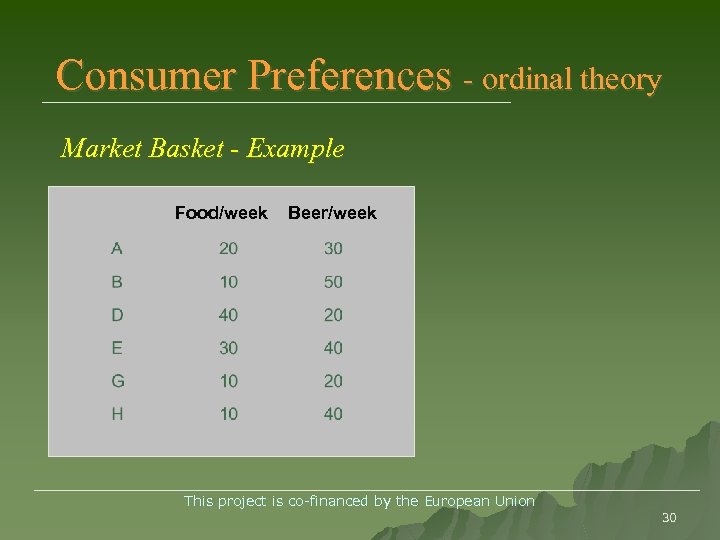
Consumer Preferences - ordinal theory Market Basket - Example Food/week Beer/week ______________________________________ This project is co-financed by the European Union 30
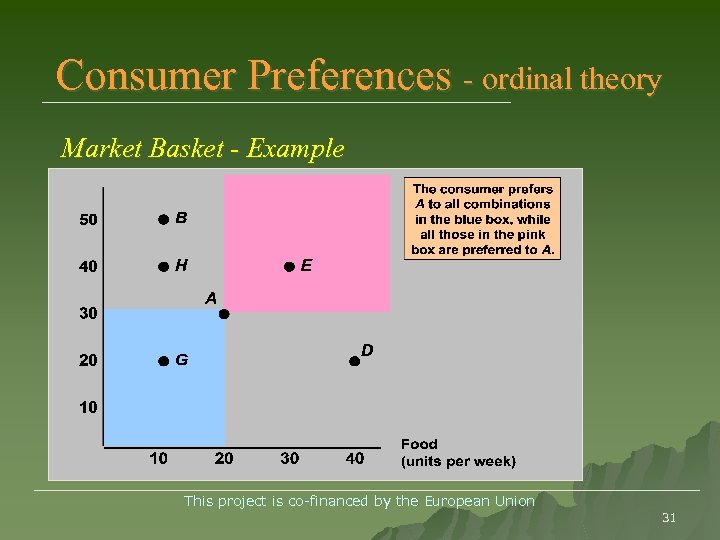
Consumer Preferences - ordinal theory Market Basket - Example ______________________________________ This project is co-financed by the European Union 31
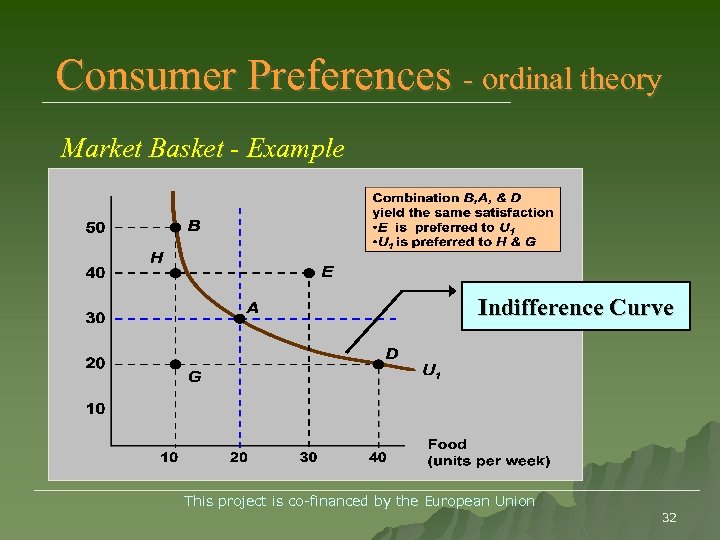
Consumer Preferences - ordinal theory Market Basket - Example Indifference Curve ______________________________________ This project is co-financed by the European Union 32
Consumer Preferences - ordinal theory Indifference Curves Indifference curves represent all combinations of market baskets that provide to consumer the same level of satisfaction (utility) Indifference curve is a graph showing combinations of two goods to which a consumer is indifferent ______________________________________ This project is co-financed by the European Union 33
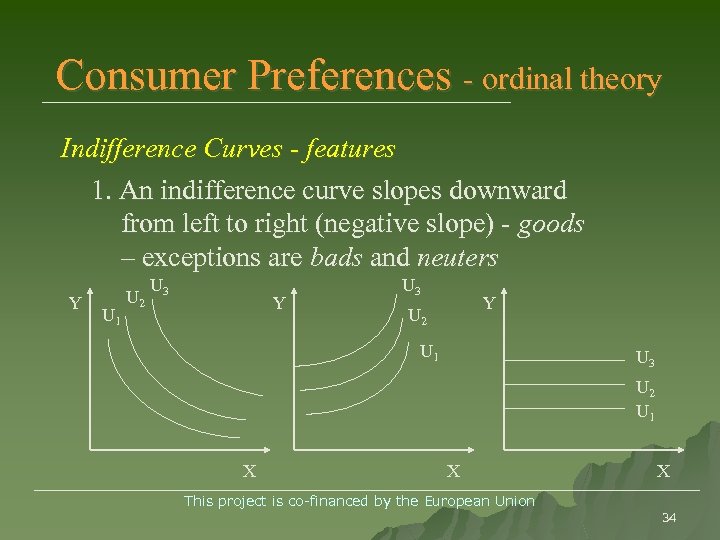
Consumer Preferences - ordinal theory Indifference Curves - features 1. An indifference curve slopes downward from left to right (negative slope) - goods – exceptions are bads and neuters Y U 1 U 2 U 3 Y U 2 U 1 U 3 U 2 U 1 X X X ______________________________________ This project is co-financed by the European Union 34
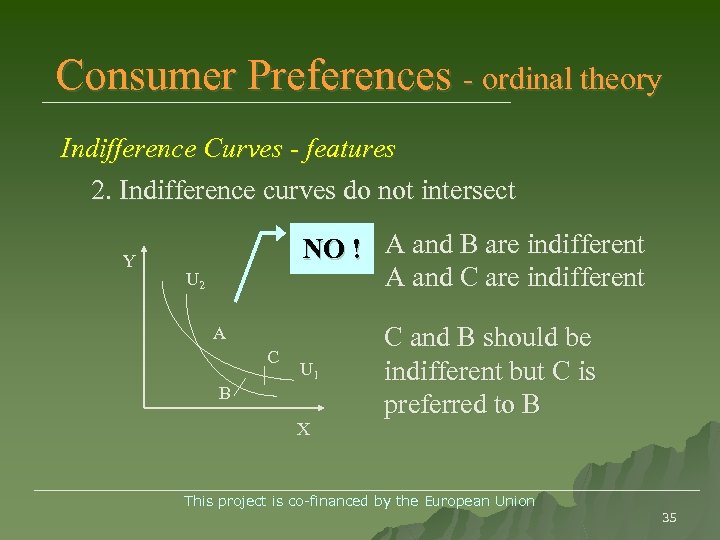
Consumer Preferences - ordinal theory Indifference Curves - features 2. Indifference curves do not intersect Y NO ! A and B are indifferent A and C are indifferent U 2 A C U 1 B X C and B should be indifferent but C is preferred to B ______________________________________ This project is co-financed by the European Union 35
Consumer Preferences - ordinal theory Indifference Curves - features 3. There exists an indifference curve through any given point on an indifference map 4. The curves are convex When consumers have less and less of one good, they require more of the other good to compensate (corresponding to the law of diminishing marginal utility) ______________________________________ This project is co-financed by the European Union 36
Consumer Preferences - ordinal theory Marginal Rate of Substitution (MRS) MRS quantifies the amount of one commodity a consumer will give up to obtain more of another commodity. MRS is measured by the slope of the indifference curve ______________________________________ This project is co-financed by the European Union 37
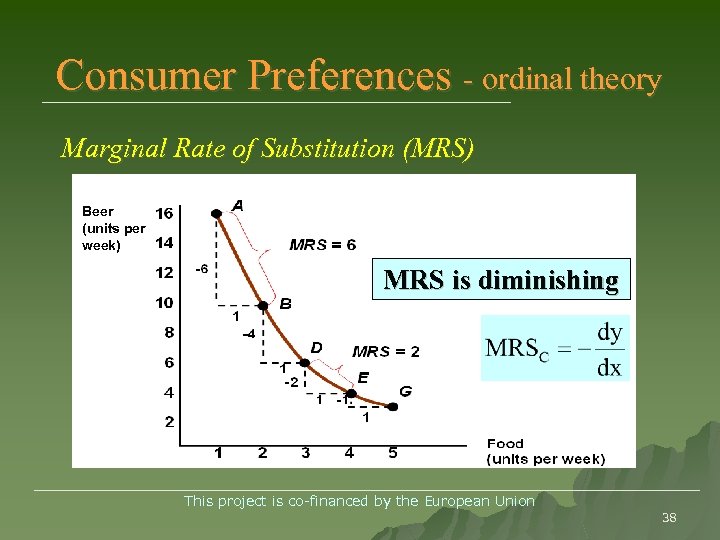
Consumer Preferences - ordinal theory Marginal Rate of Substitution (MRS) Beer (units per week) MRS is diminishing ______________________________________ This project is co-financed by the European Union 38
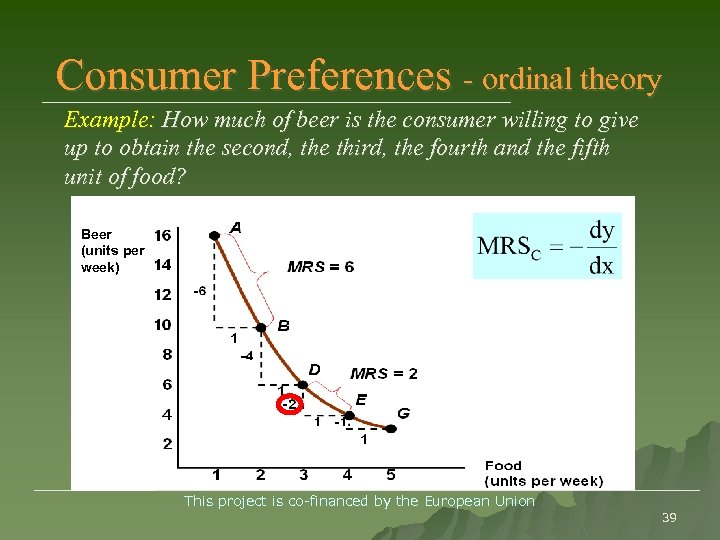
Consumer Preferences - ordinal theory Example: How much of beer is the consumer willing to give up to obtain the second, the third, the fourth and the fifth unit of food? Beer (units per week) ______________________________________ This project is co-financed by the European Union 39
Consumer Preferences - ordinal theory Substitutes and Complements Two commodities are substitutes in case that consumer can use one instead of another (rolls and pigs) Two commodities are complements if consumer consumes one commodity along with another (left and right shoes) ______________________________________ This project is co-financed by the European Union 40
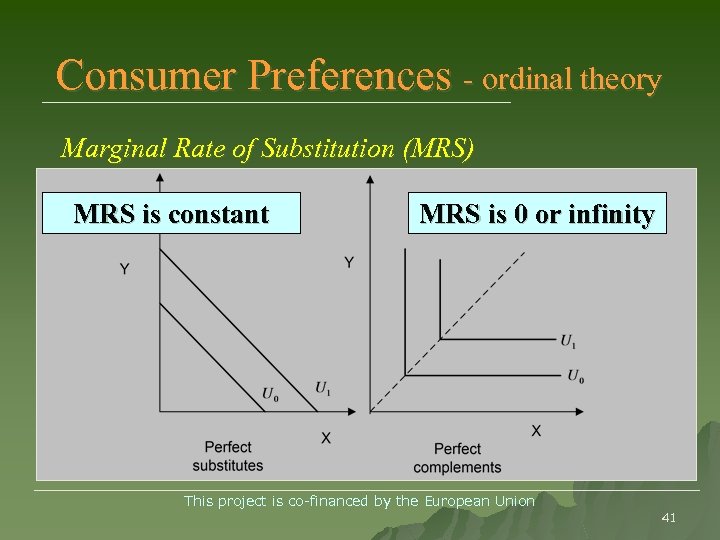
Consumer Preferences - ordinal theory Marginal Rate of Substitution (MRS) MRS is constant MRS is 0 or infinity ______________________________________ This project is co-financed by the European Union 41
Consumer Preferences - ordinal theory Budget Constraint limits a consumer's ability to buy unlimited amount of goods and services Budget Line indicates all combinations of two commodities for which total money spent equals total income. ______________________________________ This project is co-financed by the European Union 42
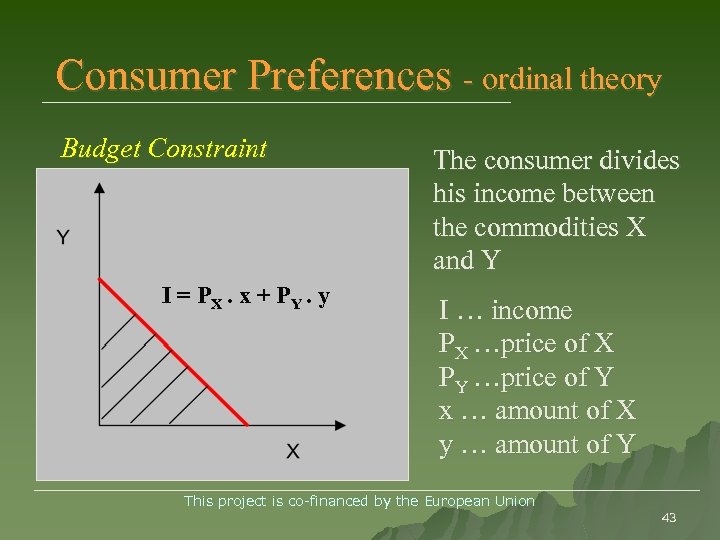
Consumer Preferences - ordinal theory Budget Constraint I = PX. x + PY. y The consumer divides his income between the commodities X and Y I … income PX …price of X PY …price of Y x … amount of X y … amount of Y ______________________________________ This project is co-financed by the European Union 43
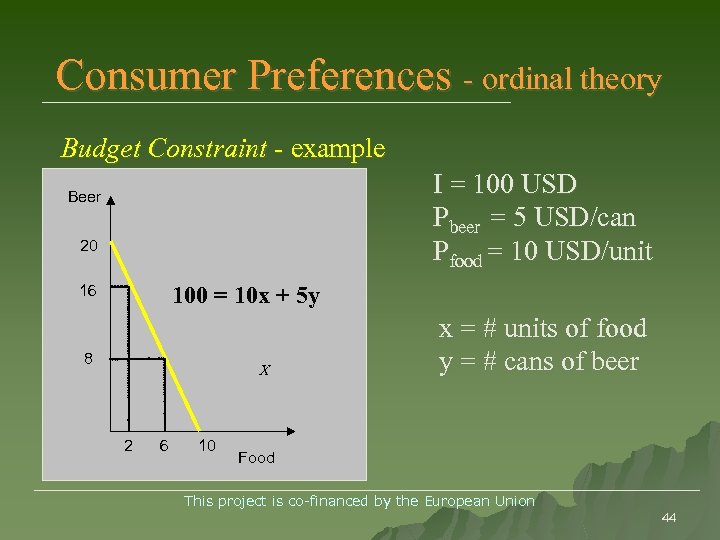
Consumer Preferences - ordinal theory Budget Constraint - example I = 100 USD Pbeer = 5 USD/can Pfood = 10 USD/unit Beer 20 100 = 10 x + 5 y 16 8 X 2 6 10 x = # units of food y = # cans of beer Food ______________________________________ This project is co-financed by the European Union 44
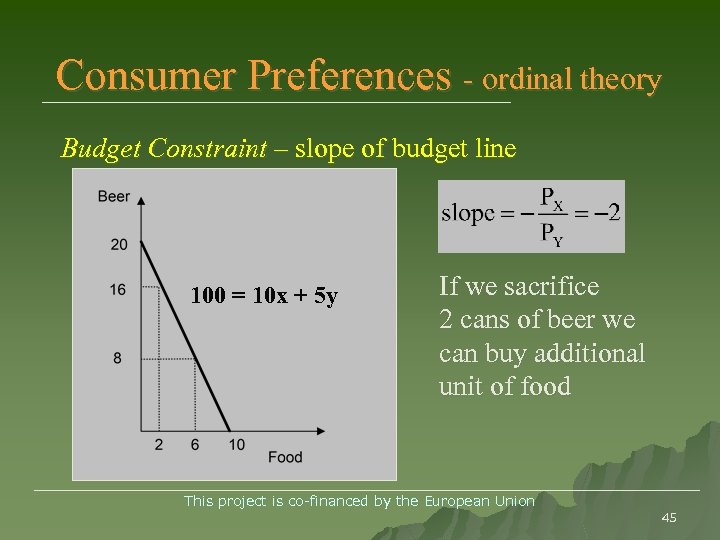
Consumer Preferences - ordinal theory Budget Constraint – slope of budget line 100 = 10 x + 5 y If we sacrifice 2 cans of beer we can buy additional unit of food ______________________________________ This project is co-financed by the European Union 45
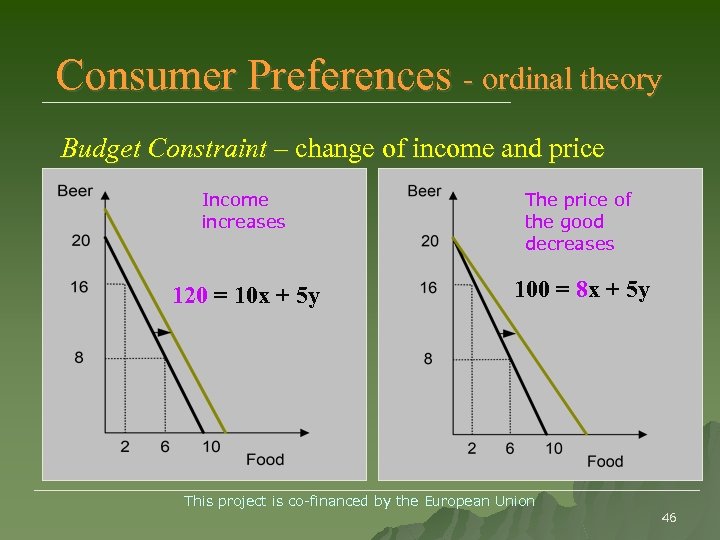
Consumer Preferences - ordinal theory Budget Constraint – change of income and price Income increases The price of the good decreases 120 = 10 x + 5 y 100 = 8 x + 5 y ______________________________________ This project is co-financed by the European Union 46
Consumer Preferences - ordinal theory Budget Constraint – change of income and price Example a) Assume there are two goods – T-shirts and skirts. The price of the T-shirt is $4 and the price of the skirt is $10. The income is I= $200. -determine the budget constraint. -determine the slope and the intercepts of the budget line. -graph the budget area. b) Assume that income increases to I= $300. At the same time the price of the T-shirt increases to $10. -determine the equation of the new budget line. -determine the slope and the intercepts of the new budget line. -graph the new budget area. ______________________________________ This project is co-financed by the European Union 47
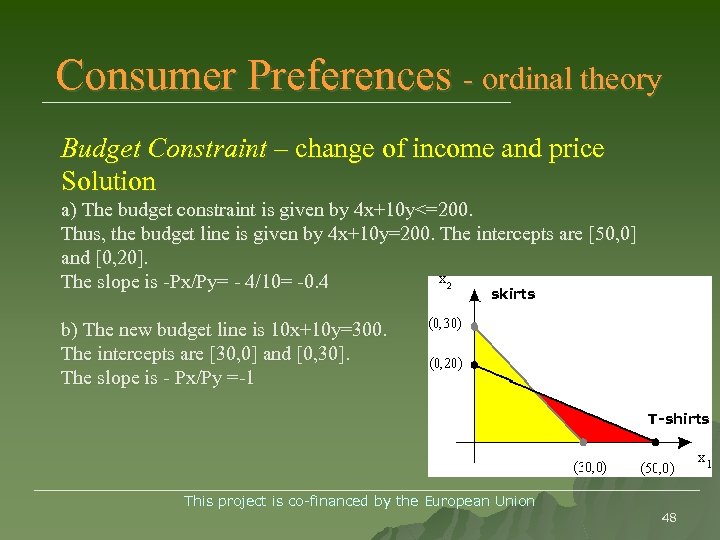
Consumer Preferences - ordinal theory Budget Constraint – change of income and price Solution a) The budget constraint is given by 4 x+10 y<=200. Thus, the budget line is given by 4 x+10 y=200. The intercepts are [50, 0] and [0, 20]. The slope is -Px/Py= - 4/10= -0. 4 skirts b) The new budget line is 10 x+10 y=300. The intercepts are [30, 0] and [0, 30]. The slope is - Px/Py =-1 T-shirts ______________________________________ This project is co-financed by the European Union 48
Consumer Preferences - ordinal theory Consumer Optimum Consumers choose a combination of goods that will maximize the satisfaction they can achieve, given the limited budget available to them The maximizing market basket must satisfy two conditions: 1) It must be located on the budget line 2) It must maximize the utility ______________________________________ This project is co-financed by the European Union 49
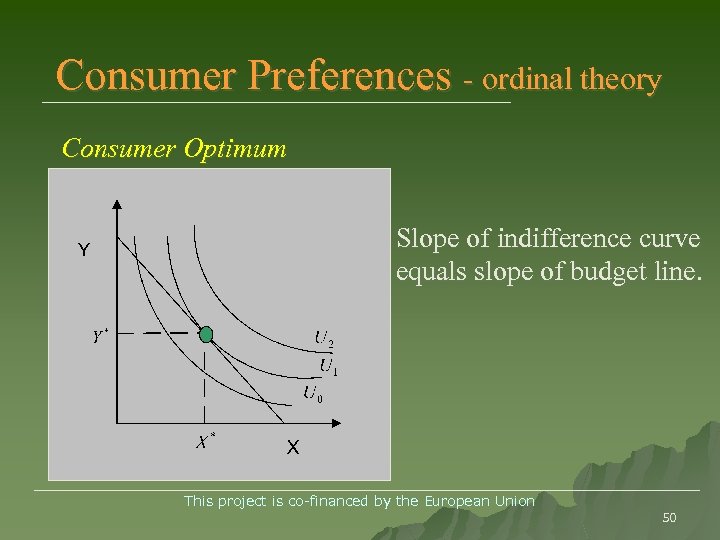
Consumer Preferences - ordinal theory Consumer Optimum Slope of indifference curve equals slope of budget line. ______________________________________ This project is co-financed by the European Union 50
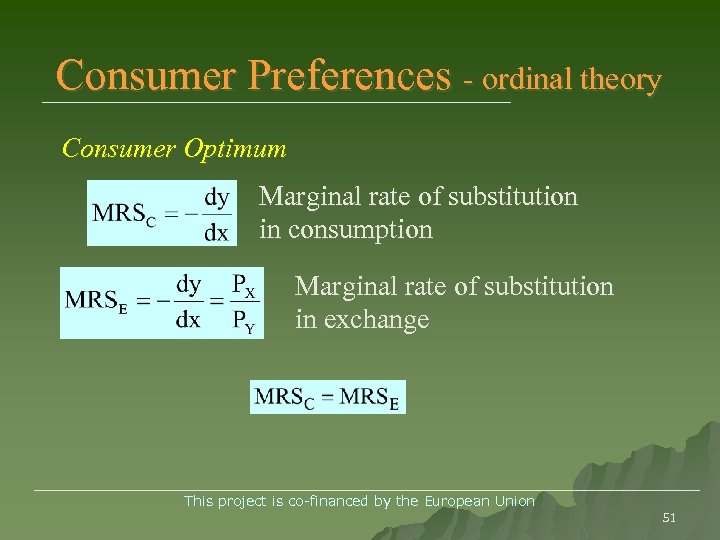
Consumer Preferences - ordinal theory Consumer Optimum Marginal rate of substitution in consumption Marginal rate of substitution in exchange ______________________________________ This project is co-financed by the European Union 51
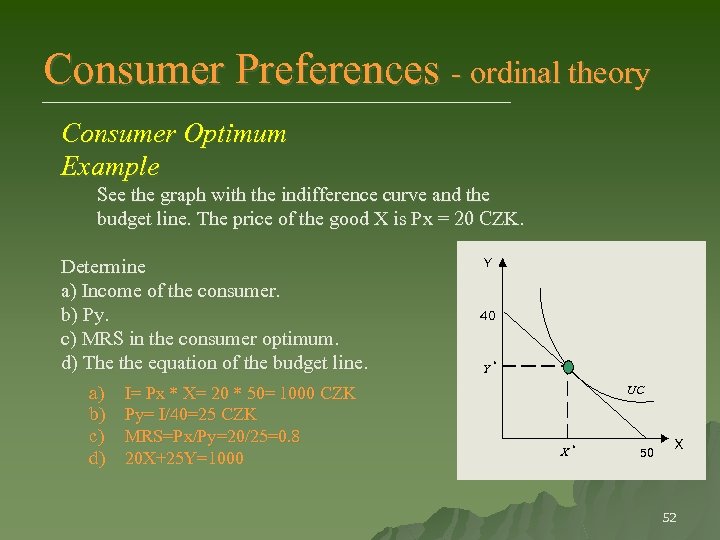
Consumer Preferences - ordinal theory Consumer Optimum Example See the graph with the indifference curve and the budget line. The price of the good X is Px = 20 CZK. Determine a) Income of the consumer. b) Py. c) MRS in the consumer optimum. d) The the equation of the budget line. a) b) c) d) I= Px * X= 20 * 50= 1000 CZK Py= I/40=25 CZK MRS=Px/Py=20/25=0. 8 20 X+25 Y=1000 Y 40 Y * UC X * 50 X 52
Individual Demand is the amount of a good, which buyers wish to purchase at each conceivable price Individual demand is a demand of one consumer for one good The curve of individual demand is derived from indifference analysis ______________________________________ This project is co-financed by the European Union 53
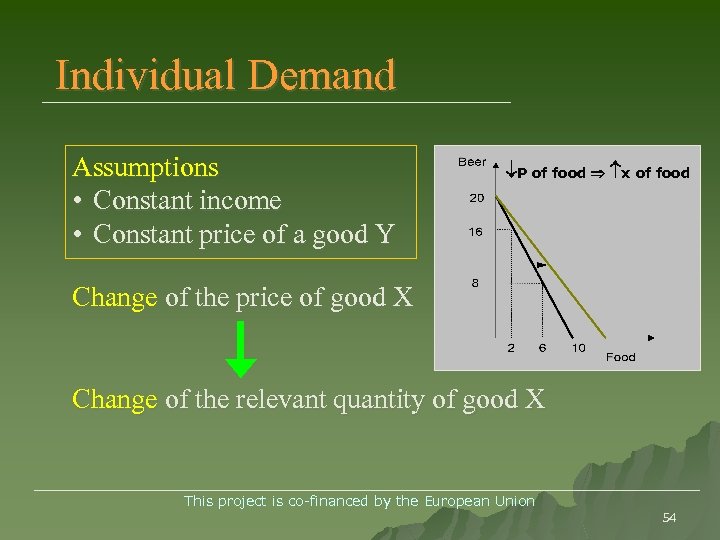
Individual Demand Assumptions • Constant income • Constant price of a good Y P of food x of food Change of the price of good X Change of the relevant quantity of good X ______________________________________ This project is co-financed by the European Union 54
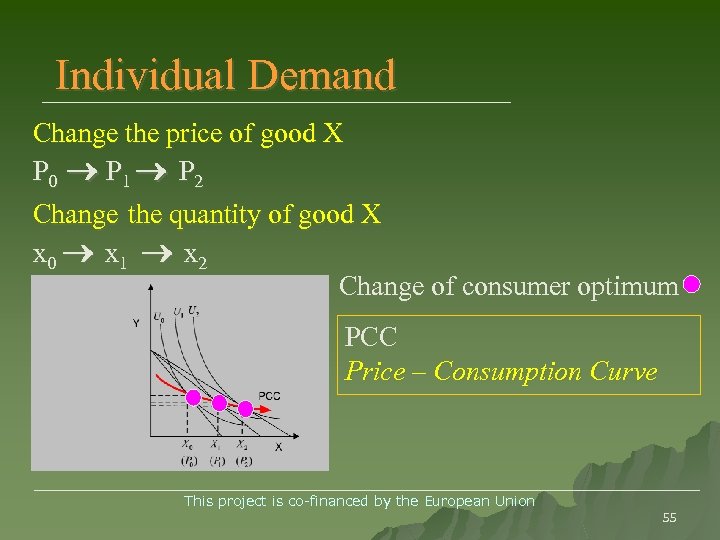
Individual Demand Change the price of good X P 0 P 1 P 2 Change the quantity of good X x 0 x 1 x 2 Change of consumer optimum PCC Price – Consumption Curve ______________________________________ This project is co-financed by the European Union 55
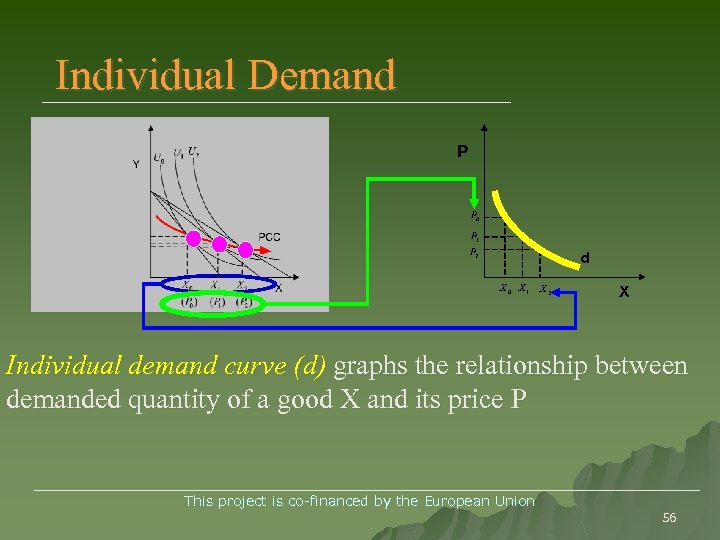
Individual Demand P P 0 P 1 P 2 d X 0 X 1 X 2 X Individual demand curve (d) graphs the relationship between demanded quantity of a good X and its price P quantity ______________________________________ This project is co-financed by the European Union 56
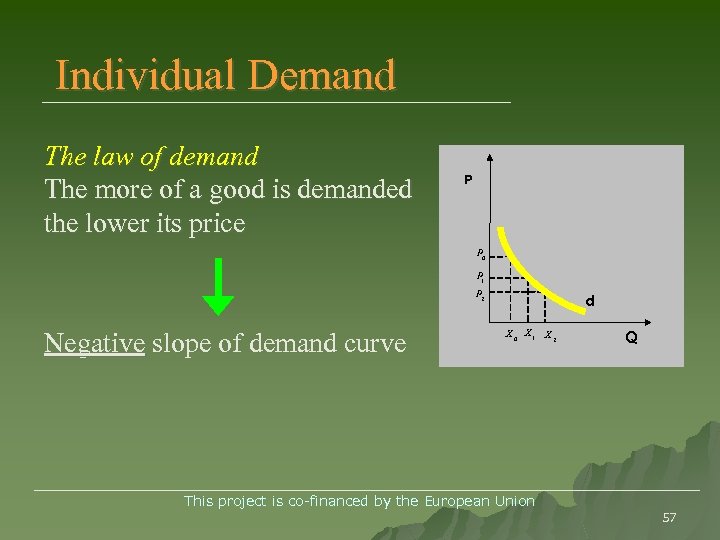
Individual Demand The law of demand The more of a good is demanded the lower its price P P 0 P 1 P 2 Negative slope of demand curve d X 0 X 1 X 2 Q ______________________________________ This project is co-financed by the European Union 57
Individual Demand Income Effect The price of a good X rises Decrease in real income (real purchasing power) Decrease in demanded quantity of X Substitution Effect The price of a good X rises Increase in relative price of X Decrease in demanded quantity of X Increase in demanded quantity of cheaper good Nominal income is constant !!!!! ______________________________________ This project is co-financed by the European Union 58
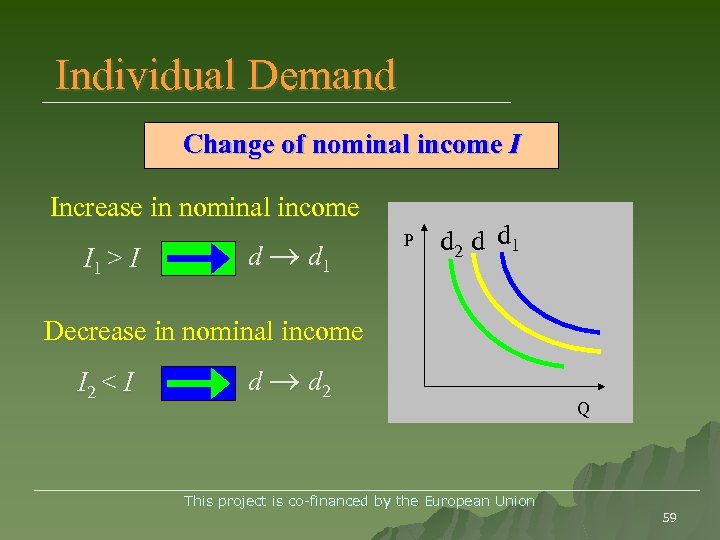
Individual Demand Change of nominal income I Increase in nominal income I 1 > I d d 1 P d 2 d d 1 Decrease in nominal income I 2 < I d d 2 Q ______________________________________ This project is co-financed by the European Union 59
Individual Demand Normal Good A good whose consumption increases with an increase of income Necessary good – low sensitivity of demand to changes of nominal income (bread, salt) Luxury good – high sensitivity of demand to changes of nominal income (gold) Inferior Good A good whose consumption decreases with an increase of income (cheap salami) ______________________________________ This project is co-financed by the European Union 60
Individual Demand Independent Goods No significant sensitivity of demand for X when price of Y changes Substitutes Increase in demand for X when price of Y rises Complements Decrease in demand for X when price of Y rises ______________________________________ This project is co-financed by the European Union 61
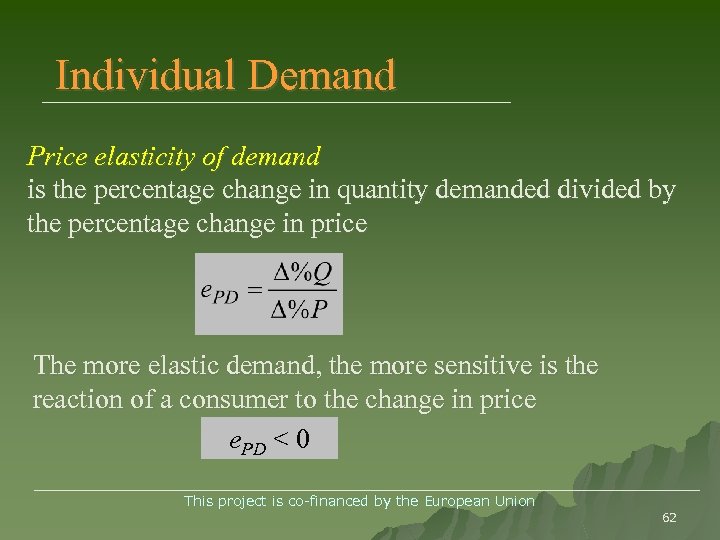
Individual Demand Price elasticity of demand is the percentage change in quantity demanded divided by the percentage change in price The more elastic demand, the more sensitive is the reaction of a consumer to the change in price e. PD < 0 ______________________________________ This project is co-financed by the European Union 62
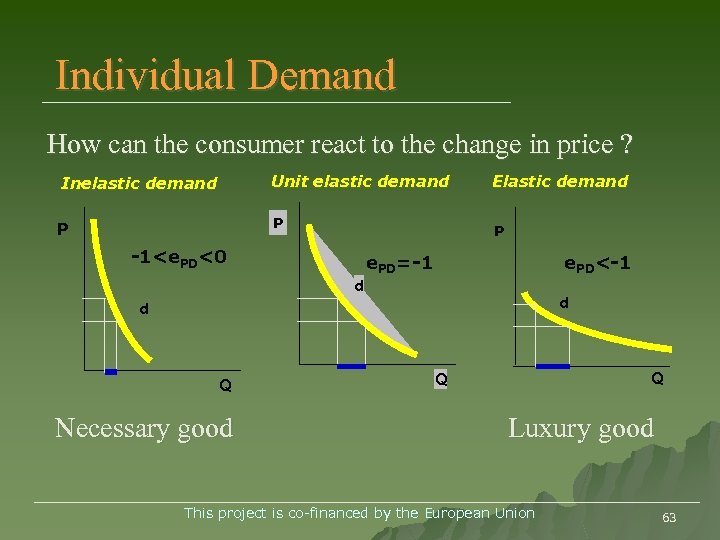
Individual Demand How can the consumer react to the change in price ? Unit elastic demand Inelastic demand P P P -1<e. PD<0 e. PD=-1 e. PD<-1 d d d Q Necessary good Elastic demand Q Q Luxury good ______________________________________ This project is co-financed by the European Union 63
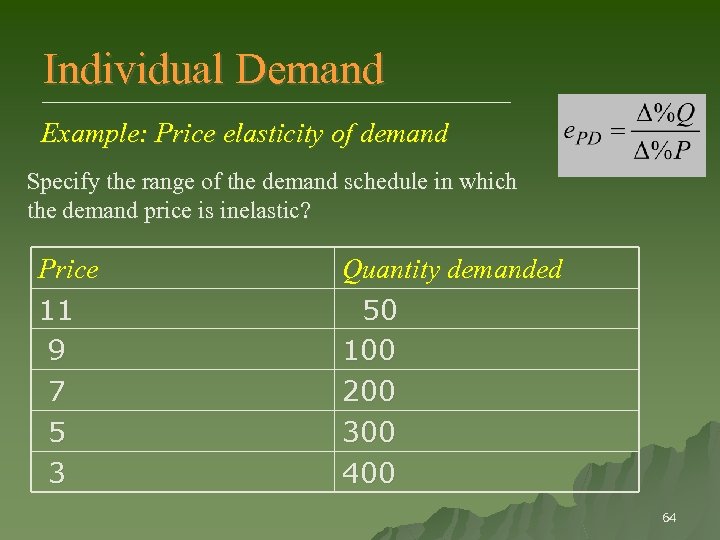
Individual Demand Example: Price elasticity of demand Specify the range of the demand schedule in which the demand price is inelastic? Price 11 9 7 5 3 Quantity demanded 50 100 200 300 400 64
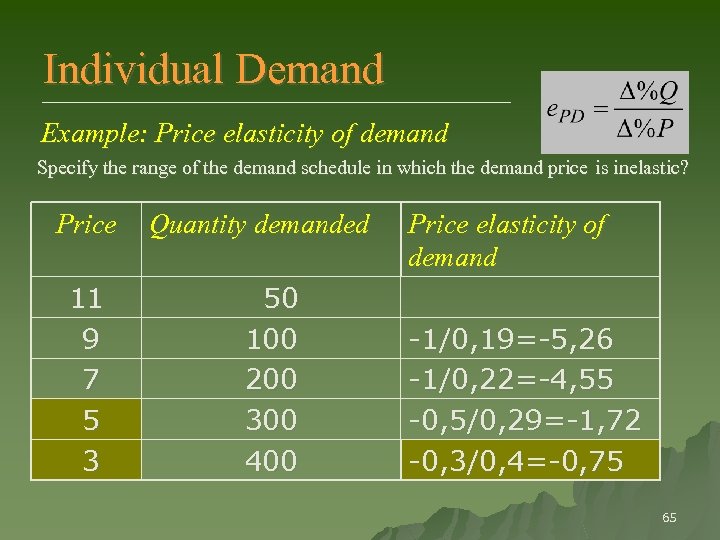
Individual Demand Example: Price elasticity of demand Specify the range of the demand schedule in which the demand price is inelastic? Price 11 9 7 5 3 Quantity demanded 50 100 200 300 400 Price elasticity of demand -1/0, 19=-5, 26 -1/0, 22=-4, 55 -0, 5/0, 29=-1, 72 -0, 3/0, 4=-0, 75 65
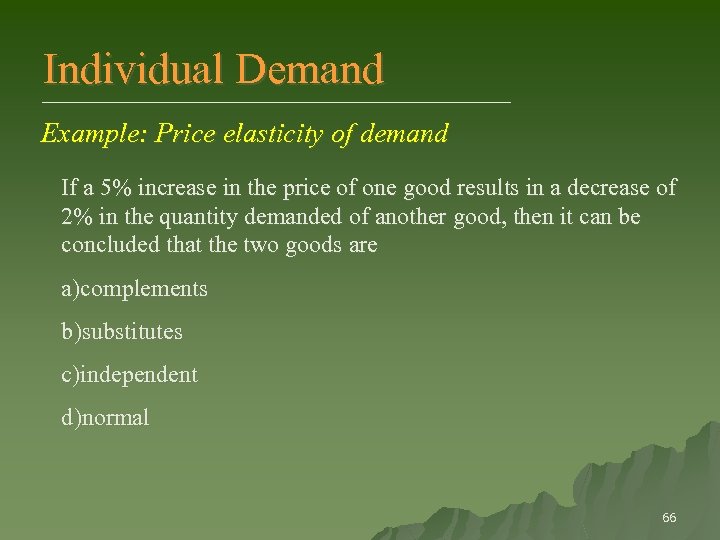
Individual Demand Example: Price elasticity of demand If a 5% increase in the price of one good results in a decrease of 2% in the quantity demanded of another good, then it can be concluded that the two goods are a)complements b)substitutes c)independent d)normal 66
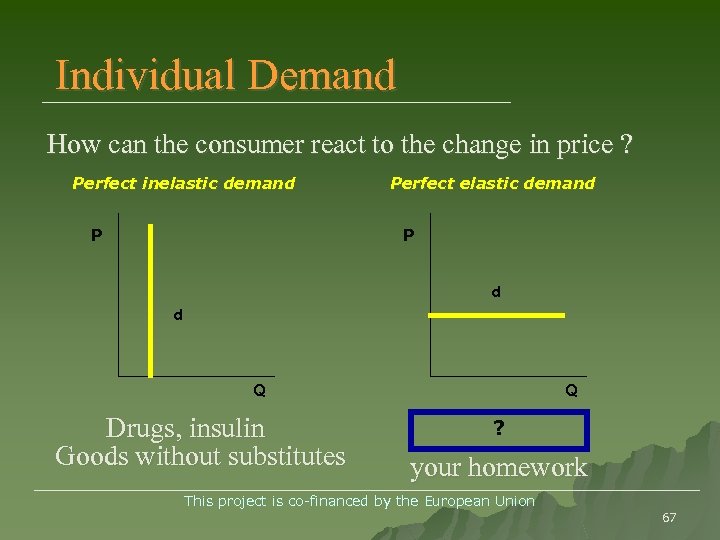
Individual Demand How can the consumer react to the change in price ? Perfect inelastic demand Perfect elastic demand P P d d Q Q Drugs, insulin Goods without substitutes ? your homework ______________________________________ This project is co-financed by the European Union 67
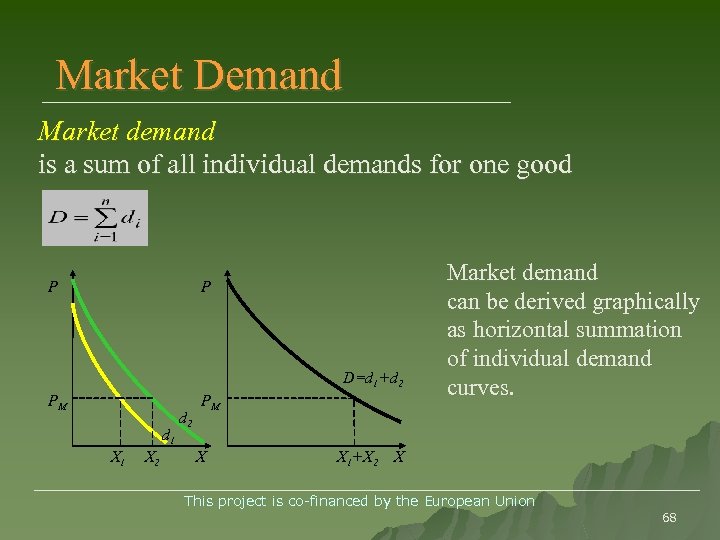
Market Demand Market demand is a sum of all individual demands for one good P P D=d 1+d 2 PM d 1 X 2 d 2 PM X Market demand can be derived graphically as horizontal summation of individual demand curves. X 1+X 2 X ______________________________________ This project is co-financed by the European Union 68
Скачать презентацию Microeconomics Jan Fábry University of Economics Prague http
4ac711980c7bb12a85f7cba488c5be83.ppt