 Скачать презентацию MICROCONTROLLER BASED TELECOM SWITCH SPONSORED BY ARJ ASIA
902cdbdb31af18803bf66f994b6fb1db.ppt
- Количество слайдов: 11



MICROCONTROLLER BASED TELECOM SWITCH SPONSORED BY: ARJ ASIA External Guide: Mr. Jitendra Date Internal Guide: Mr. M. B. Tirmare By: Neha Purandare Janhavi Shah Sonali Shelke
PROBLEM: A "telephone solicitation" is a telephone call that acts as an advertisement. Even if you have an unlisted, non-listed, or non-published telephone number, you may still receive unsolicited telephone calls with automated or prerecorded messages. In some cases unlisted or nonlisted numbers can be obtained from a directory assistance operator. They, along with non-published numbers, may be sold to other organizations or people with whom you have done business. Some sales organizations call numbers in numerical order for a neighborhood or area. SOLUTION: In the field of telecommunications, a telephone exchange (US: telephone switch) is a piece of equipment that connects phone calls. It is what makes your phone calls "work" in the sense of making connections and relaying the speech information. Here we are using our telecom switch to connect only the right call and block the unwanted ones.
BLOCK DIAGRAM
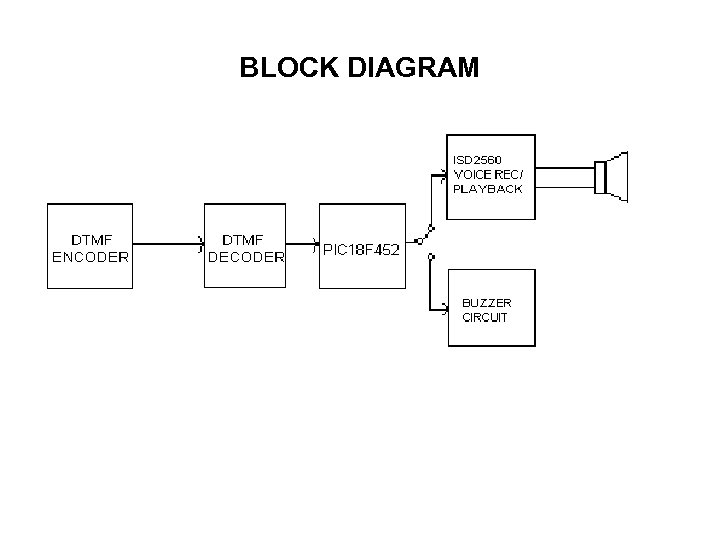
EXPLANATION OF BLOCK DIAGRAM DTMF Encoder: The DTMF encoder resembles the telephone set. It uses DTMF encoder integrated circuit, Chip UM 91214 B. This IC produces DTMF signals. DTMF Decoder: It consists of MT 8870 D chip which is a direct DTMF detector. Its output is a 4 - bit BCD code; each 4 bit code corresponding to a DTMF tone pair. Whenever a valid tone pair is detected at the input, the St. D pin goes high indicating that the tone pair has been latched.
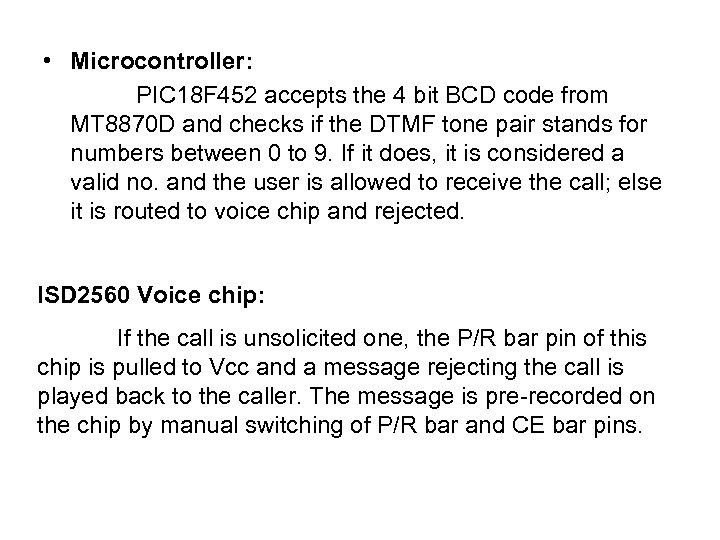
• Microcontroller: PIC 18 F 452 accepts the 4 bit BCD code from MT 8870 D and checks if the DTMF tone pair stands for numbers between 0 to 9. If it does, it is considered a valid no. and the user is allowed to receive the call; else it is routed to voice chip and rejected. ISD 2560 Voice chip: If the call is unsolicited one, the P/R bar pin of this chip is pulled to Vcc and a message rejecting the call is played back to the caller. The message is pre-recorded on the chip by manual switching of P/R bar and CE bar pins.
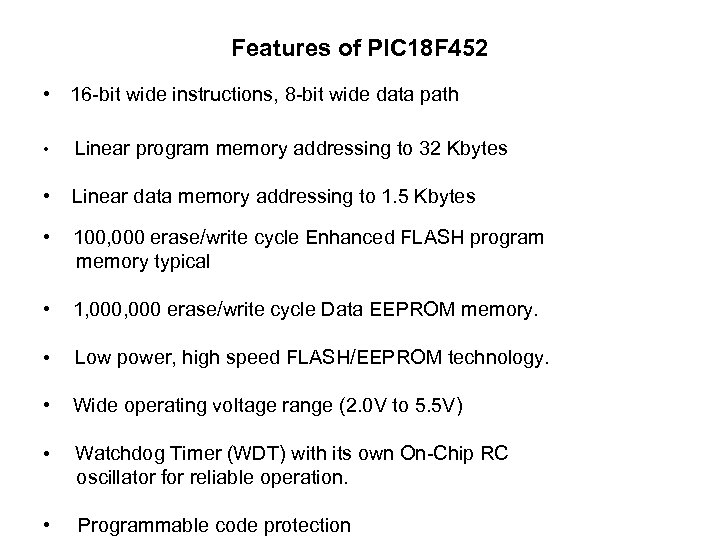
Features of PIC 18 F 452 • 16 -bit wide instructions, 8 -bit wide data path • Linear program memory addressing to 32 Kbytes • Linear data memory addressing to 1. 5 Kbytes • 100, 000 erase/write cycle Enhanced FLASH program memory typical • 1, 000 erase/write cycle Data EEPROM memory. • Low power, high speed FLASH/EEPROM technology. • Wide operating voltage range (2. 0 V to 5. 5 V) • Watchdog Timer (WDT) with its own On-Chip RC oscillator for reliable operation. • Programmable code protection
Features of MT 8870 D • • DTMF Receiver Low power consumption Internal gain setting amplifier Adjustable guard time Central office quality Power-down mode Inhibit mode
FEATURES OF ISD 2560 • Easy to use, voice record/playback solution. • Single chip with 60 sec duration • Manual switch or u. C compatible. • Auto power-down (push-button) mode • Can handle multiple messages • On-chip clock source • Single +5 volt power supply
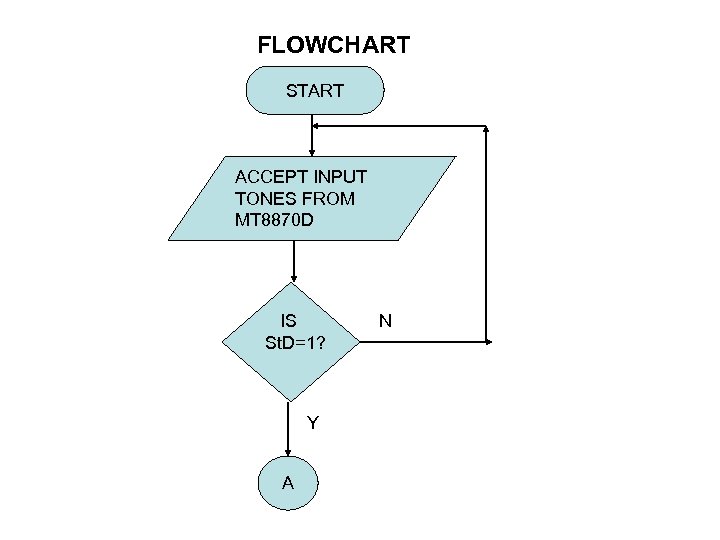
FLOWCHART START ACCEPT INPUT TONES FROM MT 8870 D IS St. D=1? Y A N
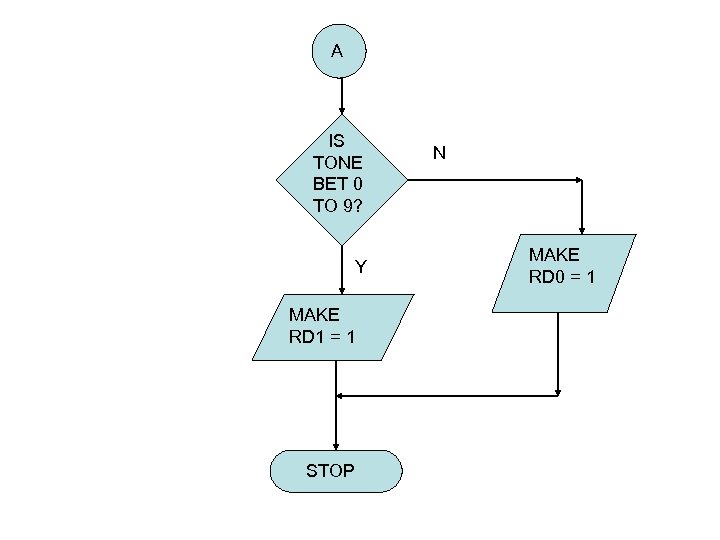
A IS TONE BET 0 TO 9? Y MAKE RD 1 = 1 STOP N MAKE RD 0 = 1
SOFTWARE • Development Environment: The MPLAB C 18 Code Development Systems are complete ANSI ‘C’ compilers for Microchip’s PIC 18 CXXX family of microcontrollers. This compiler provide powerful integration capabilities and ease of use not found with other compilers. • Programmer: PICSTART Plus Entry Level Development Programmer The PICSTART Plus development programmer is an easy-to -use, low cost, prototype programmer. It connects to the PC via a COM (RS-232) port. MPLAB Integrated Development Environment software makes using the programmer simple and efficient. The PICSTART Plus development programmer supports all PICmicro devices with up to 40 pins.
Скачать презентацию MICROCONTROLLER BASED TELECOM SWITCH SPONSORED BY ARJ ASIA
902cdbdb31af18803bf66f994b6fb1db.ppt