 Скачать презентацию MICROBIOLOGY FOR FOUNDATION YEAR 1 Dr Paul Russell
5c9c9598ad4d07c6e7f6cee303e59377.ppt
- Количество слайдов: 116




MICROBIOLOGY FOR FOUNDATION YEAR 1 Dr Paul Russell ST 4 Medical Microbiology and Virology

Introduction This presentation covers some generic principles when discussing patients with microbiology. Some antibiotic guidelines and ward rounds are specific to Southampton University Hospitals Trust. In other hospitals always refer to the local guidelines or national guidelines where indicated.

PART ONE How to use the microbiology department

The microbiology department Handles over 500, 000 specimens annually ~80 Scientific staff Admin and support staff 6 consultant microbiogists 1 consultant virologist 3 microbiology trainees (may decrease to 2) Infection Control Lyme Reference Unit (National Reference Lab)

Contacting microbiology 0900 -1700 Monday-Friday Extension 6408 Out of hours – Via switchboard

What happens when you ring. . . Office takes note of your call E-mailed to relevant consultant or St. R microbiology. Consultant enquiries are put directly through There is now a “triage” where calls from consultants and registrars are dealt with first. Important or complex calls should be made by a registrar (ST 3 or above) or consultant Time to reply will depend on workload and complexity – Avoid 11. 00 -13. 00 as bench round is conducted and results are authorised – Can get busy after 16. 30
Before you ring. . . Get to know when the ward rounds are conducted Try and be around Refer via the ward pharmacist Read the notes for previous reviews/discussion Do the available guidelines cover your enquiry

Ward Rounds Mon 14. 00 PICU/GICU (Dr Ann Pallet) 14. 00 Haematology (Dr Tatshing Yam) 15. 00 CTITU (Dr Tatshing Yam) Tues 08. 30 Oncology MDT (Dr Tatshing Yam) 08. 30 Surgery (Dr Adriana Basarab) 14. 00 Cardiothoracic (Dr Tatshing Yam) 15. 00 T+O (Dr Graeme Jones) Wed 09. 00 10. 30 13. 30 14. 00 Paeds/PICU + 12. 00 NNU (Dr Ann Pallet) Neurology/neurosurgery (Dr Julian Sutton/Dr Helmut Schuster) GICU (Dr Ann Pallet) Medicine (Dr Julian Sutton/Dr Helmut Schuster) Thurs 13. 00 Haematology MDT (Dr Tatshing Yam) 15. 00 Cardiothoracic (Dr Tatshing Yam) Fri 09. 00 Surgery (Dr Adriana Basarab) 09. 00 Medicine (Dr Julian Sutton/Dr Helmut Schuster) 15. 00 Neurology/neurosurgery (Dr Julian Sutton/Dr Helmut Schuster)

Before you ring. . . EXAMINE THE PATIENT!!!! Initial admission – when, why Progress since admission Current condition and your concerns – Resps, HR, BP, Sats, p. O 2, WCC, CRP, lactate and trends – How do they relate to the patient – Consider the “numbers” and the patient holistically Current antibiotics – Start/stop dates, efficacy, reason for antibiotics, ALLERGIES Current investigations – What has been done and those pending

Before you ring. . CHECK THE ANTIBIOTIC GUIDELINES AND THEN DISCUSS IT WITH A SENIOR MEMBER OF YOUR TEAM A vast majority of problems can be sorted at reg or consultant level

Out of hours – Consultant microbiologist On call covers 1700 -0900 following morning Contactable via switchboard Off site Weekends – Saturday 0900 -Monday 0900 – On-site during the day (usually 10. 00 -15. 00 but variable) All out of hours calls must be discussed with the consultant prior to calling microbiology The microbiology consultant will often ask your consultant to contact microbiology directly

Out of hours – Biomedical Scientist Contactable via switch Technical enquiries and processing urgent specimens On-call from 1700 weekdays – Laboratory staffed until 20. 00 – Off site and called in On call throughout weekend – – Laboratory staffed 08. 30 -17. 30 Off site and called in No category 3 work can be done once staff are off site – E. g. Acid fast staining for TB – NOTE THAT THIS IS A HEALTH AND SAFETY REQUIREMENT

Enquiries regarding sampling

Common enquiries - Sampling URGENT – Only sterile site specimens will be processed urgently i. e. A Gram stain will be done and culture set up – CSF, vitreous humour, contact lens/cornea, joint fluid, CAPD fluid, ascitic/pleural tap – Blood We do not do direct Gram stains on blood smears Malaria is requested seperately and via haematology Urines/faeces will not be processed urgently – DO NOT REQUEST THEM OOH – contact the on-call scientist ONCE the sample has been taken Leave an appropriate bleep/contact number Call the porters to deliver the sample to pathology

Common enquiries - Sampling “What bottle do I use? ” – Ask a senior – Refer to the pathology handbook (available on the SUHTranet) When taking swabs – Ensure you are requesting the correct investigation MRSA screen vs MC+S – Superficial swabs are generally unhelpful Deeper swabs – If there is pus then send a sample of pus! The lab can do more with it plus it can be stored for a short time for further tests – Viral/chlamydial vs bacterial Use the correct swab There are specific viral swabs (usually green top) Can use bacterial swab but break swab into viral transport medium

Common enquiries - Sampling Blood cultures – Good skin preparation – Correct volume – 8 -10 m. L per bottle – If struggling then use paediatric bottle Not optimal

Common enquiries - Sampling CSF – Commonly asked for MC+S, fungal culture, TB culture, Cryptococcal antigen, bacterial and viral PCR. . .


Common enquiries - sampling CSF – Approx 200μL for MC+S – 200μL for 3 PCR tests Can be diluted but loss of sensitivity Get history especially of risk factors – Prioritise
Common enquiries - Sampling Unlabelled/incorrectly labelled specimens will be rejected Caution with abbreviations – the scientific staff are not clinical – E. g. C? C Urine samples – Rejected if no appropriate clinical details Including “Dip positive” – If a UTI is suspected then say so. – If septic then say so

IMPORTANT If TB is a differential diagnosis ALL SAMPLES MUST BE LABELLED AS SUCH Irrespective whether that particular sample needs TB culture or AFB staining Specify any recent foreign travel when sending samples from unwell admissions – ALWAYS do a malaria screen if travelled through or from malaria area irrespective of taking prophylaxis

Results

Streptococcus pneumoniae “Pneumococcus”

Gram positive cocci looking like Staphylococci

Gram positive cocci looking like Streptococci

Gram positive bacilli

Gram negative bacilli

Gram negative cocci

Gram +ve Cocci (spherical) Staphylococci Streptococci Enterococci Peptococci/Peptostreptococci* Gram -ve Cocci Neisseria meningitidis Neisseria gonorrhoea Moraxella catarrhalis Acinetobacter (coccobacillus) Gram +ve Rods Clostridia* Corynebacteria (diphtheroids) Listeria Bacillus Gram -ve Rods Bacteroides* Lactose-fermenting coliforms E coli, Klebsiella, Enterobacter Non lactose-fermenting coliforms Proteus, Salmonella, Shigella Pseudomonas Haemophilus Helicobacter, Campylobacter Legionella *Anaerobes

Sample processing Gram stain gives limited information Microscopy – Cell counts in CSF and urine – Ova, cysts, parasites in faeces Culture Sensitivity Processing dependent on growth – Usually 48 hours

Growth on agar

α-Haemolysis

β-Haemolysis

Fermentation reaction

Coagulase testing

Identification

Antibiotic sensitivities

Temperature and CRP

Body Temperature The normal range for temperature in adult men and women – Oral 33. 2– 38. 2 °C – Rectal 34. 4– 37. 8 °C – Tympanic 35. 4– 37. 8 °C – Axillary 35. 5– 37. 0 °C Circadian rhythm Varies in menstrual cycle


Pyrexia Hyperthermia – Loss of thermoregulation – No role of endogenous pyrogens – Increased heat production Exercise Endocrine – thyrotoxicosis, phaeochromocytoma Drugs – malignant hyperthermia, neuroleptic malignant syndrome – Decreased heat loss Heat stroke Autonomic dysfunction Drug induced (atropine) Occlusive dressings Severe anaemia Circulatory failure Absence of sweat glans – Hypothalamic disorders Infection Trauma CVA Drug induced Neoplastic disease

Pyrexia Fever (Oral temp >37. 7) – Re-setting of the hypothalamic “thermostat” – Circadian rhythm maintained – Triggered via endogenous pyrogens (cytokines) – Triggers Microbial agents Toxins Microbial breakdown products Tissue breakdown products Immune components and cytokines Drugs (incl. antibiotics) Tumours – Take temperature at least 20 minutes following eating, drinking or smoking

Pyrexia Causes of fever – Infection – Immune disorders Auto-immune disease Inflammatory syndromes – Tissue destruction Haemolysis Surgery Crush injury Rhabdomyolysis Ischaemia – – Transfusion related Neoplastic disease especially haematological malignancy Metabolic disturbance e. g. gout, porphyria Thrombo-embolic events

C-Reactive Protein Acute phase protein produced by the liver Raised in – Infection – Immune disorders Auto-immune disease Inflammatory syndromes – Tissue destruction Haemolysis Pancreatitis Surgery Crush injury Rhabdomyolysis Ischaemia – – Transfusion related Neoplastic disease especially haematological malignancy Metabolic disturbance e. g. gout, porphyria Thrombo-embolic events

Any questions?

PART TWO Antibiotics

Antibiotic Advice – Choice of Agent Community acquired vs hospital acquired? Identifiable source? What infection are we dealing with? What antibiotics has the patient been exposed to? Is the patient neutropaenic? Has the patient got renal or liver failure? Has the patient got any allergies or on other drugs that may interact with antibiotic? Is the patient pregnant? Age Local policy – Resistance patterns – Strain selection E. g. Clostridium difficile O 27 – Cost

The infection cascade Community acquired pathogens (MSSA, E coli) Hospital acquired pathogens (MRSA, pseudomonas Co. NS) ITU pathogens (acinetobacter ESBLs) More ITU pathogens (Steno, candida) Carbapenems Benzyl penicillin + doxycycline/clarithromycin OR Chloramphenicol Vancomycin + ciprofloxacin OR tazocin Septrin, Fluconazole / caspofungin

Guidelines


Antibiotic advice - Duration Guided by the host-pathogen interaction Adequate treatment of current infection without predisposing patient to significant altered colonising flora, cannulaassociated bacteraemia or nosocomial infection 3 days in simple UTI in women 5 -7 days for chest infection 7 days for non-severe UTI in men or catheter associated UTI 7 -10 days for bacteraemia (14 days minimum for candidaemia and S aureus) 7 -14 days for meningitis (dependent on the causative organism) 4 -6 weeks for “deep” infection e. g. septic arthritis, endocarditis

Antibiotic advice - Duration Can I stop antibiotics? – Easy to start antibiotics – Microbiology often do not know why antibiotics were started in the first place – It is the team that must decide Look at the patient Physical condition Symptomatic improvement Repeat microbiology/investigations Inflammatory markers

Maintenance/increase in CRP and/or temperature despite antibiotics Look at trends Look at patient Investigate – Emergence of resistant isolate Repeat septic screen – Collection/abscess/leak Imaging – New infection focus Cannula/line site C. difficile diarrhoea/colitis – New infectious agent Consider viral – Non-infectious cause

Having discussed with microbiology Document discussion in patient notes Read notes before calling – If patient reviewed on ward round there will usually be an entry and plan in the notes – Look back 3 - 4 days!!! – HICCS entry Can be viewed on e-quest

Bactericidal versus bacteriostatic Bactericidal Beta lactams Glycopeptides Fluoroquinolones Colistin Daptomycin Aminoglycosides Bacteriostatic Tetracyclines Clindamycin Sulfonamides Trimethoprim Chloramphenicol Linezolid Intermediate (dose-dependent) Macrolides Use bactericidal antibiotics wherever possible for immunocompromised patients

Courtesy of Dr Andrej Trampuz

Broad spectrum agents Gram –ve/+ve cover Clarithromycin, Azithromycin Trimethoprim, Nitrofurantoin Amoxicillin Doxycycline Ciprofloxacin, Moxifloxacin Cefalexin, Cefuroxime, Ceftriaxone, Cefotaxime Amoxicillin, Co-amoxiclav, Piperacillin-tazobactam Ertapenem, Imipenem, Meropenem

Narrow spectrum Gram positive agents Penicillin V/G, Flucloxacillin Erythromycin, Clindamycin Fusidic acid Rifampicin Vancomycin, Teicoplanin Linezolid Daptomycin

Narrow spectrum Gram negative agents Gentamicin, Tobramicin, Amikacin Colistin Ceftazidime Aztreonam

Anti-atypical agents Doxycycline Erythromycin, Clarithromycin, Azithromycin Ciprofloxacin, Moxifloxacin

Broad-spectrum antibiotics: when are they justified? Serious or life-threatening infection or immunocompromised patient – The ‘need to be right’ is high Likely or proven polymicrobial infection Risk of infection with resistant bacteria – due to recent contact with healthcare environment – due to recent exposure to antibiotics or failed first-line therapy Known infection with resistant bacteria – Current or recent laboratory results Treatment failure of narrow spectrum agents

Antibiotic spectrum Anaerobic Streptococci & Clostridia Group A, B, C, G Bacteroides fragilis Gonococcus Meningococcus Gram Positive Staphylococci Strep pneumo Streptococci EF R A G R A Streptococcus pneumoniae Pseudomonas aeruginosa Atypicals Gram Negative MRSA and Coagulasenegative Staphylococci Legionella, Chlamydia & Mycoplasma pneumoniae Anaerobes G Enterococcus faecalis & Enterococcus faecium R GC Men Resp Coliforms Pyo ESBL A G Respiratory Gram -ve e. g. Haemophilus influenzae & Moraxella catarrhalis Gut bacteria e. g. E. coli R Extendedspectrum betalactamase producers Red = Generally Resistant; Amber = Unreliable; Green = Generally Sensitive

Penicillins (ß-lactams) Antibiotic Gram Positive Atypicals Gram Negative MRSA Staph Strep pneumo Streptococci EF GC Men Resp Coliforms Pyo ESBL Benzylpenicillin / Penicillin V R R G G R G A A A R R Flucloxacillin R G G G R R R R R Amoxicillin R R G G G A R A A A R R R Co-amoxiclav R G G G G G R R G G G G G A R Ertapenem R G G G A G G G R Imipenem R G G G R Meropenem R G G G A G G G G R Anaerobes Anti-pseudomonal Tazocin Carbapenems

Cephalosporins (ß-lactams) Antibiotic Gram Positive Atypicals Gram Negative MRSA Staph Strep pneumo Streptococci EF GC Men Resp Coliforms Pyo ESBL R G G G R A R R R R G G G R A G G A A A Ceftriaxone & Cefotaxime R G G G R A R G G G R R R Cefixime R R G G R A G G R R A A A R A G G G R R Anaerobes 1 st generation Cefalexin 2 nd generation Cefuroxime 3 rd generation Antipseudomonal Ceftazidime

Other cell wall antibiotics Antibiotic Gram Positive Atypicals Gram Negative MRSA Staph Strep pneumo Streptococci EF GC Men Resp Coliforms Pyo ESBL Vancomycin & Teicoplanin G G G R R R R Daptomycin G G R* G G G R R R R Aztreonam R R R R G G R R Colisin R R R R A G G G R Anaerobes Glycopeptides *Inactive in the lung

Protein synthesis inhibitors 1 Antibiotic Gram Positive Atypicals Gram Negative MRS A Staph Strep pneumo Streptococci EF GC Men Resp Coliforms Pyo ESBL G G G A R G A A G A R A G Erythromycin R A G A R A A R R R G Clarithromycin R G G A R A G R R R G Azithromycin R G G A R A G A R R G Clindamycin R G G G R G A R R R A Anaerobes Tetracyclines Doxycycline Macrolides/Lincosamid e

Protein synthesis inhibitors 2 Antibiotic Gram Positive Atypicals Gram Negative MRSA Staph Strep pneumo Streptococci EF GC Men Resp Coliforms Pyo ESBL R G R R A R R R G G R Sodium fusidate G G A A G G R R R Linezolid G G G A R R R R Nitrofurantoin* G G G R R A R G R Chloramphenicol G G G G A R A G Anaerobes Aminoglycosides Gentamicin / Tobramycin / Amikacin Miscellaneous

Nucleic acid & RNA / DNA inhibitors Antibiotic Gram Positive Atypicals Gram Negative MRSA Staph Strep pneumo Streptococci EF GC Men Resp Coliforms Pyo ESBL Trimethoprim A A A G G R G A A A R Septrin® G G G R R A A A R G G A G R G G R R R R R G G R R R Ciprofloxacin R A A A R R R G G A G Ofloxacin R G A A R A A G G A G Moxifloxacin A G G G G G R A G Anaerobes Anti-folates Rifamycins Rifampicin Nitroimidazole Metronidazole Quinolones

HAPPI audit (Hospital Antibiotic Prudent Prescribing Indicators) Six indicators of prescribing quality will be measured: Drug chart – 1. Allergy Box completed – 2. Review or stop date documented on drug chart Medical notes – 3. Documented indication or provisional diagnosis (on start date) – 4. Guideline antibiotic for indication or documented valid reason for off-guideline prescribing – 5. IV duration <48 hrs or as per guideline – 6. Total duration <7 days or as per guideline

HAPPI Indicator 4: Definitions “Valid reasons” for off-guideline choice of antibiotic 1. 2. 3. 4. 5. 6. Recommendation by named Micro/ID Dr Culture and Sensitivity result Failure* of guideline therapy Recent prior antimicrobial exposure Contra-indication to guideline agent Patient risk factors** for resistant pathogen *“Failure” of guideline therapy – – No clinical/inflammatory marker improvement after 48 h Acute septic deterioration on guideline abx **“Risk factors” for resistant pathogen – – – Recent or frequent contact with a healthcare environment Nursing or care home resident Prior antibiotic exposure

Urinary Tract Infection


Respiratory Tract Infection

Macfarlane JT (1999). Lower respiratory tract infection and pneumonia in the community. Semin Respir Infect, 14, 151 -162


Cellulitis

Diagnosis?
Diagnosis?

Diagnosis?

Diagnosis?

Diagnosis?

Diagnosis?

Diagnosis?

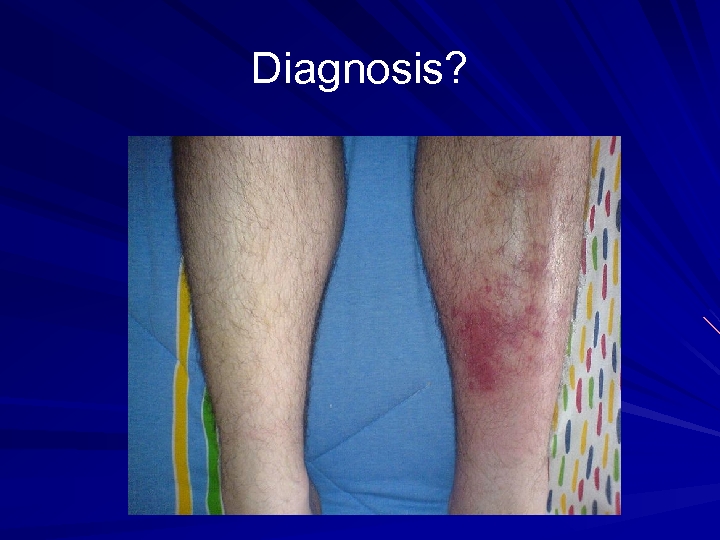
Cellulitis Can be difficult diagnosis Usually hot, erythematous, oedema and tender Systemic – Pyrexia – Nausea – Local lymphadenopathy Younger patients – Nearly always offending lesion e. g. bite Older patients – Co-morbidities may predispose – May not cure without treating underlying co-morbidity

Questions?

PART THREE Antibiotic failure and complex infection

Why do antibiotics fail? Time – Do not work instantly Especially in chest infection. X-ray changes may lag – Some effect can be seen over 24 -48 hours Wrong antibiotic – Wrong choice – Resistant organism Inherent Induced or selected Non-bacterial infection Wrong dose – Ensure flush following IV dosage Wrong route Inability to reach site – Anatomically Privileged sites e. g. CSF – Cellular Privileged intracellular sites e. g. phagolysosome – Pathological


Why do antibiotics fail? Source control – Fluid collection – Biofilm Especially on prosthetic material – Abscess New source of infection Compliance Interaction with other drugs/foods – E. g. Doxycycline and magnesium preparations

How do you know antibiotic choice is failing? Difficult Needs detailed clinical review – Review patient Physiological trends Biochemical and haematological trends – What is the “known” infection doing Visually worsening – E. g. X-ray change, spreading cellulitis – New focus Check head, chest and abdomen – THAT INCLUDES IMAGING! Skin and soft tissue Lines Clostridium difficile – Also think non-infectious Cardiac events Hypoglycaemia Malignancy Auto-immune disease Check microbiology results

Antibiotic failure Sudden onset changes – seconds-minutes are unlikely to be infection Sustained temperature, with worsening physiology – Likely antibiotic failure Temperature spikes but remains stable, inflammatory markers static and often high – Likely source control issue Slow improvement – Likely host related Especially bacteriostatic agents in immunosuppressed Neutropaenic patients may appear to get worse when neutrophils recover – Recovery of cytokine response and cell mediated immunity
Antibiotic failure Patient improves on antibiotics. Deteriorates on cessation – Likely relapse. Restart previous antibiotics, duration may have been too short

Antibiotic failure - Treatment Antibiotic change – Look at guidelines – Discuss with microbiology Source control – Surgery – Drainage – Removal of prosthesis/line If bacteraemic, try and keep line free as long as is practicable THERE ARE NO HARD AND FAST RULES – CLINICAL ACUMEN IS PARAMOUNT

Deep sited infections - Abscess Needs drainage Empirical broad cover then narrow down with microbiology results Dependent on site and successful drainage will need 2 -6 weeks+ antibiotics Sinus or fistula formation may complicate

Deep site infections - endocarditis Infection of the heart valve National guidelines Generally gram positive – Including low virulence skin flora Β-lactam/glycopeptide + aminoglycoside/rifamycin Gram negatives rarer and some unusual – Chlamydia – Brucellosis – Q-fever 4 -6 weeks intra-venous treatment dependent on cause and natural/prosthetic valve

Deep site infection – osteomyelitis/septic arthritis Infection of bone Offending organism may have been present for years before Biofilm formation Debridement/washout Generally gram positive bacteria Β-lactam/glycopeptide + rifamycin/fusidate 2 weeks IV antibiotics followed by 4 weeks oral antibiotics Prostheses infections difficult to treat and usually require removal. Replacement must be 2 stage.

Septic Shock Microbiological emergency You must be able to recognise You must be able to manage

Critical Care Protocol: Early Antibiotic Administration in Septic Shock Criteria for Severe Sepsis (see Box 1 overleaf) Senior Dr Review Fluid unresponsive? ( 20 ml/kg crystalloid or equivalent) NO Antibiotics as per trust pocket guidelines YES 1. SEPTIC SHOCK: Hypotensive despite fluid resuscitation with clinical evidence of infection. 2. High risk for requiring vasopressors within 4 hours (if not responsive to treatment below). TAKE BLOOD CULTURES X 2 and Give IV Antibiotics Immediately 1 ST Line (Document as per Box 3) For Continued Antimicrobial Use Especially MEROPENEM Single dose Gentamicin 3 mg/kg (max 240 mg)* & Piperacillin / tazobactam 4. 5 g QDS for 48 hrs Non-severe Penicillin allergy: Gentamicin 3 mg/Kg stat (max 240 mg)* Registrar / Consultant to Contact Medical Microbiologist (see Box 2 overleaf) + Meropenem 1 gm 8 hourly 2 nd Line See Box 2 paragraph 3 Severe penicillin allergy (anaphylaxis or urticarial reaction on exposure to penicillins or cephalosporins) Gentamicin 3 mg/Kg (max 240 mg)* + Ciprofloxacin 400 mg bd iv + Vancomycin IV + Metronidazole 500 mg iv tds ADD Vancomycin IV if MRSA risk + Caspofungin IV if high risk of invasive fungal infection *Check Gent level at 12 hours – if <3 mg/l and still in septic shock then re-dose at 24 hrs

Guidelines are ONLY for use in patients with Septic Shock Box 1: To diagnose Severe Sepsis patients must reach all three of the following criteria. Follow top of guideline overleaf. 1. Known infection or clinical evidence suggestive of infection 2. Meet 2 or more of SIRS criteria? Tachycardia ≥ 90 RR> 20 or Pa. CO 2 <4. 3 WCC >10 or <4 Temp ≤ 36 or ≥ 38 3. Evidence of end organ hypo-perfusion Systolic BP <90 or MAP <65 Cr >180 or U/O <0. 5 ml/kg for 2 hours Lactate >2 Bili > 35, Plt < 100, Sp. O 2 <90%, Acute confusion If your patients meets all three criteria they have Severe Sepsis. If they are fluid therapy resistant, then they have Septic Shock 1. Follow lower guideline overleaf. 2. Patient must be reviewed by senior doctor ( ST 3 / Sp. R or above)

Box 2: If patient deemed to be in Septic Shock 1. Take 2 blood cultures 2. Give antibiotics immediately (max 30 minutes post- diagnosis) 3. Inform outreach about patient 4. Sp. R / >=ST 3 / Consultant to contact microbiology after giving 1 st dose with the following information: Temp / WCC / RR / Pulse / Renal Function History of allergy History of antibiotics within 1 month (ideally within last year) Previous micro results (ESBL etc) Nursing home background 4. Re-discuss with micro (Ext 6408) at 48 hours Box 3: When patient is given antibiotics for Septic Shock please clearly document: 1. Source of sepsis (if known) 2. Time of diagnosis of SIRS / Severe Sepsis criteria & non response to fluid 3. Time cultures sent 4. Time antibiotics given 5. Time blood taken for gentamicin levels 6. Date and time of discussion with microbiology Don’t forget that the mortality for Septic Shock increases dramatically every hour antibiotics are not given


Septic shock Hit “hard and fast” Gentamicin + Tazocin Non-severe penicillin allergy – Gentamicin + Meropenem Life threatening penicillin allergy – Gentamicin + vancomycin + ciprofloxacin + metronidazole Consider vancomycin where there is risk of invasive MRSA REMEMBER – blood cultures

Bacteraemia/meningitis

Meningitis Cefotaxime 2 g 4 hrly IV – – – +Aciclovir if considering viral encephalitis +Rifampicin if recent travel overseas (anywhere!) + Amoxicillin 2 g 4 hrly IV if pregnant or >50 years old At risk for Listeria – Dexamethasone 8 mg qds IV 2 -4 days started with or just before first dose of antibiotic especially where pneumococcal meningitis is suspected and no septic shock or immunosuppression Penicillin allergy contact microbiology Duration dependent on causative pathogen but course needs to be IV

Necrotising fasciitis


Meleney’s synergistic gangrene

Necrotising fasciitis Urgent surgical review TREATMENT IS SURGICAL, ANTIBIOTICS WILL NOT CURE Tazocin + Clindamycin (1. 2 g qds IV) + Stat gentamicin Penicillin allergy – Clindamycin + ciprofloxacin + metronidazole + gentamicin

Questions?
Скачать презентацию MICROBIOLOGY FOR FOUNDATION YEAR 1 Dr Paul Russell
5c9c9598ad4d07c6e7f6cee303e59377.ppt