 Скачать презентацию Microbicides New Hope for HIV Prevention www global-campaign
3c76ffa7cce240d1707ddcba12f728c3.ppt
- Количество слайдов: 30



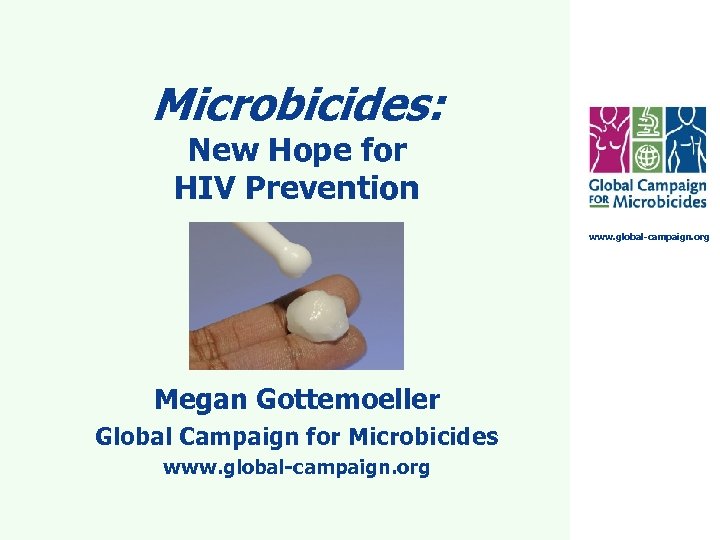
Microbicides: New Hope for HIV Prevention www. global-campaign. org Megan Gottemoeller Global Campaign for Microbicides www. global-campaign. org
Women-Controlled Prevention Methods • Women are biologically more vulnerable to HIV/AIDS • Women may be less able to assert their rights – Economic need or dependency – Social and cultural norms – Gender-based violence • Current methods (abstinence, fidelity, and condom use) often require male consent, knowledge, or cooperation • Current methods don’t allow conception without risk of infection www. global-campaign. org
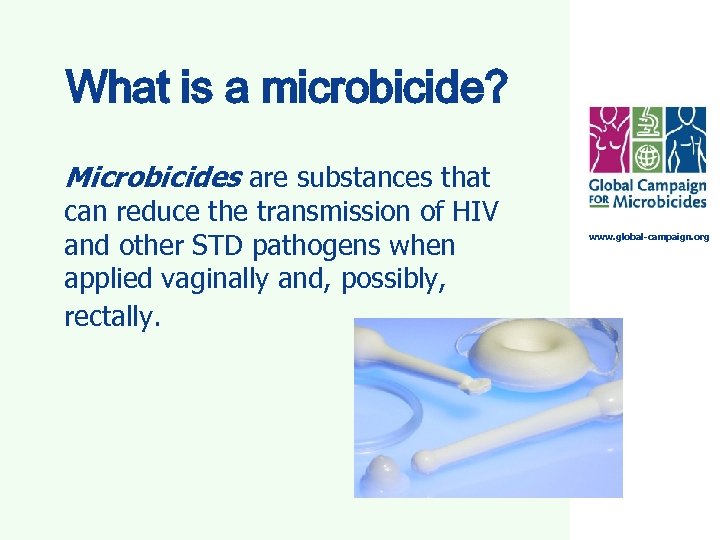
What is a microbicide? Microbicides are substances that can reduce the transmission of HIV and other STD pathogens when applied vaginally and, possibly, rectally. www. global-campaign. org
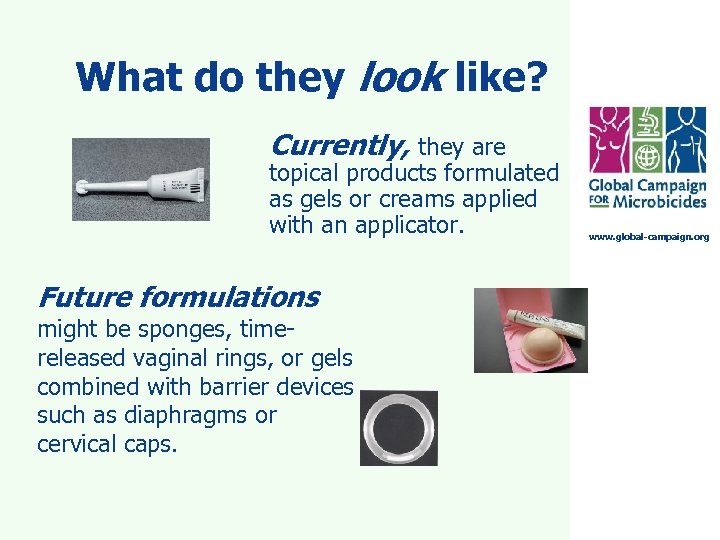
What do they look like? Currently, they are topical products formulated as gels or creams applied with an applicator. Future formulations might be sponges, timereleased vaginal rings, or gels combined with barrier devices such as diaphragms or cervical caps. www. global-campaign. org
What would they be like? • Some will also prevent pregnancy • Others will be microbicidal but not contraceptive • May reduce risk of other STDs • May be inexpensive • May be available over the counter • Could be used without partner’s cooperation or even awareness • First generation expected to be 40 -60% effective www. global-campaign. org
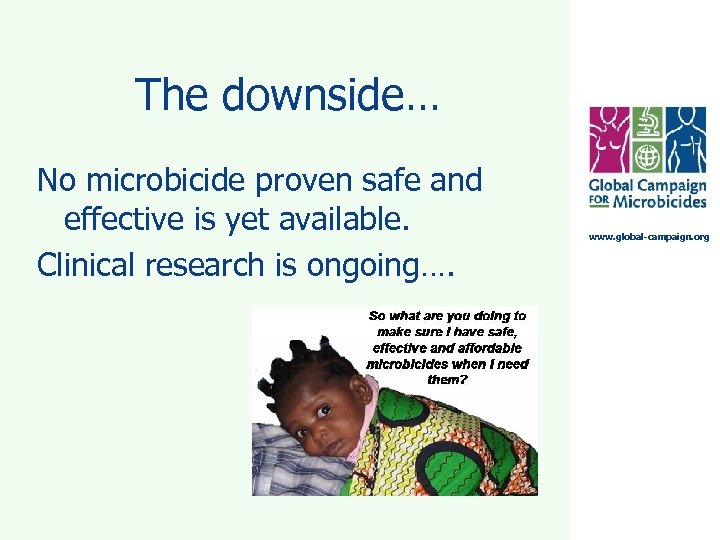
The downside… No microbicide proven safe and effective is yet available. Clinical research is ongoing…. www. global-campaign. org
Getting a microbicide: the clinical research agenda www. global-campaign. org
How microbicides work 1. Kill or inactivate the pathogen 2. Create a barrier between pathogen and vulnerable tissue 3. Interfere with fusion of virus to target cell 4. Prevent replication once virus has entered the cell 5. Boost vagina’s natural defenses www. global-campaign. org
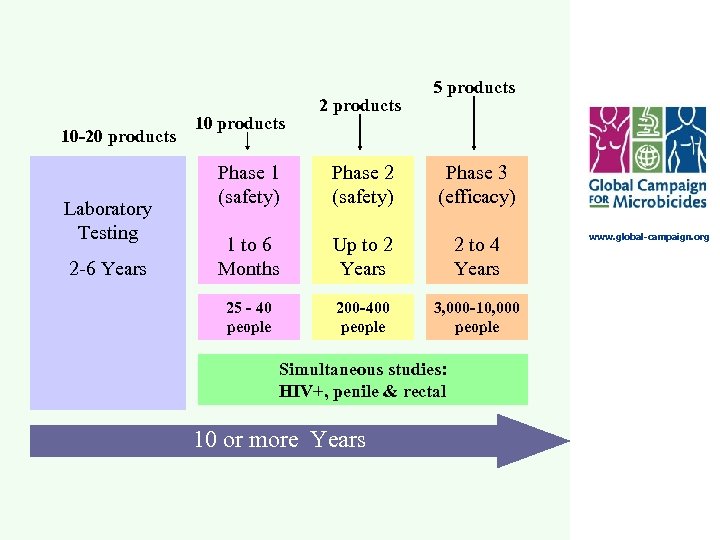
10 -20 products Laboratory Testing 2 -6 Years 10 products 2 products 5 products Phase 1 (safety) Phase 2 (safety) Phase 3 (efficacy) 1 to 6 Months Up to 2 Years 2 to 4 Years 25 - 40 people 200 -400 people 3, 000 -10, 000 people Simultaneous studies: HIV+, penile & rectal 10 or more Years www. global-campaign. org
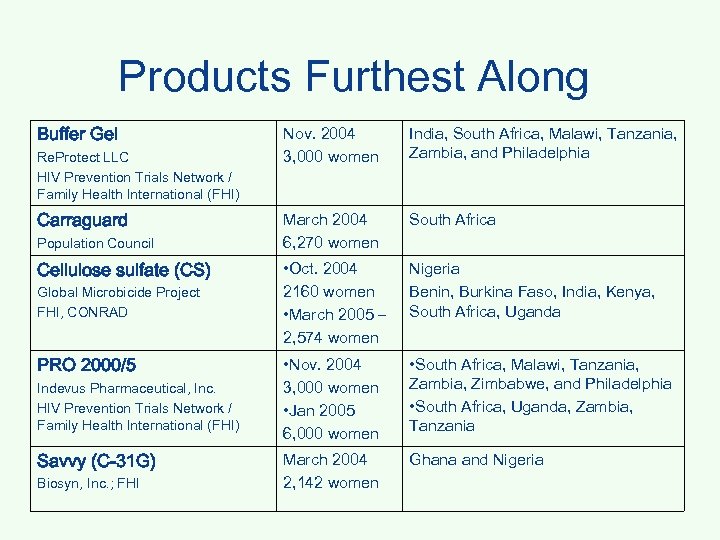
Products Furthest Along Buffer Gel Re. Protect LLC HIV Prevention Trials Network / Family Health International (FHI) Carraguard Population Council Cellulose sulfate (CS) Global Microbicide Project FHI, CONRAD PRO 2000/5 Indevus Pharmaceutical, Inc. HIV Prevention Trials Network / Family Health International (FHI) Savvy (C-31 G) Biosyn, Inc. ; FHI Nov. 2004 3, 000 women India, South Africa, Malawi, Tanzania, Zambia, and Philadelphia March 2004 6, 270 women South Africa • Oct. 2004 2160 women • March 2005 – 2, 574 women Nigeria Benin, Burkina Faso, India, Kenya, South Africa, Uganda • Nov. 2004 3, 000 women • Jan 2005 6, 000 women • South Africa, Malawi, Tanzania, Zambia, Zimbabwe, and Philadelphia • South Africa, Uganda, Zambia, Tanzania March 2004 2, 142 women Ghana and Nigeria
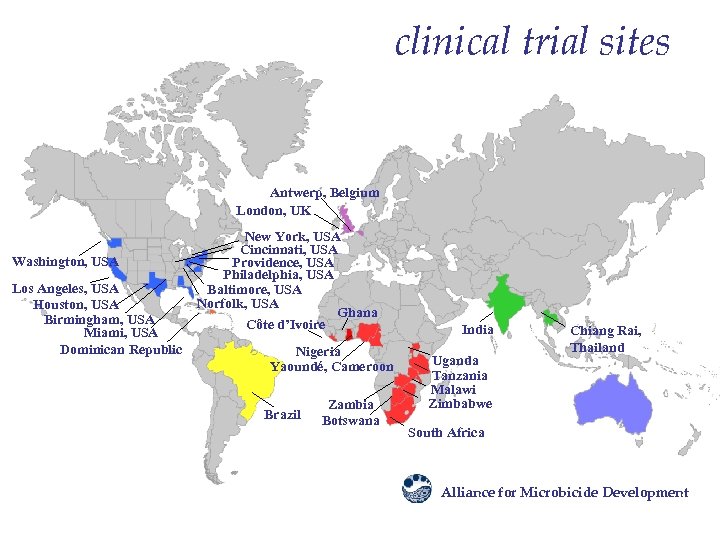
clinical trial sites Antwerp, Belgium London, UK Washington, USA Los Angeles, USA Houston, USA Birmingham, USA Miami, USA Dominican Republic New York, USA Cincinnati, USA Providence, USA Philadelphia, USA Baltimore, USA Norfolk, USA Ghana Côte d’Ivoire Nigeria Yaoundé, Cameroon Brazil Zambia Botswana India Uganda Tanzania Malawi Zimbabwe Chiang Rai, Thailand South Africa Alliance for Microbicide Development
Who Does the Research • Candidate products developed by small biotech firms • Research sponsored by public funding from USA and European governments • Research conducted through partnerships between academic or non-profit institutions in north and south • Simultaneous efforts to ensure local licensure and affordable access to effective product www. global-campaign. org
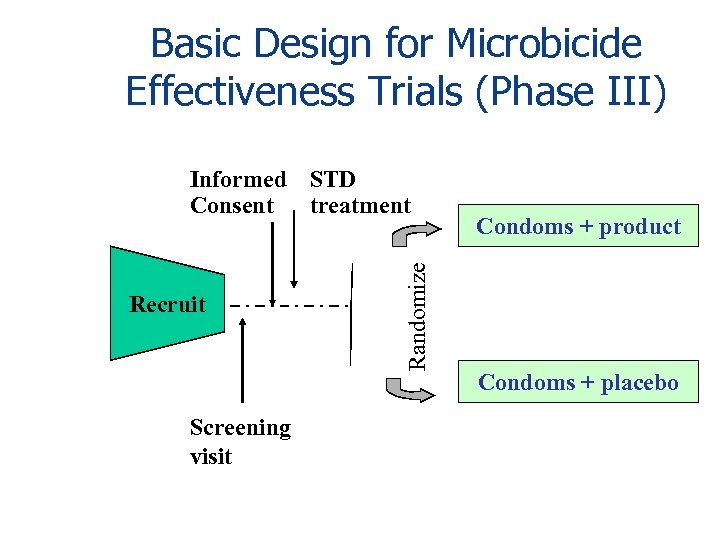
Basic Design for Microbicide Effectiveness Trials (Phase III) Recruit Screening visit Randomize Informed STD Consent treatment Condoms + product Condoms + placebo
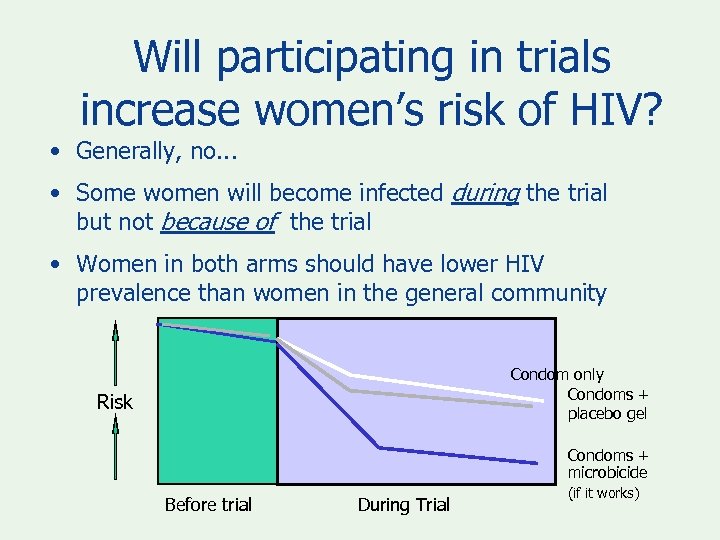
Will participating in trials increase women’s risk of HIV? • Generally, no. . . • Some women will become infected during the trial but not because of the trial • Women in both arms should have lower HIV prevalence than women in the general community Condoms only ` Risk Condom only Condoms + placebo gel Condoms + microbicide Before trial During Trial (if it works)
Positioning Microbicides: the public health perspective www. global-campaign. org
How effective will they be? • First microbicides will be 40 -60% protective • Second generation products will be 60 -80% • should be promoted as an adjunct or “backup” to condoms, not as a replacement • use with harm reduction messages, such as: – Use a male or female condom every time you have sex; if you absolutely can’t use a condom, use a microbicide – Use a microbicide with your condom for added pleasure and protection www. global-campaign. org
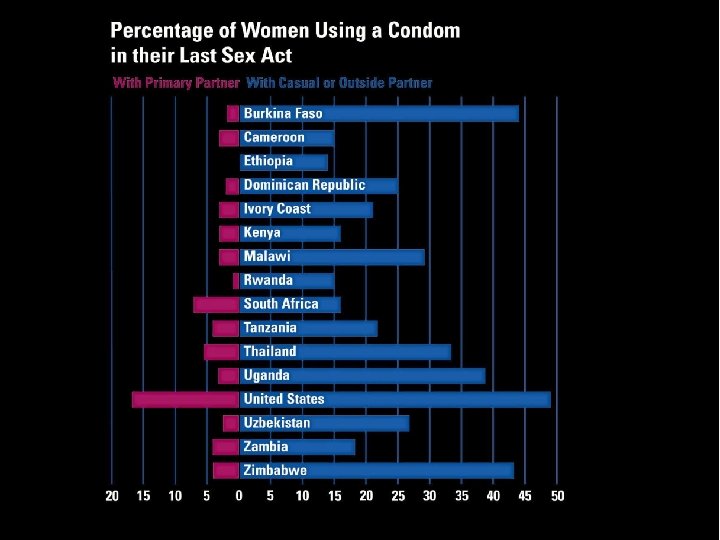
What about “condom migration”? • Will individuals switch from using from condoms to microbicides because they are easier to use? • Three lines of evidence suggest that introducing microbicides will lead to more protection rather than less - experience from family planning - research data insights from modeling www. global-campaign. org
Experience from family planning • Addition of each new method increases overall number of protected acts and decreases unintended pregnancies. • Adding a new contraceptive method to those available in an existing program increases overall use by about 12 percentage points, and decreases crude birth rate by 5. 3 points. (Ross, J & E. Frankenberg. 1993 Findings from Two Decades of Family Planning Research. Population Council) www. global-campaign. org
Existing condom use research • 9 existing studies – Two designs. Condom only vs. – condom plus gel or – hierarchy of prevention options (including female condom and gel); • 6 found that availability of additional protection options resulted in overall increase in consistent condom use • 3 found some evidence of migration • 3 highlight that consistent microbicide use could be achieved by women who could not use condoms www. global-campaign. org
Mathematical modeling suggests…. • Under most circumstances, probable levels of condom migration do not increase risk of HIV transmission • of individuals • of sub-populations • Condom migration is potentially a problem only where condom use is high (> 70%) AND achieved microbicide consistency is low (< 50 % of sex acts where condom isn’t used) (Foss et al, Shifts in condom use following microbicide introduction: should we be concerned? . AIDS 2003, 17: 1227 -1237) www. global-campaign. org
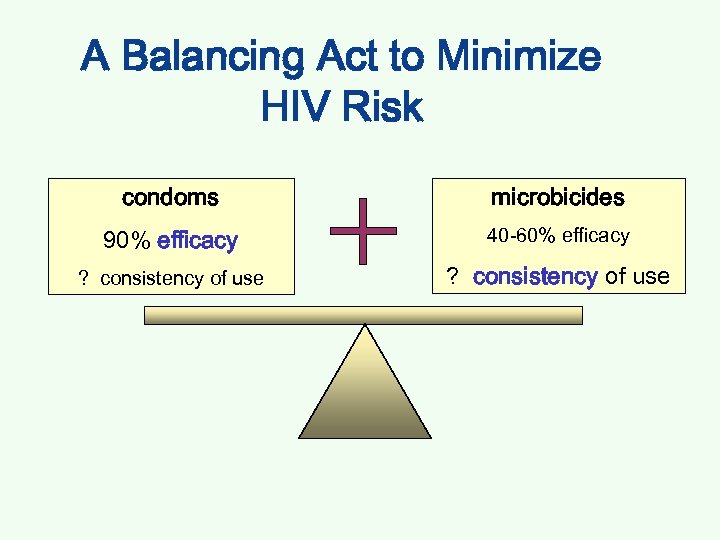
A Balancing Act to Minimize HIV Risk condoms microbicides 90% efficacy 40 -60% efficacy ? consistency of use
Will Women Use Microbicides? • In US study, an estimates 21. 3 million women interested in using a microbicide (Darroch & Frost, 1999) • Even in resource-poor countries, women at risk are willing to pay twice as much (or more) than the local price of a condom (EU study, 1998; Hardy, et al 1998) • Women have widely different needs and formulation preferences so multiple products will be the key to widespread acceptability and use www. global-campaign. org

How do we get there from here? www. global-campaign. org
Development will require significant public money Why aren’t the big pharmaceuticals investing? - perceived low profitability liability concerns lack of in-house expertise uncertain regulatory environment For the last 20 years, almost all funding for contraceptive development and related research has come from governments and foundations. www. global-campaign. org
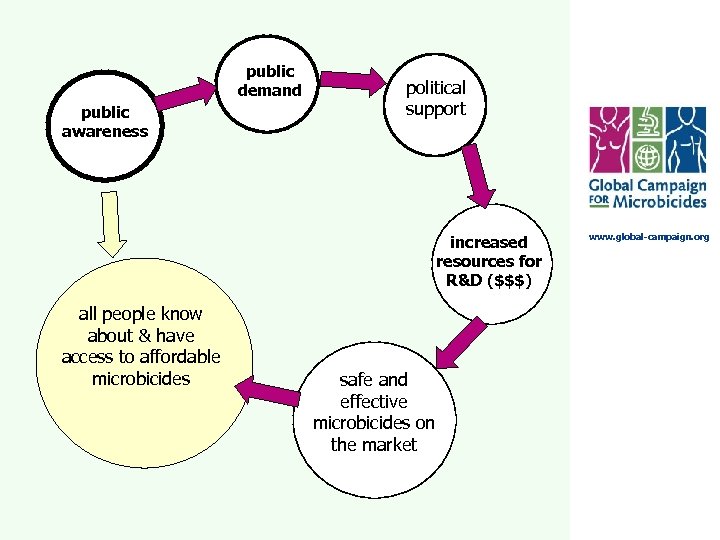
public demand public awareness political support increased resources for R&D ($$$) all people know about & have access to affordable microbicides safe and effective microbicides on the market www. global-campaign. org
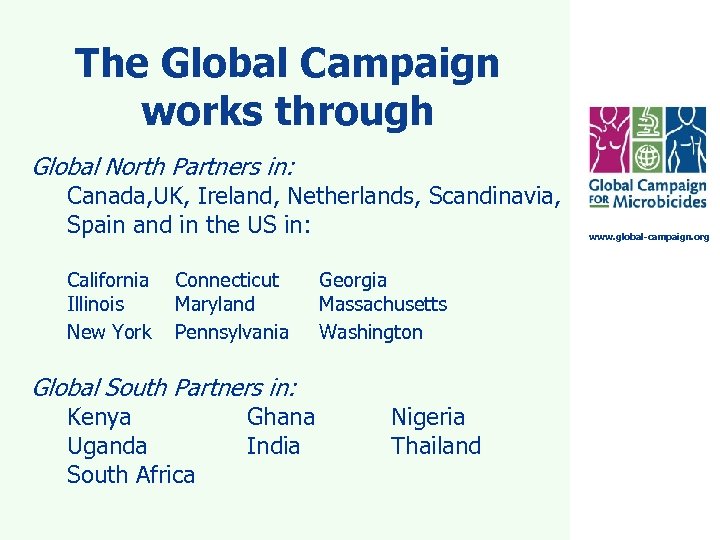
The Global Campaign works through Global North Partners in: Canada, UK, Ireland, Netherlands, Scandinavia, Spain and in the US in: California Illinois New York Connecticut Maryland Pennsylvania Global South Partners in: Kenya Uganda South Africa Ghana India Georgia Massachusetts Washington Nigeria Thailand www. global-campaign. org
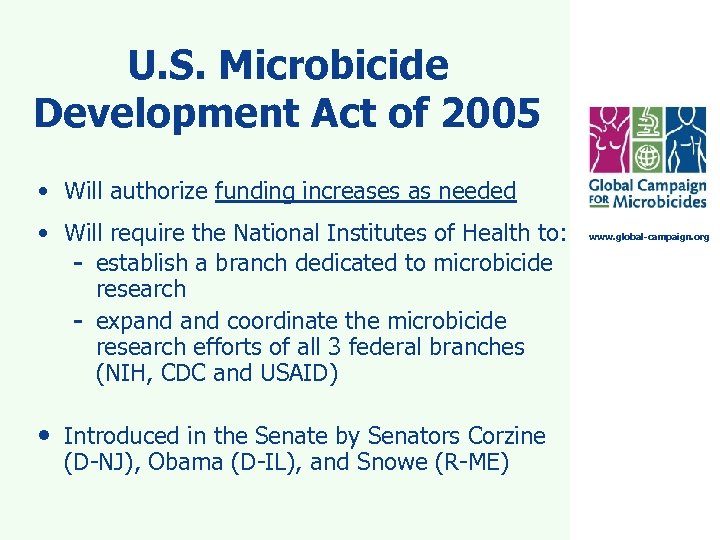
U. S. Microbicide Development Act of 2005 • Will authorize funding increases as needed • Will require the National Institutes of Health to: - establish a branch dedicated to microbicide research - expand coordinate the microbicide research efforts of all 3 federal branches (NIH, CDC and USAID) • Introduced in the Senate by Senators Corzine (D-NJ), Obama (D-IL), and Snowe (R-ME) www. global-campaign. org
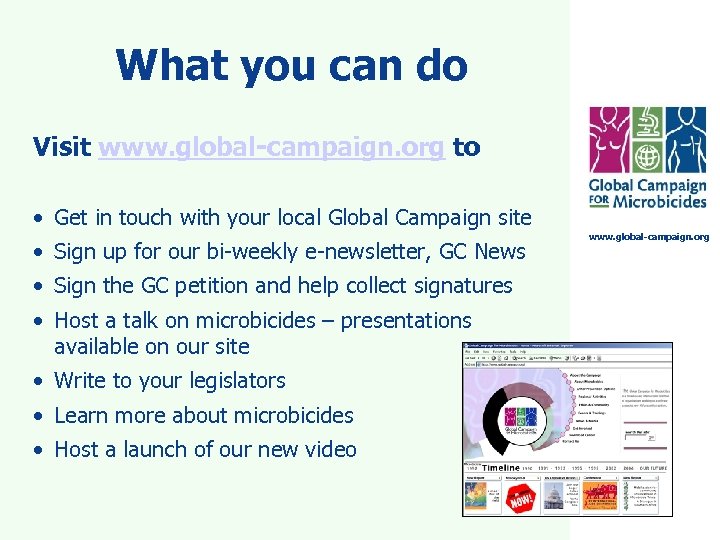
What you can do Visit www. global-campaign. org to • Get in touch with your local Global Campaign site • Sign up for our bi-weekly e-newsletter, GC News • Sign the GC petition and help collect signatures • Host a talk on microbicides – presentations available on our site • Write to your legislators • Learn more about microbicides • Host a launch of our new video www. global-campaign. org
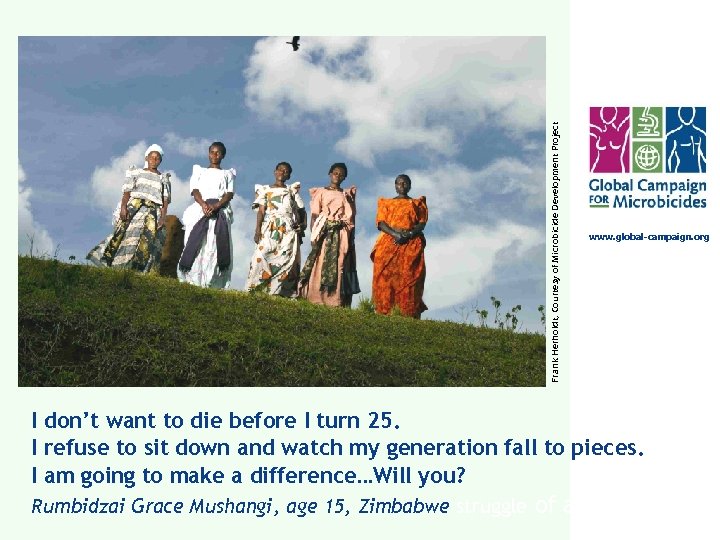
Frank Herholdt, Courtesy of Microbicide Development Project www. global-campaign. org I don’t want to die before I turn 25. I refuse to sit down and watch my generation fall to pieces. I am going to make a difference…Will you? Rumbidzai Grace Mushangi, age 15, Zimbabwe struggle of a
Скачать презентацию Microbicides New Hope for HIV Prevention www global-campaign
3c76ffa7cce240d1707ddcba12f728c3.ppt