 Скачать презентацию Microbial ecology of stable flies Effect of bacterial
8c6383894ef9473ac17de9bbca10a2e8.ppt
- Количество слайдов: 1



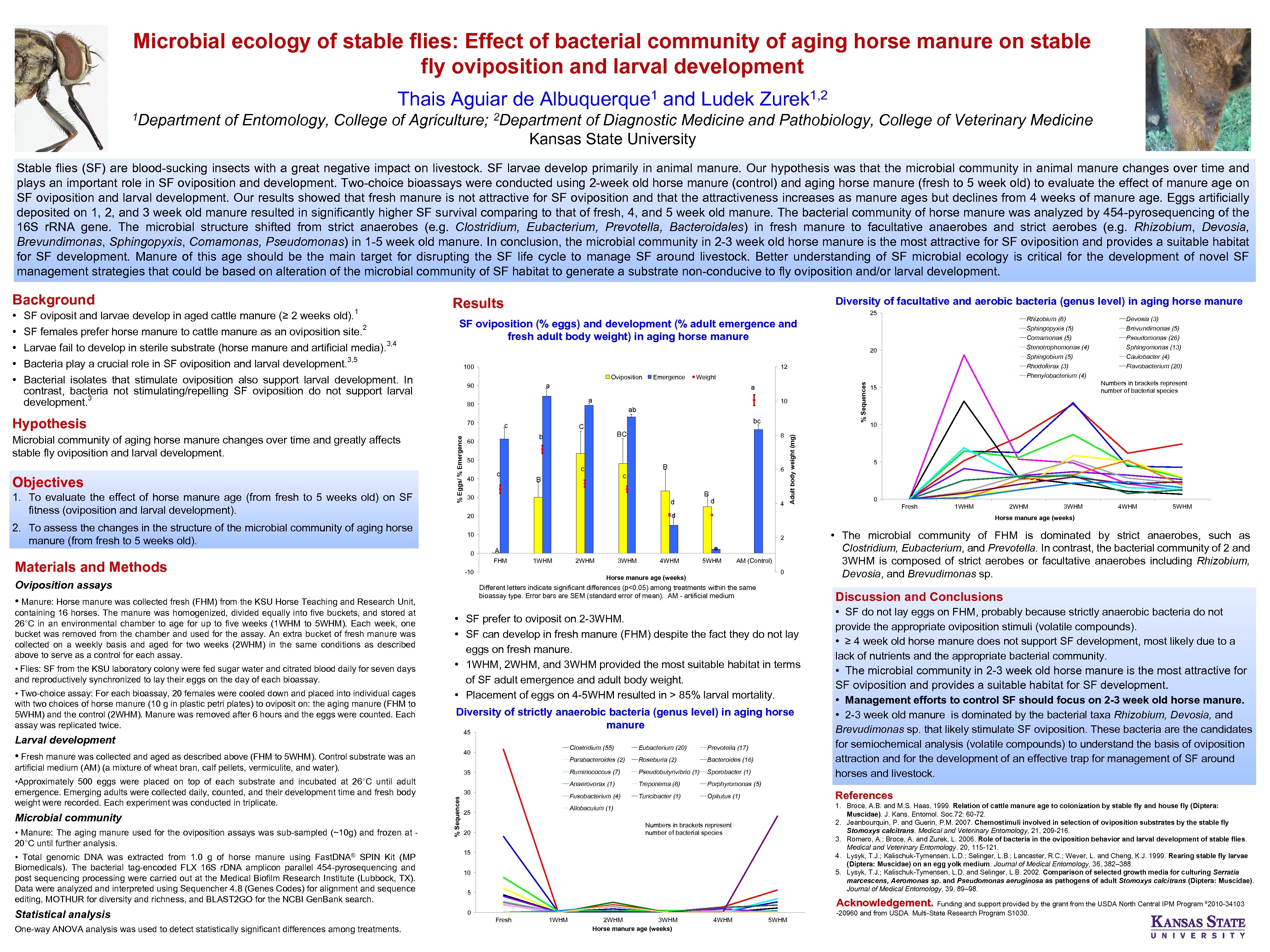
Microbial ecology of stable flies: Effect of bacterial community of aging horse manure on stable fly oviposition and larval development Thais Aguiar de 1 Department of Entomology, College of Agriculture; 1 Albuquerque and Ludek 1, 2 Zurek 2 Department of Diagnostic Medicine and Pathobiology, College of Veterinary Medicine Kansas State University Stable flies (SF) are blood-sucking insects with a great negative impact on livestock. SF larvae develop primarily in animal manure. Our hypothesis was that the microbial community in animal manure changes over time and plays an important role in SF oviposition and development. Two-choice bioassays were conducted using 2 -week old horse manure (control) and aging horse manure (fresh to 5 week old) to evaluate the effect of manure age on SF oviposition and larval development. Our results showed that fresh manure is not attractive for SF oviposition and that the attractiveness increases as manure ages but declines from 4 weeks of manure age. Eggs artificially deposited on 1, 2, and 3 week old manure resulted in significantly higher SF survival comparing to that of fresh, 4, and 5 week old manure. The bacterial community of horse manure was analyzed by 454 -pyrosequencing of the 16 S r. RNA gene. The microbial structure shifted from strict anaerobes (e. g. Clostridium, Eubacterium, Prevotella, Bacteroidales) in fresh manure to facultative anaerobes and strict aerobes (e. g. Rhizobium, Devosia, Brevundimonas, Sphingopyxis, Comamonas, Pseudomonas) in 1 -5 week old manure. In conclusion, the microbial community in 2 -3 week old horse manure is the most attractive for SF oviposition and provides a suitable habitat for SF development. Manure of this age should be the main target for disrupting the SF life cycle to manage SF around livestock. Better understanding of SF microbial ecology is critical for the development of novel SF management strategies that could be based on alteration of the microbial community of SF habitat to generate a substrate non-conducive to fly oviposition and/or larval development. SF oviposit and larvae develop in aged cattle manure (≥ 2 weeks old). 2 SF females prefer horse manure to cattle manure as an oviposition site. 3, 4 Larvae fail to develop in sterile substrate (horse manure and artificial media). 3, 5 Bacteria play a crucial role in SF oviposition and larval development. Bacterial isolates that stimulate oviposition also support larval development. In contrast, bacteria not stimulating/repelling SF oviposition do not support larval 3 development. 20 100 12 Oviposition % Eggs/ % Emergence 1. To evaluate the effect of horse manure age (from fresh to 5 weeks old) on SF fitness (oviposition and larval development). a ab c C c d One-way ANOVA analysis was used to detect statistically significant differences among treatments. e 1 WHM 2 WHM 3 WHM 4 WHM 5 WHM AM (Control) 0 Horse manure age (weeks) Clostridium (55) 5 0 Fresh Roseburia (2) Bacteroides (16) Pseudobutyrivibrio (1) Sporobacter (1) Anaerovorax (1) Treponema (8) Turicibacter (1) Opitutus (1) 4 WHM 5 WHM • The microbial community of FHM is dominated by strict anaerobes, such as Clostridium, Eubacterium, and Prevotella. In contrast, the bacterial community of 2 and 3 WHM is composed of strict aerobes or facultative anaerobes including Rhizobium, Devosia, and Brevudimonas sp. • SF do not lay eggs on FHM, probably because strictly anaerobic bacteria do not provide the appropriate oviposition stimuli (volatile compounds). • ≥ 4 week old horse manure does not support SF development, most likely due to a lack of nutrients and the appropriate bacterial community. • The microbial community in 2 -3 week old horse manure is the most attractive for SF oviposition and provides a suitable habitat for SF development. • Management efforts to control SF should focus on 2 -3 week old horse manure. • 2 -3 week old manure is dominated by the bacterial taxa Rhizobium, Devosia, and Brevudimonas sp. that likely stimulate SF oviposition. These bacteria are the candidates for semiochemical analysis (volatile compounds) to understand the basis of oviposition attraction and for the development of an effective trap for management of SF around horses and livestock. 1. Broce, A. B. and M. S. Haas. 1999. Relation of cattle manure age to colonization by stable fly and house fly (Diptera: Muscidae). J. Kans. Entomol. Soc. 72: 60 -72. 2. Jeanbourquin, P. and Guerin, P. M. 2007. Chemostimuli involved in selection of oviposition substrates by the stable fly Stomoxys calcitrans. Medical and Veterinary Entomology, 21, 209 -216. 3. Romero, A. ; Broce, A. and Zurek, L. 2006. Role of bacteria in the oviposition behavior and larval development of stable flies. Medical and Veterinary Entomology. 20, 115 -121. 4. Lysyk, T. J. ; Kalischuk-Tymensen, L. D. ; Selinger, L. B. ; Lancaster, R. C. ; Wever, L. and Cheng, K. J. 1999. Rearing stable fly larvae (Diptera: Muscidae) on an egg yolk medium. Journal of Medical Entomology, 36, 382– 388. 5. Lysyk, T. J. ; Kalischuk-Tymensen, L. D. and Selinger, L. B. 2002. Comparison of selected growth media for culturing Serratia marcescens, Aeromonas sp. and Pseudomonas aeruginosa as pathogens of adult Stomoxys calcitrans (Diptera: Muscidae). Journal of Medical Entomology, 39, 89– 98. Numbers in brackets represent number of bacterial species 20 3 WHM References Allobaculum (1) 25 2 WHM Porphyromonas (5) Fusobacterium (4) 30 1 WHM Discussion and Conclusions Prevotella (17) Ruminococcus (7) 35 Eubacterium (20) Parabacteroides (2) 40 % Sequences 10 Horse manure age (weeks) 2 A Devosia (3) Brevundimonas (5) Pseudomonas (26) Sphingomonas (13) Caulobacter (4) Flavobacterium (20) Numbers in brackets represent number of bacterial species 15 d 45 artificial medium (AM) (a mixture of wheat bran, calf pellets, vermiculite, and water). Statistical analysis 4 Diversity of strictly anaerobic bacteria (genus level) in aging horse manure • Fresh manure was collected and aged as described above (FHM to 5 WHM). Control substrate was an • Total genomic DNA was extracted from 1. 0 g of horse manure using SPIN Kit (MP Biomedicals). The bacterial tag-encoded FLX 16 S r. DNA amplicon parallel 454 -pyrosequencing and post sequencing processing were carried out at the Medical Biofilm Research Institute (Lubbock, TX). Data were analyzed and interpreted using Sequencher 4. 8 (Genes Codes) for alignment and sequence editing, MOTHUR for diversity and richness, and BLAST 2 GO for the NCBI Gen. Bank search. d • SF prefer to oviposit on 2 -3 WHM. • SF can develop in fresh manure (FHM) despite the fact they do not lay eggs on fresh manure. • 1 WHM, 2 WHM, and 3 WHM provided the most suitable habitat in terms of SF adult emergence and adult body weight. • Placement of eggs on 4 -5 WHM resulted in > 85% larval mortality. Larval development Fast. DNA® B Different letters indicate significant differences (p<0. 05) among treatments within the same bioassay type. Error bars are SEM (standard error of mean). AM - artificial medium • Manure: Horse manure was collected fresh (FHM) from the KSU Horse Teaching and Research Unit, • Manure: The aging manure used for the oviposition assays was sub-sampled (~10 g) and frozen at 20°C until further analysis. 6 c B 30 Oviposition assays Microbial community B c -10 • Approximately 500 eggs were placed on top of each substrate and incubated at 26°C until adult emergence. Emerging adults were collected daily, counted, and their development time and fresh body weight were recorded. Each experiment was conducted in triplicate. 8 10 Materials and Methods • Two-choice assay: For each bioassay, 20 females were cooled down and placed into individual cages with two choices of horse manure (10 g in plastic petri plates) to oviposit on: the aging manure (FHM to 5 WHM) and the control (2 WHM). Manure was removed after 6 hours and the eggs were counted. Each assay was replicated twice. BC 50 FHM • Flies: SF from the KSU laboratory colony were fed sugar water and citrated blood daily for seven days and reproductively synchronized to lay their eggs on the day of each bioassay. bc b 60 0 containing 16 horses. The manure was homogenized, divided equally into five buckets, and stored at 26°C in an environmental chamber to age for up to five weeks (1 WHM to 5 WHM). Each week, one bucket was removed from the chamber and used for the assay. An extra bucket of fresh manure was collected on a weekly basis and aged for two weeks (2 WHM) in the same conditions as described above to serve as a control for each assay. 10 20 2. To assess the changes in the structure of the microbial community of aging horse manure (from fresh to 5 weeks old). Weight a 80 40 Emergence a 90 Hypothesis Objectives Rhizobium (8) Sphingopyxis (5) Comamonas (5) Stenotrophomonas (4) Sphingobium (5) Rhodoferax (3) Phenylobacterium (4) SF oviposition (% eggs) and development (% adult emergence and fresh adult body weight) in aging horse manure 70 Microbial community of aging horse manure changes over time and greatly affects stable fly oviposition and larval development. 25 % Sequences • • • 1 Diversity of facultative and aerobic bacteria (genus level) in aging horse manure Results Adult body weight (mg) Background 15 10 5 Acknowledgement. Funding and support provided by the grant from the USDA North Central IPM Program #2010 -34103 0 Fresh 1 WHM 2 WHM 3 WHM Horse manure age (weeks) 4 WHM 5 WHM -20960 and from USDA Multi-State Research Program S 1030.
Скачать презентацию Microbial ecology of stable flies Effect of bacterial
8c6383894ef9473ac17de9bbca10a2e8.ppt