


 Скачать презентацию Micro Mc Eachern ECON 9 2010 -2011 CHAPTER
9bc886016e96a16f6fa246a4f5288d74.ppt
- Количество слайдов: 36
 Micro Mc. Eachern ECON 9 2010 -2011 CHAPTER Designed by Amy Mc. Guire, B-books, Ltd. Chapter 9 Monopoly Copyright © 2010 by South-Western, a division of Cengage Learning. All rights reserved 1
 Barriers to Entry § § Monopoly – Sole supplier of a product with no close substitutes Barriers to entry 1. Legal restrictions 2. Economies of scale 3. Control of essential resources LO 1 Chapter 9 Copyright © 2010 by South-Western, a division of Cengage Learning. All rights reserved 2
 Barriers to Entry 1. Legal restrictions – Patents and invention incentives • Patent – exclusive right for 20 years – Licenses and other entry restrictions • Federal license • State license LO 1 Chapter 9 Copyright © 2010 by South-Western, a division of Cengage Learning. All rights reserved 3
 Barriers to Entry 2. Economies of scale – Natural monopoly – Downward-sloping LRAC curve • One firm can supply market demand at a lower ATC per unit than could two firms LO 1 Chapter 9 Copyright © 2010 by South-Western, a division of Cengage Learning. All rights reserved 4
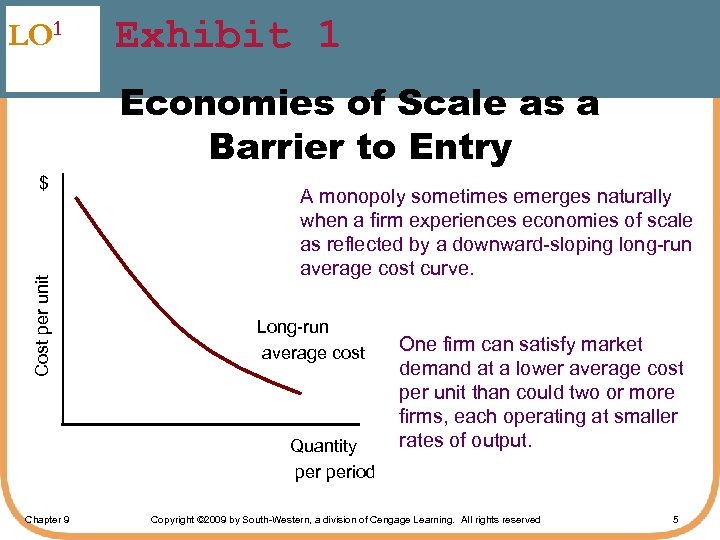 LO 1 Exhibit 1 Economies of Scale as a Barrier to Entry Cost per unit $ A monopoly sometimes emerges naturally when a firm experiences economies of scale as reflected by a downward-sloping long-run average cost curve. Long-run average cost Quantity period Chapter 9 One firm can satisfy market demand at a lower average cost per unit than could two or more firms, each operating at smaller rates of output. Copyright © 2009 by South-Western, a division of Cengage Learning. All rights reserved 5
 Barriers to Entry 3. Control of essential resources – Alcoa (aluminum) – Professional sports leagues – China (pandas) – De. Beers Consolidated Mines (diamonds) LO 1 Chapter 9 Copyright © 2010 by South-Western, a division of Cengage Learning. All rights reserved 6
 Case Study LO 1 Is a Diamond Forever? Chapter 9 u 1866, De. Beers u Great Depression – lower diamond prices u De. Beers: control the world supply of uncut diamonds u To increase consumer demand u Marketing “A diamond is forever” u Lasts forever, so should love u Remain in the family u Retain their value Copyright © 2010 by South-Western, a division of Cengage Learning. All rights reserved 7
 Case Study LO 1 Is a Diamond Forever? Chapter 9 u Limit the supply of rough diamonds u Buyers: wholesalers u Box of uncut diamonds at a set price u No negotiations u Violates U. S. antitrust laws u Mid 1990 s: lose control of some rough diamond supplies u Russia u Australia (Argyle) u Canada (Yellowknife) Copyright © 2010 by South-Western, a division of Cengage Learning. All rights reserved 8
 Case Study LO 1 Is a Diamond Forever? Chapter 9 u u Mid 1980 s: 90% of market 2007: 45% of market Synthetic diamonds 2006: settle lawsuits ($300 million) u Comply with U. S. antitrust laws u Americans u 5% of world population u 50% of world’s retail purchases u ‘Blood diamonds’; ‘Conflict diamonds’ Copyright © 2010 by South-Western, a division of Cengage Learning. All rights reserved 9
 Monopoly § Monopoly – Local – National – International § Long-lasting monopolies – Rare – Economic profit attracts competitors LO 2 – Technological change Chapter 9 Copyright © 2010 by South-Western, a division of Cengage Learning. All rights reserved 10
 Revenue for the Monopolist § Monopoly – Supplies the market demand • Downward-slopping D (law of D) • To sell more: must lower P on all units sold § Total revenue TR=p*Q § Average revenue AR=TR/Q – For monopolist: p=AR LO 2 § Demand D: also AR curve Chapter 9 Copyright © 2010 by South-Western, a division of Cengage Learning. All rights reserved 11
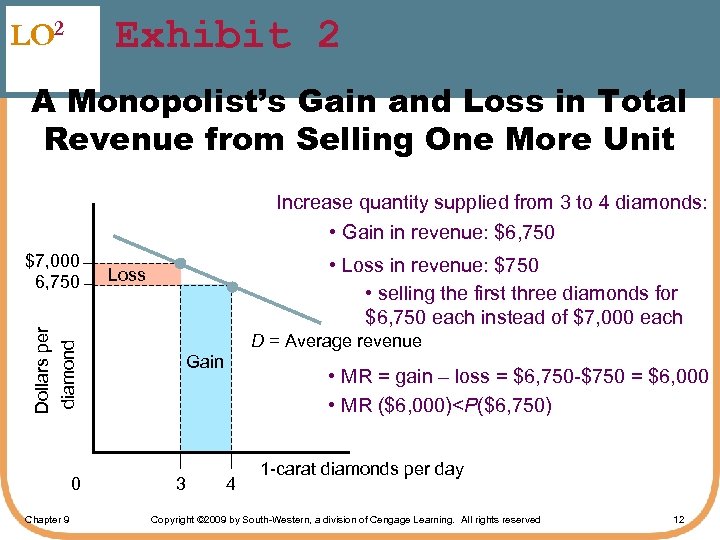 Exhibit 2 LO 2 A Monopolist’s Gain and Loss in Total Revenue from Selling One More Unit Increase quantity supplied from 3 to 4 diamonds: • Gain in revenue: $6, 750 Dollars per diamond $7, 000 6, 750 0 Chapter 9 • Loss in revenue: $750 • selling the first three diamonds for $6, 750 each instead of $7, 000 each Loss D = Average revenue Gain 3 • MR = gain – loss = $6, 750 -$750 = $6, 000 • MR ($6, 000)
 Revenue for the Monopolist § Marginal revenue MR=∆TR/∆Q – For monopolist: MR
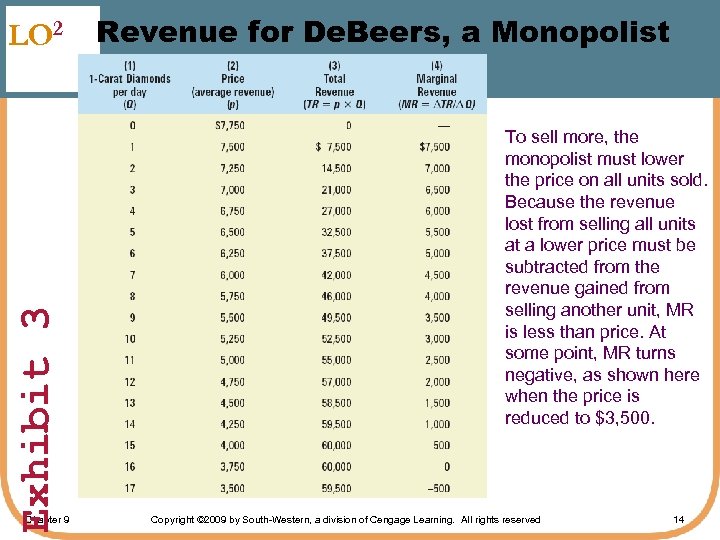 Exhibit 3 LO 2 Chapter 9 Revenue for De. Beers, a Monopolist To sell more, the monopolist must lower the price on all units sold. Because the revenue lost from selling all units at a lower price must be subtracted from the revenue gained from selling another unit, MR is less than price. At some point, MR turns negative, as shown here when the price is reduced to $3, 500. Copyright © 2009 by South-Western, a division of Cengage Learning. All rights reserved 14
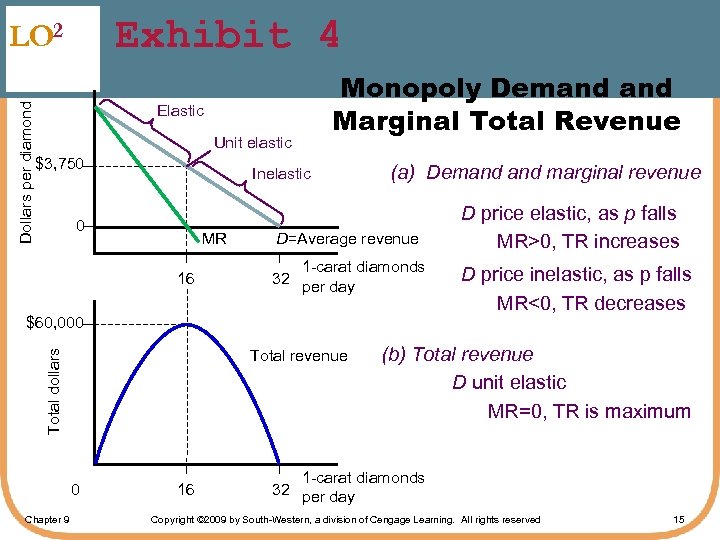 Exhibit 4 Dollars per diamond LO 2 Elastic Unit elastic $3, 750 Monopoly Demand Marginal Total Revenue Inelastic 0 MR 16 (a) Demand marginal revenue D=Average revenue 1 -carat diamonds 32 per day $60, 000 Total dollars Total revenue 0 Chapter 9 16 D price elastic, as p falls MR>0, TR increases D price inelastic, as p falls MR<0, TR decreases (b) Total revenue D unit elastic MR=0, TR is maximum 1 -carat diamonds 32 per day Copyright © 2009 by South-Western, a division of Cengage Learning. All rights reserved 15
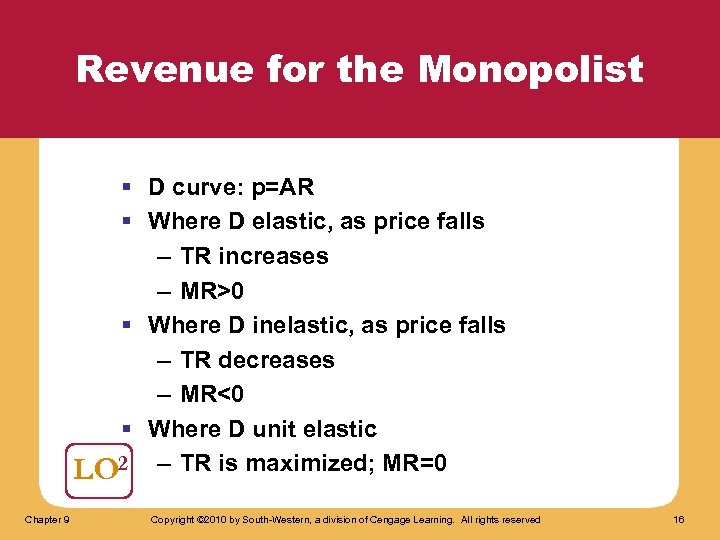 Revenue for the Monopolist § D curve: p=AR § Where D elastic, as price falls – TR increases – MR>0 § Where D inelastic, as price falls – TR decreases – MR<0 § Where D unit elastic LO 2 – TR is maximized; MR=0 Chapter 9 Copyright © 2010 by South-Western, a division of Cengage Learning. All rights reserved 16
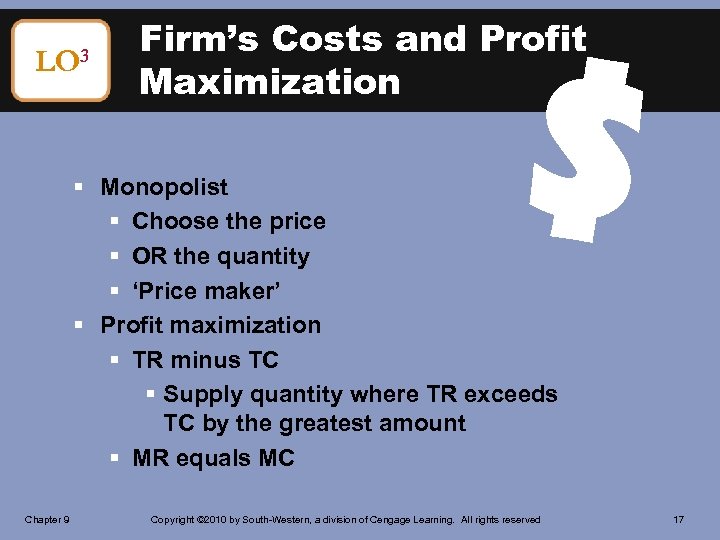 LO 3 Firm’s Costs and Profit Maximization $ § Monopolist § Choose the price § OR the quantity § ‘Price maker’ § Profit maximization § TR minus TC § Supply quantity where TR exceeds TC by the greatest amount § MR equals MC Chapter 9 Copyright © 2010 by South-Western, a division of Cengage Learning. All rights reserved 17
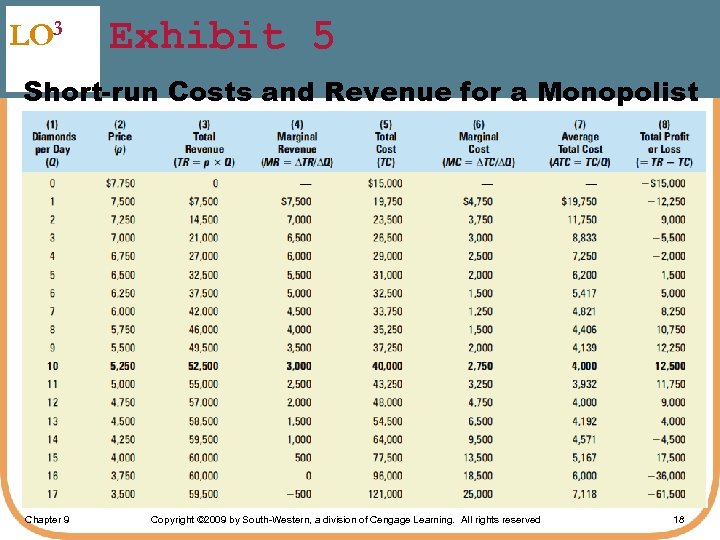 LO 3 Exhibit 5 Short-run Costs and Revenue for a Monopolist Chapter 9 Copyright © 2009 by South-Western, a division of Cengage Learning. All rights reserved 18
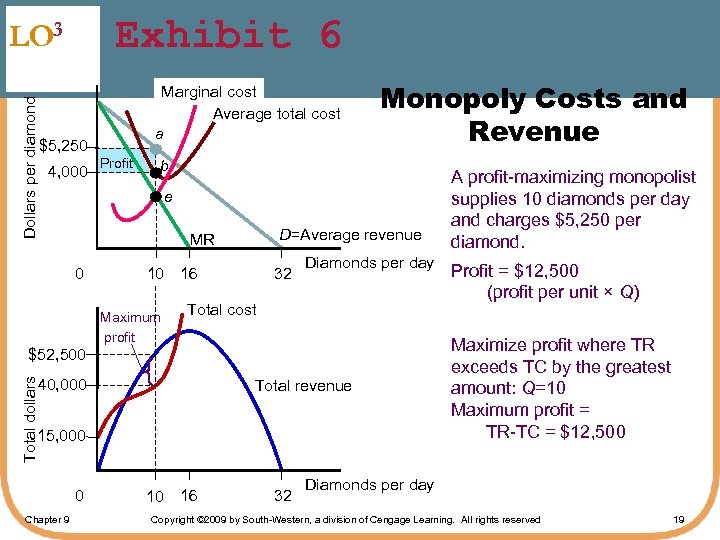 Exhibit 6 Dollars per diamond LO 3 Marginal cost Average total cost a $5, 250 4, 000 Profit Monopoly Costs and Revenue b e D=Average revenue MR 0 $52, 500 10 16 Maximum profit 32 Diamonds per day Total cost Total dollars 40, 000 Total revenue 15, 000 0 Chapter 9 10 16 32 A profit-maximizing monopolist supplies 10 diamonds per day and charges $5, 250 per diamond. Profit = $12, 500 (profit per unit × Q) Maximize profit where TR exceeds TC by the greatest amount: Q=10 Maximum profit = TR-TC = $12, 500 Diamonds per day Copyright © 2009 by South-Western, a division of Cengage Learning. All rights reserved 19
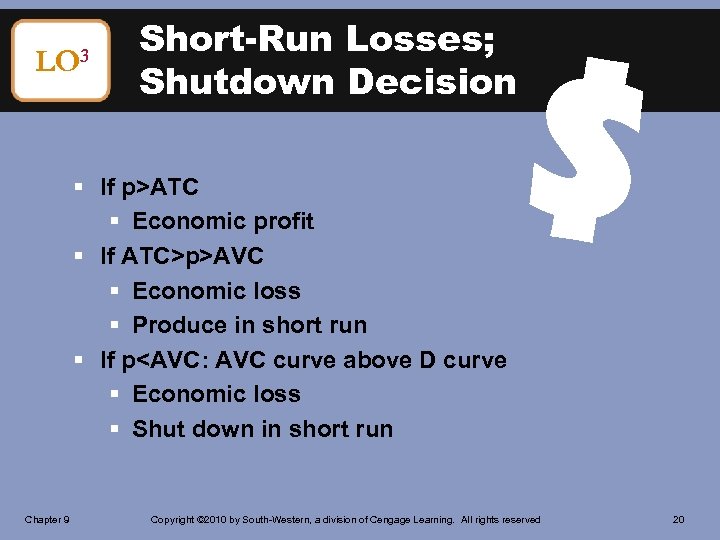 LO 3 Short-Run Losses; Shutdown Decision § If p>ATC § Economic profit § If ATC>p>AVC § Economic loss § Produce in short run § If p
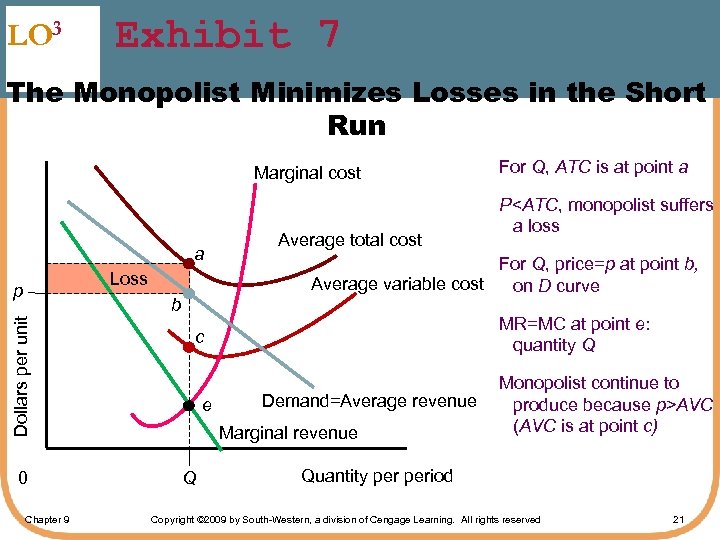 LO 3 Exhibit 7 The Monopolist Minimizes Losses in the Short Run Marginal cost a Loss p Dollars per unit b 0 Chapter 9 Average total cost MR=MC at point e: quantity Q Demand=Average revenue Marginal revenue Q P
 LO 3 Long-Run Profit Maximization § Short-run profit § No guarantee of long-run profit § High barriers that block new entry § Economic profit § Erase a loss or increase profit § Adjust the scale of the firm § If unable to erase a loss § Leave the market Chapter 9 $ Copyright © 2010 by South-Western, a division of Cengage Learning. All rights reserved 22
 Monopoly and Allocation of Resources § Perfect competition – Long run equilibrium – Constant-cost industry – Marginal benefit (p) = MC – Allocative efficient market – Max social welfare – Consumer surplus LO 4 Chapter 9 Copyright © 2010 by South-Western, a division of Cengage Learning. All rights reserved 23
 Monopoly and Allocation of Resources § Monopoly – Marginal benefit (p) > MC – Restrict Q below what would maximize social welfare – Smaller consumer surplus – Economic profit – Deadweight loss of monopoly LO 4 • Allocative inefficiency Chapter 9 Copyright © 2010 by South-Western, a division of Cengage Learning. All rights reserved 24
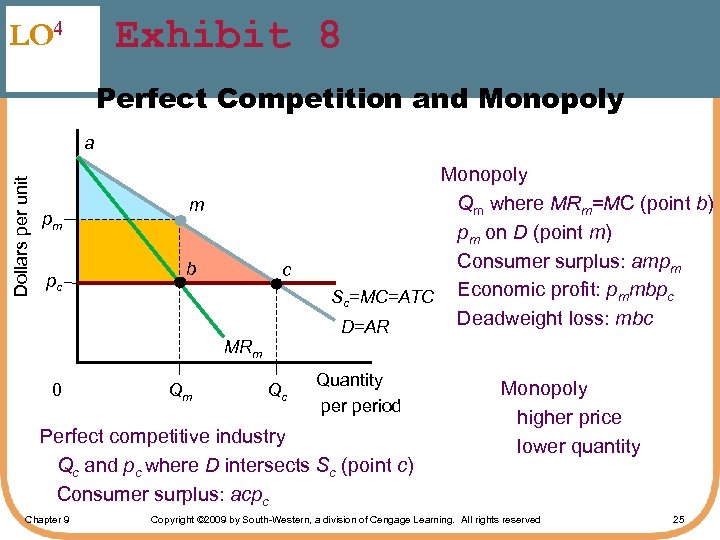 Exhibit 8 LO 4 Perfect Competition and Monopoly Dollars per unit a pm pc m b c Monopoly Qm where MRm=MC (point b) pm on D (point m) Consumer surplus: ampm Sc=MC=ATC Economic profit: pmmbpc Deadweight loss: mbc D=AR MRm 0 Qm Qc Quantity period Perfect competitive industry Qc and pc where D intersects Sc (point c) Consumer surplus: acpc Chapter 9 Monopoly higher price lower quantity Copyright © 2009 by South-Western, a division of Cengage Learning. All rights reserved 25
 Problems Estimating Deadweight Loss § Deadweight loss might be lower – Lower price and average cost • Substantial economies of scale – Price below the profit maximizing value • Public scrutiny, political pressure • Avoid attracting competition LO 5 Chapter 9 Copyright © 2010 by South-Western, a division of Cengage Learning. All rights reserved 26
 Problems Estimating Deadweight Loss § Deadweight loss might be higher – Secure and maintain monopoly position • Use resources; social waste • Influence public policy (Rent seeking) – Inefficiency – Slow to adopt new technology – Reluctant to develop new products – Lack innovation LO 5 Chapter 9 Copyright © 2010 by South-Western, a division of Cengage Learning. All rights reserved 27
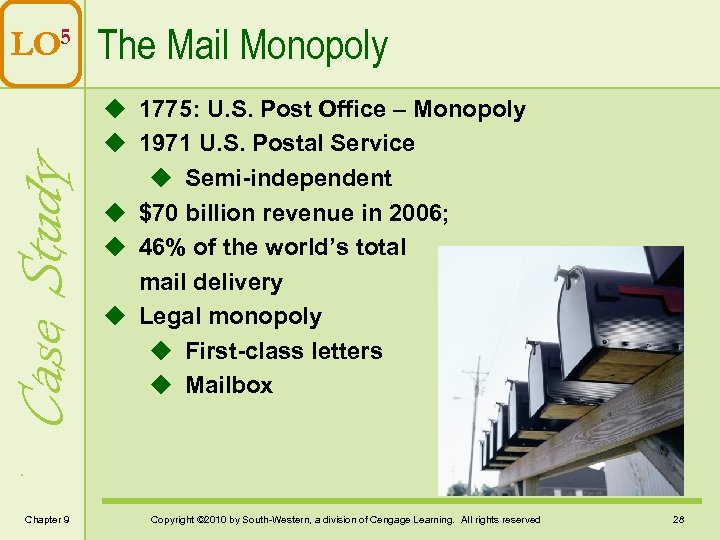 Case Study LO 5 The Mail Monopoly Chapter 9 u 1775: U. S. Post Office – Monopoly u 1971 U. S. Postal Service u Semi-independent u $70 billion revenue in 2006; u 46% of the world’s total mail delivery u Legal monopoly u First-class letters u Mailbox Copyright © 2010 by South-Western, a division of Cengage Learning. All rights reserved 28
 Case Study LO 5 The Mail Monopoly Chapter 9 u First-class stamp u 9 cents in 1970 u 42 cents in 2008 u Substitutes u Phone calls, e-mail, e -card, text message u On-line bill-payment, fax machine u Competition: UPS, Fed. Ex, DHL Copyright © 2010 by South-Western, a division of Cengage Learning. All rights reserved 29
 Case Study LO 5 The Mail Monopoly Chapter 9 u New services u Confirmed delivery for e. Bay u Netflix (DVD rentals) u On-line purchasing (package delivery) Copyright © 2010 by South-Western, a division of Cengage Learning. All rights reserved 30
 Price Discrimination § Charge different prices to different groups of consumers § Conditions – Downward sloping D curve – At last two groups of consumers • Different price elasticity of demand – Ability to charge different prices • At low cost – Prevent reselling of the product LO 6 Chapter 9 Copyright © 2010 by South-Western, a division of Cengage Learning. All rights reserved 31
 A Model of Price Discrimination § Two groups of consumers – One group (A): less elastic D – The other (B): more elastic D § Maximize profit – MR=MC in each market – Lower price for group (B) LO 6 Chapter 9 Copyright © 2010 by South-Western, a division of Cengage Learning. All rights reserved 32
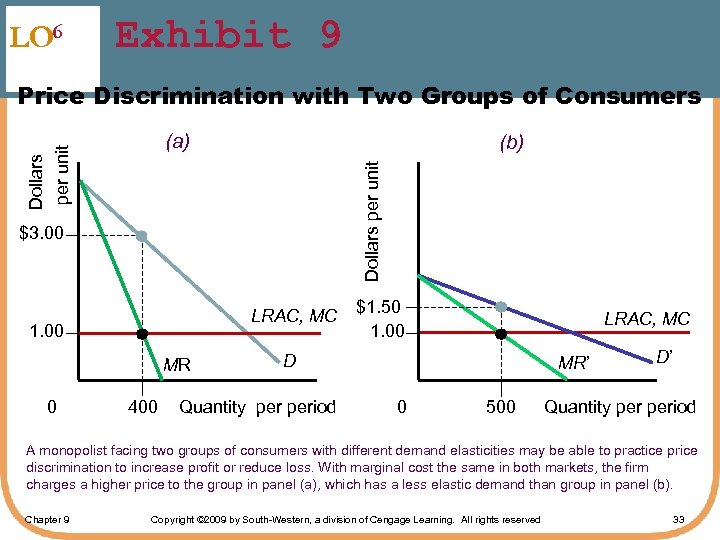 LO 6 Exhibit 9 Price Discrimination with Two Groups of Consumers (b) Dollars per unit (a) $3. 00 LRAC, MC 1. 00 MR 0 400 $1. 50 1. 00 LRAC, MC D Quantity period MR’ 0 500 D’ Quantity period A monopolist facing two groups of consumers with different demand elasticities may be able to practice price discrimination to increase profit or reduce loss. With marginal cost the same in both markets, the firm charges a higher price to the group in panel (a), which has a less elastic demand than group in panel (b). Chapter 9 Copyright © 2009 by South-Western, a division of Cengage Learning. All rights reserved 33
 Examples of Price Discrimination § Airline travel – Businesspeople (business class) • Less elastic D; Higher price – Same class, different prices • Discount fares; weekend stay § IBM laser printer – 5 pages/minute: home; cheaper – 10 pages/minute: business; expensive § Amusement parks – Out-of-towners: less elastic D LO 6 Chapter 9 Copyright © 2010 by South-Western, a division of Cengage Learning. All rights reserved 34
 Perfect Price Discrimination § The monopolist’s dream § Charge consumers what they are willing to pay – Charge different prices for each unit sold • D curve becomes MR curve – Convert consumer surplus into economic profit • Allocative efficiency • No deadweight loss LO 6 Chapter 9 Copyright © 2010 by South-Western, a division of Cengage Learning. All rights reserved 35
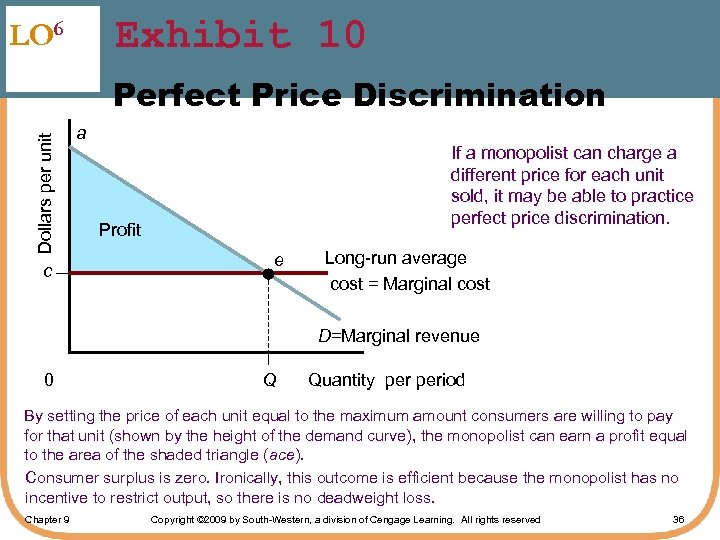 Exhibit 10 LO 6 Dollars per unit Perfect Price Discrimination c a If a monopolist can charge a different price for each unit sold, it may be able to practice perfect price discrimination. Profit e Long-run average cost = Marginal cost D=Marginal revenue 0 Q Quantity period By setting the price of each unit equal to the maximum amount consumers are willing to pay for that unit (shown by the height of the demand curve), the monopolist can earn a profit equal to the area of the shaded triangle (ace). Consumer surplus is zero. Ironically, this outcome is efficient because the monopolist has no incentive to restrict output, so there is no deadweight loss. Chapter 9 Copyright © 2009 by South-Western, a division of Cengage Learning. All rights reserved 36