Скачать презентацию Michigan Water Environment Association MWEA Industrial Pretreatment
505ec8207ee37ca5f7c18708f2e2d712.ppt
- Количество слайдов: 59
 Michigan Water Environment Association • MWEA Industrial Pretreatment Committee • IPP 2006: Standard and Emerging Issues • October 26, 2006 • Eagle Eye Banquet Facility, East Lansing, MI
 Bob Babcock, Security and Emergency Response Coordinator • Slug Discharges, PIPP Plans & Part 5 Rules • Thank You MWEA IPP Committee for your protection of the critical infrastructure – the sewerage system and your stewardship of the waters of the State.
 Part 5 Rules: “Spillage of Oil and Polluting Materials” Bob Babcock Security and Emergency Response Coordinator State of Michigan Department of Environmental Quality Contact Info: 1 -517 -373 -8566 babcockr@mi. gov
 • IPP: the past, present, future
 IPP Pop Quiz • Ed Norton of the Honeymooners • Where did he work, ever so pridefully? ? • Who was the first MWEA IPP Cte chair?
 Summary • 1. If a spill occurs into your sanitary sewer system that is a “release” as defined by the Part 5 rules, the responsible facility must comply w/ spill reporting req’ts • 2. If a toxic upset occurs in your POTW, call the drinking water folks to determine if it is from their system. • 3. Determine who is a Part 5 facility
 Proud Heritage: wwtp • A constant bioassay of the toxicity of the wastewater…sewage treatment • Strong analytical capability vs drinking water systems…physical, chemical – metals, organics, biological/microbiological • Continuous analytical monitoring
 Toxic Event • If your plant experiences a toxic upset, how do you investigate? • Would you ever think about contacting the drinking water system? • Canaries: people are the toxic warning organism on drinking water systems
 Real Time Bob • Sanitary system – Any real time continuous monitoring? ? ? • Plant/SCADA: flow, p. H, DO, conductivity • Collection system? ? ?
 PIPP facilities • How many do you have in your city?
 Alphabet Soup • • IPP, FIPP, MIPP, SIU’s, IUI’s, CIU’s, … Why ? Environmental protection Infrastructure protection Community protection Worker protection Performance Measures
 IUI’s • • Raw materials used by the industry Processes Formulants By products Wastes Discharges storage
 IUI’s (cont’d) • Because you are the city’s expert on the industries, you are an asset in the event of a need • Even though there is not a formal wastewater security program, you are one of the lines of defense for the city in the event of a need
 HSPD # 8 • Homeland Security Presidential Directive No. 8 entitled, National Preparedness, signed • December 13, 2003, indicates that local departments of public works, e. g. , public water and sewage systems, are now a part of the community first responders network.
 Bad News…. Good News • Detroit Water and Sewerage Department • Federal IPP lawsuit : 7 yrs litigation
 Part 5 Rules: “Spillage of Oil and Polluting Materials” History • Revised effective August 31, 2001 • Long standing requirement: 1954 first effective Features • Self-implementing • No discharges authorized = no permits issued • Secondary containment is req’d
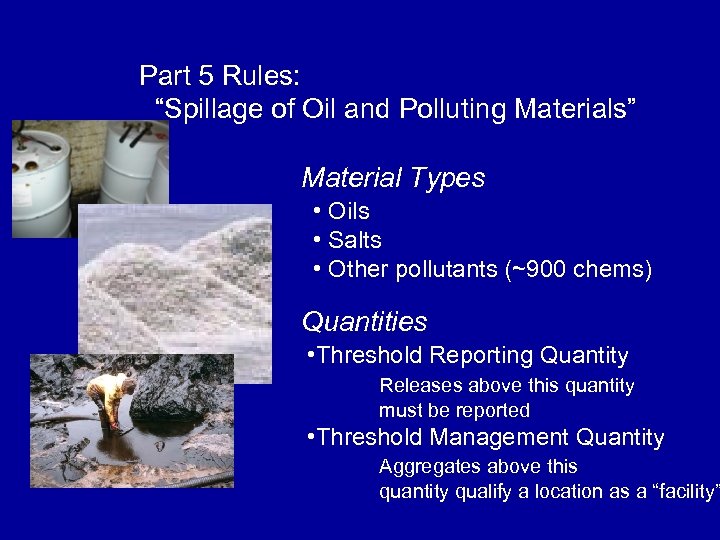 Part 5 Rules: “Spillage of Oil and Polluting Materials” Material Types • Oils • Salts • Other pollutants (~900 chems) Quantities • Threshold Reporting Quantity Releases above this quantity must be reported • Threshold Management Quantity Aggregates above this quantity qualify a location as a “facility”
 • Oils • Petroleum • Fuel Oil • Oily sludges • Oil mixed w waste • Synthetic oil • Gasoline • Grease • Oil refuse • Hydraulic oil • Vegetable oils • Salts • sodium chloride • potassium chloride • calcium chloride • Other • magnesium chloride • solutions or mixtures of these salts Pollutants • 962 chemicals, complete list of Polluting Materials is in Part 5 Rules, Table 1
 Releases • REPORTING RELEASES PER PART 5 RULES • Facilities with reportable releases as defined in Rule 324. 2002(b) and (g) and Section 3111 b of Part 31, Water Resources Protection, of the Natural Resources and Environmental Protection Act, 1994 PA 451, as amended, must notify specific agencies. Oil storage facilities subject to federal SPCC regulations must notify if they have reportable releases of oil (See Water Bureau POG #2). Due to the reorganization of the DEQ, submittal of written reports about releases as required in R 324. 2007 now go to the Water Bureau instead of the Waste Management Division as noted in the rules.
 Part 5 Release • If a release occurs and is reportable, the facility needs to meet the following requirements: • 1. Call to report releases exceeding threshold reporting quantities: – PEAS at 800 -292 -4706 or from out of state call 517 -373 -7660, and – (or their primary public safety answering 911 point) per Section 3111 b of Part 31 of Act 451, effective June 15, 2004
 Releases to a POTW • Releases that go into a public wastewater treatment plant (WWTP) and meet Part 5 rule conditions, threshold reporting quantity, are also reportable to 911 and the Water Bureau.
 Part 5 Releases • 2. Submit written report within 10 days after the release to: – Water Bureau District Supervisor DEQ (mailing addresses are the same as Part 5 staff contacts) – Local health department, environmental health section per Section 3111 b of Part 31 of Act 451, effective June 15, 2004
 Slug Control Plans Current State Part 23 Rules • Federal IPPs must evaluate, at least once every two years, whether each SIU needs a plan to control slug discharges R 323. 2306(c)(v) • EPA has historically emphasized that a plan is not required, unless determined to be necessary
 Slug Control Plan Contents • Description of discharge practices, including nonroutine batch discharges. • Description of stored chemicals. • Procedures for immediately notifying the publicly owned treatment works of slug discharges, including any discharge that would violate a prohibition under R 323. 2303(2), with procedures for follow-up written notification within 5 days.
 Slug Control Plan Contents (continued) • If necessary, procedures to prevent an adverse impact from accidental spills, including any of the following: (1) Inspection and maintenance of storage areas. (2) Handling and transfer of materials. (3) Loading and unloading operations. (4) Control of plant site runoff. (5) Worker training. (6) Building of containment structures or equipment. (7) Measures for containing toxic organic pollutants, including solvents. (8) Measures and equipment necessary for emergency response.
 Slug Control Plans Streamlined Federal Rule • Provides POTWs the flexibility to review the need for a slug control plan or other action as necessary • Contents of the plan unchanged • Clarifies that plan is not required outcome of evaluation • Requirements must be in control mechanism included
 Slug Control Plans Streamlined Federal Regulation – POTWs must evaluate need for a plan at least one time for each SIU, by the following deadline: • By October 14, 2006 or within 1 year of being designated as “significant” – SIUs must immediately notify POTW of any changes at their facilities affecting their slug control plan or spill/slug potential – Clarifies annual slug-related inspections should continue as per existing guidance
 Slug Control Plans Where to find changes? • 40 CFR 403. 8(f)(1)(iii)(B)(6) • 40 CFR 403. 8(f)(2)(vi) Must this change be adopted by the CA? • Yes - Parts of this provision are required. Slug control requirement (if necessary) in permit and notification of changes must be adopted. The CA must continue to evaluate all SIUs every other year (until state are modified). rules
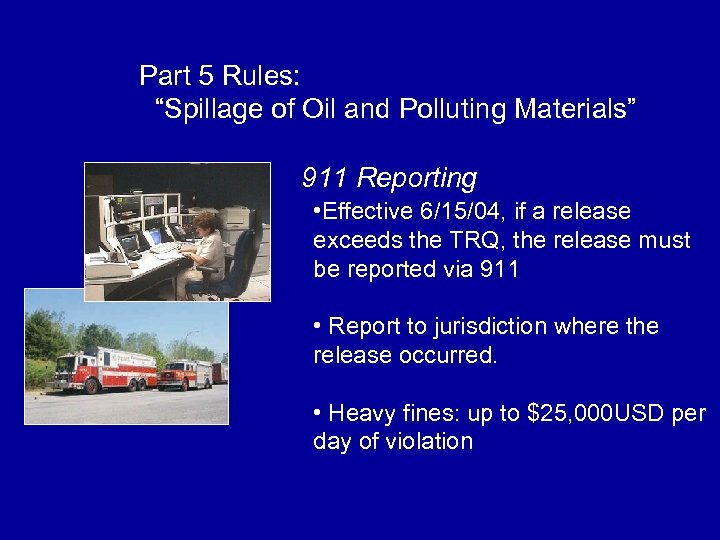 Part 5 Rules: “Spillage of Oil and Polluting Materials” 911 Reporting • Effective 6/15/04, if a release exceeds the TRQ, the release must be reported via 911 • Report to jurisdiction where the release occurred. • Heavy fines: up to $25, 000 USD per day of violation
 TRQ: threshold reporting quantity • (g) "Threshold reporting quantity" means any of the following: • (i) For releases of oil to the surface of the ground, 50 pounds. • (ii) For releases of oil to the waters of the state, any quantity that causes unnatural turbidity, color, visible sheens, oil films, foams, solids, or deposits in the receiving waterbody. • (iii) For release of salt to the surface of the ground, or waters of the state, 50 pounds in solid form, unless the use is authorized by the department for deicing purposes, or 50 gallons in liquid form, unless authorized by the department as a dust suppressant or deicing agent or permitted under part 31 of the act.
 TRQ: Threshold Reporting Quantity (cont’d) • (iv) For releases of all other polluting materials, the quantity specified in table 1 in R 324. 2009, or any quantity that causes unnatural turbidity, color, visible sheens, oil films, foams, solids, or deposits in the receiving waterbody.
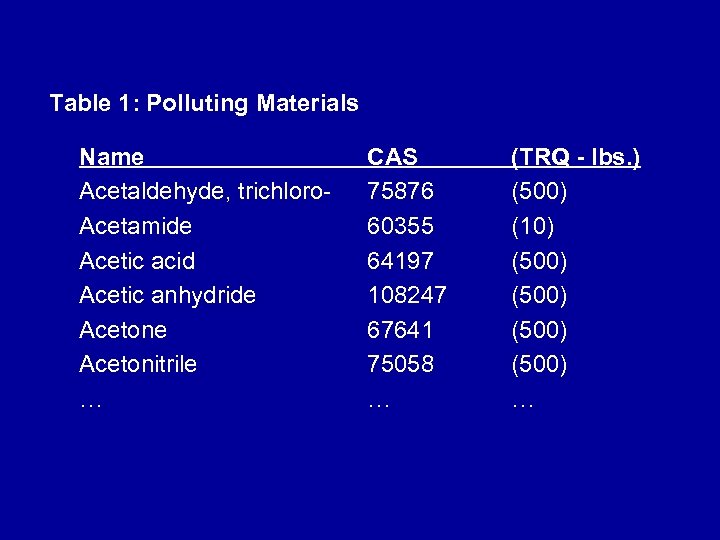 Table 1: Polluting Materials Name Acetaldehyde, trichloro. Acetamide Acetic acid Acetic anhydride Acetonitrile … CAS 75876 60355 64197 108247 67641 75058 … (TRQ - lbs. ) (500) (10) (500) …
 Part 5 Rules: “Spillage of Oil and Polluting Materials” Sec 3111 b of Part 31 was added to require a facility to call 911 (or their primary public safety answering point) and to provide a written follow-up report to their local health department if the facility is subject to release reporting under the Part 5 rules. Also effective June 15, 2004.
 Part 5 Rules: “Spillage of Oil and Polluting Materials” Part 5 Rules Structure: 1. 2. 3. 4. 5. 6. 7. 8. 9. Definitions Conditional Exemptions Oil storage and on-land facility surveillance Secondary Containment Pollution Incident Prevention Plan Pollution Incident Report Enforcement List of other pollutants (~900 chems)
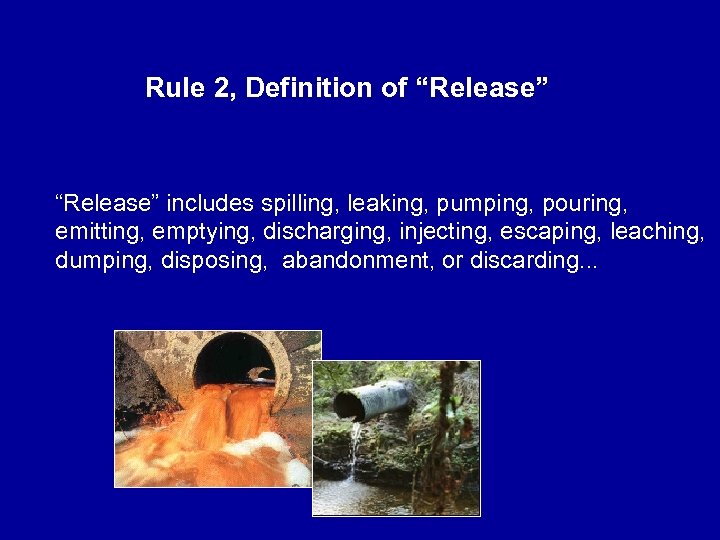 Rule 2, Definition of “Release” includes spilling, leaking, pumping, pouring, emitting, emptying, discharging, injecting, escaping, leaching, dumping, disposing, abandonment, or discarding. . .
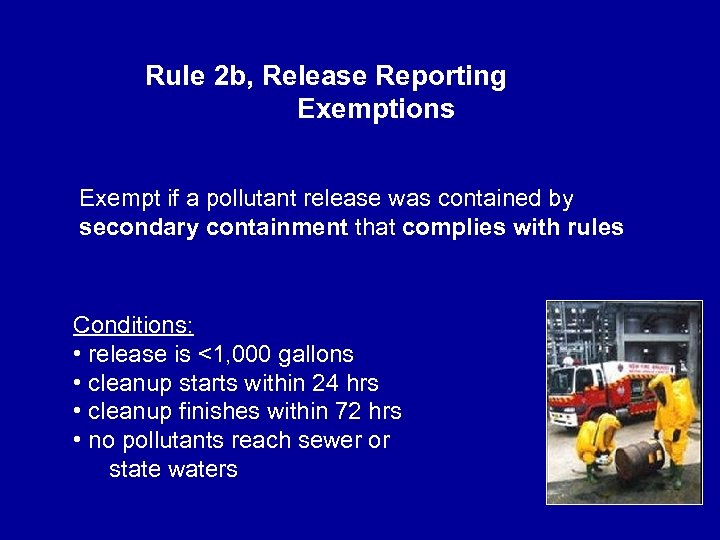 Rule 2 b, Release Reporting Exemptions Exempt if a pollutant release was contained by secondary containment that complies with rules Conditions: • release is <1, 000 gallons • cleanup starts within 24 hrs • cleanup finishes within 72 hrs • no pollutants reach sewer or state waters
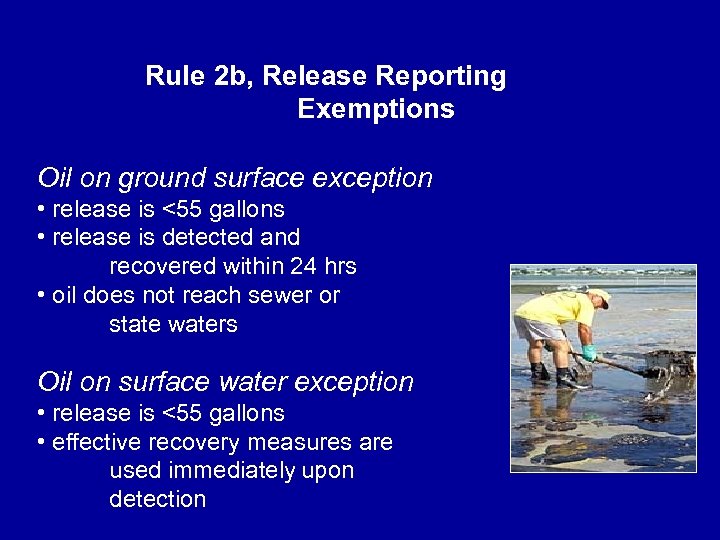 Rule 2 b, Release Reporting Exemptions Oil on ground surface exception • release is <55 gallons • release is detected and recovered within 24 hrs • oil does not reach sewer or state waters Oil on surface water exception • release is <55 gallons • effective recovery measures are used immediately upon detection
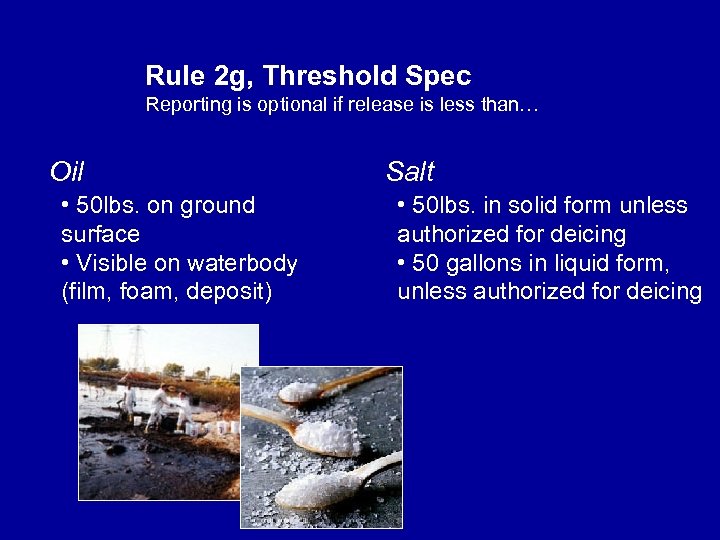 Rule 2 g, Threshold Spec Reporting is optional if release is less than… Oil • 50 lbs. on ground surface • Visible on waterbody (film, foam, deposit) Salt • 50 lbs. in solid form unless authorized for deicing • 50 gallons in liquid form, unless authorized for deicing
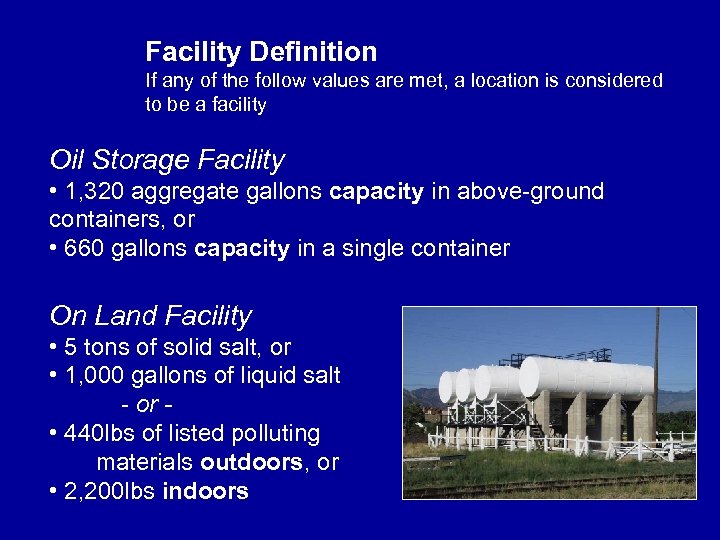 Facility Definition If any of the follow values are met, a location is considered to be a facility Oil Storage Facility • 1, 320 aggregate gallons capacity in above-ground containers, or • 660 gallons capacity in a single container On Land Facility • 5 tons of solid salt, or • 1, 000 gallons of liquid salt - or • 440 lbs of listed polluting materials outdoors, or • 2, 200 lbs indoors
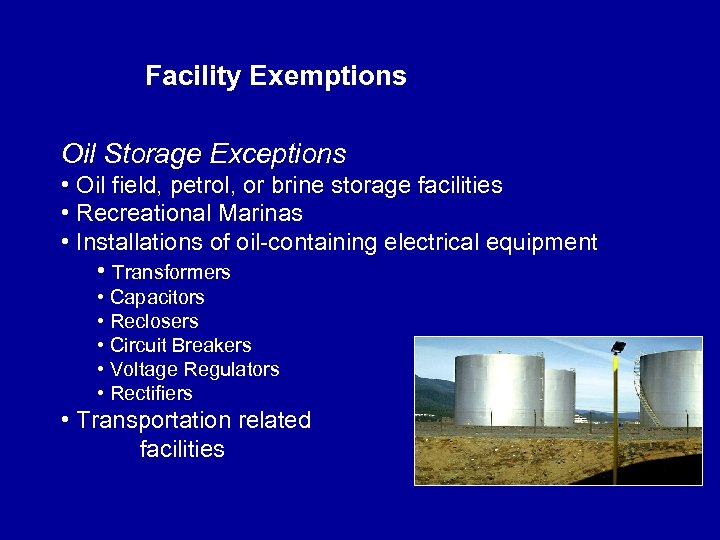 Facility Exemptions Oil Storage Exceptions • Oil field, petrol, or brine storage facilities • Recreational Marinas • Installations of oil-containing electrical equipment • Transformers • Capacitors • Reclosers • Circuit Breakers • Voltage Regulators • Rectifiers • Transportation related facilities
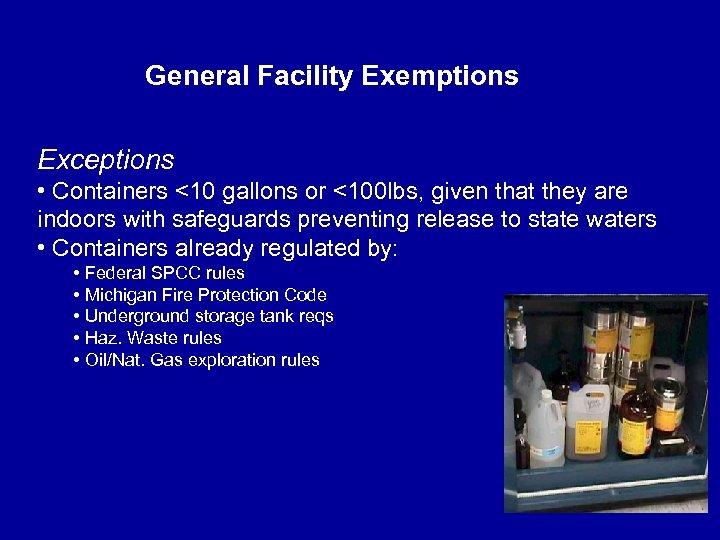 General Facility Exemptions Exceptions • Containers <10 gallons or <100 lbs, given that they are indoors with safeguards preventing release to state waters • Containers already regulated by: • Federal SPCC rules • Michigan Fire Protection Code • Underground storage tank reqs • Haz. Waste rules • Oil/Nat. Gas exploration rules
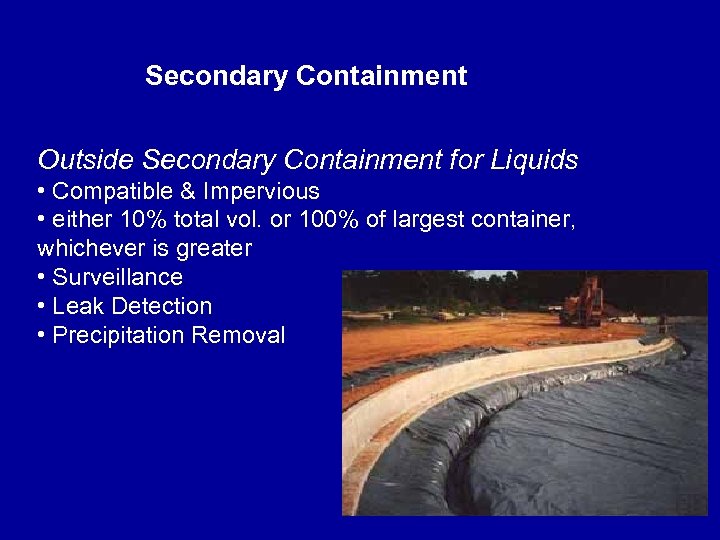 Secondary Containment Outside Secondary Containment for Liquids • Compatible & Impervious • either 10% total vol. or 100% of largest container, whichever is greater • Surveillance • Leak Detection • Precipitation Removal
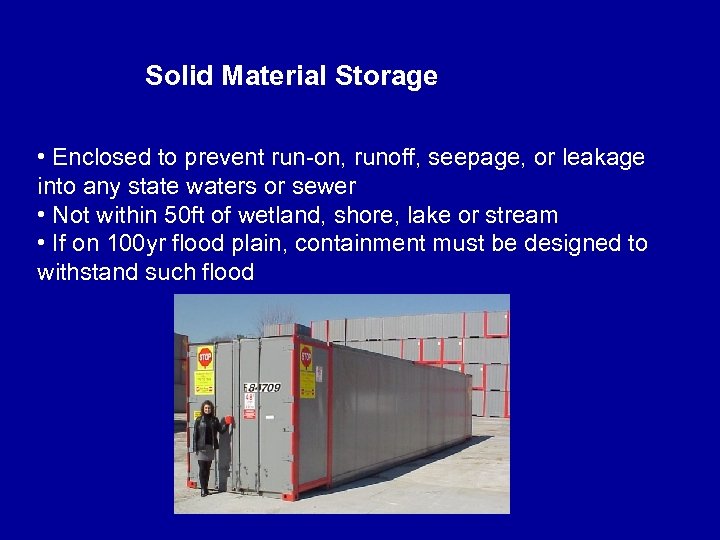 Solid Material Storage • Enclosed to prevent run-on, runoff, seepage, or leakage into any state waters or sewer • Not within 50 ft of wetland, shore, lake or stream • If on 100 yr flood plain, containment must be designed to withstand such flood
 Rule 4, Surveillance Adequate enough to detect releases and implement procedures to prevent releases to state waters.
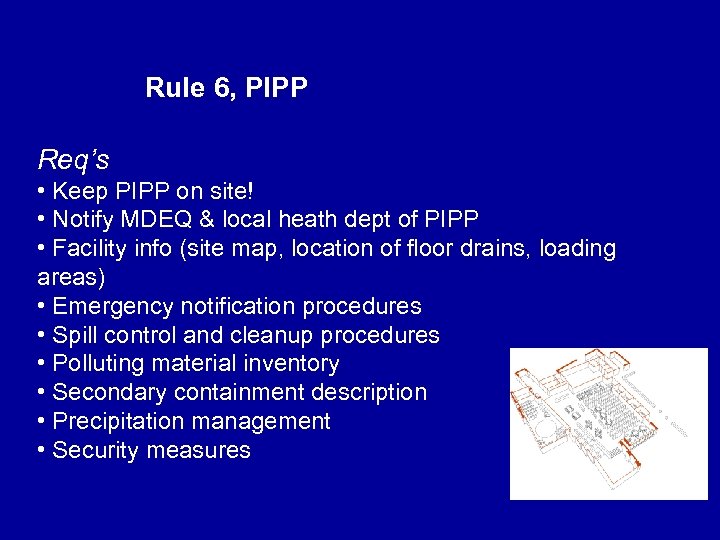 Rule 6, PIPP Req’s • Keep PIPP on site! • Notify MDEQ & local heath dept of PIPP • Facility info (site map, location of floor drains, loading areas) • Emergency notification procedures • Spill control and cleanup procedures • Polluting material inventory • Secondary containment description • Precipitation management • Security measures
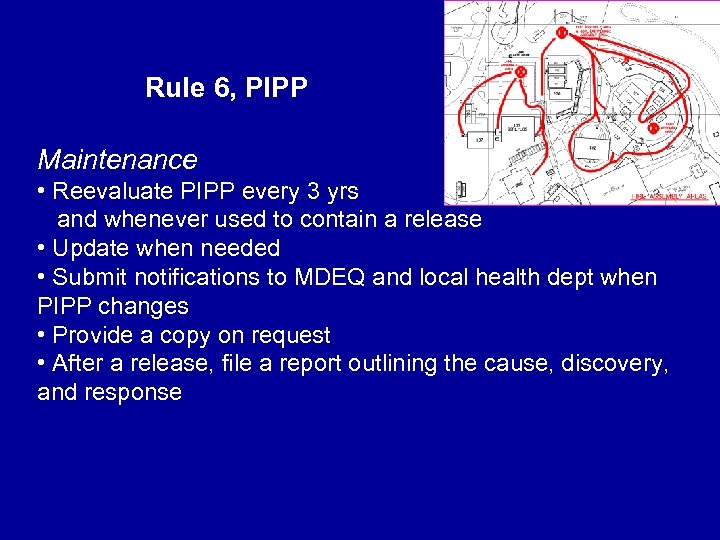 Rule 6, PIPP Maintenance • Reevaluate PIPP every 3 yrs and whenever used to contain a release • Update when needed • Submit notifications to MDEQ and local health dept when PIPP changes • Provide a copy on request • After a release, file a report outlining the cause, discovery, and response
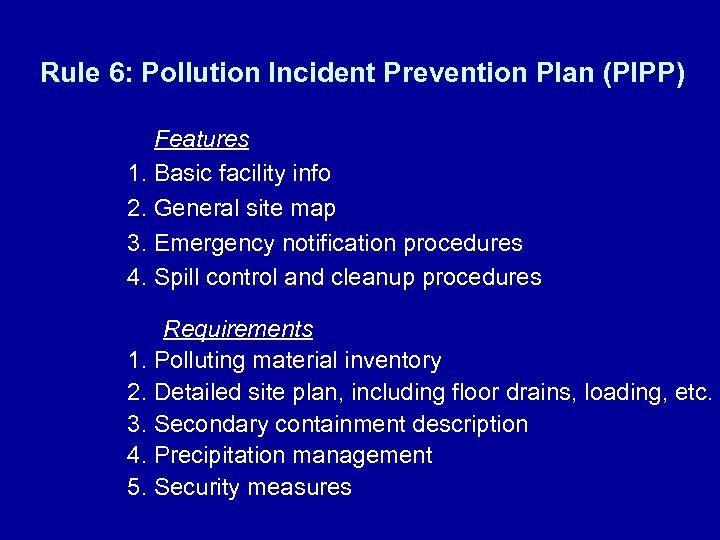 Rule 6: Pollution Incident Prevention Plan (PIPP) Features 1. Basic facility info 2. General site map 3. Emergency notification procedures 4. Spill control and cleanup procedures Requirements 1. Polluting material inventory 2. Detailed site plan, including floor drains, loading, etc. 3. Secondary containment description 4. Precipitation management 5. Security measures
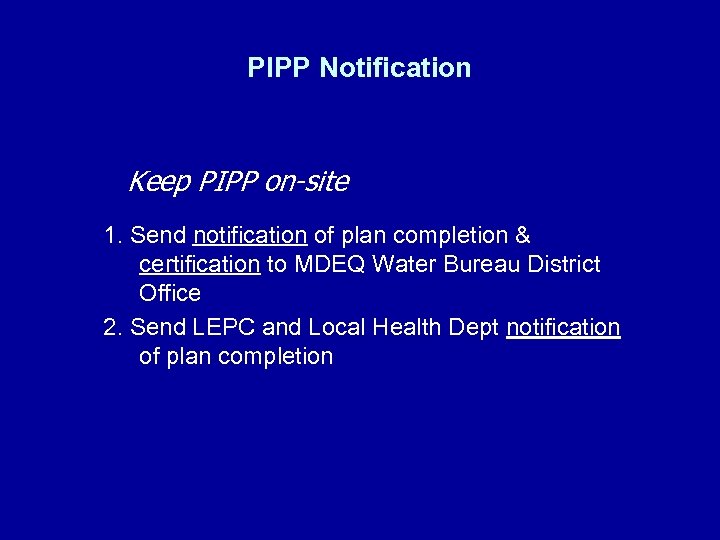 PIPP Notification Keep PIPP on-site 1. Send notification of plan completion & certification to MDEQ Water Bureau District Office 2. Send LEPC and Local Health Dept notification of plan completion
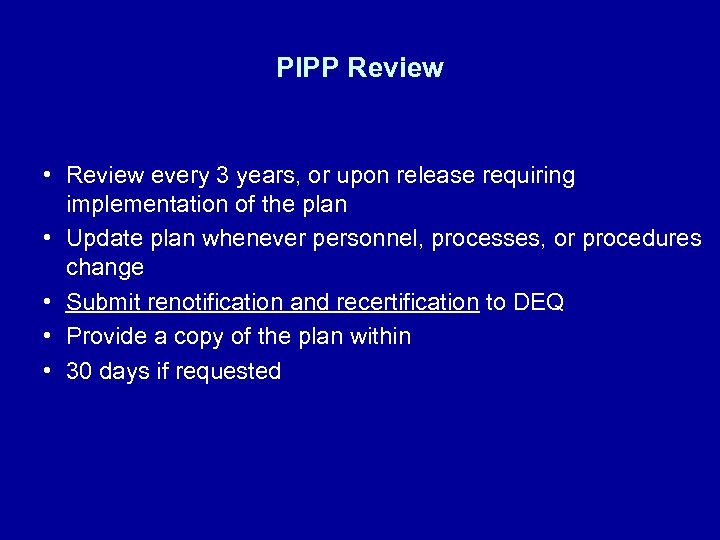 PIPP Review • Review every 3 years, or upon release requiring implementation of the plan • Update plan whenever personnel, processes, or procedures change • Submit renotification and recertification to DEQ • Provide a copy of the plan within • 30 days if requested
 Pollution Incident Reporting (Rule 7) • As soon as practicable after detection of release in excess of a TRQ during any 24 -hour period, notify Pollution Emergency Alerting System (PEAS) • Within 10 days, file written report outlining the cause, discovery and response measures taken Links to form and release reporting summary table are at www. michigan. gov/deq under “Assistance & Support Services” > “Environmental Reporting”
 Rule 8: Enforcement • A person who violates any provision of this part is subject to the procedures and penalties prescribed in sections 3112, 3114, 3115, and 3115 a of Part 31 of the act. • The maximum fine imposed by the court shall be not more than $25, 000. 00 per day of violation.
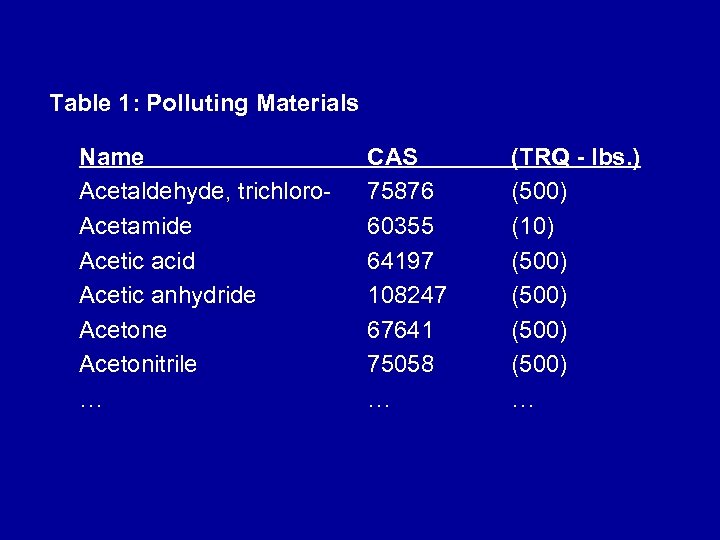 Table 1: Polluting Materials Name Acetaldehyde, trichloro. Acetamide Acetic acid Acetic anhydride Acetonitrile … CAS 75876 60355 64197 108247 67641 75058 … (TRQ - lbs. ) (500) (10) (500) …
 DEQ Staff Contacts ESSD Judy Schaefer 517 -373 -0590 Water Division Contacts Bob Babcock Bay City Gene Suuppi Cadillac Brian Myers Gaylord Rick Shoemaker Gr. Rapids Keith Zahn Jackson Greg Merricle Kalamazoo Greg Danneffel Lansing Craig Lapham SEMI Tracy Holbrooks UP Randy Conroy 517 -373 -8566 989 -686 -8025 ext 8262 989 -775 -3960 ext 6263 989 -705 -3424 616 -356 -0244 517 -780 -7841 269 -567 -3575 517 -335 -6113 734 -432 -1288 906 -346 -8527
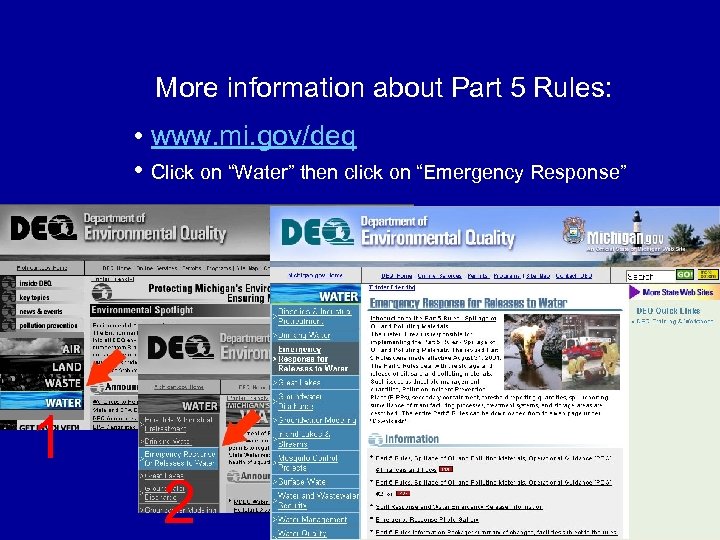 More information about Part 5 Rules: • www. mi. gov/deq • Click on “Water” then click on “Emergency Response” 1 2
 My tribute to Dan Wolz • Dan Wolz was so many things so well. A husband, a father, a Christian, a teacher, a thespian, an environmentalist, a clean water plant superintendent. He was passionate about every
 My tribute to Dan Wolz • A quote that I have long enjoyed is one that I believe Dan lived is a quote from Jackie Robinson: “A life is not important, except in the impact it has on other’s lives. ” Dan was all about impact. He was not timid – he loved to challenge. He was not glib – he loved to be honest. He was not ignorant – he loved to perceive. He did not like the status quo – he loved to improve things. • I think Dan loved to love.
 My tribute to Dan Wolz • Dan once called me weird for my long membership in MWEA because there weren’t many state employees that were long time members of MWEA. • I will always be proud of that. • Being called weird by Dan for loving something he loved – MWEA.