


 Скачать презентацию Michigan s Certificate of Need Program Michigan Department of
d4dd6cc1612ca1a8150431b8430da56e.ppt
- Количество слайдов: 15
 Michigan’s Certificate of Need Program Michigan Department of Community Health
 Federal Certificate of Need Background w Dist. of Columbia and New York developed CON in 1964. w Federally mandated CON programs were established as a national health care cost containment strategy. The 1974 National Health Planning and Resources Development Act mandated that states have CON programs to be eligible for certain public health funds. w In 1986, the federal mandate for CON was not renewed. w CON regulations are structured, in principle, to improve access to quality health care services while containing costs. Health care organizations are required to demonstrate need before investing in a regulated facility, service or equipment. w Since the repeal of the federal mandate, 37 states have retained some form of a CON program. 2
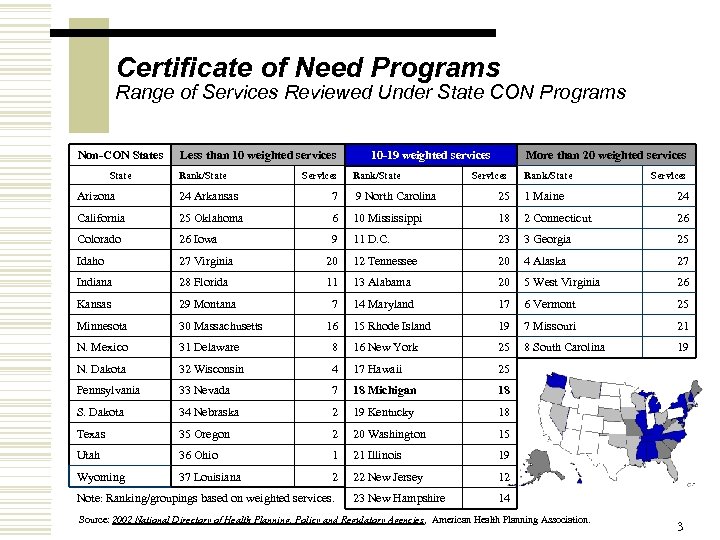 Certificate of Need Programs Range of Services Reviewed Under State CON Programs Non-CON States State Less than 10 weighted services Rank/State Services 10 -19 weighted services Rank/State More than 20 weighted services Services Rank/State Services Arizona 24 Arkansas 7 9 North Carolina 25 1 Maine 24 California 25 Oklahoma 6 10 Mississippi 18 2 Connecticut 26 Colorado 26 Iowa 9 11 D. C. 23 3 Georgia 25 Idaho 27 Virginia 20 12 Tennessee 20 4 Alaska 27 Indiana 28 Florida 11 13 Alabama 20 5 West Virginia 26 Kansas 29 Montana 7 14 Maryland 17 6 Vermont 25 Minnesota 30 Massachusetts 15 Rhode Island 19 7 Missouri 21 N. Mexico 31 Delaware 8 16 New York 25 8 South Carolina 19 N. Dakota 32 Wisconsin 4 17 Hawaii 25 Pennsylvania 33 Nevada 7 18 Michigan 18 S. Dakota 34 Nebraska 2 19 Kentucky 18 Texas 35 Oregon 2 20 Washington 15 Utah 36 Ohio 1 21 Illinois 19 Wyoming 37 Louisiana 2 22 New Jersey 12 23 New Hampshire 14 16 Note: Ranking/groupings based on weighted services. Source: 2002 National Directory of Health Planning, Policy and Regulatory Agencies, American Health Planning Association. 3
 Michigan CON Legislation w Public Act 368 of 1978 mandated the Michigan CON program. w The CON Reform Act of 1988 was passed to create a systematic way to develop standards and reduce the number of services requiring a CON. The act also created the CON Commission. The commission, whose membership is appointed by the Governor, is responsible for developing and approving CON review standards. w Public Act 619 of 2002 modified several sections the Public Health Code pertaining to CON including, but not limited to, : l l l No CON required for non-clinical capital expenditure projects Redefined “rural county” Expanded exceptions to CON under MCL 333. 22209 Expanded the CON Commission Requires review of standards every three years and changes method for developing standards 4
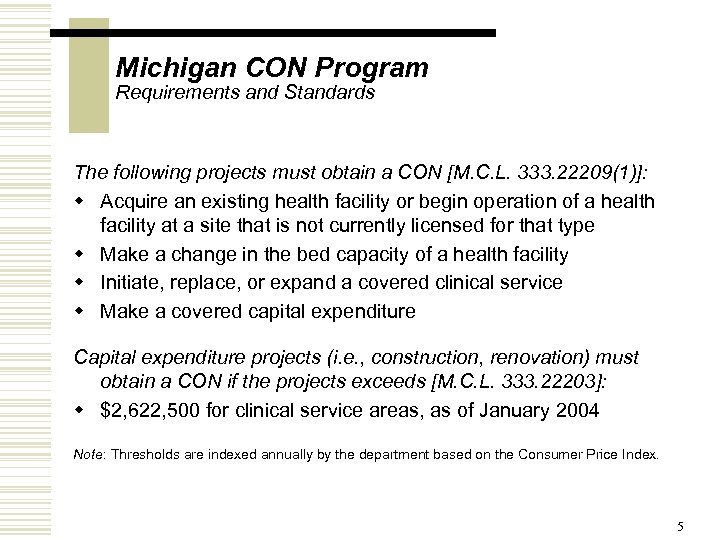 Michigan CON Program Requirements and Standards The following projects must obtain a CON [M. C. L. 333. 22209(1)]: w Acquire an existing health facility or begin operation of a health facility at a site that is not currently licensed for that type w Make a change in the bed capacity of a health facility w Initiate, replace, or expand a covered clinical service w Make a covered capital expenditure Capital expenditure projects (i. e. , construction, renovation) must obtain a CON if the projects exceeds [M. C. L. 333. 22203]: w $2, 622, 500 for clinical service areas, as of January 2004 Note: Thresholds are indexed annually by the department based on the Consumer Price Index. 5
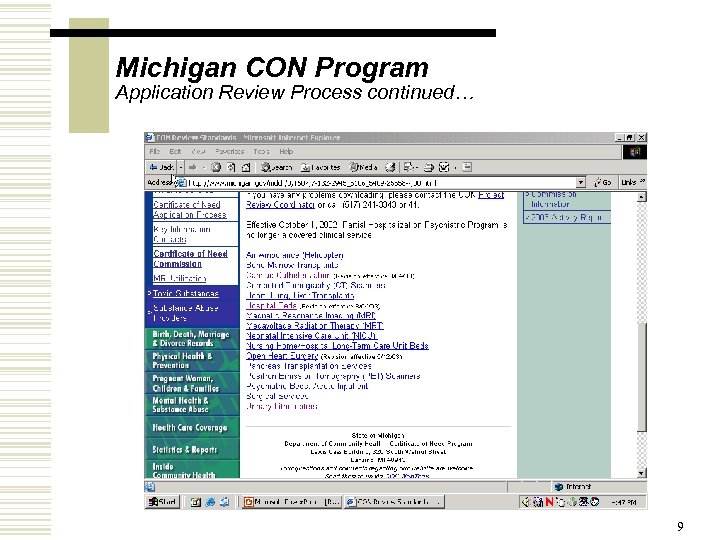
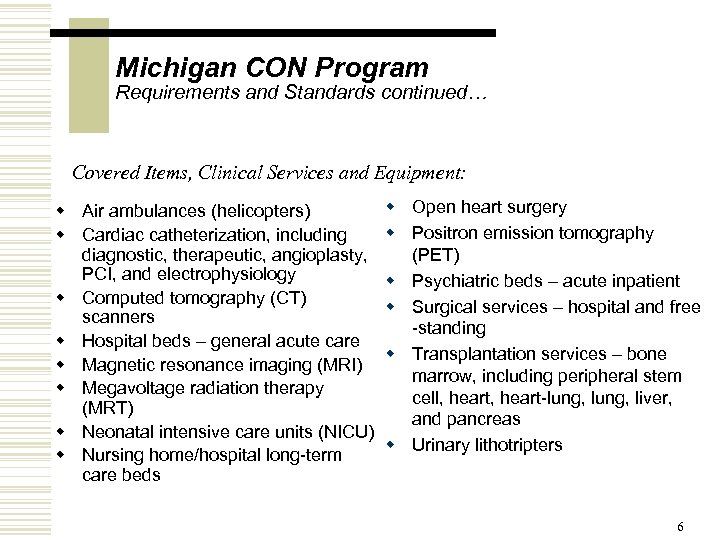 Michigan CON Program Requirements and Standards continued… Covered Items, Clinical Services and Equipment: w Air ambulances (helicopters) w Cardiac catheterization, including diagnostic, therapeutic, angioplasty, PCI, and electrophysiology w Computed tomography (CT) scanners w Hospital beds – general acute care w Magnetic resonance imaging (MRI) w Megavoltage radiation therapy (MRT) w Neonatal intensive care units (NICU) w Nursing home/hospital long-term care beds w Open heart surgery w Positron emission tomography (PET) w Psychiatric beds – acute inpatient w Surgical services – hospital and free -standing w Transplantation services – bone marrow, including peripheral stem cell, heart-lung, liver, and pancreas w Urinary lithotripters 6
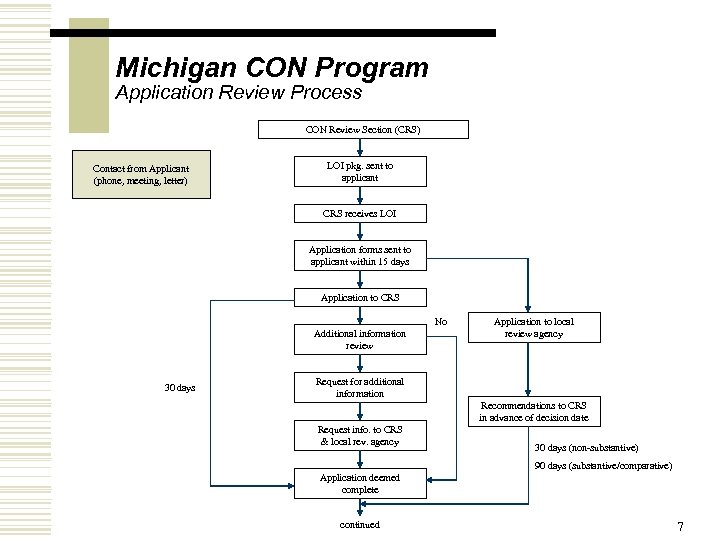 Michigan CON Program Application Review Process CON Review Section (CRS) Contact from Applicant (phone, meeting, letter) LOI pkg. sent to applicant CRS receives LOI Application forms sent to applicant within 15 days Application to CRS No Additional information review 30 days Application to local review agency Request for additional information Recommendations to CRS in advance of decision date Request info. to CRS & local rev. agency 30 days (non-substantive) 90 days (substantive/comparative) Application deemed complete continued 7
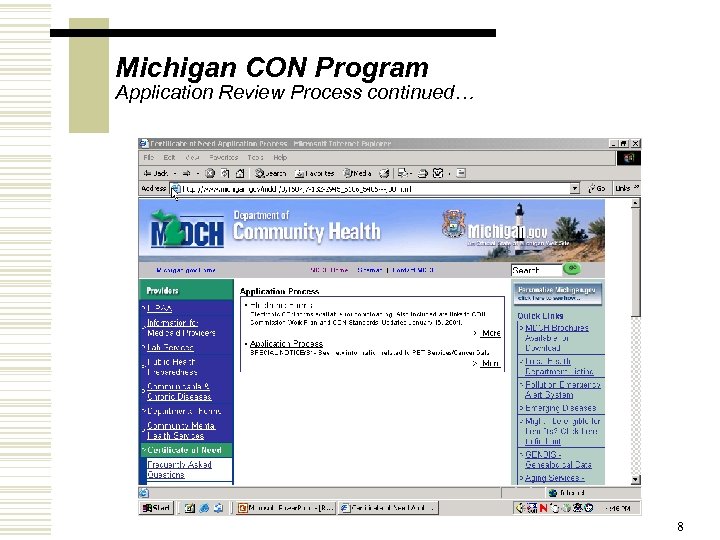 Michigan CON Program Application Review Process continued… 8
 Michigan CON Program Application Review Process continued… 9
 Michigan CON Program Application Review Process continued… 10
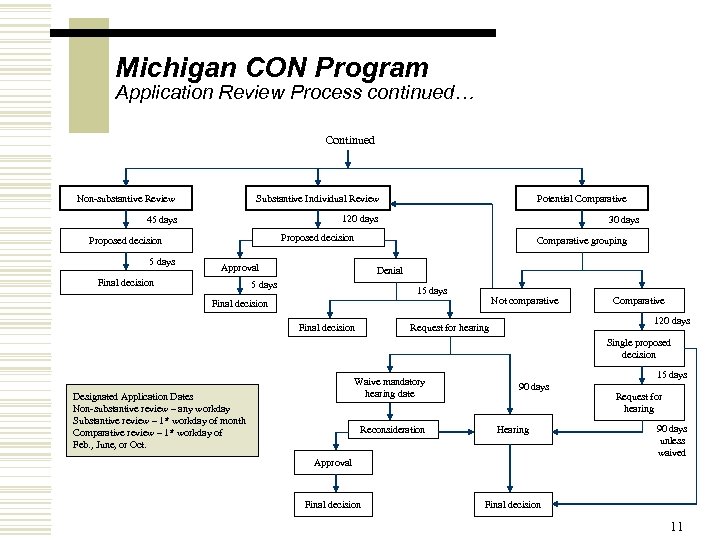 Michigan CON Program Application Review Process continued… Continued Non-substantive Review Substantive Individual Review 45 days 120 days 30 days Proposed decision 5 days Potential Comparative grouping Approval Final decision Denial 5 days 15 days Not comparative Final decision Comparative 120 days Request for hearing Single proposed decision Waive mandatory hearing date Designated Application Dates Non-substantive review – any workday Substantive review – 1 st workday of month Comparative review – 1 st workday of Feb. , June, or Oct. Reconsideration 15 days 90 days Hearing Approval Final decision Request for hearing 90 days unless waived Final decision 11
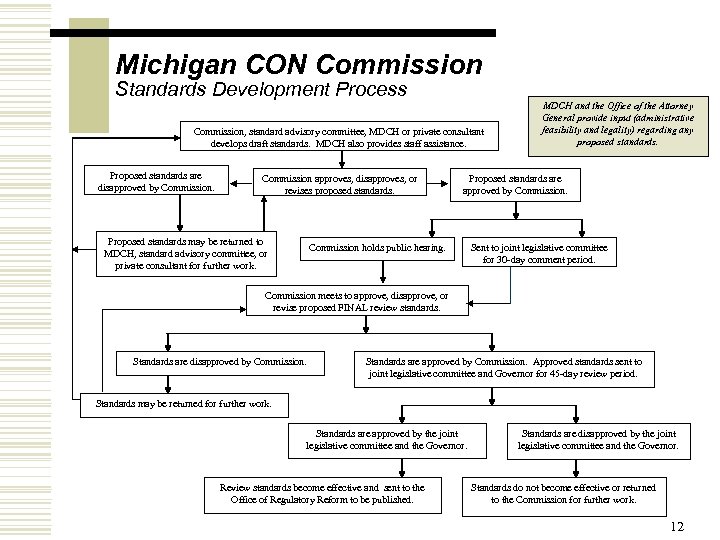 Michigan CON Commission Standards Development Process Commission, standard advisory committee, MDCH or private consultant develops draft standards. MDCH also provides staff assistance. Proposed standards are disapproved by Commission approves, disapproves, or revises proposed standards. Proposed standards may be returned to MDCH, standard advisory committee, or private consultant for further work. MDCH and the Office of the Attorney General provide input (administrative feasibility and legality) regarding any proposed standards. Proposed standards are approved by Commission holds public hearing. Sent to joint legislative committee for 30 -day comment period. Commission meets to approve, disapprove, or revise proposed FINAL review standards. Standards are disapproved by Commission. Standards are approved by Commission. Approved standards sent to joint legislative committee and Governor for 45 -day review period. Standards may be returned for further work. Standards are approved by the joint legislative committee and the Governor. Review standards become effective and sent to the Office of Regulatory Reform to be published. Standards are disapproved by the joint legislative committee and the Governor. Standards do not become effective or returned to the Commission for further work. 12
 Michigan CON Program Surveillance Tools Michigan CON Authority: Act 368, P. A. 1978 – “ A health facility or agency shall provide the department with data and statistics required to enable the department to carry out functions required by federal and state law, including rules and regulations. ” Tools: w Annual Hospital Statistical Questionnaire § Hospitals, freestanding surgical facilities, freestanding MRT facilities, and freestanding CT facilities w Annual PET scanner survey w MRI electronic database w Michigan Inpatient Data Base (MIDB) General Measures: w Infrastructure (i. e. , equipment) w Procedures w Weighted volumes Measures for Select Services: Wait times Staffing Certifications 13
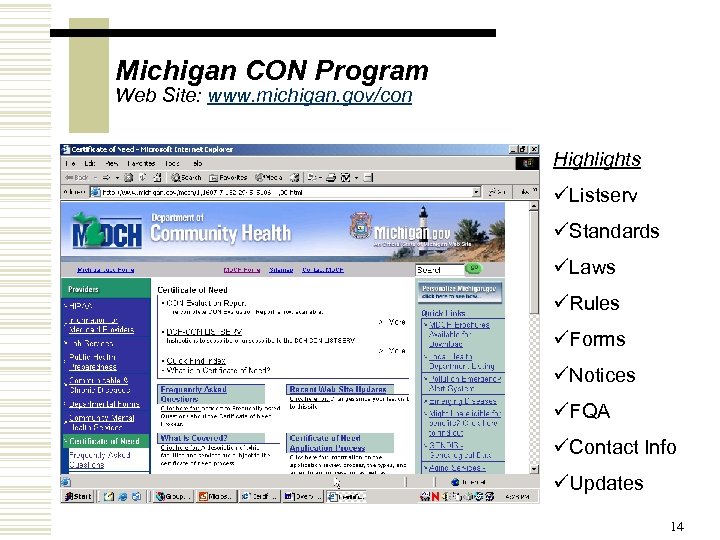 Michigan CON Program Web Site: www. michigan. gov/con Highlights üListserv üStandards üLaws üRules üForms üNotices üFQA üContact Info üUpdates 14
 Question & Answers Contact Information: Certificate of Need Program Lewis Cass Building 320 S. Walnut Street, 3 rd Floor Lansing, Michigan 48913 Phone: 517/241 -3344 Web Site: www. michigan. gov/con 15