 Скачать презентацию Michael F Price College of Business Chapter 2
f6025d69c663dc65313ab3f27e11ee38.ppt
- Количество слайдов: 36



Michael F. Price College of Business Chapter 2 The database development process
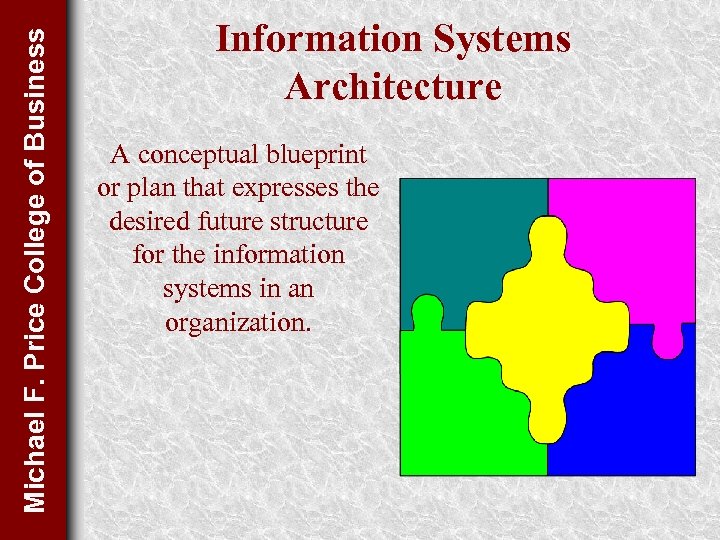
Michael F. Price College of Business Information Systems Architecture A conceptual blueprint or plan that expresses the desired future structure for the information systems in an organization.
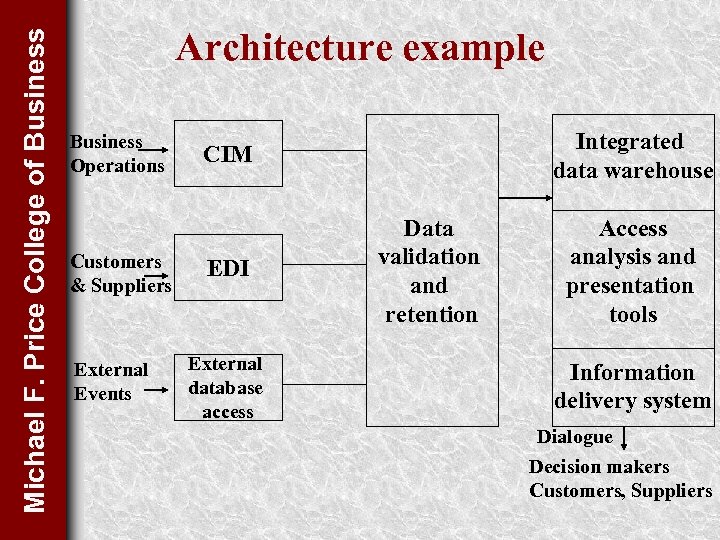
Michael F. Price College of Business Architecture example Business Operations Customers & Suppliers External Events Integrated data warehouse CIM EDI External database access Data validation and retention Access analysis and presentation tools Information delivery system Dialogue Decision makers Customers, Suppliers
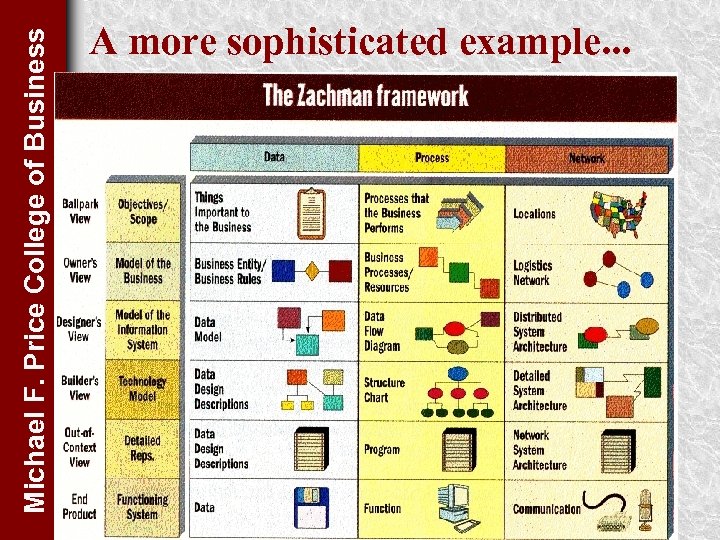
Michael F. Price College of Business A more sophisticated example. . .
Michael F. Price College of Business Information Systems Architecture u Key • • • components: data processes which manipulate data network which transports data people who perform processes and send and receive data events and points in time when processes are performed reasons for events and rules which govern data processing
Michael F. Price College of Business Information Engineering An Information Systems Architecture is developed by IS planners following a particular methodology such as Information Engineering.
Michael F. Price College of Business Information Engineering u Data-oriented methodology u Uses top-down planning in which specific information systems are deduced from a broad understanding of organization’s information needs, rather than relying on specific user information requests u Offers perspective on relationship of information systems to business objectives
Michael F. Price College of Business Top-Down vs. Bottom-Up Top-Down Planning: Bottom-Up Planning: A methodology that attempts to gain a broad understanding of the information system needs of the entire organization A methodology that identifies and defines IS development projects based upon solving operational business problems or taking advantage of business opportunities
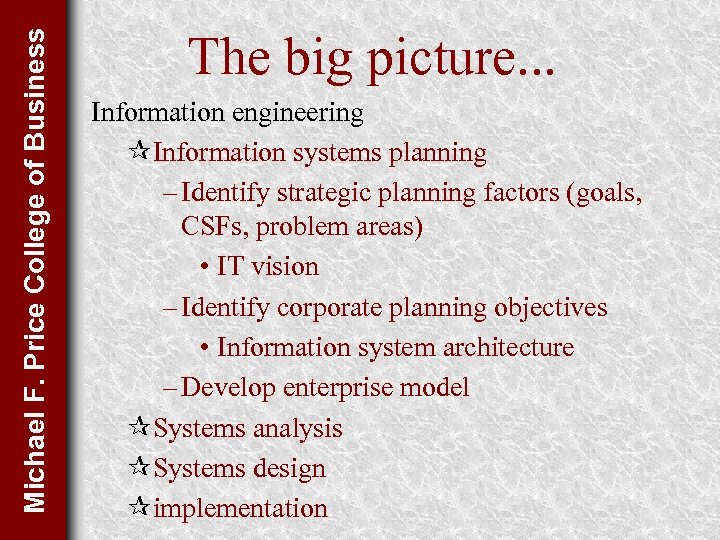
Michael F. Price College of Business The big picture. . . Information engineering ¶Information systems planning – Identify strategic planning factors (goals, CSFs, problem areas) • IT vision – Identify corporate planning objectives • Information system architecture – Develop enterprise model ¶Systems analysis ¶Systems design ¶implementation
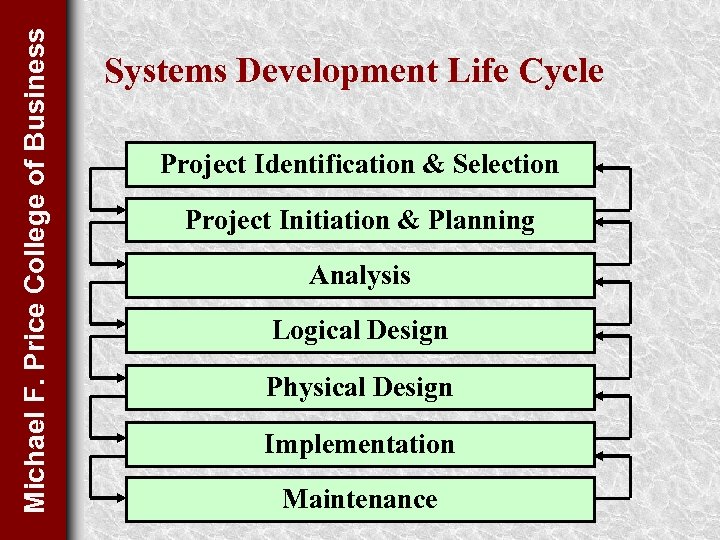
Michael F. Price College of Business Systems Development Life Cycle Project Identification & Selection Project Initiation & Planning Analysis Logical Design Physical Design Implementation Maintenance
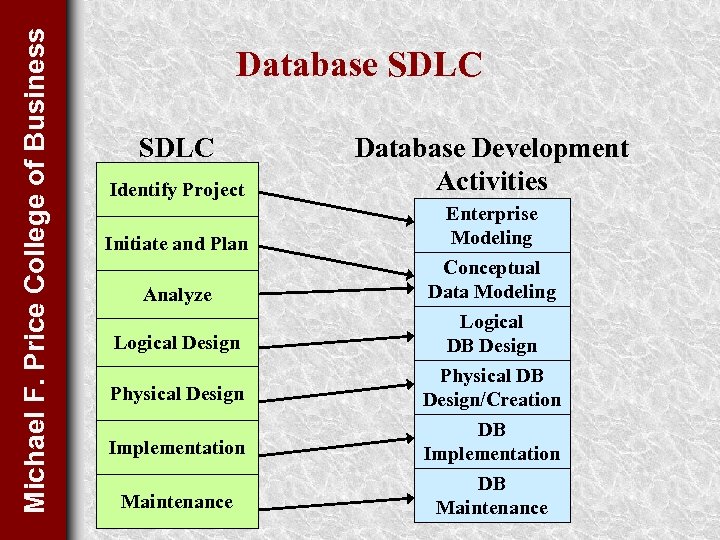
Michael F. Price College of Business Database SDLC Identify Project Database Development Activities Initiate and Plan Enterprise Modeling Analyze Conceptual Data Modeling Logical Design Logical DB Design Physical DB Design/Creation Implementation DB Implementation Maintenance DB Maintenance
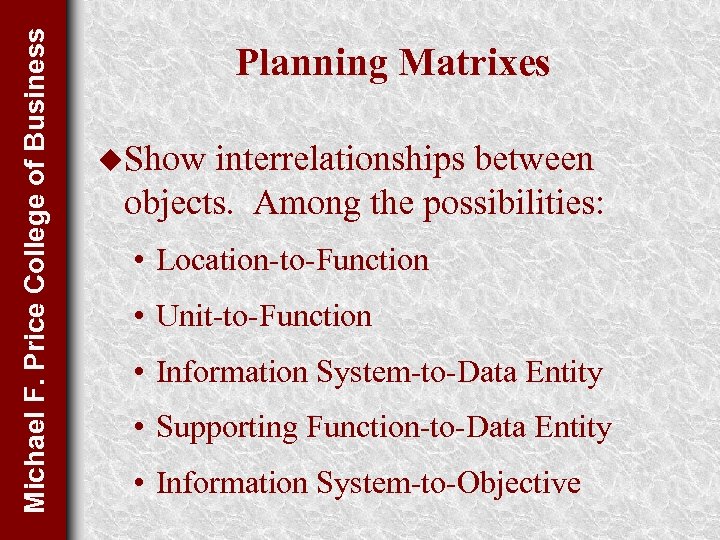
Michael F. Price College of Business Planning Matrixes u. Show interrelationships between objects. Among the possibilities: • Location-to-Function • Unit-to-Function • Information System-to-Data Entity • Supporting Function-to-Data Entity • Information System-to-Objective
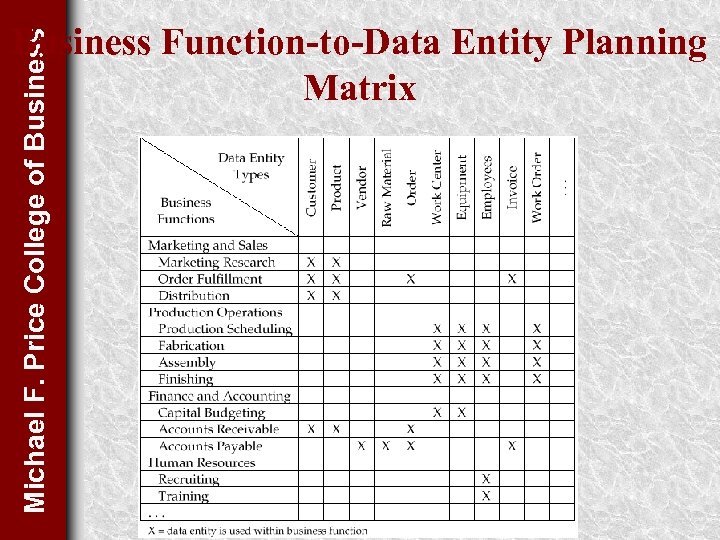
Michael F. Price College of Business Function-to-Data Entity Planning Matrix
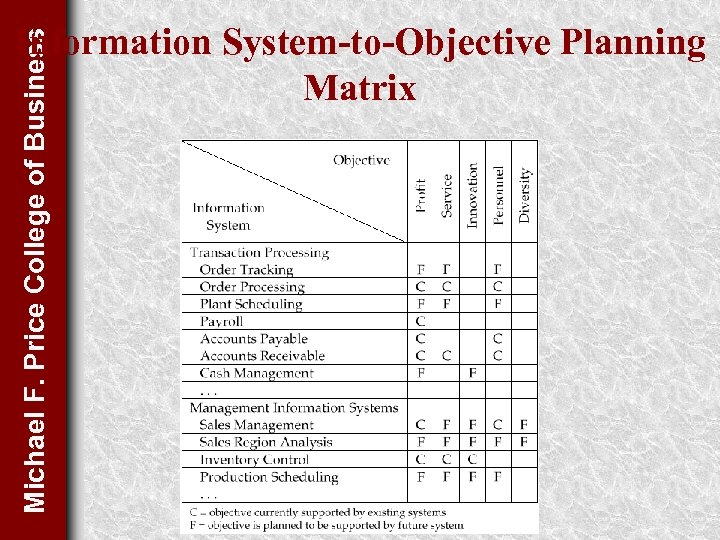
Michael F. Price College of Business Information System-to-Objective Planning Matrix
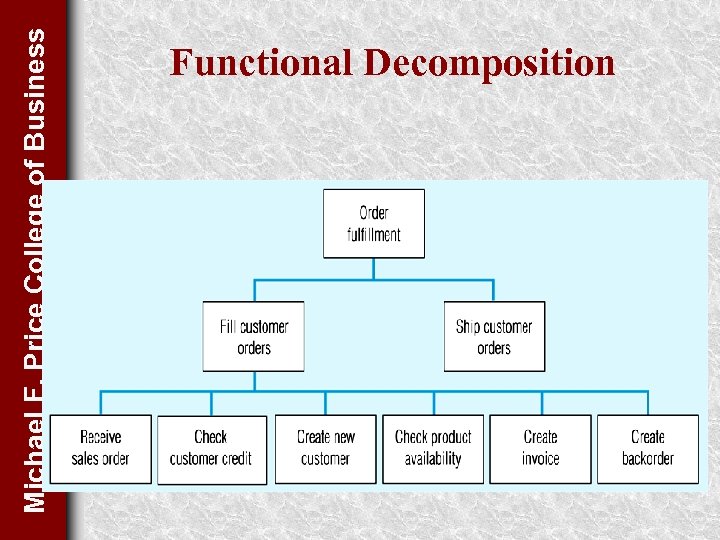
Michael F. Price College of Business Functional Decomposition
Michael F. Price College of Business Enterprise Data Modeling The first step in database development, in which the scope and general contents of organizational databases are specified.
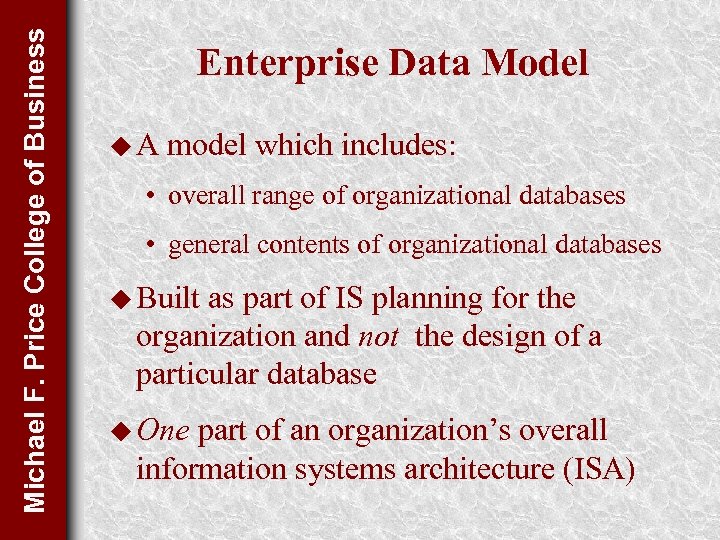
Michael F. Price College of Business Enterprise Data Model u. A model which includes: • overall range of organizational databases • general contents of organizational databases u Built as part of IS planning for the organization and not the design of a particular database u One part of an organization’s overall information systems architecture (ISA)
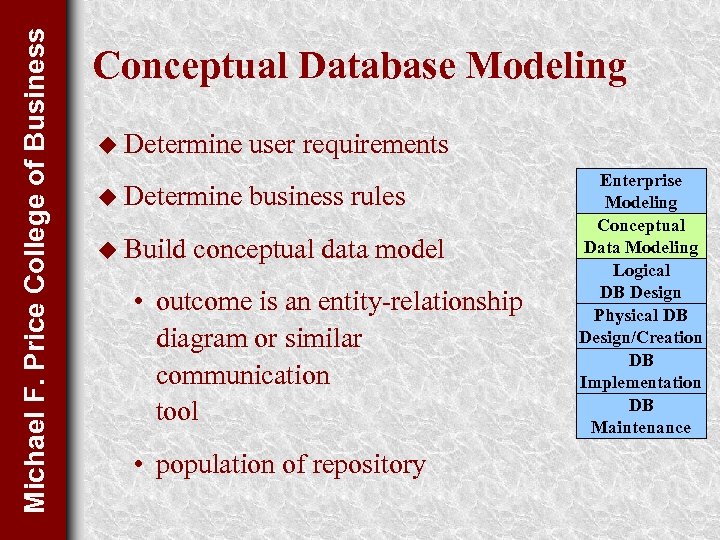
Michael F. Price College of Business Conceptual Database Modeling u Determine u Build user requirements business rules conceptual data model • outcome is an entity-relationship diagram or similar communication tool • population of repository Enterprise Modeling Conceptual Data Modeling Logical DB Design Physical DB Design/Creation DB Implementation DB Maintenance
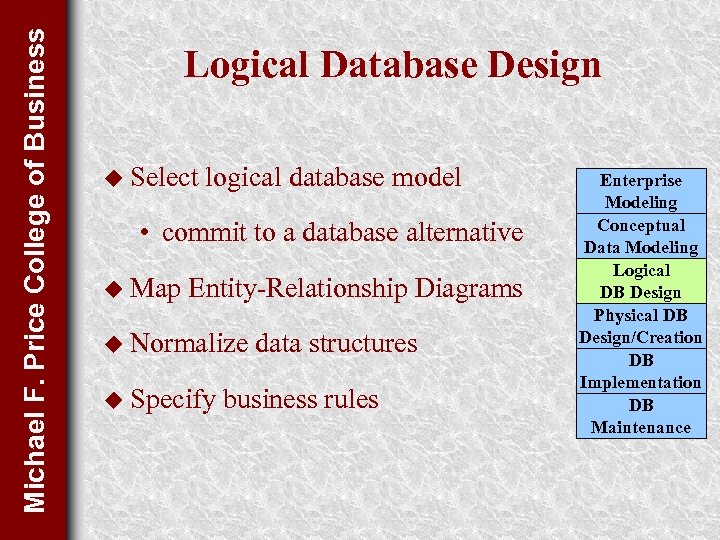
Michael F. Price College of Business Logical Database Design u Select logical database model • commit to a database alternative u Map Entity-Relationship Diagrams u Normalize u Specify data structures business rules Enterprise Modeling Conceptual Data Modeling Logical DB Design Physical DB Design/Creation DB Implementation DB Maintenance
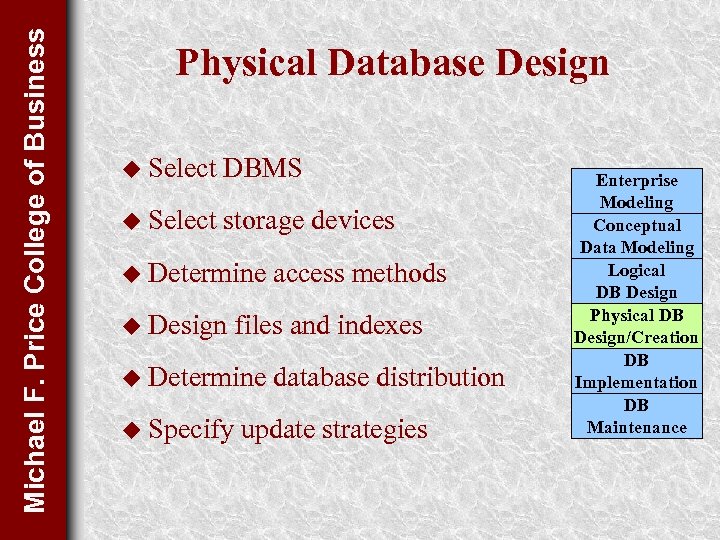
Michael F. Price College of Business Physical Database Design u Select DBMS u Select storage devices u Determine u Design files and indexes u Determine u Specify access methods database distribution update strategies Enterprise Modeling Conceptual Data Modeling Logical DB Design Physical DB Design/Creation DB Implementation DB Maintenance
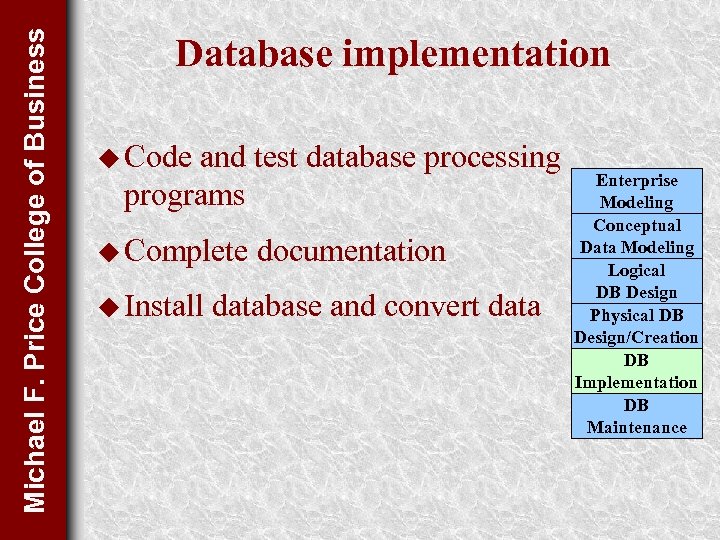
Michael F. Price College of Business Database implementation u Code and test database processing programs u Complete u Install documentation database and convert data Enterprise Modeling Conceptual Data Modeling Logical DB Design Physical DB Design/Creation DB Implementation DB Maintenance
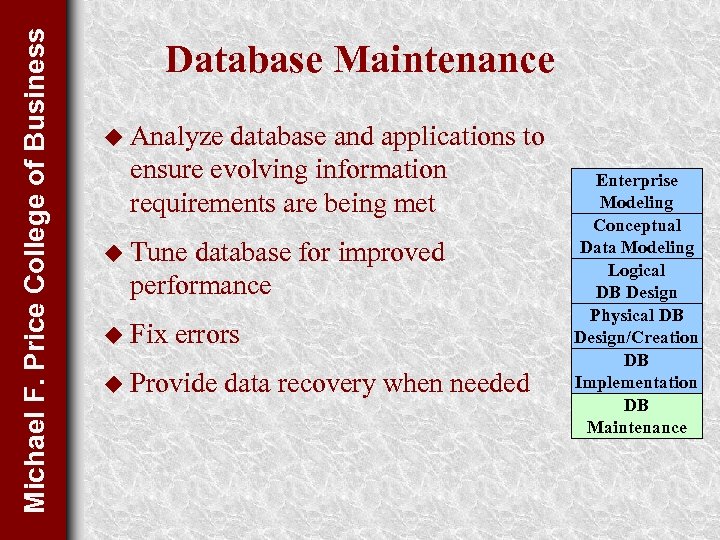
Michael F. Price College of Business Database Maintenance u Analyze database and applications to ensure evolving information requirements are being met u Tune database for improved performance u Fix errors u Provide data recovery when needed Enterprise Modeling Conceptual Data Modeling Logical DB Design Physical DB Design/Creation DB Implementation DB Maintenance
Michael F. Price College of Business Documentation u most formal development methodologies are documentation based u helps managers monitor progress and quality of project u facilitates u includes u various communication between team members models stages are not complete until documentation is accepted
Michael F. Price College of Business Some Keys to Success. . . uaccurate requirements definition ucommitment ueffective change management umanageable uchampion size

Michael F. Price College of Business So …
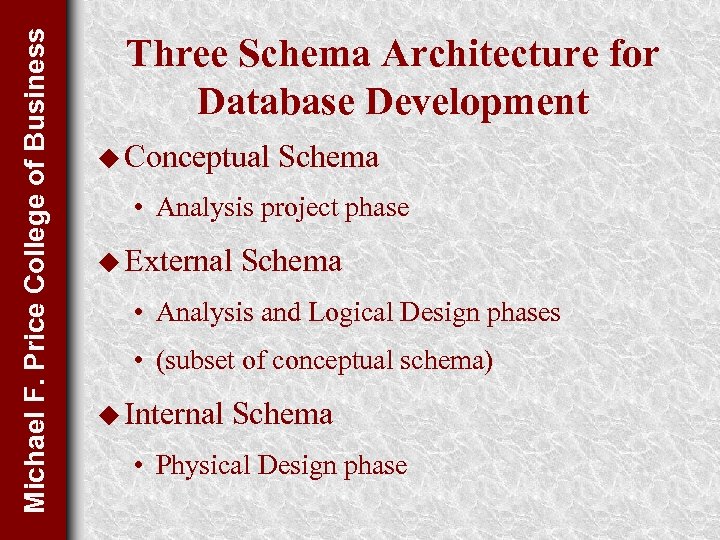
Michael F. Price College of Business Three Schema Architecture for Database Development u Conceptual Schema • Analysis project phase u External Schema • Analysis and Logical Design phases • (subset of conceptual schema) u Internal Schema • Physical Design phase
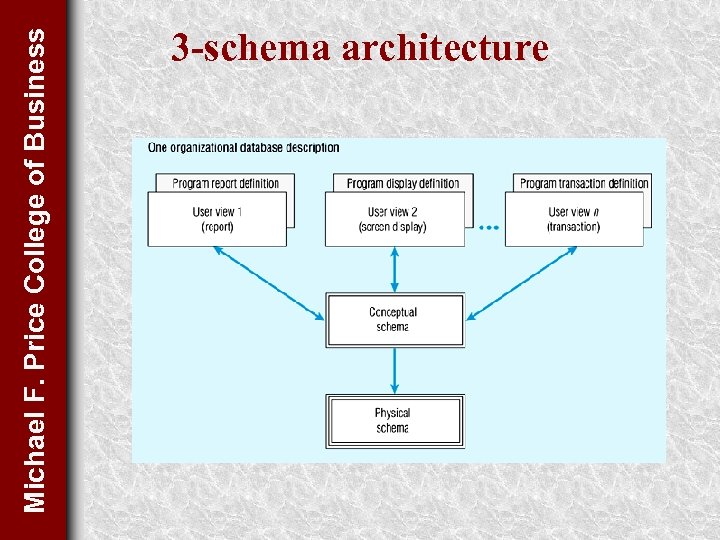
Michael F. Price College of Business 3 -schema architecture
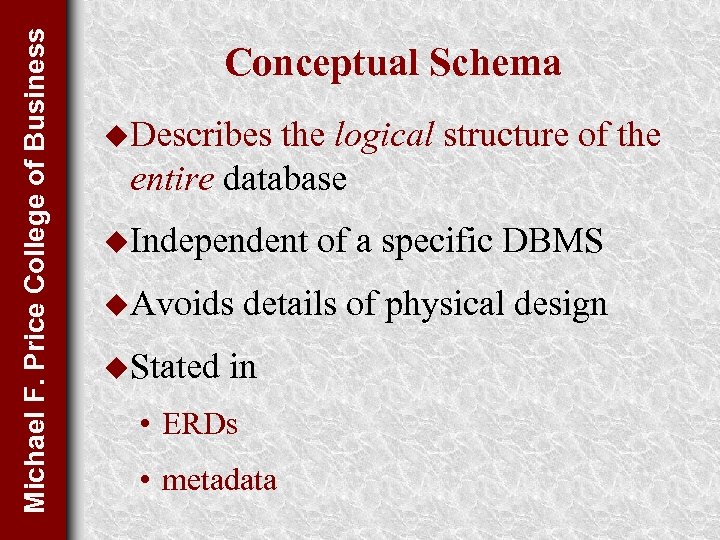
Michael F. Price College of Business Conceptual Schema u. Describes the logical structure of the entire database u. Independent u. Avoids u. Stated of a specific DBMS details of physical design in • ERDs • metadata
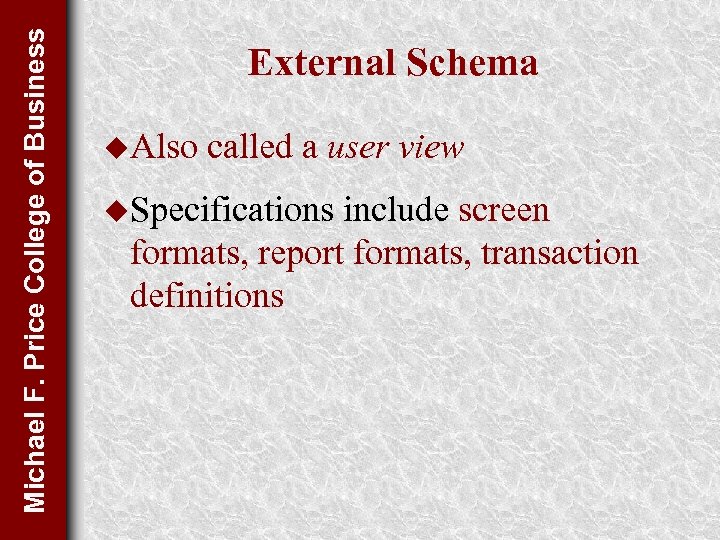
Michael F. Price College of Business External Schema u. Also called a user view u. Specifications include screen formats, report formats, transaction definitions
Michael F. Price College of Business Physical Schema u Describes physical structure of entire database u Specifies how data from a conceptual schema are stored in secondary memory u Sometimes called internal schema u Specifications include physical file and data structures, storage organization, and index structures
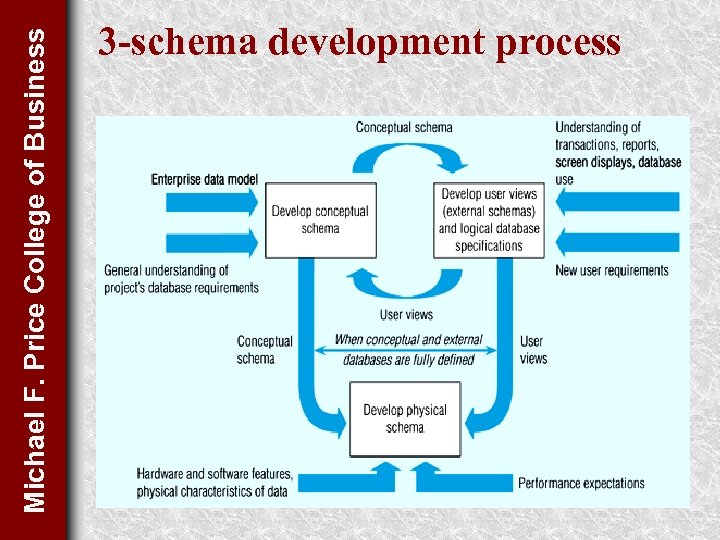
Michael F. Price College of Business 3 -schema development process
Michael F. Price College of Business Rapid application development u design methodology which speeds systems delivery through a combination of speedy design iterations, data modeling, user/developer teamwork, and automated development tools. u encompasses a set of techniques that can be used to build complex, strategic, and mission-critical applications in months rather than years
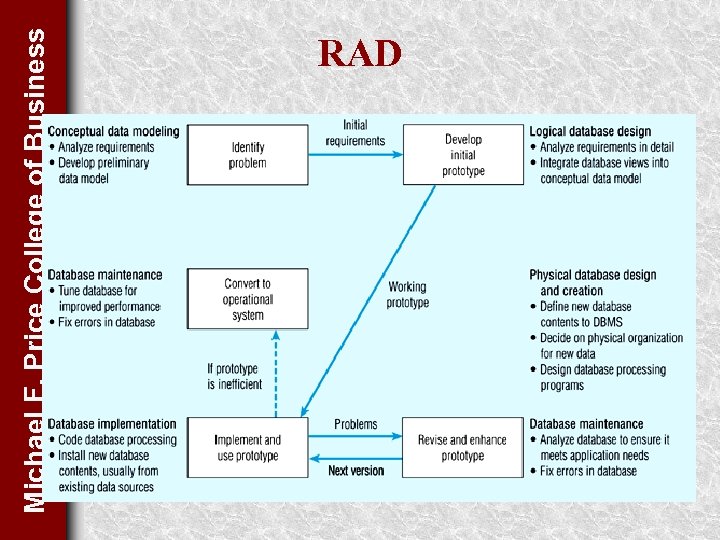
Michael F. Price College of Business RAD
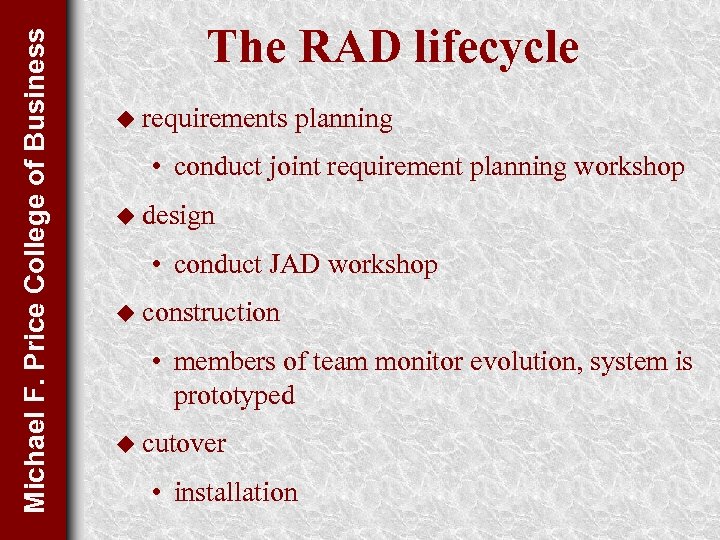
Michael F. Price College of Business The RAD lifecycle u requirements planning • conduct joint requirement planning workshop u design • conduct JAD workshop u construction • members of team monitor evolution, system is prototyped u cutover • installation
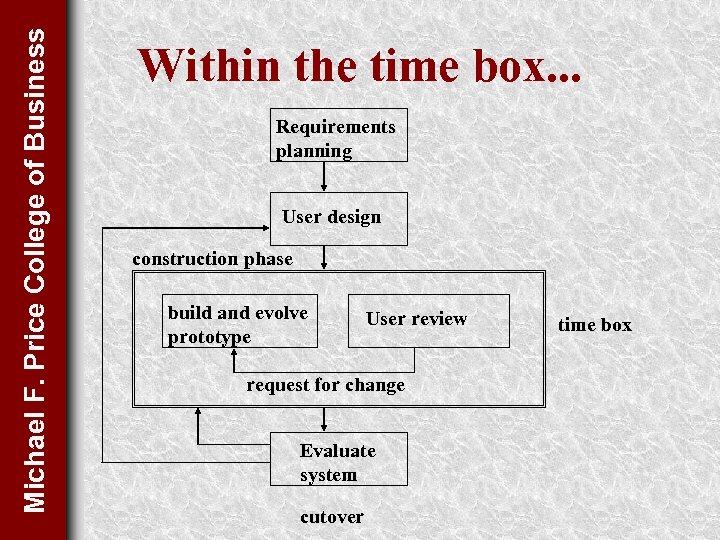
Michael F. Price College of Business Within the time box. . . Requirements planning User design construction phase build and evolve prototype User review request for change Evaluate system cutover time box
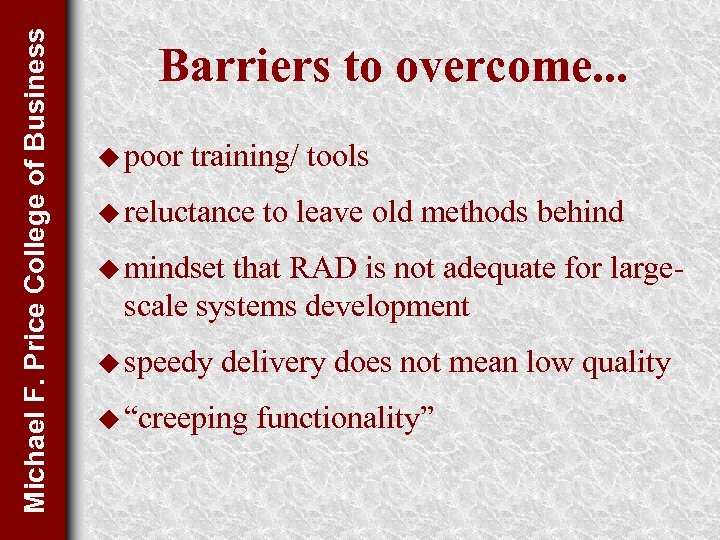
Michael F. Price College of Business Barriers to overcome. . . u poor training/ tools u reluctance to leave old methods behind u mindset that RAD is not adequate for largescale systems development u speedy delivery does not mean low quality u “creeping functionality”
Скачать презентацию Michael F Price College of Business Chapter 2
f6025d69c663dc65313ab3f27e11ee38.ppt