


 Скачать презентацию Michael E Moran M D Southwestern Urology Tucson
7363e7ca36e30a32289cc903c285a486.ppt
- Количество слайдов: 23
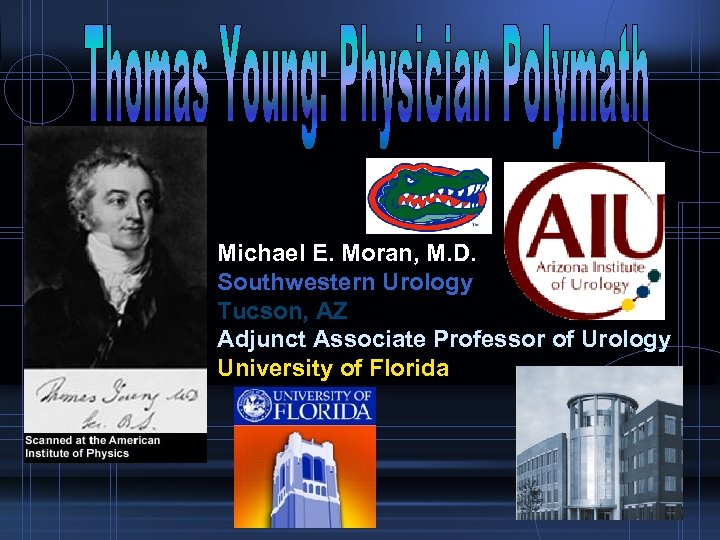 Michael E. Moran, M. D. Southwestern Urology Tucson, AZ Adjunct Associate Professor of Urology University of Florida
 Child Prodigies- not all become adult prodigies Polyglot- childhood through adulthood Polymath- comparison of Young to others Historical significance in various areas - physics - mathematics - physiology - engineering - languages - biology - botany - medicine - acoustics/music - history and biography - invention
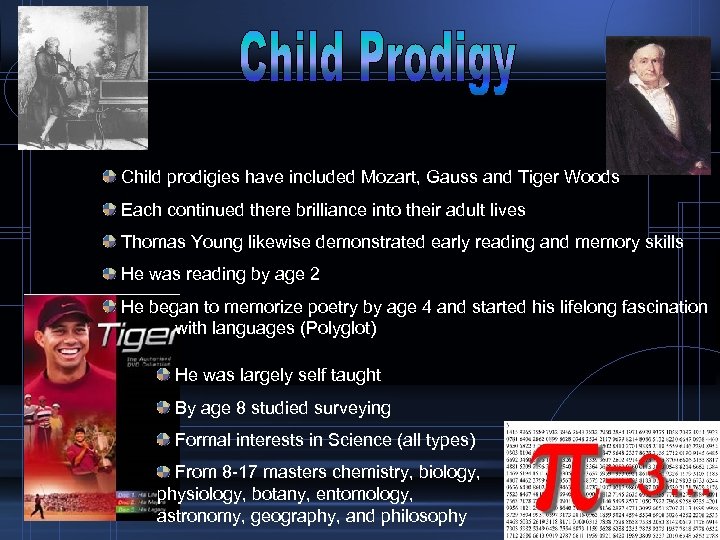 Child prodigies have included Mozart, Gauss and Tiger Woods Each continued there brilliance into their adult lives Thomas Young likewise demonstrated early reading and memory skills He was reading by age 2 He began to memorize poetry by age 4 and started his lifelong fascination with languages (Polyglot) He was largely self taught By age 8 studied surveying Formal interests in Science (all types) From 8 -17 masters chemistry, biology, physiology, botany, entomology, astronomy, geography, and philosophy
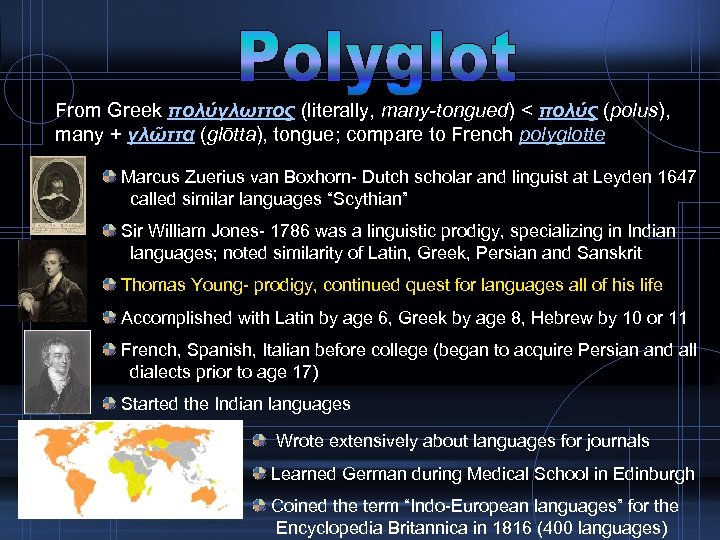 From Greek πολύγλωττος (literally, many-tongued) < πολύς (polus), many + γλῶττα (glōtta), tongue; compare to French polyglotte Marcus Zuerius van Boxhorn- Dutch scholar and linguist at Leyden 1647 called similar languages “Scythian” Sir William Jones- 1786 was a linguistic prodigy, specializing in Indian languages; noted similarity of Latin, Greek, Persian and Sanskrit Thomas Young- prodigy, continued quest for languages all of his life Accomplished with Latin by age 6, Greek by age 8, Hebrew by 10 or 11 French, Spanish, Italian before college (began to acquire Persian and all dialects prior to age 17) Started the Indian languages Wrote extensively about languages for journals Learned German during Medical School in Edinburgh Coined the term “Indo-European languages” for the Encyclopedia Britannica in 1816 (400 languages)
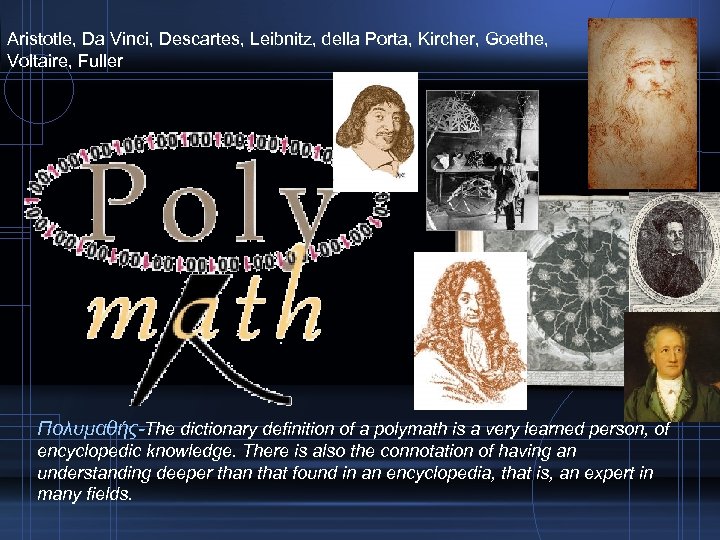 Aristotle, Da Vinci, Descartes, Leibnitz, della Porta, Kircher, Goethe, Voltaire, Fuller Πολυμαθής-The dictionary definition of a polymath is a very learned person, of encyclopedic knowledge. There is also the connotation of having an understanding deeper than that found in an encyclopedia, that is, an expert in many fields.
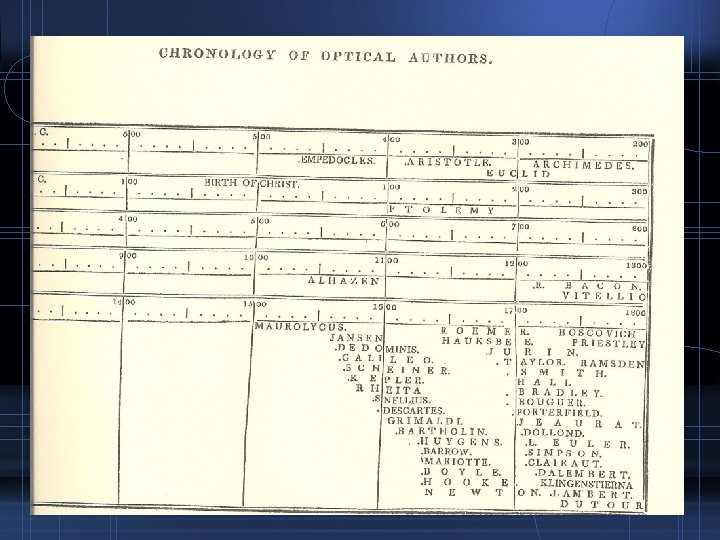
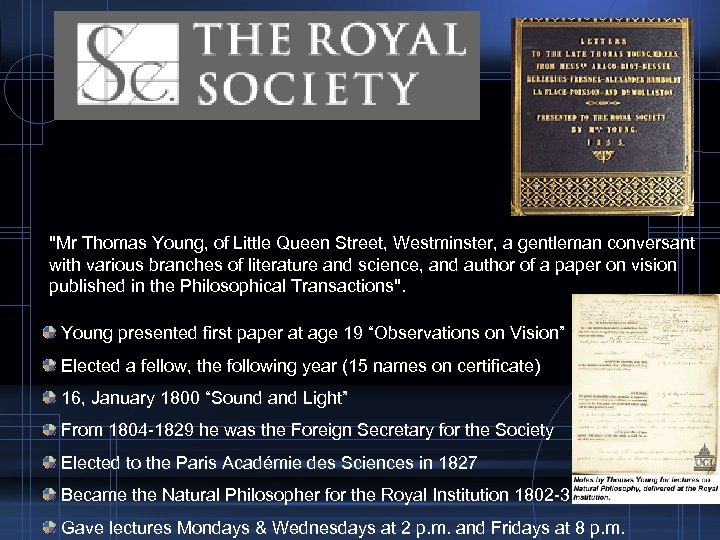 "Mr Thomas Young, of Little Queen Street, Westminster, a gentleman conversant with various branches of literature and science, and author of a paper on vision published in the Philosophical Transactions". Young presented first paper at age 19 “Observations on Vision” Elected a fellow, the following year (15 names on certificate) 16, January 1800 “Sound and Light” From 1804 -1829 he was the Foreign Secretary for the Society Elected to the Paris Académie des Sciences in 1827 Became the Natural Philosopher for the Royal Institution 1802 -3 Gave lectures Mondays & Wednesdays at 2 p. m. and Fridays at 8 p. m.
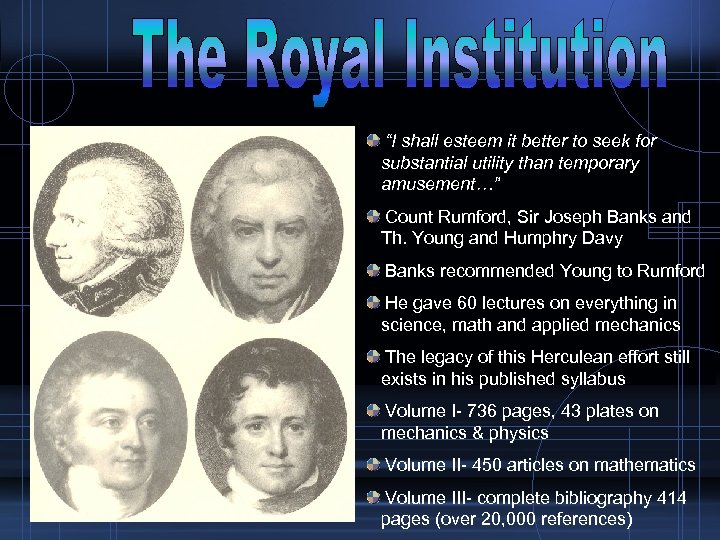 “I shall esteem it better to seek for substantial utility than temporary amusement…” Count Rumford, Sir Joseph Banks and Th. Young and Humphry Davy Banks recommended Young to Rumford He gave 60 lectures on everything in science, math and applied mechanics The legacy of this Herculean effort still exists in his published syllabus Volume I- 736 pages, 43 plates on mechanics & physics Volume II- 450 articles on mathematics Volume III- complete bibliography 414 pages (over 20, 000 references)
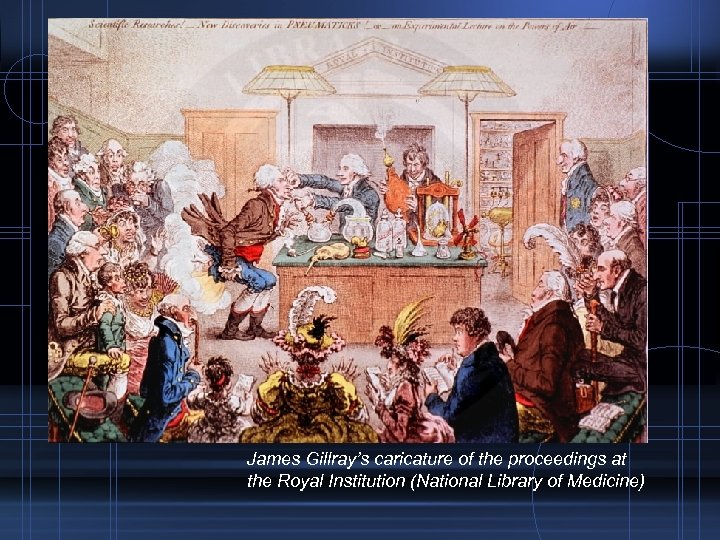 James Gillray’s caricature of the proceedings at the Royal Institution (National Library of Medicine)
 Young considered his studies of light his most significant contribution He took on the prevailing theory of Newton Mathematically investigated reflection, refraction, and interference Measured the wavelengths of all visible light No one understood what he had proven, until Fresnel came along later (1816) He presages Maxwell’s equations, Fermat’s principles and ultimately Einstein’s special theory Lord Rayleigh “Its expositions in some branches were unexcelled even now…” Helmholtz “[Young] was one of the most acute men who ever lived, but had the misfortune to be too far in advance of his contemporaries. ”
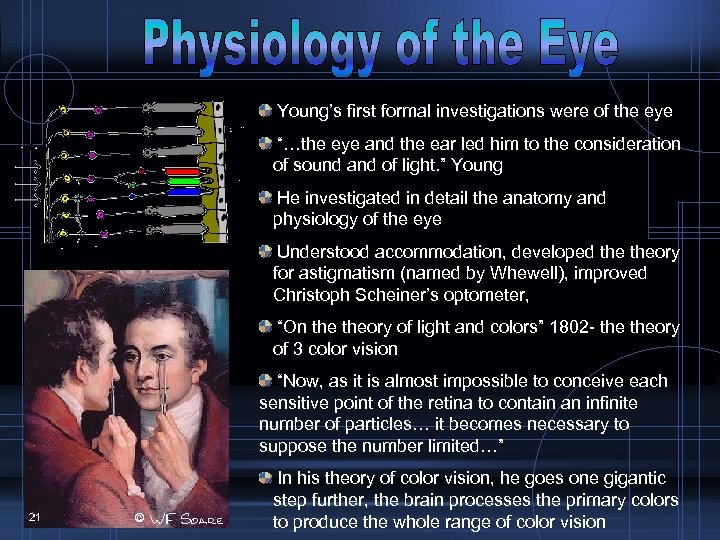 Young’s first formal investigations were of the eye “…the eye and the ear led him to the consideration of sound and of light. ” Young He investigated in detail the anatomy and physiology of the eye Understood accommodation, developed theory for astigmatism (named by Whewell), improved Christoph Scheiner’s optometer, “On theory of light and colors” 1802 - theory of 3 color vision “Now, as it is almost impossible to conceive each sensitive point of the retina to contain an infinite number of particles… it becomes necessary to suppose the number limited…” In his theory of color vision, he goes one gigantic step further, the brain processes the primary colors to produce the whole range of color vision
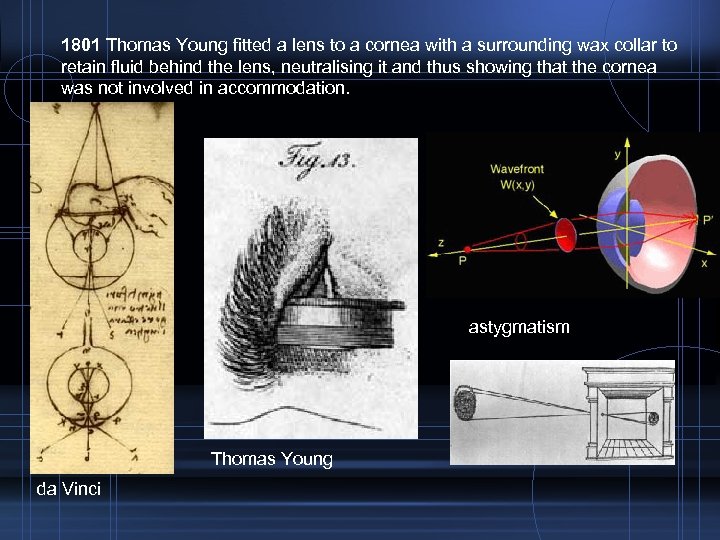 1801 Thomas Young fitted a lens to a cornea with a surrounding wax collar to retain fluid behind the lens, neutralising it and thus showing that the cornea was not involved in accommodation. astygmatism Thomas Young da Vinci
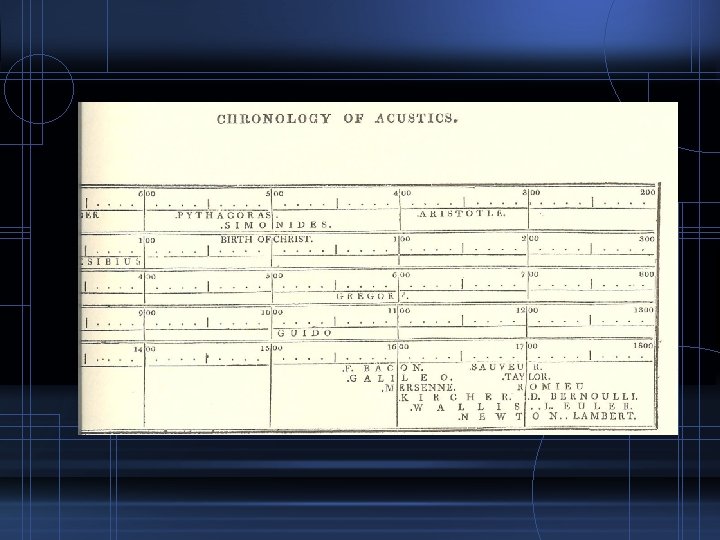
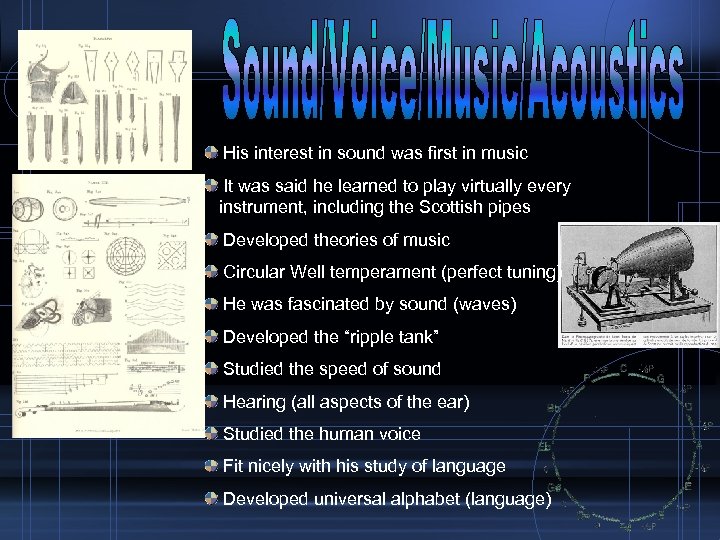 His interest in sound was first in music It was said he learned to play virtually every instrument, including the Scottish pipes Developed theories of music Circular Well temperament (perfect tuning) He was fascinated by sound (waves) Developed the “ripple tank” Studied the speed of sound Hearing (all aspects of the ear) Studied the human voice Fit nicely with his study of language Developed universal alphabet (language)
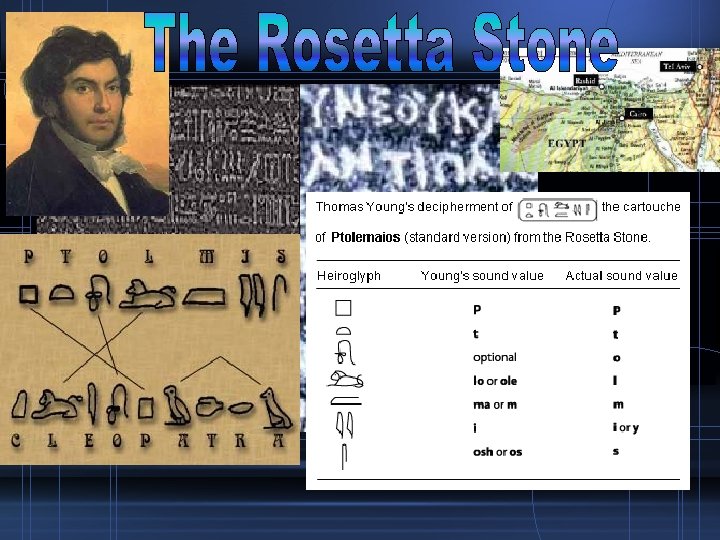
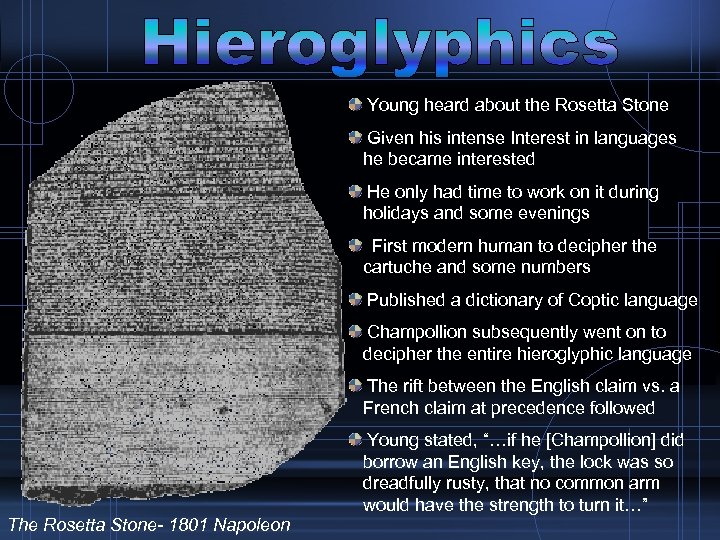 Young heard about the Rosetta Stone Given his intense Interest in languages he became interested He only had time to work on it during holidays and some evenings First modern human to decipher the cartuche and some numbers Published a dictionary of Coptic language Champollion subsequently went on to decipher the entire hieroglyphic language The rift between the English claim vs. a French claim at precedence followed Young stated, “…if he [Champollion] did borrow an English key, the lock was so dreadfully rusty, that no common arm would have the strength to turn it…” The Rosetta Stone- 1801 Napoleon
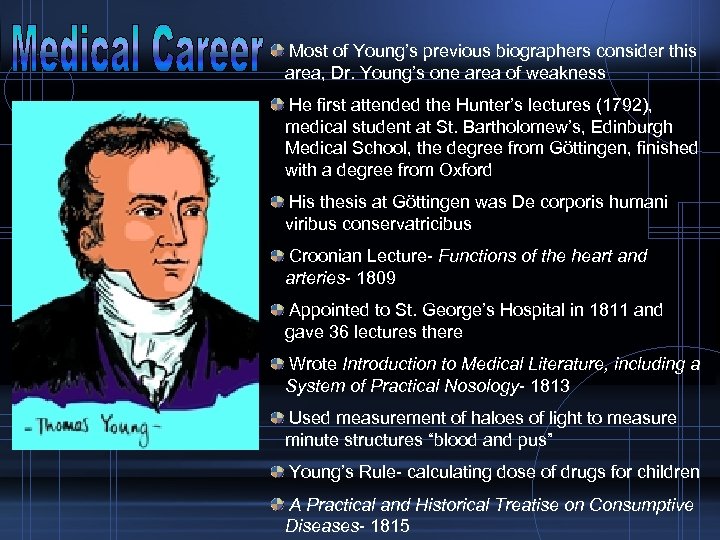 Most of Young’s previous biographers consider this area, Dr. Young’s one area of weakness He first attended the Hunter’s lectures (1792), medical student at St. Bartholomew’s, Edinburgh Medical School, the degree from Göttingen, finished with a degree from Oxford His thesis at Göttingen was De corporis humani viribus conservatricibus Croonian Lecture- Functions of the heart and arteries- 1809 Appointed to St. George’s Hospital in 1811 and gave 36 lectures there Wrote Introduction to Medical Literature, including a System of Practical Nosology- 1813 Used measurement of haloes of light to measure minute structures “blood and pus” Young’s Rule- calculating dose of drugs for children A Practical and Historical Treatise on Consumptive Diseases- 1815
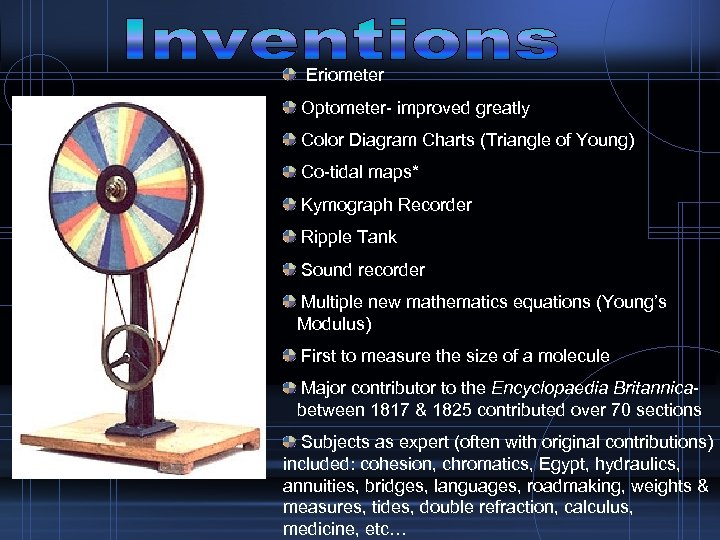 Eriometer Optometer- improved greatly Color Diagram Charts (Triangle of Young) Co-tidal maps* Kymograph Recorder Ripple Tank Sound recorder Multiple new mathematics equations (Young’s Modulus) First to measure the size of a molecule Major contributor to the Encyclopaedia Britannica- between 1817 & 1825 contributed over 70 sections Subjects as expert (often with original contributions) included: cohesion, chromatics, Egypt, hydraulics, annuities, bridges, languages, roadmaking, weights & measures, tides, double refraction, calculus, medicine, etc…
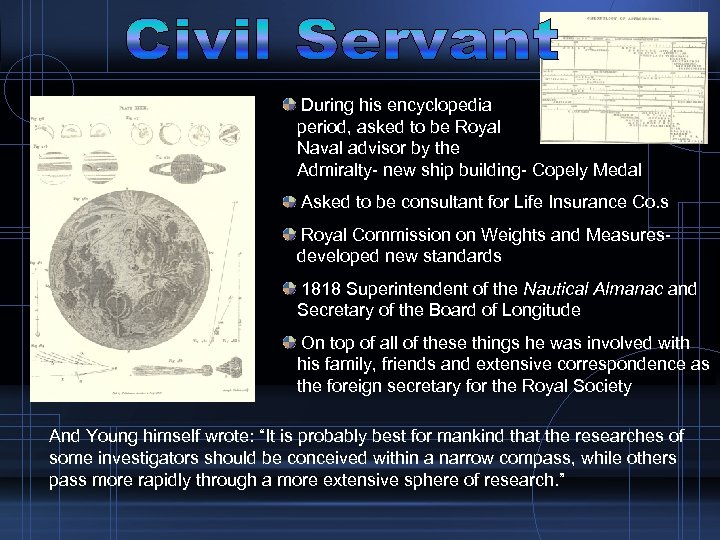 During his encyclopedia period, asked to be Royal Naval advisor by the Admiralty- new ship building- Copely Medal Asked to be consultant for Life Insurance Co. s Royal Commission on Weights and Measures- developed new standards 1818 Superintendent of the Nautical Almanac and Secretary of the Board of Longitude On top of all of these things he was involved with his family, friends and extensive correspondence as the foreign secretary for the Royal Society And Young himself wrote: “It is probably best for mankind that the researches of some investigators should be conceived within a narrow compass, while others pass more rapidly through a more extensive sphere of research. ”
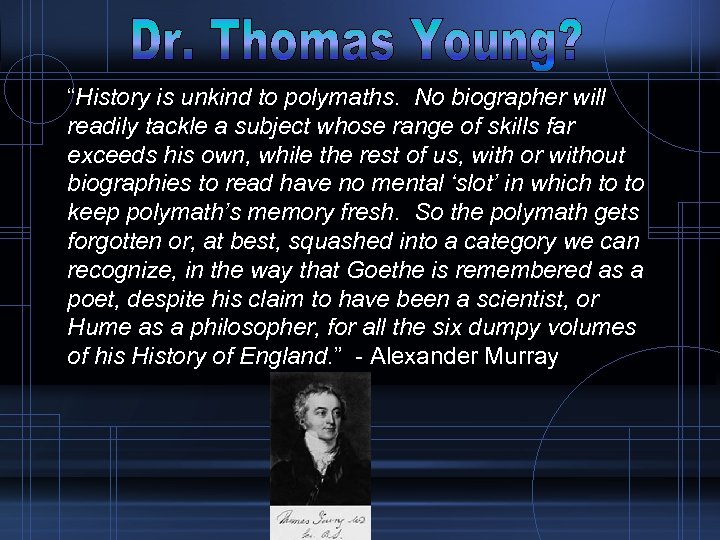 “History is unkind to polymaths. No biographer will readily tackle a subject whose range of skills far exceeds his own, while the rest of us, with or without biographies to read have no mental ‘slot’ in which to to keep polymath’s memory fresh. So the polymath gets forgotten or, at best, squashed into a category we can recognize, in the way that Goethe is remembered as a poet, despite his claim to have been a scientist, or Hume as a philosopher, for all the six dumpy volumes of his History of England. ” - Alexander Murray
 1. Wood, A: Thomas Young: Natural Philosopher 1773 -1829. Cambridge Univ Press, London 1954 2. Pettigrew, TJ: Biographical Memoirs of the most celebrated Physicians, Surgeons, etc. Whittaker &Co, London, 1839 3. Robinson, A: The Last Man Who Knew Everything. Pi Press, NY 2006 4. Young, T: A Course of Lectures on Natural Philosophy and the Mechanical Arts. 1807 5. Young, T: An Introduction to Medical Literature, including a System of Practical Nosology. 1813 6. Young, T: A Practical and Historical Treatise on Consumptive Diseases. 1815 7. Arago, M: Biographical Memoir of Dr. Thomas Young. Edin New Phil J 20: 213 -241, 1836 8. Hilts, VL: Thomas Young’s “Autobiographical Sketch. ” Proc Am Phil Soc 122: 248 -260, 1978
 9. Dr. Young. Lancet 2: 255 (23 May 1829) 10. Larmor, J: Thomas Young. Nature 133: 276 -9, 1934 11. Rowell, HS: Thomas Young and Göttingen. Nature 88: 516, 1912 12. Rubinowicz, A: Thomas Young and theory of diffraction. Nature 180: 160 -2, 1957 13. Oldham, F: Thomas Young. Br Med J 4: 150 -52, 1974 14. Cantor, GN: Thomas Young’s lectures at the Royal Institution. Notes and Records R Soc Lond 25(1): 87 -112, 1970 15. Mollon, JD: The origins of the concept of interference. Phil Trans R Soc Lond 360: 807 -819, 2002