 Скачать презентацию MICE Collaboration meeting RAL 21 24 Oct
91714142fdbb30d43071a735f0989dd2.ppt
- Количество слайдов: 33



MICE Collaboration meeting RAL 21 – 24 Oct 2005 AFC – towards manufacturing By Wing Lau, Stephanie Yang – Oxford University Steve Virostek -- LBNL
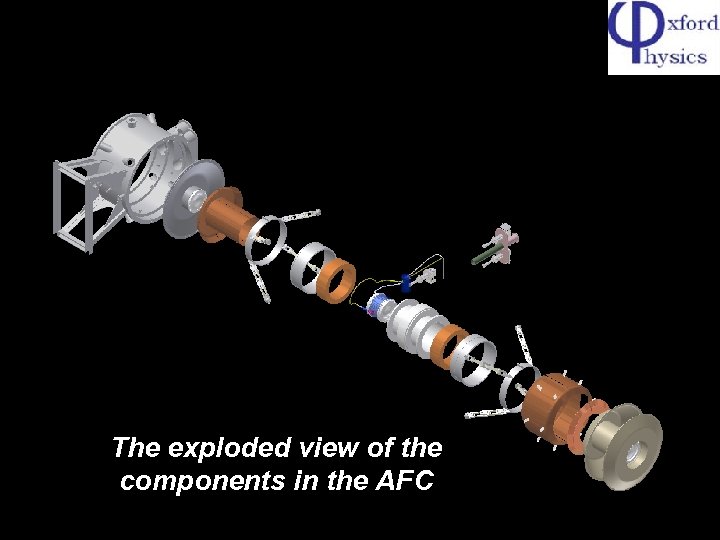
The exploded view of the components in the AFC
Status of the AFC design The design is largely complete, bar a few minor details which require feed back from the R&D results on thermal performance of the hydrogen cooling. They will not be available until the latter half of 2006 when the R&D on Hydrogen system is completed. The funding for AFC is not released until phase 2 begins which is still a couple of years away. So why do we need to bother with the manufacturing activities on the AFC module so early? It is because the tendering and manufacturing of the Tracker Solenoid is imminent and AFC will benefit by working alongside with the Tracker Spectrometer group right from the beginning.
The governing document – the pressure vessel code
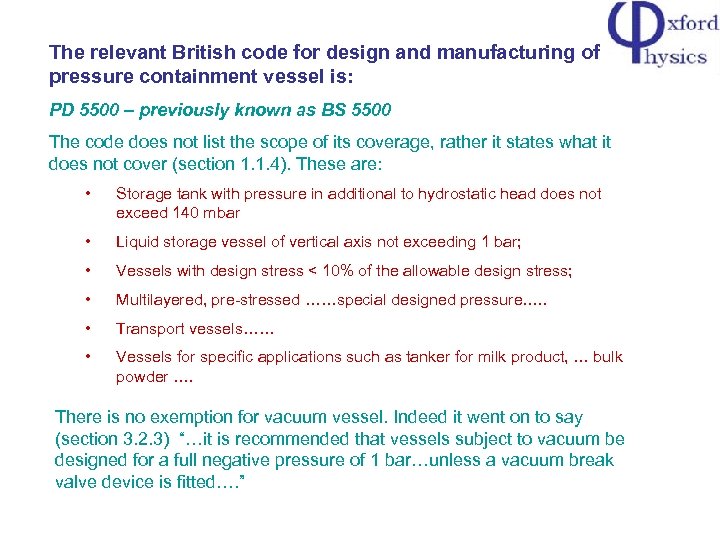
The relevant British code for design and manufacturing of pressure containment vessel is: PD 5500 – previously known as BS 5500 The code does not list the scope of its coverage, rather it states what it does not cover (section 1. 1. 4). These are: • Storage tank with pressure in additional to hydrostatic head does not exceed 140 mbar • Liquid storage vessel of vertical axis not exceeding 1 bar; • Vessels with design stress < 10% of the allowable design stress; • Multilayered, pre-stressed ……special designed pressure…. . • Transport vessels…… • Vessels for specific applications such as tanker for milk product, … bulk powder …. There is no exemption for vacuum vessel. Indeed it went on to say (section 3. 2. 3) “…it is recommended that vessels subject to vacuum be designed for a full negative pressure of 1 bar…unless a vacuum break valve device is fitted…. ”
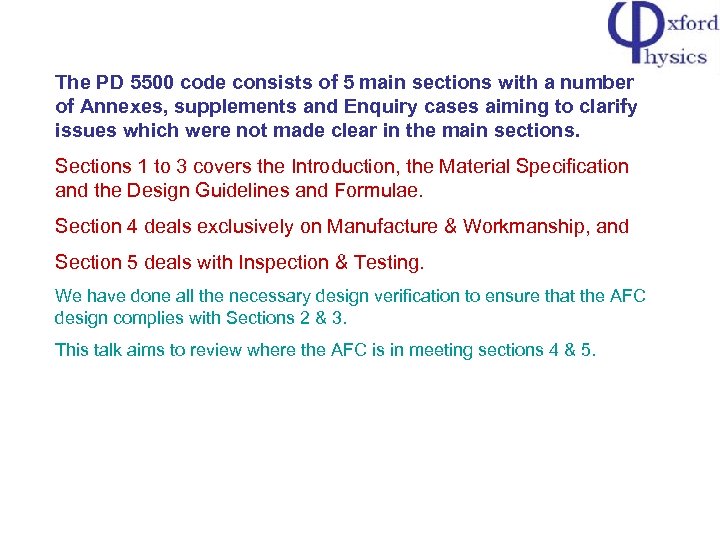
The PD 5500 code consists of 5 main sections with a number of Annexes, supplements and Enquiry cases aiming to clarify issues which were not made clear in the main sections. Sections 1 to 3 covers the Introduction, the Material Specification and the Design Guidelines and Formulae. Section 4 deals exclusively on Manufacture & Workmanship, and Section 5 deals with Inspection & Testing. We have done all the necessary design verification to ensure that the AFC design complies with Sections 2 & 3. This talk aims to review where the AFC is in meeting sections 4 & 5.
Guidelines on managing manufacturing contracts – from the PD 5500 prospective
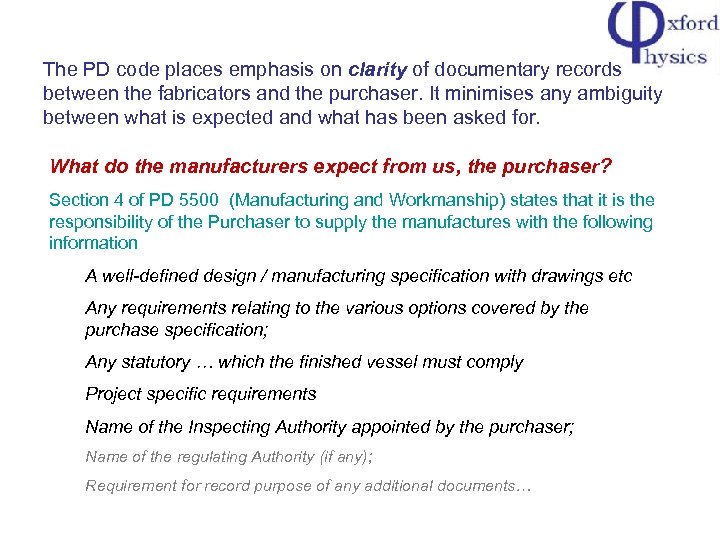
The PD code places emphasis on clarity of documentary records between the fabricators and the purchaser. It minimises any ambiguity between what is expected and what has been asked for. What do the manufacturers expect from us, the purchaser? Section 4 of PD 5500 (Manufacturing and Workmanship) states that it is the responsibility of the Purchaser to supply the manufactures with the following information A well-defined design / manufacturing specification with drawings etc Any requirements relating to the various options covered by the purchase specification; Any statutory … which the finished vessel must comply Project specific requirements Name of the Inspecting Authority appointed by the purchaser; Name of the regulating Authority (if any); Requirement for record purpose of any additional documents…
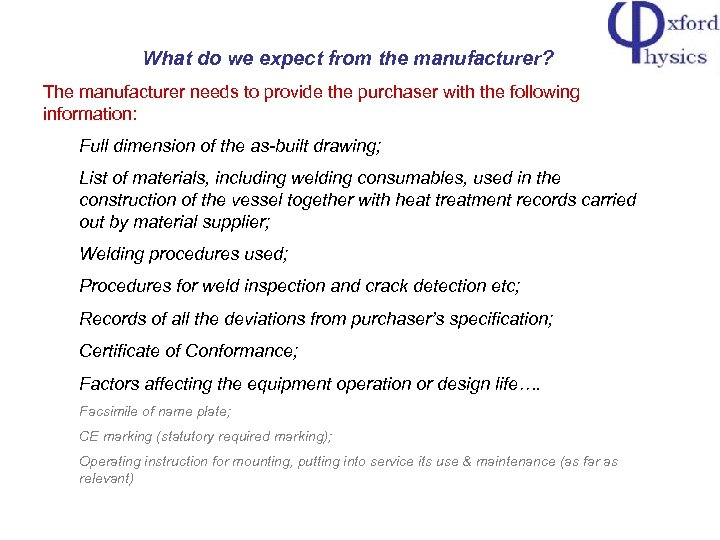
What do we expect from the manufacturer? The manufacturer needs to provide the purchaser with the following information: Full dimension of the as-built drawing; List of materials, including welding consumables, used in the construction of the vessel together with heat treatment records carried out by material supplier; Welding procedures used; Procedures for weld inspection and crack detection etc; Records of all the deviations from purchaser’s specification; Certificate of Conformance; Factors affecting the equipment operation or design life…. Facsimile of name plate; CE marking (statutory required marking); Operating instruction for mounting, putting into service its use & maintenance (as far as relevant)
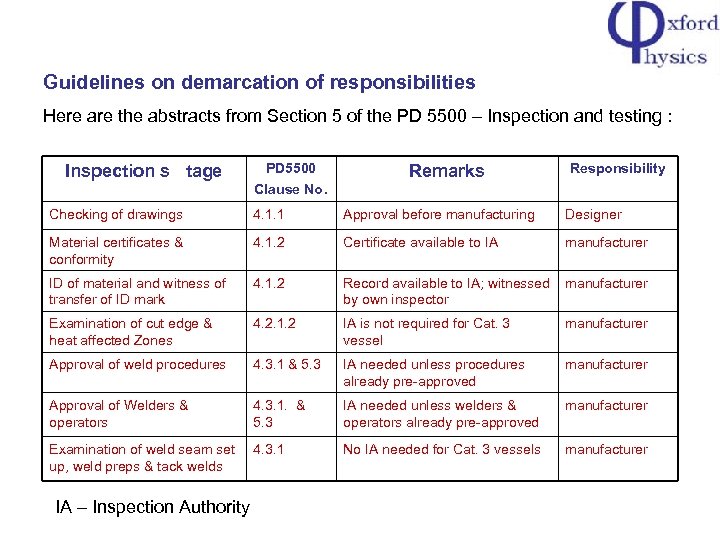
Guidelines on demarcation of responsibilities Here are the abstracts from Section 5 of the PD 5500 – Inspection and testing : Inspection s tage PD 5500 Clause No. Remarks Responsibility Checking of drawings 4. 1. 1 Approval before manufacturing Designer Material certificates & conformity 4. 1. 2 Certificate available to IA manufacturer ID of material and witness of transfer of ID mark 4. 1. 2 Record available to IA; witnessed by own inspector manufacturer Examination of cut edge & heat affected Zones 4. 2. 1. 2 IA is not required for Cat. 3 vessel manufacturer Approval of weld procedures 4. 3. 1 & 5. 3 IA needed unless procedures already pre-approved manufacturer Approval of Welders & operators 4. 3. 1. & 5. 3 IA needed unless welders & operators already pre-approved manufacturer Examination of weld seam set up, weld preps & tack welds 4. 3. 1 No IA needed for Cat. 3 vessels manufacturer IA – Inspection Authority
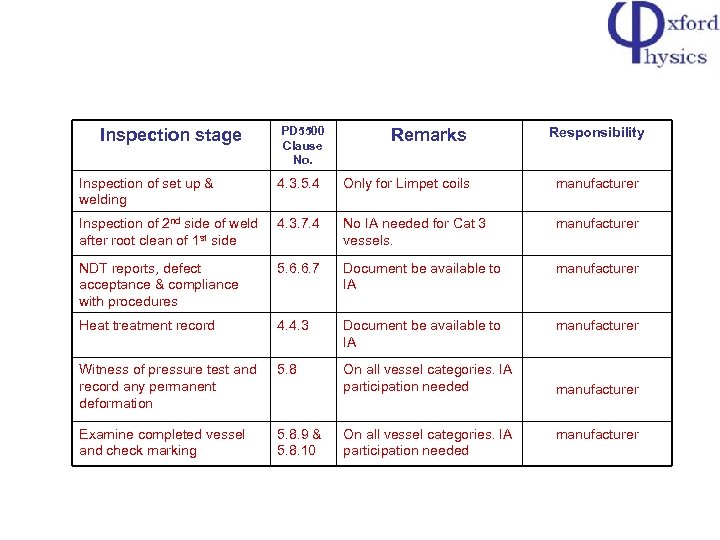
Inspection stage PD 5500 Clause No. Remarks Responsibility Inspection of set up & welding 4. 3. 5. 4 Only for Limpet coils manufacturer Inspection of 2 nd side of weld after root clean of 1 st side 4. 3. 7. 4 No IA needed for Cat 3 vessels. manufacturer NDT reports, defect acceptance & compliance with procedures 5. 6. 6. 7 Document be available to IA manufacturer Heat treatment record 4. 4. 3 Document be available to IA manufacturer Witness of pressure test and record any permanent deformation 5. 8 On all vessel categories. IA participation needed Examine completed vessel and check marking 5. 8. 9 & 5. 8. 10 On all vessel categories. IA participation needed manufacturer

Vessel classification and its implication
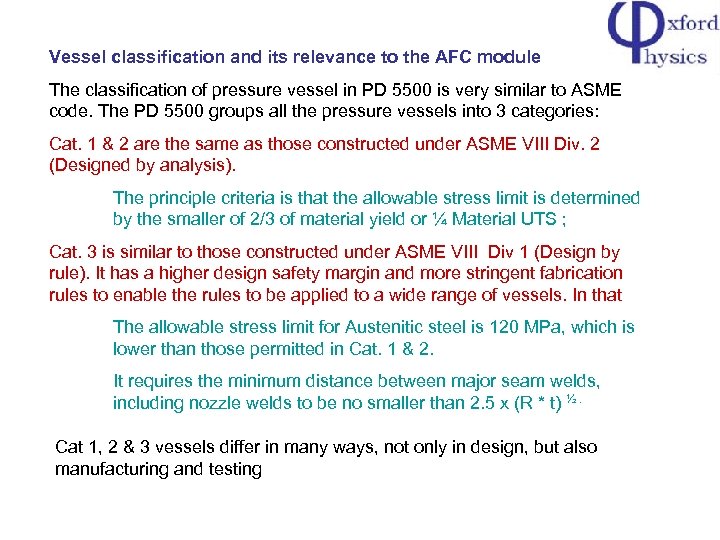
Vessel classification and its relevance to the AFC module The classification of pressure vessel in PD 5500 is very similar to ASME code. The PD 5500 groups all the pressure vessels into 3 categories: Cat. 1 & 2 are the same as those constructed under ASME VIII Div. 2 (Designed by analysis). The principle criteria is that the allowable stress limit is determined by the smaller of 2/3 of material yield or ¼ Material UTS ; Cat. 3 is similar to those constructed under ASME VIII Div 1 (Design by rule). It has a higher design safety margin and more stringent fabrication rules to enable the rules to be applied to a wide range of vessels. In that The allowable stress limit for Austenitic steel is 120 MPa, which is lower than those permitted in Cat. 1 & 2. It requires the minimum distance between major seam welds, including nozzle welds to be no smaller than 2. 5 x (R * t) ½. Cat 1, 2 & 3 vessels differ in many ways, not only in design, but also manufacturing and testing
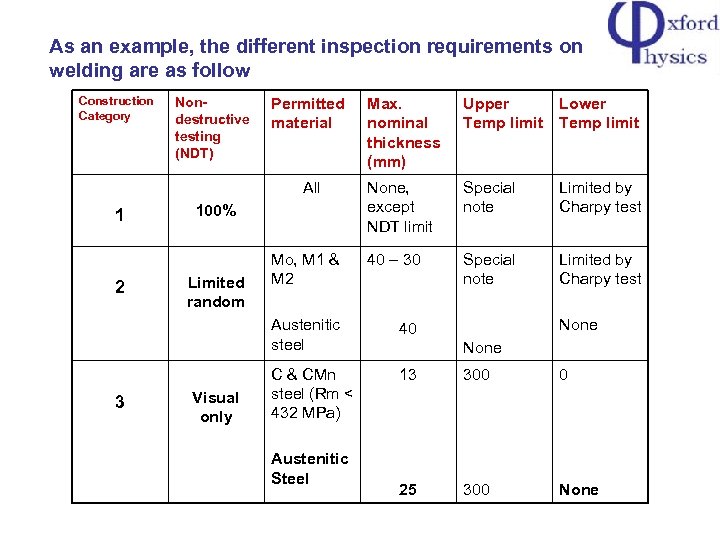
As an example, the different inspection requirements on welding are as follow Construction Category Nondestructive testing (NDT) 3 Upper Temp limit Lower Temp limit None, except NDT limit Special note Limited by Charpy test Mo, M 1 & M 2 40 – 30 Special note Limited by Charpy test Austenitic steel 2 Max. nominal thickness (mm) All 1 Permitted material 40 C & CMn steel (Rm < 432 MPa) 13 300 0 25 300 None 100% Limited random Visual only Austenitic Steel None
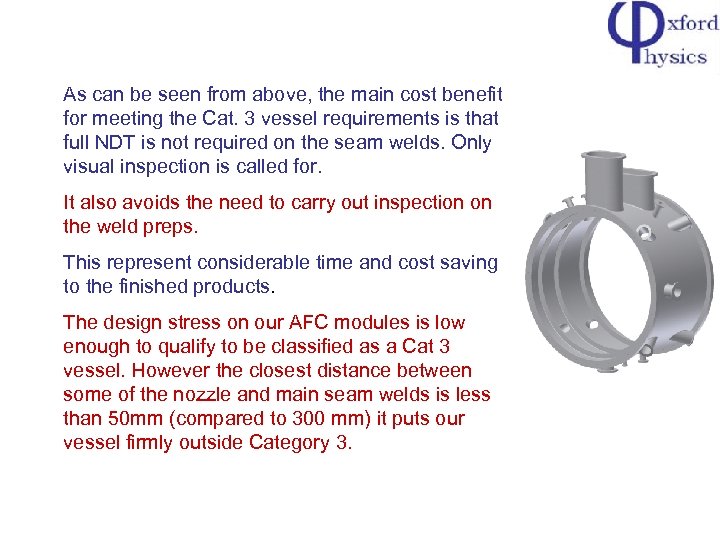
As can be seen from above, the main cost benefit for meeting the Cat. 3 vessel requirements is that full NDT is not required on the seam welds. Only visual inspection is called for. It also avoids the need to carry out inspection on the weld preps. This represent considerable time and cost saving to the finished products. The design stress on our AFC modules is low enough to qualify to be classified as a Cat 3 vessel. However the closest distance between some of the nozzle and main seam welds is less than 50 mm (compared to 300 mm) it puts our vessel firmly outside Category 3.
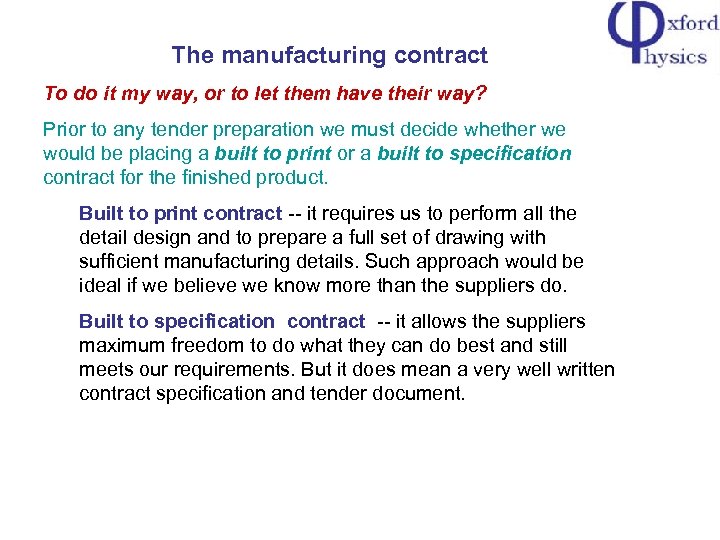
The manufacturing contract To do it my way, or to let them have their way? Prior to any tender preparation we must decide whether we would be placing a built to print or a built to specification contract for the finished product. Built to print contract -- it requires us to perform all the detail design and to prepare a full set of drawing with sufficient manufacturing details. Such approach would be ideal if we believe we know more than the suppliers do. Built to specification contract -- it allows the suppliers maximum freedom to do what they can do best and still meets our requirements. But it does mean a very well written contract specification and tender document.
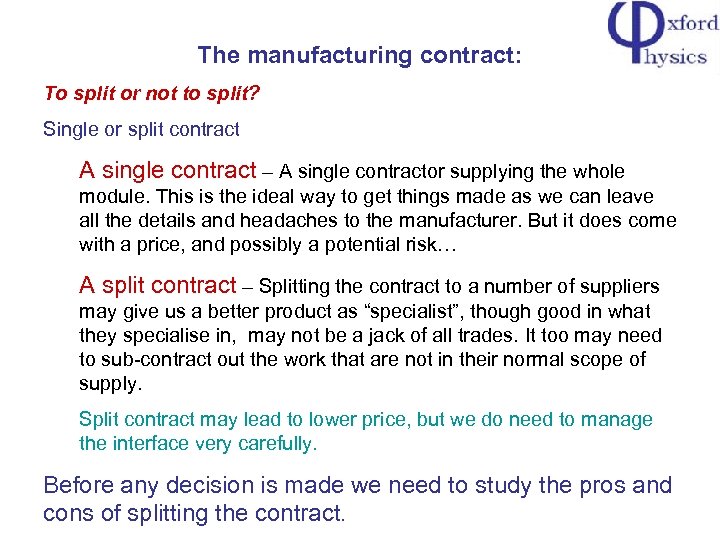
The manufacturing contract: To split or not to split? Single or split contract A single contract – A single contractor supplying the whole module. This is the ideal way to get things made as we can leave all the details and headaches to the manufacturer. But it does come with a price, and possibly a potential risk… A split contract – Splitting the contract to a number of suppliers may give us a better product as “specialist”, though good in what they specialise in, may not be a jack of all trades. It too may need to sub-contract out the work that are not in their normal scope of supply. Split contract may lead to lower price, but we do need to manage the interface very carefully. Before any decision is made we need to study the pros and cons of splitting the contract.
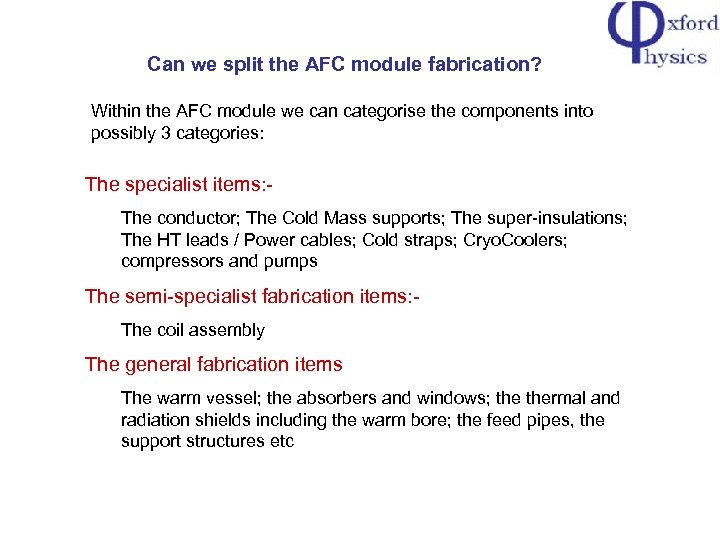
Can we split the AFC module fabrication? Within the AFC module we can categorise the components into possibly 3 categories: The specialist items: The conductor; The Cold Mass supports; The super-insulations; The HT leads / Power cables; Cold straps; Cryo. Coolers; compressors and pumps The semi-specialist fabrication items: The coil assembly The general fabrication items The warm vessel; the absorbers and windows; thermal and radiation shields including the warm bore; the feed pipes, the support structures etc
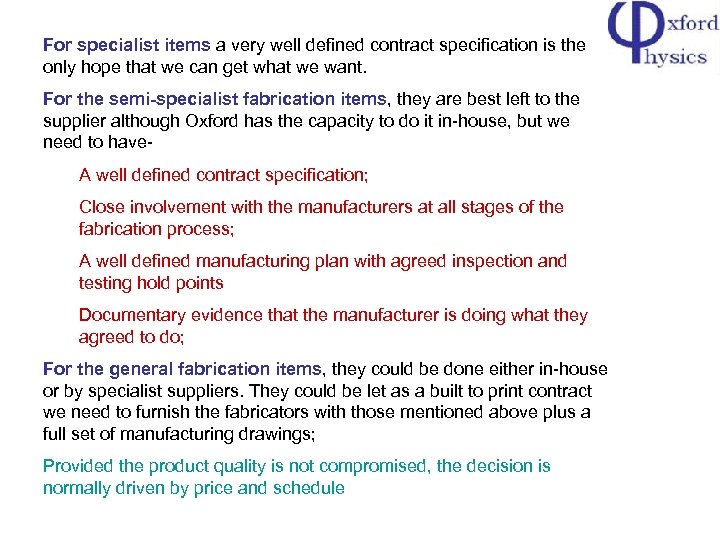
For specialist items a very well defined contract specification is the only hope that we can get what we want. For the semi-specialist fabrication items, they are best left to the supplier although Oxford has the capacity to do it in-house, but we need to have. A well defined contract specification; Close involvement with the manufacturers at all stages of the fabrication process; A well defined manufacturing plan with agreed inspection and testing hold points Documentary evidence that the manufacturer is doing what they agreed to do; For the general fabrication items, they could be done either in-house or by specialist suppliers. They could be let as a built to print contract we need to furnish the fabricators with those mentioned above plus a full set of manufacturing drawings; Provided the product quality is not compromised, the decision is normally driven by price and schedule
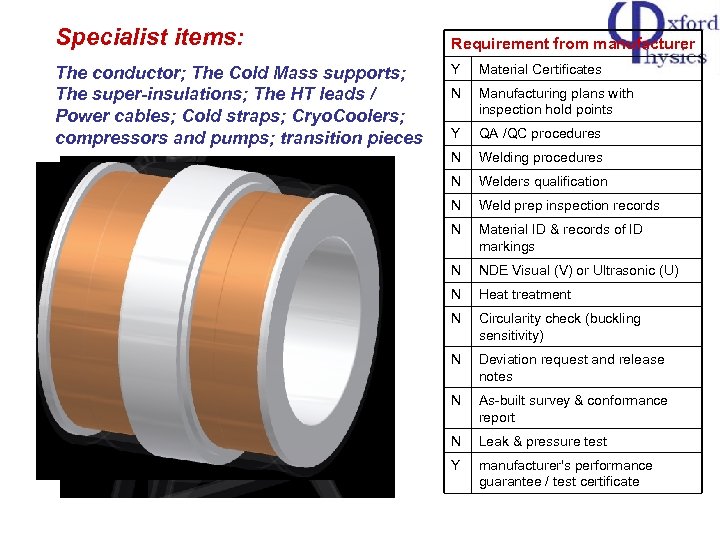
Specialist items: The conductor; The Cold Mass supports; The super-insulations; The HT leads / Power cables; Cold straps; Cryo. Coolers; compressors and pumps; transition pieces Requirement from manufacturer Y Material Certificates N Manufacturing plans with inspection hold points Y QA /QC procedures N Welding procedures N Welders qualification N Weld prep inspection records N Material ID & records of ID markings N NDE Visual (V) or Ultrasonic (U) N Heat treatment N Circularity check (buckling sensitivity) N Deviation request and release notes N As-built survey & conformance report N Leak & pressure test Y manufacturer's performance guarantee / test certificate
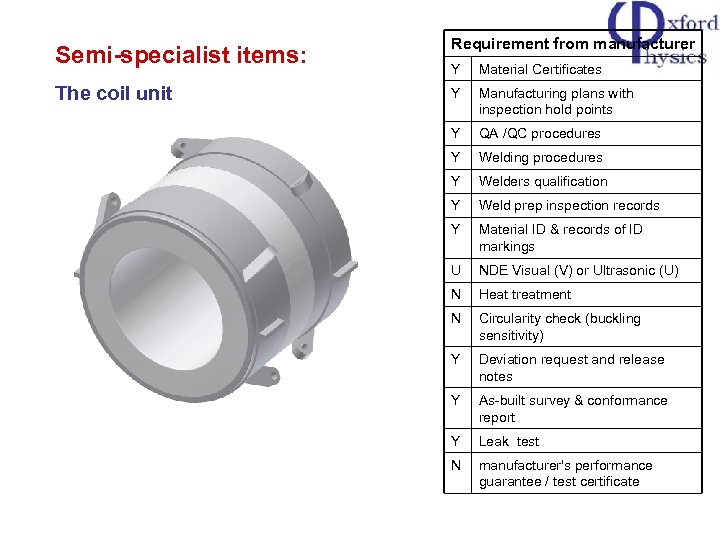
Semi-specialist items: Requirement from manufacturer Y Material Certificates The coil unit Y Manufacturing plans with inspection hold points Y QA /QC procedures Y Welding procedures Y Welders qualification Y Weld prep inspection records Y Material ID & records of ID markings U NDE Visual (V) or Ultrasonic (U) N Heat treatment N Circularity check (buckling sensitivity) Y Deviation request and release notes Y As-built survey & conformance report Y Leak test N manufacturer's performance guarantee / test certificate
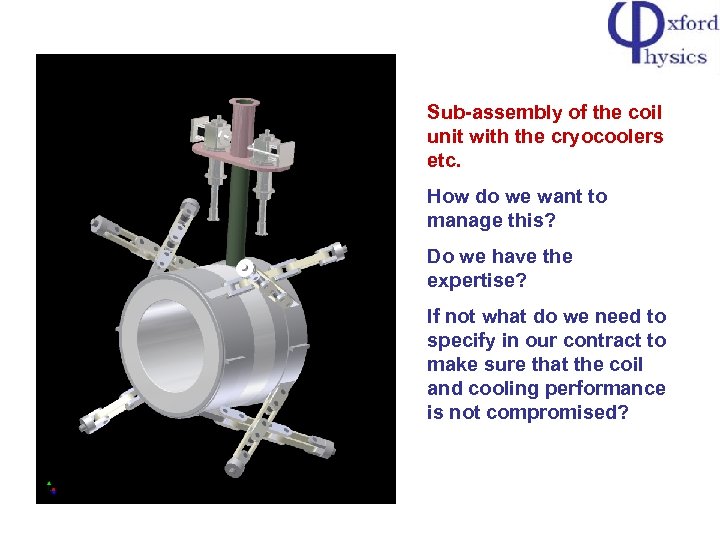
Sub-assembly of the coil unit with the cryocoolers etc. How do we want to manage this? Do we have the expertise? If not what do we need to specify in our contract to make sure that the coil and cooling performance is not compromised?
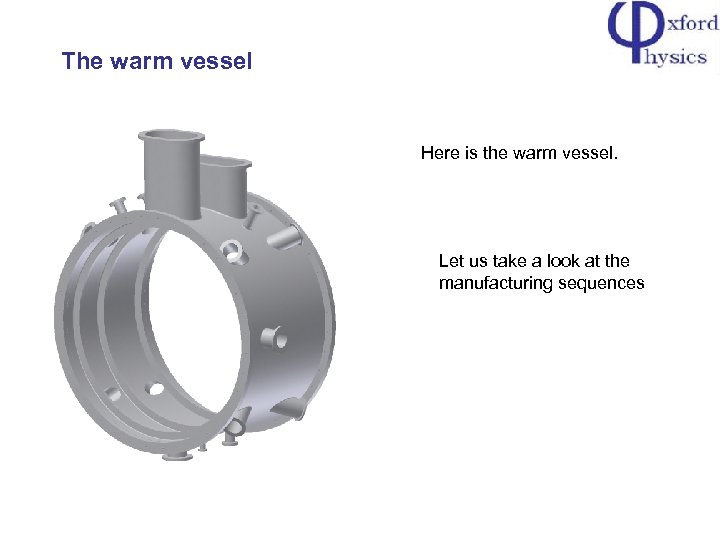
The warm vessel Here is the warm vessel. Let us take a look at the manufacturing sequences
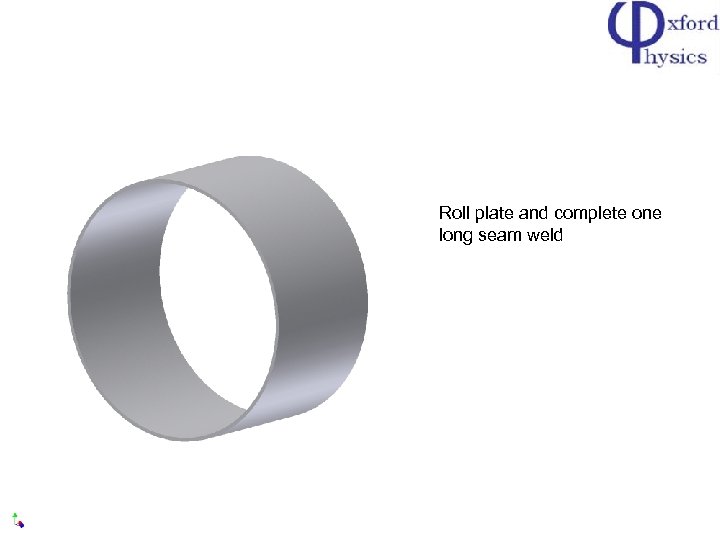
Roll plate and complete one long seam weld
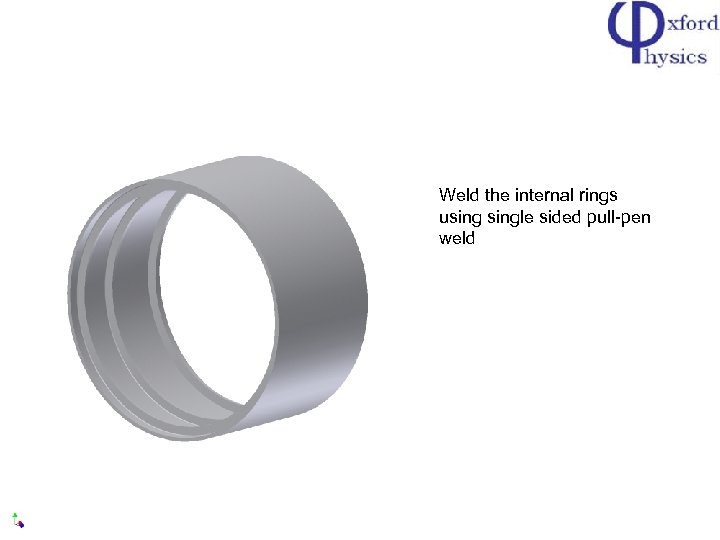
Weld the internal rings usingle sided pull-pen weld
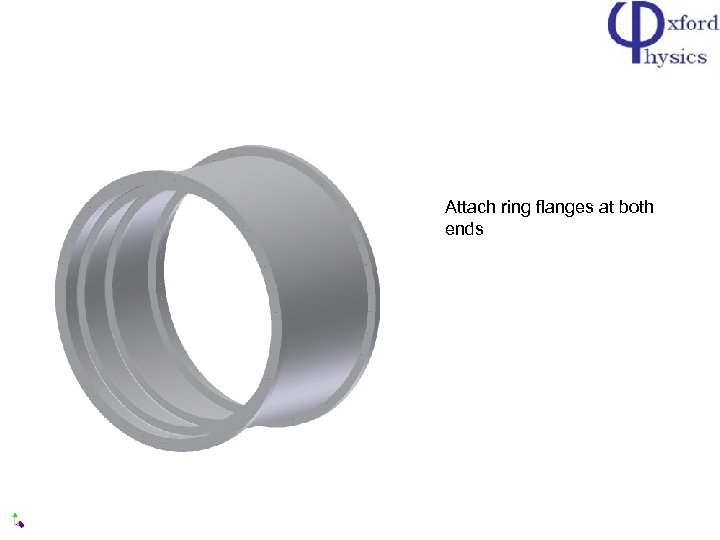
Attach ring flanges at both ends
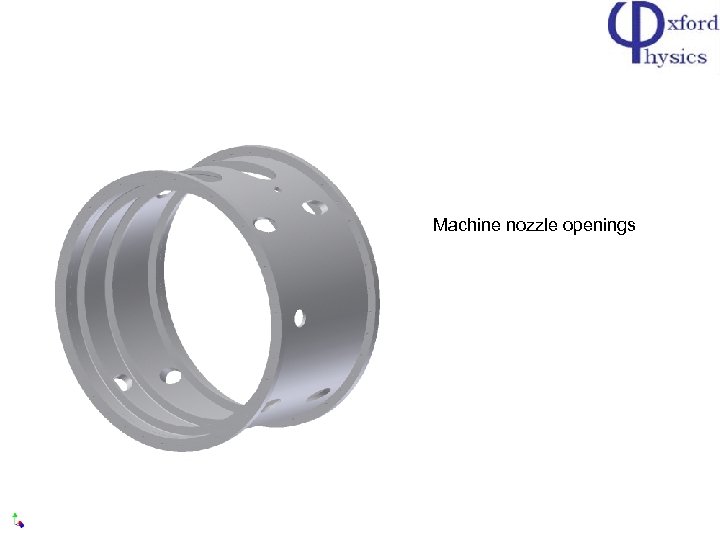
Machine nozzle openings
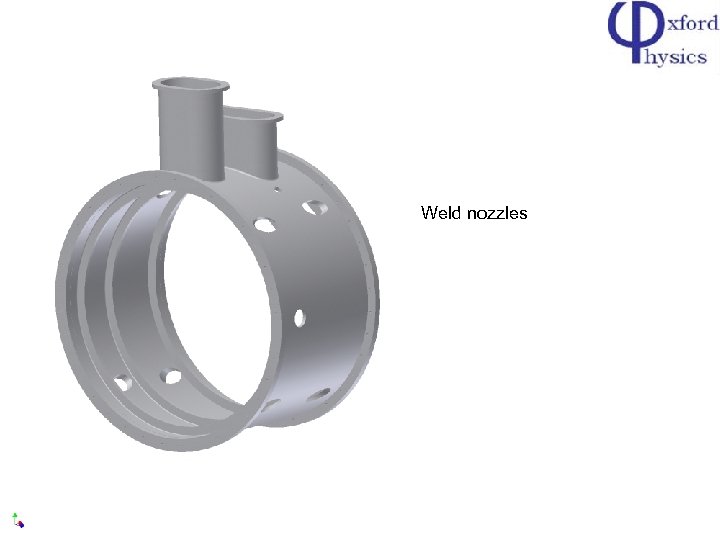
Weld nozzles
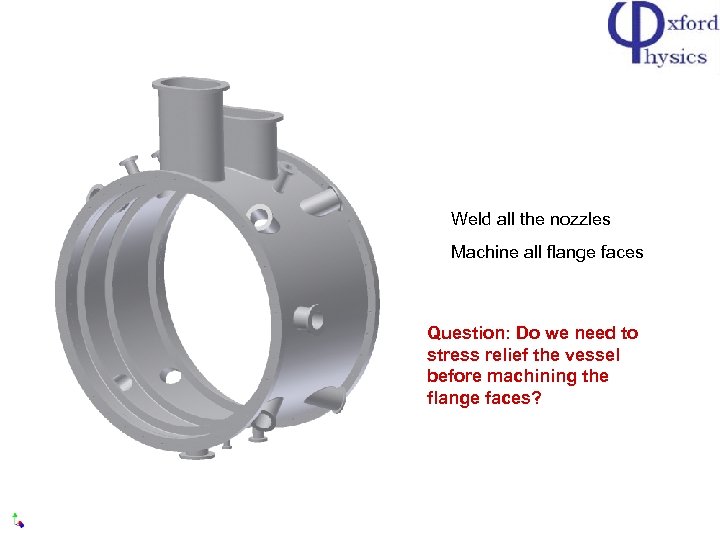
Weld all the nozzles Machine all flange faces Question: Do we need to stress relief the vessel before machining the flange faces?
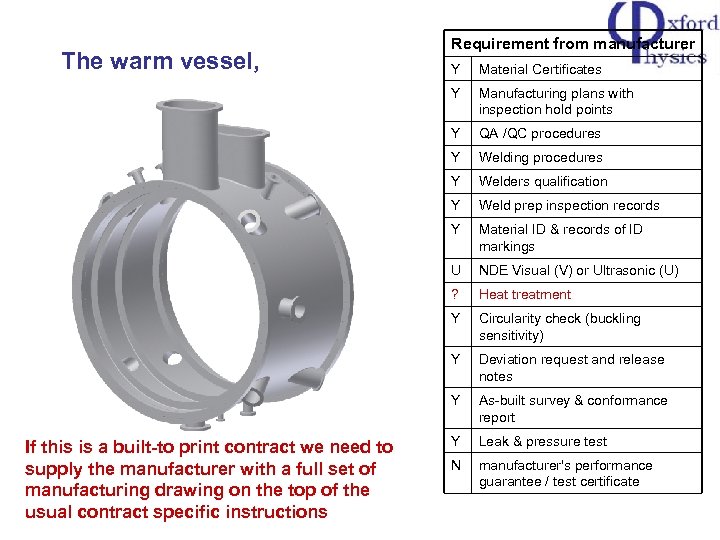
The warm vessel, Requirement from manufacturer Material Certificates Y Manufacturing plans with inspection hold points Y QA /QC procedures Y Welding procedures Y Welders qualification Y Weld prep inspection records Y Material ID & records of ID markings U NDE Visual (V) or Ultrasonic (U) ? Heat treatment Y Circularity check (buckling sensitivity) Y Deviation request and release notes Y If this is a built-to print contract we need to supply the manufacturer with a full set of manufacturing drawing on the top of the usual contract specific instructions Y As-built survey & conformance report Y Leak & pressure test N manufacturer's performance guarantee / test certificate
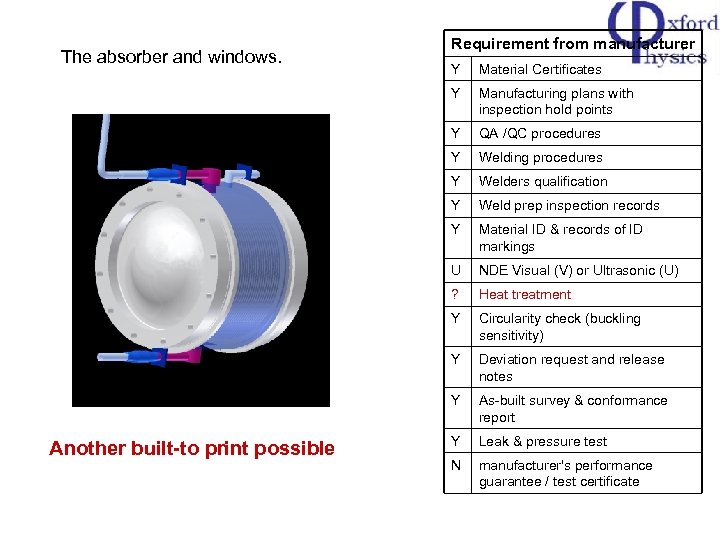
The absorber and windows. Requirement from manufacturer Material Certificates Y Manufacturing plans with inspection hold points Y QA /QC procedures Y Welding procedures Y Welders qualification Y Weld prep inspection records Y Material ID & records of ID markings U NDE Visual (V) or Ultrasonic (U) ? Heat treatment Y Circularity check (buckling sensitivity) Y Deviation request and release notes Y Another built-to print possible Y As-built survey & conformance report Y Leak & pressure test N manufacturer's performance guarantee / test certificate
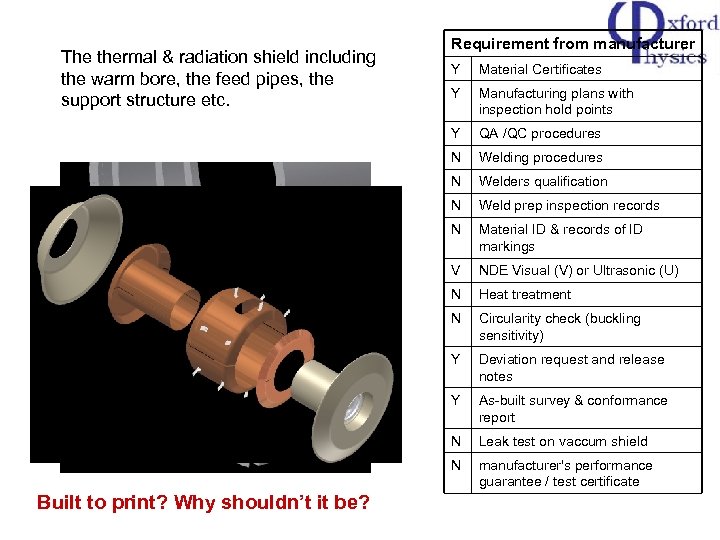
The thermal & radiation shield including the warm bore, the feed pipes, the support structure etc. Requirement from manufacturer Material Certificates Y Manufacturing plans with inspection hold points Y QA /QC procedures N Welding procedures N Welders qualification N Weld prep inspection records N Material ID & records of ID markings V NDE Visual (V) or Ultrasonic (U) N Heat treatment N Circularity check (buckling sensitivity) Y Deviation request and release notes Y As-built survey & conformance report N Leak test on vaccum shield N Built to print? Why shouldn’t it be? Y manufacturer's performance guarantee / test certificate
In summary…. Before we prepare the tender document we need to make some hard decisions on how we want to manage this contract… Contract split…. . Built to print…. It may be that the tender should be prepared in such a way that it allows the supplier to choose what suits them best with a price that is acceptable to us. Although the AFC design is not quite finalised, it is our intention to work closely with LBL at all stages of the tracker spectrometer contract, from Tender preparation to tender assessment and technical clarifications so that we can benefit from the experiences.
Скачать презентацию MICE Collaboration meeting RAL 21 24 Oct
91714142fdbb30d43071a735f0989dd2.ppt