


 Скачать презентацию MICA R D Project Human-Machine Interaction Interazione Uomo-Machina
05a72a3a814375f34ea1be1f04b3445f.ppt
- Количество слайдов: 27
 MICA R&D Project Human-Machine Interaction / Interazione Uomo-Machina/ ? by Adam Maria Gadomski E-mail: gadomski_a@casaccia. enea. it URL: http: //erg 4146. casaccia. enea. it/ ENEA, C. R. Casaccia 18 November 1999 On the rights of the web white paper (Intell. Prop. ) - © ENEA, A. M. Gadomski, 1999.
 MICA Project Human-Machine Interaction from the Systemic and Cognitive Perspective Contribution to the MICA 2. 8. 3. 3 Task D: Realization of an Integrated Modeling Environment for the Hardware/Software/Human Components of Plant Control Room Systems : Study on a Meta-Modeling Frameworks. http: //erg 4146. casaccia. enea. it/ Presentation outline £ £ Problem Recognition Problem Identification Possible Solutions Conclusions "Make everything as simple as possible, but not simpler. ” [Albert Einstein] © ENEA, A. M. Gadomski, 1999. E-mail: gadomski_a@casaccia. enea. it
 Human-Machine Interaction MICA Project Preface This my activity have been focused on a preliminary study of the human mental errors of industrial operators involved in the control and supervisory of high-risk complex technological systems. It deals with the identification of human mental errors and possibilities of their mitigation through an application of intelligent computer decision support systems. Methodology £ £ Problem Recognition Problem Identification Possible Solutions Conclusions Heuristic application of the TOGA (Top-down Object-based Goaloriented Approach) methodology to the problem identification. Application of the IPK conceptual framework to the cognitive operator modelling [http: //erg 4146. casaccia. enea. it/]. Results An indication and the preliminary analysis of mental functins and tasks which could be supported or executed by IDSSs (Intelligent Computer Decision Support Systems). Dec. 97, http: //erg 4146. casaccia. enea. it/Mika-saf. html © ENEA, A. M. Gadomski, 1999. E-mail: gadomski_a@casaccia. enea. it
 Human-Machine Interaction MICA Project Problem Recognition Human-Machine Interaction is a continuously growing domain of interest of researchers and practictioners. It is a consequence of ever more and more complex technologies and systems controlled and managed by humans. £ £ Problem Recognition Problem Identification The problem is dedected from the perspectives of : Possible Solutions - efficacy and quality of the production Conclusions - economy and sostenibility , and especially, - safety and reliability of human component in human-machine aggregates. © ENEA, A. M. Gadomski, 1999. E-mail: gadomski_a@casaccia. enea. it
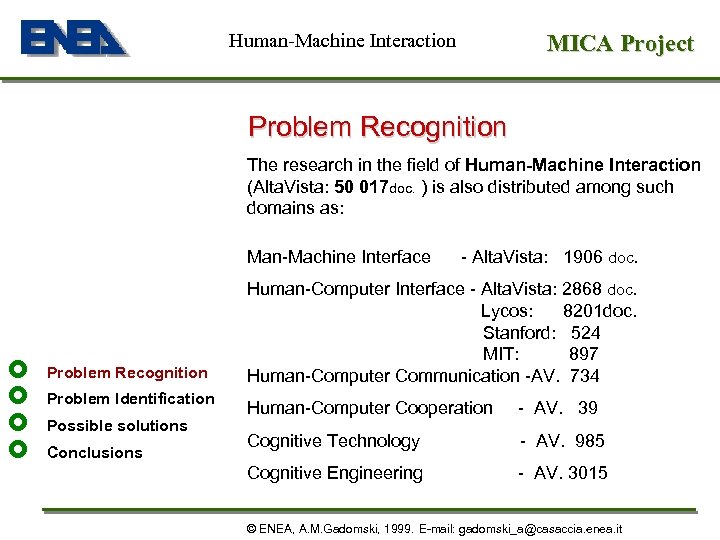 Human-Machine Interaction MICA Project Problem Recognition The research in the field of Human-Machine Interaction (Alta. Vista: 50 017 doc. ) is also distributed among such domains as: Man-Machine Interface £ £ Problem Recognition Problem Identification Possible solutions Conclusions - Alta. Vista: 1906 doc. Human-Computer Interface - Alta. Vista: 2868 doc. Lycos: 8201 doc. Stanford: 524 MIT: 897 Human-Computer Communication -AV. 734 Human-Computer Cooperation - AV. 39 Cognitive Technology - AV. 985 Cognitive Engineering - AV. 3015 © ENEA, A. M. Gadomski, 1999. E-mail: gadomski_a@casaccia. enea. it
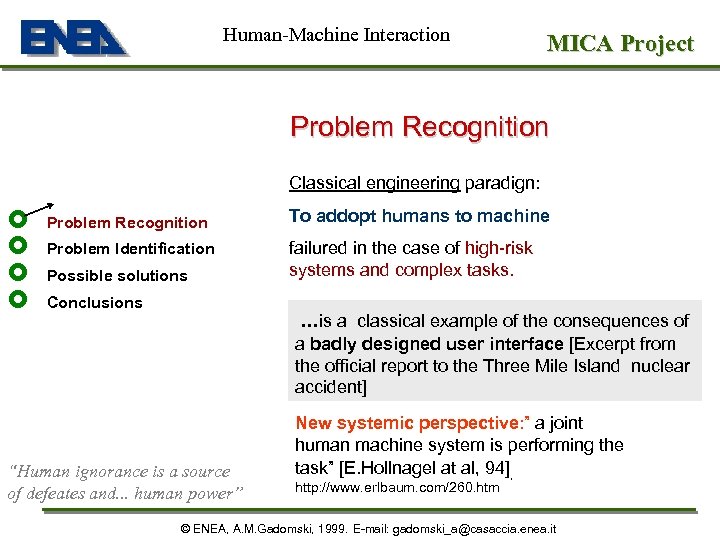 Human-Machine Interaction MICA Project Problem Recognition Classical engineering paradign: £ £ Problem Recognition To addopt humans to machine Problem Identification failured in the case of high-risk systems and complex tasks. Possible solutions Conclusions . . . is a classical example of the consequences of a badly designed user interface [Excerpt from the official report to the Three Mile Island nuclear accident] “Human ignorance is a source of defeates and. . . human power” New systemic perspective: ” a joint human machine system is performing the task” [E. Hollnagel at al, 94], http: //www. erlbaum. com/260. htm © ENEA, A. M. Gadomski, 1999. E-mail: gadomski_a@casaccia. enea. it
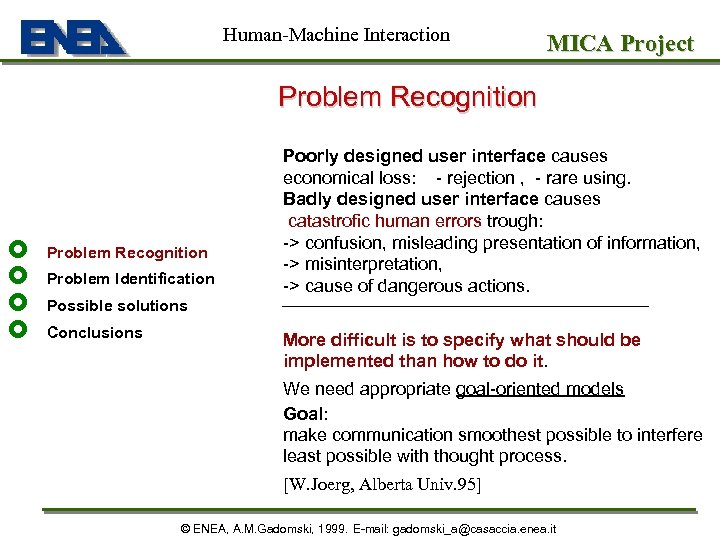 Human-Machine Interaction MICA Project Problem Recognition £ £ Problem Recognition Problem Identification Poorly designed user interface causes economical loss: - rejection , - rare using. Badly designed user interface causes catastrofic human errors trough: -> confusion, misleading presentation of information, -> misinterpretation, -> cause of dangerous actions. Possible solutions Conclusions More difficult is to specify what should be implemented than how to do it. We need appropriate goal-oriented models Goal: make communication smoothest possible to interfere least possible with thought process. [W. Joerg, Alberta Univ. 95] © ENEA, A. M. Gadomski, 1999. E-mail: gadomski_a@casaccia. enea. it
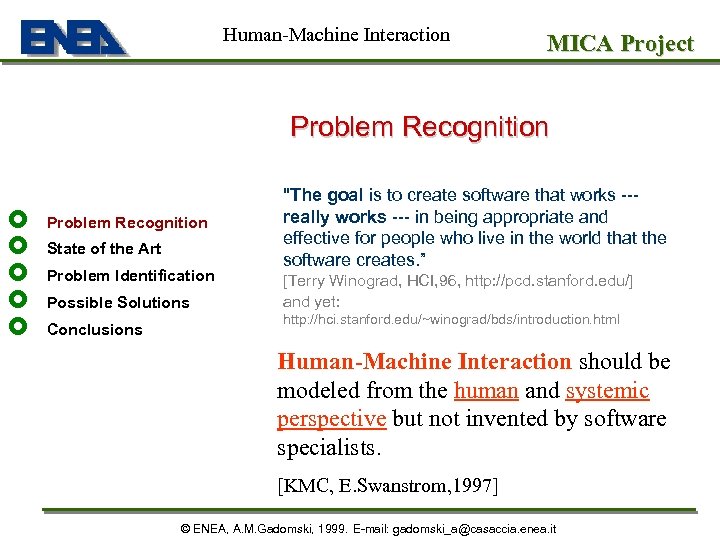 Human-Machine Interaction MICA Project Problem Recognition £ £ £ Problem Recognition State of the Art Problem Identification Possible Solutions Conclusions "The goal is to create software that works --really works --- in being appropriate and effective for people who live in the world that the software creates. ” [Terry Winograd, HCI, 96, http: //pcd. stanford. edu/] and yet: http: //hci. stanford. edu/~winograd/bds/introduction. html Human-Machine Interaction should be modeled from the human and systemic perspective but not invented by software specialists. [KMC, E. Swanstrom, 1997] © ENEA, A. M. Gadomski, 1999. E-mail: gadomski_a@casaccia. enea. it
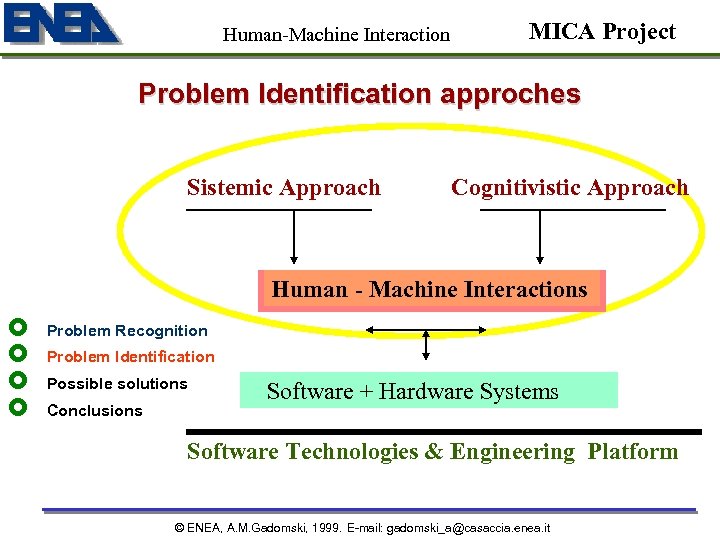 Human-Machine Interaction MICA Project Problem Identification approches Sistemic Approach Cognitivistic Approach Human - Machine Interactions £ £ Problem Recognition Problem Identification Possible solutions Conclusions Software + Hardware Systems Software Technologies & Engineering Platform © ENEA, A. M. Gadomski, 1999. E-mail: gadomski_a@casaccia. enea. it
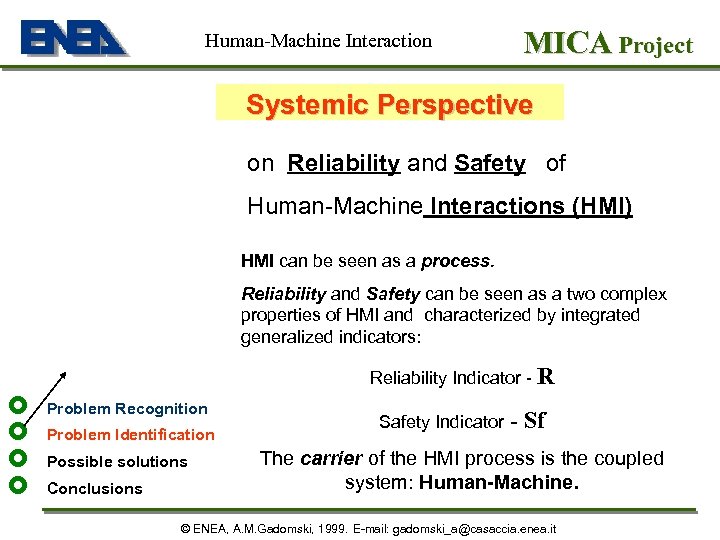 Human-Machine Interaction MICA Project Systemic Perspective on Reliability and Safety of Human-Machine Interactions (HMI) HMI can be seen as a process. Reliability and Safety can be seen as a two complex properties of HMI and characterized by integrated generalized indicators: Reliability Indicator - R £ £ Problem Recognition Problem Identification Possible solutions Conclusions Safety Indicator - Sf The carrier of the HMI process is the coupled system: Human-Machine. © ENEA, A. M. Gadomski, 1999. E-mail: gadomski_a@casaccia. enea. it
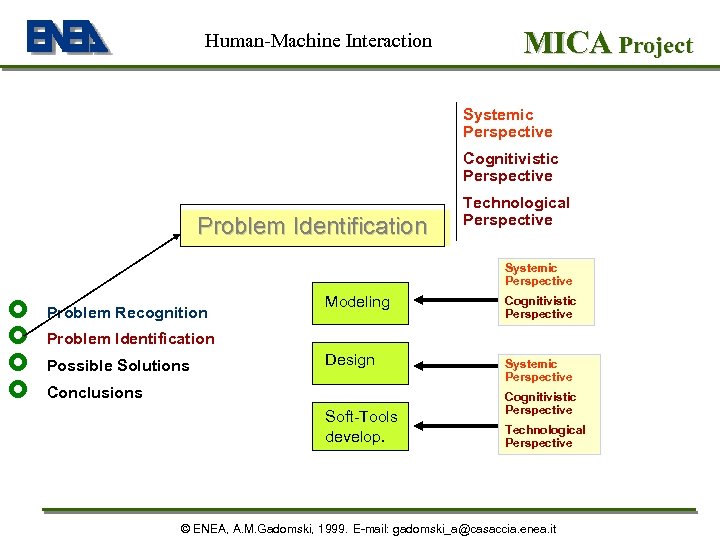 Human-Machine Interaction MICA Project Systemic Perspective Cognitivistic Perspective Problem Identification Technological Perspective Systemic Perspective £ £ Problem Recognition Modeling Cognitivistic Perspective Problem Identification Possible Solutions Design Conclusions Soft-Tools develop. Systemic Perspective Cognitivistic Perspective Technological Perspective © ENEA, A. M. Gadomski, 1999. E-mail: gadomski_a@casaccia. enea. it
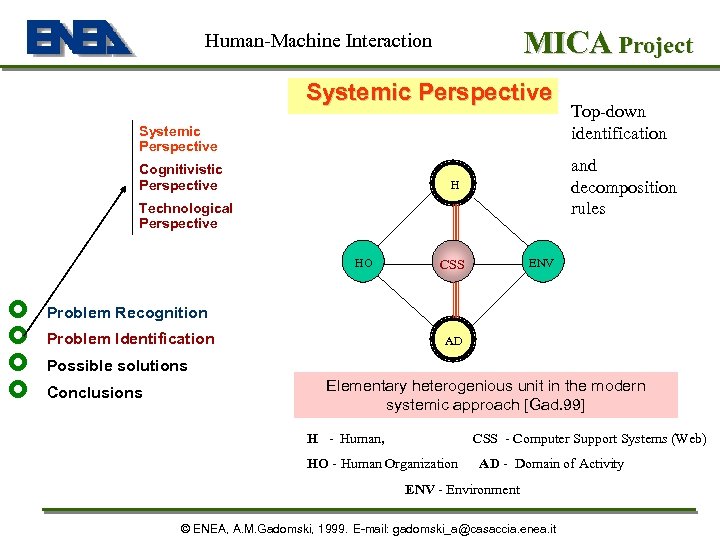 MICA Project Human-Machine Interaction Systemic Perspective Cognitivistic Perspective and decomposition rules H Technological Perspective HO £ £ Top-down identification ENV CSS Problem Recognition Problem Identification AD Possible solutions Conclusions Elementary heterogenious unit in the modern systemic approach [Gad. 99] H - Human, CSS - Computer Support Systems (Web) HO - Human Organization AD - Domain of Activity ENV - Environment © ENEA, A. M. Gadomski, 1999. E-mail: gadomski_a@casaccia. enea. it
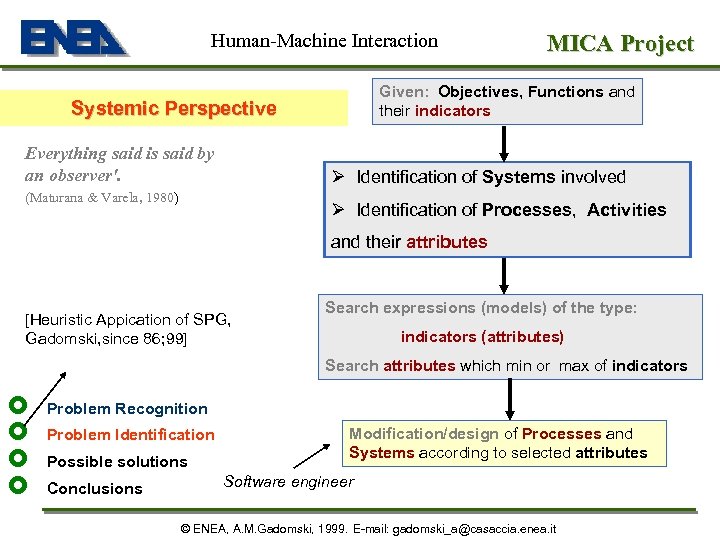 Human-Machine Interaction Given: Objectives, Functions and their indicators Systemic Perspective Everything said is said by an observer'. MICA Project Ø Identification of Systems involved (Maturana & Varela, 1980) Ø Identification of Processes, Activities and their attributes [Heuristic Appication of SPG, Gadomski, since 86; 99] Search expressions (models) of the type: indicators (attributes) Search attributes which min or max of indicators £ £ Problem Recognition Problem Identification Possible solutions Conclusions Modification/design of Processes and Systems according to selected attributes Software engineer © ENEA, A. M. Gadomski, 1999. E-mail: gadomski_a@casaccia. enea. it
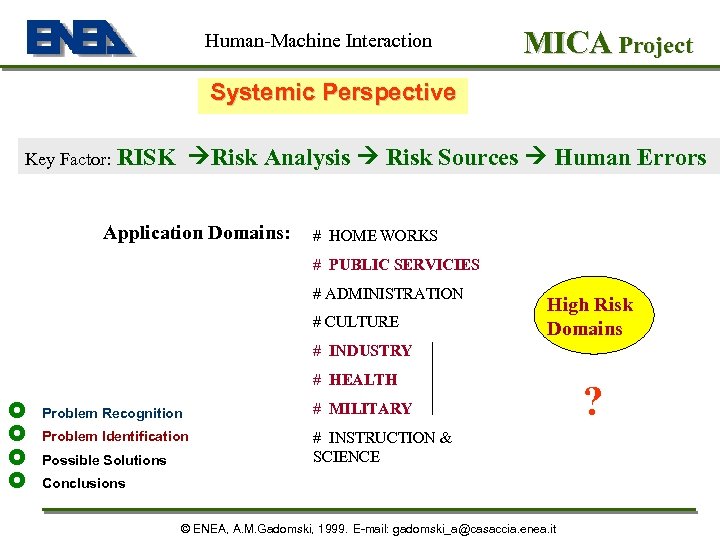 Human-Machine Interaction MICA Project Systemic Perspective Key Factor: RISK Risk Analysis Risk Sources Human Errors Application Domains: # HOME WORKS # PUBLIC SERVICIES # ADMINISTRATION # CULTURE High Risk Domains # INDUSTRY # HEALTH £ £ Problem Recognition # MILITARY Problem Identification # INSTRUCTION & SCIENCE Possible Solutions Conclusions © ENEA, A. M. Gadomski, 1999. E-mail: gadomski_a@casaccia. enea. it ?
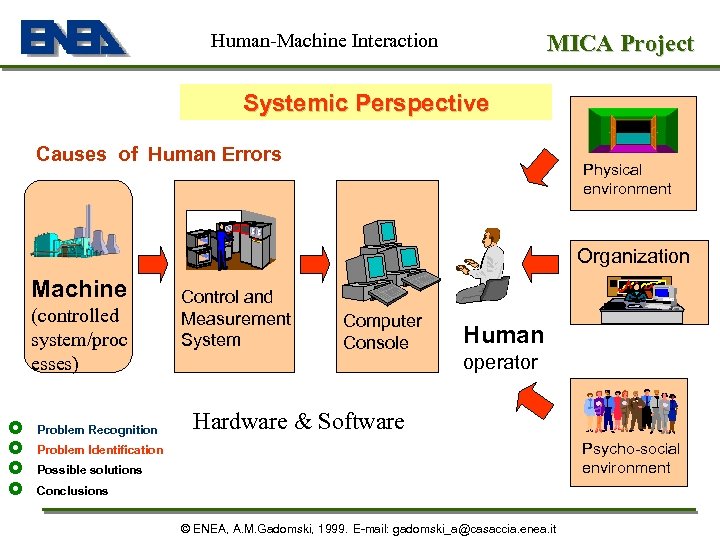 Human-Machine Interaction MICA Project Systemic Perspective Causes of Human Errors Physical environment Organization Machine (controlled system/proc esses) £ £ Problem Recognition Control and Measurement System MIND Computer Console Human operator Hardware & Software Psycho-social environment Problem Identification Possible solutions Conclusions © ENEA, A. M. Gadomski, 1999. E-mail: gadomski_a@casaccia. enea. it
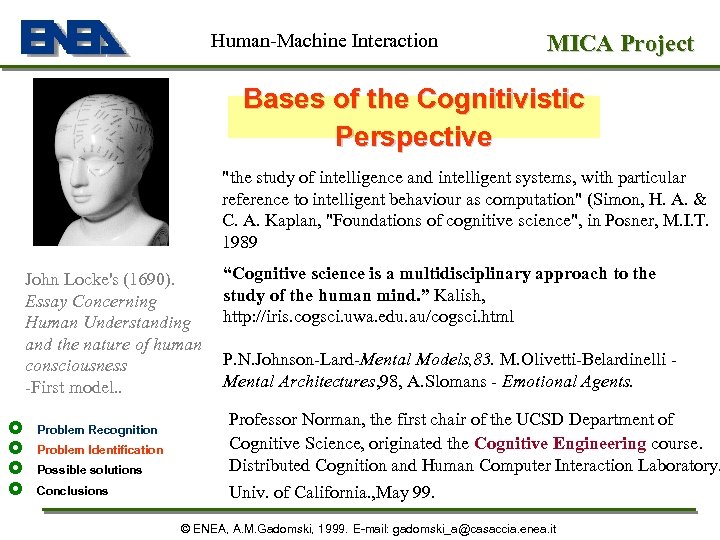 Human-Machine Interaction MICA Project Bases of the Cognitivistic Perspective "the study of intelligence and intelligent systems, with particular reference to intelligent behaviour as computation" (Simon, H. A. & C. A. Kaplan, "Foundations of cognitive science", in Posner, M. I. T. 1989 John Locke's (1690). Essay Concerning Human Understanding and the nature of human consciousness -First model. . £ £ “Cognitive science is a multidisciplinary approach to the study of the human mind. ” Kalish, http: //iris. cogsci. uwa. edu. au/cogsci. html P. N. Johnson-Lard-Mental Models, 83. M. Olivetti-Belardinelli Mental Architectures, 98, A. Slomans - Emotional Agents. Possible solutions Professor Norman, the first chair of the UCSD Department of Cognitive Science, originated the Cognitive Engineering course. Distributed Cognition and Human Computer Interaction Laboratory. Conclusions Univ. of California. , May 99. Problem Recognition Problem Identification © ENEA, A. M. Gadomski, 1999. E-mail: gadomski_a@casaccia. enea. it
 Human-Machine Interaction MICA Project Cognitive Engineering Perspective £ £ Problem Recognition the principles of cognitive engineering refers to: user-centered design ( its practices have wide applicability) and human-computer interaction in particular. It is base on cognitive models. Human-computer interaction (HCI) is the intersection between the social and cognitive sciences, on the one hand, and computer science and technology, on the other. HCI researchers analyze and design interaction technologies (e. g. , displays and pointing devices, gestures and sketching). They study and improve the processes of technology development (e. g. , usability evaluation, software toolkits, cognitive ethnography). Over the past two decades, HCI has progressively integrated scientific concerns with the engineering goal of improving the usability of computers. established a body of technical knowledge and methodology, and contributed broadly to the development of new computer technologies and applications. Problem Identification http: //hci. ucsd. edu/132/nsyllabus. html Possible solutions See also: MIT Encyclopedia of Cognitive Science. Conclusions © ENEA, A. M. Gadomski, 1999. E-mail: gadomski_a@casaccia. enea. it
 Human-Machine Interaction MICA Project Cognitive Technology Perspective Douglas Hofstadter is College Professor of cognitive science and computer science, director of the Center for Research on Concepts and Cognition, Ph. D. in physics, University of Oregon, 1975; Pulitzer Prize. The First International Conference on Cognitive Technology (Hong Kong, 1995) stressed the need for a radically new way of thinking about the impact computer technology has on humans, especially on the human mind. Our main aim at that time was a consideration of these effects with respect to rendering the interface between people and computers more humane. Cognitive technologies in Europe: £ £ Problem Recognition Problem Identification Possible solutions Conclusions - Rasmunssen, Andeson - Riso National Lab. - Hollnagel - Halden Project (from about 18 years) -Gadomski (since 86), Nanni (87), Balducelli (93), Di. Costanzo - ENEA. © ENEA, A. M. Gadomski, 1999. E-mail: gadomski_a@casaccia. enea. it
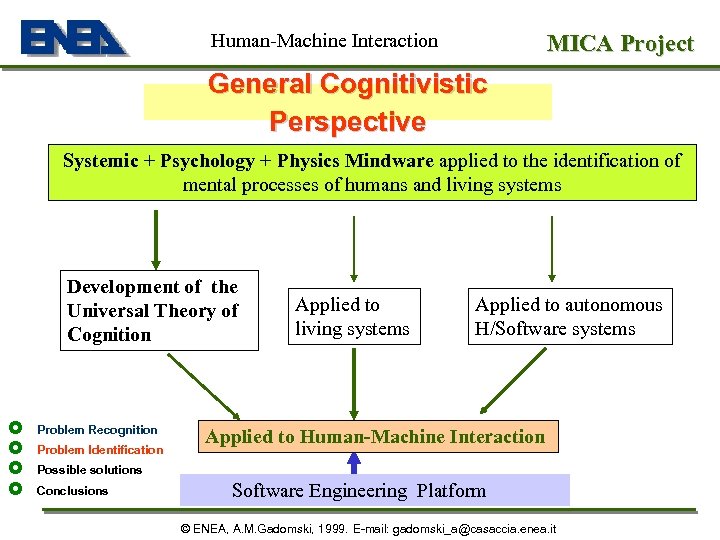 Human-Machine Interaction MICA Project General Cognitivistic Perspective Systemic + Psychology + Physics Mindware applied to the identification of mental processes of humans and living systems Development of the Universal Theory of Cognition £ £ Problem Recognition Problem Identification Applied to living systems Applied to autonomous H/Software systems Applied to Human-Machine Interaction Possible solutions Conclusions Software Engineering Platform © ENEA, A. M. Gadomski, 1999. E-mail: gadomski_a@casaccia. enea. it
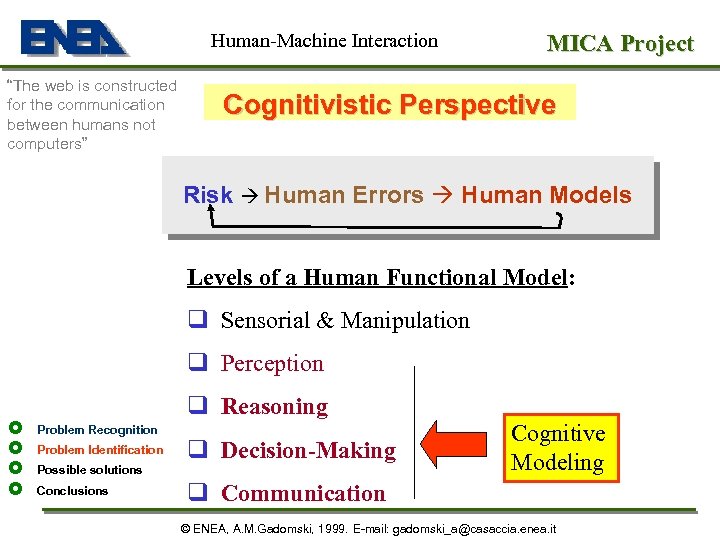 Human-Machine Interaction “The web is constructed for the communication between humans not computers” MICA Project Cognitivistic Perspective Risk Human Errors Human Models Levels of a Human Functional Model: q Sensorial & Manipulation q Perception £ £ q Reasoning Problem Recognition Problem Identification q Decision-Making Possible solutions Conclusions Cognitive Modeling q Communication © ENEA, A. M. Gadomski, 1999. E-mail: gadomski_a@casaccia. enea. it
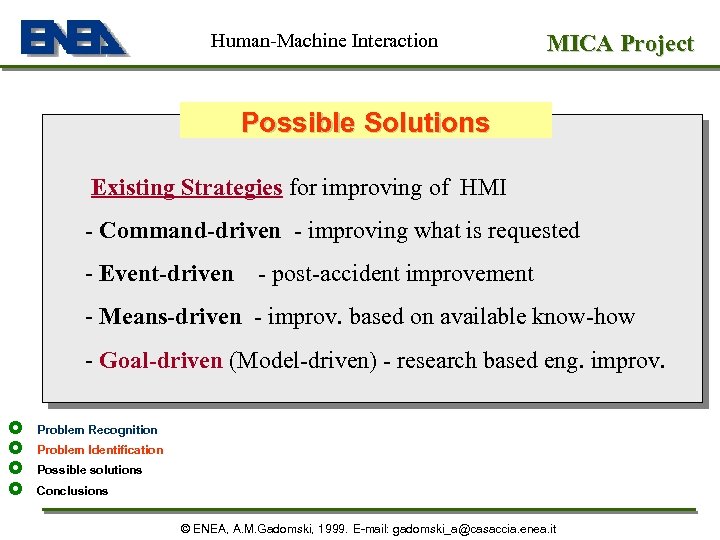 Human-Machine Interaction MICA Project Possible Solutions Existing Strategies for improving of HMI - Command-driven - improving what is requested - Event-driven - post-accident improvement - Means-driven - improv. based on available know-how - Goal-driven (Model-driven) - research based eng. improv. £ £ Problem Recognition Problem Identification Possible solutions Conclusions © ENEA, A. M. Gadomski, 1999. E-mail: gadomski_a@casaccia. enea. it
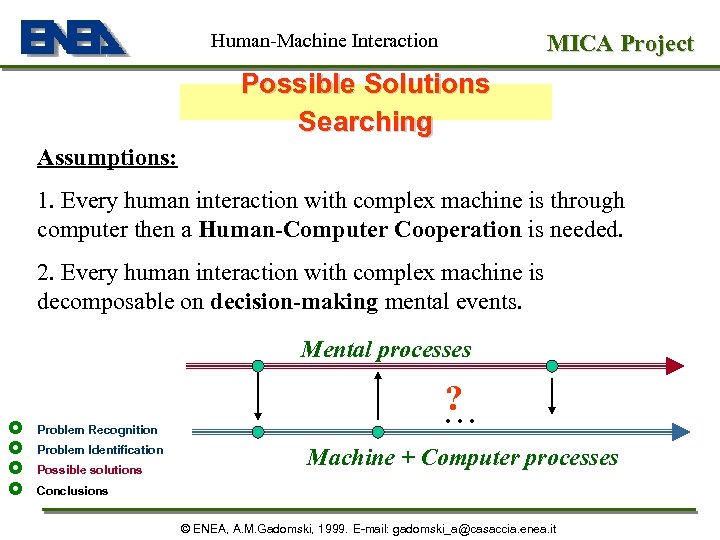 Human-Machine Interaction MICA Project Possible Solutions Searching Assumptions: 1. Every human interaction with complex machine is through computer then a Human-Computer Cooperation is needed. 2. Every human interaction with complex machine is decomposable on decision-making mental events. Mental processes £ £ Problem Recognition Problem Identification Possible solutions ? . . . Machine + Computer processes Conclusions © ENEA, A. M. Gadomski, 1999. E-mail: gadomski_a@casaccia. enea. it
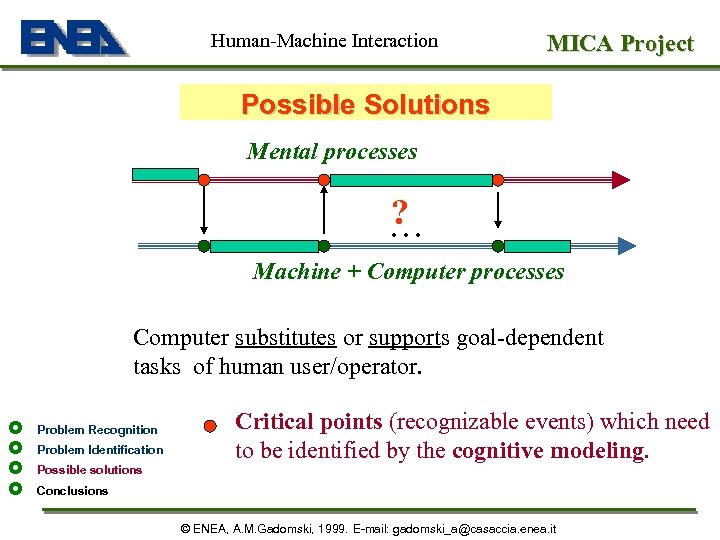 Human-Machine Interaction MICA Project Possible Solutions Mental processes ? . . . Machine + Computer processes Computer substitutes or supports goal-dependent tasks of human user/operator. £ £ Problem Recognition Problem Identification Critical points (recognizable events) which need to be identified by the cognitive modeling. Possible solutions Conclusions © ENEA, A. M. Gadomski, 1999. E-mail: gadomski_a@casaccia. enea. it
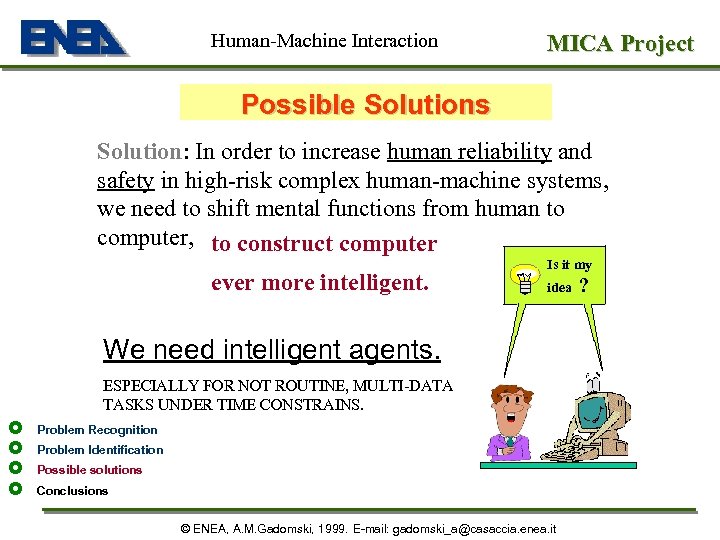 Human-Machine Interaction MICA Project Possible Solutions Solution: In order to increase human reliability and safety in high-risk complex human-machine systems, we need to shift mental functions from human to computer, to construct computer ever more intelligent. Is it my idea We need intelligent agents. ESPECIALLY FOR NOT ROUTINE, MULTI-DATA TASKS UNDER TIME CONSTRAINS. £ £ Problem Recognition Problem Identification Possible solutions Conclusions © ENEA, A. M. Gadomski, 1999. E-mail: gadomski_a@casaccia. enea. it ?
 Human-Machine Interaction MICA Project Possible Solutions: an Abstract Intelligent Agent, AIA Two roles of AIA: 1. user model -- cognitive intelligent agent 2. kernel of a computer intelligent assisstant. Intelligent - an agent with capability to the modification of own preferences, capability of learning and meta-reasoning. [TOGA, Gadomski]. £ £ Problem Recognition Problem Identification Possible solutions Emotional agent - Modeling of emotions, emotional behaviour [Web] Conclusions © ENEA, A. M. Gadomski, 1999. E-mail: gadomski_a@casaccia. enea. it
 Human-Machine Interaction Possible Solutions: Project Results MICA Project 1. Recognized utility of the TOGA meta-theory [Gadomski, 90, 99] and SPG conceptualization [Gadomski, 86, 99] to the goal-oriented knowledge ordering in meta-system engineering applied to the analysis of HMI attributes. 2. Recognized plausibility of the identification of human mental states by the Protocol Analysis [K. A. Ericsson, H. A. Simon] applied to the IPK cognitive architecture [A. M. Gadomski, 98, 99]. 3. Formal conceptual separation of knowledge, £ £ Problem Recognition preferences and information acquisition in Human. Machine Interactions [Gadomski at al. , 99]; has been applied to the IDA-MICA Project. Problem Identification Possible solutions Conclusions © ENEA, A. M. Gadomski, 1999. E-mail: gadomski_a@casaccia. enea. it
 Human-Machine Interaction MICA Project Conclusions The work has been supported by the Scientific Cooperaton (ortogonal no profits activity) with The Interuniversity Center for the Research on Cognitive Processing in Natural and Artificial Systems ( ECONA). Gadomski, Pestilli : INTELLIGENT DECISION SUPPORT SYSTEM: TOGA COGNITIVE AGENT, in frame of The ECONA’s Meeting on “ Research Activities on Cognitive Modeling, May , 99 [Web]. A. M. Gadomski, S. Ceccacci: Seminar ”Contesto TOGA per la Progettazione di un Agente Intelligente Astratto ed il suo Decision-Making” , Perugia, 99 [Web](Bora per Tesi di L. ) A. M. Gadomski: TOWARDS SYSTEM ENGINEERING & TECHNOLOGIES, SET, transparent-sheet, ENEA, 99[Web]. The obtained resualts are also the base for the proposal of a research project for the FET * Open (5 th Program EU) with Univ. of Brussel, Poland, Ansaldo, ECONA (under preparation). *FET - Future and Emerging Technologies © ENEA, A. M. Gadomski, 1999. E-mail: gadomski_a@casaccia. enea. it