 Скачать презентацию Mi DAS INDUCTION TRAINING FOR DRIVERS Standard Minibuses
a0db0b6e8d624f023a2989a9cf5f49a0.ppt
- Количество слайдов: 72



Mi. DAS INDUCTION TRAINING FOR DRIVERS Standard Minibuses 1 For use by Mi. DAS Trainers only September 2003 Copyright Hampshire County Council
OBJECTIVES OF Mi. DAS The objectives of Mi. DAS are that you will: n Be assessed to ensure that your driving skills are of an acceptable standard n Be given help where necessary to improve your driving skills n Be aware of the legal, practical and safety issues surrounding minibus driving n Be trained in the use of accessible minibuses where necessary n Receive a certificate which is accepted by other Mi. DAS members 2 For use by Mi. DAS Trainers only September 2003 Copyright Hampshire County Council
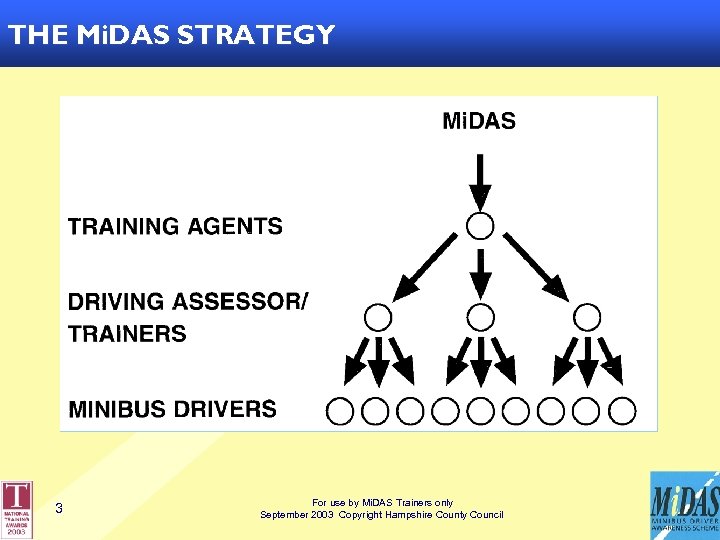
THE Mi. DAS STRATEGY 3 For use by Mi. DAS Trainers only September 2003 Copyright Hampshire County Council
HOW Mi. DAS WORKS FOR DRIVERS Key steps to becoming a Mi. DAS driver: n Pre-assessment procedures n An assessment of your driving ability n Option of some driving skills training n Training in the skills and information you need to drive a minibus n Theory assessment 4 For use by Mi. DAS Trainers only September 2003 Copyright Hampshire County Council
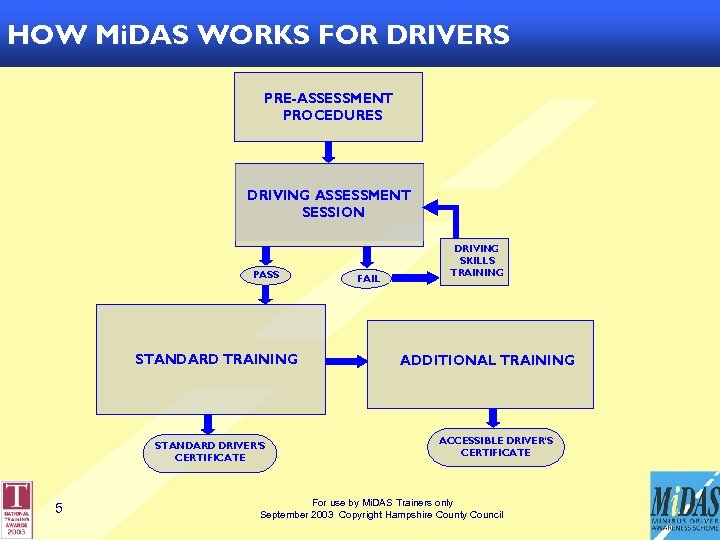
HOW Mi. DAS WORKS FOR DRIVERS PRE-ASSESSMENT PROCEDURES DRIVING ASSESSMENT SESSION PASS STANDARD TRAINING STANDARD DRIVER’S CERTIFICATE 5 FAIL DRIVING SKILLS TRAINING ADDITIONAL TRAINING ACCESSIBLE DRIVER’S CERTIFICATE For use by Mi. DAS Trainers only September 2003 Copyright Hampshire County Council
WHAT Mi. DAS OFFERS DRIVERS n You and your passengers know that your driving competence has been assessed to a common standard n You will have received up to date training in the skills and information needed to drive a minibus n You will be able to drive the minibuses of other Mi. DAS members without having your driving skills re-assessed 6 For use by Mi. DAS Trainers only September 2003 Copyright Hampshire County Council
Mi. DAS DRIVERS’ CERTIFICATES AND REFRESHER TRAINING n A certificate is issued after successfully completing a driver assessment, training and a theory assessment n There are two types of certificate: standard and accessible - the type you get depends on the training you receive n All certificates are valid for four years n After four years Refresher Training is required n This will involve a re-assessment of your driving ability and a theory assessment 7 For use by Mi. DAS Trainers only September 2003 Copyright Hampshire County Council
ENDORSEMENT OF Mi. DAS is endorsed by many organisations including: n Ro. SPA n National Union of Teachers n Help the Aged n Driving Standards Agency n Association of Transport Co-ordinating Officers n British Red Cross n The National Trust 8 For use by Mi. DAS Trainers only September 2003 Copyright Hampshire County Council
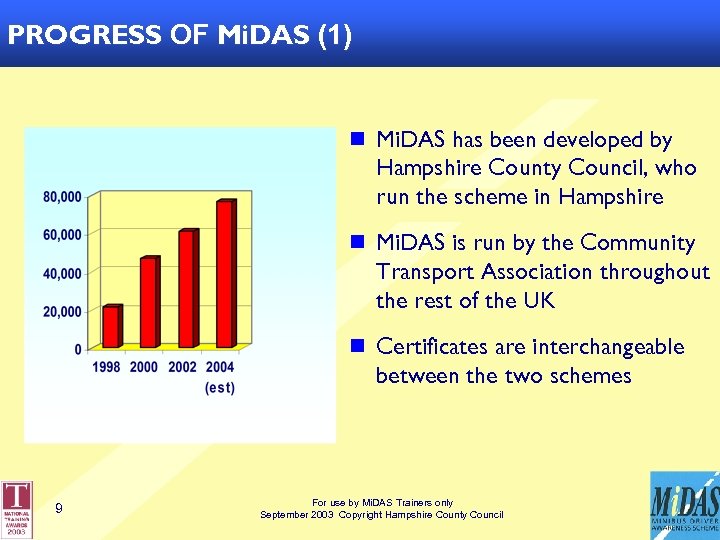
PROGRESS OF Mi. DAS (1) n Mi. DAS has been developed by Hampshire County Council, who run the scheme in Hampshire n Mi. DAS is run by the Community Transport Association throughout the rest of the UK n Certificates are interchangeable between the two schemes 9 For use by Mi. DAS Trainers only September 2003 Copyright Hampshire County Council
PROGRESS OF Mi. DAS (2) The ongoing success of Mi. DAS depends on: n Drivers n Driver Assessor/Trainers n Mi. DAS member organisations all continuing to adopt a sense of responsibility for their actions 10 For use by Mi. DAS Trainers only September 2003 Copyright Hampshire County Council
PASSENGER ASSISTANT TRAINING SCHEME Delivered in a flexible “modular” format: n Module A: The Role of the Passenger Assistant n Module B: Assisting Passengers with Disabilities n Module C 1: Children and Young People with Special Needs n Module C 2: Adults Who Need Care and Supervision n Module D: Emergency Aid n Module E: Manual Handling n Module F: Safely Managing Challenging Behaviour PATS is also relevant to drivers with a caring role 11 For use by Mi. DAS Trainers only September 2003 Copyright Hampshire County Council
DEFENSIVE DRIVING (1) … is safe driving … is driving with responsibility, care, consideration and courtesy … is about never relying on other road users to do the correct thing. 12 For use by Mi. DAS Trainers only September 2003 Copyright Hampshire County Council
DEFENSIVE DRIVING (2) Defensive driving involves: n An awareness of what is happening around you n Planning driving actions to take account of what you can see and what you cannot see n Anticipating the actions of others n Staying in control at all times 13 For use by Mi. DAS Trainers only September 2003 Copyright Hampshire County Council
DEFENSIVE DRIVING (3) As a defensive driver you must: n Look n Assess what you see n Decide what to do before you… n Act 14 For use by Mi. DAS Trainers only September 2003 Copyright Hampshire County Council
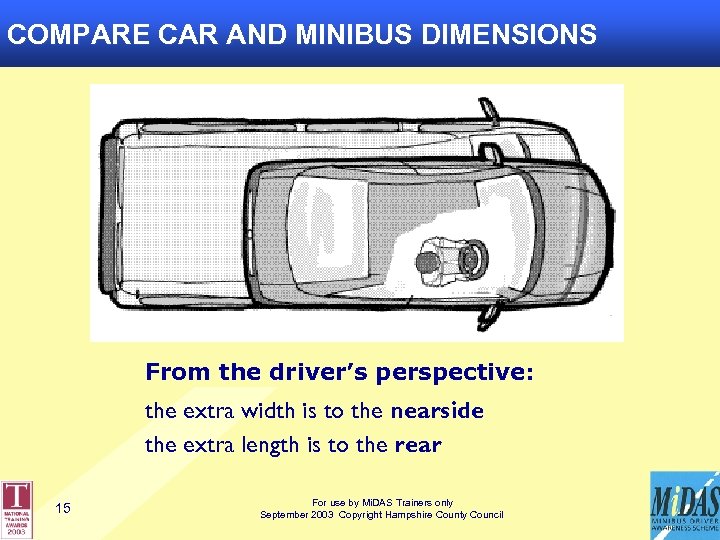
COMPARE CAR AND MINIBUS DIMENSIONS From the driver’s perspective: the extra width is to the nearside the extra length is to the rear 15 For use by Mi. DAS Trainers only September 2003 Copyright Hampshire County Council
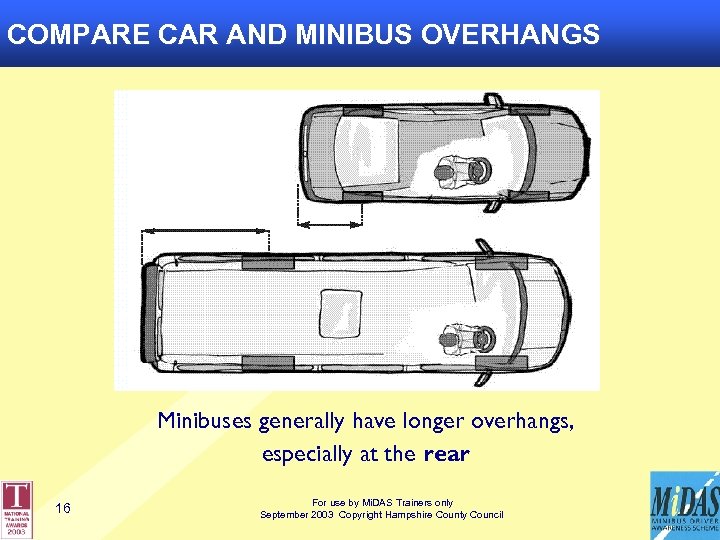
COMPARE CAR AND MINIBUS OVERHANGS Minibuses generally have longer overhangs, especially at the rear 16 For use by Mi. DAS Trainers only September 2003 Copyright Hampshire County Council
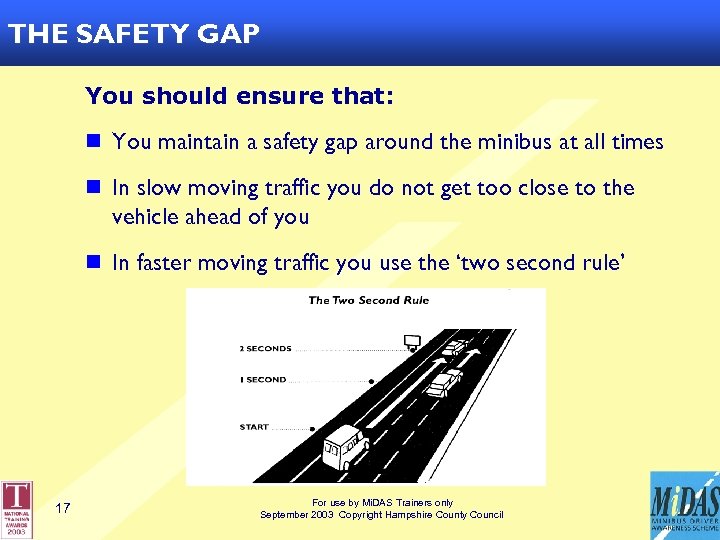
THE SAFETY GAP You should ensure that: n You maintain a safety gap around the minibus at all times n In slow moving traffic you do not get too close to the vehicle ahead of you n In faster moving traffic you use the ‘two second rule’ 17 For use by Mi. DAS Trainers only September 2003 Copyright Hampshire County Council
ANTI-LOCK BRAKING SYSTEMS – ABS (1) n From May 2002 new minibuses must have ABS n Older minibuses may already have ABS You need to know: n If a minibus has ABS n How to use ABS With ABS you still need a safety gap 18 For use by Mi. DAS Trainers only September 2003 Copyright Hampshire County Council
ANTI-LOCK BRAKING SYSTEMS – ABS (2) n Activates automatically when driver brakes very heavily n Prevents wheels locking so allows you to maintain control and steer n No need for ‘cadence’ braking n No need to ‘pump’ the brakes n ABS does not necessarily shorten stopping distances – it can make them longer. So… n … always keep a safe distance behind the vehicle in front 19 For use by Mi. DAS Trainers only September 2003 Copyright Hampshire County Council
MIRRORS AND BLIND SPOTS You should ensure that: n Mirrors are clean and correctly positioned before starting off n Mirrors are used frequently and especially before moving off, signalling, speeding up, slowing down or changing course n You know where the blind spots are n You try to keep out of other drivers’ blind spots n You use side mirrors to ensure adequate vision 20 For use by Mi. DAS Trainers only September 2003 Copyright Hampshire County Council
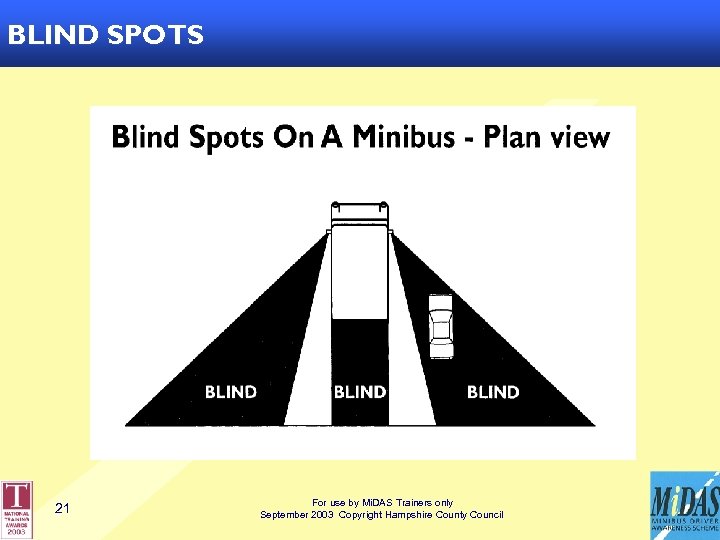
MIRRORS AND BLIND SPOTS 21 For use by Mi. DAS Trainers only September 2003 Copyright Hampshire County Council
REVERSING n Slow speed reverse collisions are common n Avoid reversing where possible n Ask: Can your manoeuvre be made safely? n Ask a colleague for help where possible n Carry out the manoeuvre slowly n You must use side mirrors and over-the-shoulder observation n Be aware of blind spots n Use a rear window lens if fitted n Take particular care if children are nearby n Practice helps! 22 For use by Mi. DAS Trainers only September 2003 Copyright Hampshire County Council
REVERSING A VEHICLE USING A GUIDE n The driver is responsible for the vehicle even when being guided n Guiding a driver requires appropriate training and safety measures such as high visibility clothing n Guides should stand in a safe place, keep pedestrians clear of the reversing area and give clear signals to the driver n If a passenger assistant is acting as a guide, vulnerable passengers must not be left unsupervised n If a driver loses sight of the guide s/he should stop the vehicle 23 For use by Mi. DAS Trainers only September 2003 Copyright Hampshire County Council
SIGNALS, SPEED AND PASSENGER CONSIDERATION You should ensure that: n You avoid giving confusing signals n You don’t make assumptions about another driver’s signals n You travel at the correct speed for the road, traffic and weather conditions n You show passenger consideration – avoid harsh cornering, stopping or braking, etc. n You are aware of the capabilities of your minibus n You do not commit yourself to a manoeuvre you cannot complete safely 24 For use by Mi. DAS Trainers only September 2003 Copyright Hampshire County Council
VITAL STATISTICS ABOUT SPEED (1) n 70% of drivers regularly exceed the 30 mph limit n An average of 10 people are killed every day on UK roads n Your chances of being killed in a road traffic accident are 1 in 200 n You are twice as likely to kill someone if you hit them at 35 mph than if you hit them at 30 mph n A child hit by a motor vehicle travelling at 40 mph has only a 5% chance of surviving the accident 25 For use by Mi. DAS Trainers only September 2003 Copyright Hampshire County Council
VITAL STATISTICS ABOUT SPEED (2) n 66% of accidents resulting in injury or death occur on roads with a speed limit of 30 mph or less n The overall stopping distance of a car travelling at 30 mph is 23 metres (about 6 car lengths) n Minibuses may take even further to stop n One person less every day would die and injury accidents would fall by 5% if the average speed fell by just 1 mph 26 For use by Mi. DAS Trainers only September 2003 Copyright Hampshire County Council
YOUR EYESIGHT n Naturally deteriorates with age especially after you reach your mid-forties n Drivers have to read a number plate during their driving test at 67 feet (20. 5 metres), or 66 feet (20 metres) for new style plates n A recent survey suggests 16% of drivers could not meet the minimum legal eyesight standard for driving n An eye examination by an optician offers a comprehensive check n Eye examinations are now very cheap n Mi. DAS recommends an eyesight test at least every two years 27 For use by Mi. DAS Trainers only September 2003 Copyright Hampshire County Council
GENERAL POINTS ABOUT MINIBUSES n Minibuses are vehicles with 9 – 16 passenger seats n A minibus is a Public Service Vehicle (PSV) unless a totally free service is provided n Section 19 and 22 Permit minibuses can operate on a not-for- profit basis without complying with the full PSV regulations (e. g. requiring a PCV licence) n Drivers have a duty of care to their passengers 28 For use by Mi. DAS Trainers only September 2003 Copyright Hampshire County Council
DRIVER LICENSING: RECAP OF 1997 CHANGES n Drivers passing their car driving test do not automatically receive an entitlement to drive a minibus n Derogation introduced, which enables drivers passing their car driving test from 1 st January 1997 to continue to drive a minibus under certain conditions n Arrangements for taking a minibus abroad have changed 29 For use by Mi. DAS Trainers only September 2003 Copyright Hampshire County Council
DRIVER LICENSING: 1988 CHANGES DRIVER LICENSING: 1998 CHANGES n Drivers with a medically restricted licence or reaching the age of 70 will not automatically retain entitlement to drive a minibus when their licence is renewed n Drivers under the age of 70 with a medical condition can continue to drive a minibus if: • they meet higher medical standards or • they meet the terms of the UK derogation n Drivers over the age of 70 can continue to drive a minibus if: • they meet higher medical standards 30 For use by Mi. DAS Trainers only September 2003 Copyright Hampshire County Council
PHOTOCARD DRIVING LICENCES n Have replaced paper driving licences n Take the form of a credit card size licence with a picture of the driver n Only valid for a maximum of 10 years n PCV or LGV drivers may need to renew their licence more frequently n DVLA will issue a reminder that your licence is about to expire n Has a counterpart which shows information about any endorsements 31 For use by Mi. DAS Trainers only September 2003 Copyright Hampshire County Council
DRIVER’S HOURS (1) DRIVER’S HOURS n Domestic driver rules do not apply to volunteer drivers or to those individuals whose primary function is not driving (Df. T view) n Community rules apply if you take a minibus abroad n If rules do not apply you should use a common sense approach: • Rest periods of 15 minutes or more after every two hours driving • Use a second driver on longer journeys where possible • Do not drive for any significant length of time after a day’s work or during your normal hours of sleep • Do not drive if you are feeling tired, unwell or on medication which may affect your driving 32 For use by Mi. DAS Trainers only September 2003 Copyright Hampshire County Council
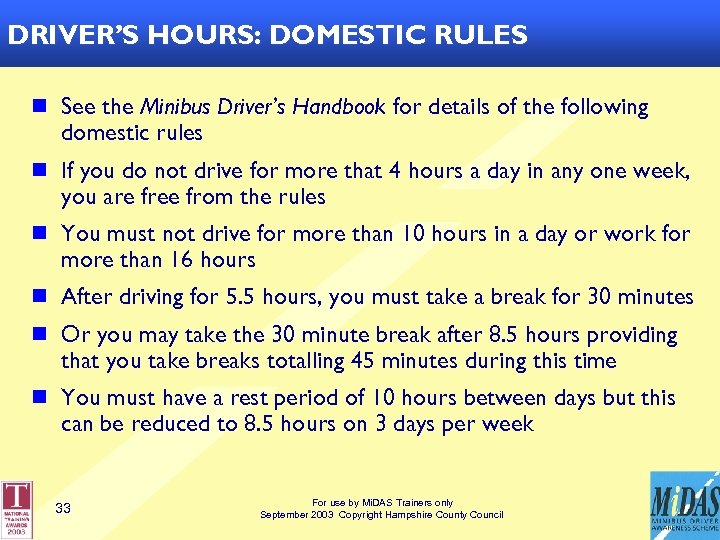
DRIVER’S HOURS: (DOMESTIC RULES) DRIVER’S HOURS DOMESTIC RULES n See the Minibus Driver’s Handbook for details of the following domestic rules n If you do not drive for more that 4 hours a day in any one week, you are free from the rules n You must not drive for more than 10 hours in a day or work for more than 16 hours n After driving for 5. 5 hours, you must take a break for 30 minutes n Or you may take the 30 minute break after 8. 5 hours providing that you take breaks totalling 45 minutes during this time n You must have a rest period of 10 hours between days but this can be reduced to 8. 5 hours on 3 days per week 33 For use by Mi. DAS Trainers only September 2003 Copyright Hampshire County Council
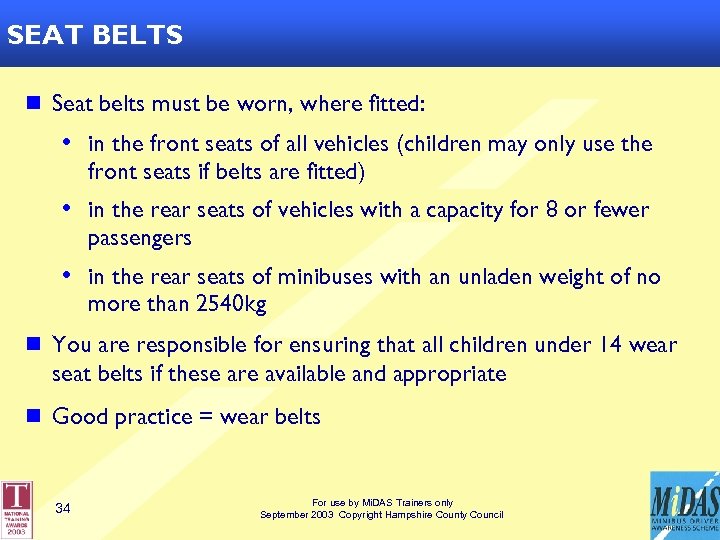
SEAT BELTS n Seat belts must be worn, where fitted: • in the front seats of all vehicles (children may only use the front seats if belts are fitted) • in the rear seats of vehicles with a capacity for 8 or fewer passengers • in the rear seats of minibuses with an unladen weight of no more than 2540 kg n You are responsible for ensuring that all children under 14 wear seat belts if these are available and appropriate n Good practice = wear belts 34 For use by Mi. DAS Trainers only September 2003 Copyright Hampshire County Council
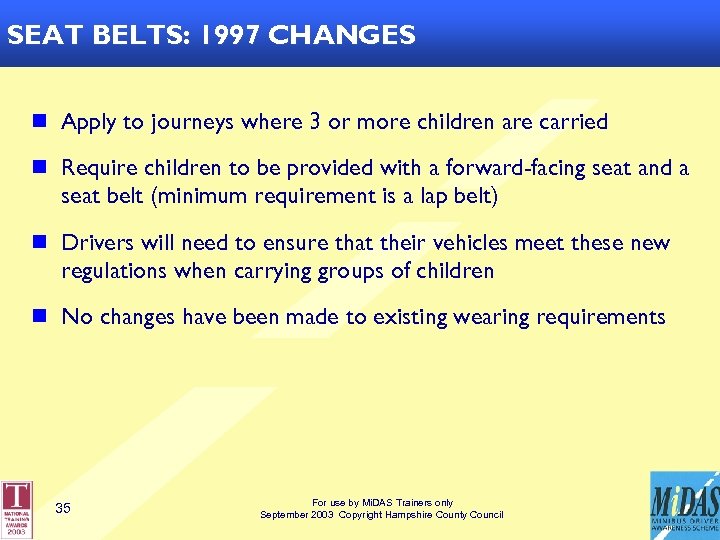
SEAT BELTS: 1997 CHANGES n Apply to journeys where 3 or more children are carried n Require children to be provided with a forward-facing seat and a seat belt (minimum requirement is a lap belt) n Drivers will need to ensure that their vehicles meet these new regulations when carrying groups of children n No changes have been made to existing wearing requirements 35 For use by Mi. DAS Trainers only September 2003 Copyright Hampshire County Council
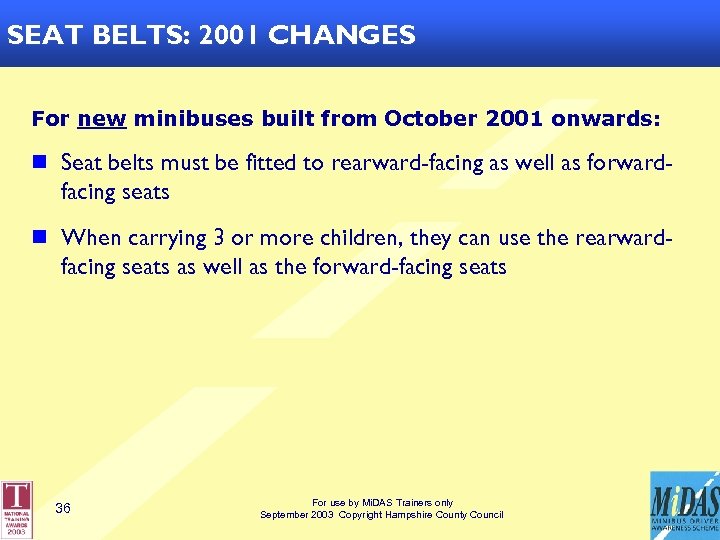
SEAT BELTS: 1997 CHANGES SEAT BELTS: 2001 CHANGES For new minibuses built from October 2001 onwards: n Seat belts must be fitted to rearward-facing as well as forward- facing seats n When carrying 3 or more children, they can use the rearward- facing seats as well as the forward-facing seats 36 For use by Mi. DAS Trainers only September 2003 Copyright Hampshire County Council
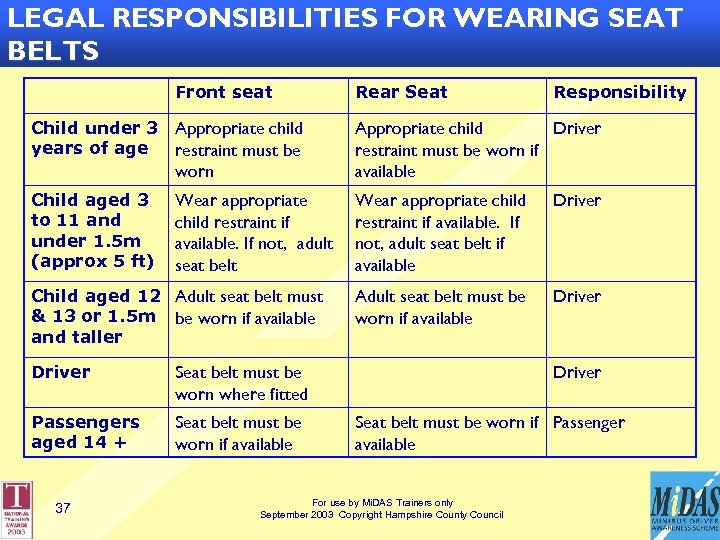
LEGAL RESPONSIBILITIES FOR WEARING SEAT BELTS Front seat Child under 3 Appropriate child years of age restraint must be Rear Seat Responsibility worn Child aged 3 to 11 and under 1. 5 m (approx 5 ft) Appropriate child Driver restraint must be worn if available Wear appropriate child restraint if available. If not, adult seat belt if available Driver Adult seat belt must be worn if available Driver Child aged 12 Adult seat belt must & 13 or 1. 5 m be worn if available and taller Driver Seat belt must be worn where fitted Passengers aged 14 + Seat belt must be worn if available 37 Driver Seat belt must be worn if Passenger available For use by Mi. DAS Trainers only September 2003 Copyright Hampshire County Council
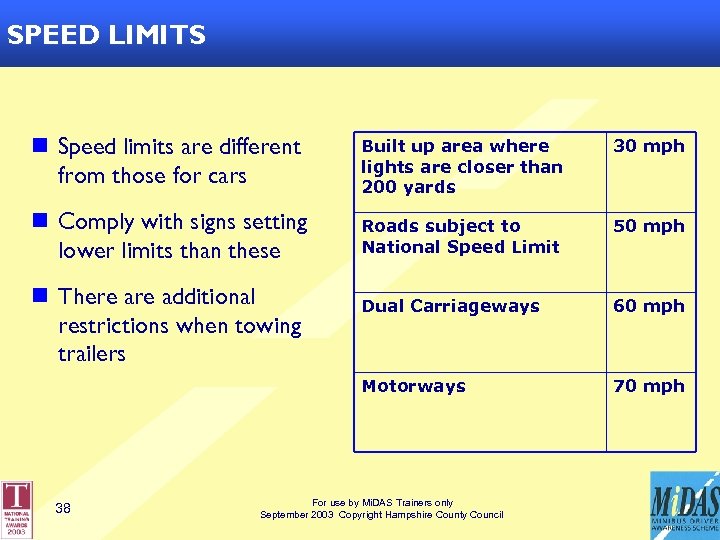
SPEED LIMITS n Speed limits are different from those for cars Built up area where lights are closer than 200 yards 30 mph n Comply with signs setting lower limits than these Roads subject to National Speed Limit 50 mph Dual Carriageways 60 mph Motorways 70 mph n There additional restrictions when towing trailers 38 For use by Mi. DAS Trainers only September 2003 Copyright Hampshire County Council
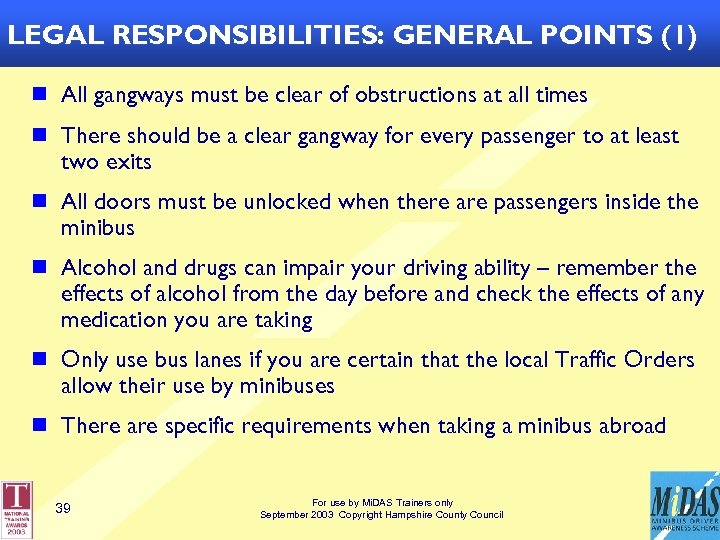
LEGAL RESPONSIBILITIES: GENERAL POINTS (1) n All gangways must be clear of obstructions at all times n There should be a clear gangway for every passenger to at least two exits n All doors must be unlocked when there are passengers inside the minibus n Alcohol and drugs can impair your driving ability – remember the effects of alcohol from the day before and check the effects of any medication you are taking n Only use bus lanes if you are certain that the local Traffic Orders allow their use by minibuses n There are specific requirements when taking a minibus abroad 39 For use by Mi. DAS Trainers only September 2003 Copyright Hampshire County Council
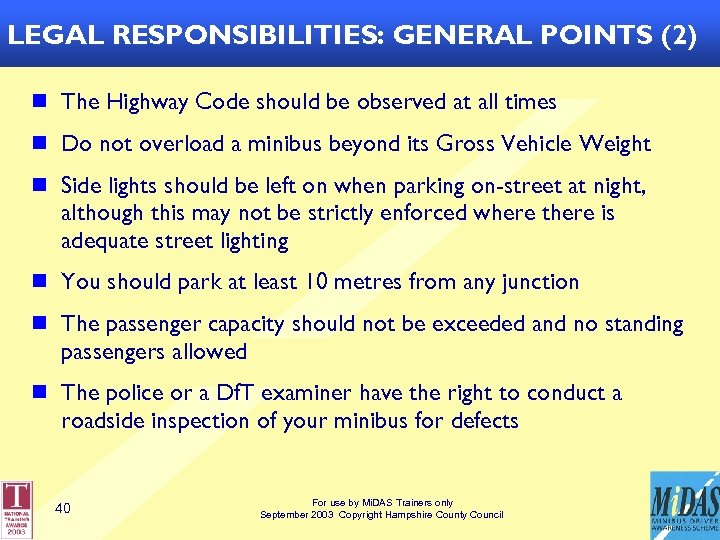
LEGAL RESPONSIBILITIES: GENERAL POINTS (2) n The Highway Code should be observed at all times n Do not overload a minibus beyond its Gross Vehicle Weight n Side lights should be left on when parking on-street at night, although this may not be strictly enforced where there is adequate street lighting n You should park at least 10 metres from any junction n The passenger capacity should not be exceeded and no standing passengers allowed n The police or a Df. T examiner have the right to conduct a roadside inspection of your minibus for defects 40 For use by Mi. DAS Trainers only September 2003 Copyright Hampshire County Council
PASSENGER SAFETY GENERAL SAFETY POINTS n Do not drive a particular type of minibus until you have received vehicle familiarisation n Equipment or luggage carried inside a minibus should be securely stowed and must not block the gangways n Know where the first aid kit is and report any items used n Know where the fire extinguishers are and how they operate n If you use a roof rack on a minibus, know the manufacturer’s recommendations on the maximum load n Do not use a trailer without first receiving some training on its use 41 For use by Mi. DAS Trainers only September 2003 Copyright Hampshire County Council
CONDITION OF A A MINIBUS CONDITION OF MINIBUS n As a driver you are legally responsible for the condition of the minibus that you are driving n This includes tyres, steering, brakes, lights, the fire extinguisher and the first aid kit n This responsibility cannot be passed on to the organisation owning the minibus n You should know the arrangements for reporting defects 42 For use by Mi. DAS Trainers only September 2003 Copyright Hampshire County Council
STARTING OFF PROCEDURE (1) At the start of your journey you should check: n For new external damage to the bodywork n Mirrors are intact and correctly positioned n All doors are unlocked n Windows and mirrors are clean n Tyre condition and pressures n Horn is in working order n Oil, water, brake fluid, washer n Seat belts are working where fluid and fuel levels n Lights and indicators are working and clean 43 n Fire extinguisher is intact n First aid kit is complete n Windscreen wipers and washers are in working order fitted n Any necessary paperwork is completed For use by Mi. DAS Trainers only September 2003 Copyright Hampshire County Council
STARTING OFF PROCEDURE (2) For accessible minibuses: n Passenger lift or ramp is securely stowed n There are sufficient wheelchair and passenger restraints for your journey n Seats are removed to accommodate wheelchair users, if required n Other seats are fixed and secure 44 For use by Mi. DAS Trainers only September 2003 Copyright Hampshire County Council
COMPLETION PROCEDURE At the end of each trip you should check: n For any new external damage to the bodywork n The minibus is parked safely and legally with the handbrake firmly applied n All switches are off n The minibus is left in a clean and tidy condition n Any paperwork is complete n Any use of first aid kit or fire extinguisher is reported 45 … and for accessible minibuses: n Any seats which may have been removed are securely refitted n The passenger lift or ramp is correctly stowed For use by Mi. DAS Trainers only September 2003 Copyright Hampshire County Council
PERSONAL SAFETY FOR DRIVERS (1) CHILD PASSENGER SAFETY (1) n Seat belts and restraints should be appropriate for the size and age of the child n You are responsible for ensuring all children under 14 are wearing seat belts if these are available and appropriate n The back row and very front seats are the danger zones for front and rear end collisions n Policy on supervision / passenger assistants n Policy on behaviour and passengers’ details 46 For use by Mi. DAS Trainers only September 2003 Copyright Hampshire County Council
PERSONAL SAFETY FOR DRIVERS (1) CHILD PASSENGER SAFETY (2) When children are boarding or alighting from a minibus you should ensure that: n You use a safe stopping place, on the nearside of the road, away from traffic n The minibus is completely stopped n Boarding and alighting is supervised n Your passengers are comfortably seated and wearing seat belts (where applicable) before you drive away n Any passengers who have just alighted are well clear of the minibus before you drive away 47 For use by Mi. DAS Trainers only September 2003 Copyright Hampshire County Council
PERSONAL SAFETY FOR DRIVERS (1) n Plan your route n Carry: • Maps • Loose change and a phone card • Torch • Breakdown services information • Personal alarm • A mobile phone if one is available n Check the minibus before setting off n When driving alone: • Lock all the doors • Don’t pick up hitch-hikers 48 For use by Mi. DAS Trainers only September 2003 Copyright Hampshire County Council
PERSONAL SAFETY FOR DRIVERS (2) n Park in a well-lit place n Lock doors when leaving the minibus (including when re-fuelling) n Have your keys ready when you return to a parked minibus n Be cautious if involved in an accident n If followed or harassed, go to a police station or public place (eg a 24 hour petrol station which will have CCTV) 49 For use by Mi. DAS Trainers only September 2003 Copyright Hampshire County Council
PERSONAL SAFETY FOR DRIVERS (3) BREAKDOWN, ACCIDENT AND EMERGENCY PROCEDURES You should: n Assess each situation n Take account of individual circumstances n Follow the safest course of action 50 For use by Mi. DAS Trainers only September 2003 Copyright Hampshire County Council
BREAKDOWN PROCEDURES In the event of a minibus breakdown: n Remember that passengers are more important than minibuses n On a motorway, passengers must leave the vehicle unless they may be at more danger outside n On all other roads, tell the passengers to stay inside the vehicle unless they are at risk n Inform the office or base n Call a vehicle recovery service n Inform people waiting to be picked up and those waiting for relatives to return n Read the Minibus Driver’s Handbook for more detailed advice 51 For use by Mi. DAS Trainers only September 2003 Copyright Hampshire County Council
ROAD TRAFFIC ACCIDENT PROCEDURE (1) ACCIDENT PROCEDURES (1) In the event of an accident involving your minibus, you should: n STOP! n Immobilise the minibus n Evacuate the passengers only if there is a risk of fire or further accident n Alert other road users n Check carefully for injuries and make passengers comfortable 52 For use by Mi. DAS Trainers only September 2003 Copyright Hampshire County Council
ROAD TRAFFIC ACCIDENT PROCEDURE (1) ACCIDENT PROCEDURES (2) n Give details to anyone with reasonable grounds for requiring them n If someone is injured, or property damaged (other than property in or on your vehicle) and particulars cannot be exchanged, then this must be reported to the Police within 24 hours n Make a note of relevant details (e. g. witnesses, time, diagram) n Inform office/base 53 For use by Mi. DAS Trainers only September 2003 Copyright Hampshire County Council
ROAD TRAFFIC ACCIDENT PROCEDURE (3) ACCIDENT PROCEDURES (3) You should NOT: n Admit liability n Discuss the accident with anyone at the scene except the police n Visit other parties involved in the accident n Talk to the media 54 For use by Mi. DAS Trainers only September 2003 Copyright Hampshire County Council
EVACUATION PROCEDURES (1) EVACUATION PROCEDURES n Get passengers out and a safe distance away from the minibus n Start with the passengers who are quickest and easiest to evacuate n Do not waste too much time in trying to put any fire out 55 For use by Mi. DAS Trainers only September 2003 Copyright Hampshire County Council
EVACUATION PROCEDURES (2) FIRE EVACUATION PROCEDURES If your minibus catches fire: n Stop the minibus and engage the handbrake n Switch off the engine and put the gearstick into gear n Engage the fuel cut off if there is one n Close the doors of the minibus n Do a head count n Call the emergency services n Calmly ask passengers to leave the minibus by the nearest exit 56 n Assist passengers to leave the minibus n Tackle the fire only if it is safe to do so For use by Mi. DAS Trainers only September 2003 Copyright Hampshire County Council
ASSISTING A PERSON WHO HAS HAD A SEIZURE n Most but not all seizures are caused by epilepsy n Generalised seizures usually cause loss of consciousness: • Protect the person until fitting subsides • Do not try to restrain them • Do not put anything in their mouth as they may choke n If the person becomes unconscious: • Check for injuries • Put the person on their side in the recovery position n You may need to call the Emergency Services – read the Minibus Driver’s Handbook for more detailed advice 57 For use by Mi. DAS Trainers only September 2003 Copyright Hampshire County Council
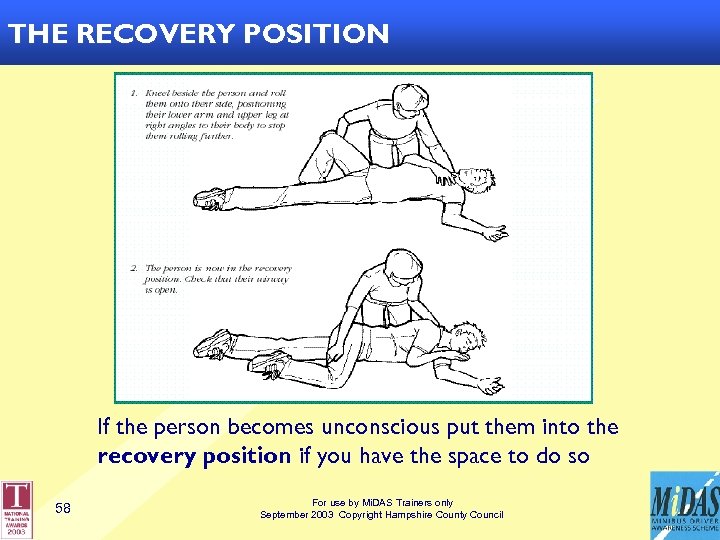
THE RECOVERY POSITION If the person becomes unconscious put them into the recovery position if you have the space to do so 58 For use by Mi. DAS Trainers only September 2003 Copyright Hampshire County Council
HEALTH AND SAFETY LEGISLATION Health and Safety Legislation refers to: n ‘employers’ and ‘employees’ n ‘others affected by the undertaking’ The Health and Safety Executive takes the view that if an organisation exposes volunteers to greater risks than those faced by employees in the same situation, it would have difficulty in proving that it had met its duty of care Good practice = providing the same (high) standard of protection to volunteers and employees doing the same job 59 For use by Mi. DAS Trainers only September 2003 Copyright Hampshire County Council
DRIVERS’ HEALTH AND SAFETY RIGHTS (1) Drivers are entitled to: n A safe and healthy workplace n Safe work equipment n Liability insurance (5+ employees) n Written safety policy (5+ employees) n Adequate training and supervision 60 For use by Mi. DAS Trainers only September 2003 Copyright Hampshire County Council
DRIVERS’ HEALTH AND SAFETY RIGHTS (2) Employer/Organisation should: n Assess the risks of work tasks n Ensure drivers are competent n Set up safe work systems n Set up emergency procedures 61 For use by Mi. DAS Trainers only September 2003 Copyright Hampshire County Council
DRIVERS’ HEALTH AND SAFETY RESPONSIBILITIES (1) Drivers must take reasonable care of: n Their own health and safety n The health and safety of others Drivers must: n Follow instructions when using work equipment n Use correctly any personal protective equipment n Report damage to any equipment 62 For use by Mi. DAS Trainers only September 2003 Copyright Hampshire County Council
DRIVERS’ HEALTH AND SAFETY RESPONSIBILITIES (2) Drivers must co-operate with their employer or organisation by informing them of any: n Dangers to their or others’ health and safety n Shortcomings in health and safety provision n Injuries that happen at work n Failure of a load-bearing part of a lift platform 63 For use by Mi. DAS Trainers only September 2003 Copyright Hampshire County Council
HEALTH AND SAFETY – HAZARDS and RISKS (1) A hazard is anything which can cause harm A risk is the chance of a hazard actually causing harm Answer these questions: n What hazards do you and your passengers face? n Which hazards have the most serious outcome? n Which are most likely to happen? n Are existing precautions adequate? n Should further precautions be taken? 64 For use by Mi. DAS Trainers only September 2003 Copyright Hampshire County Council
HEALTH AND SAFETY – HAZARDS and RISKS (2) An acceptable level of risk is one which the Health and Safety Executive define as ‘reasonably practicable’, that is, the level of risk has been reduced until the costs of taking further safety precautions far outweigh the benefits. 65 For use by Mi. DAS Trainers only September 2003 Copyright Hampshire County Council
MANUAL HANDLING AWARENESS (1) Manual Handling is: “any transporting or supporting of loads by bodily force” This includes: n Pulling n Pushing n Lifting n Lowering n Carrying n Supporting 66 For use by Mi. DAS Trainers only September 2003 Copyright Hampshire County Council
MANUAL HANDLING AWARENESS (2) Manual Handling injuries (96/97): n 36% of work accidents and of these: • 73% were strains or sprains • 49% were to the back • 33% were to the arm or hand 67 For use by Mi. DAS Trainers only September 2003 Copyright Hampshire County Council
POSTURAL AWARENESS n Good posture is vital when carrying out manual handling tasks n Two key factors: • Have a firm base of support • Keep the spine in its natural shape 68 For use by Mi. DAS Trainers only September 2003 Copyright Hampshire County Council
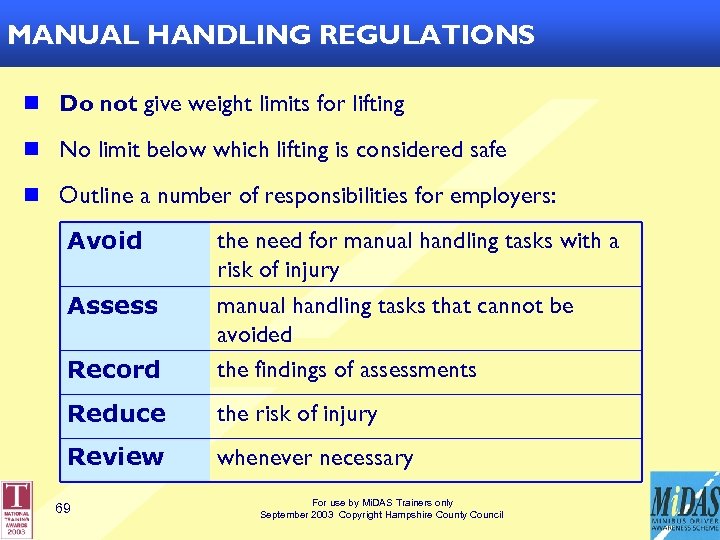
MANUAL HANDLING REGULATIONS n Do not give weight limits for lifting n No limit below which lifting is considered safe n Outline a number of responsibilities for employers: Avoid Record the need for manual handling tasks with a risk of injury manual handling tasks that cannot be avoided the findings of assessments Reduce the risk of injury Review whenever necessary Assess 69 For use by Mi. DAS Trainers only September 2003 Copyright Hampshire County Council
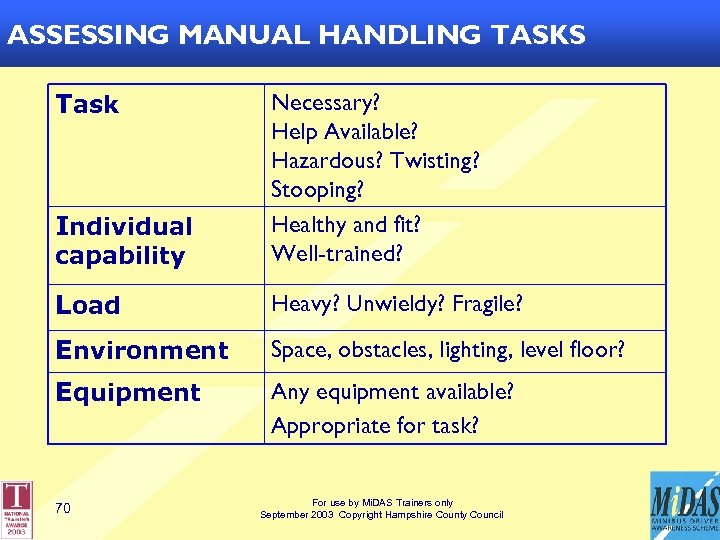
ASSESSING MANUAL HANDLING TASKS Task capability Necessary? Help Available? Hazardous? Twisting? Stooping? Healthy and fit? Well-trained? Load Heavy? Unwieldy? Fragile? Environment Space, obstacles, lighting, level floor? Equipment Any equipment available? Appropriate for task? Individual 70 For use by Mi. DAS Trainers only September 2003 Copyright Hampshire County Council
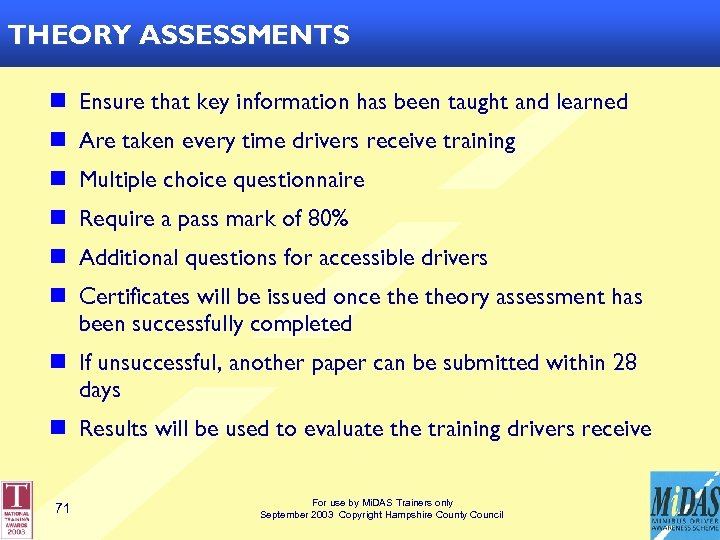
THEORY ASSESSMENTS n Ensure that key information has been taught and learned n Are taken every time drivers receive training n Multiple choice questionnaire n Require a pass mark of 80% n Additional questions for accessible drivers n Certificates will be issued once theory assessment has been successfully completed n If unsuccessful, another paper can be submitted within 28 days n Results will be used to evaluate the training drivers receive 71 For use by Mi. DAS Trainers only September 2003 Copyright Hampshire County Council
CONCLUSION Thank you for attending n Any final questions? n Please complete the Group Training Evaluation Form n Thank you for your hard work 72 For use by Mi. DAS Trainers only September 2003 Copyright Hampshire County Council
Скачать презентацию Mi DAS INDUCTION TRAINING FOR DRIVERS Standard Minibuses
a0db0b6e8d624f023a2989a9cf5f49a0.ppt