


 Скачать презентацию MHS 5340 Foundations of Career Development Evolution of
43ea61d3aff573e7b4f104218c917770.ppt
- Количество слайдов: 28
 MHS 5340 Foundations of Career Development Evolution of Work, Mental Health, Family, Education, and Leisure James P. Sampson, Jr. Florida State University 1
 Why work? • Economic • Social • Psychological 2
 Past, Present, & Future Trends • Hunter-gatherer model – Men hunted, women gathered • Agrarian / Agricultural model – Tools needed to work farms – Trade became popular • Class development – Landowners vs. laborers 3
 Past, Present, & Future Trends • Class development – Middle class composed of merchants and very skilled craftsmen – Professions develop • Clergy • Medicine • Law 4
 Past, Present, & Future Trends • Children – Eldest son enters father’s occupation – Other sons enter varied occupations – Daughters become wives and care for children as well as work in the home and often work in the family business 5
 Past, Present, & Future Trends • Industrial Revolution – Movement of workers from farms to cities • Self-employment to working for others – Difficulty with career development in new trades • Families less helpful in guiding children • Family influence strong in deterministic society 6
 Past, Present, & Future Trends • Immigrants – New groups wanted to reinvent themselves in America – Commonality of achievement motivation – Needed education – Ability to read & write supports vibrant middle class – Still needed vocational guidance 7
 Past, Present, & Future Trends • Frank Parsons (1908) – Leader in social reform movement – Innovative practitioner and theorist – Three-part model of decision making • Self knowledge • Occupational knowledge • True reasoning 8
 Past, Present, & Future Trends • WWI – Tests developed for selection of soldiers and officers – Aptitude tests created 9
 Past, Present, & Future Trends • School guidance and work – Education and economic achievement at work allows upward mobility in social class • unprecedented social development – Guidance programs • Vocational education • College selection 10
 Past, Present, & Future Trends • W W II – Women moved into work force vacated by men – Women didn’t want to stop working after war – valued independence – Rise of women’s movement – Soldiers needed counseling for “shell shock” (now PTSD) 11
 Past, Present, & Future Trends • W W II – Soldiers needed career counseling for college major choice for post-military careers • Sputnik (1957) – Russians launch 1 st satellite – Americans surprised and embarrassed – Counselors encouraged to “guide” students into math and engineering careers 12
 Past, Present, & Future Trends • Alternative ways to work – Permanent full-time – Part-time – Flextime – Overtime – Shift work – Multiple jobs 13
 Past, Present, & Future Trends • Alternative ways to work – Job sharing – Telecommuting – Independent contractor, Self-employment, Freelancer or Consultant – Contingent workforce • Outsourcing, temporary services, on-call workers, interns, co-ops 14
 Past, Present, & Future Trends • Career Education integrates the school, community and employers • Human Resource Development emerges among private, not-for-profit, and public sector employers • School-to-Work movement emerges from the career education movement • One-Stop Centers integrate public employment, training, and social services in one location 15
 Problems of Unemployment • Admundson & Borgen: – Job loss and grieving process • denial, anger, bargaining, depression, and acceptance – Job search / burnout • enthusiasm, stagnation, frustration, apathy, and further depression 16
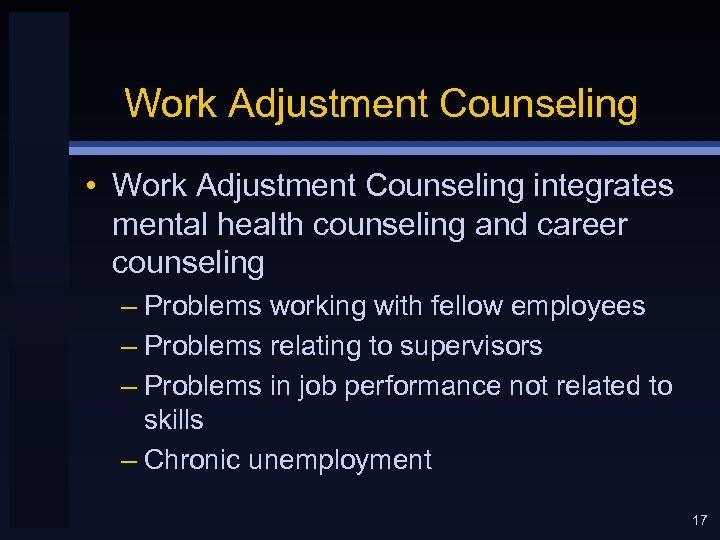 Work Adjustment Counseling • Work Adjustment Counseling integrates mental health counseling and career counseling – Problems working with fellow employees – Problems relating to supervisors – Problems in job performance not related to skills – Chronic unemployment 17
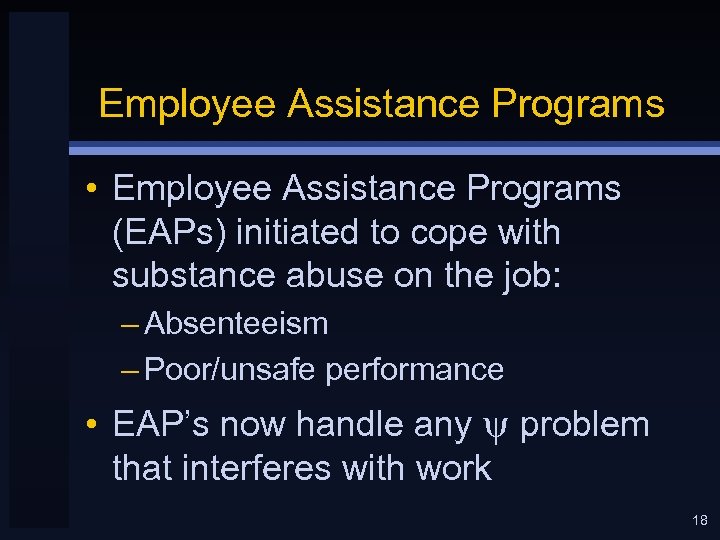 Employee Assistance Programs • Employee Assistance Programs (EAPs) initiated to cope with substance abuse on the job: – Absenteeism – Poor/unsafe performance • EAP’s now handle any problem that interferes with work 18
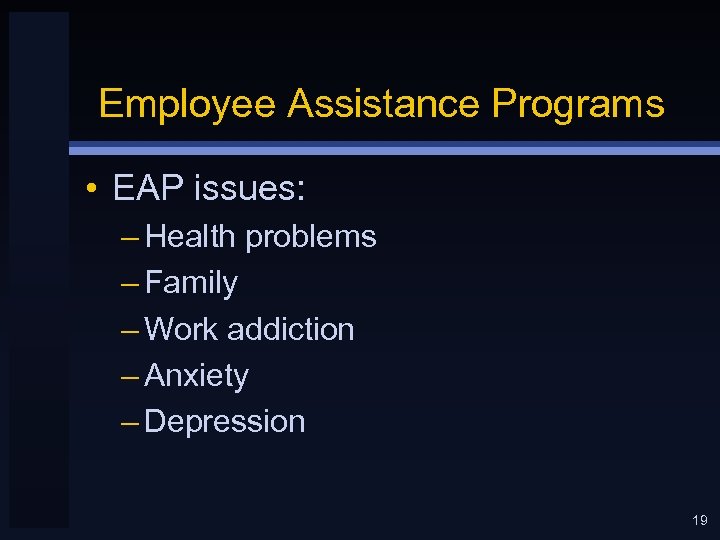 Employee Assistance Programs • EAP issues: – Health problems – Family – Work addiction – Anxiety – Depression 19
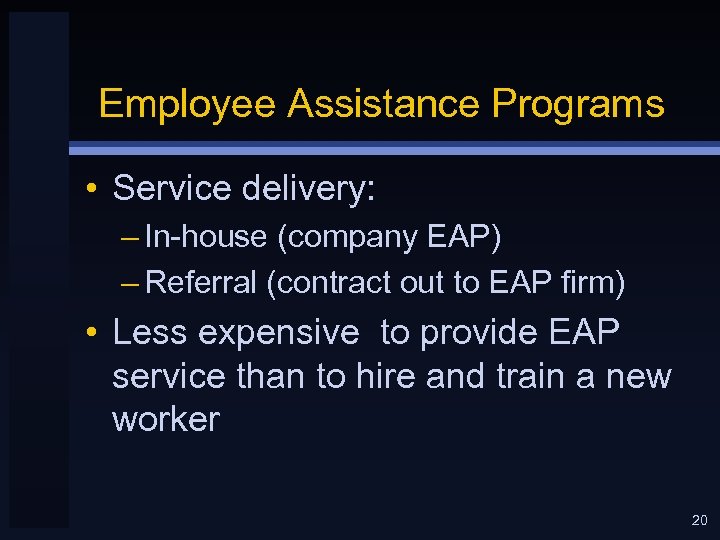 Employee Assistance Programs • Service delivery: – In-house (company EAP) – Referral (contract out to EAP firm) • Less expensive to provide EAP service than to hire and train a new worker 20
 Systems Approach to Career • A system of interrelated factors affect Career Development • Three levels: – I. World events (war, economics) – II. Culture – III. Elements of work, family, education / training, and leisure 21
 Systems Approach • World and economic events may affect work, family, education, and leisure • Interventions in one life role affect other life roles • Be aware of client’s culture when considering his/her system of work, family, education, leisure 22
 Leisure • Hard work highly valued • This century has seen increase in leisure time • Better leisure = better work • People don’t always make good leisure choices 23
 Types of Leisure • Blocker & Siegal – Complementary – Supplementary – Compensatory • Supplementary and Compensatory can be the same activity 24
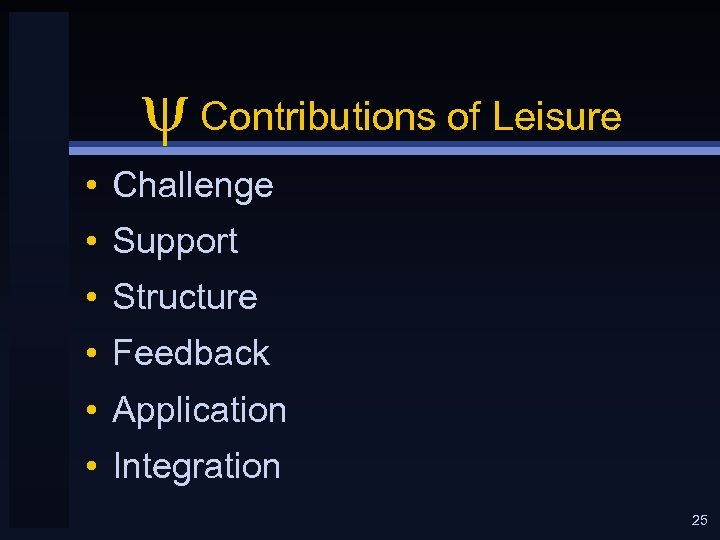 Contributions of Leisure • Challenge • Support • Structure • Feedback • Application • Integration 25
 Homework Assignment #2 • What are your leisure activities? • What types of leisure are they? – complementary, supplemental, compensatory • What contribution does your leisure give you? 26
 For Additional Information www. career. fsu. edu/techcenter/ Thank You
 28
28