


 Скачать презентацию Metropolitan Transportation Authority July Financial Plan 2017
e48c8b7aa8e8d030dc48c7b435d497cf.ppt
- Количество слайдов: 16
 Metropolitan Transportation Authority July Financial Plan 2017 – 2020 Presentation to the Board July 27, 2016
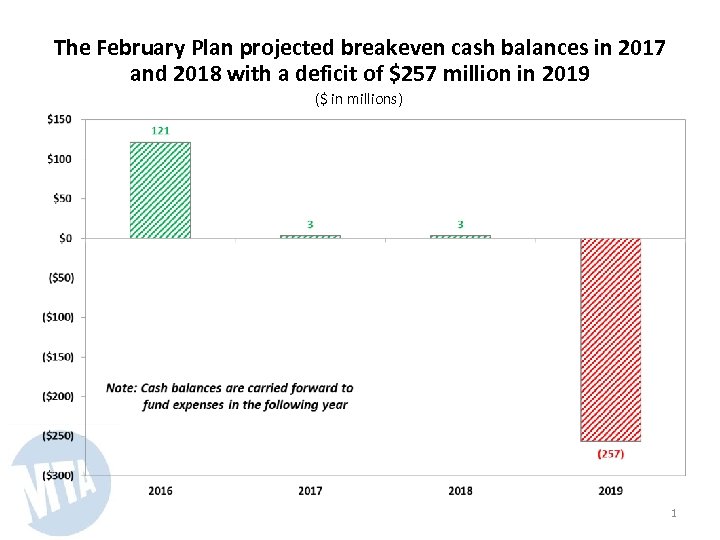 The February Plan projected breakeven cash balances in 2017 and 2018 with a deficit of $257 million in 2019 ($ in millions) 1
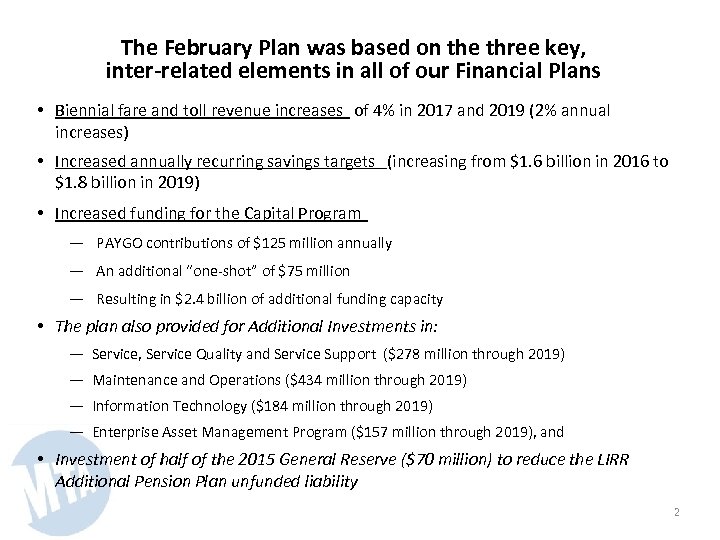 The February Plan was based on the three key, inter-related elements in all of our Financial Plans • Biennial fare and toll revenue increases of 4% in 2017 and 2019 (2% annual increases) • Increased annually recurring savings targets (increasing from $1. 6 billion in 2016 to $1. 8 billion in 2019) • Increased funding for the Capital Program — PAYGO contributions of $125 million annually — An additional “one-shot” of $75 million — Resulting in $2. 4 billion of additional funding capacity • The plan also provided for Additional Investments in: — Service, Service Quality and Service Support ($278 million through 2019) — Maintenance and Operations ($434 million through 2019) — Information Technology ($184 million through 2019) — Enterprise Asset Management Program ($157 million through 2019), and • Investment of half of the 2015 General Reserve ($70 million) to reduce the LIRR Additional Pension Plan unfunded liability 2
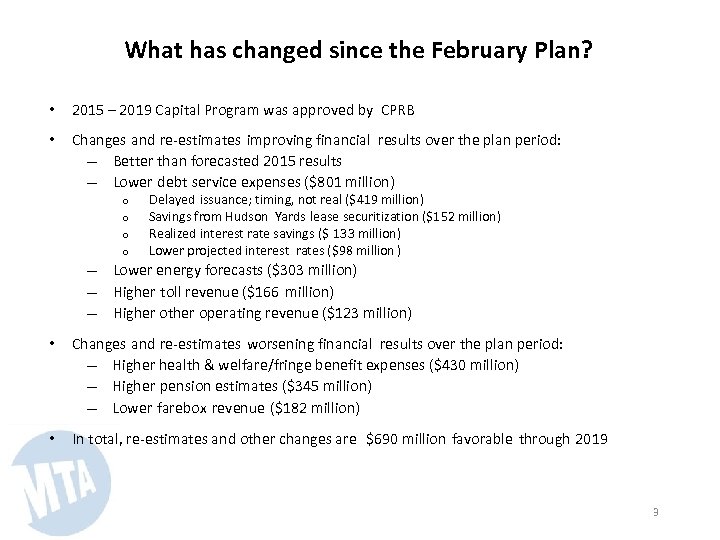 What has changed since the February Plan? • 2015 – 2019 Capital Program was approved by CPRB • Changes and re-estimates improving financial results over the plan period: — Better than forecasted 2015 results — Lower debt service expenses ($801 million) o o Delayed issuance; timing, not real ($419 million) Savings from Hudson Yards lease securitization ($152 million) Realized interest rate savings ($ 133 million) Lower projected interest rates ($98 million ) Lower energy forecasts ($303 million) — Higher toll revenue ($166 million) — Higher other operating revenue ($123 million) — • Changes and re-estimates worsening financial results over the plan period: ― Higher health & welfare/fringe benefit expenses ($430 million) ― Higher pension estimates ($345 million) ― Lower farebox revenue ($182 million) • In total, re-estimates and other changes are $690 million favorable through 2019 3
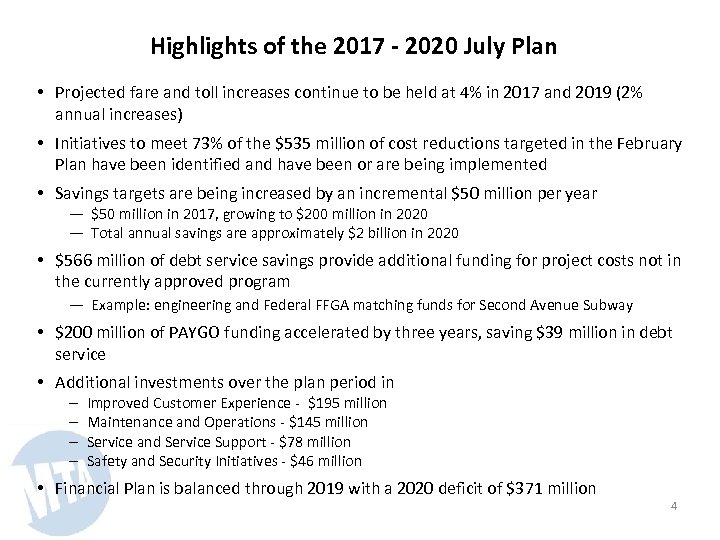 Highlights of the 2017 - 2020 July Plan • Projected fare and toll increases continue to be held at 4% in 2017 and 2019 (2% annual increases) • Initiatives to meet 73% of the $535 million of cost reductions targeted in the February Plan have been identified and have been or are being implemented • Savings targets are being increased by an incremental $50 million per year — $50 million in 2017, growing to $200 million in 2020 — Total annual savings are approximately $2 billion in 2020 • $566 million of debt service savings provide additional funding for project costs not in the currently approved program — Example: engineering and Federal FFGA matching funds for Second Avenue Subway • $200 million of PAYGO funding accelerated by three years, saving $39 million in debt service • Additional investments over the plan period in – – Improved Customer Experience - $195 million Maintenance and Operations - $145 million Service and Service Support - $78 million Safety and Security Initiatives - $46 million • Financial Plan is balanced through 2019 with a 2020 deficit of $371 million 4
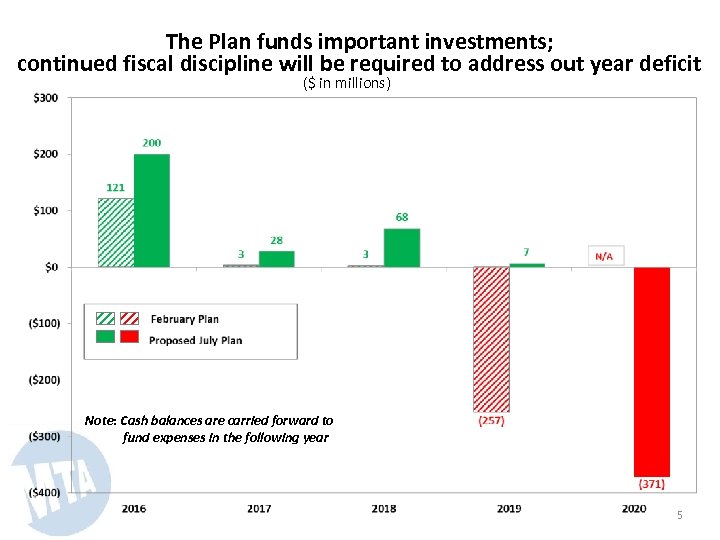 The Plan funds important investments; continued fiscal discipline will be required to address out year deficit ($ in millions) Note: Cash balances are carried forward to fund expenses in the following year 5
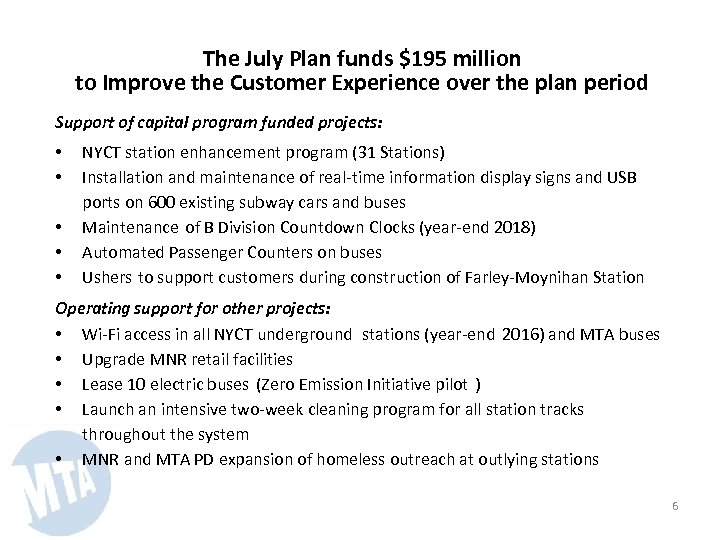 The July Plan funds $195 million to Improve the Customer Experience over the plan period Support of capital program funded projects: • • • NYCT station enhancement program (31 Stations) Installation and maintenance of real-time information display signs and USB ports on 600 existing subway cars and buses Maintenance of B Division Countdown Clocks (year-end 2018) Automated Passenger Counters on buses Ushers to support customers during construction of Farley-Moynihan Station Operating support for other projects: • Wi-Fi access in all NYCT underground stations (year-end 2016) and MTA buses • Upgrade MNR retail facilities • Lease 10 electric buses (Zero Emission Initiative pilot ) • Launch an intensive two-week cleaning program for all station tracks throughout the system • MNR and MTA PD expansion of homeless outreach at outlying stations 6
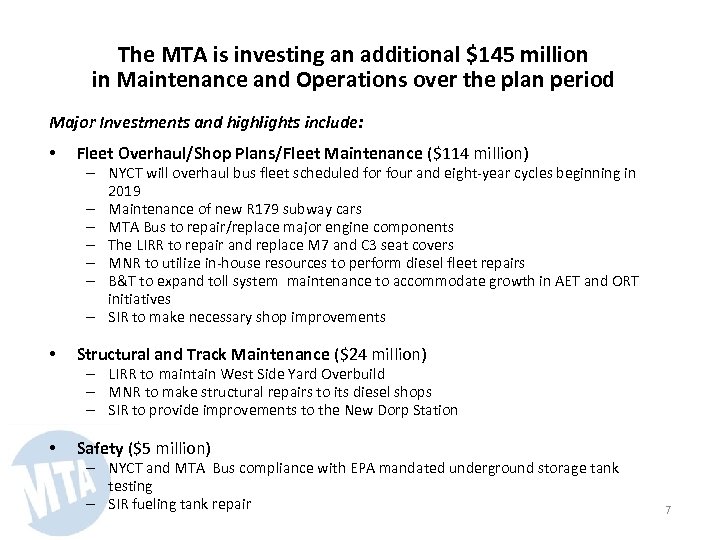 The MTA is investing an additional $145 million in Maintenance and Operations over the plan period Major Investments and highlights include: • Fleet Overhaul/Shop Plans/Fleet Maintenance ($114 million) • Structural and Track Maintenance ($24 million) • Safety ($5 million) – NYCT will overhaul bus fleet scheduled for four and eight-year cycles beginning in 2019 – Maintenance of new R 179 subway cars – MTA Bus to repair/replace major engine components – The LIRR to repair and replace M 7 and C 3 seat covers – MNR to utilize in-house resources to perform diesel fleet repairs – B&T to expand toll system maintenance to accommodate growth in AET and ORT initiatives – SIR to make necessary shop improvements – LIRR to maintain West Side Yard Overbuild – MNR to make structural repairs to its diesel shops – SIR to provide improvements to the New Dorp Station – NYCT and MTA Bus compliance with EPA mandated underground storage tank testing – SIR fueling tank repair 7
 The MTA is investing an additional $78 million in Service and Service Support over the plan period Proposed investments include: • New Service ($36 million) ‒ MTA Bus will implement SBS on key routes: Q 70, Q 52/53, Q 25, Q 113 ‒ LIRR will provide year-round Greenport weekend service on the North Fork and add trains timed to connect with Fire Island ferries during the peak summer season • Platform Service Adjustments ($21 million) – NYCT and MTA Bus will continue to adjust Platform Service to meet demand – LIRR will increase consist lengths on select trains to meet ridership demands • Service Support ($21 million) – NYCT will expand its Platform Controllers program (originated in 2015) – B&T will increase funding to meet increased demand on Customer Service Center operations 8
 The MTA is investing an additional $46 million in Safety and Security Initiatives over the plan period Key initiatives include: • • “Don’t Block the Box” grade crossing initiative Support for on-bus vehicle cameras, GPS technology and wireless communications • Support and staffing for “Help Point” intercoms • Purchase of wheel impact load detectors • Increase fire safety coverage at Jamaica Station • Expand security camera installation and oversight • New MTA Police facility in Bethpage, Long Island • B&T Security Operations Center in Long Island City 9
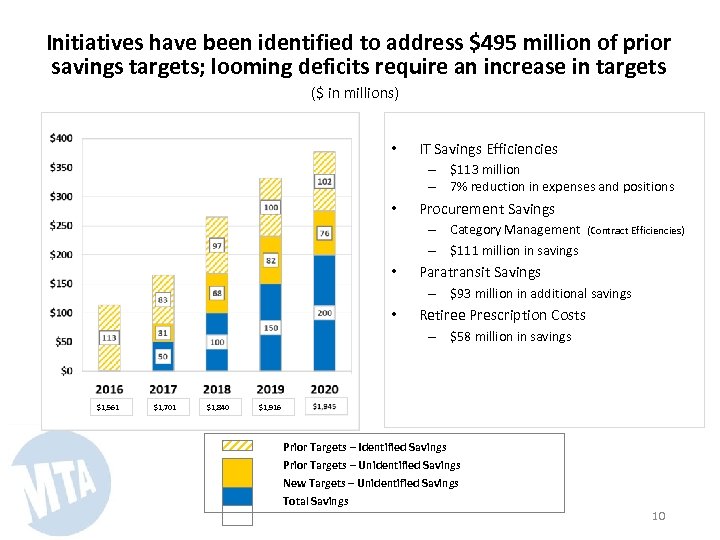 Initiatives have been identified to address $495 million of prior savings targets; looming deficits require an increase in targets ($ in millions) • IT Savings Efficiencies – – • Procurement Savings – – • $1, 701 $1, 840 (Contract Efficiencies) $93 million in additional savings Retiree Prescription Costs – $1, 561 Category Management $111 million in savings Paratransit Savings – • $113 million 7% reduction in expenses and positions $58 million in savings $1, 916 Prior Targets – Identified Savings Prior Targets – Unidentified Savings New Targets – Unidentified Savings Total Savings 10
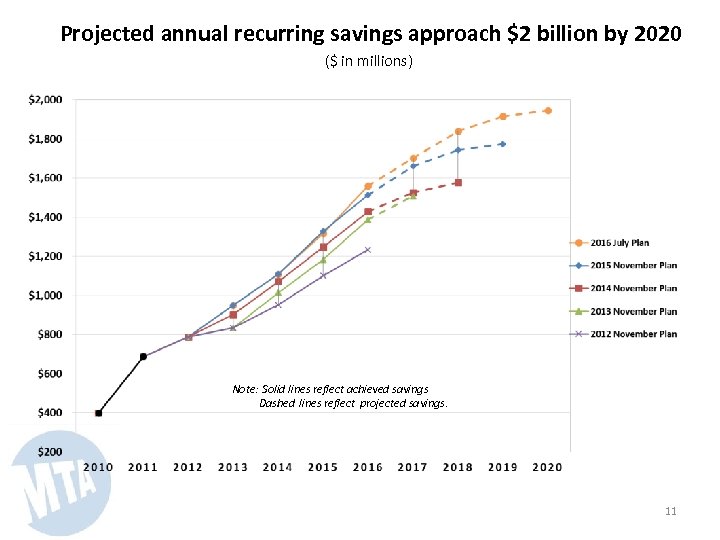 Projected annual recurring savings approach $2 billion by 2020 ($ in millions) Note: Solid lines reflect achieved savings Dashed lines reflect projected savings. 11
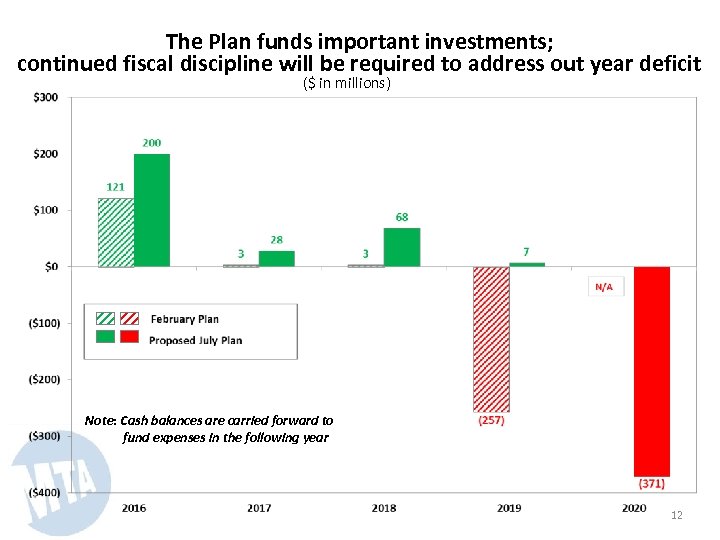 The Plan funds important investments; continued fiscal discipline will be required to address out year deficit ($ in millions) Note: Cash balances are carried forward to fund expenses in the following year 12
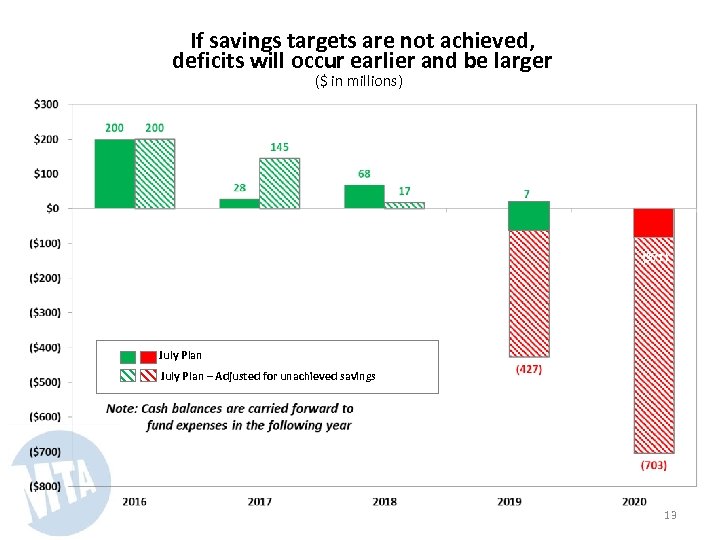 If savings targets are not achieved, deficits will occur earlier and be larger ($ in millions) (371) July Plan – Adjusted for unachieved savings 13
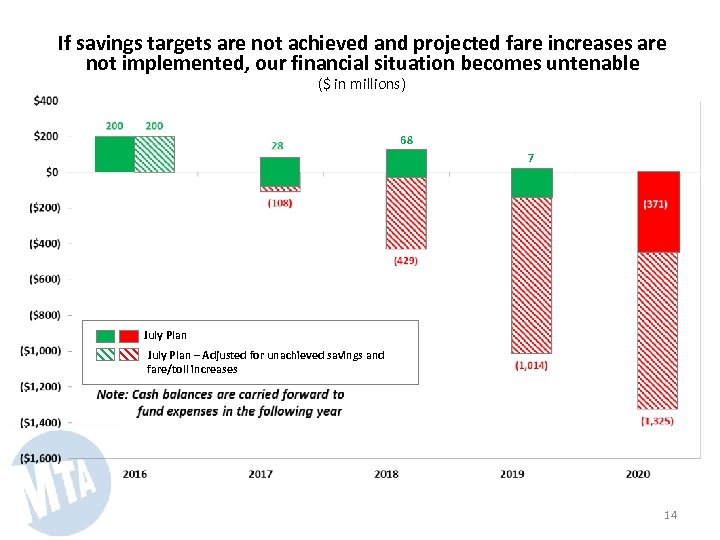 If savings targets are not achieved and projected fare increases are not implemented, our financial situation becomes untenable ($ in millions) 68 7 July Plan – Adjusted for unachieved savings and fare/toll increases 14
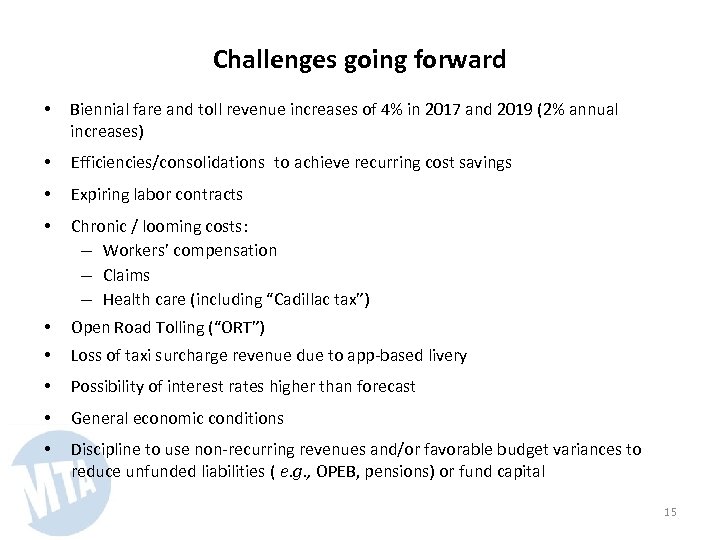 Challenges going forward • Biennial fare and toll revenue increases of 4% in 2017 and 2019 (2% annual increases) • Efficiencies/consolidations to achieve recurring cost savings • Expiring labor contracts • Chronic / looming costs: ― Workers’ compensation ― Claims ― Health care (including “Cadillac tax”) • • Open Road Tolling (“ORT”) • Possibility of interest rates higher than forecast • General economic conditions • Discipline to use non-recurring revenues and/or favorable budget variances to reduce unfunded liabilities ( e. g. , OPEB, pensions) or fund capital Loss of taxi surcharge revenue due to app-based livery 15