


 Скачать презентацию Metric System Notes Introduction The official name of
f11d74e5cc668c1d78aff12a7669fcf1.ppt
- Количество слайдов: 25
 Metric System Notes Introduction The official name of the metric system is Systeme International d'Unites (International System of Units), usually known simply as SI. The term metric comes from the base unit of length in the system, the meter, for which the international spelling is meter.
 Metric System Notes Why do we use the metric system? 1. Almost all other countries are using the metric system 2. Other countries’ companies are refusing to buy products from the U. S. if not labeled in metric units 3. Scientists need a universal way to communicate data (SI Units)
 Metric System Notes Using the metric system The metric system is simple to use for two reasons: 1. First, it follows the decimal number system-- metric units increase or decrease in size by 10's. 2. The metric system has only 7 base units that make up all its measurements. (The inch-pound system has more than 20 base units for just its common measurements. )
 Metric System Notes Introduction Scientists all over the world use SI units to measure: Length Volume Mass Temperature Time
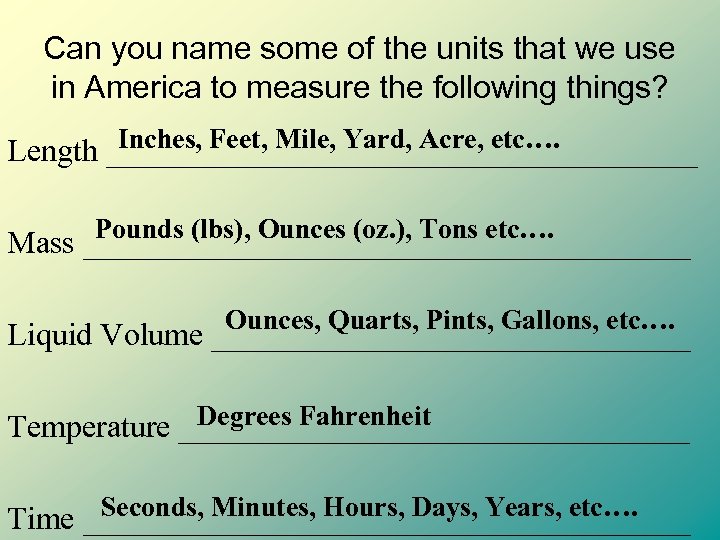 Can you name some of the units that we use in America to measure the following things? Inches, Feet, Mile, Yard, Acre, etc…. Length ___________________ Pounds (lbs), Ounces (oz. ), Tons etc…. Mass ___________________ Ounces, Quarts, Pints, Gallons, etc…. Liquid Volume _______________ Degrees Fahrenheit Temperature ________________ Seconds, Minutes, Hours, Days, Years, etc…. Time ___________________
 Metric System Notes The Metric System has 3 simple Base Units 1. Meter (m) - measures length 2. Gram (g) - measures the mass of an object. 3. Liter (L) measures volume which is used when measuring liquids
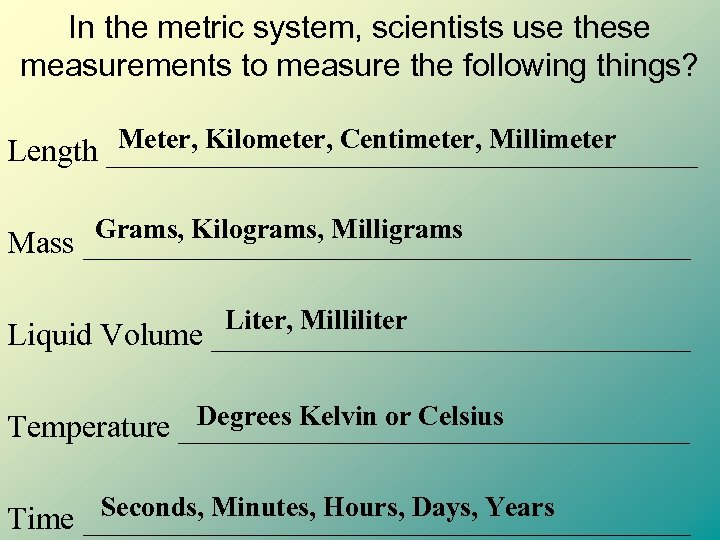 In the metric system, scientists use these measurements to measure the following things? Meter, Kilometer, Centimeter, Millimeter Length ___________________ Grams, Kilograms, Milligrams Mass ___________________ Liter, Milliliter Liquid Volume _______________ Degrees Kelvin or Celsius Temperature ________________ Seconds, Minutes, Hours, Days, Years Time ___________________
 Metric System Notes L eng th Length is the distance between two points. The metric tool used to measure length is the meter stick or metric ruler. The most common units used to measure length are kilometer (km), meter (m), centimeter (cm) and millimeter (mm).
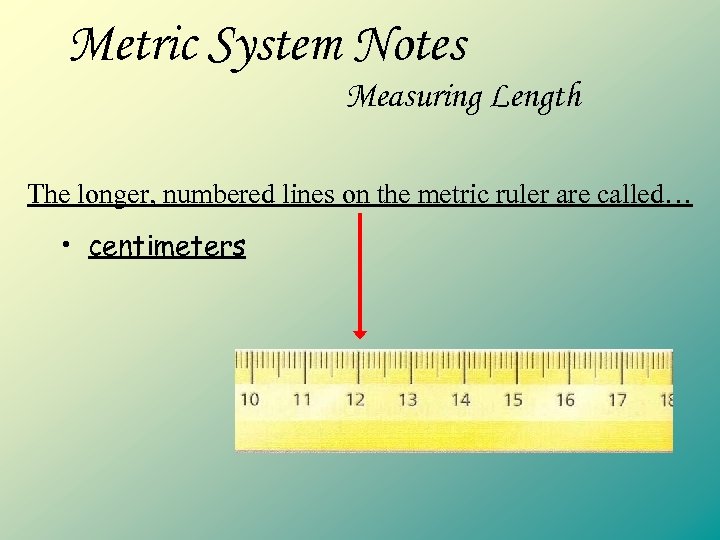 Metric System Notes Measuring Length The longer, numbered lines on the metric ruler are called… • centimeters
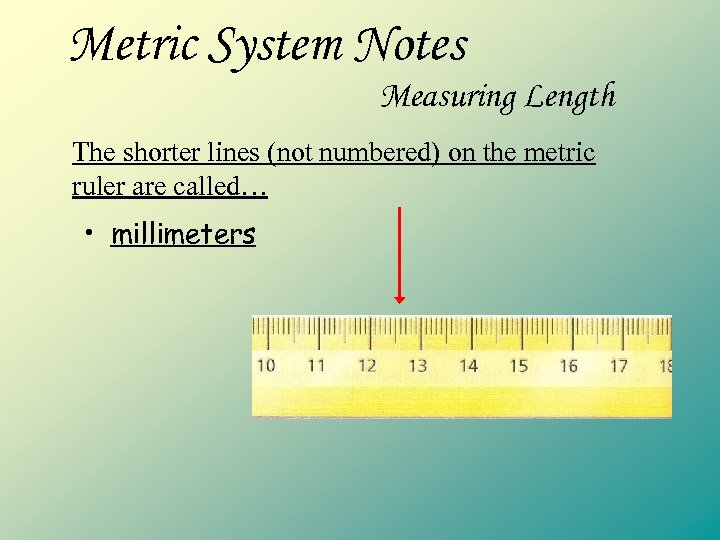 Metric System Notes Measuring Length The shorter lines (not numbered) on the metric ruler are called… • millimeters
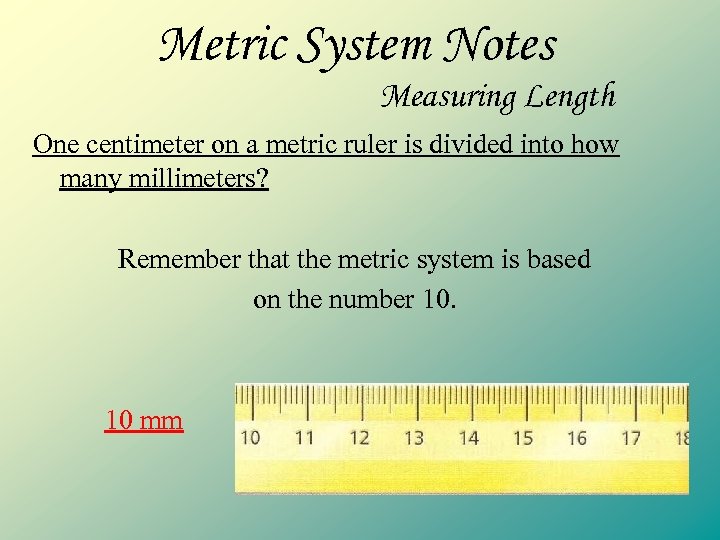 Metric System Notes Measuring Length One centimeter on a metric ruler is divided into how many millimeters? Remember that the metric system is based on the number 10. 10 mm
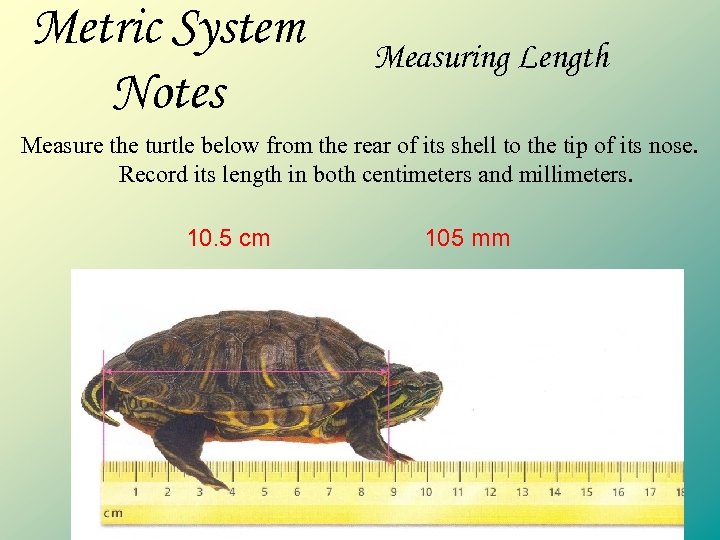 Metric System Notes Measuring Length Measure the turtle below from the rear of its shell to the tip of its nose. Record its length in both centimeters and millimeters. 10. 5 cm 105 mm
 Metric System Notes ss a M Mass is the amount of matter in an object. The metric tool used to measure mass is the triplebeam balance. The most common units used to measure mass are kilogram (kg), gram (g), and milligram (mg).
 Metric System Notes Weight Vs. Mass How would your weight differ if you were to travel to the moon? If you were to travel to the moon your weight would be less. Your weight would be lesser because the force of gravity is less. Weight is a factor of the force of gravity
 Metric System Notes Weight Vs. Mass Why would your mass stay constant if you were to travel to the moon? Your mass would stay the same if you were to travel to the moon because mass is the amount of matter that an object contains Since you are still made up of the same amount of “stuff”, your mass would not change
 Metric System Notes Weight Vs. Mass Why do scientists prefer to use the mass of an object instead of its weight? Scientists prefer to use an objects mass instead of its weight because mass does not change when the force of gravity does.
 Metric System Notes Measuring Mass A triple-beam balance works by comparing the mass of the object you are measuring to a known mass. When you use a triple-beam balance, you: 1. Check to make sure the scale is balanced and all riders are aligned on the left side. 2. Place the object on the pan 3. Shift the riders on the beams until the pointer is level with the 0. >>Start with the large rider (increments of 100) >>Next, the medium sized rider (increments of 10) >>Lastly, the small rider (increments of 1) – sometimes it’s best to use a pencil to move this rider 4. Add up all the values to get the objects’ mass. 5. Take the object off the pan and zero out all riders.
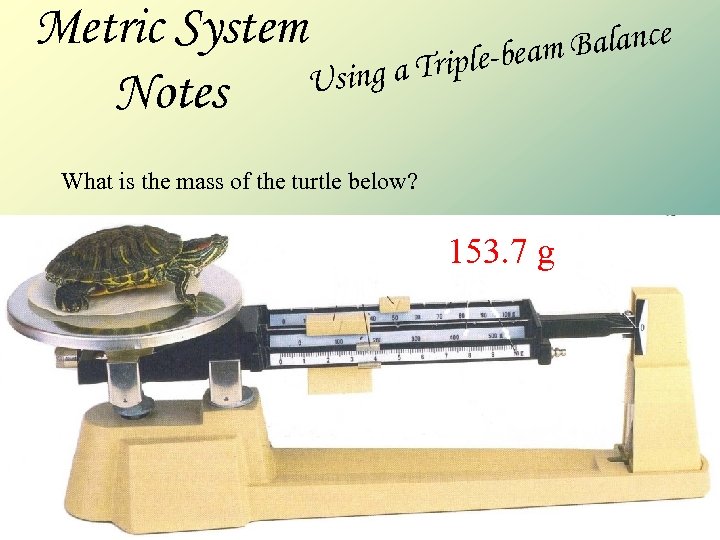 Metric System alance le-beam B ing a Trip Us Notes What is the mass of the turtle below? 153. 7 g
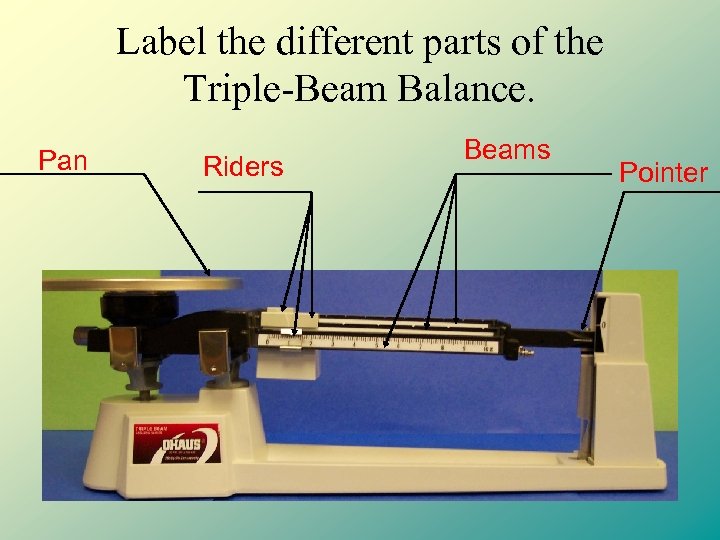 Label the different parts of the Triple-Beam Balance. Pan Riders Beams Pointer
 Metric System Notes e m lu o V Volume is the amount of space an object takes up. The metric tool most commonly used to measure volume in science class is the graduated cylinder. The most common units used to measure volume are liter (L) and milliliter (m. L).
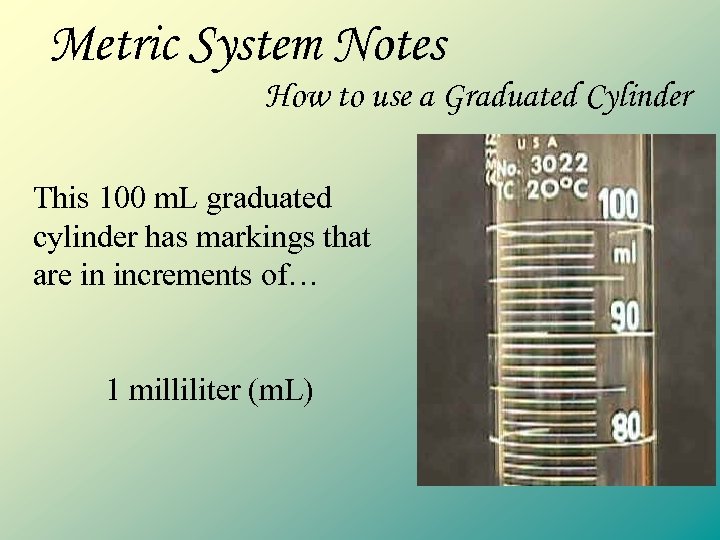 Metric System Notes How to use a Graduated Cylinder This 100 m. L graduated cylinder has markings that are in increments of… 1 milliliter (m. L)
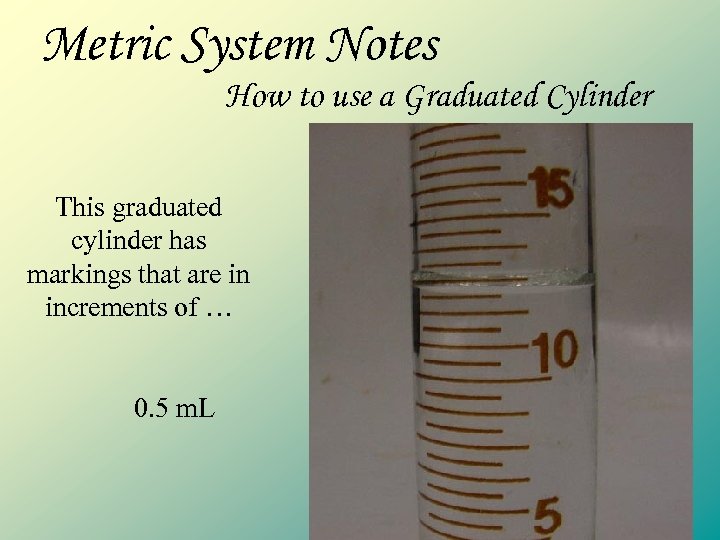 Metric System Notes How to use a Graduated Cylinder This graduated cylinder has markings that are in increments of … 0. 5 m. L
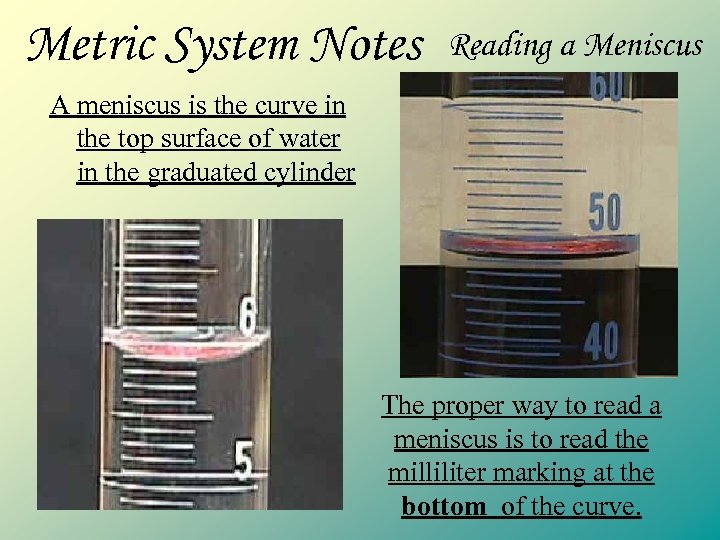 Metric System Notes Reading a Meniscus A meniscus is the curve in the top surface of water in the graduated cylinder The proper way to read a meniscus is to read the milliliter marking at the bottom of the curve.
 Metric System Notes Volume of a Regular Solid A regular solid is any 3 dimensional object that has sides that can be measured. To measure a regular solid, a formula for volume can be applied To measure a rectangular object such as a shoebox, multiply the object’s length, width, and height Volume = Length x Width x Height
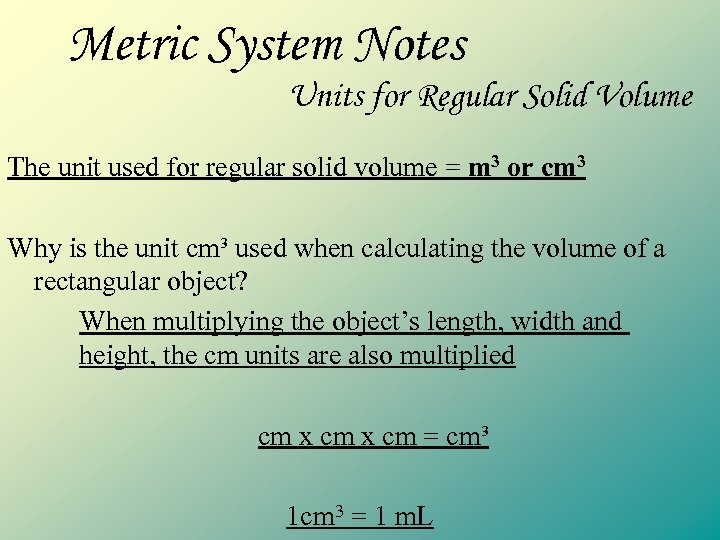 Metric System Notes Units for Regular Solid Volume The unit used for regular solid volume = m 3 or cm 3 Why is the unit cm³ used when calculating the volume of a rectangular object? When multiplying the object’s length, width and height, the cm units are also multiplied cm x cm = cm³ 1 cm 3 = 1 m. L