

METHODS OF SOCIOLOGICAL RESARCH QUANTITATIVE METHODS




 Скачать презентацию METHODS OF SOCIOLOGICAL RESARCH QUANTITATIVE METHODS
Qualitative enquiry.ppt
- Количество слайдов: 33
METHODS OF SOCIOLOGICAL RESARCH
QUANTITATIVE METHODS
Probability sampling Sampling
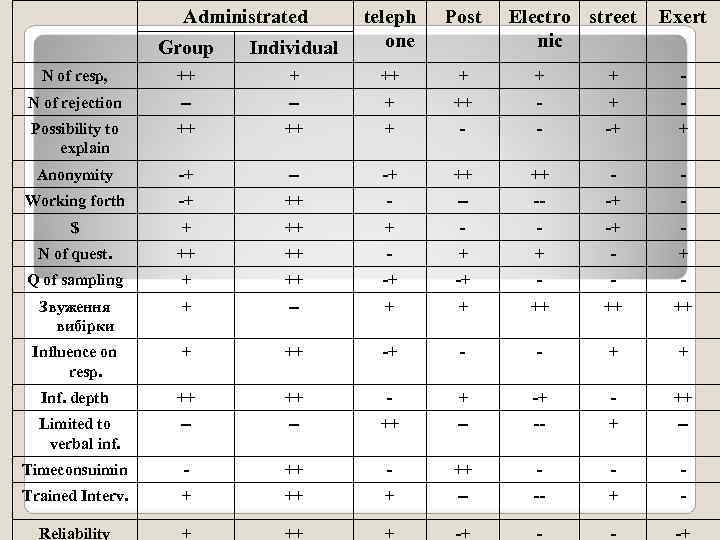
Administrated teleph Post Electro street Exert Group Individual one nic N of resp, ++ + + - N of rejection -- + ++ - Possibility to ++ + - - -+ + explain Anonymity -+ -- -+ ++ ++ - - Working forth -+ ++ - -- -- -+ - $ + + - - -+ - N of quest. ++ - + + - + Q of sampling + ++ -+ -+ - - - Звуження + -- + + ++ ++ ++ вибірки Influence on + ++ -+ - - + + resp. Inf. depth ++ - + - ++ Limited to -- ++ -- -- + -- verbal inf. Timeconsuimin - ++ - ++ - - - Trained Interv. + + -- -- + - Reliability + + -+ - - -+
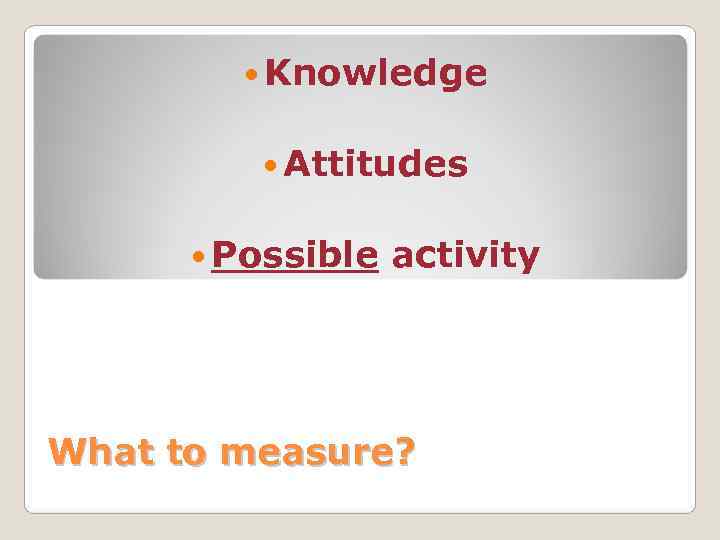
Knowledge Attitudes Possible activity What to measure?
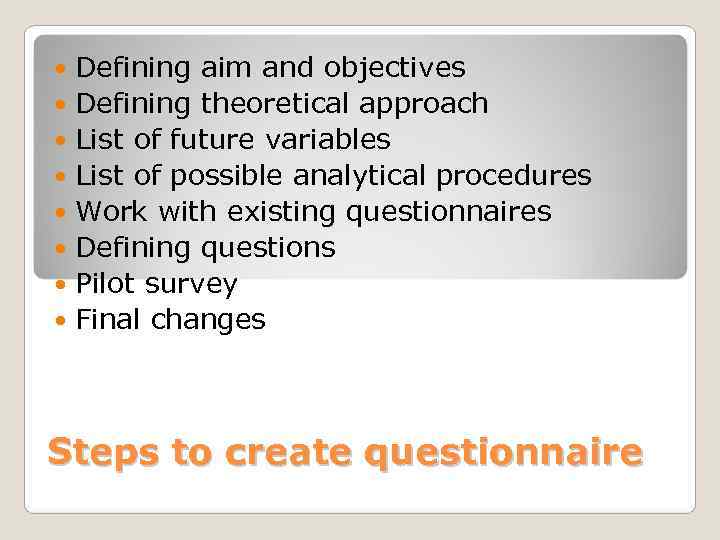
Defining aim and objectives Defining theoretical approach List of future variables List of possible analytical procedures Work with existing questionnaires Defining questions Pilot survey Final changes Steps to create questionnaire
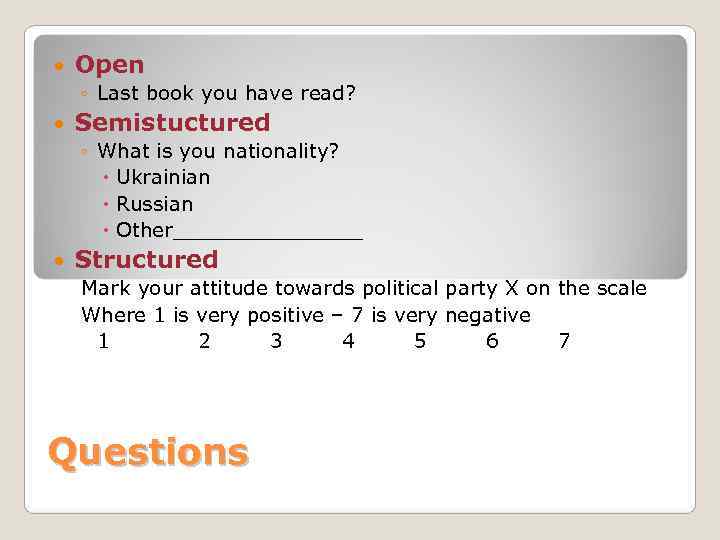
Open ◦ Last book you have read? Semistuctured ◦ What is you nationality? Ukrainian Russian Other________ Structured Mark your attitude towards political party X on the scale Where 1 is very positive – 7 is very negative 1 2 3 4 5 6 7 Questions
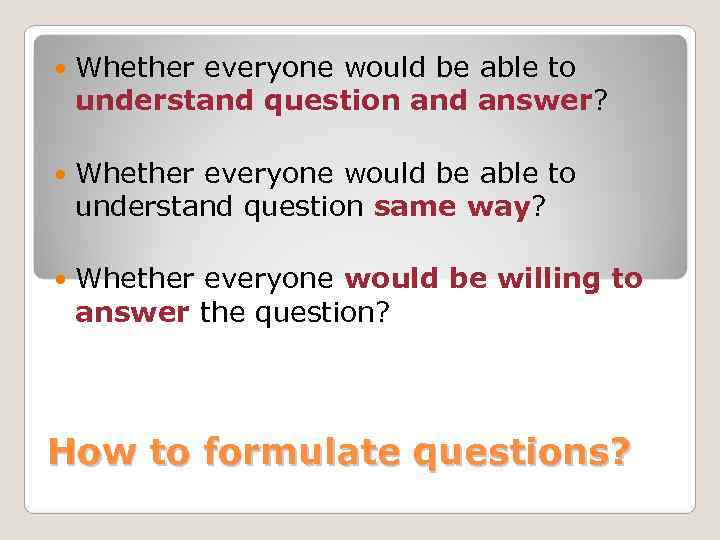
Whether everyone would be able to understand question and answer? Whether everyone would be able to understand question same way? Whether everyone would be willing to answer the question? How to formulate questions?
Price Time Number of non-response Quality of answers Length of the questionnaire
We can not change questions during the fieldwork Big number of non-responses Possible unpleasant experience Field work
Qualitative research
Qualitative research is an interpretative approach concerned with understanding the meanings which people attach to phenomena (actions, decisions, beliefs, values etc. ) within their social worlds. (J. Ritchie & J. Lewis: 2003) Qualitative research is usually interested in three sings: social routines, their conditions, and the subjective experiences of those, who take part in them. (Carspecken & Cordeiro, 1995) Definition
Aims are directed at providing in-depth and interpreted understanding of the social world of research participants Importance of participants’ frames of reference Volume and richness of qualitative data; data are very detailed, information rich and extensive Output tends to focus on the interpretation of social meaning through mapping and “re- presenting” the social world of research participants. Important features
In-depth interview
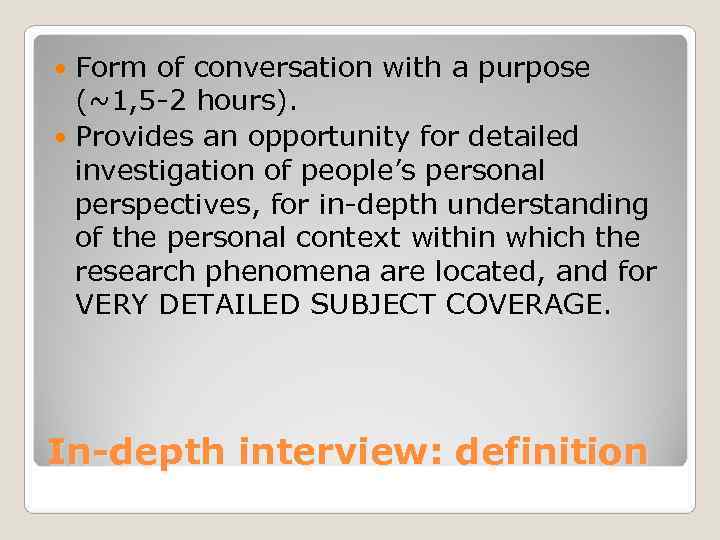
Form of conversation with a purpose (~1, 5 -2 hours). Provides an opportunity for detailed investigation of people’s personal perspectives, for in-depth understanding of the personal context within which the research phenomena are located, and for VERY DETAILED SUBJECT COVERAGE. In-depth interview: definition
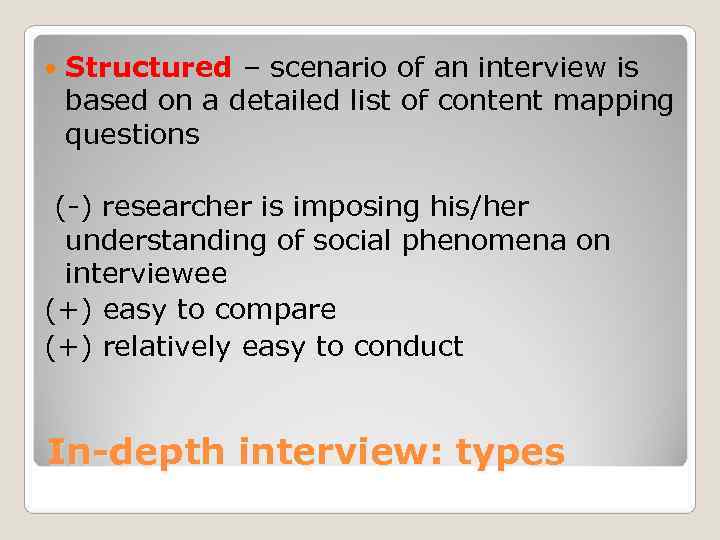
Structured – scenario of an interview is based on a detailed list of content mapping questions (-) researcher is imposing his/her understanding of social phenomena on interviewee (+) easy to compare (+) relatively easy to conduct In-depth interview: types
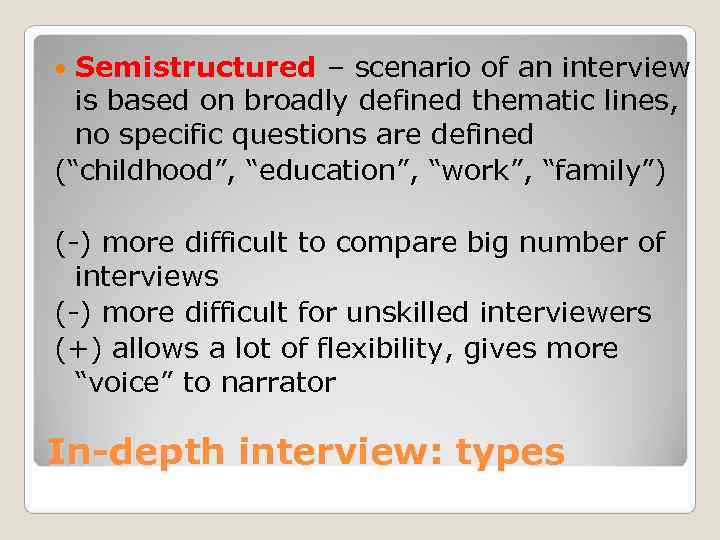
Semistructured – scenario of an interview is based on broadly defined thematic lines, no specific questions are defined (“childhood”, “education”, “work”, “family”) (-) more difficult to compare big number of interviews (-) more difficult for unskilled interviewers (+) allows a lot of flexibility, gives more “voice” to narrator In-depth interview: types
Unstructured – 3 stages. ◦ I stage – no questions with an exception of an opening one (Tell me the story of our life…) ◦ II stage – only narrative questions are allowed (You told that …, ) ◦ III stage – other questions. Limited number of prepared questions of any character are allowed. In-depth interview: types
(-) difficult to compare big number of interviews (-) even more difficult to conduct for unskilled interviewers (+) allows a lot of flexibility, gives more “voice” to narrator (+) this type of interview gives us much deeper understanding of what is really important, what really matters to our respondents In-depth interview: types
Focus group discussion
FGD – involves several (6 -10) participants brought together to discuss the research topic as a group. Provides an opportunity for direct and explicit discussion of differences as it emerges in the group. We study more opinions, but in comparison to an in-depth interview less questions can be asked Focus group discussion: definition
Observation
Participant observation – researcher joins the constituent study population or its organizational or community setting to record actions, interactions and events that occur. (+) we can study and experience social phenomena in their natural setting (-) time-consuming, rises many ethical issues Participant observation
Observation – offers opportunity to record analyze behavior and interactions as they occur, although not as a member of the study population. Autoethnography - “ ‘figural anthropology’ of the self” (Lionnet, 1991), “generative autobiography” (Alexander, 2000). Observation
Textual analysis
Conversational analysis involves a detailed examination of “talk interactions” to determine how conversation is constructed and enacted. The aim is to investigate social intercourse, as it occurs in natural settings, is “an attempt to describe peoples methods for producing orderly social interaction” (Silverman, 2001) Textual analysis: types
Discourse analysis is “concerned with texts as social practices”. It alerts us to the intimate connections between meaning, power and knowledge (Potter & Wetherell, 1987). Textual analysis: types
Content analysis “claims to offer an “objective”, “systematic” and “quantitative” analysis of documentary content” (Ball, 1992). It allows to examine the major elements or categories present in, and communicated by certain texts as well as to compare frequencies of those categories. Textual analysis: types
However, content analysis does not allow the possibility for a researcher to uncover variability in the construction of different texts, to compare it and to assess the functions this variation is framing. Nor does it take into account motives for the reproduction of a specific theme or/and context in which these themes were reproduced. It also fragments and decontextualizes data. Content-analysis
Sampling
Qualitative research uses non-probability sampling, where units are deliberately selected to reflect particular features of or groups within the sampled population. Sampling
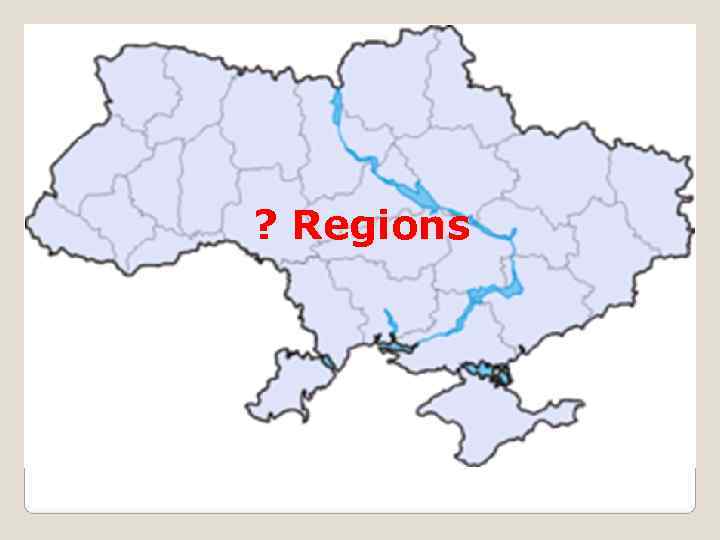
? Regions
Thank you for your attention! Questions, comments?