


 Скачать презентацию Methods for Designing SIP Services in SDL with
f0df0d757aa73b0074d01da6d24ada23.ppt
- Количество слайдов: 24
 Methods for Designing SIP Services in SDL with Fewer Feature Interactions Presented by: Ken Y. Chan School of Information Technology and Engineering, University of Ottawa Feature Interactions Workshop 2003 Date: Wed, June 11, 2003 1
 Outline n n n n Motivations Overview of SIP & FI SDL Model of SIP and its services Simulation, Verification & Validation Extended FI taxonomy Detecting & Preventing SIP FI’s using Tau New FIs in SIP Conclusion & Future Works 2
 Motivations n n No Formal Service Specification of SIP (IETF RFC 2543 & 3261) -> To improve existing RFC and drafts. Feasibility of SDL/MSC (Tau) tools to model IETF signaling protocols. Leverage POTS FIs to prevent FIs in SIP New Feature Interactions in SIP 3
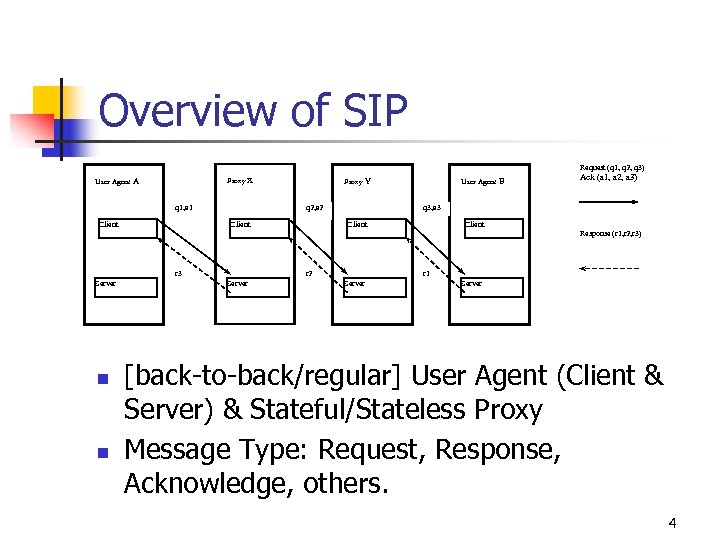 Overview of SIP Request (q 1, q 2, q 3) Proxy X User Agent A q 1, a 1 Client Proxy Y q 2, a 2 Client User Agent B Ack (a 1, a 2, a 3) q 3, a 3 Client Response (r 1, r 2, r 3) r 3 Server n n r 2 Server r 1 Server [back-to-back/regular] User Agent (Client & Server) & Stateful/Stateless Proxy Message Type: Request, Response, Acknowledge, others. 4
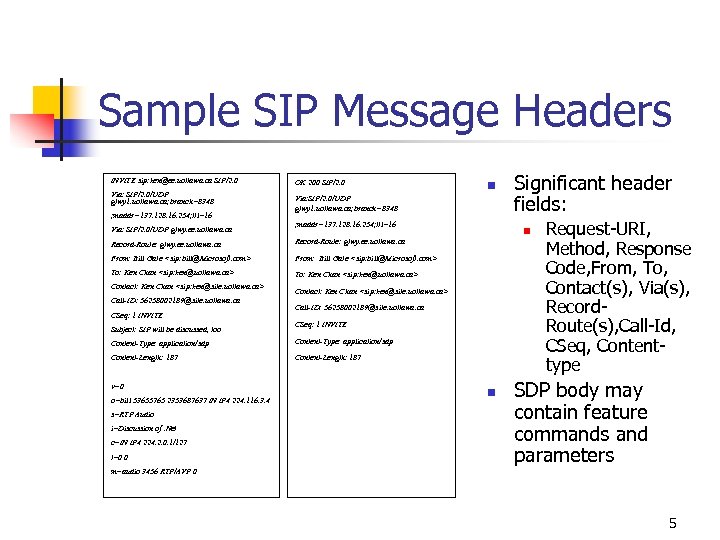 Sample SIP Message Headers INVITE sip: ken@ee. uottawa. ca SIP/2. 0 Via: SIP/2. 0/UDP gtwy 1. uottawa. ca; branch=8348 ; maddr=137. 128. 16. 254; ttl=16 Via: SIP/2. 0/UDP gtwy. ee. uottawa. ca OK 200 SIP/2. 0 n Via: SIP/2. 0/UDP gtwy 1. uottawa. ca; branch=8348 ; maddr=137. 128. 16. 254; ttl=16 Record-Route: gtwy. ee. uottawa. ca From: Bill Gate
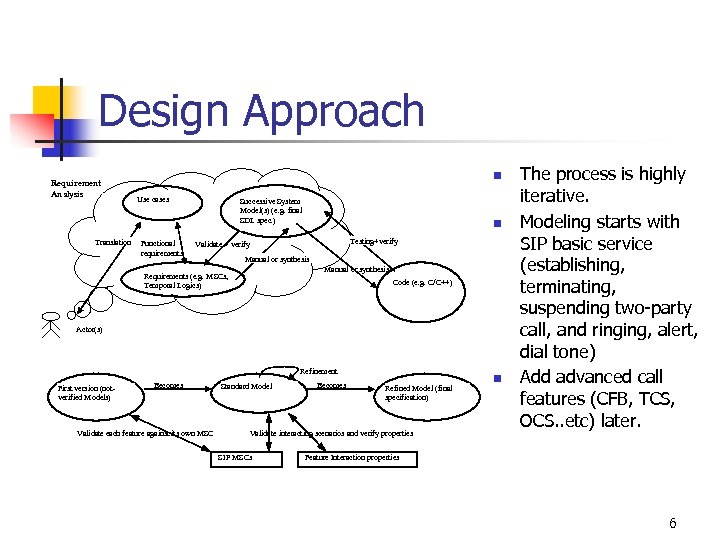 Design Approach Requirement Analysis Translation n Use cases Functional requirements Successive System Model(s) (e. g. final SDL spec. ) n Testing+verify Validate + verify Manual or synthesis Requirements (e. g. MSCs, Temporal Logics) Code (e. g. C/C++) Actor(s) Refinement First version (notverified Models) Becomes Validate each feature against its own MSC Standard Model Becomes Refined Model (final specification) Validate interacting scenarios and verify properties SIP MSCs n The process is highly iterative. Modeling starts with SIP basic service (establishing, terminating, suspending two-party call, and ringing, alert, dial tone) Add advanced call features (CFB, TCS, OCS. . etc) later. Feature Interaction properties 6
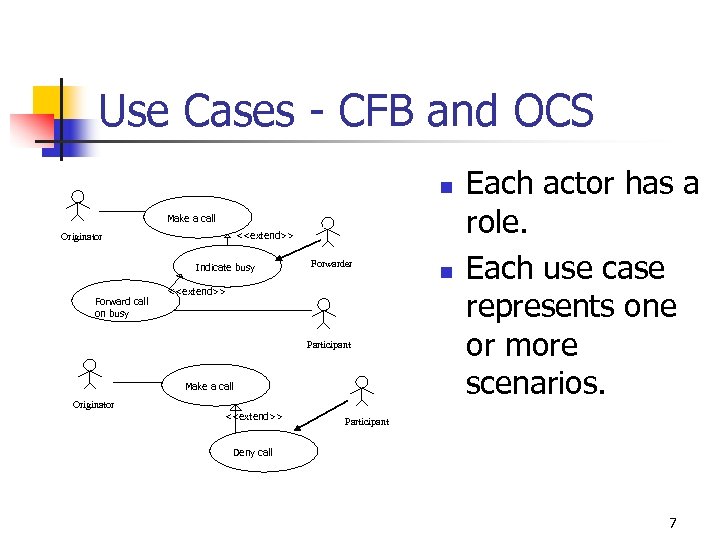 Use Cases - CFB and OCS n Make a call <
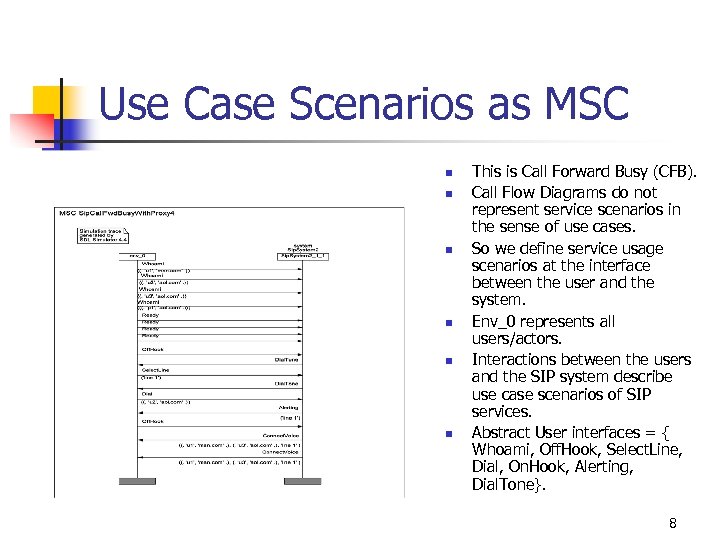 Use Case Scenarios as MSC n n n This is Call Forward Busy (CFB). Call Flow Diagrams do not represent service scenarios in the sense of use cases. So we define service usage scenarios at the interface between the user and the system. Env_0 represents all users/actors. Interactions between the users and the SIP system describe use case scenarios of SIP services. Abstract User interfaces = { Whoami, Off. Hook, Select. Line, Dial, On. Hook, Alerting, Dial. Tone}. 8
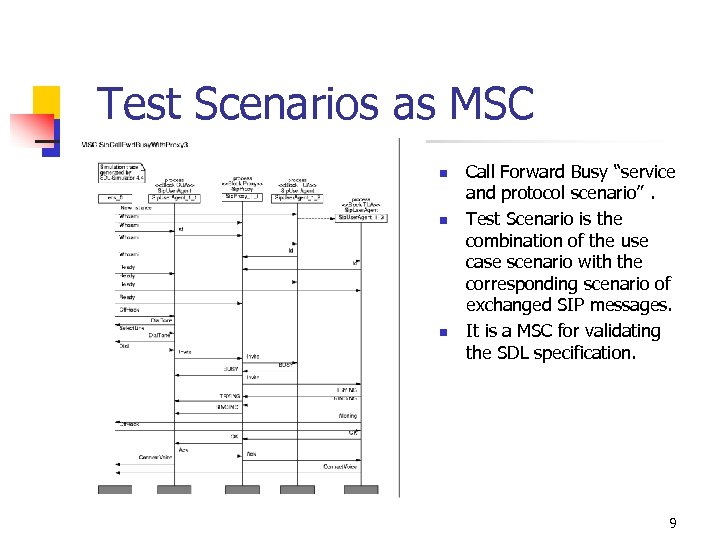 Test Scenarios as MSC n n n Call Forward Busy “service and protocol scenario”. Test Scenario is the combination of the use case scenario with the corresponding scenario of exchanged SIP messages. It is a MSC for validating the SDL specification. 9
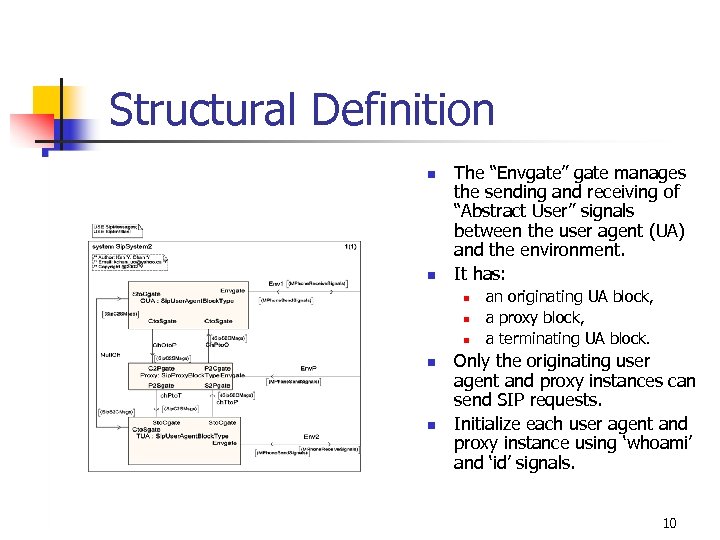 Structural Definition n n The “Envgate” gate manages the sending and receiving of “Abstract User” signals between the user agent (UA) and the environment. It has: n n n an originating UA block, a proxy block, a terminating UA block. Only the originating user agent and proxy instances can send SIP requests. Initialize each user agent and proxy instance using ‘whoami’ and ‘id’ signals. 10
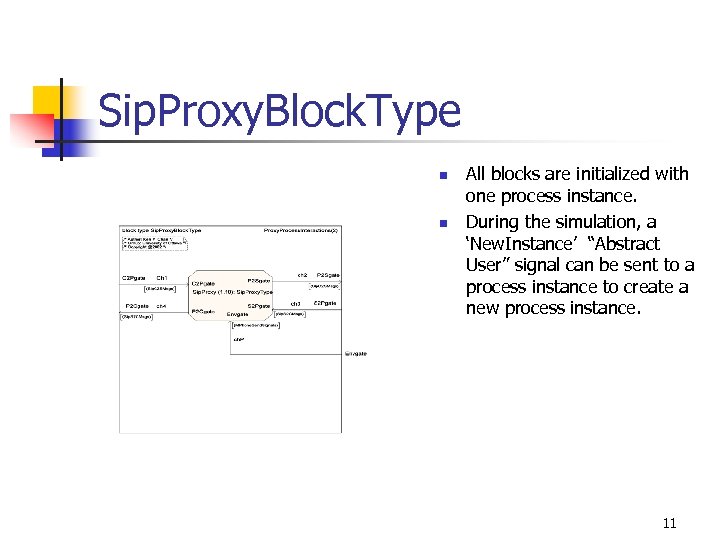 Sip. Proxy. Block. Type n n All blocks are initialized with one process instance. During the simulation, a ‘New. Instance’ “Abstract User” signal can be sent to a process instance to create a new process instance. 11
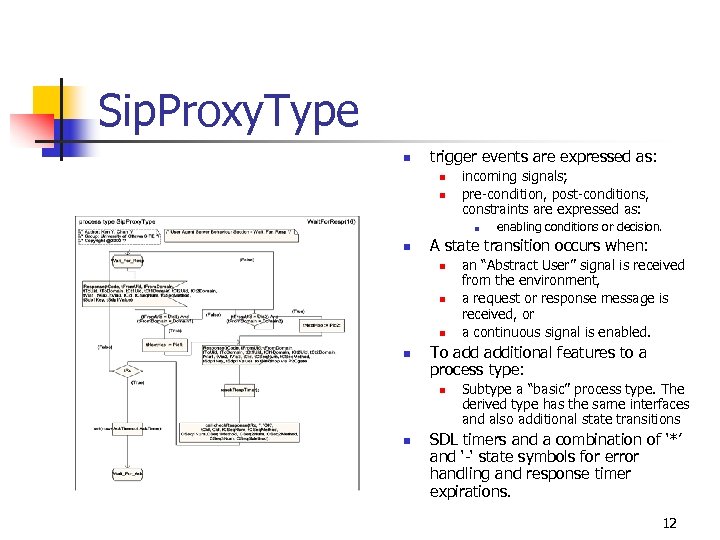 Sip. Proxy. Type n trigger events are expressed as: n n incoming signals; pre-condition, post-conditions, constraints are expressed as: n n A state transition occurs when: n n an “Abstract User” signal is received from the environment, a request or response message is received, or a continuous signal is enabled. To additional features to a process type: n n enabling conditions or decision. Subtype a “basic” process type. The derived type has the same interfaces and also additional state transitions SDL timers and a combination of ‘*’ and ‘-‘ state symbols for error handling and response timer expirations. 12
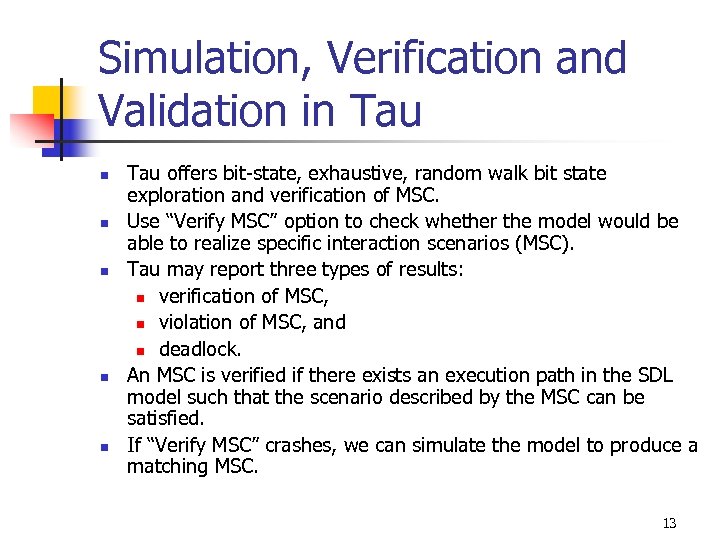 Simulation, Verification and Validation in Tau n n n Tau offers bit-state, exhaustive, random walk bit state exploration and verification of MSC. Use “Verify MSC” option to check whether the model would be able to realize specific interaction scenarios (MSC). Tau may report three types of results: n verification of MSC, n violation of MSC, and n deadlock. An MSC is verified if there exists an execution path in the SDL model such that the scenario described by the MSC can be satisfied. If “Verify MSC” crashes, we can simulate the model to produce a matching MSC. 13
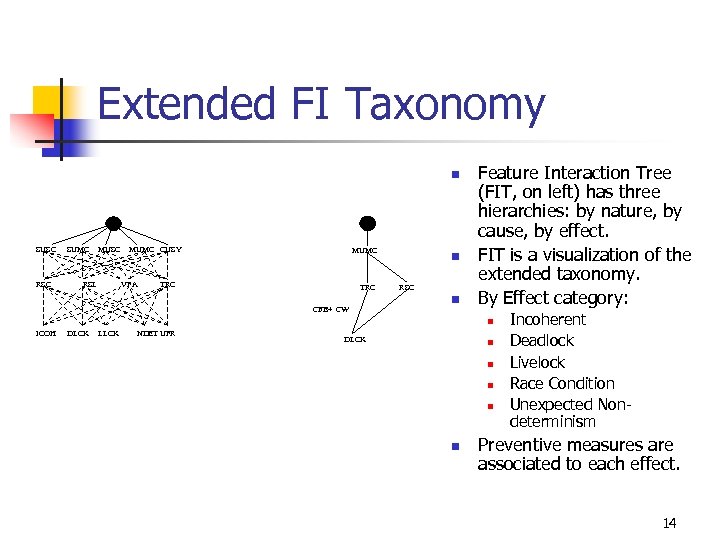 Extended FI Taxonomy n SUSC RSC SUMC MUSC RSL MUMC CUSY VFA MUMC TRC CFB+ CW n RSC n Feature Interaction Tree (FIT, on left) has three hierarchies: by nature, by cause, by effect. FIT is a visualization of the extended taxonomy. By Effect category: n ICOH DLCK LLCK NDET UFR DLCK n n n Incoherent Deadlock Livelock Race Condition Unexpected Nondeterminism Preventive measures are associated to each effect. 14
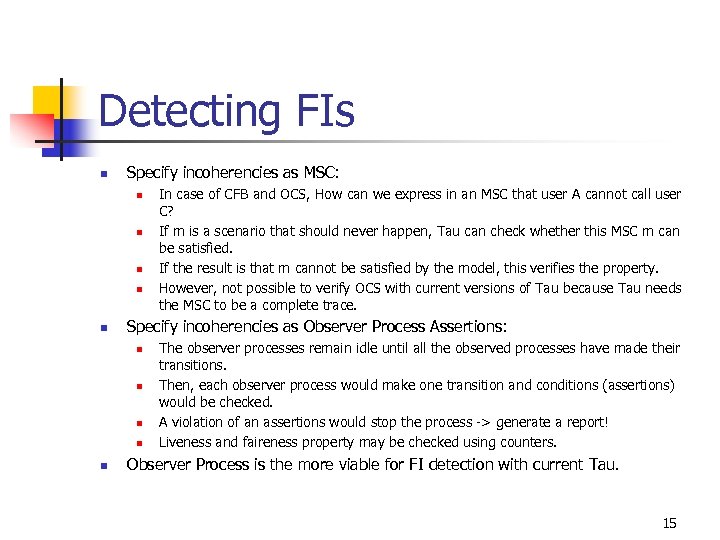 Detecting FIs n Specify incoherencies as MSC: n n n Specify incoherencies as Observer Process Assertions: n n n In case of CFB and OCS, How can we express in an MSC that user A cannot call user C? If m is a scenario that should never happen, Tau can check whether this MSC m can be satisfied. If the result is that m cannot be satisfied by the model, this verifies the property. However, not possible to verify OCS with current versions of Tau because Tau needs the MSC to be a complete trace. The observer processes remain idle until all the observed processes have made their transitions. Then, each observer process would make one transition and conditions (assertions) would be checked. A violation of an assertions would stop the process -> generate a report! Liveness and faireness property may be checked using counters. Observer Process is the more viable for FI detection with current Tau. 15
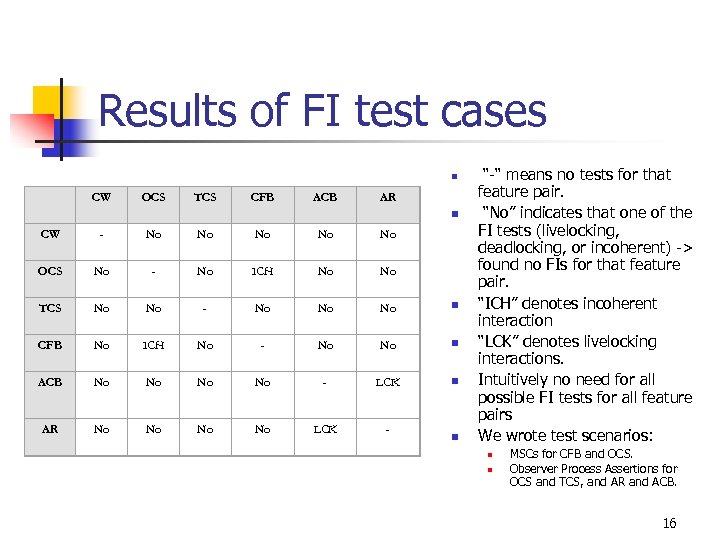 Results of FI test cases n CW OCS TCS CFB ACB AR n CW - No No No OCS No - No ICH No No TCS No No - No No No n CFB No ICH No - No No n ACB No No - LCK n AR No No LCK - n “-“ means no tests for that feature pair. “No” indicates that one of the FI tests (livelocking, deadlocking, or incoherent) -> found no FIs for that feature pair. “ICH” denotes incoherent interaction “LCK” denotes livelocking interactions. Intuitively no need for all possible FI tests for all feature pairs We wrote test scenarios: n n MSCs for CFB and OCS. Observer Process Assertions for OCS and TCS, and AR and ACB. 16
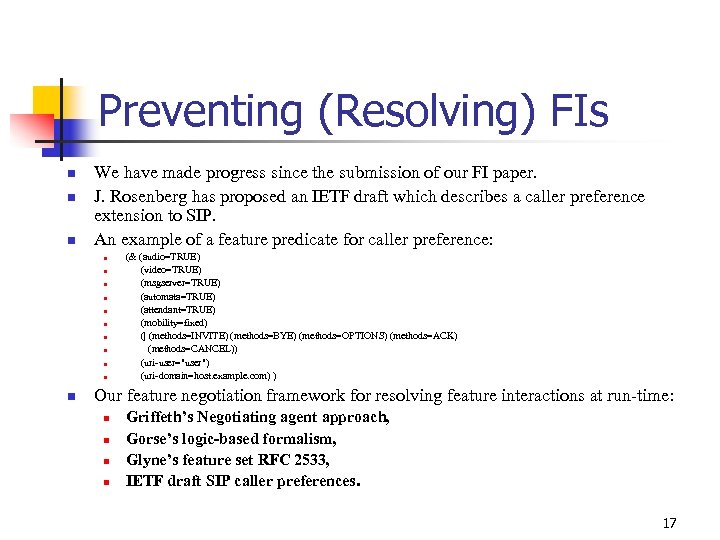 Preventing (Resolving) FIs n n n We have made progress since the submission of our FI paper. J. Rosenberg has proposed an IETF draft which describes a caller preference extension to SIP. An example of a feature predicate for caller preference: n n n (& (audio=TRUE) (video=TRUE) (msgserver=TRUE) (automata=TRUE) (attendant=TRUE) (mobility=fixed) (| (methods=INVITE) (methods=BYE) (methods=OPTIONS) (methods=ACK) (methods=CANCEL)) (uri-user="user") (uri-domain=host. example. com) ) Our feature negotiation framework for resolving feature interactions at run-time: n n Griffeth’s Negotiating agent approach, Gorse’s logic-based formalism, Glyne’s feature set RFC 2533, IETF draft SIP caller preferences. 17
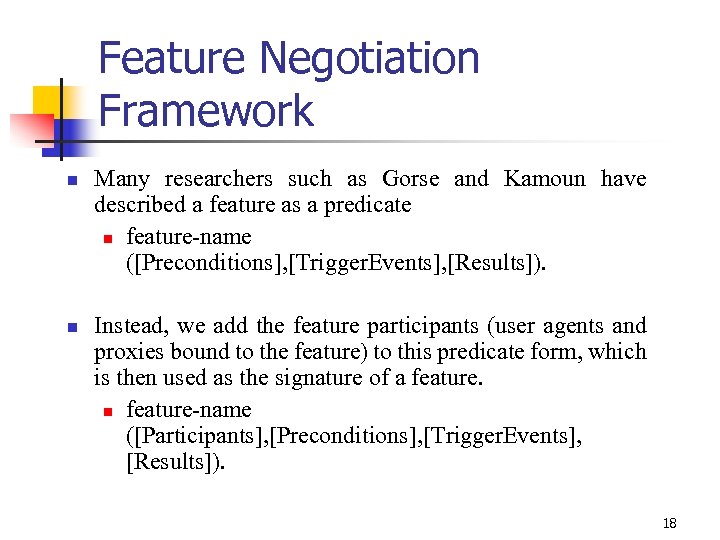 Feature Negotiation Framework n n Many researchers such as Gorse and Kamoun have described a feature as a predicate n feature-name ([Preconditions], [Trigger. Events], [Results]). Instead, we add the feature participants (user agents and proxies bound to the feature) to this predicate form, which is then used as the signature of a feature. n feature-name ([Participants], [Preconditions], [Trigger. Events], [Results]). 18
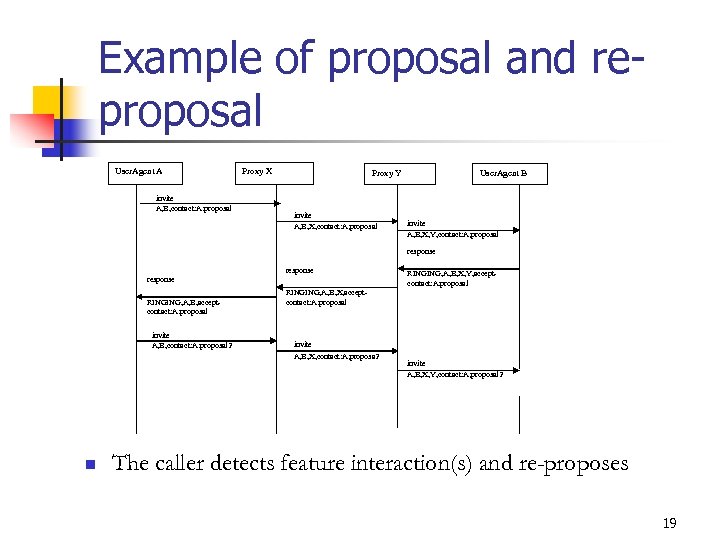 Example of proposal and reproposal User. Agent A invite A, B, contact: A: proposal Proxy X Proxy Y invite A, B, X, contact: A; proposal User. Agent B invite A, B, X, Y, contact: A; proposal response RINGING, A, B, acceptcontact: A: proposal invite A, B, contact: A: proposal 2 n RINGING, A, B, X, Y, acceptcontact: A: proposal RINGING, A, B, X, acceptcontact: A: proposal invite A, B, X, contact: A; proposa 2 invite A, B, X, Y, contact: A; proposal 2 The caller detects feature interaction(s) and re-proposes 19
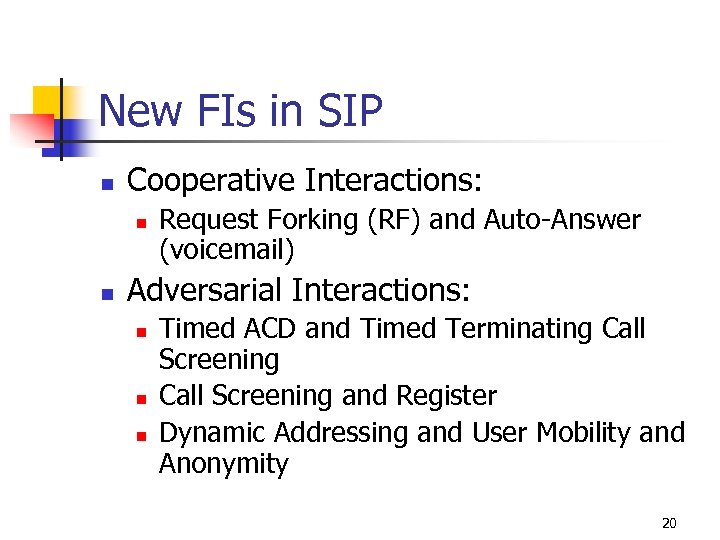 New FIs in SIP n Cooperative Interactions: n n Request Forking (RF) and Auto-Answer (voicemail) Adversarial Interactions: n n n Timed ACD and Timed Terminating Call Screening and Register Dynamic Addressing and User Mobility and Anonymity 20
 Conclusion 1 n n n We believe SIP or any IETF application protocols should be specified from a user-centric perspective (e. g. Abstract User Interface). Feature Interaction Tree is currently a catalog of FIs. Useful for giving us the intuition on the new FIs. Our Feature Negotiation Framework can resolve many known feature interactions (e. g. MUMC). It also allows distributing the resolution decision making around. Our Feature Negotiation extension to SIP is compatible to caller preferences, and SIP 1. x/2. x. Should be compatible to all sorts of call features (e. g. mid-call, multi-user call), and web services. 21
 Conclusion 2 n Enhance SDL and Tau: n n n MSCs have limitations in terms of expressing quantification of instances and their behaviors LSC? ? Observer Process Assertions is the only viable approach for detecting FI. To model SIP messages as SDL signals, we cannot easily insert, remove, search, and modify values from the optional and/or variable size header fields. n The SDL language could be extended with additional built-in ADTs, e. g. linked list and hash table like Java and C++. n String processing facilities like the int index. Of(String substring) To incorporate model checking of the SDL system using temporal logic formula -> easier to specify distributed properties like liveness. Too many crashes in Tau Validation Engine -> complex data type or model size? ? 22
 Future Works and References n n Submit an IETF draft on our Feature Negotiation extension to SIP. Explore properties of FIT. Investigate LSC for specifying FI (test scenarios). Perhaps modify the model to support RFC 3261. 23
 Acknowledgements and References n n Thanks Dr. G. v. Bochmann for his supervision, and Dr D. Amyot and L. Logrippo for their insights in FI and Telephony Service Specifications. More info can be found on: n n n My research web site is: http: //www. geocities. com/kchan_uo Or my university web site: http: //www. site. uottawa. ca/~kchan Publications: My thesis: K. Chan, “Ken Chan University of Ottawa Thesis Page”, http: //beethoven. site. uottawa. ca/DSRG/Public. Documents/REPORTS-THESES/Thesis. Chan/, accessed on April 30, 2003. [1] K. Chan, "Methods for Designing Internet Telephony Services with Fewer Feature Interactions", Master Thesis, University of Ottawa, ON, Canada, May 2003. [2] K. Chan, and G. v. Bochmann, "Methods for Designing IP Telephony Services with Fewer Feature Interactions", Feature Interactions in Telecommunications and Software Systems VII, IOS Press, June 2003. [3] K. Chan, and G. v. Bochmann, "Modeling IETF Session Initiation Protocol and its services in SDL", In Proceeding of Eleventh SDL Forum, LNCS, Springer-Verlag Heidelberg, Stuttgart, Germany, July 14, 2003. n n 24